
I stood at the bottom of the staircase with the small brass key pressed into my palm. For several seconds, neither David nor I spoke. The house felt different now. Twenty minutes earlier, it had simply been my home.
The place where I had raised my son. The place where my husband and I had celebrated birthdays, Christmas mornings, graduations, anniversaries, and quiet Sunday afternoons.
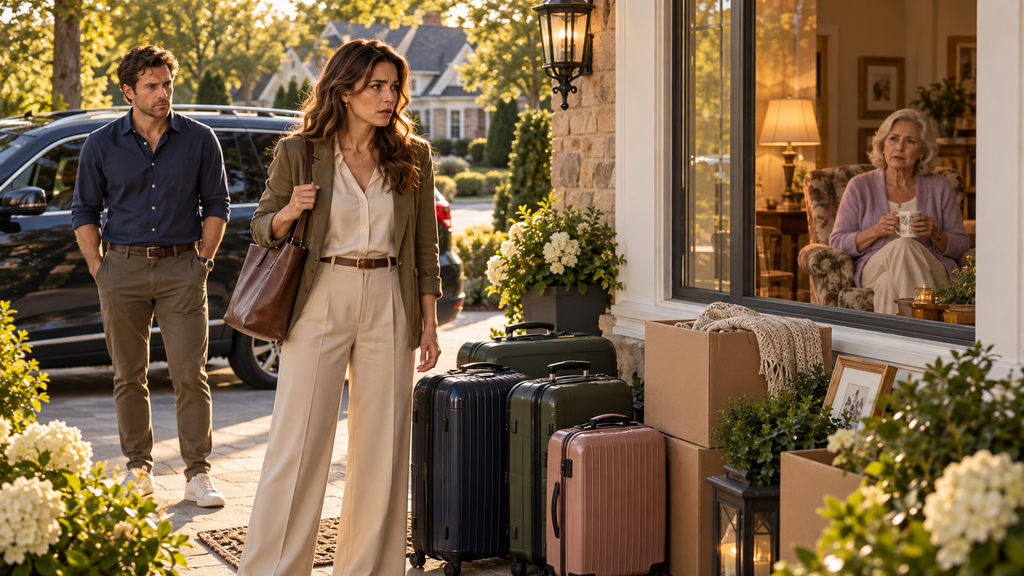
Now every shadow seemed to be hiding something.
I looked at David.
“How did Sarah know about the compartment?”
His face tightened.
“Mom…”
“How did she know?”
He looked toward the staircase.
Then toward the kitchen.
Anywhere except at me.
Finally, he whispered,
“She found something.”
My stomach dropped.
“What?”
“A note.”
I didn’t move.
David rubbed both hands over his face.
“She was upstairs yesterday while you were grocery shopping.”
Yesterday.
They had been living in my house for two days.
Two days.
And Sarah had already been searching through my private belongings.
“She said she was looking for an extra blanket,” David continued.
I almost laughed.
Not because it was funny.
Because the lie was so insulting.
“There are six blankets in the hallway closet.”
“I know.”
“And none of them are inside my husband’s desk.”
“I know.”
David looked ashamed.
That was something, at least.
Not enough.
But something.
“What did she find?”
David hesitated again.
Then he reached into his pocket and handed me a folded piece of yellowed paper.
I recognized my husband’s handwriting instantly.
My breath caught.
Even after seven years, I could still recognize the way Michael wrote the letter K.
He always gave it an extra loop.
He had written my name thousands of times during our marriage.
Birthday cards.
Grocery lists.
Notes on the refrigerator.
Little scraps of paper beside the coffee maker.
Kim — plumber comes Tuesday.
Kim — don’t forget dinner at seven.
Kim — I love you.
Seeing that handwriting again made something inside my chest ache.
I unfolded the paper.
There were only three sentences.
Kimberly,
The blue folder is in the locked compartment.
If anyone besides David asks about it, say nothing until you speak to Martin.
The key will be where David eventually finds it.
Michael.
I read it twice.
Then a third time.
“Who is Martin?” David asked.
I looked up.
“Martin Ellis.”
David frowned.
Then recognition appeared.
“Dad’s lawyer?”
“Our lawyer.”
Michael and I had used Martin for nearly thirty years.
Wills.
Property documents.
Business matters.
Anything important.
I stared at the note again.
My husband had died seven years earlier.
Whatever was inside that blue folder had mattered enough for him to leave instructions.
And apparently he had believed David would someday need to give me the key.
That thought chilled me more than anything Sarah had done.
“Where did you find the key?” I asked.
David swallowed.
“In Dad’s toolbox.”
My eyes narrowed.
“You went through his toolbox?”
“Sarah did.”
Of course.
I closed my eyes.
For seven years, Michael’s old workbench in the garage had barely been touched.
His tools still hung exactly where he had left them.
Sometimes I would walk past them and remember Saturday mornings when he would disappear into the garage with coffee and come back three hours later covered in sawdust.
Sarah had been living here for three days.
And she had already searched the master bedroom and the garage.
That wasn’t curiosity.
That was hunting.
“How long has she been looking for this folder?”
David didn’t answer.
“David.”
He whispered,
“Before we moved in.”
I stared at him.
“What?”
“She knew Dad had left something.”
“How?”
“She found an old tax document when we were going through some boxes last year.”
“What tax document?”
“A property assessment.”
I felt my stomach tighten.
“Which property?”
David looked miserable.
“I don’t know. Something in Jefferson County.”
I did know.
At least, I thought I did.
Thirty-two acres of land.
Mostly trees and open field.
Michael had bought it almost twenty-five years earlier.
We used to joke about building a little retirement cabin there someday.
But life became busy.
Then Michael got sick.
After he died, I had assumed the land had been sold as part of settling the estate.
Martin handled most of the paperwork because I could barely remember my own name during those first months of grief.
I looked toward the stairs.
“Come with me.”
“Mom…”
“Now.”
I walked upstairs.
David followed.
Neither of us spoke.
At the end of the hallway, sunlight spilled through my bedroom windows.
Michael’s old reading chair sat beside them.
His desk stood against the far wall.
For seven years, I had never moved it.
Sometimes grief makes ordinary furniture sacred.
That desk was where he had paid bills.
Written birthday cards.
Done crossword puzzles.
Filed receipts.
And occasionally fallen asleep while pretending he was working.
I ran my hand across the wood.
There was a scratch near the edge.
David had made it when he was fourteen.
He had been building a model airplane and slipped with a screwdriver.
Michael had pretended to be furious for five minutes.
Then he laughed.
I could almost hear him.
I opened the lower cabinet.
At first, I saw nothing unusual.
Then David crouched beside me.
“There.”
A tiny brass keyhole was hidden beneath the underside of the drawer.
I would never have noticed it.
I pushed the key inside.
It turned smoothly.
Click.
A narrow panel released.
My heart started beating harder.
Behind it was a shallow compartment.
And inside that compartment…
Was a blue folder.
Nothing else.
Just one thick blue folder tied closed with a black elastic band.
I lifted it out.
It was heavier than I expected.
Across the front, Michael had written two words.
FOR KIMBERLY.
My throat tightened.
David stood behind me.
Neither of us moved for a moment.
Then I carried it to the bed.
My hands trembled as I pulled away the elastic.
The first document was a letter.
The envelope had my name written across the front.
I sat down.
David remained standing.
“Do you want me to leave?” he asked quietly.
I looked at him.
Part of me wanted to say yes.
But another part of me knew Michael had included him in this somehow.
“Stay.”
I opened the envelope.
The paper inside was several pages long.
Michael’s handwriting covered every page.
I took a breath.
And began reading.
Kim,
If you are reading this, I’m probably gone.
I stopped.
My vision blurred instantly.
Seven years disappeared.
Suddenly I was sitting beside Michael in a hospital room again, listening to machines breathe beside him.
I wiped my eyes.
Then kept reading.
I know you hate when I try to prepare for the worst.
You always tell me I’m stubborn.
You are correct.
But you married me anyway, so technically this is partly your fault.
A broken laugh escaped me.
That sounded exactly like him.
David lowered his head.
I continued.
There are some things I handled quietly because I wanted you protected without making you afraid.
The land in Jefferson County was never sold.
I placed it into the Porter Family Trust six months before my diagnosis became serious.
You are the sole controlling beneficiary during your lifetime.
After your death, whatever remains passes to David under the protections Martin and I established.
My hands froze.
I looked at David.
He looked equally stunned.
I turned the page.
The trust also contains the investment account we built over the years.
You probably know less about that account than you should because I handled most of our investing.
For once, please resist saying, “I told you so.”
I laughed through my tears.
Michael had hated admitting I was right.
Even from beyond the grave, apparently.
Then the letter changed.
The handwriting became heavier.
More deliberate.
There is something else you need to know.
A year before I became sick, Sarah approached me privately.
I stopped reading.
David’s face went pale.
“What?”
I looked at him.
Then continued.
She asked me whether the Jefferson County land was going to David when I died.
At the time, I thought it was an odd question.
I told her the land belonged to you and me and that our estate planning was private.
Two weeks later, she asked whether you planned to sell the house after my death.
That concerned me.
My chest tightened.
I remembered that year.
Michael had been tired more often.
Nothing serious, we thought.
Sarah and David had been married for two years.
Family dinners still happened every Sunday.
Sarah always offered to help me wash dishes.
She hugged me on birthdays.
She called Michael “Dad.”
I kept reading.
I did not tell you because I knew you would worry about David.
I watched instead.
I discovered Sarah had been encouraging David to think of our property as his future inheritance.
That is why I created the trust.
Not because I wanted to punish David.
Because I wanted him protected from decisions he might make under pressure.
David sat heavily in Michael’s old reading chair.
His face had drained of color.
“Dad knew?”
I said nothing.
There were still two pages.
The next paragraph hurt most.
Kim, our home is not David’s inheritance.
It is your home.
Never let anyone make you feel guilty for continuing to live your life in something we worked forty years to build.
I don’t care whether you are sixty, seventy, ninety, or one hundred and five.
As long as you are alive, your life is not an obstacle standing between someone else and an inheritance.
My eyes filled completely.
I covered my mouth.
For seven years, I had missed him in a thousand different ways.
His coffee cup.
His jacket by the door.
His terrible singing in the shower.
The warmth of his hand against mine in bed.
But at that moment, I missed him with such force that it felt like losing him again.
David was crying too.
Quietly.
I continued.
If David is standing beside you while you read this, tell him I love him.
Tell him I always loved him.
But tell him something else.
Being a good husband does not mean surrendering your judgment.
Being a good son does not mean choosing your mother over your wife.
Being a good man means knowing when someone you love is asking you to become someone you should not be.
I looked at David.
His shoulders shook once.
He wiped his face quickly.
The final lines were simple.
Kim, trust yourself.
You were always stronger than you believed.
And David, if you are reading over your mother’s shoulder, stop slouching.
Love,
Dad.
David laughed.
Then cried harder.
Because Michael used to say that constantly.
“Shoulders back, son.”
Every photograph from David’s childhood seemed to contain Michael somewhere in the background telling him to stop slouching.
For a minute, neither of us spoke.
Then I returned to the folder.
Beneath the letter was a copy of the Porter Family Trust.
Property deeds.
Investment statements.
Insurance records.
And a sealed envelope addressed to David.
He stared at it.
“Open it,” I said.
His hands shook.
Inside was another letter.
This one was shorter.
David read silently at first.
Then his jaw tightened.
“What does it say?”
He handed it to me.
Son,
I’m writing this because there may come a day when you need someone who loves you enough to tell you something you don’t want to hear.
Sarah has repeatedly asked questions about money that does not belong to her.
That alone does not make her a bad person.
But I have also learned about the credit card opened using your information last March.
David went completely still.
I stopped reading.
“What credit card?”
His voice was barely audible.
“I don’t know.”
I looked back at the letter.
Your mother does not know.
I am giving you a chance to handle this yourself.
I spoke with Sarah and told her the account needed to be closed and the balance repaid.
She promised me it would be.
I hope she kept that promise.
If she did, forgive her and move forward carefully.
If she did not, son, please understand the difference between love and surrender.
I folded the letter.
The room was silent.
David stared at the carpet.
“That was eight years ago,” he whispered.
I nodded.
He stood suddenly.
Then he took out his phone.
“What are you doing?”
“Checking something.”
He opened his banking app.
Then another application.
Then his email.
His expression changed.
Confusion.
Then concern.
Then fear.
“David?”
He looked at me.
“There are accounts I don’t recognize.”
My stomach dropped.
“How many?”
“I don’t know.”
He started scrolling faster.
“David.”
“Mom, I don’t know.”
He walked toward the window.
His breathing changed.
I had seen that expression once before.
When he was nineteen and totaled Michael’s car.
He looked like a child waiting for someone to tell him the disaster wasn’t real.
But he was forty-two years old now.
And nobody could fix this for him.
“Call the bank,” I said.
He looked at me.
“Now.”
He nodded.
Before he could dial, footsteps sounded in the hallway.
Sarah appeared in the doorway.
Her eyes immediately landed on the blue folder.
Everything about her face changed.
It happened quickly.
But I saw it.
Relief.
Excitement.
Then calculation.
“You found it.”
Neither David nor I spoke.
Sarah stepped into the room.
“What’s in it?”
David looked at his wife as though he had never seen her before.
“Did you open a credit card in my name eight years ago?”
Sarah stopped.
For just a second.
Then she laughed.
A strange little laugh.
“What?”
“Answer me.”
“David, seriously?”
“Did you?”
Sarah crossed her arms.
“This is what your mother does. She creates drama and turns you against me.”
I stood.
“I haven’t said anything about you.”
Sarah pointed at the folder.
“You’re literally going through private documents!”
“They’re my documents.”
“That affects David.”
David stepped between us.
“Sarah.”
She looked at him.
“What?”
“Did you open the card?”
Silence.
Then Sarah sighed.
“Oh my God. That was years ago.”
My son went white.
“You did.”
“It was eighteen hundred dollars.”
Michael’s letter said nothing about the amount.
Which meant Sarah remembered exactly what she had done.
David stared at her.
“You told me Dad was lying when he warned me about you.”
Sarah’s expression hardened.
“Your father hated me.”
“No,” I said.
She snapped her head toward me.
“He didn’t hate you.”
“You have no idea what he said to me.”
“I know exactly what he wrote about you.”
She looked at the folder again.
And there it was.
That hunger.
“What else is in there?”
I closed the folder.
“That is none of your business.”
“David is Michael’s son.”
“And I was Michael’s wife.”
“So?”
The word came out before she could stop it.
So.
As though forty years of marriage were some inconvenient technicality.
I felt something inside me settle.
Not anger.
Something stronger.
Clarity.
I picked up the folder.
Sarah stepped forward.
“Kimberly, wait.”
I held up one hand.
“Don’t.”
She stopped.
“You have searched my bedroom.”
“You searched my husband’s desk.”
“You searched my garage.”
“You pressured my son to take my bedroom because you wanted access to private documents.”
Her face tightened.
“I wasn’t trying to steal anything.”
“Then why didn’t you ask me?”
She had no answer.
“Because you knew I would say no.”
Still silence.
I nodded.
“That’s what I thought.”
David lowered his voice.
“What were you looking for, Sarah?”
She looked at him.
“The land.”
My pulse jumped.
David frowned.
“What land?”
Sarah looked toward me again.
“The property in Jefferson County.”
“How do you know about that?” I asked.
“I found the assessment.”
“You told me you found one document.”
“I found several.”
David stared at her.
“When?”
“Last year.”
“And you didn’t tell me?”
“I was going to.”
“When?”
Sarah’s voice rose.
“When it mattered!”
“It matters now!”
She threw both hands in the air.
“Oh, please. Stop acting like some victim.”
David flinched.
Sarah pointed toward me.
“Your mother is sitting in a four-bedroom house by herself!”
I said nothing.
“She has investments.”
“Property.”
“Money.”
“Everything.”
“And we were drowning!”
There it was.
Not a misunderstanding.
Not a closet.
Not remote work.
Resentment.
Raw and ugly.
“We were drowning,” Sarah repeated, “and she never once offered to help.”
My mouth fell open.
“I invited you into my house rent-free.”
“For three months!”
“Yes.”
“You know what three months does for us? Nothing!”
David stared at her.
“What do you mean?”
Sarah suddenly realized she had said too much.
My son noticed.
“What do you mean, nothing?”
“David…”
“How much do we owe?”
Sarah looked away.
He stepped closer.
“How much?”
She said nothing.
“Sarah.”
“Don’t yell at me.”
“I am not yelling.”
“You’re interrogating me!”
“How much debt do we have?”
She folded her arms tightly.
“Some.”
“How much?”
Silence.
David’s voice cracked.
“How much?”
Finally, she whispered,
“About seventy-eight.”
He frowned.
“Seventy-eight hundred?”
Sarah said nothing.
And then I understood.
So did David.
“Seventy-eight thousand dollars?”
Sarah looked away.
My son sat down as though his knees had stopped working.
I felt cold.
He stared at her.
“We don’t have seventy-eight thousand dollars of debt.”
Apparently they did.
Sarah began talking quickly.
“It’s not all credit cards.”
“That doesn’t make it better.”
“Some of it is personal loans.”
David blinked.
“Loans?”
“And the car.”
“The car is financed.”
“There was negative equity from the last one.”
He stared at her.
“What last one?”
Sarah’s mouth closed.
David stood again.
“The BMW?”
She said nothing.
“You told me the dealership bought out the lease.”
“They did.”
“What did you roll into the new loan?”
Silence.
“How much?”
Sarah’s eyes flashed.
“Why are you doing this in front of your mother?”
David looked stunned.
“I’m doing this because apparently my mother knows less about our marriage than I do.”
Sarah’s face hardened.
Then she said something I think destroyed whatever remained between them.
“You were never good with money.”
David looked at her.
He didn’t raise his voice.
He didn’t slam a door.
He simply said,
“You never let me see it.”
Sarah rolled her eyes.
“Because you panic.”
“You told me everything was fine.”
“It was manageable.”
“You told me our rent went up.”
“It did.”
“Did we get evicted?”
Silence.
David stared at her.
My stomach tightened.
“Sarah.”
She looked away.
“Did we get evicted?”
“Not technically.”
David laughed once.
There was no humor in it.
“What does that mean?”
“We were asked to leave.”
“Because?”
“The rent was late.”
“How late?”
She didn’t answer.
“Sarah!”
“Three months!”
My son closed his eyes.
I felt like I was watching something collapse in slow motion.
The apartment.
The debt.
The hidden credit accounts.
The lies.
Suddenly their desperate need to move into my house made sense.
Sarah had not come here because she wanted time to save money.
She had come here looking for money.
My money.
Michael’s money.
The land.
The trust.
My house.
David opened his eyes.
“You knew about the land.”
Sarah said nothing.
“You knew there might be money.”
Silence.
“And that’s why you wanted Mom’s bedroom.”
Sarah’s face changed.
Just slightly.
But enough.
David whispered,
“Oh my God.”
She stepped toward him.
“David, listen to me.”
“No.”
“We needed a way out.”