
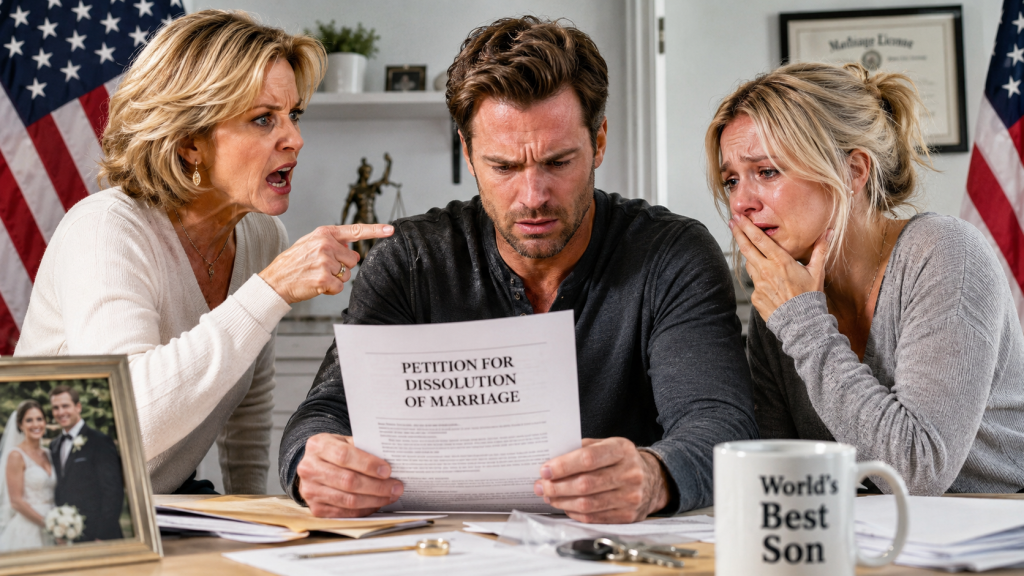
My mother stole my wife’s bank card and went shopping as if my marriage automatically made my wife’s money hers—then she called me, screaming with outrage, the second the payment was declined.
I drove home burning with anger, ready to accuse Olivia of humiliating my mother on purpose. Instead, I walked into divorce papers, sealed evidence, and a timeline that made one thing horrifyingly clear:
Olivia had never been the one losing control.
I had simply spent years believing the wrong woman.
The Call
“Son, I took that idiot wife of yours’ card—and it bounced! There was no money on it!”

My mother’s shrill voice tore through my phone so violently that I flinched.
I was standing in the break room of the auto shop where I worked in Phoenix, halfway through a sandwich and listening to two mechanics argue about Sunday football.
The room went quiet.
Everyone had heard her.
I pushed back my chair and walked outside.
“Mom, what are you talking about?”
“I went to Sprouts,” Marjorie snapped. “I picked up what I needed, used her card like I always do, and it DECLINED. Right there in front of everyone! The cashier looked at me like I was some kind of criminal.”
My stomach tightened.
“Why do you even have Olivia’s card?”
There was a pause.
Not embarrassment.
Not confusion.
Offense.
“Because she’s your wife,” Mom said. “And you’re my son. What belongs to the family belongs to the family.”
“That doesn’t answer my question.”
“I told her last month that I needed help with groceries. She ignored me. So today I stopped by your place and borrowed the card.”
Borrowed.
That word should have stopped me.
Instead, I asked the wrong question.
“Did Olivia know?”
“Of course not. She would have made one of her ridiculous scenes.”
I closed my eyes.
“Where are you?”
“In the parking lot. And I want you to call your wife right now and find out what she did.”
“What she did?”
“She obviously blocked the card to embarrass me.”
Even now, I’m ashamed of how quickly that explanation made sense to me.
Olivia had been quiet lately.
Too quiet, I had decided.
She had stopped arguing when Mom arrived without calling.
She had stopped protesting when Mom made comments about our finances.
She had stopped asking me to defend her.
That morning, Olivia had handed me coffee before work.
“Have a good day, Derek.”
She had smiled.
Not warmly.
Calmly.
I should have recognized that calm.
It was the calm of someone who had finally stopped hoping.
Instead, sitting behind the wheel of my truck ten minutes later, I convinced myself she was planning something.
She had probably transferred the money.
Maybe she had frozen the card.
Maybe she knew Mom would take it.
Maybe she wanted to humiliate her.
By the time I reached our apartment, anger had drowned out every reasonable thought.
I charged upstairs.
I jammed my key into the lock.
And I threw open the door.
“What the hell is wrong with you?” I shouted. “Have you lost your mind?”
Silence answered me.
The apartment smelled like lemon cleaner.
Sharp.
Bright.
Wrong.
The couch cushions were perfectly straight.
The television stand was bare.
And the wedding photograph that had hung beside the hallway for seven years was gone.
A pale rectangle remained on the wall.
“Olivia?”
Nothing.
Then I noticed the dining table.
My spare key was sitting in the center.
Beside it lay the credit card I had believed I’d misplaced months earlier.
There was also a small clear evidence bag containing a gold ring.
And beneath my favorite coffee mug was a stack of papers.
World’s Best Son.
Mom had given me that mug for Christmas.
I lifted it.
The first document underneath read:
PETITION FOR DISSOLUTION OF MARRIAGE.
I stopped breathing.
For several seconds, I simply stared.
Then I looked toward our bedroom.
The closet door was open.
Olivia’s clothes were gone.
Her shoes were gone.
Her grandmother’s cedar jewelry box was gone.
In the bathroom, only my toothbrush remained.
My phone buzzed.
MOM.
I rejected the call.
Then I reached for the plastic evidence bag.
Inside was her gold ring.
I recognized it immediately.
Mom wore that ring almost every day.
She liked pointing with the hand that wore it.
Especially when she was angry.
Beneath the bag was a photograph printed from our front-door camera.
The timestamp was from that morning.
Mom stood inside our apartment.
Olivia’s purse was open in her hands.
My knees suddenly felt weak.
Underneath was another document.
Draft Incident Report: Unauthorized Entry and Suspected Theft.
I sat down.
There were more pages.
Dozens.
And Olivia had arranged them chronologically.
That was when my marriage began telling me its story.
Not the version I remembered.
The version Olivia had survived.
The First Boundary I Helped My Mother Break
The timeline began almost three years earlier.
There was a screenshot of a text Olivia had sent me.
Derek, your mother came over while I was working and let herself in. I didn’t know she still had a key. Please ask her to return it.
My response was printed beneath it.
She’s my mom, Liv. She’s not some stranger. Relax.
I remembered sending it.
At the time, it seemed harmless.
Mom had been helping us water plants while we were on vacation. Apparently, she had made a copy of our key.
Olivia wanted the copy returned.
I told her she was overreacting.
A month later came another message.
Your mom went through the kitchen cabinets again and criticized what I buy. This is becoming uncomfortable.
My reply:
She’s trying to help.
Then:
She opened my mail today.
My reply:
Probably an accident.
Then:
She asked me how much money I have in savings.
I had answered:
She worries about us.
I kept reading.
Every page made me smaller.
There were photographs of drawers left open.
Screenshots of messages.
Dates.
Times.
Amounts.
Mom had borrowed $80.
Then $120.
Then $200.
Sometimes Olivia had given it voluntarily.
Other times Mom had pressured her.
“I raised Derek alone.”
“Family helps family.”
“You earn more than you need.”
“You don’t understand what mothers sacrifice.”
When Olivia eventually said no, Mom came to me.
And I became her collection agency.
“Liv, it’s only a hundred dollars.”
“Liv, she’s struggling.”
“Liv, why does everything have to become a boundary with you?”
Boundary.
I used to hate that word.
Now it was everywhere.
What I Had Refused to See
Halfway through the stack was a handwritten page.
Olivia’s writing.
March 14 — Marjorie entered at 2:10 p.m. without calling. Opened desk drawer. Asked why I keep separate savings. Derek said I was paranoid.
April 2 — Marjorie took $60 from kitchen envelope. Said she thought it was Derek’s. Derek reimbursed me and asked me not to embarrass her.
I remembered that.
Olivia had been furious.
I had taken sixty dollars from my wallet and slapped it onto the kitchen counter.
“There. Problem solved.”
She stared at the money.
“No, Derek. The money isn’t the problem.”
“Then what is?”
“Your mother took something that wasn’t hers.”
“She misunderstood.”
“She opened an envelope with my name on it.”
“So what do you want me to do? Call the police on my mother over sixty dollars?”
Olivia had gone silent.
I remembered feeling victorious.
I thought silence meant I had won.
Now I understood.
She had learned there was no point explaining herself to a husband committed to misunderstanding her.
The timeline continued.
Then I reached the page that made me physically sick.
It concerned the credit card sitting beside the divorce papers.
The one I had supposedly misplaced.
Olivia had found it six months earlier.
In Mom’s handbag.
There was a photograph.
Mom had left her bag open on our kitchen chair.
My card was visible inside.
Olivia had photographed it instead of removing it.
Then she had checked our statement.
Four purchases appeared.
A pharmacy.
A department store.
A restaurant.
A gas station.
Total: $486.17.
I remembered confronting Mom about those charges.
Not because Olivia asked me to.
Because the bank flagged them.
Mom cried.
She said she must have grabbed my card accidentally.
I believed her.
Then I accused Olivia of being heartless when she suggested canceling Mom’s access to our apartment.
The memory came back with brutal clarity.
“Your mother stole your card.”
“Stop using that word.”
“What word would you prefer?”
“She made a mistake.”
“Four times?”
“She’s getting older.”
“She’s fifty-nine.”
“You know what I mean.”
“No, Derek. I don’t.”
I had stormed out.
Mom called me afterward and said Olivia was trying to separate us.
I believed that too.
There was always an explanation.
And somehow, every explanation ended with Olivia apologizing.
The Recording
A yellow sticky note was attached to a small flash drive.
Listen before calling me.
My laptop was still in the bedroom.
I plugged it in.
There were six audio files.
The first began with Mom’s voice.
“Why do you keep your money separate?”
Olivia answered calmly.
“Because Derek and I agreed to keep personal accounts and contribute to shared expenses.”
“That’s ridiculous.”
“It works for us.”
“No. It works for you. It keeps my son from knowing what you have.”
“He knows exactly what I have.”
“Then why can’t you help me?”
“I have helped you.”
“Three hundred dollars is nothing to you.”
“That isn’t the point.”
There was silence.
Then Mom said something I had never heard her say.
“If you loved my son, you’d understand that helping me is part of being his wife.”
Olivia’s voice remained controlled.
“I married Derek. I didn’t sign over my bank account to you.”
Mom laughed.
A nasty little laugh.
“You really think you’re permanent?”
I froze.
“You’ll learn,” she continued. “Women come and go. Mothers don’t.”
The recording ended.
I stared at the laptop.
Then I opened the second file.
Mom was angrier.
“You’ve changed him.”
“No, Marjorie.”
“He never kept things from me before you.”
“He’s thirty-eight years old.”
“He’s my son.”
“And my husband.”
“You’re replaceable.”
That word landed differently.
Replaceable.
I suddenly remembered Olivia crying in our bedroom two years earlier.