 Reading Time: 38 minutes
“Ray, come here.” He hesitated, confused. I took the keys from my biological father’s hand, crossed the driveway, and placed them carefully into Ray’s palm.
“This car is yours.” For several seconds, nobody moved. Nobody even seemed to breathe. My mother stared at me. Danny’s mouth dropped open.
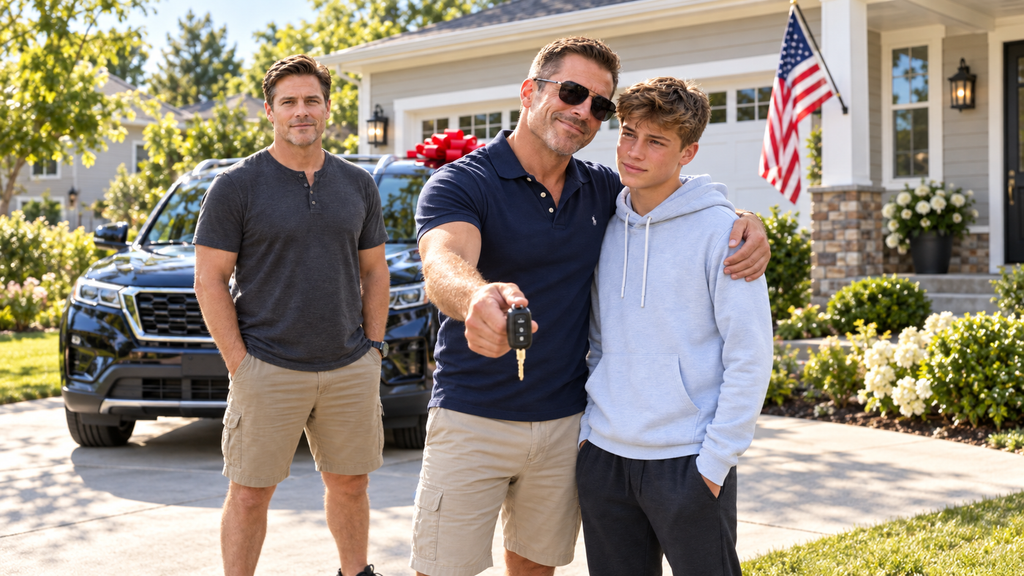
Cara looked from me to Ray and back again like she was trying to figure out whether I was joking.
And my biological father’s smile vanished so quickly it was almost frightening.
“What are you doing?” he demanded.
I turned toward him.
“You bought a car to prove you’re my father.”
Then I looked at Ray.
“He never had to prove anything.”
Ray’s fingers slowly closed around the keys.
His eyes were already shining.
“He showed up every day,” I said. “That’s what a father does.”
My biological father stared at me.
For the first time since arriving, he had absolutely nothing to say.
But I wasn’t finished.
Because there really was one more surprise waiting inside.
And unlike the car sitting in our driveway, that surprise hadn’t been purchased that morning.
It had taken nearly a year to make.
I turned toward the house.
“Come inside.”
My father folded his arms.
“For what?”
“You wanted everyone to know who my real father is.”
I looked directly into his eyes.
“So let’s finish that conversation.”
My mother whispered my name.
There was nervousness in her voice.
Maybe she thought I was about to explode.
Maybe she was afraid fourteen years of anger were finally going to come pouring out in front of everybody.
But I wasn’t angry anymore.
Not in the way I had imagined I would be if I ever saw him again.
When I was younger, I had dreamed about confronting him.
At eight years old, I imagined screaming.
At eleven, I imagined refusing to speak to him.
At thirteen, I imagined becoming so successful that someday he would see my name somewhere and regret leaving.
By seventeen, though, I had learned something.
Sometimes the opposite of love isn’t anger.
Sometimes it is simply understanding that someone no longer has the power to define you.
I walked into the house.
Everyone followed.
Ray came last.
He still had the car keys in his hand.
Mom’s birthday cake was sitting on the kitchen counter.
The candles had already been removed.
There were paper plates beside it and a half-melted tub of ice cream sweating on the counter.
It should have been an ordinary family birthday.
Instead, everyone gathered around our kitchen table while two men stood on opposite sides of the room.
One had given me his DNA.
The other had given me his time.
I walked toward the small cabinet beside the refrigerator.
On the top shelf was a plain brown envelope.
I had hidden it there the night before.
I pulled it out.
Ray frowned.
“What’s that?”
I smiled at him.
“You’ll see.”
My biological father let out a short laugh.
“This is ridiculous.”
I ignored him.
I slid one finger beneath the envelope flap.
Inside were several pieces of paper.
The first was a photograph.
It had been taken seven months earlier.
Ray and I were standing outside the high school gym after one of my basketball games.
We had lost by twelve points.
I had played maybe four minutes.
But you would never have known that from Ray’s face.
In the picture, he had one arm around my shoulders and was grinning like I had scored the winning shot in the state championship.
I placed the photograph on the table.
Then another.
Ray teaching me how to change a tire.
Another.
The two of us painting my bedroom.
Another.
Ray asleep on the couch with my chemistry textbook open on his chest.
Danny had taken that one.
Another.
All five of us crowded around a tiny Christmas tree the previous December because the larger ones had been too expensive.
Another.
Ray standing beside me at my school awards ceremony.
Another.
Ray helping me tie a necktie before my junior formal.
Another.
Ray grilling hamburgers while rain poured down because he had promised us a cookout and refused to cancel it.
There were dozens.
None of them were dramatic.
That was the point.
Fatherhood hadn’t happened to me in dramatic moments.
It had happened in hundreds of ordinary ones.
It was rides home after practice.
It was asking whether I had eaten.
It was leaving the hallway light on when I studied late.
It was reminding me to bring a jacket.
It was pretending not to notice when I took the biggest piece of chicken.
It was knocking before entering my room.
It was listening when I talked.
It was staying.
Ray stared at the photographs.
His lips parted, but nothing came out.
“I started collecting those last year,” I said.
He looked at me.
“Why?”
“Because I knew I wanted to give you something.”
His expression changed.
“Kid, you don’t have to give me anything.”
“I know.”
I swallowed.
“That’s why I wanted to.”
My biological father shifted impatiently.
“So this whole thing is some kind of performance?”
That finally made Mom turn toward him.
“No,” she said quietly.
He looked at her.
Mom’s face had gone pale.
But her voice didn’t shake.
“You arriving after fourteen years with a brand-new car and insulting the man who helped raise your son?”
She pointed toward the driveway.
“That was the performance.”
My father stared at her.
“I came here to do something nice.”
“You came here to be admired.”
“I bought him a car.”
“And?”
Mom’s voice sharpened.
“You think money erases fourteen birthdays?”
He looked annoyed.
“I knew this would happen. You’ve poisoned him against me.”
That sentence hit the room like a slammed door.
Mom took one step backward.
I saw pain flash across her face.
Ray moved slightly toward her.
But I spoke first.
“She never poisoned me against you.”
My father looked at me.
“She barely talked about you at all.”
His expression changed.
I continued.
“When I asked why you weren’t around, she told me adults sometimes make choices children don’t understand.”
Mom looked down.
“She never called you selfish.”
I took another photograph from the envelope.
“She never told me you didn’t care.”
Another photograph.
“She never told me to hate you.”
Another.
“She didn’t have to.”
His jaw tightened.
“You’re seventeen. You don’t understand what happened between your mother and me.”
“You’re right.”
I nodded.
“I don’t.”
For a second, he seemed surprised.
I continued.
“I don’t know every argument you had.”
I looked at Mom.
“I don’t know who said what.”
Then back at him.
“And maybe your relationship ended for reasons I’ll never completely understand.”
I paused.
“But your relationship with Mom ending didn’t require your relationship with me to end.”
Silence.
“You didn’t divorce me.”
He blinked.
“You left me.”
Those three words finally removed the last trace of confidence from his face.
I had imagined saying them for years.
Strangely, they didn’t feel satisfying.
They just felt true.
He looked away.
I reached deeper into the envelope.
There was a folded sheet of paper.
Unlike the photographs, Ray had never seen it.
Neither had Mom.
I unfolded it.
Across the top I had written:
WHAT MAKES SOMEONE A FATHER?
Ray looked at me.
I gave a nervous laugh.
“This is going to sound stupid.”
“No,” Ray whispered.
His voice was already breaking.
“It won’t.”
I looked down at the page.
“I wrote this for an English assignment.”
My teacher had asked us to write about someone who had changed our lives.
Most of the class wrote about athletes, grandparents, teachers, musicians or historical figures.
I had written about Ray.
I hadn’t told him.
I started reading.
“A father is not necessarily the man whose face you inherited.”
My throat tightened immediately.
“A father is the man who learns what scares you.”
Ray lowered his head.
“The man who notices when you are pretending to be okay.”
I continued.
“The man who works all day, comes home tired, and still asks how your game went.”
My voice shook.
“The man who has children of his own but never makes you feel like loving you takes something away from them.”
Danny moved closer to Ray.
Cara slipped her hand into his.
“A father is the man who teaches you things he knows and sits beside you while you learn things he doesn’t.”
Ray laughed through his tears.
“Chemistry,” he whispered.
I laughed too.
“Definitely chemistry.”
Everyone smiled except my biological father.
I returned to the page.
“A father is someone who understands that being present is not one grand gesture.”
“It is ten thousand small ones.”
“It is every ordinary Tuesday.”
“It is every boring ride home.”
“It is every question asked twice because he knows your first answer wasn’t honest.”
“It is standing in the rain beside a soccer field.”
“It is saving five dollars when you barely have five dollars to spare.”
“It is reminding a boy who has spent years wondering why one father left that he must have been worth staying for.”
My voice stopped.
I couldn’t read the next sentence.
The words blurred.
I wiped my eyes.
Ray was crying openly now.
I had never seen him cry before.
Not once.
Even when his father died.
Even when money got so tight the previous winter that he sold his old motorcycle without telling anyone why.
Even when Danny broke his arm falling out of a tree and Ray spent six hours at the emergency room.
He was the kind of man who swallowed his emotions because there was always something else that needed doing.
Now his face had crumbled.
I forced myself to continue.
“The man I call Ray entered my life only one year ago.”
“He did not make me.”
“He did not give me my eyes.”
“He did not give me my hair.”
“He was not there when I was born.”
“But he has spent every day since meeting me showing me what I used to think I had missed.”
I looked directly at him.
“So if anyone ever asks me who my father is, I know what I will say.”
Ray covered his mouth with one hand.
I read the final line.
“I will say his name is Ray.”
Nobody spoke.
I folded the paper carefully.
Then I placed it in front of him.
“That’s your birthday gift.”
He blinked.
“My birthday?”
“Your birthday is in three weeks.”
I shrugged.
“I figured today was close enough.”
That finally made him laugh.
He crossed the room before I could say anything else.
Then his arms were around me.
Ray hugged hard.
Not the awkward one-arm hug we usually did.
Not a quick pat on the shoulder.
He hugged me like he had been holding something inside since the moment he entered our lives.
I buried my face against his shoulder.
For one strange second, I was three years old again.
Except this time, somebody was holding on.
Ray whispered something only I heard.
“I’m not going anywhere.”
Four words.
That was all.
But I think some sentences arrive years after you need them and somehow still manage to heal something.
I nodded against his shoulder.
When we finally separated, his face was red.
He wiped his eyes.
“You’re still not giving me that car.”
Everybody laughed.
Even Mom.
I shook my head.
“I’m serious.”
“So am I.”
He looked toward the keys in his hand.
“This belongs to you.”
“I don’t want it.”
Ray studied me.
“You might feel differently tomorrow.”
“I won’t.”
“Next month?”
“No.”
“Next year?”
“No.”
He smiled faintly.
“You’re stubborn.”
“Learned it from you.”
“That is absolutely your mother’s fault.”
Mom threw a napkin at him.
For the first time since my biological father had arrived, the tension broke.
It lasted maybe three seconds.
Then he spoke.
“This is unbelievable.”
We all turned.
He stood near the kitchen doorway, arms folded, face flushed.
It occurred to me then that everything about this moment had gone differently than he expected.
He had imagined driving up in a new car.
He had imagined me shouting.
Maybe hugging him.
Maybe telling everyone how incredible he was.
He had probably rehearsed that line about my “real father.”
He probably thought Ray would shrink.
That Mom would be impressed.
That I would be overwhelmed.
Instead, the most expensive object in the driveway had become the least important thing in the house.
“You’ve known this man for one year,” my biological father said.
I nodded.
“Yes.”
“And you’re standing there acting like he raised you.”
“I didn’t say he raised me.”
I pointed toward Mom.
“She did.”
Mom’s eyes filled.
“She raised me for fourteen years while you were gone.”
He looked irritated.
“I sent money.”
I froze.
Mom’s face changed.
Ray looked at her.
My father noticed.
“There,” he said. “Funny how nobody mentions that.”
I turned toward Mom.
“Did he?”
She hesitated.
That hesitation told me there was more to the story.
“Mom?”
She exhaled slowly.
“Sometimes.”
My father threw his hands up.
“Exactly.”
Mom looked at him.
“You sent money six times.”
He went quiet.
“In fourteen years,” she continued.
“Six.”
His mouth tightened.
“I wasn’t exactly rich.”
“Neither was I.”
“I had problems.”
“So did we.”
“I was trying to get my life together.”
“For fourteen years?”
Her question hung in the room.
He looked toward the window.
Mom continued.
“The first payment came when he was five.”
She nodded toward me.
“One hundred dollars.”
I had never known any of this.
“The second came almost two years later.”
She swallowed.
“Three hundred.”
My father muttered something.
Mom kept going.
“The largest amount you ever sent was eight hundred dollars.”
She looked at him.
“You called me the next morning and asked if I had told him it came from you.”
He didn’t answer.
“I said no because he was nine years old and needed school clothes, not another reason to sit beside the window waiting for you.”
My chest hurt hearing that.
I remembered being nine.
I remembered asking why Mom suddenly let me buy new shoes instead of used ones.
I remembered how happy she looked when I found a pair on sale.
I hadn’t known any of it was connected to him.
My father looked at me.
“I did what I could.”
I shook my head.
“No.”
His eyes narrowed.
“You did what you wanted.”
“That’s not fair.”
“You were gone.”
“You don’t know anything about my life.”
“That’s true.”
I nodded.
“And whose fault is that?”
He fell silent.
I continued.
“I don’t know where you lived.”
“I don’t know what jobs you had.”
“I don’t know who your friends are.”
“I don’t know what you did on weekends.”
“I don’t know whether you drink coffee or tea.”
“I don’t know your favorite movie.”
“I don’t even know your middle name.”
His face shifted.
“My middle name is Thomas.”
I almost laughed.
Not because it was funny.
Because there was something incredibly sad about learning my father’s middle name seventeen years into my life while standing beside a half-eaten birthday cake.
“Okay.”
I nodded.
“Thomas.”
He looked wounded.
And for the first time, I realized something else.
He had probably imagined this reunion too.
Maybe not every day.
Maybe not for fourteen years.
But enough.
Perhaps in his version, the expensive gift opened the door.
Maybe we went for a drive.
Maybe I called him Dad before sunset.
Maybe we made up for fourteen years during one birthday.
But time doesn’t work like that.
You can’t return to an abandoned relationship and continue from where you left it.
The child grows.
The empty chair gets filled.
The questions eventually stop being asked.
People adapt around the absence.
And sometimes when the person returns, they discover there is no empty space waiting for them.
My biological father glanced at the photographs spread across the table.
Then his eyes landed on the essay.
His expression hardened again.
“This guy has been around for a year and suddenly I’m nothing?”
I sighed.
“This isn’t about making you nothing.”
“It sure feels like it.”
“You made yourself absent.”
“I came back.”
“Today.”
“I’m here now.”
“Why?”
He opened his mouth.
Then closed it.
I asked again.
“Why today?”
“It’s your birthday.”
“You knew my birthday last year.”
He looked away.
“And the year before that.”
No answer.
“And the year before that.”
He rubbed his jaw.
“I wasn’t ready.”
“For what?”
“To see you.”
I nodded slowly.
“At least that’s honest.”
He looked surprised.
I pulled out a chair and sat down.
The anger inside me had become something else.
Curiosity.
Sadness.
Maybe even pity.
Not enough to erase anything.
But enough to want the truth.
“So why now?”
He stared at the floor.
Mom started gathering the photographs.
Ray gently stopped her.
“Leave them.”
My father looked at the three of us.
Then at Danny and Cara.
Finally, he pulled out the chair across from me and sat.
For the first time that day, he didn’t look confident.
He looked old.
Not physically old.
He was only in his early forties.
But suddenly I could see the years.
The tiredness around his eyes.
The gray beginning at his temples.
The lines beside his mouth.
He rested his elbows on his knees.
“My mother died four months ago.”
I blinked.
I had never met my grandmother on his side.
I barely knew anything about her.
Mom sat down beside me.
My father continued.
“She kept asking about you.”
His voice was quieter now.
“Even near the end.”
He rubbed his hands together.
“She had pictures.”
“What pictures?”
“The ones your mother sent when you were little.”
I turned toward Mom.
She looked uncomfortable.
“You sent pictures?”
“For a few years.”
“To him?”
“To your grandmother.”
“Why didn’t you tell me?”
“Because she loved you.”
Mom glanced toward him.
“Whatever happened between your father and me, I wasn’t going to punish his mother for it.”
That was exactly the kind of thing Mom would do.
Quietly.
Without asking for credit.
My biological father stared at the floor.
“She had your kindergarten picture framed.”
He gave a small, humorless laugh.
“The one where you were missing two front teeth.”
I remembered that photograph.
“She kept telling me to call you.”
He swallowed.
“I kept saying I would.”
His eyes finally met mine.
“Tomorrow.”
“Next week.”
“After work calmed down.”
“When I had more money.”
“When I had something worth telling you.”
He paused.
“And then fourteen years were gone.”
Nobody interrupted.
“At the hospital, Mom asked me one more time.”
His voice cracked slightly.
“She said, ‘Do you even know what kind of person your son became?’”
He looked at me.
“And I realized I didn’t.”
I felt something twist inside my chest.
Not forgiveness.
Not yet.
Maybe not ever in the way people imagine forgiveness.
But understanding.
He continued.
“After she died, I found a box.”
“What box?”
“She had kept everything.”
He laughed faintly.
“Every school picture.”
“Every Christmas card.”
“Every note your mother sent.”
“She even had a newspaper clipping from when your middle school team won some tournament.”
I knew which one.
I had scored two points the entire tournament.
Ray probably would have been proud anyway.
My father looked toward me.
“I spent one night going through everything.”
He inhaled.
“And I realized your entire childhood existed in that box.”
His voice lowered.
“And I wasn’t in any of it.”
Nobody said anything.
For a moment, I could see the pain in him.
Real pain.
The type money can’t fix.
The type that arrives when time has already taken something you cannot purchase back.
“I thought the car would help,” he admitted.
Ray finally spoke.
“You thought a car would replace fourteen years?”
My father looked at him sharply.
“I wasn’t talking to you.”
Ray didn’t react.
That calm made my biological father even angrier.
“I’m his father.”
Ray nodded.
“Biologically, yes.”
My father stood so quickly the chair scraped across the floor.
“You think you can walk into his life and replace me?”
Ray remained seated.
“No.”
His voice stayed calm.
“You did the walking out.”
That sentence silenced everyone.
My biological father’s hands clenched.
Ray continued.
“I never tried to replace you.”
He pointed at me.
“When I met him, he was sixteen.”
“He already had a mother.”
“He already had a history.”
“He already had questions I couldn’t answer.”
“I didn’t ask him to call me Dad.”
“I never told him what to think about you.”
Ray leaned back.
“I took him to practice because he needed a ride.”
“I helped with homework because he asked.”
“I showed up because I told him I would.”
“That’s it.”
My father stared at him.
Ray’s voice softened.
“If that feels like competition to you, then maybe you’re angry at the wrong person.”
My father looked away.
Nobody had raised their voice.
Nobody had insulted him.
And somehow that seemed to hurt him more than shouting would have.
He sat down again.
I stared at my birthday cake.
Seventeen candles had been removed only half an hour earlier.
I thought about all the birthday wishes I had made as a child.
When I was six, I wished for a bicycle.
When I was eight, I wished for a puppy.
When I was ten, I wished Mom would get a better job so she would stop looking worried every time she opened the mailbox.
When I was twelve, I wished my biological father would call.
I remembered that one clearly.
I didn’t tell anyone.
I blew out the candles and waited all day.
Every time the phone rang, my heart jumped.
At midnight, I told myself maybe he had forgotten the time difference.
The next morning, I stopped waiting.
I looked at him now.
“Do you know what I wanted for my twelfth birthday?”
He shook his head.
“You.”
His face changed.
“I wanted one phone call.”
I smiled sadly.
“Funny, right?”
I pointed toward the driveway.
“That car probably cost more than Mom made in a year when I was little.”
He looked down.
“But at twelve, I would’ve traded it for a ten-minute phone call.”
His eyes filled.
I had never expected to see him cry.
A tear slid down his cheek.
He wiped it away quickly.
“I’m sorry.”
The room became completely still.
Two words.
Fourteen years late.
I thought hearing them would change something inside me.
Maybe I had imagined a wall collapsing.
Maybe some hurt disappearing.
Instead, they simply entered the room and sat with us.
I nodded.
“I believe you.”
He looked up.
“But?”
“There is a but.”
He gave a tiny nod.
“You being sorry doesn’t make Ray less important.”
“I know.”
“You being my biological father doesn’t give you permission to disrespect him.”
He glanced at Ray.
“I know.”
“And buying me things isn’t going to make this relationship happen faster.”
He swallowed.
“I know.”
“If you want to know me, you have to actually know me.”
“What does that mean?”
“It means no grand gestures.”
I pointed toward the driveway.
“No expensive gifts.”
“No showing up twice a year and trying to make up for everything in an afternoon.”
“No competing with Ray.”
His jaw tightened slightly at Ray’s name.
I noticed.
“So that one matters.”
He looked at me.
“If you’re going to be part of my life, Ray stays part of it too.”
He was silent.
“He’s not leaving so you can feel comfortable.”
More silence.
“And I’m not going to pretend he’s less important to protect your feelings.”
My father inhaled slowly.
“That’s hard to hear.”
“I know.”
“But is it true?”
“Yes.”
“Then you needed to hear it.”
He nodded.
I leaned forward.
“You want to know what being my father looks like now?”
He waited.
“It looks boring.”
For the first time, he seemed confused.
“Boring?”
“Yes.”
I smiled faintly.
“It looks like coming to a game when I might not play.”
“It looks like asking about school.”
“It looks like remembering when I have exams.”
“It looks like calling when there’s nothing important to say.”
“It looks like hearing no sometimes.”
“It looks like showing up next week even if today doesn’t go the way you hoped.”
“It looks like time.”
I sat back.
“You missed fourteen years.”
“You don’t fix that with money.”
“You fix whatever can still be fixed one ordinary day at a time.”
His eyes moved toward Ray.
I could practically see the battle happening inside him.
Pride against regret.
Jealousy against common sense.
Then he looked at me again.
“What happens to the car?”
Ray tossed the keys onto the table.
“Finally.”
Everyone laughed softly.
I stared at them.
“I don’t know.”
My biological father looked surprised.
“You really don’t want it?”
“I didn’t say I don’t like it.”
That made Danny laugh.
“It’s an awesome car.”
Cara elbowed him.
“What?”
He shrugged.
“It is.”
Even my biological father smiled faintly.
I looked through the kitchen window.
The car was beautiful.
Shiny black paint.
Brand-new wheels.
Everything someone my age was supposed to dream about.
A few hours earlier, seeing it would have made me feel like the luckiest kid at school.
Now it looked different.
Not bad.
Just complicated.
“I can’t take it the way you gave it.”
My father nodded slowly.
“What does that mean?”
“It means if it’s a gift, it’s a gift.”
“No conditions.”
“No using it later to remind me what you’ve done for me.”
“No expecting me to choose you over Mom or Ray because you bought it.”
He thought for a moment.
“Fair.”
“And the first thing I’m doing with it is teaching Danny how to wash it.”
Danny grinned.
“Yes.”
“He’s eleven.”
Ray said.
“He can hold a sponge.”
Danny looked betrayed.
“I can do more than that.”
“No, you absolutely cannot.”
Cara laughed.
I looked back at my biological father.
“And if you ever say something like ‘now he knows who his real father is’ again, I’m handing you the keys back.”
His expression became serious.
“I won’t.”
I nodded.
“Okay.”
Something shifted then.
Not everything.
We weren’t suddenly father and son in the way movies like to make people become family within five minutes.
But the room felt different.
Less like a battlefield.
More like people standing among the ruins deciding what might still be worth rebuilding.
Mom started cutting cake again.
Because apparently even emotional confrontations don’t stop mothers from worrying about melted ice cream.
“Everybody sit,” she ordered.
“No more family trauma until people have eaten.”
Ray laughed.
“Yes, ma’am.”
My biological father almost smiled.
Mom handed him a plate.
He looked surprised.
“You’re giving me cake?”
“It’s cake, not absolution.”
Danny nearly choked laughing.
That was Mom.
She could make a room breathe again with one sentence.
We sat around the table.
For the first time in my life, my biological father and Ray sat across from each other.
It was awkward.
Painfully awkward.
Danny filled the silence by asking my father how fast the car could go.
“Danny,” Ray warned.
“What? I’m asking scientifically.”
“Scientifically?”
“Yes.”
Cara rolled her eyes.
“You don’t even like science.”
“I like cars.”
My biological father laughed.
The sound surprised me.
Then he started explaining the engine.
Danny listened like he had discovered a new hero.
Ray shook his head.
“Do not encourage him.”
“I’m not.”
“You’re definitely encouraging him.”
We ate cake.
And for almost five minutes, everything felt strangely normal.
Then my father’s phone buzzed.
He pulled it from his pocket.
“I should probably go.”
The old version of me might have panicked.
The twelve-year-old version might have thought:
Of course.
He’s leaving again.
Instead, I simply nodded.
“Okay.”
He stood.
Everyone else did too.
We walked toward the front door.
At the porch, he stopped beside me.
The new car reflected the late-afternoon sun.
He looked at it, then at me.
“I really did pick it because I thought you’d like it.”
I nodded.
“I do.”
“You don’t have to give it to Ray.”
Ray raised both hands.
“Thank you.”
I smiled.
“I know.”
My father shoved his hands into his pockets.
There was another awkward silence.
Then he asked something I never expected.
“Do you have a game next week?”
I stared at him.
“Tuesday.”
“What time?”
“Six-thirty.”
“Home?”
“Yes.”
He nodded.
“I’d like to come.”
I looked toward Ray.
He didn’t say anything.
Didn’t make a face.
Didn’t claim his territory.
He simply waited for my answer.
I turned back.
“Okay.”
My biological father’s face brightened slightly.
“What position do you play?”
I stared at him.
He looked embarrassed.
“I told you. I don’t know much.”
“Small forward.”
He nodded like he was memorizing it.
“Small forward.”
“I might not play much.”
“That’s okay.”
The answer came quickly.
I glanced at Ray.
His eyes met mine.
I think he knew why that sentence mattered.
My father took three steps toward his car, then stopped.
He turned back toward Ray.
For a moment, neither man spoke.
Then my biological father extended his hand.
“I shouldn’t have said what I said.”
Ray looked down at his hand.
Then back at him.
“No.”
“You shouldn’t have.”
My father almost withdrew it.
Then Ray shook it.
“But thank you for saying that.”
My father nodded.
“I’m David.”
It hit me then.
Ray had never even known his name.
“Ray.”
They released hands.
It wasn’t friendship.
It wasn’t forgiveness.
But it was respect.
Or at least the beginning of it.
David walked toward his rental car.
Before opening the door, he looked at me.
“Tuesday.”
“Six-thirty.”
“I’ll be there.”
I nodded.
Then he drove away.
I watched until his car disappeared.
Ray stood beside me.
“You okay?”
“Yeah.”
“You sure?”
I smiled.
“That question is annoying.”
“Good.”
“Why?”
“Means I’m doing my job.”
I looked at him.
Then at the new car.
“So.”
He groaned.
“No.”
“What?”
“I know that look.”
“What look?”
“You’re going to ask me something.”
“I need you to teach me how to drive it.”
He stared at me.
“You already know how to drive.”
“Not something like that.”
Ray looked toward the car.
Then smiled.
“All right.”
He picked up the keys.
“But first, birthday boy, you’re helping me with dinner.”
“It’s my birthday.”
“Exactly.”
“I thought birthday people didn’t work.”
“That sounds like something rich people made up.”
Mom shouted from inside.
“I heard that!”
Ray grinned.
“You were supposed to.”
That evening, the five of us ate hamburgers on the back porch.
The car stayed in the driveway.
Every few minutes Danny would glance toward it as if somebody might steal it.
Cara eventually covered his eyes with both hands.
“Stop staring.”
“I’m appreciating.”
“You’re obsessed.”
“It has heated seats.”
“It’s seventy-eight degrees.”
“That’s not the point.”
I laughed.
It had been one of the strangest birthdays of my life.
Maybe the strangest.
But after dinner, something happened that I remember more clearly than the car.
Ray and I were washing dishes.
Mom had gone upstairs.
Danny and Cara were arguing over a movie.
Ray stood beside the sink drying a plate.
For several minutes neither of us spoke.
Then he said,
“You didn’t have to do that.”
I knew exactly what he meant.
“The car?”
“The essay.”
I shrugged.
“I wanted to.”
He dried another plate.
“Still.”
He stopped.
“I don’t want you thinking you owe me something because I’m around.”
“I don’t.”
“Good.”
He placed the plate in the cabinet.
“And I don’t want what happened today making things harder between you and your dad.”
I looked at him.
“My dad?”
He gave me a look.
“You know who I mean.”
“You.”
He shook his head.
“Him.”
“David.”
“Your biological father.”
I leaned against the counter.
“Does it bother you?”
“What?”
“If I call him Dad someday?”
The question seemed to surprise him.
He thought before answering.
“No.”
I studied his face.
“Really?”
“Really.”
“Not even a little?”
He smiled.
“I’m human. Maybe a little.”
I laughed.
“But that doesn’t make it wrong.”
He continued drying dishes.
“You don’t have to take something away from me to give something to him.”
I didn’t answer.
Ray looked at me.
“Family isn’t a pie.”
“What?”
“You heard me.”
“That might be the dumbest thing you’ve ever said.”
“I’m serious.”
He pointed the dish towel at me.
“You don’t run out of slices.”
“You can love your mom.”
“You can love me.”
“You can love Danny and Cara.”
He paused.
“And if someday you want a relationship with David, you can love him too.”
Something about hearing that released a tension I hadn’t known I was carrying.
Ray continued.
“I don’t need to win.”
“He’s not my competition.”
He looked down.
“I just need you to know I’m here.”
“I know.”
“Good.”
He tossed the towel onto the counter.
“Now go pick a movie before Danny puts on that ridiculous racing movie again.”
“He likes cars.”
“Today has already involved enough cars.”
I started toward the living room.
Then stopped.
“Ray?”
“Yeah?”
“I meant what I wrote.”
He looked at me.
“I know.”
I walked over and hugged him again.
This time he laughed.
“Careful.”
“What?”
“You hug me twice in one day, people might think you like me.”
“Don’t push it.”
He patted my back.
That night, I lay awake for hours.
The keys sat on my desk.
I kept looking at them.
Not because of the car.
Because of what they represented.
For fourteen years, I had imagined my biological father’s absence as a locked door.
I thought someday he might return with a key.
I thought that if he apologized correctly, explained everything, or somehow proved he had missed me enough, the door would open and all the lost years would come rushing back.
But that wasn’t how it worked.
There was no single key.
No perfect explanation.
No gift.
No apology.
No dramatic reunion powerful enough to restore a childhood.
Those years were gone.
I could grieve them.
I could be angry about them.
I could forgive him for them.
But I could not live them again.
And strangely, realizing that made me feel free.
Because it meant David didn’t have to fix my past.
He only had to decide what kind of man he wanted to be in my future.
And I got to decide whether there was room for him there.
Tuesday came.
Our game started at six-thirty.
At six-fifteen, I looked toward the bleachers.
Ray was already there.
Of course he was.
He sat in his usual spot about halfway up.
Mom sat beside him.
Danny and Cara were eating popcorn.
There was an empty seat on Ray’s other side.
I pretended not to notice it.
At six-twenty, it was still empty.
At six-twenty-five, still empty.
I told myself I didn’t care.
That was a lie.
At six-twenty-eight, I looked again.
Still empty.
Something cold settled in my stomach.
The old feeling.
The old expectation.
Of course.
I turned toward the court.
Coach called us into the huddle.
I stopped looking.
Then, just before the buzzer, the gym door opened.
David rushed inside.
He was wearing a dress shirt with the sleeves rolled up.
His tie was hanging loose around his neck.
He looked around the gym, saw Mom, Ray and the kids, then climbed the bleachers.
Ray stood and moved aside so he could reach the empty seat.
David sat beside him.
He looked down at the court.
Our eyes met.
He raised one hand.
Not dramatically.
No shouting.
No huge gesture.
Just a small wave.
I waved back.
Then the game started.
I played six minutes.
I scored four points.
We lost by nine.
When the buzzer sounded, I walked toward the locker room.
Part of me expected David to leave.
People had places to be.
He had already seen me play.
But twenty minutes later when I walked out, he was still there.
Everyone was.
David smiled.
“Four points.”
I laughed.
“You counted?”
“Of course.”
Ray interrupted.
“He also had three rebounds.”
David looked embarrassed.
“I missed that.”
Ray grinned.
“Rookie.”
David laughed.
And just like that, something impossible happened.
The two men stood beside each other talking about my game.
Not competing.
Not measuring.
Just talking.
David asked if we had another game Friday.
I told him yes.
He came.
The next week, he called on Wednesday.
Not my birthday.
Not Christmas.
Not because something dramatic had happened.
Just Wednesday.
“What are you doing?” he asked.
“Homework.”
“Chemistry?”
“Unfortunately.”
He laughed.
“I was terrible at chemistry.”
“Ray too.”
There was a tiny pause.
Then David said,
“Maybe it’s genetic.”
I laughed.
That was our first ordinary phone call.
It lasted eleven minutes.
The next one lasted fifteen.
Some weeks he called twice.
Sometimes I didn’t answer.
He left messages.
And unlike the father I remembered from childhood, he called again.
Not obsessively.
Not angrily.
Just consistently.
One Saturday, he asked if I wanted to get lunch.
I agreed.
We met at a diner.
For the first twenty minutes, conversation was awkward.
Then he told me about the first car he had owned.
A horrible old pickup that overheated every summer.
I told him about Ray’s motorcycle.
David asked,
“He still has it?”
“No.”
I stirred my soda.
“He sold it last winter.”
“Why?”
I shrugged.
“Money was tight.”
David nodded.
Then asked,
“Did he want to sell it?”
“No.”
“How do you know?”
“Because he still looks at motorcycles every time one drives past.”
David stared out the window.
He didn’t say anything else about it.
Two months later, something appeared in our driveway.
A motorcycle.
Not brand-new.
Not flashy.
It was used.
Dark blue.
Clean.
Reliable.
Ray walked outside and stared at it.
There was an envelope taped to the seat.
Inside was a note.
Ray read it.
Then read it again.
“What does it say?” Mom asked.
He handed it to her.
She read aloud.
“Ray, I’m learning that sometimes the best gift is not the biggest one. Sometimes it is noticing what another person gave up. You gave my son something I should have given him years ago—your time. I can’t repay that, and I know you wouldn’t let me try. But I heard you sold something you loved during a hard year. Please accept this as one father thanking another. David.”
Nobody spoke.
Ray stared at the motorcycle.
Then at me.
“You told him?”
“He asked.”
Ray looked annoyed for about three seconds.
Then his face softened.
“Where is he?”
I pointed across the street.
David was sitting in his car.
Apparently he had been too nervous to come to the door.
Ray walked across the street.
I watched through the window.
David got out.
They talked for several minutes.
Ray pointed toward the motorcycle.
David shrugged.
Ray shook his head.
David said something.
Ray said something.
Finally, Ray held out his hand.
David shook it.
Then Ray pulled him into a quick hug.
When Ray returned, I smiled.
“So you’re keeping it?”
“Temporarily.”
Mom laughed.
“That means yes.”
“I’m going to pay him back.”
“No, you’re not,” I said.
He glared at me.
“You stay out of adult business.”
“I’m almost eighteen.”
“Then enjoy your remaining months of not being responsible for anything.”
That motorcycle changed something between them.
Not because of its price.
Because David had listened.
He was finally beginning to understand the difference between buying something to be seen and giving something because you saw someone else.
The months passed.
David kept coming around.
Slowly.
Carefully.
He never again referred to himself as my “real father.”
He stopped trying to impress me.
Sometimes he failed in smaller ways.
He forgot one of my games.
He called two days late after an exam he had promised to ask about.
Once he canceled lunch because work got busy.
The first time that happened, I expected him to disappear for another month.
Instead, he called that evening.
“I messed up.”
“Yeah.”
“I’m sorry.”
“Okay.”
“Can I take you tomorrow?”
I went.
That mattered.
He wasn’t becoming perfect.
He was becoming present.
There is a difference.
Ray stayed exactly who he had always been.
He attended games.
He helped with college applications.
He made terrible jokes.
He threatened to frame my first parking ticket.
And every month, he and Mom continued putting money into that college account.
I discovered how much during my senior year.
It wasn’t a fortune.
Compared with tuition costs, it wasn’t even close.
But when Mom showed me the balance, I stared at it for a long time.
Almost every deposit was small.
Forty dollars.
Seventy-five.
Twenty-five.
Sometimes ten.
One month there were three separate deposits.
Fifteen.
Twenty.
Eight dollars.
I stared at that eight-dollar deposit.
“Why eight?”
Mom smiled.
“That was all we had left.”
I looked at Ray.
“You put your last eight dollars in my college account?”
He shrugged.
“It wasn’t our last eight.”
Mom raised an eyebrow.
“It absolutely was.”
Ray looked betrayed.
“We had food.”
“Barely.”
“We had electricity.”
“Because I paid the bill.”
“We were fine.”
Mom shook her head.
I laughed.
Then I looked at those numbers again.
That eight dollars meant more to me than the car.
Because the car represented what someone could afford to give.
The eight dollars represented what someone chose to give when he could barely afford anything.
There is a difference between price and cost.
It took me seventeen years to understand that.
A few weeks before graduation, I received an acceptance letter from the university I had wanted to attend.
I got a partial scholarship.
When I opened the email, I screamed so loudly that Mom came running upstairs.
“What happened?”
I turned the laptop around.
Her hands flew over her mouth.
Then she screamed too.
Ray came running with a wrench in his hand.
“What?”
“What?”
“Who’s hurt?”
“I got in!”
He stared at the screen.
Then at me.
“You got in?”
“I got in.”
He dropped the wrench on the carpet and hugged me.
Mom joined us.
Danny and Cara ran upstairs.
We ended up in one ridiculous five-person pile.
Then I called David.
He answered on the second ring.
“Hey.”
“I got in.”
There was silence.
Then he shouted so loudly I had to hold the phone away from my ear.
“You got in?”
“Yes.”
“That school?”
“Yes.”
“The one you wanted?”
“Yes!”
He started laughing.
Then I heard him tell somebody nearby,
“My son got into college.”
My son.
The words hit differently now.
Not because he had earned all seventeen years.
He hadn’t.
But because over the previous year, he had started earning the right to be part of the years ahead.
Graduation came in June.
The school gave each student only four tickets.
I had Mom.
Ray.
David.
Then one ticket left.
Danny and Cara fought over it for two days.
Finally Mom bought an extra ticket from another family whose grandparents couldn’t come, and somehow both kids got inside.
I walked across the stage.
When my name was announced, I heard five people screaming.
Mom.
Ray.
Danny.
Cara.
And David.
Afterward, we took photographs outside.
One with Mom.
One with the kids.
One with Ray.
One with David.
Then Mom said,
“Everybody together.”
There was a brief awkward moment.
David looked toward Ray.
Ray looked toward David.
Then Ray waved him over.
“Get in here.”
David stood on my left.
Ray stood on my right.
Mom beside Ray.
Danny and Cara in front.
The camera flashed.
That photograph is still my favorite.
Not because it showed a perfect family.
We weren’t.
It showed something better.
A family willing to become larger without pretending the past had been different.
That evening, David handed me an envelope.
I groaned.
“If there are car keys in this—”
He laughed.
“No keys.”
Inside was a check.
I looked at the amount.
Then looked again.
It was enough to cover a large portion of what my scholarship and Mom and Ray’s savings wouldn’t.
“David.”
He raised a hand.
“Before you say anything, there are no conditions.”
“I can’t take this.”
“Yes, you can.”
“This is too much.”
“No.”
His expression became serious.
“It isn’t.”
I shook my head.
“You don’t have to buy your way—”
“I know.”
He interrupted gently.
“I know.”
He looked at Ray.
Then at Mom.
“This isn’t me trying to catch up.”
He turned back toward me.
“I finally understand that I can’t.”
His eyes filled.
“I missed things.”
“A lot of things.”
“I’m going to regret that for the rest of my life.”
“But college hasn’t happened yet.”
He tapped the envelope.
“That is something I can help with now.”
I didn’t know what to say.
Ray stepped beside me.
“Take it.”
I turned.
“Really?”
He nodded.
“Really.”
David looked surprised.
Ray smiled.
“The kid’s going to eat enough instant noodles without turning down tuition money.”
Everyone laughed.
I hugged David.
The hug still felt different from hugging Ray.
It probably always would.
But different didn’t mean fake.
“Thank you.”
He hugged me tighter.
“You’re welcome, son.”
That fall, I left for college.
Mom cried for two weeks before I even moved out.
Ray pretended he wasn’t emotional.
Then I caught him standing alone in my empty bedroom after we packed the car.
“What are you doing?”
He quickly wiped his face.
“Checking the window.”
“You’re crying.”
“I have allergies.”
“In August?”
“Very aggressive pollen.”
I laughed.
He pulled me into a hug.
“Call your mother.”
“I will.”
“And me.”
“I will.”
“And don’t live on pizza.”
“I won’t.”
“And check your oil.”
“Yes.”
“And—”
“Ray.”
“What?”
“I’m going to college, not war.”
He nodded.
“Right.”
Then hugged me again.
David followed in his car so he could help us move.
That was his idea.
For most of the drive, I watched both cars through my mirrors.
Mom and Ray behind me.
David behind them.
Three adults whose choices had shaped my life in completely different ways.
At one point, I thought about the birthday when all of this started.
The black car.
The keys.
The sentence.
“Now he knows who his real father is.”
I smiled.
Because by then, I understood how wrong the question had always been.
Who is your real father?
As if family is a courtroom where only one person can win.
As if biology cancels devotion.
As if love has limited seating.
David was my biological father.
That was real.
He gave me part of my face.
Part of my personality.
Probably my terrible chemistry skills.
He also abandoned me.
That was real too.
Both truths could exist at once.
Ray was my stepfather.
He entered my life when I was sixteen.
He did not raise me from birth.
That was real.
But he chose me when he didn’t have to.
He showed up when it was inconvenient.
He gave me time when he had very little money.
He loved me without asking what title he would receive in return.
That was real too.
Mom was the person who carried almost everything for fourteen years.
She had been both stability and shelter.
She had worked extra hours.
Skipped meals.
Bought secondhand clothes.
And somehow managed not to fill my childhood with bitterness toward the man who left.
That was real.
There was no single person who could erase the others.
There was no trophy labeled REAL PARENT.
There were simply people.
Choices.
Years.
Mistakes.
Sacrifices.
Absences.
Returns.
And love proven through repetition.
My first semester was difficult.
Harder than high school.
I failed my first chemistry exam.
I stared at the grade and almost laughed.
Then I called Ray.
“I’m dropping chemistry.”
He didn’t even say hello.
“No.”
I laughed.
“You don’t know what happened.”
“You failed.”
“How did you know?”
“Because you only threaten to quit when you fail.”
“I got a forty-eight.”
“Ouch.”
“Exactly.”
“Read the questions again.”
I laughed so hard my roommate stared at me.
“You’re joking.”
“Nope.”
“You’re two hundred miles away.”
“And yet somehow you can still hear me.”
I called David afterward.
He laughed.
“I got a thirty-two on a chemistry test once.”
“That actually makes me feel better.”
“Glad my academic failures finally became useful.”
Between the two of them, I survived chemistry.
Barely.
At Thanksgiving, I returned home.
The first night, we had dinner with Mom, Ray, Danny and Cara.
The next afternoon, David came over.
He brought pie.
Not an expensive gift.
Not car keys.
Pie.
I remember noticing that.
Maybe other people wouldn’t.
I did.
We sat on the porch afterward.
He asked about classes.
I told him everything.
Then he said something strange.
“Your grandmother would have liked Ray.”
I turned toward him.
“Really?”
He nodded.
“She would’ve given me hell about what I said on your birthday.”
I laughed.
“Good.”
“She gave me hell about almost everything.”
We sat quietly.
Then I asked something I had been afraid to ask.
“Why did you actually leave?”
He inhaled.
I expected excuses.
Instead, he said,
“Because I was selfish.”
I looked at him.
“That simple?”
“No.”
He rubbed his hands.
“But that’s the honest version.”
He stared across the yard.
“Your mother and I were young.”
“We fought.”
“I was angry.”
“I thought I deserved a different life.”
He shook his head.
“And instead of separating being unhappy in my marriage from being your father, I ran from both.”
“Why didn’t you come back?”
“Shame.”
The answer surprised me.
He continued.
“The longer I stayed away, the harder it became to call.”
“Every birthday I missed made the next one worse.”
“I kept telling myself you probably hated me.”
“I used that as an excuse.”
He looked at me.
“It was easier to imagine you didn’t want me than to admit I was afraid you would ask where I’d been.”
I sat with that.
There was no heroic explanation.
No secret tragedy.
No hidden reason that transformed what he had done into something understandable.
Just weakness.
Fear.
Pride.
Human mistakes allowed to grow for fourteen years.
Strangely, that honesty made forgiveness easier.
Not immediate.
Not complete.
But possible.
“I did hate you sometimes.”
He nodded.
“I know.”
“And sometimes I missed you.”
His eyes filled.
“I know.”
“I used to think those feelings couldn’t exist together.”
“They can.”
I looked toward the house.
Through the window, Ray was helping Danny with something at the kitchen table.
I smiled.
“I also thought liking you would somehow betray him.”
David followed my gaze.
“And?”
“He told me family isn’t pie.”
David frowned.
“What does that mean?”
“I said the same thing.”
We both laughed.
“He means I don’t have to love one person less to love someone else.”
David nodded.
“Sounds like something Ray would say.”
“You know him pretty well now.”
“A little.”
He smiled.
“He texted me last week.”
“What?”
“Motorcycle question.”
“He texts you?”
“Sometimes.”
I stared at him.
“When did that happen?”
He shrugged.
I laughed.
That was how healing happened in our family.
Not through one grand scene.
Through small things you noticed afterward.
A text message.
An extra chair.
A pie instead of a car.
A father arriving before the game started.
A stepfather making space.
A son learning he did not have to choose.
Years passed.
David never disappeared again.
He wasn’t perfect.
Neither was Ray.
Neither was Mom.
Neither was I.
But he stayed.
He called.
He visited.
He attended my college graduation.
He sat beside Ray.
After the ceremony, both men argued over who got to carry one of my boxes.
“You’re older,” Ray told David.
“By eleven months.”
“Exactly. Fragile bones.”
“You have a bad knee.”
“That’s completely different.”
Mom finally yelled,
“Neither of you is carrying it. Danny is nineteen. Make him work.”
Danny looked horrified.
Some things never changed.
A few years later, I got engaged.
My fiancée, Emily, had heard the story of my seventeenth birthday many times.
One night while we were discussing the wedding, she asked,
“Who’s walking with your mom?”
I didn’t hesitate.
“Ray.”
“And David?”
I smiled.
“I have an idea.”
At our wedding, Mom walked down the aisle with Ray.
David sat in the front row.
Before the ceremony began, I walked to him.
“Come with me.”
He looked confused.
“Where?”
“To the front.”
“You’re supposed to be waiting.”
“I know.”
I led him beside Ray.
Then I asked both men to stand with me.
Not as best men.
Not as replacements.
As fathers.
Ray looked at David.
David looked at Ray.
Neither spoke.
Then David put a hand on my shoulder.
Ray placed his hand on the other.
The photographer captured the moment.
Later, David found me alone near the reception hall.
He was holding a glass of water.
His eyes were red.
“Thank you.”
“For what?”
“You know.”
I did.
“You stayed.”
He nodded.
“I almost didn’t deserve another chance.”
I looked at him.
“Maybe second chances aren’t always about what someone deserves.”
He smiled.
“Where did you learn that?”
“Probably Ray.”
“Of course.”
A few years after that, Emily and I had our first son.
When I held him for the first time, something happened inside me that I still struggle to explain.
He was tiny.
Red-faced.
Furious at the world.
His fingers wrapped around mine.
And suddenly I thought about David leaving when I was three.
For years, I believed becoming a father myself would make me understand him.
It didn’t.
It made his decision harder to understand.
I looked at my son and knew there was nothing that could make me voluntarily lose fourteen years of his life.
That realization reopened an old wound.
For a while, I was angry again.
I didn’t tell anyone.
Not even Emily.
Then one evening, David came to visit.
He held his grandson.
He stared at the baby for a long time.
Then tears filled his eyes.
“I don’t know how I left you.”
The sentence shocked me.
He looked at me.
“I thought maybe holding him would help me understand the person I used to be.”
He shook his head.
“It doesn’t.”
He looked down at my son.
“It makes me hate that version of myself more.”
I sat beside him.
For years, I had wanted him to explain.
Now I understood that some choices are not redeemed by explanation.
Sometimes the most honest thing someone can say is:
There was no good reason.
“I forgave you.”
He looked at me.
“When?”
“I don’t know.”
That was true.
Forgiveness had not arrived like lightning.
It had grown quietly.
One Tuesday game.
One Wednesday phone call.
One canceled lunch followed by an apology.
One ordinary Thanksgiving.
One graduation.
One wedding.
One small act after another.
Exactly the same way trust had grown with Ray.
Except Ray started with trust.
David had started in debt.
He spent years repaying something that could never truly be repaid.
Not with money.
With consistency.
When my son turned three, both grandfathers came to his birthday party.
Ray brought a toolbox made for children.
David brought a bicycle helmet.
My son ran to them screaming,
“Grandpa Ray!”
Then,
“Grandpa David!”
Nobody flinched.
Nobody competed.
Nobody corrected him.
Two grandfathers.
One little boy.
Plenty of room.
Years later, Mom found the original essay I had written for Ray.
The paper had yellowed around the edges.
Ray had kept it in the same brown envelope with the photographs from my seventeenth birthday.
Inside was something else.
A note I had never seen.
Ray had written it that night.
I read it alone.
It said:
“Today a seventeen-year-old kid told me I was his father. I don’t know if I’ve ever been more proud or more terrified. I know I can’t replace what he lost. I don’t want to. I only want to make sure that from today forward, he never wonders whether someone will show up. If he calls, I’ll answer. If he falls, I’ll help him stand. If he succeeds, I’ll be in the loudest seat in the room. I hope someday he understands that he never owed me the word Dad. Being allowed to love him was enough.”
I had to stop reading halfway through.
Ray found me sitting at the kitchen table holding the paper.
His hair was grayer by then.
His bad knee was worse.
He had reading glasses he constantly lost despite usually leaving them on top of his head.
“You weren’t supposed to find that.”
I looked at him.
“You wrote this the night of my seventeenth birthday?”
He shrugged.
“I was emotional.”
“You?”
“Shocking, I know.”
I stood.
Then I hugged him.
He laughed.
“There it is.”
“What?”
“The third hug.”
“It’s been twenty years.”
“Still keeping count.”
I shook my head.
Then asked the question I should have asked years earlier.
“Did you ever resent David coming back?”
Ray thought about it.
“Sometimes.”
I laughed.
“At least you’re honest.”
“I was jealous.”
“Of what?”
“He had history I didn’t.”
I stared at him.
“He had DNA.”
“He knew you as a baby.”
“Not for long.”
“Still.”
Ray smiled.
“And I knew if he ever got his act together, there were things he could give you I couldn’t.”
“Like what?”
“Answers.”
He looked at the photographs.
“Where your nose came from.”
“Why you tap your fingers when you’re nervous.”
“Whether baldness runs in your family.”
I touched my hair.
“Why would you say that?”
“Just preparing you.”
I laughed.
Then Ray became serious.
“But I also learned something.”
“What?”
“You choosing to love him didn’t take anything away from us.”
I nodded.
“Family isn’t pie.”
He grinned.
“Finally.”
That sentence became a joke in our family.
Whenever someone got jealous about anything, somebody said:
“Family isn’t pie.”
When Danny got married and worried about dividing holidays between households, I texted it to him.
When Cara had twins and worried she could never love a second baby as much as the first, Ray said it.
When David worried my children preferred Grandpa Ray because he lived closer, I told him:
“Family isn’t pie.”
He laughed.
Then showed up the next weekend anyway.
That was the real ending to the story.
Not the birthday.
Not the car.
Not the confrontation.
The ending was that there was no ending.
Life continued.
People changed.
Some relationships grew stronger.
Some scars stayed.
Some questions never received satisfying answers.
But we learned to live without forcing everything into neat categories.
Good father.
Bad father.
Real father.
Fake father.
Life turned out to be more complicated than that.
David had failed me terribly.
Then he spent the rest of his life trying not to fail me again.
Ray had no obligation to love me.
Then he did it anyway.
Mom had every reason to become bitter.
She refused.
And I learned something from all three of them.
From Mom, I learned resilience.
From David, I learned that regret means nothing unless it changes what you do next.
And from Ray, I learned what love looks like when nobody is applauding.
Years after my seventeenth birthday, the black car finally died.
By then it had nearly two hundred thousand miles.
The paint was scratched.
One window didn’t work properly.
The air conditioner made a horrible noise.
Danny had spilled an entire milkshake across the back seat during one summer trip.
Cara had backed it into a mailbox.
I had driven it to college.
To my first job interview.
To my first date with Emily.
To the hospital when my son was born.
When the mechanic finally told me repairing it made no financial sense, I sat behind the wheel one last time.
The steering wheel was worn smooth.
The seats were cracked.
I found an old parking pass beneath the passenger seat.
And suddenly I was seventeen again.
Standing in the driveway.
David holding out the keys.
His smile proud.
Ray standing near the porch.
“Now he knows who his real father is.”
I laughed softly.
Then I cried.
Not because of the car.
Because the boy who had received it thought he needed to choose.
He believed honoring one father required rejecting another.
He believed family titles were prizes.
He believed fourteen years of pain needed one dramatic answer.
The man sitting behind the wheel understood something different.
Real fathers are not proven by one moment.
Neither are real mothers.
Neither are real families.
They are built through accumulation.
Minute after minute.
Promise after promise.
Showing up after showing up.
Sometimes biology begins the story.
Sometimes love continues it.
Sometimes someone fails completely and returns asking for the chance to write a better chapter.
And sometimes another person enters halfway through and becomes indispensable simply because he stays.
I sold the car for parts.
Before the tow truck arrived, I removed one thing.
The original key.
I cleaned it.
Placed it in a small wooden box.
Then I added the essay I had written for Ray.
A copy of David’s first birthday apology.
The photograph from my high school graduation.
And the photograph from my wedding with both men standing beside me.
I keep that box in my office.
My son once found it.
He was about ten.
He pulled out the old key.
“What does this open?”
I smiled.
“Nothing anymore.”
“Then why keep it?”
I thought about the answer.
Because objects can stop working while memories remain useful.
Because a car that once symbolized competition eventually became proof that people could change.
Because that key had been held by three men in one afternoon.
A biological father trying desperately to reclaim a title.
A stepfather who never asked for one.
And a seventeen-year-old boy learning that love is measured differently than he had been taught.
I sat beside my son.
“That key reminds me of something.”
“What?”
I looked at him.
“That being a father isn’t about what you buy your child.”
He waited.
“It’s about whether your child knows you’ll be there.”
He smiled.
“You’re always here.”
Those words almost broke me.
I pulled him into a hug.
“Good.”
He squirmed.
“Dad.”
“What?”
“You’re squeezing me.”
I let go.
He returned the key to the box.
Then ran downstairs.
I sat alone for a minute.
And somewhere inside me, the twelve-year-old boy who once waited beside a phone finally stopped waiting.
Because I understood now.
I had spent years believing my story was about the father who left.
Then I thought it was about the stepfather who stayed.
But eventually, I realized it was about something larger.
It was about choice.
David chose to leave.
Then years later, he chose to return.
Ray chose to step into a family that was already complicated.
Mom chose not to let abandonment turn into bitterness.
And at seventeen, standing in that driveway with a set of keys in my hand, I chose not to let someone else define what the word “father” meant to me.
I didn’t choose between two men.
I chose the standard.
Presence.
Consistency.
Sacrifice.
Humility.
Love.
One man had already lived up to it.
The other had fourteen years to make up for.
And to his credit, he spent the years that followed trying.
David never asked me again who my “real father” was.
Neither did Ray.
Because eventually, both men understood what I had learned that afternoon.
Real love does not need to defeat another person to prove itself.
It does not stand in a driveway pointing at an expensive gift.
It does not demand applause.
It does not say,
“Look what I bought.”
It says,
“I remembered.”
“I came.”
“I stayed.”
“I’m sorry.”
“I’ll try again tomorrow.”
And sometimes the most powerful proof of love is incredibly ordinary.
A man sitting in uncomfortable bleachers even though you might never leave the bench.
A man struggling through chemistry homework after a ten-hour workday.
A mother putting eight dollars into a college account because eight dollars is all she has.
A biological father showing up on a random Wednesday years after he finally understands that birthdays are not the only days a son needs him.
A stepfather making room for the man who once abandoned the child he now loves.
Those things do not photograph as beautifully as a brand-new car.
They do not impress neighbors.
Nobody posts them online.
But they are what lasts.
My seventeenth birthday began with a man trying to prove who my real father was.
By the end of that day, I no longer needed anyone to prove it.
I already knew.
A father is not simply the person whose blood runs through you.
And he is not automatically the person who arrived later either.
A father is revealed by what he repeatedly chooses to do.
Ray taught me that first.
David eventually learned it.
And now, every time my own son looks toward the bleachers, the audience, the driveway, the doorway, or anywhere else children instinctively search for the people who promised to come, I make sure he sees me.
Because after everything that happened, that is the one inheritance I intend to pass down.
Not the car.
Not the key.
Not the anger.
The presence.
And whenever someone asks me about the day my biological father returned with that beautiful new car and announced that I finally knew who my real father was, I tell them the same thing.
He was right about one part.
That day really did teach me who my father was.
Just not in the way he expected.
Because when I looked past the shiny car and the expensive keys, past the pride and the fourteen missing years, I saw Ray standing quietly near the porch.
The man who had never demanded the title.
The man who had never tried to purchase it.
The man who simply kept showing up.
And later, after pride had been stripped away and excuses no longer worked, I watched David begin doing the same.
One ordinary day at a time.
That became our family’s second chance.
Not a perfect ending.
Something better.
A truthful one.
And if I could go back to that driveway at seventeen and whisper something to the angry boy holding those car keys, I would tell him this:
Don’t waste your whole life trying to decide which man deserves to be called real.
Watch what they do next.
Watch who stays when nobody is celebrating.
Watch who remembers the ordinary days.
Watch who apologizes without demanding forgiveness.
Watch who keeps showing up after the embarrassment, after the argument, after the missed years, and after the applause has ended.
That is where you will find your answer.
Because blood may explain where you came from.
But love, repeated consistently, shows you where you belong.
And for the first time in my life, I finally knew exactly where I belonged.
Home.
THE END! THANK YOU FOR READING!❤️