 Reading Time: 34 minutes
Daniel didn’t answer. The officer standing beside the garage door held Noah’s phone in one hand and mine in the other. Both were sealed inside a clear evidence bag.
For several seconds, nobody moved. I watched Daniel’s face. I had known that face for seventeen years. I had watched it laugh across a hospital room when Noah was born.
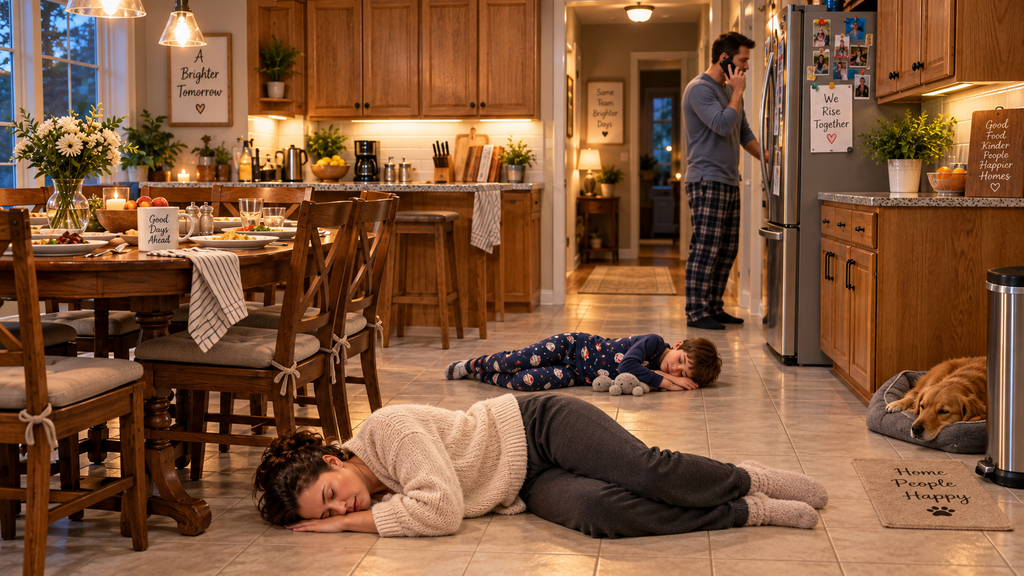
I had watched it turn pale when we signed the papers for our first house.
I had watched it soften when his mother died.
I had watched it become irritated, exhausted, distant, affectionate, apologetic, angry, loving.
But I had never seen the expression he wore now.
It wasn’t fear.
Not exactly.
It was calculation.
Daniel wasn’t looking at the police officers.
He was looking at the room.
At the windows.
At the doors.
At Noah.
At me.
As though somewhere inside his mind, he was still searching for a way to put everything back under his control.
“Sir,” the officer repeated, “why were their phones inside your toolbox?”
Daniel swallowed.
“I put them there.”
The officer waited.
Daniel gave a short, nervous laugh.
“My wife has been… unstable lately.”
Noah flinched beside me.
I felt his hand tighten around my sleeve.
Daniel saw it.
He immediately changed his tone.
“That’s not an insult,” he said quickly. “I’m concerned about her. She’s been paranoid. She’s been accusing me of things.”
“Like what?” the officer asked.
Daniel looked at me.
For half a second, his eyes hardened.
Then the softness returned.
“Affairs. Money. People following her. She hasn’t been sleeping.”
Every word came out smooth.
Practiced.
Reasonable.
He wasn’t shouting.
He wasn’t panicking.
That somehow made it worse.
One of the officers glanced toward me.
“Ma’am?”
“That’s not true.”
Daniel sighed.
“Claire.”
The way he said my name made my skin crawl.
It was the same exhausted tone he had used hundreds of times when we disagreed.
The same voice that implied I was being dramatic.
Irrational.
Difficult.
Except this time, there were police officers standing between us.
“I heard you on the phone,” I said.
Daniel rubbed both hands over his face.
“She heard half of a business conversation.”
“You said, ‘It’s done. Soon they’ll both be gone.'”
The officer near Daniel stopped writing.
Daniel stared at me.
“I never said that.”
“You did.”
“No.”
His answer came immediately.
Too immediately.
Noah spoke.
His voice shook.
“I heard it too.”
Daniel looked at our son.
Something passed across his face.
Pain.
Or maybe disappointment.
“Noah, buddy—”
“Don’t call me that.”
Daniel froze.
Noah stepped closer to me.
His face was pale.
He was sixteen years old, but standing there barefoot in our kitchen, wearing the gray T-shirt he had worn to dinner, he suddenly looked like the five-year-old who used to crawl into our bed during thunderstorms.
His father had frightened him.
And Noah was trying desperately not to show it.
“You took our phones,” Noah said.
Daniel stared at him.
“You took them because you didn’t want us calling anyone.”
“Noah—”
“And you knew we would pass out.”
“I didn’t know anything.”
“You checked Mom’s pulse.”
Daniel’s expression changed.
Only slightly.
But I saw it.
So did the officer beside him.
Noah continued.
“You checked mine too.”
Daniel shook his head slowly.
“Because I found both of you unconscious.”
“No.”
Noah’s voice became stronger.
“You said, ‘This will be easier for everybody.'”
The kitchen went silent.
Daniel looked at our son for a long time.
Then he said something that made me understand, finally, exactly how frightened he was.
“He’s confused.”
Not he’s lying.
Not that never happened.
He’s confused.
The officer closest to Daniel shifted his stance.
“Sir, I’m going to ask you to step away from the table.”
Daniel didn’t move.
“Why?”
“So we can secure the scene.”
“This is my house.”
“And right now we need you to step away from the table.”
Daniel’s jaw tightened.
Then he took two steps backward.
The officer nodded toward the food.
“Did you prepare dinner tonight?”
“Yes.”
“What did you make?”
“Pasta. Chicken. Vegetables.”
“Did you eat any?”
Daniel hesitated.
It was less than a second.
But everyone noticed.
“No.”
“Why not?”
“I wasn’t hungry.”
Noah stared at him.
Daniel looked away.
The officer continued.
“Did you prepare separate plates?”
“No. I served them.”
“You served your wife and son, but didn’t eat.”
“That’s not unusual.”
It was.
In seventeen years of marriage, Daniel had never cooked dinner and then refused to eat any of it.
Not once.
But before I could say that, my knees suddenly weakened.
The room tilted.
I grabbed the counter.
Noah reached for me.
“Mom?”
One of the officers caught my arm.
“Sit down.”
“I’m fine.”
“You collapsed after eating something. You’re not fine.”
My vision blurred at the edges.
Adrenaline had kept me standing longer than my body wanted to.
Now that police were inside the house, now that Daniel wasn’t controlling the room anymore, every ounce of strength seemed to drain out of me.
An ambulance arrived minutes later.
Paramedics came through the doorway carrying equipment.
One of them immediately knelt beside Noah.
Another guided me into a chair.
Daniel tried to approach.
An officer blocked him.
“Stay where you are.”
“That’s my wife.”
“Stay where you are.”
Daniel looked at me.
“Claire, tell them this is ridiculous.”
I couldn’t believe him.
Even then.
Even with our phones recovered from his hidden toolbox.
Even after Noah and I had both collapsed.
Even after I had heard him say we wouldn’t be a problem after tonight.
He still believed there was a version of reality where I might protect him.
I stared at the man I had shared a bed with for seventeen years.
And I wondered how many times he had relied on that.
How many lies had survived because he trusted my instinct to keep the peace.
My desire to preserve our marriage.
My habit of making excuses.
The paramedic wrapped a blood pressure cuff around my arm.
Daniel took another step.
“Claire.”
I looked directly at him.
“Don’t.”
One word.
That was all.
Something in my voice finally stopped him.
The police separated us.
Noah and I were taken to the hospital in the same ambulance.
As the doors closed, I saw Daniel standing in the kitchen behind two uniformed officers.
He wasn’t handcuffed.
Not yet.
He was simply standing there.
Watching us leave.
And somehow that frightened me more.
The emergency room lights were painfully bright.
Noah was put in a room next to mine.
I kept asking to see him.
The nurses kept assuring me he was stable.
I believed them.
Then I didn’t.
Then I did again.
Fear makes time behave strangely.
Five minutes feels like an hour.
An hour disappears in seconds.
Doctors took blood.
Asked questions.
Checked my heart.
Checked my pupils.
Asked what we had eaten.
Asked how much.
Asked whether we had taken any medications.
Asked whether there were chemicals in our home.
Asked whether Daniel had ever threatened us.
That question stopped me.
“No.”
The doctor looked up from his chart.
“Never?”
I opened my mouth.
And found that I didn’t know how to answer.
Had Daniel ever said, I’m going to hurt you?
No.
Had he ever raised a fist?
No.
Had he ever slammed me against a wall?
No.
But there were other things.
Little things.
Things I had filed away under marriage is hard.
He had started controlling the bank accounts two years earlier because, according to him, I was “bad with details.”
He had convinced me to stop working full-time after my mother became ill.
He had complained whenever I spent too much time with my sister.
He had changed the passwords on several shared accounts.
He had started opening my mail.
Six months earlier, I had discovered he had taken out a large insurance policy on me.
Daniel told me it was normal financial planning.
Three months after that, he increased it.
I hadn’t even known until I noticed a document on his desk.
When I asked him about it, he kissed my forehead and told me not to worry about boring paperwork.
Suddenly those memories didn’t feel small anymore.
The doctor repeated the question.
“Has your husband ever threatened you?”
“Not directly.”
“What does that mean?”
I looked toward the curtain separating my room from the hallway.
“It means I think I’ve been explaining away things I shouldn’t have.”
The doctor nodded slowly.
“Police will probably want to speak with you again.”
“They can.”
I took a breath.
“Can I see my son first?”
A nurse finally walked me to Noah’s room.
He was sitting upright in bed with an IV in his arm.
The second he saw me, his face crumpled.
I reached him before he could say anything.
He wrapped both arms around me.
For the first time that night, I cried.
Not quiet tears.
Not graceful tears.
I broke.
I buried my face against my son’s shoulder and shook so badly that the nurse quietly stepped outside.
“I’m sorry,” I whispered.
Noah pulled back.
“For what?”
“I didn’t know.”
His eyes filled.
“Mom.”
“I should have known something was wrong.”
“How?”
“I don’t know.”
I wiped my face.
“I keep thinking there must have been something.”
“There wasn’t.”
“There had to be.”
“No.”
He grabbed my hand.
“Mom, stop.”
His voice was stronger now.
“You heard him. You called the police. You saved us.”
I looked at my son.
He was sixteen.
He shouldn’t have needed to say that to me.
He shouldn’t have been lying in a hospital because his father had apparently done something to our dinner.
He shouldn’t have needed to tell his mother how to survive guilt.
“I was so scared,” he whispered.
That broke whatever remained of my composure.
“So was I.”
“Do you think he wanted us dead?”
I wanted to say no.
Every maternal instinct in me wanted to protect Noah from that sentence.
From the possibility.
From the reality.
But lying to him would have been another form of betrayal.
“I don’t know exactly what he wanted.”
Noah looked down.
“I heard what he said.”
“So did I.”
“He sounded normal.”
I understood immediately.
That was the part haunting him too.
Daniel hadn’t sounded angry.
There had been no rage.
No shouting.
He had sounded almost bored.
Like he was confirming a delivery.
“It’s done.”
Soon they would both be gone.
Noah squeezed my fingers.
“Who was he talking to?”
“I don’t know.”
That question would become everything.
A detective arrived shortly after midnight.
Her name was Detective Lena Ortiz.
She was in her forties, with tired eyes and a voice that never seemed to rise.
She spoke to Noah separately first.
Then she sat beside my hospital bed.
“I’m going to ask you some difficult questions.”
“Okay.”
“Is your husband having an affair?”
The question surprised me.
“I don’t know.”
“Do you suspect one?”
“I did about a year ago.”
“Why?”
“Messages.”
“What kind?”
“He started keeping his phone face down. Going outside to answer calls. There was one number that appeared constantly.”
“Do you remember it?”
“No.”
“Did you confront him?”
“Yes.”
“What did he say?”
“That it was a client.”
Ortiz wrote something down.
“Did you believe him?”
“I wanted to.”
Her pen stopped.
That sentence seemed to interest her.
“Tell me about your finances.”
I explained what I could.
Our house.
Savings.
Daniel’s construction consulting business.
My former job at a local architectural firm.
My mother’s small inheritance.
The life insurance.
Ortiz looked up.
“How much?”
I hesitated.
“Two million dollars.”
“When was the policy taken out?”
“About six months ago.”
“Beneficiary?”
“Daniel.”
“And your son’s?”
I stared at her.
“What?”
“Does Noah have a policy?”
“I don’t know.”
Ortiz didn’t react.
That frightened me.
“Why would you ask that?”
“It’s part of understanding the financial picture.”
“He’s sixteen.”
“Parents sometimes insure children.”
“Daniel handles the financial accounts.”
She wrote another note.
Then she asked, “Did your husband know you had access to that old landline?”
“No.”
“You’re sure?”
“He wanted it disconnected years ago. I kept it because my mother used to say every house should have one phone that worked when everything else failed.”
My throat tightened.
My mother had died eighteen months earlier.
Daniel used to tease her about that phone.
Old-fashioned Elaine.
Always preparing for disaster.
That outdated telephone had saved our lives.
Ortiz leaned back.
“Officers found your husband’s laptop in the den.”
I waited.
“He hasn’t been arrested at this point.”
My stomach dropped.
“Why not?”
“We’re still establishing exactly what happened.”
“He hid our phones.”
“Yes.”
“He knew we were unconscious.”
“Yes.”
“I heard him talking about us being gone.”
“I understand.”
“Then why isn’t he arrested?”
Her expression softened slightly.
“Because what you need right now is a case that survives more than tonight.”
That answer terrified me.
But I understood it.
“What happens next?”
“We test the food.”
“How long?”
“I can’t give you an exact timeline.”
I looked toward Noah’s room.
“Can Daniel come here?”
“Hospital security has been alerted.”
“That wasn’t my question.”
Ortiz paused.
“No court order currently prevents him from coming here.”
My heart pounded.
“But we’re taking precautions.”
I nodded.
Then she said something else.
“There’s another reason I’m here.”
I looked at her.
“One of the officers reviewing the property found a second phone.”
I stared.
“Where?”
“In your husband’s truck.”
“Maybe it’s for work.”
“Maybe.”
Her tone told me she didn’t believe that.
“What was on it?”
“We’re working on access.”
“Was that who he was talking to?”
“We don’t know yet.”
I closed my eyes.
My marriage had become evidence.
Every room in my house had become evidence.
Every unanswered question had become evidence.
Detective Ortiz stood.
“Mrs. Bennett?”
I opened my eyes.
“Yes?”
“If you remember anything unusual from the last few months, write it down. Don’t decide whether it’s important. Let us decide.”
After she left, I borrowed a pen from the nurse.
I began writing.
At first there were only five things.
Then ten.
Then twenty-three.
Daniel changing the garage code.
Daniel installing a lock on his office door.
Daniel asking whether my mother’s inheritance had fully transferred into my name.
Daniel becoming unusually interested in whether I had updated my will.
Daniel insisting we refinance the house.
Daniel asking Noah whether he wanted to spend the summer with his grandparents.
Daniel suddenly cooking more often.
Daniel replacing our security cameras.
Daniel becoming furious when I scheduled a physical without telling him.
Daniel telling me repeatedly that I looked exhausted.
Daniel mentioning twice that I had been “forgetful.”
Daniel telling my sister, jokingly, that I was becoming paranoid like my mother.
I stared at the page.
The list didn’t look like a marriage.
It looked like preparation.
At 3:17 in the morning, the doctor returned.
He closed the door behind him.
My stomach tightened.
“Your son’s okay.”
I exhaled.
“Thank God.”
“So are you.”
“What did we ingest?”
He chose his words carefully.
“Your symptoms are consistent with exposure to a sedating substance. The initial tests don’t give us every answer yet.”
“Would it have killed us?”
His hesitation answered before he did.
“The amount matters.”
“Would it?”
“It could have become very dangerous without intervention, especially depending on the dose, other medications, and how your bodies responded.”
I gripped the blanket.
“Daniel knew?”
“I can’t tell you what your husband knew.”
“But someone put it in the food.”
“That’s a law-enforcement question.”
I nodded.
Then the doctor sat down.
“There’s something else.”
My skin went cold.
“Noah?”
“No. This is about you.”
“What?”
“Your bloodwork suggests this may not have been your first recent exposure.”
I stared at him.
“I don’t understand.”
“Some findings suggest you’ve had repeated exposure to certain sedating compounds.”
The words didn’t make sense.
“Repeated?”
“We’ll need confirmation.”
“How repeated?”
He wouldn’t speculate.
But my mind already had.
The headaches.
The mornings when I couldn’t remember turning off the television.
The weeks of waking exhausted.
The afternoon I fell asleep in my car in the grocery store parking lot.
The night Daniel found me on the couch and joked that I was becoming a lightweight even though I hadn’t been drinking.
The night I stumbled on the stairs.
The time I forgot an entire conversation with Noah.
No.
Not forgot.
Maybe I had never been fully awake.
My hands started shaking.
“Call the detective.”
The doctor stood.
“Mrs. Bennett—”
“Please.”
Detective Ortiz returned twenty minutes later.
I told her everything.
This time, she didn’t take many notes.
She simply listened.
When I finished, she asked one question.
“Who prepares your morning coffee?”
I stopped breathing.
Daniel.
Almost every morning.
Daniel.
For fifteen years, I had made my own coffee.
Then, six months earlier, he suddenly started bringing it upstairs.
A peace offering, he’d called it.
A small thing husbands should do.
I pressed both hands over my mouth.
Ortiz stood immediately.
“I need to make some calls.”
“Wait.”
She turned.
“My husband knows where my sister lives.”
“We’ll contact her.”
“My father too.”
“We’ll contact him.”
“Daniel has keys to both houses.”
“We’ll tell them not to engage with him.”
My voice cracked.
“Detective.”
She stopped.
“I think he’s been doing this for months.”
Ortiz looked at me.
This time, there was no softness in her expression.
Only focus.
“We’re going to find out.”
By sunrise, Daniel was under arrest.
I found out when Detective Ortiz returned to the hospital at 6:40.
Noah was asleep in the chair beside my bed.
I hadn’t slept at all.
Ortiz closed the door.
“We arrested your husband.”
I stared at her.
“What changed?”
“We obtained additional evidence.”
“What evidence?”
“Some of it I can’t discuss yet.”
“Please.”
She hesitated.
Then sat down.
“The second phone was accessible.”
My heart started beating faster.
“There were messages.”
“With who?”
“A woman named Elise Warren.”
I didn’t recognize the name.
“Who is she?”
“We’re investigating that.”
“Was he having an affair?”
Ortiz watched my face.
“Yes.”
There it was.
One word.
Seventeen years.
Reduced to one word.
Yes.
I thought I would cry.
I didn’t.
Something colder moved through me.
“How long?”
“At least fourteen months based on the messages we’ve reviewed so far.”
Noah stirred.
I lowered my voice.
“Was she the person on the phone?”
“We believe so.”
“What did they say?”
Ortiz paused.
“I don’t think you should hear everything right now.”
“I heard my husband talk about getting rid of me and my son. I can hear this.”
She studied me.
Then nodded.
“Several conversations discuss you.”
“What about me?”
“Your health.”
I felt sick.
“Meaning?”
“Your husband told her you had been experiencing episodes of confusion and exhaustion.”
“He caused them.”
“That’s something we’re investigating.”
“What else?”
“Money.”
“The insurance?”
“Insurance. Property. Your mother’s inheritance.”
I looked away.
My mother had left me just over six hundred thousand dollars.
It came from the sale of the small apartment building she and my father had bought in the 1980s.
Daniel had always acted indifferent to it.
“It’s your mother’s gift to you,” he’d said.
Apparently not.
“What did he want to do with it?”
“Some messages suggest he was planning for a future where he controlled several assets currently held in your name.”
“And Noah?”
Ortiz hesitated.
That hesitation frightened me more than anything.
“Tell me.”
“Your husband believed Noah knew something.”
I looked at my sleeping son.
“What?”
“We don’t know.”
“But he targeted him.”
“We are still investigating.”
I reached over and touched Noah’s hair.
“Did Daniel take out insurance on him?”
Ortiz didn’t answer immediately.
Then:
“Yes.”
The room seemed to contract.
“How much?”
“Five hundred thousand dollars.”
I couldn’t speak.
“When?”
“Three months ago.”
“Who signed it?”
“Your husband handled the paperwork.”
“I never knew.”
“We know.”
Noah woke.
His eyes moved between us.
“What happened?”
I couldn’t say it.
Detective Ortiz did.
“Your father’s been arrested.”
Noah sat up completely.
“For what?”
“Right now, multiple charges related to last night’s incident. The investigation is ongoing.”
Noah looked at me.
I could see the question in his eyes.
I reached for his hand.
“He had a second phone.”
Noah understood immediately.
“The call.”
“Yes.”
“Who was he talking to?”
“A woman.”
Noah looked away.
For a long moment, he said nothing.
Then:
“I know.”
My heart stopped.
“What?”
Noah looked at Detective Ortiz.
“I think I know who she is.”
Three weeks earlier, Noah had come home early from soccer practice.
He hadn’t told me because practice being canceled wasn’t important.
Daniel was supposed to be at work.
Instead, Noah found his truck parked around the side of our house.
When Noah entered through the mudroom, he heard voices upstairs.
A woman.
Laughing.
He thought I was home.
Then he heard Daniel.
Noah crept up the stairs.
Our bedroom door was partly open.
Daniel was inside with a woman Noah didn’t recognize.
He didn’t see everything.
He didn’t need to.
He backed away before they noticed him.
He went outside.
Walked nearly two miles.
Sat at a park.
Then returned home after Daniel’s truck was gone.
“Why didn’t you tell me?”
My voice broke.
Noah stared at the floor.
“I was going to.”
“Why didn’t you?”
“Because I thought it would destroy everything.”
I started crying.
“Noah.”
“I kept thinking maybe I was wrong.”
“You weren’t.”
“I know.”
He wiped his eyes angrily.
“Then a week later, I saw her again.”
“Where?”
“Outside Dad’s office.”
Detective Ortiz leaned forward.
“What did she look like?”
Noah described her.
Blonde hair.
Maybe late thirties.
A tattoo near her wrist.
Black SUV.
Ortiz nodded slightly.
“That matches Elise Warren.”
I squeezed Noah’s hand.
“What happened after you saw her?”
“He saw me.”
“Daniel?”
Noah nodded.
“He came outside and asked what I was doing there.”
“Why were you?”
“I needed money for the team fundraiser. I thought I could stop by.”
“What did he say?”
“He acted normal.”
Noah rubbed his palms against his jeans.
“That night he came into my room.”
“What did he say?”
“He asked if I knew what happened when people interfered in adult problems.”
The room went silent.
“What?”
“I thought he meant the affair.”
“What exactly did he say?”
Noah closed his eyes.
“He said, ‘Sometimes people learn things they don’t understand, and then they create disasters by opening their mouths.'”
Detective Ortiz wrote it down.
“What else?”
“He asked if I loved you.”
My throat tightened.
“And?”
“I said of course.”
Noah’s lips trembled.
“He said if I loved you, I wouldn’t hurt you with things that didn’t matter.”
I covered my mouth.
My son had carried that alone.
For three weeks.
Living in the same house as the man who had threatened him into silence.
“Why didn’t you tell me any of this?”
He looked at me.
“Because Dad told me you weren’t doing well.”
The sentence landed like a blow.
“He said you were already unstable. That Grandma dying had messed you up. He said if I told you something upsetting, you might…”
Noah stopped.
“Might what?”
He began crying.
I had almost never seen Noah cry.
Even as a little boy, he hated crying in front of people.
He would hide his face.
He did it now.
He covered his eyes with one hand.
“He said you might hurt yourself.”
I couldn’t breathe.
“Oh, Noah.”
“I didn’t know what to do.”
I pulled him against me.
“I thought if I stayed quiet, maybe everything would be okay.”
I held him while he cried.
And as I did, another terrible realization came over me.
Daniel hadn’t only been drugging me.
He had been building a story.
A version of me.
Forgetful.
Emotionally unstable.
Exhausted.
Paranoid.
Grieving.
Unreliable.
Possibly suicidal.
A story other people might believe if one day I didn’t wake up.
And Noah?
Noah had become dangerous because he knew Daniel’s secret.
That was why dinner had changed.
That was why both plates had been prepared by Daniel.
That was why two phones disappeared.
That was why Daniel said they.
Both of them.
Gone.
The police searched our house for almost two days.
I wasn’t allowed home.
My sister Rachel picked us up from the hospital.
The second I saw her standing beside her car, I fell apart again.
Rachel didn’t ask questions.
She simply hugged Noah first.
Then me.
Then Noah again.
“We’re going to my place,” she said.
“No.”
She frowned.
“You are absolutely coming to my place.”
“Daniel knows where you live.”
“So do police officers.”
“I don’t want to bring this to your house.”
“Claire.”
“No.”
“Look at me.”
I did.
“I’m your sister.”
“I know.”
“You don’t get to decide you’re a burden today.”
That sounded exactly like our mother.
I started crying again.
Rachel opened the passenger door.
“Get in.”
Her husband Michael had changed the locks that morning.
Their security cameras were running.
Police had already spoken to them.
For the first three nights, I barely slept.
Every engine outside made me sit upright.
Every phone vibration made my heart pound.
Noah slept on the floor beside my bed the first night.
Neither of us acknowledged it.
Around 2:00 a.m., I looked down.
“Noah?”
“Yeah?”
“You awake?”
“Yeah.”
“Want to get in the bed?”
“I’m sixteen.”
“I know.”
There was a pause.
Then the mattress dipped.
He climbed onto the far side.
We lay there staring at the ceiling.
After several minutes, Noah whispered:
“Do you hate Dad?”
I swallowed.
“I don’t know what I feel.”
“I do.”
I turned toward him.
“Noah.”
“I hate him.”
“You have every right to be angry.”
“No.”
He looked at me.
“I hate him.”
His face was hard.
Scared.
Young.
I understood then that if I let hatred become the only language available to him, Daniel would keep hurting him even from jail.
I reached across the blanket.
“You can hate what he did.”
Noah said nothing.
“You can hate the lies. You can hate that he scared us. You can hate that he betrayed us.”
“I hate him.”
“Maybe you do.”
His eyes filled.
“But you don’t have to decide tonight what you feel forever.”
That sentence was partly for him.
Mostly for me.
Two weeks after the arrest, Detective Ortiz called.
“We identified more evidence.”
I was sitting at Rachel’s kitchen table.
Noah was at school for the first time since the incident.
“What kind?”
“Financial.”
My stomach tightened.
“Okay.”
“Can you come in?”
The police station smelled like burnt coffee and printer paper.
Ortiz met me downstairs.
She brought me into a conference room where a man in a gray suit was already waiting.
“This is Special Agent Marcus Bell. He’s with the financial crimes unit assisting us.”
That frightened me immediately.
Financial crimes?
Bell shook my hand.
“We’ve been reviewing transactions linked to your husband and Ms. Warren.”
“What did you find?”
He opened a folder.
“Your husband has significant debt.”
“How significant?”
“Approximately 1.3 million dollars.”
I laughed.
Not because anything was funny.
Because the number was absurd.
“That’s impossible.”
Bell didn’t react.
“I wish it were.”
“How?”
“Business losses. Private loans. Investments. Gambling appears to be part of it.”
“Gambling?”
“Online accounts and private betting activity.”
My husband hated casinos.
He used to complain when Rachel bought lottery tickets.
Apparently he had simply hated other people gambling.
“When did this start?”
“Several years ago.”
“And Elise?”
“Ms. Warren appears to have been financially involved with him.”
“Involved how?”
“We’re still determining the extent.”
Detective Ortiz slid another paper toward me.
It was a photocopy.
A transfer request.
My name appeared at the bottom.
My signature.
Except I hadn’t signed it.
“What is this?”
“A request to transfer funds from an investment account established with part of your mother’s inheritance.”
“I didn’t do this.”
“We know.”
My hands went cold.
“He forged my signature?”
“That appears likely.”
“How much?”
Bell answered.
“Two hundred fifty thousand dollars.”
I stared at him.
“Was it transferred?”
“No. The institution requested additional verification. The transaction failed.”
I remembered.
Three months earlier, Daniel had been furious for two days.
He told me a contractor had pulled out of a major deal.
Maybe that was the day the bank refused to give him my money.
“There’s more,” Ortiz said.
Of course there was.
There was always more.
“Your husband began searching for ways to gain control of several assets in the event of your incapacity.”
I stared.
“What does that mean?”
Bell spoke carefully.
“He looked into medical power of attorney, trust structures, beneficiary procedures, and asset transfers following death.”
I felt physically ill.
“How long?”
“Months.”
The room became blurry.
I thought about morning coffee.
I thought about headaches.
I thought about Daniel joking that I was forgetting things.
I thought about him telling Noah I was unstable.
“Did he plan all of this?”
Ortiz didn’t answer.
Bell did.
“We believe there was significant preparation.”
I looked at both of them.
“And Elise?”
Ortiz folded her hands.
“She was arrested yesterday.”
I wasn’t prepared for the relief that moved through me.
“Why?”
“Conspiracy charges.”
“She knew?”
“Messages indicate she knew enough to be criminally involved.”
“What did she say?”
“She’s asking for an attorney.”
“Was she the one Daniel called?”
“Yes.”
The answer landed differently now.
It wasn’t a theory anymore.
It was fact.
Daniel had called his mistress while his wife and child lay on the kitchen floor.
He had told her it was done.
I closed my eyes.
Then Ortiz said:
“Claire, there’s one other thing we need to discuss.”
I opened them.
“What?”
“The food you put in the freezer.”
My throat tightened.
“What about it?”
“The lab found evidence of a prescription sedative that wasn’t prescribed to either you or Noah.”
“Daniel?”
“Not prescribed to him either.”
“Elise?”
Ortiz didn’t answer immediately.
Bell closed his folder.
Then she said:
“Elise Warren worked for a medical supply distributor until last year.”
I understood.
“You think she got it.”
“We believe she may have had access to controlled inventory through someone in her network. We’re tracing that now.”
I stared at the table.
If I hadn’t saved that food…
If I had simply run…
If Daniel had thrown the plate into the sink…
If the police had arrived ten minutes later…
“So the food proves it?”
“It establishes what you and Noah were exposed to.”
“And Daniel?”
“His communications and other evidence are being connected.”
I looked up.
“Will he go to prison?”
Ortiz’s expression changed.
Not hopeful.
Not pessimistic.
Professional.
“That’s for prosecutors and ultimately the court.”
“But do you believe me?”
She paused.
Then she said:
“Yes.”
I cried.
Not because I had doubted what happened.
I remembered every second.
But after weeks of hearing Daniel describe me as unstable in messages to other people, after learning he had spent months creating a version of me that wasn’t real, one simple word mattered more than I expected.
Yes.
Someone believed me.
Then the case became public.
That was almost as difficult as surviving the night itself.
News vans appeared outside the courthouse.
Reporters called Rachel’s house.
People I hadn’t spoken to in years sent messages.
Some were kind.
Some were curious.
Some were cruel.
One woman Daniel worked with wrote:
There must be more to the story. Daniel adored his family.
I stared at that sentence for a long time.
Adored his family.
People always say that when they discover they never truly knew someone.
He seemed normal.
He loved his children.
He was always polite.
He worked hard.
He smiled.
He volunteered.
He brought his wife coffee.
They don’t understand that terrible people rarely spend every minute appearing terrible.
If they did, nobody would stay close enough to be hurt by them.
Daniel had loved us once.
Maybe some part of him still did.
That was the hardest truth to accept.
Love doesn’t always disappear before betrayal begins.
Sometimes people carry affection in one hand and selfishness in the other.
Then, little by little, they decide which hand matters more.
Three months after the arrest, Daniel asked to speak to me.
His attorney delivered the request.
I said no.
A week later, another request came.
No.
Then a letter arrived.
I almost threw it away unopened.
Instead, I put it in a drawer.
For eleven days.
On the twelfth night, Noah found me sitting at Rachel’s kitchen table staring at the envelope.
“You going to read it?”
“I don’t know.”
“You should.”
“Why?”
“So you stop wondering.”
He was right.
I opened it.
Daniel’s handwriting hadn’t changed.
That was somehow offensive.
The same slanted letters that had written birthday cards.
Grocery lists.
Anniversary notes.
Love you. Back by six.
Don’t forget milk.
Proud of you.
Now they filled four pages.
He began with an apology.
Not for trying to kill us.
For “everything that happened.”
That phrase immediately made me angry.
Things didn’t simply happen.
Rain happens.
Accidents happen.
He made choices.
He wrote that business pressures had destroyed his judgment.
He wrote that Elise had manipulated him.
He wrote that he never intended for Noah to be involved.
Then why was Noah’s food drugged?
He wrote that he only wanted “time.”
Time for what?
Time with me unconscious?
Time to access accounts?
Time to stage something worse?
He never explained.
Then came the sentence that ended any remaining part of our marriage.
You need to understand that I was desperate, Claire. I felt like I had no way out.
I read it three times.
No way out.
We had a front door.
A divorce attorney.
Bankruptcy.
A confession.
A smaller house.
A ruined credit score.
Public embarrassment.
Prison for financial fraud.
A thousand terrible choices.
He had ways out.
He simply didn’t like the price of those exits.
So he tried to make Noah and me pay instead.
I folded the letter.
Noah watched me.
“What did he say?”
“Nothing that matters.”
I walked to the fireplace.
Rachel looked up from the couch.
“Claire?”
I held the pages over the flames.
For a moment, I hesitated.
Then I dropped them.
The corner caught.
Daniel’s handwriting curled black.
Noah stood beside me.
Neither of us spoke until the last piece disappeared.
The prosecution offered Elise a deal.
She accepted.
That changed everything.
According to what prosecutors later explained, Elise admitted that Daniel had talked for months about needing money.
At first, he talked about divorce.
Then he complained divorce would expose the debt.
He feared I would discover forged documents.
He feared business partners would discover missing funds.
He feared losing the house.
His reputation.
His company.
Everything.
Then my mother’s inheritance arrived.
Daniel became obsessed with it.
Elise told investigators he began talking about a future where “Claire wasn’t around.”
At first, she claimed she thought he meant divorce.
Then the conversations became darker.
He started asking questions about insurance.
About what happened to assets if spouses died.
About whether certain medications could make someone appear confused or intoxicated.
The prosecutors never told me every detail.
I didn’t want every detail.
I didn’t need to know exactly how the monster was assembled.
Only that Daniel had built it one decision at a time.
Elise admitted she helped him obtain pills.
She claimed he told her he was using them personally.
Later she realized that wasn’t true.
Still later, according to her statement, she understood exactly what he intended.
And stayed.
That part was important.
She had opportunities to stop.
To call someone.
To warn me.
She didn’t.
According to Elise, the original plan did not include Noah.
Noah became part of it only after Daniel realized he’d seen them together.
That knowledge nearly destroyed me.
My child had been targeted because he came home from soccer early.
Because he saw something.
Because his father believed protecting an affair mattered more than protecting his son.
But there was an even darker detail.
Daniel had been telling friends and business associates for months that I was having emotional problems.
People later remembered comments.
“Claire’s having a hard time.”
“She hasn’t been herself.”
“Her memory’s getting bad.”
“She’s struggling since her mom died.”
At a neighborhood barbecue, Daniel had apparently joked that he sometimes worried I would “accidentally take the wrong medication one day.”
I wasn’t there when he said it.
Nobody thought anything of it.
Why would they?
Husbands complain.
People joke.
Life moves on.
But once investigators put everything together, the pattern became impossible to ignore.
He wasn’t just preparing to hurt me.
He was preparing everyone else to explain my death for him.
The trial began fourteen months later.
By then, I had divorced Daniel.
Technically, the divorce became final six weeks before opening arguments.
I expected some strange sense of freedom when the judge signed the papers.
Instead, I felt tired.
The marriage had ended the night on the kitchen floor.
The paperwork simply caught up.
Noah and I had moved into a smaller house across town.
Not because we had to.
Because neither of us could go back.
I sold the old house after the investigation released it.
The kitchen had been cleaned.
The floor replaced.
The walls repainted.
It didn’t matter.
When I walked in, I still saw Noah lying beside the chair.
I still heard Daniel saying:
This will be easier for everybody.
A young couple bought the house.
They had a toddler.
The mother was pregnant.
At closing, she told me she loved the kitchen.
I smiled.
“I hope you make good memories there.”
I meant it.
Houses shouldn’t be sentenced for what people do inside them.
The first day of trial, Daniel entered wearing a dark suit.
For one dangerous second, he looked like my husband again.
Then he turned.
Our eyes met.
The illusion disappeared.
He had aged.
His hair was grayer.
His face thinner.
But his eyes were the same.
He looked at me as though I had betrayed him by surviving.
I sat beside Rachel.
Noah was not in the courtroom that day.
He would testify later.
Daniel’s attorney presented a different story.
There had been no murder plot.
No deliberate attempt to kill anyone.
Daniel had been under enormous pressure.
He had obtained sedatives illegally, yes.
He had put them in my food, yes.
But according to the defense, the intention had been to make me sleep while Daniel removed financial documents from the house.
Noah’s exposure?
An accident.
He wasn’t supposed to eat that plate.
The phone conversation?
Misinterpreted.
“They’ll both be gone” allegedly referred to me and Noah leaving the house for a planned weekend trip.
The hidden phones?
Daniel had panicked when we collapsed.
Every explanation technically had words.
None had sense.
The prosecutors presented the timeline.
The insurance policies.
The forged financial documents.
The second phone.
Messages to Elise.
Search histories.
Drug purchases.
Witness testimony.
My medical records.
Noah’s testimony.
Then mine.
Walking to the witness stand felt like crossing an ocean.
I swore to tell the truth.
Then I told them about dinner.
The chicken.
The pasta.
Daniel carrying the plates.
Noah making a joke about how Dad cooking meant we should check the smoke alarms.
The three of us laughing.
That detail hurt the most.
We laughed.
Less than an hour before I realized my husband might be trying to kill us, we laughed together.
The prosecutor asked what happened after I ate.
“I became dizzy.”
“What did you think?”
“At first I thought I stood up too quickly.”
“What happened to Noah?”
“He dropped his fork.”
I remembered it clearly.
The metal striking the plate.
His confused face.
“Mom?”
Then his chair scraping backward.
Then the floor.
I explained that I collapsed moments later.
“What happened next?”
“I heard my husband make a phone call.”
“What did he say?”
My eyes moved toward Daniel.
He stared straight ahead.
“He said, ‘It’s done.'”
The courtroom was silent.
“What else?”
“He said, ‘Soon they’ll both be gone.'”
“And later?”
“He said, ‘They won’t be a problem after tonight.'”
Daniel finally looked at me.
I didn’t look away.
The prosecutor asked:
“Why didn’t you immediately get up?”
“Because I was afraid.”
“Of whom?”
“My husband.”
Those two words broke something inside me.
But they also released something.
For months, I had avoided saying them.
My husband.
The person I feared was my husband.
The person police arrested was my husband.
The person prosecutors accused was my husband.
Not a stranger.
Not a masked attacker.
The man whose hand I had held when Noah was born.
The man who knew exactly how I took my coffee.
The man who had stood beside me at my mother’s funeral.
The prosecutor showed the jury a photograph of the sealed freezer bag.
“Why did you preserve the food?”
“I didn’t know whether police would believe me.”
That answer surprised even me.
But it was true.
Some part of me had already understood how Daniel would fight.
He would call me unstable.
Confused.
Emotional.
So I saved proof.
“Why the freezer?”
“It was the first thing I thought of.”
“Why hide it under your clothes?”
“Because I heard Daniel coming back.”
“What did you think he might do if he found it?”
“Destroy it.”
“Why?”
“Because he had already taken our phones.”
The prosecutor nodded.
Then asked the question everyone had been waiting for.
“Mrs. Bennett, when you called 911, did you know whether you and your son would survive?”
My voice broke.
“No.”
I looked toward Noah sitting behind the prosecutor.
“I just knew I needed someone to know where we were.”
Daniel’s attorney cross-examined me for nearly four hours.
He asked about my grief after my mother’s death.
My sleep problems.
My memory.
My marriage.
Arguments.
Medication.
Alcohol.
Stress.
At first, I became angry.
Then I understood what he was doing.
He was continuing Daniel’s story.
Claire was unstable.
Claire misunderstood.
Claire was emotional.
Claire couldn’t remember.
Claire imagined things.
Finally, the attorney asked:
“Mrs. Bennett, isn’t it true that during the months before this incident you repeatedly complained about confusion?”
“Yes.”
“Memory issues?”
“Yes.”
“Fatigue?”
“Yes.”
“And headaches?”
“Yes.”
He looked toward the jury.
“So your ability to accurately interpret events may have been compromised.”
I looked at him.
Then at Daniel.
Then back at the attorney.
“My symptoms were real.”
He nodded quickly.
“Exactly.”
“Because somebody was drugging me.”
The prosecutor objected.
The judge gave an instruction.
But the words were already in the courtroom.
Daniel looked down.
For the first time all day, I smiled.
Not because I enjoyed any of this.
Because he had spent months trying to turn my symptoms into evidence against me.
Now they were evidence against him.
Noah testified two days later.
I had dreaded it more than my own testimony.
He was seventeen by then.
Taller.
Stronger.
Different.
Trauma changes children in ways no parent wants to see.
But healing changes them too.
He walked to the witness stand in a navy suit he had picked out himself.
Daniel watched him.
Noah never looked at his father.
The prosecutor asked about the affair.
The conversation in his bedroom.
Dinner.
The collapse.
Pretending to remain unconscious.
Then:
“What did you hear your father say while you were on the floor?”
Noah swallowed.
“He touched my shoulder.”
“And?”
“He said, ‘This will be easier for everybody.'”
“What did you understand that to mean?”
Daniel’s attorney objected.
The judge sustained it.
The prosecutor changed direction.
“How did you feel when he said it?”
Noah looked toward me.
“Like my dad had disappeared.”
The entire room went still.
The prosecutor didn’t ask another question for several seconds.
Noah continued without being prompted.
“I know he was physically there. But the person I thought he was… that person was gone.”
Daniel lowered his head.
That was the only moment during the entire trial when I saw him cry.
One tear.
Maybe two.
I felt nothing.
Then I felt guilty for feeling nothing.
Then I remembered the kitchen floor.
And I stopped feeling guilty.
The verdict came after eleven hours of deliberation.
Rachel held my left hand.
Noah held my right.
The foreperson stood.
The first guilty made my heart stop.
Then another.
Then another.
Conspiracy.
Attempted murder.
Aggravated assault.
Evidence tampering.
Financial fraud.
Forgery.
There were more.
I lost count.
Daniel stood perfectly still.
When the judge ordered him remanded, he finally turned toward us.
“Claire.”
A deputy touched his arm.
Daniel resisted just enough to look back again.
“Claire, please.”
I didn’t answer.
He looked at Noah.
“Noah.”
My son stared at the floor.
Daniel was led away.
The courtroom doors closed behind him.
And just like that, the man who had dominated every thought in my life for more than a year was gone.
I expected triumph.
Instead, I felt emptiness.
Rachel hugged me.
People whispered.
Reporters waited outside.
The prosecutor shook my hand.
Detective Ortiz hugged Noah.
I stood in the middle of all of it and thought:
I survived.
That should have felt bigger.
Maybe survival doesn’t always feel like fireworks.
Sometimes it just feels like finally being allowed to sit down.
At sentencing, Daniel was allowed to speak.
I almost didn’t attend.
Noah chose not to.
“I already heard enough from him,” he said.
I respected that.
I went because I needed to hear the final door close.
Daniel stood before the judge.
He apologized.
This time, he used clearer words.
He said he had betrayed his family.
He said fear and greed had consumed him.
He said he deserved punishment.
Then he looked directly at me.
“I loved you.”
I closed my eyes.
Past tense.
Loved.
Maybe he believed it.
Maybe he still did.
That didn’t change anything.
“I don’t expect Claire to forgive me,” he continued. “But I want her to know that I think every day about the life I destroyed.”
That sentence almost made me angry.
The life he destroyed.
Singular.
His.
But he had damaged many lives.
Mine.
Noah’s.
Rachel’s.
His own parents.
Friends.
Employees.
Even people who trusted his business.
Destruction spreads.
So does survival.
When it was my turn to speak, I walked to the front of the courtroom carrying one sheet of paper.
I had written six pages.
Then thrown them away.
There were things Daniel didn’t deserve to hear.
He didn’t deserve every sleepless night.
Every panic attack.
Every time Noah asked if the doors were locked.
Every time coffee made my stomach turn because I remembered him carrying a mug upstairs.
Every time I woke confused and wondered if someone had put something in my drink.
Those details belonged to me now.
Not him.
I looked at the judge.
Then at Daniel.
“You told our son, ‘This will be easier for everybody.'”
Daniel closed his eyes.
“It wasn’t easier.”
My voice stayed steady.
“It wasn’t easier when Noah stopped sleeping.
“It wasn’t easier when he blamed himself for seeing your affair.
“It wasn’t easier when I had to explain to him that his own father had insured his life.
“It wasn’t easier when we left our home because neither of us could stand to walk into the kitchen.
“It wasn’t easier when I learned you’d spent months telling people I was unstable so that, if something happened to me, you would already have an explanation.
“It wasn’t easier when our son testified against you.
“And it wasn’t easier when I realized that the person I trusted most had been slowly teaching me not to trust myself.”
Daniel was crying.
I didn’t stop.
“But there is something you got wrong.”
I folded the paper.
“You thought removing us would solve your problems.”
I looked directly at him.
“Instead, we survived long enough to tell the truth.”
Then I returned to my seat.
The judge sentenced Daniel to decades in prison.
Long enough that Noah would be older than Daniel was now before he could realistically expect freedom.
I didn’t celebrate.
I walked outside.
The sunlight hurt my eyes.
Rachel was waiting beside the courthouse steps.
Noah was waiting in the car.
I climbed inside.
He looked at me.
“It’s over?”
I thought about the question.
The legal case?
Almost.
The fear?
Not completely.
The memories?
Never.
But Daniel could no longer reach us.
And that mattered.
“Yes,” I said.
“It’s over.”
Noah leaned across the console and hugged me.
And for the first time, I believed it.
Two years later, Noah graduated from high school.
He almost didn’t attend the ceremony.
Crowds still made him nervous.
Unexpected noises sometimes froze him.
He hated being seated where he couldn’t see the exits.
But he had worked with a therapist.
So had I.
Healing became less dramatic than survival.
It was appointments.
Breathing exercises.
Locked doors.
Unlocked doors.
Sleeping through one whole night.
Then two.
Eating at restaurants again.
Letting someone else prepare food.
Drinking coffee without staring at the cup.
Small victories.
At graduation, I sat beside Rachel and Michael.
When Noah’s name was called, he walked across the stage.
For one second, he looked toward us.
I stood.
So did Rachel.
So did Michael.
We screamed embarrassingly loudly.
Noah shook his head and laughed.
Afterward, he found us outside.
“You guys are insane.”
Rachel hugged him.
“You’re welcome.”
He looked at me.
“Mom?”
“Yeah?”
“I got something for you.”
“It’s your graduation.”
“I know.”
He reached inside his gown and pulled out a small box.
Inside was an old-fashioned corded telephone.
Tiny.
Plastic.
A miniature model.
I stared at it.
He grinned.
“For your desk.”
I started laughing.
Then crying.
Then both.
“You’re terrible.”
“That phone saved us.”
“It did.”
He became serious.
“Grandma saved us.”
I thought about my mother.
Her stubborn insistence that some old things still had value.
Her refusal to let me disconnect that line.
Every house should have one phone that works when everything else fails.
I wrapped my arms around Noah.
“Yeah.”
My voice cracked.
“She did.”
Years passed.
Slowly, Daniel stopped being the first thing people knew about us.
That mattered more than I can explain.
For a long time, whenever I met someone new, I could see the recognition.
Claire Bennett.
That woman.
The dinner.
The husband.
The trial.
The news story.
Then eventually, fewer people recognized the name.
Life grew around the wound.
Noah went to college.
Studied engineering.
Changed majors twice.
Fell in love once.
Got his heart broken.
Fell in love again.
Normal pain.
I was almost grateful for normal pain.
He called me one night after his first breakup.
“I feel like I’m dying.”
I laughed.
“You’re not.”
“How do you know?”
“Experience.”
“That’s dark, Mom.”
“I’ve earned dark humor.”
He laughed.
And hearing him laugh over the phone felt like a miracle.
I eventually returned to architecture.
At first only part-time.
Then full-time.
I had spent years letting Daniel convince me that I wasn’t good with details.
That statement became absurd once I returned to work.
Details were what I had always been good at.
Lines.
Measurements.
Load-bearing walls.
Structures.
You learn something interesting in architecture.
When a building cracks, you don’t always tear the entire thing down.
First you identify why it cracked.
Then you remove what failed.
Strengthen what remains.
Add support.
Sometimes the repaired structure becomes stronger than the original because now you understand exactly where it was vulnerable.
People are like that too.
I rarely thought about Elise.
She served a shorter sentence because of her cooperation.
Years later, a letter from her arrived.
I almost didn’t open it.
But curiosity won.
Her apology was different from Daniel’s.
Maybe because she didn’t ask me to understand.
She didn’t blame fear.
Or money.
Or him.
She simply wrote:
I knew enough to stop it before that night, and I didn’t.
Then:
I will live with that.
I believed her.
I didn’t forgive her.
But I believed her.
Those are not the same thing.
I never answered.
Daniel sent letters for years.
At first, I returned them unopened.
Then I asked the prison to stop forwarding correspondence.
Eventually, the letters stopped.
Noah received some too.
He never told me what they said.
I never asked.
That relationship belonged to him.
When he was twenty-three, he visited Daniel once.
I only found out afterward.
Noah came to my house carrying takeout Thai food.
We ate at the kitchen island.
Halfway through dinner, he said:
“I saw Dad.”
My fork stopped.
“When?”
“Yesterday.”
I forced myself not to overreact.
“How was it?”
“Strange.”
“Do you want to talk about it?”
“Not really.”
“Okay.”
He ate another bite.
Then:
“He looks old.”
I nodded.
“People age.”
“Not like that.”
I didn’t know what to say.
Noah pushed rice around his container.
“He said he’s sorry.”
“What did you say?”
“That being sorry doesn’t change what happened.”
“That’s true.”
“He asked if I forgive him.”
My heart tightened.
“And?”
“I told him I don’t know.”
I reached across the island.
“You don’t owe anyone a particular answer.”
“I know.”
“He doesn’t get to define what healing looks like for you.”
“I know.”
Noah smiled slightly.
“Therapy made you annoyingly wise.”
“Therapy made me expensive.”
He laughed.
Then became serious.
“He cried when I left.”
I squeezed his hand.
“How did that make you feel?”
Noah looked toward the window.
“Sad.”
“For him?”
“For everything.”
I understood.
That was perhaps the most accurate description of our entire story.
Not hatred.
Not revenge.
Sadness for everything.
For the family we had.
For the father Noah lost while Daniel was still alive.
For the husband I thought existed.
For every moment that had once been real before greed and fear poisoned what came after.
The strangest part of surviving something terrible is that ordinary life eventually returns.
Laundry.
Taxes.
Birthdays.
Dentist appointments.
Grocery shopping.
You think trauma will transform every second forever.
It doesn’t.
One day you realize you have gone an entire morning without thinking about it.
Then an entire day.
Then several.
At first, that feels like betrayal.
Then it feels like freedom.
On my fiftieth birthday, Noah invited me to dinner.
He was twenty-five then.
He wouldn’t tell me where we were going.
I became suspicious when he drove nearly forty minutes outside the city.
“Noah.”
“Relax.”
“I raised you. I know when you’re hiding something.”
“You’re going to like this.”
“If we arrive at a murder-mystery dinner theater, I’m leaving.”
He laughed.
“No murder.”
“Good.”
We turned onto a narrow road.
At the end stood a small farmhouse surrounded by maple trees.
Lights glowed on the porch.
Rachel’s car was parked beside the barn.
So was Michael’s.
“What is this?”
Noah parked.
“Come inside.”
I followed him.
Rachel opened the door before we reached it.
“Surprise.”
The house was filled with people I loved.
Coworkers.
Friends.
Family.
There was music.
Food.
A ridiculous cake with fifty candles.
I stood in the doorway.
Then noticed something on a side table.
An old beige telephone.
Corded.
I turned slowly toward Noah.
He was trying not to laugh.
“You didn’t.”
Rachel pointed at him.
“His idea.”
I picked up the receiver.
There was no dial tone.
Just a recording.
My mother’s voice.
I froze.
Noah’s smile disappeared.
The room fell silent.
My mother had recorded the message years earlier on Rachel’s old answering machine.
Her voice filled the room.
“Claire, honey, it’s Mom. You never answer your phone. I’m assuming you’re busy building something beautiful again…”
My hand flew to my mouth.
I had forgotten that recording existed.
Mom kept talking.
Complaining gently.
Telling me to call.
Reminding me she loved me.
Then the message ended.
For several seconds, I couldn’t move.
Noah stepped closer.
“Happy birthday.”
I hugged him so tightly he laughed.
“Mom, ribs.”
“Too bad.”
Rachel joined.
Then Michael.
Soon half the room was hugging us.
It was messy.
Loud.
Beautiful.
Exactly the opposite of that silent kitchen floor.
Later that evening, I stood alone on the porch.
Noah came outside carrying two pieces of cake.
He handed me one.
“You okay?”
“Yeah.”
He leaned against the railing.
“Thinking about Grandma?”
“Partly.”
We watched fireflies blink across the grass.
After a while, Noah said:
“You know what I think about sometimes?”
“What?”
“That night.”
My body still reacted to the words.
Even after all those years.
“What about it?”
“How close we came.”
I nodded.
“Me too.”
“If you hadn’t heard Dad…”
“I did.”
“If you hadn’t remembered the phone…”
“I did.”
“If you hadn’t saved the food…”
“I did.”
“If police had taken longer…”
“But they didn’t.”
He looked at me.
“I know.”
I touched his shoulder.
“We can spend the rest of our lives measuring every inch between what happened and what almost happened.”
He listened.
“But almost isn’t where we live.”
Noah smiled faintly.
“Where do we live?”
I looked through the window.
At Rachel dancing badly.
At Michael trying to light candles outside because someone had complained about the smoke alarm.
At people laughing.
At the ridiculous beige telephone on the table.
“Here.”
Noah followed my gaze.
Then nodded.
“Here.”
Sometimes people ask whether I ever understood why Daniel did it.
The answer is complicated.
I understood the facts.
Debt.
Greed.
Fear.
The affair.
Insurance.
Money.
Exposure.
Shame.
But understanding the sequence is not the same as understanding the soul.
There is no mathematical formula that explains the moment a person decides another human life is worth less than the problem standing in front of them.
Daniel could have told me the truth.
He could have said:
Claire, I’ve ruined us financially.
Claire, I’m having an affair.
Claire, I’ve stolen money.
Claire, I’m terrified.
I would have hated him.
I would have divorced him.
He might have lost his business.
His home.
His reputation.
But Noah would still have had a father he could someday understand.
Instead Daniel chose secrecy.
Then manipulation.
Then intimidation.
Then poison.
Then the kitchen floor.
Every step made the next one easier.
Maybe that’s the lesson I carry most.
People rarely arrive at terrible decisions in one dramatic leap.
Sometimes they get there through a thousand smaller permissions.
One lie allowed.
One betrayal justified.
One person blamed.
One line crossed.
Then another.
Until eventually they stand over someone who trusted them and convince themselves there was never another choice.
There is always another choice.
I kept the little plastic telephone Noah gave me.
It sits on my desk.
People ask about it occasionally.
I never tell strangers the whole story.
I simply say:
“It reminds me to keep a backup plan.”
That’s true.
But it reminds me of something else too.
That survival often depends on the smallest details.
A forgotten landline.
A freezer bag.
A child pretending not to move.
A mother refusing to panic.
A police dispatcher who believed a whispered voice.
A doctor who looked at bloodwork twice.
A detective who asked the right question.
A sister who changed her locks before sunrise.
A son who survived something no child should ever face.
None of those things felt heroic in the moment.
They were simply choices.
Move.
Stay still.
Listen.
Call.
Save the food.
Tell the truth.
One choice.
Then another.
Maybe survival works that way too.
There is one moment I remember more clearly than everything else.
Not the trial.
Not the verdict.
Not the ambulance.
Not even hearing Daniel say that we would both be gone.
I remember lying on the kitchen floor and opening my eyes.
Noah’s eyes were already open.
We looked at each other.
Neither of us knew whether Daniel was still inside the house.
Neither of us knew what was in our bodies.
Neither of us knew whether we would be able to stand.
I lifted one finger to my lips.
Noah nodded.
And for a few seconds, we simply breathed.
Together.
Alive.
Everything that happened afterward began in that moment.
Not because we knew what to do.
We didn’t.
Not because we weren’t afraid.
We were terrified.
But fear and helplessness are not the same thing.
Daniel thought unconscious meant powerless.
He thought silence meant surrender.
He thought because he controlled the food, the phones, the money, and the story, he controlled what happened next.
He was wrong.
Because while he was making his phone call, telling someone it was done, his wife was listening.
His son was listening.
And the family he had already written off was still breathing.
That was the mistake Daniel never recovered from.
He thought the story ended when we hit the floor.
It didn’t.
That was where ours began again.
And this time, he didn’t get to write the ending.