 Reading Time: 10 minutes
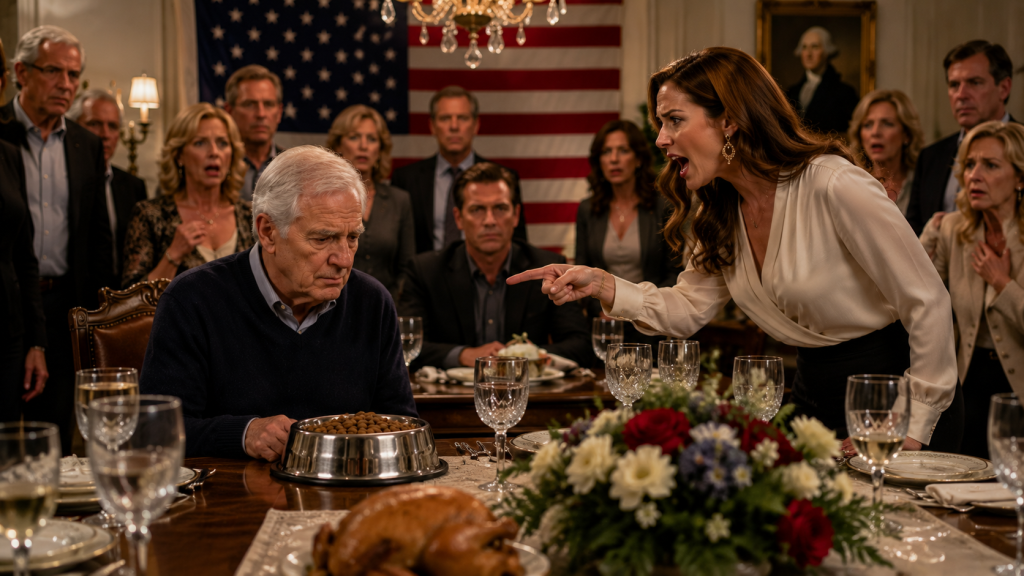
My daughter-in-law placed a dog bowl in front of me at my own seventieth birthday dinner. Then she looked around my dining room with fake pity and whispered, “Oh, Arthur… you forgot again, didn’t you?” The room went quiet. Not horrified quiet. Curious quiet.
The kind of quiet people fall into when they want to know whether the humiliation is part of the entertainment. I stared at the bowl. It was Buster’s old bowl. Buster had been my Labrador. He had died six years ago.
I had kept the bowl in the garage because I couldn’t bring myself to throw it away.
Now it sat in front of me on my own dining table, filled with dry dog food.
On my birthday.
In my house.
My name is Arthur Pendelton.
I am seventy years old.
I am not senile.
I am not confused.
And I had not forgotten anything.
But for one cold second, I understood exactly what Jessica wanted everyone in that room to believe.
My daughter-in-law placed one hand dramatically over her chest.
“It’s getting worse, you guys,” she murmured. “We just don’t know what to do anymore.”
My son David said nothing.
He sat at the head of my dining table.
My chair.
He stared down at his plate as if the roasted chicken in front of him required deep study.
That silence hurt more than Jessica’s cruelty.
David was my only child.
After my wife Eleanor died nine years earlier, he was all I had left.
Maybe that was where I went wrong.
Maybe grief made me generous past the point of wisdom.
David had always been restless.
At thirty-six, he still had no stable job, no finished degree, no patience for slow progress, and no ability to turn grand ideas into actual work.
Four years earlier, he asked to move in “just for a short time.”
I said yes.
Because he was my son.
A short time became months.
Months became years.
Then Jessica moved in with designer handbags, false lashes, expensive perfume, and the confidence of someone already spending money she had never earned.
Neither paid rent.
Neither contributed to the bills.
Neither helped with repairs.
But they enjoyed the house.
The fireplace.
The wine cellar.
The guest rooms.
The garden Eleanor had planted.
And I let them.
Because David was my son.
Because Eleanor had always believed there was a good man inside him.
Because some part of me kept waiting for that man to arrive.
That Saturday morning, I woke early and cooked my own birthday dinner.
Yes, my own birthday dinner.
Roasted chicken.
Rice.
Salad.
Potatoes.
And a lemon ricotta cake from the bakery Eleanor used to love.
I thought it would be quiet.
Just David, Jessica, maybe a few relatives.
Maybe David would sit beside me.
Maybe he would remember his mother.
Maybe he would remember that I was still a person, not just the owner of a house he wanted someday.
Instead, I fell asleep upstairs after taking my blood pressure medication.
When I woke, laughter floated up from below.
I came downstairs and froze in the doorway.
More than twenty people crowded my dining room.
Relatives.
Neighbors.
David’s friends.
Jessica’s friends.
And one stranger in a severe gray suit sitting near the sideboard, taking mental notes.
They were eating the food I had purchased.
The meal I had prepared.
And not one person had called me.
I made myself smile.
“You started without me?”
Silence settled over the room.
David looked up from the head of the table.
“Oh, Dad,” he chuckled, “we thought you were out cold. You’re so quiet these days, you’re basically a ghost anyway.”
A few people laughed.
Jessica was sitting in Eleanor’s chair.
That alone made something inside me tighten.
Then she stood, disappeared into the kitchen, and returned holding the dog bowl.
The performance began.
“Here you go, Arthur,” she said sweetly, setting it before me. “Don’t you remember? You poured this yourself earlier. You forgot again, didn’t you?”
I looked around the room.
At my cousin shifting uncomfortably.
At my neighbor June lowering her eyes.
At David avoiding my face.
Then at the stranger in the gray suit, who was watching me carefully.
And that was when the humiliation became something colder.
This was not a joke.
This was staging.
Evidence.
A public demonstration.
They were trying to make me look mentally incompetent in front of witnesses.
Jessica sighed loudly.
“We’ve been so worried about him. He gets confused. He wanders. He signs things and forgets.”
Signs things.
There it was.
My blood went cold.
I had spent forty years as a forensic accountant.
I had followed money through shell companies, divorce fraud, estate theft, nonprofit embezzlement, and corporate lies dressed up as bookkeeping errors.
I knew the smell of a setup.
And this room reeked of one.
I did not yell.
I did not throw the bowl.
I did not give them the outburst they wanted.
I simply looked at Jessica.
Then at David.
Then at the stranger in the gray suit.
“I’m tired,” I said quietly.
Jessica’s face softened with fake concern.
“Of course you are, Arthur. Why don’t you go rest?”
So I did.
I turned and walked upstairs.
Behind me, laughter slowly returned.
That was their second mistake.
Their first mistake was underestimating me.
Their second was laughing before checking whether the old man still knew how to work.
I locked my bedroom door.
Opened my laptop.
And logged into my master financial dashboard.
Most people my age keep bank statements in folders.
I kept encrypted dashboards, asset maps, credit locks, account alerts, property monitoring, and digital records of every major financial instrument tied to my name.
Retirement had not erased my habits.
It had simply given them better passwords.
Within minutes, I saw it.
A red notification.
Pending secured home equity loan: $620,000.
Scheduled closing: Monday, 9:00 a.m.
Electronic signature attached.
My heart slowed.
Not from calm.
From shock so deep it became precision.
Beneath the loan alert was a second warning.
Power of attorney package uploaded for capacity review.
New document set.
Witness statements pending.
Psychological observation summary attached.
My hands hovered over the keyboard.
There it was.
The dog bowl.
The gray-suited stranger.
The birthday ambush.
They were not only trying to humiliate me.
They were building a paper trail to declare me incompetent, seize legal control, and drain the equity from the house before I could stop it.
The house Eleanor and I had bought when we were young.
The house where she planted roses.
The house she died in.
The house David had decided was already his.
For one moment, grief tried to take me.
Then the old part of me woke up.
Arthur Pendelton, forensic accountant.
Certified fraud examiner.
Retired, not dead.
I copied every document.
Downloaded every timestamp.
Captured metadata.
Saved the digital signature file.
Traced login histories.
Pulled IP addresses.
Compared them to the Wi-Fi access logs from my home router.
Every unauthorized upload came from inside my house.
David’s laptop.
Jessica’s tablet.
Then I found the email thread they thought they had deleted.
Jessica to David:
Once Arthur is ruled unfit, the house is ours before he understands what happened.
David replied:
We just need the evaluator to say the decline is obvious. The birthday dinner will give us witnesses.
Evaluator.
I opened the attachment.
The man in the gray suit was named Peter Lang.
A quick search through professional licensing databases showed no medical license.
No psychology license.
No social work registration.
Then I found him on Jessica’s social media.
Her cousin.
A debt collector.
Not a doctor.
I leaned back and closed my eyes.
Downstairs, they were still laughing.
At my table.
In my house.
While a fraudulent loan in my name ticked toward closing.
Thirty-six hours.
That was all they thought they needed.
I made three calls.
The first was to my attorney, Margaret Vale.
She had handled my estate planning after Eleanor died.
She answered on the fourth ring.
“Arthur? Is everything all right?”
“No,” I said. “But it will be.”
I explained everything.
She did not interrupt.
When I finished, she said, “Send me the documents now. Do not confront them alone.”
“My house is full of witnesses.”
“Witnesses they invited.”
“I know.”
My second call was to Harold Crane, a retired federal investigator I had once helped on a fraud case involving a nonprofit director and three fake vendors.
He owed me a favor.
He answered with, “Arthur, if this is about golf, I still refuse.”
“It’s about attempted elder financial exploitation.”
His tone changed instantly.
“Send me everything.”
My third call was to the bank’s fraud director.
Not the customer service number.
A direct line.
Her name was Diane Brooks.
Years earlier, I had helped her institution uncover a laundering scheme.
When I told her there was a forged electronic signature attached to a pending home equity loan, she asked for the account number.
Then she went silent.
“Mr. Pendelton,” she said finally, “this closes Monday.”
“Yes.”
“Not anymore.”
By 2:00 a.m., the loan was frozen.
By dawn, a fraud hold had been placed on every connected account.
By 7:15, Margaret had filed emergency notices.
By 8:30, Harold had confirmed that Peter Lang had accepted payment from Jessica two days earlier.
At 9:00, I showered, shaved, put on a navy sweater Eleanor had always liked, and walked downstairs.
The dining room was a mess.
Plates left out.
Wineglasses everywhere.
Jessica sat at the kitchen island drinking coffee from Eleanor’s china cup.
David was eating leftover cake straight from the bakery box.
Peter Lang, the fake evaluator, was gone.
Jessica smiled too brightly.
“Feeling better, Arthur?”
I placed thirty-two printed pages beside her plate.
“Much better,” I said. “Especially now that the bank, the police, and my lawyer are all on their way.”
David stopped chewing.
Jessica’s smile cracked.
“What is this?”
“Evidence.”
David stood slowly.
“Dad, don’t start.”
“No, David,” I said. “You started. I finished.”
Jessica flipped the first page.
Her face changed.
“You went through private documents?”
“They were forged in my name and uploaded through my home network.”
David went pale.
“It’s not what you think.”
I almost laughed.
“That sentence has retired men sending wire transfers to fake princes.”
Jessica shoved the papers away.
“You’re confused.”
“No,” I said. “I was polite. There’s a difference.”
The doorbell rang.
Jessica flinched.
I opened the door.
Margaret entered first, sharp in a black coat.
Behind her came Harold Crane.
Then two police officers and Diane Brooks from the bank.
Jessica stood so quickly her chair fell backward.
David looked at me as if I had betrayed him.
That hurt.
Even then, it hurt.
Because part of me still saw the little boy who used to climb into my lap during thunderstorms.
But grief had made me blind long enough.
Love does not require you to hand thieves the deed.
Margaret placed a folder on the island.
“Mr. Pendelton has revoked all unsigned authority requests. The bank has frozen the loan. A report has been filed regarding forged documents and attempted financial exploitation.”
Jessica pointed at me.
“He’s incompetent.”
Diane looked at her.
“Then it’s remarkable how thoroughly he documented the fraud.”
Harold turned to David.
“The evaluator you brought last night is not licensed. He is your wife’s cousin. He was paid five hundred dollars through a transfer labeled ‘birthday review.’”
One officer looked at Jessica.
“Ma’am, we need you to answer some questions.”
Jessica began talking fast.
Too fast.
She blamed David.
David blamed Jessica.
Both claimed they were trying to protect me.
Neither could explain the loan.
Neither could explain the forged signature.
Neither could explain why the proceeds were scheduled to route into a newly created account connected to Jessica’s business name.
I listened without speaking.
Then David turned to me.
“Dad, please.”
That word nearly broke me.
Please.
The word children use when they still believe parents exist to rescue them from consequences.
I looked at my son.
“You put a dog bowl in front of me.”
His face reddened.
“That was Jessica.”
“You sat there.”
He looked down.
“You let her call me confused.”
Silence.
“You let strangers laugh in my house.”
His eyes filled, but tears did not save him.
“You tried to take the home your mother loved.”
That one landed.
He whispered, “I was desperate.”
“So was I after your mother died,” I said. “I did not steal from you.”
The room went quiet.
By noon, Jessica and David were out of my house.
Not permanently yet.
The legal process had steps.
But the officers supervised while they packed essentials and left.
Margaret arranged emergency protections.
The locks were changed that afternoon.
The alarm codes were reset.
My accounts were secured.
My estate documents were updated within the week.
David called seventeen times.
I did not answer.
Then he texted:
You’re really choosing money over your son?
I stared at the message for a long time.
Then I typed:
No. You chose my money over your father.
I blocked him after that.
The legal process took months.
Jessica was charged first.
David followed when the evidence made it impossible for him to remain a victim in the story.
The fake evaluator cooperated quickly once he realized fraud was not a family prank.
The loan officer who had overlooked several red flags was dismissed.
The notary who processed the power-of-attorney package lost her commission pending investigation.
People asked whether I felt victorious.
I did not.
Victory is the wrong word when your only child tries to steal your life.
I felt protected.
I felt awake.
But not victorious.
For weeks, I wandered the house like a man living inside a memory.
Eleanor’s chair.
Eleanor’s roses.
The dining room where Jessica had placed that bowl.
I threw the bowl away.
Then I took it back out.
Not because I wanted to keep it.
Because evidence matters.
Eventually, after the case closed, I smashed it in the garage with a hammer.
Not in anger.
In ceremony.
One clean strike.
Then another.
Then another.
Until it was only shards.
I swept them into a trash bag and did not look back.
Six months later, I turned seventy-one.
This time, I did not cook.
My neighbor June brought lasagna.
Margaret brought wine.
Harold brought a terrible store-bought cake and insisted it was gourmet.
A few real friends came.
People who rang the doorbell.
People who waited for me to sit before eating.
People who did not call me a ghost in my own house.
Before dessert, June raised her glass.
“To Arthur,” she said. “Still sharper than all of us.”
Everyone laughed.
So did I.
Later that night, after they left, I sat in Eleanor’s chair.
For years, I had not allowed myself to sit there.
It felt like trespassing on grief.
But that night, I did.
The house was quiet.
Not empty.
Quiet.
Safe.
I thought about David.
I still loved him.
That is the cruel part.
Love does not vanish just because someone betrays you.
But love can change shape.
It can stop being permission.
It can stop being access.
It can become distance.
A locked door.
A boundary.
A prayer said from far away.
I updated my estate one final time.
A portion went to charities Eleanor loved.
A portion to a scholarship fund for forensic accounting students.
A portion to elder financial abuse prevention.
David received a letter.
Not money.
A letter.
In it, I wrote:
I hope one day you become the man your mother believed you could be. But you will not become that man using my house as collateral.
I signed it.
Dad.
Because no court order could erase that part of me.
But no blood tie could blind me again.
On my seventieth birthday, my daughter-in-law placed a dog bowl in front of me and called it proof that I was losing my mind.
She thought humiliation would make me small.
She thought age made me weak.
She thought grief made me careless.
She forgot that before I was an old man in a cardigan, I was a forensic accountant.
I had spent my life reading lies in numbers.
And that night, while they laughed downstairs, the truth lit up red on my screen.
Thirty-six hours from disaster.
Thirty-six hours from losing everything Eleanor and I built.
They almost got away with it.
Almost.
But predators make one mistake again and again.
They confuse kindness with blindness.
They confuse age with helplessness.
And they forget that quiet people often notice everything.
By morning, the house was still mine.
The truth was printed.
The loan was frozen.
The locks were changed.
And the old man they tried to bury under pity was standing at the kitchen island, serving consequences for breakfast.
THE END! THANKS FOR READING