 Reading Time: 12 minutes
At nineteen, Hannah came home with a pregnancy test tucked inside the pocket of her jacket.She carried it for six blocks, holding one hand over it as if the little plastic stick might burn through the fabric and expose her secret before she was ready.Her parents lived in a quiet neighborhood in Albany, in a modest but carefully kept house.Brown front door.White curtains.A narrow garden along the walkway.
The kind of street where neighbors noticed what time you came home, who dropped you off, and whether your mother’s roses had been trimmed properly.Inside, her mother, Diane, was folding laundry in the living room.Her father, Frank, sat in his armchair watching the evening news, still wearing his gray factory uniform. His hands were marked with grease from another long shift.
Hannah stood near the coffee table.
Her mouth went dry.
She had practiced the words all afternoon.
Mom, Dad, I need to tell you something.
Please listen before you get angry.
I’m pregnant.
But when the moment came, every sentence disappeared.
So she reached into her jacket pocket, pulled out the pregnancy test, and placed it on the coffee table.
Diane froze with one of Frank’s shirts in her hands.
Frank turned off the television.
The silence that followed was worse than shouting.
“Who’s the father?” he asked.
His voice was already cold.
Hannah felt her chest tighten.
“I can’t tell you.”
Diane’s face went pale.
“What do you mean you can’t tell us? Is he married? Is he older? Did he hurt you?”
“No,” Hannah whispered quickly. “It’s not like that.”
“Then who is he?” Frank demanded.
Hannah looked at her father.
The man who had taught her how to ride a bike.
The man who had once carried her home in the rain when she twisted her ankle at school.
The man whose name appeared in a folder she had found by accident only two nights earlier.
“I can’t lose this baby,” Hannah said. “If I do, all of us will regret it one day.”
Frank stood so fast his chair slammed against the wall.
“Don’t threaten me, young lady.”
“I’m not threatening you.”
“Then explain yourself.”
“I can’t. Not yet.”
Diane began crying.
“Hannah, please. You’re nineteen. You don’t know what this means.”
“I know exactly what it means.”
“No, you don’t,” Frank snapped. “You are not bringing some nameless shame into this house.”
The word shame cut deeper than Hannah expected.
“Dad, please,” she said. “Someday you’ll understand.”
“I understand plenty.”
Frank pointed toward the door.
“You either end this pregnancy, or you leave.”
Diane covered her mouth.
But she did not speak.
That hurt more than Frank’s anger.
Hannah waited for her mother to stand up.
To say, Frank, stop.
To say, She’s our daughter.
To say anything.
But Diane only cried.
Less than an hour later, Hannah stood on the sidewalk with one suitcase, a little cash, and an old jacket.
Her mother watched from behind the curtain with one hand pressed to the glass.
But she never opened the door.
That night, Hannah slept at the bus terminal.
She sat with her suitcase between her knees and one hand over her stomach, though she was not showing yet.
The air smelled like coffee, cold metal, and people with nowhere better to go.
She cried quietly until she had no tears left.
The next morning, she bought a one-way ticket to Chicago.
An old high school friend named Mara let Hannah sleep in a tiny room behind her aunt’s beauty salon.
There was one narrow bed, one cracked mirror, and a window that faced a brick wall.
That was where Hannah began again with nothing.
She sold sandwiches in the morning.
Washed dishes in the afternoon.
Cleaned salon floors at night.
When her feet swelled during pregnancy, she sat on an overturned bucket and studied accounting online until her eyes burned.
She was lonely.
Exhausted.
Afraid.
But every time fear told her to go home, she remembered her father pointing at the door.
Then she kept going.
Her son was born on a rainy Tuesday.
She named him Owen Caleb Miller.
Owen after her grandmother.
Caleb after his father.
She did not write Caleb’s last name on the birth certificate.
Not yet.
She told herself it was safer.
Owen was born with intense dark eyes, the kind that made nurses laugh and say he looked like he was already judging the world.
As he grew, people said he looked like Hannah.
But Hannah saw someone else every time he smiled.
The shape of his mouth.
The crease between his eyebrows when he concentrated.
The way he stared at clocks, locks, wires, and broken radios as if they were puzzles waiting to confess.
He had Caleb Reed’s mind.
Caleb had been a junior safety engineer at the factory where Frank worked.
He was twenty-four when Hannah met him.
Gentle.
Quiet.
The kind of man who listened before answering.
He came to the diner where Hannah worked part-time and always ordered black coffee and toast, then left a tip too large for what he bought.
At first, Hannah thought he was shy.
Then she realized he was tired.
Caleb had discovered something wrong at the factory.
A defect in the hydraulic press line.
A danger management had ignored because repairs would stop production for weeks.
Caleb tried to report it.
He sent emails.
Filed safety forms.
Took photos.
Asked supervisors to shut the line down before someone got hurt.
Then the accident happened.
One worker died.
Two were injured.
And Caleb Reed was blamed.
The company said he had bypassed the safety lockout.
They said he was careless.
They said he wanted to look important.
Frank signed a statement supporting that version.
Hannah found out because Caleb came to her the night before he died.
His hands shook when he handed her a yellow folder and a USB drive wrapped in a napkin.
“If anything happens to me,” he said, “keep this safe.”
“What do you mean if anything happens?”
He looked away.
“They’re calling me reckless. But I didn’t cause it, Hannah. I tried to stop it.”
“Then tell someone.”
“I did.”
His eyes filled with something like heartbreak.
“Your father signed against me.”
Hannah had not believed him at first.
Frank was hard.
Proud.
Stubborn.
But dishonest?
A coward?
She refused to accept it.
Then Caleb kissed her forehead and said, “If our baby is real, protect them first.”
She had told him only that morning she might be pregnant.
Two days later, Caleb died in what the report called a late-night equipment malfunction.
A second accident.
A convenient ending.
By the time Hannah confirmed the pregnancy, Caleb was gone.
And Frank’s name was on the statement that destroyed him.
That was why Hannah could not speak that night in her parents’ living room.
Not because she was ashamed.
Because she was afraid that saying Caleb’s name too soon would bury the last proof he had left behind.
For ten years, Hannah built a life around survival.
She became a bookkeeper.
Then an accountant.
She moved from the room behind the salon into a small apartment with yellow curtains.
She learned which grocery stores marked down vegetables after seven.
She learned how to smile at school events when other parents asked about Owen’s father.
“He passed away before Owen was born,” she would say.
That was true.
Not all the truth.
But enough.
Owen grew thin, gentle, and curious.
He asked questions about everything.
Why the sky turned orange.
Why trains screamed at night.
Why old radios worked after wires were twisted back together.
Why his mother never talked about her parents.
Why there were no pictures of his father on the wall.
Hannah always gave only the answers she could.
“Your father was a good man.”
“And my grandparents?”
“One day, sweetheart.”
That one day arrived when Owen turned ten.
Hannah bought a cheap chocolate cake from the grocery store and placed one candle in the middle.
Owen blew it out, then looked at her with serious eyes.
“Mom?”
“Yes?”
“I want to meet them.”
Hannah’s hand froze over the plastic knife.
“Meet who?”
“My grandparents.”
Her chest tightened.
“Owen…”
“Just once.”
He looked down.
“I want to know where I come from.”
Hannah sat across from him in the little kitchen.
For ten years, she had told herself she was protecting him.
From pain.
From rejection.
From the truth that his grandfather had helped destroy his father’s name.
But children grow toward truth the way plants grow toward light.
Denying it does not stop them.
It only bends them.
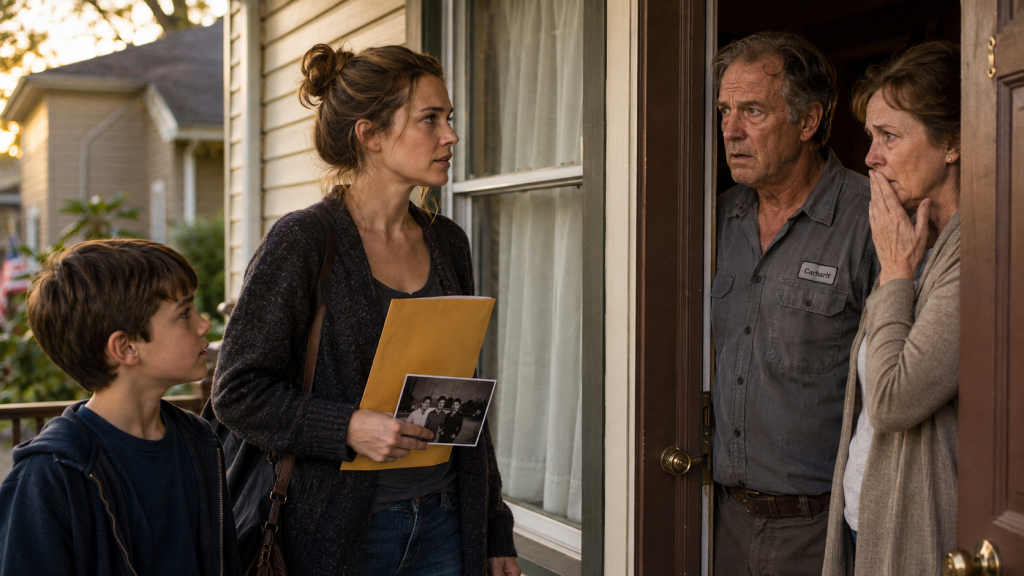
Three days later, Hannah and Owen boarded a bus to Albany.
She carried a backpack, the yellow folder, and the USB drive wrapped in the same old napkin.
The house looked exactly the same.
The brown door.
The white curtains.
The same front step where she had cried while pregnant ten years earlier.
Owen stood beside her, holding the strap of his backpack.
“Are you nervous?” he asked.
Hannah smiled faintly.
“Yes.”
“Me too.”
She squeezed his hand.
Then she knocked.
Frank opened the door.
At first, he stared like he had seen a ghost.
“Hannah?”
Diane appeared behind him.
Her hair was grayer.
Her face thinner.
When she saw Owen, she gasped.
No one spoke.
Owen stepped slightly behind his mother.
Hannah took a slow breath.
“I came to tell you the truth.”
Frank’s jaw tightened.
“After ten years?”
“Yes.”
Diane’s eyes filled with tears.
“Hannah, is he…?”
“My son.”
Owen looked up.
“Hello.”
Diane pressed a hand to her chest.
Frank glanced from Owen to Hannah, and something like fear passed through his eyes.
Not confusion.
Fear.
Somewhere inside him, he had always known the past would return with a face.
Hannah walked into the living room without being invited.
The furniture had changed.
Frank’s chair was the same.
The coffee table was the same.
That made her stomach twist.
She opened the yellow folder and pulled out an old photograph.
Caleb Reed stood in it wearing an engineer’s hard hat, smiling beside Frank in front of the factory gates.
Diane covered her mouth.
Frank stepped back.
Hannah placed the photograph on the table.
On the back, written in Caleb’s shaky handwriting, was one sentence:
Your father tried to save us.
Frank began to tremble.
Owen stared at the young man in the photo.
“Mom,” he whispered, “is that man my dad?”
Hannah knelt beside him.
“Yes, sweetheart.”
Owen’s eyes widened.
“That’s my dad?”
“Yes.”
Diane started crying harder.
Frank lowered himself into the armchair as if his legs could no longer hold him.
Hannah looked at her parents and said the sentence she had carried for ten years.
“Owen is not my shame. He is the son of the man Dad let take the blame.”
The room seemed to collapse around the words.
Diane whispered, “Frank?”
Frank said nothing.
Hannah removed the rest of the documents.
Factory emails.
Safety complaints.
Photos of the damaged press line.
Copies of Caleb’s reports.
A handwritten timeline.
And finally, the witness statement Frank had signed.
Diane took it with shaking hands.
Her eyes scanned the page.
Then she looked at her husband as if she had never seen him before.
“You told me the engineer caused the accident.”
Frank’s lips moved.
No sound came out.
“You told me Caleb was careless.”
“He was asking questions,” Frank whispered.
Hannah’s voice hardened.
“He was doing his job.”
Frank rubbed his face.
“You don’t understand what it was like.”
“Then explain it.”
He looked at Diane.
Then at Owen.
Then at the photograph.
“The company was going to close the line. Hundreds of jobs. Mine included. They said Caleb was young, reckless, ambitious. They said if the investigation blamed maintenance and management, everyone would suffer.”
“So you lied.”
Frank flinched.
“I signed what they gave me.”
“That is lying.”
He looked at Hannah, wounded by her bluntness, as if she was the one who had betrayed him.
“I had a family to feed.”
“You threw your pregnant daughter out.”
“I didn’t know it was his child.”
“You didn’t ask long enough to hear me.”
Diane began sobbing.
“I asked if he hurt you. You said no. I thought…”
Her voice broke.
“I thought you were protecting some boy who ran away.”
Hannah looked at her mother.
“I was protecting the only proof Caleb had left.”
Then she pulled out the USB drive.
Frank’s face changed.
“What is that?”
“The reason I waited.”
She plugged it into Diane’s old laptop on the side desk.
The video file opened.
The image was grainy.
Caleb’s face appeared on screen, tired and pale, sitting in his apartment.
His voice filled the room.
“My name is Caleb Reed. If this recording is being watched, then the company has succeeded in blaming me. The hydraulic press line was unsafe. I filed reports on May third, May nineteenth, and June second. Management ignored them.”
Owen moved closer to the screen.
Caleb continued.
“Frank Miller knows the lockout system failed before the accident. He saw it happen twice. He told me he would back me up.”
Hannah looked at Frank.
His eyes were wet now.
On the recording, Caleb swallowed hard.
“Frank, if you see this, I hope you remember what you told me. You said no job was worth a man’s life.”
Diane let out a broken sound.
Frank covered his face.
The video continued.
“Hannah, if you’re watching this, I’m sorry. I wanted more time. If the baby is real, tell them I tried to do the right thing.”
Owen began crying.
Hannah wrapped an arm around him.
“He knew about me?” Owen asked.
“He hoped for you,” Hannah whispered. “He just didn’t get enough time to know you.”
When the video ended, the room stayed silent.
Then Owen picked up the photograph with shaking hands.
“My dad wasn’t a bad man?”
Hannah touched his face.
“No, sweetheart. He was brave.”
Owen looked at Frank.
His voice was quiet, but it cut through the room like truth itself.
“You didn’t just kick Mom out. You erased my father.”
Frank broke then.
Not dramatically.
Not loudly.
He bent forward in the chair and cried into his hands like an old man finally crushed by the weight he had carried too long.
Diane stepped away from him.
That was the first sign the family had truly been destroyed.
Not by Hannah.
Not by Owen.
By what Frank had done.
“What did they give you?” Diane asked.
Frank looked up.
“What?”
“The company,” she said, trembling. “What did they give you for signing?”
He did not answer.
Hannah pulled another document from the folder.
“A promotion. Back pay. And a bonus listed as safety compliance cooperation.”
Diane stared at him.
“You sold a dead man’s name?”
Frank whispered, “I was scared.”
Hannah’s eyes burned.
“So was I. Nineteen, pregnant, sleeping in a bus terminal. But I didn’t sell anyone.”
For years, Hannah had imagined this moment.
She thought she would scream.
She thought she would feel victorious.
Instead, she felt tired.
Truth had not healed her childhood home.
It had simply exposed the rot beneath the wallpaper.
Frank stood unsteadily.
“Hannah, please. Let me fix this quietly.”
“No.”
His face twisted.
“You don’t know what reopening this could do.”
“I know exactly what it will do.”
She placed the USB drive back into the folder.
“It will clear Caleb’s name.”
Diane looked at her.
“Who else has this?”
“My attorney.”
Frank’s eyes widened.
“You brought lawyers into this?”
“You brought lies into my son’s life.”
Owen was still holding the photograph.
His small fingers gripped the edges carefully.
“Can people know my dad was good?” he asked.
Hannah looked down at him.
“Yes.”
“Then they should.”
That decided it.
Not Hannah’s anger.
Not Frank’s fear.
Owen’s simple need for the truth.
By morning, Hannah’s attorney had the evidence.
By the end of the week, Caleb Reed’s mother received a call that made her weep for twenty minutes before she could speak.
Hannah took Owen to meet her.
Mrs. Reed opened the door and stared at the boy.
Then at Hannah.
Then back at Owen.
“He has Caleb’s eyes,” she whispered.
Owen stepped forward nervously.
“Are you my grandma too?”
The older woman covered her mouth.
Then she pulled him into her arms.
That was the first time Hannah truly cried.
Not when Frank threw her out.
Not when she slept in the bus terminal.
Not when Caleb’s recording played.
But when her son was finally held by someone who loved him because of who his father was, not despite it.
The investigation took months.
Old emails were recovered.
Former workers gave statements.
The company had changed names, replaced managers, and buried its past beneath legal language.
But records are patient.
So are lies.
Eventually, the official report was amended.
Caleb Reed had not caused the accident.
He had warned about the defect.
His reports had been suppressed.
Frank’s statement had been false.
The news did not become national.
But in Albany, people knew.
At the factory, old workers whispered.
At church, Diane sat alone for the first time in forty years.
Frank’s reputation, built on being a hardworking honest man, cracked in public.
But what hurt him most was Owen.
Owen visited Diane sometimes.
He visited Mrs. Reed too.
He did not visit Frank for a long time.
One afternoon, Frank came to Hannah’s hotel before she returned to Chicago.
He stood outside with his cap in his hands.
“Hannah,” he said. “Can I speak to him?”
She crossed her arms.
“That is Owen’s choice.”
Owen stood behind her.
Frank crouched slowly, his knees stiff.
“I’m sorry,” he said.
Owen looked at him.
“For what?”
Frank swallowed.
“For lying about your father.”
“And for my mom?”
Frank looked up at Hannah.
“For sending your mother away.”
Owen’s eyes filled.
“Why did you do it?”
Frank’s face crumpled.
“Because I was afraid.”
Owen thought about that.
“My mom was afraid too. She didn’t do bad things.”
Frank closed his eyes.
“No. She didn’t.”
Owen stepped back.
“I’m not ready.”
Frank nodded.
Tears ran down his face.
“Okay.”
That was the first honest thing he gave the boy.
He did not demand forgiveness.
He did not say family.
He accepted the boundary.
It was not enough.
But it was something.
Diane left Frank six months later.
Not forever, she said.
But long enough to understand who she was without protecting his silence.
She came to Chicago for Owen’s eleventh birthday.
She cried when she saw Hannah’s apartment.
The yellow curtains.
The bookshelf.
The desk where Owen built little machines from spare parts.
“I imagined you suffering forever,” Diane whispered.
“I did suffer,” Hannah said. “Then I built.”
Diane nodded.
“I should have opened the door.”
Hannah had waited ten years to hear that.
When it came, it did not fix everything.
But it landed somewhere soft.
“Yes,” Hannah said. “You should have.”
Diane did not make excuses.
That mattered.
Owen eventually asked if he could use Caleb’s last name too.
Hannah took him to court, and his name became Owen Caleb Miller-Reed.
When the judge approved it, Owen smiled so wide Hannah saw Caleb again.
Not as grief.
As legacy.
Years later, Hannah would think back to the day she placed the pregnancy test on the coffee table.
She had been terrified.
Alone.
Nineteen.
But she had also been right.
If she had lost Owen, all of them would have regretted it.
Not because a child fixes a family.
A child should never have to.
But because Owen carried the truth back into a house where adults had buried it.
He did not destroy the family.
He revealed what had already been broken.
Frank’s lie.
Diane’s silence.
The company’s cover-up.
Hannah’s exile.
Caleb’s stolen name.
One sentence changed everything.
Owen is not my shame.
He is the son of the man Dad let take the blame.
After that, no one could pretend anymore.
For ten years, people thought Hannah had left home in disgrace.
But disgrace had never belonged to her.
It belonged to the father who chose fear over truth.
The mother who chose silence over her daughter.
And the family who called a child shame before learning he was the only innocent proof left behind.
Owen kept Caleb’s photograph on his desk.
Whenever someone asked about the man in the hard hat, he answered proudly:
“That’s my dad. He tried to save people.”
And every time Hannah heard him say it, the weight she had carried since nineteen grew lighter.
Because at last, Caleb Reed was not a rumor.
Not a scandal.
Not a dead man blamed for corporate lies.
He was a father.
A brave man.
A truth.
And his son knew it.
THE END! THANKS FOR READING!🙏