 Reading Time: 41 minutes
For several seconds, I couldn’t breathe. The airport continued moving around us as if nothing had happened. Suitcases rolled across polished floors. Departure announcements echoed overhead.
Somewhere nearby, a child laughed. And I was kneeling on the marble floor of Terminal 4, staring at a cashier’s check my mother had written to the woman I had once planned to marry.
Sixty thousand dollars.
The price my mother had apparently put on removing Evelyn from my life.
I looked at the date.
Six years earlier.
Three days before Evelyn disappeared.
My hands began to shake.
“You refused this?”
Evelyn gave a bitter little laugh.
“Marcus, look at the check.”
I looked again.
Across the front, in Evelyn’s handwriting, were three words.
I DON’T WANT IT.
“I mailed it back to your mother,” she said. “She mailed it to me again.”
My throat tightened.
“Why keep it?”
“Because eventually I realized I might need proof.”
Proof.
The word cut deeper than it should have.
Proof that the woman I loved had needed protection from my own family.
Proof that while I was telling myself she had abandoned me, she had been preparing evidence.
Proof that she had expected someday no one would believe her.
I looked at Maya and Nora.
Both girls were awake now.
They sat pressed against Evelyn’s sides, watching me with enormous brown eyes.
My eyes.
One of them—Maya, I thought—held the sleeve of Evelyn’s coat.
Nora hugged a faded stuffed rabbit against her chest.
They looked frightened.
Not frightened of the airport.
Not frightened of strangers.
Frightened of me.
That realization nearly broke me.
I lowered my voice.
“Evelyn, where have you been?”
She looked at the girls before answering.
“Everywhere.”
“What does that mean?”
“It means wherever I could afford to keep them safe.”
I felt something cold move through my chest.
“Safe from whom?”
Her eyes met mine.
“At first?”
She swallowed.
“From you.”
I closed my eyes.
Those three words hurt more than anything she could have screamed.
When I opened them again, she was watching me carefully.
“Your mother told me you wanted the pregnancy handled quietly.”
My stomach turned.
“What?”
“She told me you were embarrassed.”
“Evelyn—”
“She said you didn’t want your investors knowing you’d gotten a woman like me pregnant.”
“A woman like you?”
Her mouth twisted.
“Those were her words.”
I stood slowly.
The airport seemed suddenly too bright.
Too loud.
Too public.
“I never said that.”
“I know that now.”
The answer stopped me.
“You know?”
Evelyn nodded.
“Not completely. But enough.”
She reached back into the tote bag.
This time she pulled out something thicker.
A cream-colored legal folder.
The moment I saw the embossed logo at the bottom, my blood went cold.
PIERCE, HALLOWAY & VANCE FAMILY COUNSEL
Our family’s law firm.
The firm that had represented my father’s businesses.
The firm that had handled my first hotel acquisition.
The firm that still handled portions of my mother’s estate planning.
Evelyn stared at the folder for several seconds before handing it to me.
“Your mother gave me this the week after you left for London.”
I opened it.
The first page contained my full legal name.
MARCUS ALEXANDER VANCE.
The second contained Evelyn’s.
The third contained language about paternity.
Confidentiality.
Financial settlement.
Future parental claims.
I skimmed faster.
My heartbeat became louder with every paragraph.
Then I reached the final page.
And everything inside me stopped.
There was my signature.
Not something similar to it.
Not a sloppy imitation.
My signature.
The same long downward stroke beneath the M.
The same sharp curve at the end of Vance.
Even the tiny break in the line caused by the way I lifted my pen before finishing my surname.
I had signed my name that way since college.
Underneath it was a date.
Six years earlier.
And above the signature were words I had never seen in my life.
I, Marcus Alexander Vance, acknowledge notification of the pregnancy and voluntarily relinquish any present or future parental interest, involvement, or financial responsibility except as specifically provided under this confidential agreement.
I read it twice.
Then three times.
The letters began to blur.
“No.”
Evelyn said nothing.
“This isn’t real.”
“It looked real to me.”
“I never signed this.”
Her expression changed.
Not relief.
Not yet.
Something more cautious.
“That’s what I hoped you’d say.”
I looked up.
“Evelyn, I swear to you—”
“I believed this document for almost six years.”
“I never signed it.”
“It has your signature.”
“I know what it has.”
My voice rose sharply enough that one of the girls flinched.
I immediately lowered it.
“I’m sorry.”
I crouched again.
Not close enough to invade their space.
Just close enough that I wasn’t towering over them.
“I’m not angry with you.”
Maya glanced at Evelyn.
Nora hugged the rabbit tighter.
My chest felt like it was splitting open.
I had spent years negotiating deals worth tens of millions of dollars.
I had walked into rooms full of hostile investors and never felt intimidated.
But kneeling in front of two five-year-old girls who might be my daughters, I had never felt more afraid of saying the wrong thing.
My phone rang.
I almost ignored it.
Then I saw the name.
DAVID CHEN — CFO
Boston.
The acquisition.
For thirty-five minutes, I had forgotten the biggest business deal of my career existed.
I answered.
“Marcus, where are you? The sellers moved the meeting forward. Their attorney says if you’re not physically present—”
“Cancel it.”
Silence.
“What?”
“Cancel the acquisition.”
“Marcus.”
“You heard me.”
“We have forty-two million dollars in financing committed.”
“I know.”
“We’ve spent fourteen months negotiating this.”
“I know.”
“There are penalties.”
“Pay them.”
Another silence.
“Marcus, what’s happening?”
I looked at Evelyn.
At Maya.
At Nora.
Then back at the legal document carrying my signature.
“My family has been lying to me for six years.”
David knew me well enough not to ask whether I was serious.
He simply said, “What do you need?”
“Freeze anything that requires Eleanor Vance’s authorization.”
My mother.
David became very quiet.
“Everything?”
“Everything.”
“Marcus, that includes the Boston transaction.”
“Then freeze it.”
I stood.
“And David?”
“Yes?”
“Have legal pull every document containing my signature from May through August six years ago.”
“That’s thousands of pages.”
“Then start with anything signed before my London trip.”
There was a pause.
“Understood.”
I ended the call.
Evelyn stared at me.
“You canceled your deal?”
“Yes.”
“You didn’t have to do that.”
“Yes, I did.”
“No. You didn’t.”
I looked down at the agreement.
“Evelyn, somebody used my signature to erase my children.”
The words came out before I could stop them.
My children.
Maya’s head lifted.
Nora stared at me.
Evelyn’s expression tightened.
“We don’t know that yet.”
“You’re right.”
I forced myself to slow down.
“You’re absolutely right.”
Six years ago, I might have demanded answers immediately.
I might have let anger decide what happened next.
But those girls had lived their entire lives without me.
I had no right to appear suddenly and claim space they hadn’t offered.
I handed the folder back.
“What do you need right now?”
Evelyn blinked.
“What?”
“Not six years ago. Not tomorrow. Right now.”
Her eyes dropped toward the suitcase.
Only then did I really look at it.
One zipper was broken.
A strip of silver tape reinforced the side.
A child’s pink sweater was trapped beneath the top flap.
Beside it sat a plastic grocery bag containing two bottles of water, crackers, and what looked like half a package of peanut butter sandwiches.
I looked back at her.
“Were you sleeping here because you had a flight?”
Evelyn didn’t answer.
My stomach sank.
“Evelyn.”
“Our flight was yesterday.”
“Where were you going?”
“Atlanta.”
“Why?”
“I had an interview.”
“Had?”
“The flight was canceled because of weather. They rebooked us, but the interview couldn’t move.”
“Where are you staying in New York?”
She looked away.
That was my answer.
I felt sick.
“You and the girls slept here?”
“Only last night.”
“Only?”
“We’ve done worse.”
The words hit me like a punch.
I started to speak.
Then a familiar voice came from behind me.
“What exactly is going on here?”
Every muscle in my body locked.
Evelyn’s face changed instantly.
She grabbed both girls and pulled them closer.
I turned.
My mother stood twenty feet away.
Eleanor Vance looked exactly as she always did.
Immaculate.
Tailored ivory coat.
Pearl earrings.
Leather gloves.
Her silver-blonde hair perfectly arranged.
She had been scheduled to fly to Boston separately that morning because, although the acquisition belonged to my company, a portion of the financing involved a legacy family trust on which she remained an adviser.
Of course she was at JFK.
Of all mornings.
Of all terminals.
Of all cruel coincidences.
Her eyes moved from me to Evelyn.
Then to the girls.
For the first time in my life, I saw my mother lose control of her expression.
Not surprise.
Recognition.
She knew exactly who they were.
That told me more than words ever could.
“You knew,” I said.
My mother recovered quickly.
“Marcus, this is not the place.”
“You knew they existed.”
She glanced around us.
“Lower your voice.”
“Answer me.”
“Those children should not be dragged into an adult disagreement.”
Evelyn stood.
“Don’t pretend you care about them now.”
My mother’s mouth hardened.
“I did what was necessary.”
Something inside me went completely still.
“What was necessary?”
“Marcus—”
“What was necessary?”
She exhaled impatiently.
“Evelyn was never prepared for the responsibilities attached to our family.”
I stared at her.
“Our family?”
“You were about to open three properties. Your father was dying. The company was vulnerable. And she appeared with a pregnancy at the worst possible moment.”
Evelyn laughed softly.
Not because anything was funny.
Because sometimes pain becomes so enormous there is nowhere else for it to go.
“Appeared with a pregnancy?”
My mother looked at her.
“You knew the complications involved.”
“I knew I loved your son.”
“Love is not the same thing as suitability.”
I stepped between them.
“Stop.”
Mother looked at me.
“Marcus, you are emotional.”
“No.”
I held up the legal agreement.
“I’m becoming extremely clear.”
Her eyes dropped to the document.
For half a second, fear flashed across her face.
There.
Gone almost immediately.
But I saw it.
“Where did you get that?” she asked.
Evelyn answered.
“You gave it to me.”
Mother’s jaw tightened.
“That matter was resolved years ago.”
“No,” I said.
“It was buried years ago.”
A few travelers had begun glancing in our direction.
My mother lowered her voice.
“Evelyn made her decision.”
“After you showed her a document claiming I had abandoned my children.”
“She chose to leave.”
“After you told her I wanted her gone.”
“Marcus.”
“Did you send her my letters?”
Silence.
I took one step toward her.
“Did you send Evelyn any of my letters?”
My mother’s face remained unreadable.
“Your communications were handled through the office at that time.”
“What does that mean?”
“It means you had employees.”
“Did you intercept my letters?”
Her eyes hardened.
“I protected you from a mistake.”
Evelyn whispered, “There it is.”
Mother turned toward her.
“You should never have brought those girls back here.”
Maya gripped Evelyn’s hand.
I saw it.
And my mother’s eyes saw it too.
But she continued.
“You had six years to build a life elsewhere.”
Evelyn’s voice trembled.
“I tried.”
“You should have tried harder.”
“Mother.”
She ignored me.
“This is exactly what I warned you about, Evelyn. Chaos follows people who refuse to understand their position.”
Evelyn went completely pale.
I felt a rage unlike anything I had ever experienced.
Then my mother said the sentence that destroyed whatever remained between us.
“Their mother should have known her place.”
Silence.
Even the noise of the terminal seemed to disappear.
I looked at the woman who had raised me.
The woman whose approval I had spent half my life unconsciously chasing.
The woman who had taught me table manners, business discipline, family history, investment strategy, and how to shake hands while looking someone directly in the eye.
And suddenly I understood something horrifying.
For years, I thought my mother believed in standards.
She didn’t.
She believed in hierarchy.
And she had spent her entire life making sure everyone knew where she believed they belonged.
I looked down at Maya.
Then Nora.
Five years old.
They had never been allowed to know their father because my mother believed their mother was beneath us.
Not dangerous.
Not cruel.
Not dishonest.
Just beneath us.
I took out my phone.
My mother watched me.
“Who are you calling?”
“David.”
“Why?”
“He needs confirmation.”
“Of what?”
I dialed.
David answered almost instantly.
“Marcus?”
“Cancel Boston permanently.”
My mother’s eyes widened.
“Marcus.”
I continued.
“Release the seller. Pay whatever termination fee our contract requires.”
“Marcus, don’t do this,” Mother snapped.
I turned away from her.
“And remove the Vance family trust from every pending company transaction where legally possible. Have independent counsel review the rest.”
David hesitated.
“Understood.”
Mother stepped closer.
“That acquisition is the most important deal you have ever made.”
I ended the call.
“No.”
I looked at the twins.
“It isn’t.”
My mother stared at me as though I had struck her.
“You are throwing away years of work because of a woman who disappeared.”
“Evelyn didn’t disappear.”
My voice broke.
“You erased her.”
For the first time, my mother’s face cracked.
“That is not what happened.”
“Then explain my signature.”
Her lips parted.
Nothing came out.
“Explain it.”
“I suggest you speak to Randall.”
Randall Pierce.
Our family attorney.
My heart began pounding.
“Why?”
“He prepared the documentation.”
“Did he watch me sign it?”
Mother said nothing.
“Did he?”
“Marcus, you signed hundreds of pages during that period.”
Something clicked.
A memory.
A conference room.
Two days before London.
Stacks of documents spread across a walnut table.
My father had been hospitalized.
The Savannah property financing was falling apart.
I had been rushing between meetings.
Randall Pierce had appeared with a folder.
Routine authorizations, he’d called them.
Signature pages.
Initial here.
Sign there.
I hadn’t read everything.
I had trusted him.
I had trusted my mother.
A wave of nausea rolled through me.
“What did you do?”
My mother’s eyes shifted toward Evelyn.
And I knew.
I knew before she answered.
“You were under extraordinary pressure.”
“What did you do?”
“I used a signature page you had lawfully executed.”
Evelyn gasped.
I felt the entire world tilt.
“You attached my signature to this?”
Mother’s face stiffened.
“The agreement reflected what was best for everyone.”
My hand tightened around the folder until the paper bent.
“You attached my signature to a document I had never seen.”
“You had given Randall authority to finalize routine family matters.”
“A document relinquishing my unborn children is not a routine family matter!”
The girls flinched.
I stopped.
I hated that they were hearing this.
I hated everything about this moment.
I turned to Evelyn.
“Please.”
My voice shook.
“Let’s get them somewhere quiet.”
She looked at my mother.
Then at me.
For several seconds, I could see the battle inside her.
Six years of fear telling her not to trust another Vance.
Six years of exhaustion telling her she needed help.
Finally she nodded.
“Not your house.”
“Anywhere you choose.”
“Not one of your hotels.”
“Fine.”
“And your mother doesn’t come.”
I looked back at Eleanor.
“She won’t.”
Mother’s eyes flashed.
“Marcus, you cannot simply—”
“Do not follow us.”
Her face hardened.
“I am your mother.”
“And those are my daughters.”
The words came out with more certainty than I felt entitled to.
I looked at Evelyn immediately.
She didn’t correct me.
That almost destroyed me.
Mother took another step.
“You have no idea what you’re doing.”
“No.”
I held her gaze.
“But I’m finally beginning to understand what you did.”
Then I took Evelyn’s battered suitcase.
For the first time in six years, I walked away from my mother without looking back.
We found a small hotel near the airport that had no connection to my company.
Nothing luxurious.
Nothing carrying the Vance name.
Just a quiet room with two beds, heavy curtains, and a heater that rattled every few minutes.
The girls were hungry.
I ordered too much food because I didn’t know what five-year-olds ate.
Pancakes.
Macaroni and cheese.
Chicken soup.
Fruit.
French fries.
Grilled cheese.
Milk.
Orange juice.
Chocolate cake.
Evelyn stared at the room-service cart.
“You ordered half the kitchen.”
“I panicked.”
For the first time that morning, the corner of her mouth moved.
Almost a smile.
It disappeared quickly.
But I saw it.
Maya chose pancakes.
Nora chose exactly four french fries and half a strawberry.
I sat across the room.
I didn’t ask them questions.
Didn’t tell them who I was.
Didn’t try to win them over.
I simply stayed.
Eventually, Maya looked at me.
“Are you rich?”
Evelyn choked on her coffee.
I almost laughed.
“That’s a complicated question.”
“You wear a rich-person watch.”
I looked down at the watch on my wrist.
A gift from my father.
I took it off and placed it on the nightstand.
“Now I’m less rich.”
Maya frowned.
“That’s not how it works.”
Evelyn covered her mouth.
This time, she actually laughed.
The sound hit me so hard I had to look away.
Six years.
I had not heard that laugh in six years.
Nora studied me.
“Mom says money doesn’t make people good.”
“Your mom is right.”
“Grandma says money makes people important.”
The word Grandma made me freeze.
Evelyn went still.
“Which grandma?” I asked quietly.
Nora looked confused.
“The mean one.”
Evelyn closed her eyes.
My stomach dropped.
“She knows my mother?”
Evelyn stared into her coffee.
“Yes.”
“How?”
The room changed.
Whatever softness had appeared disappeared immediately.
“I told you there was more.”
I looked at the twins.
“Do they need to hear it?”
“No.”
Evelyn stood.
“Girls, cartoons?”
They climbed onto one bed.
She turned on the television, lowered the volume, and led me toward the small desk near the window.
Then she whispered, “Your mother didn’t just send me away.”
My skin prickled.
“What did she do?”
“She kept track of us.”
I stared at her.
“How do you know?”
“Because she visited me.”
“When?”
“The first time?”
Evelyn looked toward the girls.
“When they were eight months old.”
I had to grip the desk.
“She saw them.”
“Yes.”
“She saw my daughters when they were babies.”
“Yes.”
“And she never told me.”
“No.”
I couldn’t speak.
Evelyn continued.
“I was living in Albany. Tiny apartment. Third floor. No elevator. I was working from home doing event coordination and bookkeeping.”
She folded her arms around herself.
“One afternoon someone knocked.”
Her face tightened at the memory.
“Your mother was standing outside.”
I could picture it.
Eleanor in some expensive coat.
Standing in a narrow apartment hallway.
Evaluating everything.
“She came inside?”
“I didn’t invite her.”
That sounded like my mother.
“What did she want?”
“To remind me that the agreement was enforceable.”
“The fake agreement.”
“I didn’t know it was fake.”
Her voice cracked.
“Marcus, you have to understand that I believed you had signed it.”
I nodded.
“I know.”
“No, I don’t think you do.”
She looked at me.
“I hated you.”
The words landed quietly.
Almost gently.
Which made them worse.
“I hated you while I was pregnant.”
I said nothing.
“I hated you during labor.”
Her eyes filled.
“I hated you when I filled out the birth certificates.”
My throat closed.
“I hated you every time one of them got sick and I sat in an emergency room by myself.”
A tear slipped down her cheek.
“I hated you when Nora asked why other children had fathers at preschool.”
I looked toward the bed.
Nora was watching cartoons, her stuffed rabbit tucked under her chin.
“I hated you when Maya drew our family in kindergarten and left a blank space where the teacher told her to draw her dad.”
I looked down.
“Because hating you was easier than admitting I still loved the man I thought you had been.”
That one broke something open inside me.
I sat down.
Not because I wanted to.
Because my legs stopped holding me.
Evelyn wiped her face angrily.
“Then three years ago, your mother came again.”
I looked up.
“Three years ago?”
“She knew where we were living in Baltimore.”
“How?”
“Private investigator.”
I felt sick.
“You’re sure?”
“She left his business card accidentally.”
Evelyn reached into the folder.
Another piece of paper.
A surveillance-company card.
She had written dates on the back.
Three visits.
Albany.
Baltimore.
Philadelphia.
My mother had known where they were for years.
“Why did you keep moving?”
“Because every time I thought we’d finally disappeared, she found us.”
A terrible possibility entered my mind.
“Evelyn…”
I could barely say it.
“Did she threaten you?”
She hesitated.
Then nodded.
“Not the way you’re thinking.”
“What way am I thinking?”
“Violence.”
I exhaled shakily.
“No.”
“She threatened custody.”
My blood went cold.
“She said if I ever contacted you directly, your family would argue that I was unstable, financially insecure, and attempting to manipulate you for money.”
“That would never have worked.”
“You know that now.”
Her voice sharpened.
“I didn’t.”
She pointed toward the girls.
“I was alone. I had very little money. Your family had attorneys, investigators, trusts, connections. Your mother showed me copies of psychological evaluations.”
I stared.
“What evaluations?”
“Fake ones, apparently.”
She gave a humorless laugh.
“They said I was emotionally unstable.”
“I’ve never had you evaluated.”
“I know.”
She reached into the folder again.
This time she handed me photocopies.
My hands went numb.
A psychiatrist’s letterhead.
Clinical language.
Claims of emotional volatility.
Obsessive attachment.
Possible risk to children.
At the bottom was a doctor’s signature.
I recognized the name.
Dr. Samuel Keene.
A longtime friend of my mother’s.
He had attended Thanksgiving at our house when I was a teenager.
“This is insane.”
“I believed they could take my babies.”
I closed my eyes.
“You were scared.”
“I was terrified.”
“You should have come to me.”
The instant I said it, I regretted it.
Evelyn’s expression changed.
“How?”
I opened my mouth.
Nothing came.
“How, Marcus?”
She stepped closer.
“Your office returned my letters.”
I looked down.
“Your assistant told me you would call security if I showed up.”
My head snapped up.
“What?”
“Three times.”
“I never told anyone that.”
“I know that now.”
She continued.
“I emailed you. I mailed your hotels. I sent certified letters. I called your office.”
Her voice rose.
“I even drove to your mother’s house once with six-month-old twins in the back seat.”
I stared at her.
“The gate wouldn’t let me in.”
My chest tightened.
“Security told me I was trespassing.”
I could barely breathe.
“And the whole time I had a legal agreement with your signature telling me you wanted nothing to do with us.”
Tears ran down her face now.
“So please don’t ask why I didn’t come to you.”
I stood immediately.
“You’re right.”
She looked away.
“You’re right.”
My voice broke.
“I should never have said that.”
For several seconds neither of us spoke.
Then I said the only truthful thing left.
“I failed you before I even knew I was failing you.”
She shook her head.
“You didn’t know.”
“I stopped looking.”
That was the piece I couldn’t excuse.
“My mother told me you left. I was hurt. I was angry. And I accepted the easiest explanation because it protected my pride.”
Evelyn looked at me.
“I searched for three months.”
I laughed bitterly.
“Three months.”
“Marcus—”
“You spent six years raising our daughters alone because I gave up after three months.”
“I changed my name.”
“I should have kept looking.”
“You thought I didn’t want to be found.”
“I should have questioned why.”
My voice became quieter.
“I knew you.”
That hurt the most.
“I knew you would never leave without a conversation.”
Evelyn’s face crumpled slightly.
“And yet I believed my mother because believing her required less courage than believing something terrible might have happened to you.”
I sat down again.
“I can’t get those six years back.”
“No.”
“I know.”
The girls laughed at something on television.
We both looked over.
Maya had put the stuffed rabbit on Nora’s head.
Nora was trying not to giggle.
I watched them.
Five years of birthdays I had missed.
Five Christmas mornings.
First words.
First steps.
First day of school.
Nightmares.
Fevers.
Lost teeth.
Favorite songs.
Favorite foods.
All of it gone.
I couldn’t buy it back.
Couldn’t negotiate it back.
Couldn’t threaten anyone into returning it.
For the first time in my adult life, money was completely useless.
My phone vibrated.
David.
I answered quietly.
“What did you find?”
“Enough that I think you need outside counsel immediately.”
My stomach tightened.
“Explain.”
“Six years ago, before your London trip, you signed nine detached authorization pages as part of the Savannah refinancing.”
I looked at Evelyn.
“And?”
“One page is missing from the final archived packet.”
My entire body went cold.
“Missing?”
“According to the scanned version, yes.”
“Could that page have been attached to something else?”
David was silent.
“David.”
“Yes.”
I looked at the legal agreement in Evelyn’s hands.
“Who handled the originals?”
“Randall Pierce’s office.”
Of course.
“And my mother?”
“She was copied on several internal correspondence chains.”
“What correspondence?”
“I can’t explain over the phone.”
“Try.”
David exhaled.
“Marcus, there is an email from Eleanor to Randall three days after you left for London.”
My heart hammered.
“What does it say?”
Another pause.
Then:
“‘Use the executed page. He doesn’t need another distraction.'”
I closed my eyes.
Evelyn covered her mouth.
David continued.
“There’s a response from Randall.”
“What response?”
“‘Understood. I’ll prepare the family resolution exactly as discussed.'”
The room seemed to shrink.
“Send me copies.”
“Already encrypted and sent.”
“Preserve everything.”
“Done.”
“And David?”
“Yes?”
“Nobody inside the family office gets access.”
“Already locked them out.”
For the first time that day, I almost smiled.
“Thank you.”
“Marcus?”
“Yeah?”
“There is one more thing.”
My hand tightened around the phone.
“What?”
“The family resolution wasn’t the only file attached to that correspondence.”
I looked at Evelyn.
“What else?”
“A medical trust.”
I frowned.
“What medical trust?”
“I don’t know yet.”
“Whose name?”
David went silent.
I heard typing.
Then he said:
“Maya Evelyn Hart.”
My heart stopped.
“And Nora Grace Hart.”
I couldn’t speak.
Evelyn stared at me.
“What?”
I put the call on speaker.
David repeated it.
“There are two dormant medical trusts created five years and eleven months ago.”
Evelyn went white.
“I never knew about any trust.”
David continued carefully.
“Each account originally contained two hundred fifty thousand dollars.”
I stared at the phone.
Evelyn whispered, “What?”
“Who funded them?” I asked.
Another pause.
David’s answer shattered the room.
“Your father.”
My father.
Thomas Vance.
Dead four years.
The man whose jawline Maya carried.
The man I had mourned believing he had died without grandchildren.
I sank into the chair.
“No.”
David sounded confused.
“Marcus?”
“My father knew.”
Silence.
Evelyn looked as stunned as I felt.
My father knew.
Which meant my mother hadn’t acted alone in absolute secrecy.
At some point, my father had discovered the twins.
And he had done something.
I thought of his final year.
Cancer.
Hospital rooms.
Morphine.
The way he sometimes looked at me like he wanted to say something but didn’t have enough strength.
A memory surfaced.
One I hadn’t thought about in years.
My father in a hospital bed.
Three months before he died.
His voice weak.
“Marcus, don’t let your mother decide what family means for you.”
At the time, I thought he was talking about marriage.
Succession.
The company.
I had laughed.
“Since when does Mom decide anything for me?”
My father had closed his eyes.
“More than you know.”
I felt physically sick.
He had been trying to tell me.
“David.”
“Yes?”
“Find everything connected to those trusts.”
“Already doing it.”
“And find out who has controlled them since my father’s death.”
David hesitated.
Then said:
“Eleanor Vance.”
Of course.
We did the DNA test that afternoon.
Not because I doubted Evelyn.
By then I didn’t.
But because the girls deserved certainty.
And Evelyn deserved something objective after six years of lies created by people with my last name.
The test was expedited through a private laboratory.
The results came the next morning.
Probability of paternity: 99.9998%.
I stared at the number for almost a minute.
Then I walked into the hotel bathroom, closed the door, sat on the floor, and cried.
I hadn’t cried when my father died.
Not properly.
I had organized the funeral.
Spoken to attorneys.
Comforted my mother.
Reviewed succession documents.
Handled investors.
I had performed grief like another business responsibility.
But that morning, sitting on cheap hotel tile, I covered my face and sobbed.
Because I was a father.
I had been a father for five years.
And I hadn’t known.
A small knock came on the bathroom door.
I wiped my face quickly.
“One minute.”
Another knock.
Then Maya’s voice.
“Mom says you’re crying.”
I closed my eyes.
“I’m okay.”
“Adults say that when they’re not okay.”
I almost laughed.
That sounded exactly like Evelyn.
I opened the door.
Maya stood there in purple pajamas.
Her hair was messy.
She looked at my face.
Then held something out.
A tissue.
I took it.
“Thank you.”
She studied me.
“Mom said the test says you’re our dad.”
My chest tightened.
“Yes.”
“Did you know?”
“No.”
“Mom says you didn’t.”
“I didn’t.”
She looked at the floor.
“Why didn’t you find us?”
There it was.
The question I had feared.
I crouched.
“Because I made a mistake.”
She looked up.
“What mistake?”
“I believed something that wasn’t true.”
“Grandma?”
Children understand more than adults think.
I nodded.
“Yes.”
Maya frowned.
“She’s mean.”
A laugh escaped me through tears.
“Sometimes people can be more complicated than mean.”
“She was mean to Mom.”
I nodded.
“Yes.”
“And you didn’t stop her.”
No business negotiation had ever hurt this much.
“No.”
Her eyes remained fixed on mine.
“I didn’t know.”
She said nothing.
“But I wish I had.”
Still nothing.
“And I can’t change what already happened.”
I swallowed.
“But if you and Nora let me, I’d like to be here for what happens next.”
Maya thought about this.
Then asked:
“Do you know how to braid hair?”
I blinked.
“No.”
“Mom says dads are supposed to learn stuff.”
“Then I can learn.”
“You’ll be bad.”
“Probably.”
That earned a tiny smile.
Then she ran back toward the bed.
I remained crouched in the doorway long after she was gone.
Evelyn was watching me.
She had tears in her eyes.
Neither of us said anything.
We didn’t need to.
At noon, David called again.
This time, his voice was different.
“Marcus, you need to come to the office.”
“Why?”
“We found your father’s file.”
“What file?”
“A physical file.”
My heart kicked.
“Where?”
“Behind a false back in the old executive safe.”
I stood.
“Who found it?”
“Clara.”
Clara Morrison had been my father’s executive assistant for twenty-seven years.
She retired after his death.
“What was she doing there?”
“I called her when the digital records stopped making sense.”
“And?”
“She said your father told her there was a sealed envelope to be opened if Eleanor ever tried to dissolve the girls’ trusts.”
I couldn’t speak.
“He knew this could happen?”
“Apparently.”
“Is Clara there?”
“Yes.”
I looked at Evelyn.
“You should come.”
She immediately shook her head.
“I don’t want to go anywhere near your family office.”
“I understand.”
“But if those trusts belong to Maya and Nora…”
“They do.”
“Then I need to know what’s in that file.”
An hour later, we walked into Vance Holdings headquarters together.
The lobby receptionist looked stunned.
Several older employees recognized Evelyn.
Their expressions told me everything.
They remembered her.
They remembered us.
They remembered how suddenly she had disappeared.
Evelyn’s fingers tightened around the strap of her bag.
“Do you want to leave?” I whispered.
“No.”
“You don’t have to prove anything.”
“I’m not here to prove anything.”
She looked at me.
“I’m here for my daughters.”
We went upstairs.
David was waiting in my office.
So was Clara.
She was seventy-two now.
White hair.
Glasses.
The same straight posture she had always possessed.
The moment she saw Evelyn, her hand flew to her mouth.
“Oh, sweetheart.”
Evelyn froze.
Clara crossed the room slowly.
“I am so sorry.”
Evelyn’s eyes filled.
“You knew?”
Clara shook her head immediately.
“Not until after Mr. Vance got sick.”
“My father?” I asked.
She nodded.
“He found out Eleanor had been having an investigator monitor Evelyn.”
I stared at her.
“How?”
“An invoice.”
Of course.
My father reviewed everything.
No matter how ill he became, he reviewed every expense.
“He confronted your mother,” Clara continued. “I heard part of the argument.”
“What did she say?”
Clara hesitated.
Then looked at Evelyn.
“She said she had saved Marcus from ruining his life.”
My jaw tightened.
“And my father?”
“He called her monstrous.”
I had never heard my father call anyone that.
Clara continued.
“The next morning he asked me to find Evelyn.”
Evelyn stared.
“He tried to contact me?”
“Yes.”
Clara’s eyes filled with tears.
“But by then you had moved from Albany.”
“Baltimore.”
“We didn’t know.”
“What about the investigator?”
“Your mother refused to provide his information.”
Clara looked at me.
“Your father hired another investigator.”
My heart pounded.
“He found them?”
“Eventually.”
Evelyn whispered, “When?”
“Just after the girls turned one.”
Evelyn sat down.
Clara continued.
“Your father was already very sick.”
I remembered that year.
Chemotherapy.
Hospital stays.
Weeks when he could barely walk.
“He wanted to tell you immediately,” Clara said.
“Why didn’t he?”
Her expression tightened.
“Because Eleanor threatened to expose Evelyn’s location to tabloids and claim she was attempting to blackmail the family.”
I stared.
Clara looked ashamed.
“Your father believed her.”
Evelyn closed her eyes.
“He created the trusts instead,” Clara said. “He wanted the girls protected financially until he could fix everything.”
“Did he meet them?”
Evelyn looked up sharply.
Clara nodded.
“Once.”
The room went silent.
Evelyn stared at her.
“When?”
“Philadelphia.”
Evelyn’s face changed.
Then suddenly she whispered:
“The old man at the library.”
Clara covered her mouth.
Evelyn stood.
“Oh my God.”
“What old man?” I asked.
She turned toward me.
“Three and a half years ago.”
Her voice trembled.
“I took the girls to a children’s reading hour at a library.”
She looked at Clara.
“There was an older man sitting near the windows.”
Clara nodded through tears.
“He didn’t speak to you?”
“He asked if he could pick up Nora’s toy when she dropped it.”
I couldn’t breathe.
Evelyn continued slowly.
“He told Maya she had beautiful eyes.”
My father.
He had seen them.
Once.
Only once.
Without telling them who he was.
Without telling me.
Clara began crying.
“He came back to the office that afternoon.”
She removed her glasses.
“I had never seen Mr. Vance cry before.”
Neither had I.
“He kept saying, ‘They look like Marcus.'”
I turned away.
The windows blurred.
My father had seen my daughters before he died.
He had known.
He had held that knowledge while I sat beside his hospital bed talking about hotels, expansion, staffing problems, and financial forecasts.
Clara walked toward the safe.
She removed a sealed envelope.
My name was written across the front.
In my father’s handwriting.
MARCUS — WHEN THE TRUTH CAN NO LONGER BE DELAYED.
My hands trembled as I opened it.
Inside was a letter.
I recognized the shaky handwriting immediately.
I read silently at first.
Then Evelyn whispered:
“Read it.”
So I did.
“Marcus,
If you are reading this, then I failed to correct something before I ran out of time.
Your mother believes family is something that can be managed like an asset.
I allowed that belief to control too much of our life.
That failure belongs partly to me.
Evelyn did not leave you because she stopped loving you.
Your mother deceived her.
Worse, she used documents carrying your valid signature to create the appearance that you had knowingly rejected Evelyn and the children.
You did not.
I know because I confronted Randall Pierce.
He admitted what was done.
I should have told you immediately.
Instead, I hesitated because I was sick, because your mother threatened scandal, because I convinced myself I could repair the damage quietly.
That was cowardice.
Do not repeat it.
You have two daughters.
I saw them once.
Marcus, they have your eyes.
I established trusts for them because I could not guarantee I would live long enough to make this right.
Money is not an apology.
It is not a father.
It is not a family.
Do not make the mistake I made of believing providing something financially is the same as standing beside someone when they need you.
If Evelyn allows you into their lives, earn your place.
Do not demand it because your blood gives you a claim.
Your mother may tell you she acted for the family.
Remember this:
A family preserved through cruelty is not preserved at all.
It is only controlled.
Be better than I was.
Dad.”
I couldn’t finish the last word aloud.
I lowered the letter.
Nobody spoke.
My father’s final lesson had been hidden inside a safe for four years.
Not about business.
Not about wealth.
Not about the Vance name.
About cowardice.
His.
Mine.
And the kind of courage required to stop passing it down.
Randall Pierce arrived forty minutes later with his own attorney.
That told me everything.
He wasn’t there to deny it.
He was there to survive it.
He looked older than I remembered.
His expensive suit couldn’t hide the sweat at his temples.
He sat across from me in the conference room.
Evelyn sat beside me.
David stood by the window.
Clara had gone home.
Randall folded his hands.
“Marcus, before anyone says anything further, I want it understood that I am here voluntarily.”
I laughed.
It was not a pleasant sound.
“Six years too late.”
His attorney shifted.
“We are prepared to discuss records.”
“No.”
I placed the agreement on the table.
“We’re going to discuss this.”
Randall looked at it.
His shoulders sagged.
“Did I sign this document?”
He hesitated.
“You signed the page.”
“Did I sign this document?”
“No.”
Evelyn inhaled sharply.
Even though she knew.
Even though we all knew.
Hearing it from him was different.
I leaned forward.
“Say it clearly.”
Randall looked at his attorney.
His attorney nodded once.
Randall swallowed.
“The signature page came from another document.”
“What document?”
“A financing authorization.”
“And you attached it here.”
“Yes.”
“At whose request?”
Silence.
“Randall.”
“Eleanor’s.”
Evelyn closed her eyes.
“Did you know I had no idea Evelyn was pregnant?”
“At first, no.”
“Eventually?”
“Yes.”
“How?”
“Your mother told me.”
I stared at him.
“And you continued?”
His face tightened.
“I was advised that the situation needed to be contained.”
“By whom?”
“Eleanor.”
“You were my attorney.”
“I represented the family.”
I felt my anger rise.
“No.”
I pointed at the document.
“You represented the person with the most power in the room.”
Randall looked down.
Evelyn spoke for the first time.
“Did you know she threatened to take my children?”
Randall’s eyes flickered toward her.
“I knew there were discussions about custody exposure.”
“Exposure?”
Her voice broke.
“I was twenty-two weeks pregnant when you sat in a room with me and told me Marcus had signed away his children.”
Randall looked miserable.
“You told me if I made trouble, your firm would make sure I spent years fighting people I couldn’t afford to fight.”
“I regret—”
“Don’t.”
Evelyn’s voice sharpened.
“Don’t give me regret because you finally got caught.”
Randall fell silent.
She continued.
“I spent five years checking behind me every time I picked my daughters up from school.”
Her eyes filled.
“I moved three times.”
She pointed toward the papers.
“I slept in my car twice.”
My chest tightened.
“I worked while I had pneumonia because missing rent meant giving your firm another argument that I couldn’t provide stability.”
Randall’s face went pale.
“And every birthday,” Evelyn whispered, “I wondered whether their father remembered the day they were born.”
She looked at him.
“He didn’t even know there was a day to remember.”
Randall couldn’t meet her eyes.
I put my father’s letter on the table.
“You admitted this to my father.”
Randall froze.
That surprised him.
“Where did you get that?”
“My father left records.”
His attorney whispered something to him.
Randall shook his head.
“There’s more,” I said.
I slid copies of the emails across the table.
Use the executed page. He doesn’t need another distraction.
Randall read them.
Then closed his eyes.
“You preserved these?” he asked.
“My company preserved everything.”
For the first time, he looked afraid.
“What do you want?”
I thought the question would feel satisfying.
It didn’t.
Six years earlier, I might have wanted destruction.
His license.
His money.
His reputation.
Everything.
Now I looked at Evelyn.
I thought about Maya’s tissue.
Nora’s stuffed rabbit.
And my father’s words.
Earn your place.
“What I want doesn’t matter.”
Randall looked confused.
“Evelyn decides what she wants to pursue against you.”
Her head turned toward me.
“The trusts belong to the girls.”
I continued.
“And every document involving them will be reviewed by counsel with no connection to the Vance family.”
Randall nodded slowly.
“My mother will never control another dollar belonging to those children.”
His attorney spoke.
“We can cooperate.”
I looked at him.
“You should.”
My mother did not call me that night.
She called thirty-seven times.
I answered none of them.
On the thirty-eighth, she left a voicemail.
“Marcus, I know you’re angry, but eventually you are going to understand that I made impossible decisions while everyone else was thinking emotionally. Call me when you’re prepared to discuss this rationally.”
I listened twice.
Not because I agreed.
Because I needed to understand.
That was how she saw it.
Not cruelty.
Management.
Not theft.
Protection.
Not six stolen years.
An impossible decision.
I saved the voicemail.
Then forwarded it to my attorney.
Three days later, my mother appeared at my apartment.
I almost didn’t let her in.
Then I realized I wanted one conversation.
Not for her.
For me.
She entered and looked around.
“You removed the family portraits.”
“I removed photographs of people I don’t recognize anymore.”
Her face tightened.
“Drama has never suited you.”
“Neither has fraud.”
She removed her gloves.
“Randall is blaming me.”
“Randall has records.”
“He is protecting himself.”
“So are you.”
She sat.
I remained standing.
“Where is Evelyn?”
“Safe.”
“Are the girls with her?”
“Yes.”
“Have you confirmed paternity?”
“Yes.”
For the first time, something shifted in her face.
“They’re yours?”
“You already knew that.”
“I suspected.”
“No.”
I pulled an investigator report from the table.
“You had DNA collected from a drinking straw when Maya was eighteen months old.”
Mother went silent.
“You tested them without anyone’s consent.”
“I needed certainty.”
“You had certainty three and a half years before I did.”
She looked away.
I had never seen my mother look ashamed.
Even now, I wasn’t sure it was shame.
Maybe merely discomfort.
“Why?”
I asked.
One word.
The only one that mattered.
“Why did you hate Evelyn that much?”
“I did not hate her.”
“You destroyed her life.”
“I prevented a disastrous marriage.”
“There wasn’t even a wedding date.”
“There would have been.”
I laughed bitterly.
“That’s what this was about?”
“It was about your future.”
“My future included them.”
“You don’t know that.”
“They are my daughters.”
“You were building something, Marcus.”
Her voice rose for the first time.
“Your father was ill. Investors were circling. The family name was under pressure. You were about to attach yourself permanently to a woman with no understanding of our world.”
I stared at her.
“She coordinated galas for your foundation.”
“That is not the same as belonging.”
There it was again.
Belonging.
Place.
Hierarchy.
I walked to the window.
“Do you know what Maya asked me yesterday?”
Mother said nothing.
“She asked if I could braid hair.”
My voice cracked.
“I don’t know how.”
“Marcus—”
“I don’t know their favorite bedtime stories.”
I turned around.
“I don’t know which one gets carsick.”
Mother looked down.
“I don’t know which foods Nora refuses to eat unless they’re cut into triangles.”
“Stop.”
“I don’t know which daughter had pneumonia at three.”
Her eyes closed.
“I don’t know which one needed stitches after falling off a scooter.”
“Marcus.”
“I don’t know what their first words were.”
My voice finally broke.
“Because you decided my hotels were more important.”
Tears filled my mother’s eyes.
The sight stunned me.
But I continued.
“Five birthdays.”
I held up my hand.
“Five.”
She whispered, “I was protecting you.”
“From what?”
“From losing everything.”
I looked around the apartment.
At expensive furniture.
Art.
The Manhattan skyline.
Everything people like my mother considered proof of success.
Then I said:
“I did lose everything.”
She stared at me.
“I just didn’t know it.”
A tear moved down her cheek.
I had spent my life believing my mother did not cry.
Apparently she did.
It changed nothing.
“You destroyed the Boston acquisition over this,” she said.
“I canceled a building.”
“Forty-two million dollars.”
“A building.”
She shook her head.
“You are not thinking clearly.”
“For the first time in six years, I am.”
“Your board will question your judgment.”
“Then they can question it.”
“Investors will talk.”
“Let them.”
“Our family will be humiliated.”
I stared at her.
There.
Even now.
Reputation.
“What happened to Evelyn?”
My mother looked away.
“What happened to Maya and Nora?”
Silence.
“What you did with my signature?”
Silence.
“Those things don’t humiliate you.”
I stepped closer.
“But people finding out does.”
Her face hardened.
I knew I had finally reached the truth.
“You’re afraid of scandal.”
“I’m afraid of what this will do to generations of work.”
“No.”
I shook my head.
“You’re afraid people will see what you were willing to do to protect it.”
She stood.
“What happens now?”
It was a strange question coming from her.
For the first time in my life, Eleanor Vance wasn’t deciding.
She was asking.
“Independent counsel controls the girls’ trusts until the court approves a permanent structure.”
Her jaw tightened.
“You removed me.”
“Yes.”
“From Thomas’s trusts?”
“From anything involving my daughters.”
She looked stunned.
“I am their grandmother.”
“No.”
My voice was quiet.
“Biologically, yes.”
Her face changed.
“But being family is not a title you inherit.”
I thought of my father’s letter.
“It’s a place you earn.”
She stared at me.
“You would keep them from me?”
“They’re not objects to keep or give.”
I stepped closer.
“Evelyn decides who has access to them right now.”
“Of course she does.”
The contempt returned.
“And that sentence is exactly why she doesn’t trust you.”
Mother picked up her gloves.
At the door, she turned.
“Someday those girls will understand that everything I did protected the life they will eventually inherit.”
I shook my head.
“No.”
“They’re going to inherit something else.”
“What?”
“The truth.”
Then I opened the door.
My mother left.
The investigation lasted months.
There was no dramatic courtroom confession.
Real consequences moved slower than anger.
Lawyers reviewed documents.
Former employees were interviewed.
Digital archives were preserved.
Randall Pierce eventually entered into agreements requiring his cooperation in the civil proceedings and the professional investigation that followed.
His role in the altered documents became public through the legal process.
The psychiatrist whose letterhead had been used denied ever evaluating Evelyn and turned over records showing my mother had requested “general language” about custody concerns years earlier.
My mother’s private investigator confirmed he had been paid through a family-office account.
The mailroom supervisor from six years earlier admitted he had been instructed to divert all correspondence bearing Evelyn’s name to Eleanor’s office.
My former executive assistant cried when investigators interviewed her.
She had been told Evelyn was harassing me.
She had believed it.
That part mattered to me.
Because the conspiracy had not required dozens of evil people.
It required a few powerful people telling believable lies to everyone beneath them.
The rest followed procedure.
That terrified me more.
My mother resigned from the family foundation after the board learned charitable administrative accounts had been used to pay private investigators.
She called the resignation voluntary.
The newspapers called it something else.
I didn’t read them.
For once, I didn’t care what the Vance name looked like in print.
The Boston estate sold to another company.
David brought me the final termination statement.
“You sure you don’t want to frame this?”
I looked at the penalty amount.
It was painful.
“Burn it.”
He laughed.
Then he became serious.
“You know the board would understand if you reconsidered expansion for a year.”
“I am.”
He raised an eyebrow.
“Marcus Vance voluntarily slowing growth.”
“Terrifying, isn’t it?”
“Mostly confusing.”
I smiled.
Then looked through the glass wall of my office.
Five months earlier, I would have been boarding planes four days a week.
Now I was home almost every night.
Not because Evelyn asked.
She hadn’t.
Because I was finally learning something my father discovered too late.
Availability was not the leftover space after ambition.
It was a decision.
Evelyn did not move in with me.
She didn’t accept a house.
She didn’t accept a car.
She refused every dramatic gesture I initially tried to make.
When I offered to buy her an apartment, she stared at me.
“No.”
“It’s not charity.”
“No.”
“It belongs to the girls too.”
“No.”
“Evelyn.”
“If you want to help your daughters, help your daughters.”
She folded her arms.
“But you are not purchasing forgiveness from me.”
That hurt.
Because she was right.
So I stopped trying to solve emotional wounds with financial tools.
I paid legally established child support.
We set up education accounts with independent oversight.
I covered half of childcare and medical expenses.
Normal things.
Boring things.
Responsible things.
And then I started showing up.
Tuesday breakfasts.
Thursday school pickup.
Saturday mornings.
At first Evelyn came with us everywhere.
Then she allowed me to take the girls to the park alone.
I arrived twenty minutes early.
She noticed.
“You don’t have to come this early.”
“Yes, I do.”
“Why?”
“Because I’m terrified of being late.”
Her face softened.
“Marcus.”
“I missed five years.”
I looked toward the playground.
“I’m never making them wonder if I’m coming.”
Learning to be their father was humiliating in the best possible way.
Maya was fearless.
Nora was careful.
Maya jumped from playground equipment she had no business climbing.
Nora inspected everything first.
Maya loved strawberries.
Nora insisted strawberries had “tiny creepy dots.”
Nora loved dinosaurs.
Maya thought dinosaurs were boring unless they could fly.
They both hated peas.
They both loved pancakes.
Neither cared that I owned hotels.
The first time I tried to impress them by taking them to one of my properties, Maya asked why the lobby smelled “like rich soap.”
Nora asked whether we could go to the playground instead.
So we left my five-star hotel and spent two hours pushing swings in Central Park.
It was the happiest afternoon I could remember.
And yes.
I learned to braid hair.
Badly.
Very badly.
The first morning I tried, Maya looked in the mirror.
“That looks injured.”
Nora touched her crooked braid.
“Mine looks like a rope.”
I stared at Evelyn.
“Help.”
She laughed so hard she had to sit down.
I hadn’t realized how much I missed making her laugh until I started doing it again.
But rebuilding trust with Evelyn was harder.
There were good days.
Then there were days when I reached for her hand without thinking and she pulled away.
Not angrily.
Instinctively.
Those moments reminded me that love does not erase trauma.
Once, seven months after JFK, we stood outside the girls’ school during a rainstorm.
The twins had gone inside.
Evelyn held an umbrella.
I was getting soaked because I had forgotten mine.
She sighed.
“Come here.”
I stepped under hers.
We stood shoulder to shoulder.
Close enough that I could smell the same faint vanilla perfume she used six years earlier.
“Do you ever think about what would’ve happened?” I asked.
She knew what I meant.
“If your mother hadn’t interfered?”
“Yes.”
“Sometimes.”
“Would we have gotten married?”
She looked at the rain.
“Probably.”
I smiled faintly.
“Probably?”
“You were impossible.”
“I’ve improved.”
“Debatable.”
I laughed.
Then she became serious.
“I used to imagine it all the time.”
Her voice quieted.
“You coming home from London.”
“Me telling you.”
“You panicking.”
“I would have panicked.”
“I know.”
“You teasing me.”
“Definitely.”
“We’d fight about names.”
“You would’ve wanted something absurdly traditional.”
“Victoria is a perfectly good name.”
“It’s a queen’s name.”
“So?”
She smiled.
Then tears suddenly filled her eyes.
“We don’t get that version.”
The smile disappeared from my face.
“No.”
She looked at me.
“And sometimes when I’m happy now, I get angry about it.”
I understood.
“Because we should’ve had it then.”
She nodded.
I wanted to touch her.
I didn’t.
“I get angry too.”
“At your mother?”
“At everyone.”
“At yourself?”
“Mostly.”
She looked away.
“Marcus, you can’t punish yourself forever.”
“I know.”
“But?”
“I haven’t figured out what forgiveness looks like yet.”
She considered that.
“Maybe it doesn’t look like forgetting.”
I looked at her.
“Maybe it just looks like not letting what happened decide every day that comes after.”
We stood under that umbrella for a long time.
Then she moved half an inch closer.
Our shoulders touched.
Neither of us moved away.
My mother sent the girls birthday presents when they turned six.
Huge boxes.
Designer dresses.
Gold bracelets.
A miniature electric car.
Evelyn called me.
“What do you want me to do?”
It mattered that she asked.
A year earlier, she would have thrown everything away without calling.
“What do the girls want?”
“They haven’t seen them.”
I thought about it.
“Return everything.”
“All of it?”
“All of it.”
There was silence.
“You sure?”
“Yes.”
Then I added:
“If she wants to be part of their lives someday, she starts with an apology.”
“To them?”
“To you first.”
Evelyn became quiet.
“You would require that?”
“I should have required respect for you six years ago.”
That evening, we returned the packages.
No note.
Two weeks later, a letter arrived.
Not from an attorney.
From my mother.
Evelyn didn’t open it for three days.
When she finally did, I sat across from her.
The letter was four pages.
My mother did not excuse everything.
For once.
She admitted she had believed wealth gave her the right to make decisions for other people.
She admitted she had viewed Evelyn as a threat because Evelyn couldn’t be controlled by the social expectations that controlled everyone else around us.
She admitted she had convinced herself the twins would be better without public connection to the Vance family.
Then she wrote something that surprised me.
The truth is that I was afraid Marcus loved you enough to stop needing my approval.
Evelyn stopped reading.
I stared at the page.
There it was.
Not legacy.
Not business.
Not reputation.
Control.
My mother had been afraid of losing her place in my life.
So she had taken Evelyn’s.
And Maya’s.
And Nora’s.
Evelyn finished the letter.
“Do you believe her?”
“Yes.”
“Do you forgive her?”
“No.”
She looked at me.
“Never?”
“I don’t know.”
That was the truth.
I no longer wanted revenge.
But forgiveness was not an obligation.
And reconciliation was not something anyone was owed because they finally admitted the harm they caused.
“What about the girls?” Evelyn asked.
“When they’re older, they can decide what relationship they want.”
She nodded.
“Until then?”
“Until then, we protect their peace.”
For the first time, the word we didn’t frighten either of us.
A year after JFK, Maya lost her first tooth at my apartment.
She panicked because it fell into her spaghetti.
Nora screamed because she thought the tooth fairy wouldn’t accept “pasta teeth.”
Evelyn arrived twenty minutes later carrying toothbrushes and laughing before she’d even made it through the door.
“You called me because of a tooth?”
“It was an emergency.”
“It was in spaghetti.”
“Exactly.”
Maya ran toward her.
“Mom! Dad almost threw it away!”
Dad.
The room stopped.
Maya didn’t notice.
Neither did Nora.
They kept talking.
But Evelyn did.
She looked at me.
I looked at her.
I had heard them call me Dad before in carefully planned moments.
But this was different.
It had slipped out naturally.
No ceremony.
No question.
No permission sought.
Just Dad.
As if I belonged there.
I turned toward the sink because suddenly my eyes burned.
Evelyn followed me.
“You okay?”
“No.”
She smiled.
“Good no or bad no?”
“Good.”
I swallowed.
“Very good.”
She touched my arm.
I looked at her hand.
Then at her.
She didn’t pull away.
That night, after the girls fell asleep on my couch watching a movie, Evelyn and I sat beside them.
Maya’s feet were in my lap.
Nora’s head rested against Evelyn.
“I got the Atlanta job,” Evelyn said quietly.
My heart stopped.
“What?”
“The one I was supposed to interview for when you found us.”
I stared.
“How?”
“They contacted me months later. They had another opening.”
I forced myself to breathe.
“Are you taking it?”
She watched my face.
“I turned it down.”
“Why?”
“I got something better here.”
Relief hit me so strongly I hated myself for it.
I immediately said:
“You shouldn’t stay because of me.”
“I’m not.”
She smiled.
“I accepted a job with an events company in Manhattan.”
“Oh.”
“They’re paying me more.”
“Good.”
“And I found an apartment.”
My stomach dipped again.
“Where?”
“Queens.”
“That’s…”
I calculated.
“Twenty-two minutes from me without traffic.”
“Twenty-nine.”
“You mapped it?”
“I timed it.”
We smiled.
Then she looked at the sleeping girls.
“They deserve both of us.”
My throat tightened.
“Yes.”
She turned back to me.
“So do we.”
I froze.
“What does that mean?”
She took a breath.
“It means I’m tired of pretending I don’t still love you.”
Every thought disappeared.
“Evelyn.”
“But don’t ruin it.”
I almost laughed.
“How?”
“By turning this into one of your giant gestures.”
I shut my mouth.
She narrowed her eyes.
“You were about to propose something.”
“No.”
“You were.”
“I may have briefly considered it.”
“Marcus.”
“I said briefly.”
She laughed quietly.
Then her expression softened.
“I’m not ready to marry you.”
“I know.”
“I’m not ready to live together.”
“I know.”
“I still get angry.”
“I know.”
“Sometimes I might look at you and remember everything we lost.”
“I know.”
Her eyes filled.
“But when I look at you now…”
She touched my face.
“I also see the man who came back.”
I closed my eyes against her palm.
“I never should’ve been gone.”
“No.”
She leaned closer.
“But you’re here now.”
Then she kissed me.
Not like six years had disappeared.
They hadn’t.
Not like everything was healed.
It wasn’t.
She kissed me like two people who understood exactly how much damage had been done and had decided, carefully, to see whether something beautiful could still grow beside it.
When we separated, Nora spoke sleepily from the couch.
“Gross.”
We both froze.
Maya opened one eye.
“Very gross.”
Evelyn laughed into my shoulder.
And for once, I didn’t wish for a different version of my life.
I simply held the one I had.
Two years after JFK, I stood inside a renovated brick building in Brooklyn.
Not a luxury hotel.
Not another Vance property.
A community center.
Evelyn’s idea.
Part family-resource center.
Part legal-aid clinic.
Part emergency housing network for parents facing sudden displacement.
The girls had helped choose the furniture.
Which explained why one room contained six beanbag chairs and a wall covered in stars.
We funded the center using money recovered from accounts my mother had controlled improperly.
Evelyn insisted her name not be on the building.
So we called it The Open Door Center.
At the opening, a reporter asked me why I had invested in it instead of expanding my hotels.
Two years earlier, I would have delivered a polished answer about social responsibility.
Instead I said:
“Because there are moments when a locked door can change somebody’s entire life.”
Evelyn heard me.
She squeezed my hand.
My relationship with my mother remained complicated.
She never went to prison.
Real life was less cinematic than people expected.
There were settlements.
Professional consequences.
Financial penalties.
Public embarrassment.
She lost her foundation position.
She lost control of several trusts.
And, for a long time, she lost me.
Nearly three years passed before Evelyn agreed to let her see Maya and Nora.
The first meeting occurred in a therapist’s office.
Not at my mother’s mansion.
Not on her terms.
She arrived without jewelry.
Without an assistant.
Without gifts.
The twins sat beside Evelyn.
I sat nearby.
My mother looked at them.
For once, Eleanor Vance seemed small.
She began:
“I’m your grandmother.”
Maya immediately said:
“We know.”
Mother almost smiled.
Then her eyes filled.
“I did something terrible before you were born.”
Nora looked at Evelyn.
Evelyn nodded gently.
Mother continued.
“I thought I knew what was best for your father.”
She looked at me.
“And because I wanted control, I hurt your mother.”
Her voice shook.
“And I took years away from all of you.”
Maya asked the question only a child would ask.
“Why?”
Mother looked at her for a very long time.
“Because I was selfish.”
No excuses.
No family legacy.
No reputation.
No “impossible decisions.”
Just selfish.
Maya considered this.
Then asked:
“Are you still selfish?”
I had to look away so I wouldn’t laugh.
My mother almost did too.
“Sometimes.”
Maya nodded.
“Mom says people have to practice being better.”
Mother looked at Evelyn.
“Your mother is right.”
They did not hug that day.
Nobody forced them.
My mother left after thirty minutes.
Outside, she stopped beside me.
“Thank you.”
I shook my head.
“Don’t thank me.”
I looked through the glass door at Evelyn and the girls.
“They’re the ones who gave you thirty minutes.”
Mother nodded.
She understood.
Finally.
The legal document bearing my signature now sits in a locked file.
I could have destroyed it.
For a long time, I wanted to.
Eventually, I realized I should keep it.
Not because I enjoy remembering what it did.
Because it reminds me how easily a signature can become a weapon when trust replaces attention.
How easily powerful people can call control protection.
How easily pride can convince you not to ask one more question.
And how much can be stolen in the silence that follows.
Beside that document, I keep my father’s letter.
And beside the letter is a photograph.
Maya and Nora on their seventh birthday.
Chocolate frosting on their faces.
Evelyn laughing behind them.
Me wearing a paper crown that says:
DAD OF THE BIRTHDAY QUEENS.
It is objectively the most ridiculous picture ever taken of me.
It is also my favorite.
Four years after JFK, I took Evelyn back to Terminal 4.
She hated the idea.
“Why are we here?”
“You’ll see.”
“If this is a giant gesture, I’m leaving.”
“It’s medium-sized.”
“Marcus.”
“Small.”
“You have never done anything small in your life.”
“That’s hurtful.”
Maya and Nora ran ahead of us.
They were nine now.
Maya still fearless.
Nora still observant.
Both too smart for me.
We stopped near the windows.
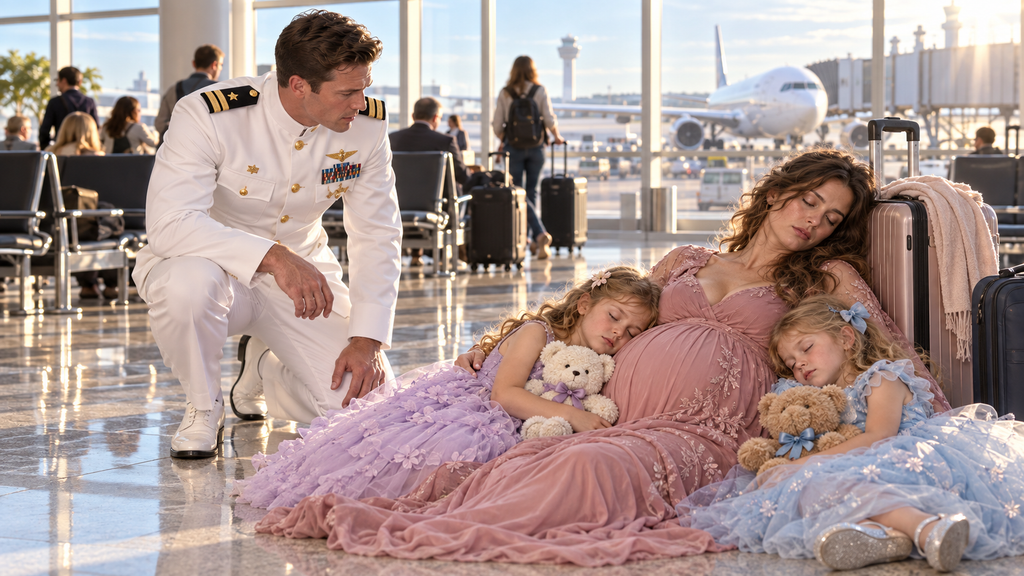
Almost exactly where I had first seen them sleeping beside that battered blue suitcase.
Evelyn became quiet.
“You remember?”
“Every second.”
She looked toward the floor.
“I was so tired.”
“I know.”
“I had eleven dollars.”
My chest tightened.
“What?”
“I never told you that.”
She smiled sadly.
“Eleven dollars and seventeen cents.”
I closed my eyes.
“And two granola bars.”
“Evelyn.”
“We were going to figure it out.”
“You always did.”
She looked at me.
“I shouldn’t have had to.”
“No.”
I took her hand.
“I know.”
Maya came running back.
“Can we tell her now?”
Evelyn narrowed her eyes.
“Tell me what?”
Nora joined us.
“Dad is being dramatic.”
“Traitor,” I said.
She grinned.
I reached into my coat.
Evelyn immediately pointed at me.
“Marcus Alexander Vance.”
I froze.
“That tone is unnecessary.”
“If that’s a giant diamond, I swear—”
“It’s not.”
I pulled out a small box.
Her eyes widened.
“Marcus.”
“Relax.”
Inside was not a diamond.
It was a key.
A simple brass key.
She stared.
“What is this?”
“The house on Willow Street.”
Her expression changed.
We had looked at the house months earlier.
Not a mansion.
A warm, ordinary brownstone with a small garden.
Close to the girls’ school.
Close to Evelyn’s work.
A place we both liked.
A place neither of us owned.
“I thought someone bought it.”
“Someone did.”
Her eyes narrowed.
“You bought it?”
“No.”
She frowned.
I handed her an envelope.
Inside was the ownership paperwork.
Both our names appeared on the first page.
I waited.
“You put my name—”
“No.”
I interrupted gently.
“You did.”
She looked confused.
“I had the attorney send you the documents last week disguised with the boring tax paperwork you never read.”
Her mouth fell open.
“You tricked me into signing property documents?”
My face drained.
The girls burst out laughing.
Then Evelyn started laughing too.
“Marcus, look at your face.”
I realized what I had just said.
“Oh, God.”
She wiped tears from her eyes.
“You really learned nothing.”
“No, no, no.”
I pulled another folder from my coat.
“You signed an acknowledgment to review a proposed joint purchase. Nothing was finalized.”
She laughed harder.
“I hate you.”
“I deserved that.”
I handed her the actual documents.
“Nothing happens unless you read every page.”
She looked at me.
“Every page?”
“Every single one.”
“What about the tiny print?”
“Especially the tiny print.”
Her laughter faded into something softer.
“And if I say no?”
“Then we don’t buy it.”
“If I want a different house?”
“We find one.”
“If I want to keep my apartment?”
“You keep it.”
“And if I say yes?”
My heart began pounding.
“Then we build something that belongs to all four of us.”
The girls exchanged glances.
Maya whispered loudly to Nora:
“He’s still being dramatic.”
“I heard that.”
“Good.”
Evelyn looked at the key.
Then at me.
“There’s something else, isn’t there?”
I sighed.
“You know me too well.”
I reached into my other pocket.
This time, I did take out a ring.
Small.
Elegant.
Nothing like the massive stone my younger self would have chosen.
Evelyn stared at it.
I didn’t kneel.
Not yet.
Because I needed to say something first.
“Six years ago, I thought love meant wanting someone in your future.”
My voice shook.
“Then I lost you.”
The girls became quiet.
“And when I found you again, I thought love meant fixing everything.”
Evelyn’s eyes filled.
“I learned I couldn’t.”
I took her hand.
“I couldn’t give you back those years.”
“I couldn’t be there for their first steps.”
“I couldn’t hold your hand when they were born.”
“I couldn’t undo the nights you were scared.”
Tears slipped down her cheeks.
“I couldn’t become the man I should have been six years ago.”
I swallowed.
“But you’ve allowed me to become their father.”
I looked at Maya and Nora.
“And you’ve allowed me to become your partner again.”
Then I looked back at her.
“I don’t want ownership.”
“I don’t want control.”
“I don’t want promises made because someone thinks they’re supposed to make them.”
I opened the ring box.
“I want choices.”
“Yours.”
“Mine.”
“Theirs.”
I nodded toward the girls.
“Every day.”
My voice nearly failed.
“So I’m asking you a question.”
Now I knelt.
Maya gasped dramatically even though she had clearly helped plan everything.
Nora whispered:
“Finally.”
I almost laughed.
“Evelyn Hart, will you marry me?”
She stared down at me.
Tears on her face.
Then she looked at the girls.
Maya gave two thumbs up.
Nora said:
“Mom, he’s been practicing that speech for three weeks.”
“Nora!”
“What?”
Evelyn laughed through her tears.
Then she looked back at me.
“Yes.”
One word.
The word I had once assumed I would hear six years earlier.
The word I thought had been stolen forever.
Yes.
I stood and she wrapped her arms around me.
Maya and Nora crashed into both of us.
Four people tangled together in the middle of an airport terminal.
Travelers walked around us.
Announcements echoed overhead.
Planes arrived.
Planes departed.
People said goodbye.
People came home.
And for one strange, beautiful moment, the place where I had discovered everything I lost became the place where I understood what I had found.
We married six months later.
Small ceremony.
Forty people.
No business partners invited out of obligation.
No society pages.
No family expectations.
Maya carried the rings.
Nora forgot the flower petals and threw them all at once directly onto my shoes.
Evelyn laughed so hard she could barely finish her vows.
My mother attended.
She sat in the third row.
Not beside us.
Not controlling anything.
Just present.
When Evelyn walked toward me, I thought about the first time I saw her six years after she disappeared.
Exhausted.
Sleeping against an airport wall.
Protecting two little girls with eleven dollars in her wallet.
I thought about the man I had been.
Successful.
Wealthy.
Respected.
And unbelievably empty.
Then I looked at the woman walking toward me.
And I finally understood what my father had meant.
Money was not a family.
A surname was not a family.
A house was not a family.
Even blood alone was not a family.
Family was who stayed when staying was difficult.
Who told the truth when the truth was costly.
Who respected your freedom even when they were afraid to lose you.
Who showed up.
Again.
And again.
And again.
After the ceremony, Maya pulled my jacket sleeve.
“Dad.”
“Yeah?”
“Mom’s crying.”
I looked toward Evelyn.
She stood beneath the garden lights, wiping tears from her cheeks.
“Happy crying?”
Maya nodded.
“I think so.”
Nora joined us.
“Go kiss her.”
I raised an eyebrow.
“Excuse me?”
“You’re married now.”
“So?”
“That’s what married people do.”
Maya rolled her eyes.
“Just go.”
I laughed.
Then walked toward my wife.
Evelyn looked at me.
“What?”
“The management team sent me.”
She glanced behind me.
The twins waved impatiently.
Evelyn laughed.
I wrapped my arms around her.
“You okay?”
She nodded against my chest.
“I was just thinking.”
“Dangerous.”
“Very.”
She looked up.
“Do you ever wish you hadn’t been delayed that morning?”
I thought about it.
The mechanical delay.
The Boston deal.
The red letters on the departure board.
The thirty-five minutes that once felt like a disaster.
“No.”
“Never?”
“If that plane had left on time…”
My voice caught.
“I might have spent the rest of my life believing you abandoned me.”
She rested her forehead against mine.
“And I might have spent mine believing you abandoned us.”
Behind us, the girls started arguing over cake.
I smiled.
“Turns out missing that flight was the best business decision I ever made.”
She groaned.
“That was terrible.”
“It was accurate.”
“It was terrible.”
“You married me anyway.”
“I can still change my mind.”
I kissed her.
She laughed against my mouth.
And in that moment, surrounded by the family I had almost never known existed, I realized that the greatest loss of my life had never been the Boston estate.
It wasn’t the acquisition I canceled.
It wasn’t the millions spent cleaning up the damage.
It wasn’t my mother’s influence.
It wasn’t even my family’s reputation.
The greatest loss had been six years.
Six years of believing a lie.
Six years when two little girls learned to walk, talk, laugh, fall, get back up, and become themselves without knowing their father would have given anything to be there.
I could never reclaim those years.
That truth would always hurt.
But pain was no longer the only truth.
Because I had tomorrow.
I had Tuesday breakfasts.
Saturday parks.
Crooked braids.
Lost teeth.
School concerts.
Bedtime stories.
Birthday cakes.
Arguments over peas.
Future heartbreaks I didn’t know about yet.
Graduations I intended to embarrass them at.
Wedding dances I hoped were decades away.
Ordinary mornings.
Ordinary nights.
Thousands of ordinary moments.
The things wealthy people sometimes overlook while chasing extraordinary ones.
Those were my fortune now.
And every morning, when Maya or Nora ran into our room without knocking, when Evelyn groaned and buried her head beneath the pillow, when tiny feet landed directly on my ribs and someone demanded pancakes before sunrise…
I remembered the man standing in Terminal 4.
The man staring at two sleeping children who had his eyes.
The man who thought a delayed flight was ruining his life.
He had no idea.
His life wasn’t being ruined.
It was finally arriving.
THE END! THANK YOU FOR READING!❤️