
“Commander… there’s something you need to see about the fourth boy.” Major Bishop’s words hung between us. I glanced through the narrow window in the hospital door.
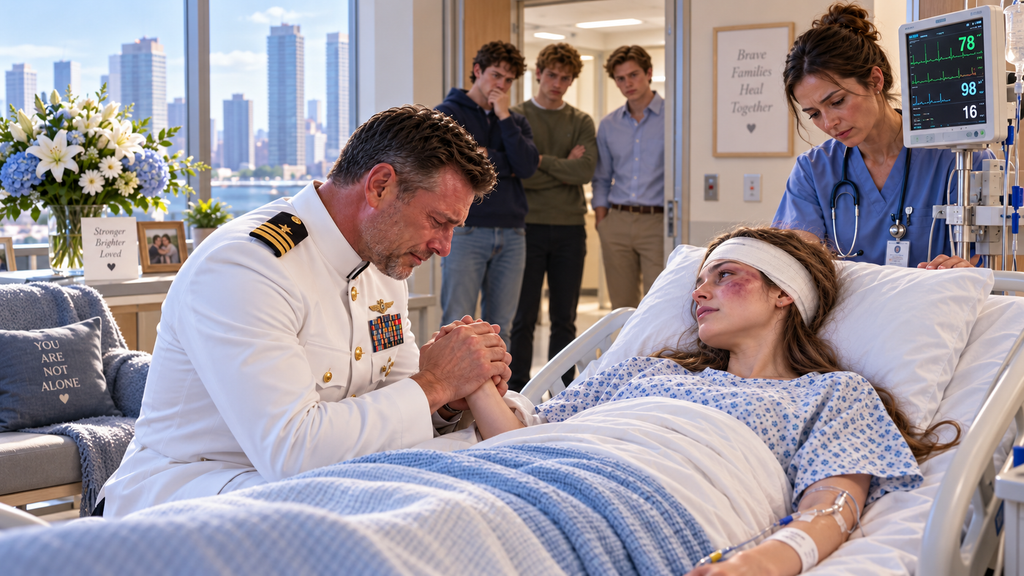
Nora had fallen asleep beneath a thin white blanket. Even unconscious, she kept one hand curled near her chest, as though she were holding on to something no one else could see.
“What about Preston Caldwell?”
Bishop did not answer immediately.
That bothered me more than if he had sworn.
Finally, I heard him exhale.
“Preston didn’t leave campus with the other three.”
I tightened my grip on the phone.
“Explain.”
“He left in an ambulance.”
I went still.
“What?”
“I pulled hospital intake records through an old contact who owes me more favors than either of us should admit. Preston Caldwell was admitted to St. Matthew’s Medical Center forty-seven minutes after Nora.”
My eyes moved toward my sleeping daughter again.
“For what?”
“Three fractured ribs. A dislocated shoulder. Concussion. Split lip.”
There was another pause.
“And bruising around his throat.”
For several seconds, the only sound in the hallway was the distant electronic beeping of medical equipment.
“Who did it?”
“We don’t know yet.”
I stared at the floor.
Four names had been written on that bloodstained piece of paper.
Chad Kensington.
Brantley Sterling.
Wyatt Holbrook.
Preston Caldwell.
I had assumed they were four attackers.
Maybe Nora had been telling me something more complicated.
“Where is Preston now?”
“That’s the interesting part.”
Bishop’s keyboard started clicking again.
“Officially, he was discharged to his family.”
“And unofficially?”
“Nobody has seen him since.”
A coldness settled inside me.
“Bishop.”
“Yes, Commander?”
“Find him.”
His answer came without hesitation.
“Already looking.”
I ended the call.
Then I walked back into Nora’s room.
She was awake.
Her eyes were barely open, but they were fixed on me.
I sat beside her.
“Hey.”
She blinked slowly.
Because of the wires holding her jaw in place, she couldn’t speak.
So I handed her my phone.
“Can you type?”
Her fingers trembled.
It took almost a minute.
Then she handed the phone back.
Four words appeared on the screen.
PRESTON TRIED TO HELP.
I looked at her.
My daughter’s eyes filled with tears.
I typed a question.
Did the other three hurt him?
She nodded.
Then she took the phone again.
Her fingers moved painfully across the screen.
He brought me there.
Another pause.
He said they only wanted to talk.
Then:
When Chad hit me, Preston tried to stop them.
Her hands began shaking harder.
I reached toward her.
She pulled back.
Not because she was afraid of me.
Because she needed to finish.
They beat him too.
My chest tightened.
Nora looked at me.
Then she typed one final sentence.
Dad, they weren’t trying to scare me because of some party.
I read it twice.
I looked up.
Her expression had changed.
There was fear in it.
But beneath the fear was something else.
Something I recognized.
Determination.
I gave the phone back.
“Why did they attack you?”
Nora typed slowly.
Because of Emma Ruiz.
I had never heard the name.
“Who is Emma?”
Nora swallowed painfully.
Then she typed.
A freshman.
She disappeared from school six months ago.
And suddenly, the attack on my daughter became something much bigger.
THE GIRL WHO DISAPPEARED
Nora had always been stubborn about injustice.
Her mother used to laugh about it.
When Nora was six, she saw a boy shove another child off a swing and marched directly between them.
When she was eleven, she found out a classmate was eating lunch alone because other kids mocked his stutter.
For the next four months, Nora sat beside him every day.
When she was fifteen, she confronted a teacher for humiliating a girl who couldn’t afford a field trip.
That was Nora.
She was gentle.
Until someone weaker than her needed help.
Then she became steel.
According to what she typed over the next twenty minutes, Emma Ruiz had entered Worthington University on a full academic scholarship.
First person in her family to attend college.
Straight-A student.
Pre-law.
Her father repaired elevators.
Her mother cleaned offices at night.
Emma had spent eighteen years doing everything right.
Six months into her freshman year, she suddenly withdrew from school.
No explanation.
No goodbye.
People were told she had suffered “emotional difficulties.”
Nora didn’t believe it.
Because two weeks before Emma vanished, she had shown up at Nora’s dorm room crying.
She claimed Chad Kensington had assaulted her after a fraternity fundraiser.
She had gone to campus security.
Two days later, she was summoned to the university president’s office.
A lawyer was waiting.
So was Chad’s father.
Emma was told there had been “a misunderstanding.”
She was also reminded that her scholarship was funded through a foundation connected to the Kensington family.
Then a confidential settlement appeared.
Emma refused to sign.
Three days later, security footage from the fraternity house mysteriously became corrupted.
Witnesses changed their stories.
A disciplinary complaint disappeared.
Within two weeks, Emma was gone.
Nora had tried calling her.
No answer.
Then, one month ago, Nora received an envelope.
No return address.
Inside were photocopies.
Complaints.
Settlement agreements.
Security reports.
Internal university emails.
Not one victim.
Seven.
Seven young women over four years.
Different accusations.
Different dates.
Same names appearing again and again.
Chad Kensington.
Brantley Sterling.
Wyatt Holbrook.
And sometimes—
Preston Caldwell.
But Preston’s name appeared differently.
He wasn’t identified as an attacker.
He was listed as a witness.
Twice.
In one complaint, Preston had allegedly told an investigator that Chad had been intoxicated and aggressive.
Three days later, his statement had been withdrawn.
In another report, Preston said he saw Wyatt dragging an unconscious student toward a vehicle.
That statement disappeared too.
Nora had begun copying everything.
She contacted two former students.
Then a third.
And eventually—
Emma.
Emma finally responded.
She had never willingly left Worthington.
Her parents had been threatened with financial ruin.
Her father’s employer suddenly lost a major contract.
Her younger brother’s private-school scholarship disappeared.
The Ruiz family understood the message.
Stop talking.
Or everyone you love suffers with you.
Nora wanted to expose it.
She had arranged to meet a reporter.
But someone discovered what she was doing.
Three days later, Preston Caldwell approached her.
He told Nora that Chad knew.
He begged her to destroy the documents.
Nora refused.
Preston insisted she didn’t understand how powerful their families were.
She asked him why he was warning her.
Preston said something she had never forgotten.
Because I’ve spent my entire life watching my father make problems disappear.
The night Nora was attacked, Preston called her.
He told her Chad wanted to meet.
Five minutes.
Public campus parking structure.
He promised nothing would happen.
Nora went because Preston claimed he was finally willing to testify.
Instead, Chad, Brantley, and Wyatt were waiting.
Preston realized too late that he had been used to lure her there.
Chad demanded the documents.
Nora refused.
He slapped her.
Preston stepped between them.
Brantley struck him from behind.
Then all three turned on Nora.
By the time Preston got back to his feet, Nora was already on the ground.
He threw himself over her.
That was how he got the broken ribs.
The last thing Nora remembered was Preston screaming at them to stop.
Then someone kicked her in the face.
Everything went black.
I sat beside my daughter, reading the final message she had typed.
I thought Preston left me there.
A tear slid into her hair.
Another message.
But I heard him call 911 before I passed out.
Then:
Dad, if he disappeared, they did something to him.
My daughter was asking me to help one of the people I had arrived prepared to destroy.
I studied her swollen face.
A strange feeling moved through me.
Pride.
Even after what had happened to her, Nora still cared whether somebody else was suffering.
I covered her hand with mine.
“I’ll find him.”
Her eyes closed.
Then she typed one final word.
Promise?
I leaned forward and kissed her forehead.
“Promise.”
At 3:12 that morning, Task Force Vanguard came back from the dead.
Not with guns.
Not with uniforms.
Not with helicopters.
We were older now.
Some of us had gray hair.
One had an artificial knee.
Another wore reading glasses.
But the thing that had once made Vanguard dangerous had never been firepower.
It was the fact that each member knew how to find the truth when somebody powerful wanted it buried.
Major Thomas Bishop arrived first.
He walked into the hospital waiting room carrying an old leather laptop bag and wearing a charcoal suit that looked slept in.
He had been thirty-two the last time I saw him.
Now he was fifty-one.
His hair was almost completely silver.
But his eyes were the same.
Sharp.
Patient.
Always noticing.
He stopped six feet away from me.
Neither of us spoke for several seconds.
Then he smiled faintly.
“You got old, Commander.”
“So did you.”
“Speak for yourself.”
I almost smiled.
Then his expression changed.
“How is she?”
“Alive.”
Bishop nodded.
Sometimes soldiers understand everything contained inside one word.
Alive meant broken.
Alive meant hurting.
Alive meant we still had a chance.
Behind him came Colonel Lena Ortiz.
She had left the Army and spent twelve years as a federal prosecutor before entering private practice.
She carried no weapon.
Just a red legal folder.
Frankly, Lena had always frightened more people with folders than the rest of us did with rifles.
She hugged me.
No salute.
No formalities.
Just a hug.
“I’m sorry, David.”
“Thank you.”
The third person through the door was Marcus Reed.
Former intelligence specialist.
Now an investigator for financial crimes cases.
Six foot four.
Broad shoulders.
Thick beard.
He looked at me.
Then toward Nora’s room.
“Which one do you want first?”
Lena shot him a look.
“Marcus.”
“What?”
“We are not murdering college students.”
“I meant interviewing.”
“No, you didn’t.”
Marcus shrugged.
I stared at all three of them.
Nineteen years.
Nineteen years since we had stood in the same room.
Nineteen years since I walked away.
And yet none of them asked why I had called.
None hesitated.
Bishop placed his bag on a table.
“You said everything.”
“Yes.”
He opened the laptop.
“So here’s everything.”
The screen filled with names.
Companies.
Foundations.
University board members.
Political donations.
Construction contracts.
Private-security firms.
Banking connections.
Bishop pointed.
“Chad’s father, Lawrence Kensington, controls Kensington Development Group. They have roughly two billion dollars in active university and municipal construction projects.”
Next.
“Brantley Sterling’s family owns Sterling Capital Partners. Private equity, commercial property, debt acquisition.”
Next.
“Wyatt Holbrook’s mother sits on the state university oversight commission. His father owns Sentinel Strategic Services.”
I frowned.
That name.
Sentinel.
Something inside me shifted.
Bishop saw it.
“Recognize it?”
“Yes.”
I stepped closer.
Sentinel Strategic Services had once been called Sentinel Defense Logistics.
Nineteen years earlier, Sentinel had been one of the private contractors attached to an operation that destroyed Task Force Vanguard.
Lena noticed my expression.
“What is it?”
I didn’t answer immediately.
There are memories you bury so deeply that even thinking about them feels like digging up a grave.
A desert road.
Burning vehicles.
Radio silence.
Seven men waiting for extraction that never came.
Four of them never leaving that valley.
Sentinel had been responsible for logistics.
They changed a route.
Delayed an aircraft.
Then claimed miscommunication.
For years I believed it had been incompetence.
Later I discovered evidence suggesting otherwise.
But before I could prove it, the investigation was classified.
Vanguard was dissolved.
My record vanished.
And I was given a choice.
Keep digging.
Or disappear and keep my family safe.
Nora had been six months old.
I chose her.
“What about Caldwell?” I asked.
Bishop looked down.
And I knew.
There it was.
The thing he had hesitated to tell me.
“Preston Caldwell’s father isn’t just a banker.”
A photograph appeared.
Malcolm Caldwell.
White hair.
Expensive suit.
Polished smile.
I knew him.
I had known him before half the country knew his name.
Nineteen years earlier, Malcolm Caldwell had been Sentinel Defense Logistics’ chief legal adviser.
He had been one of the civilians sitting in the room when Task Force Vanguard was ordered to stand down.
He had looked me directly in the eyes after four of my men died and told me there would be no investigation.
I whispered his name.
“Caldwell.”
Lena looked at me.
“You know him.”
“He helped bury Vanguard.”
Silence.
Marcus stopped smiling.
Bishop turned the laptop toward me.
“There’s more.”
A scanned document appeared.
CLASSIFIED.
OPERATION NIGHT LANTERN.
My old designation appeared beneath it.
VANCE, DAVID A.
COMMANDING OFFICER.
My throat tightened.
“Where did you get this?”
“I didn’t.”
Bishop clicked.
“Preston did.”
I stared at him.
“What?”
“Three months ago, someone using an encrypted account uploaded portions of the Vanguard archive into a protected cloud server. I found the access trail because Preston’s laptop synchronized with it.”
“Why would Caldwell’s son have my file?”
Bishop leaned back.
“My guess?”
“Yes.”
“He found his father’s private archive.”
Something shifted inside my chest.
Bishop opened another document.
This one wasn’t military.
It was a personal letter.
Handwritten.
Malcolm Caldwell’s handwriting.
The recipient was Wyatt Holbrook’s father.
The date was nineteen years ago.
Bishop read one sentence aloud.
“Vance has refused to let the matter die. If necessary, we will ensure he does.”
Lena went pale.
Marcus muttered something under his breath.
I continued staring at the letter.
For nineteen years, I had wondered whether I had been paranoid.
Whether I had imagined the threat.
Whether disappearing had really been necessary.
Now I was looking at proof.
My old life and Nora’s attack were connected by the same families.
Not because anyone knew who Nora’s father was.
But because the machine that had buried my soldiers nineteen years ago had never stopped operating.
It had simply found new things to bury.
Contracts.
Crimes.
Victims.
Young women.
And now my daughter.
Bishop spoke quietly.
“David.”
I looked at him.
“If Preston found all this, his father knows.”
“And if his father knows…”
“He knows Preston can destroy him.”
I turned toward the hospital window.
“Find the boy.”
Bishop nodded.
Then Lena caught my arm.
“And David?”
I looked at her.
“We do this right.”
Her eyes held mine.
“No bodies.”
“No revenge.”
“No disappearing people.”
“You understand me?”
I thought of Nora.
Of the swelling around her face.
Of the surgeon pointing to six fractures.
For one dark second, an older version of me whispered that justice was too slow.
That men like Caldwell understood fear better than courtrooms.
Then I remembered my daughter typing through trembling fingers.
Promise?
I looked at Lena.
“We do it right.”
She held my gaze for another second.
Then nodded.
“Good.”
Marcus sighed.
“I liked the old Commander better.”
Lena looked at him.
“No, you didn’t.”
Marcus considered it.
“Fair.”
THE FIRST CRACK
At 6:40 a.m., Bishop found Preston’s phone.
Or rather, he found where it had stopped moving.
Forty miles outside the city.
A private property belonging to Caldwell Agricultural Holdings.
Which sounded wholesome until you realized Malcolm Caldwell hadn’t grown anything in his life.
The property was an old hunting lodge surrounded by six hundred acres.
Preston’s phone had arrived there at 11:18 p.m.
Then gone dark.
“We call law enforcement,” Lena said.
Marcus shook his head.
“Local sheriff’s campaign committee received twenty-seven thousand dollars from Caldwell interests last year.”
“Then state police.”
“Caldwell’s brother-in-law chaired their appropriations committee for eight years.”
“Federal?”
Bishop looked at me.
“We need probable cause.”
I stared at the map.
Then Nora texted me from her hospital bed.
Ask about the watch.
I walked back into her room.
“What watch?”
She pointed toward my phone.
Then typed.
Preston always wears one.
Old black sports watch.
He told me his mother gave it to him before she died.
Said he never takes it off.
Bishop heard me repeat the message.
His expression changed.
“What brand?”
Nora typed it.
Bishop smiled.
“I love your daughter.”
I raised an eyebrow.
“Respectfully.”
He started typing.
“Certain models retain independent location data even if the paired phone is disabled.”
Lena crossed her arms.
“Can you access it legally?”
“No.”
“Then don’t.”
Bishop sighed dramatically.
“Lawyers ruin everything.”
But Nora had something better.
She knew Preston’s sister.
Claire Caldwell.
Twenty-three.
Graduate student in Boston.
Nora had met her twice.
At 7:03 a.m., Nora sent Claire a message.
Your brother is in danger. Call me.
Claire called in twelve seconds.
I answered.
“Who is this?”
“My name is David Miller. I’m Nora’s father.”
Silence.
Then:
“Oh my God.”
“You know what happened?”
“My father said Nora was injured in an accident.”
“She was beaten.”
Claire began breathing faster.
“Where’s Preston?”
“That’s what we’re trying to determine.”
“My father said he sent Preston abroad.”
“He didn’t.”
Silence again.
Then Claire whispered:
“I knew it.”
“What?”
“Preston called me last night.”
Everyone in the room looked toward the phone.
Claire continued.
“He was crying. I’ve never heard my brother cry.”
“What did he say?”
“He said he’d done something terrible.”
My stomach tightened.
“He said he brought Nora to Chad.”
Claire’s voice broke.
“He said he thought they were just going to frighten her. Then Chad started hitting her.”
I closed my eyes.
“He tried to stop them.”
“I know.”
“How?”
“Because Preston told me Chad and Wyatt beat him until he couldn’t stand.”
Nora turned her face away.
Claire continued.
“He called 911. Then he called me from the hospital. He said Dad was coming.”
“What happened when your father arrived?”
“He told Preston not to say anything.”
“Then?”
“Preston told him he was done protecting everyone.”
Claire swallowed.
“He said he had copies.”
Bishop moved closer.
“Copies of what?” I asked.
“Everything.”
The room became completely silent.
“Claire, I need you to tell me exactly what your brother said.”
She took a breath.
“He said, ‘If Dad comes after Nora, I’m burning the whole kingdom down.’”
Marcus slowly smiled.
I didn’t.
Because men like Malcolm Caldwell did not hear threats from their children as rebellion.
They heard them as problems.
“Does Preston have the watch Nora mentioned?”
“Yes.”
“Can you access the account?”
“Yes.”
Lena spoke immediately.
“Claire, if you voluntarily access your brother’s shared family-location account, can you see his device?”
There was tapping.
Then a gasp.
“Yes.”
“Where is he?”
Claire gave us the address.
The hunting lodge.
But the watch had not stopped there.
It was moving.
Fast.
North.
Bishop opened a map.
Claire read the location updates aloud.
Highway 18.
Then Route 6.
Then an industrial road.
Marcus leaned toward the screen.
“Where are they taking him?”
Bishop zoomed out.
There was almost nothing ahead.
Except an airfield.
Private.
Owned by Caldwell Aviation Holdings.
Lena was already dialing.
“Now we have a witness reporting possible unlawful detention, a live location and evidence he may be transported.”
She looked at me.
“I have someone at the U.S. Attorney’s Office who will listen.”
I nodded.
“Call.”
For nineteen years, I had lived with the belief that institutions could be bought.
Some could.
Some people could.
But corruption makes one mistake repeatedly.
It assumes everyone has a price.
They don’t.
At 7:32 a.m., Lena reached Assistant U.S. Attorney Rachel Monroe.
At 7:41, Monroe contacted a federal magistrate.
At 7:52, federal agents were moving.
At 8:06, the vehicle carrying Preston Caldwell reached the private airfield.
At 8:11, a Gulfstream began preparing for departure.
At 8:14, three black SUVs entered through the main gate.
Not ours.
Federal agents.
The plane never left the ground.
Preston Caldwell was found in the rear cabin.
No passport.
No luggage.
One hospital bracelet still around his wrist.
Two private security employees claimed he was voluntarily traveling to Switzerland for medical treatment.
Preston told agents three words.
“I was kidnapped.”
And with that—
the first crack appeared in the wall.
PRESTON CALDWELL
I met him that afternoon.
Federal protection placed him in another wing of the same hospital.
When I entered, Preston looked nothing like the arrogant billionaire’s son I had imagined.
His left eye was swollen.
His shoulder was immobilized.
Bandages wrapped his ribs.
He looked twenty years older than twenty-one.
When he saw me, fear crossed his face.
“You’re Nora’s father.”
“Yes.”
He tried to sit up.
Pain stopped him.
“I’m sorry.”
I said nothing.
Tears appeared in his eyes.
“I didn’t know they were going to hurt her.”
Still, I said nothing.
“I swear.”
“Did you bring my daughter to them?”
His face collapsed.
“Yes.”
“Then you bear responsibility.”
“I know.”
“Do you?”
He looked away.
I stepped closer.
“For the rest of your life, Preston, when Nora touches the plates in her jaw, part of that belongs to you.”
He began crying silently.
I didn’t enjoy it.
That surprised me.
Twenty-four hours earlier, I would have imagined satisfaction.
There was none.
Only exhaustion.
“You made a coward’s decision,” I said.
He nodded.
“My whole life has been cowardly.”
“No.”
He looked at me.
“One decision doesn’t get to become your entire identity unless you let it.”
His breathing shook.
“You tried to stop them.”
“Too late.”
“Yes.”
I pulled a chair beside his bed.
“But you called 911.”
“Yes.”
“You kept evidence.”
His eyes snapped toward me.
“How do you know?”
“Because you’re not the only person who knows how to hide things.”
Something changed in his expression.
Recognition.
He stared at me.
Then whispered:
“Vance.”
The room seemed to shrink.
I stood very still.
Preston swallowed.
“Commander David Vance.”
I closed the door.
“How do you know that name?”
“My father.”
He looked toward the hallway.
“He kept files.”
“What files?”
“Everything.”
Preston spoke for almost an hour.
His mother had died when he was sixteen.
Afterward, Preston began drinking.
Getting into trouble.
His father covered everything.
Traffic tickets vanished.
A drug possession charge disappeared.
A school fight became a misunderstanding.
At first, Preston loved it.
Then he began noticing how easy it was.
Not just for him.
For everyone around his father.
Judges attended Caldwell fundraisers.
University presidents called him personally.
Police chiefs played golf at his estate.
Business partners received contracts after private dinners.
Problems vanished.
People vanished from careers.
Complaints disappeared.
Eventually Preston began wondering what else his father had erased.
One night, he opened a locked room in Caldwell’s study.
Inside were physical files.
Decades of them.
Politicians.
Executives.
Judges.
Military contractors.
Journalists.
Victims.
Enemies.
Leverage.
And one thick gray folder labeled:
VANGUARD.
Preston opened it.
That was how he learned about me.
About Operation Night Lantern.
About Sentinel.
About the extraction that never came.
And about a handwritten order instructing Caldwell’s people to monitor my wife.
My blood turned cold.
“What?”
Preston nodded.
“Your wife.”
“Her name was Sarah.”
“I know.”
I grabbed the bedrail.
Sarah had died twelve years ago.
Cancer.
Nothing suspicious.
Nothing anyone caused.
But the thought that Caldwell had watched her while Nora was an infant made something ancient wake inside me.
Preston continued.
“Your family was under surveillance for almost eight months.”
“Why?”
“Because my father believed you had copied documents.”
I remembered.
Of course.
The missing procurement files.
The altered route orders.
The payments routed through shell companies.
I had copied everything onto an encrypted drive.
Then hidden it.
But Sarah had begged me to let it go after men began following her.
So I did.
Or I thought I did.
“Where are those files now?” I asked.
Preston stared at me.
“My father doesn’t have them.”
“Then who does?”
He swallowed.
“I think you do.”
I frowned.
“That’s impossible.”
“No.”
He leaned closer despite the pain.
“My father wrote a note about you.”
“What note?”
Preston recited it from memory.
“Vance never destroyed his insurance policy. He hid it inside the only thing he trusted more than Vanguard.”
My heart stopped.
The only thing I trusted more than Vanguard.
Sarah.
I stood.
Memories crashed through me.
Our first apartment.
Nora’s birth.
Sarah standing in the kitchen holding our baby.
The night I came home and told her everything.
Her crying.
My promise.
I had given Sarah the drive.
I told her to hide it somewhere nobody connected to my work could find it.
I never asked where.
Because not knowing was safer.
After Sarah died, I packed away her belongings without going through most of them.
Twelve years.
The answer might have been in my house for twelve years.
Preston watched my face.
“You know where it is.”
“I know where to look.”
Then his expression changed.
“There’s something else.”
“What?”
“The university.”
He reached for water.
I helped him.
After drinking, he continued.
“Those girls weren’t the beginning.”
“What do you mean?”
“My father and the others have used Worthington for years.”
“For what?”
“Money.”
Bishop had been right.
Universities receive enormous construction funding.
Research grants.
Defense partnerships.
Real-estate financing.
Technology contracts.
Scholarship foundations.
Each of the four families had interests intersecting through Worthington.
Kensington built facilities.
Sterling financed them.
Holbrook supplied private security and data systems.
Caldwell arranged capital and political connections.
Together, they moved hundreds of millions.
And according to Preston, some contracts were inflated.
Some companies barely existed.
Some money flowed into shell organizations.
Anyone who asked too many questions was pressured.
Employees were fired.
Audits were delayed.
Students were easy to intimidate.
Especially students without powerful families.
The assault allegations had become part of the same culture.
The sons had grown up watching their fathers erase consequences.
Eventually, they believed consequences did not exist.
Nora threatened that belief.
“She had copies of complaints,” Preston said.
“I know.”
“No.”
He shook his head.
“She had more.”
I stared at him.
“What?”
“Emma Ruiz didn’t just send her assault documents.”
Preston looked terrified.
“She sent financial records.”
That explained everything.
The attack had not merely been three spoiled young men protecting themselves.
Their fathers had something at stake too.
Nora had unknowingly been carrying evidence of federal crimes.
“How much did Nora know?”
“Almost nothing. She thought the spreadsheets were university budget records.”
“Who knew she had them?”
“Chad.”
“How?”
“His father told him.”
I leaned back.
There it was.
The fathers had known before the attack.
Maybe they never explicitly ordered their sons to break Nora’s jaw.
People like Caldwell were smarter than that.
They didn’t say:
Destroy her.
They said:
Handle the problem.
Young men raised without consequences supplied the rest.
I looked at Preston.
“Will you testify?”
Fear moved across his face.
“My father will destroy me.”
“Maybe.”
“He can ruin Claire too.”
“Maybe.”
“He’ll go after Nora.”
“He already did.”
Preston looked down.
I waited.
Courage is rarely the absence of fear.
Usually, it is a person looking at everything they could lose and deciding some things matter more.
Finally Preston raised his eyes.
“Yes.”
I nodded.
“Yes what?”
“I’ll testify.”
“About all of it?”
His jaw tightened.
“All of it.”
For the first time, Preston Caldwell stopped being his father’s son.
SARAH’S BOX
I had not been home in thirty-one hours.
The house felt wrong without Nora.
Her sneakers sat beside the front door.
A mug she had used during her last visit was still in the dishwasher.
On the refrigerator was a photograph of her and Sarah taken months before Sarah died.
Nora was seven.
Two missing front teeth.
Sarah’s arms wrapped around her.
For a moment, the mission disappeared.
I was just a widower standing in a dark kitchen, wishing the dead could answer questions.
I walked upstairs.
Sarah’s belongings were in the cedar chest at the foot of my bed.
I had opened it perhaps five times in twelve years.
Her scarf lay on top.
Then letters.
Photographs.
A tiny pair of Nora’s baby shoes.
Sarah kept everything.
I sat on the floor.
For twenty minutes, I found nothing.
Then I saw the blue cookbook.
Sarah couldn’t cook.
She once burned boiled eggs.
I used to tease her because she owned exactly one cookbook and never opened it.
The spine felt too thick.
I opened it.
Pages had been cut away from the center.
Inside was a small black drive.
My hands began shaking.
Beneath it was an envelope.
My name.
Sarah’s handwriting.
I stared at it for almost a minute before opening it.
Inside was a letter.
David,
If you’re reading this, then something you hoped would stay buried has come back.
I stopped breathing.
I could almost hear her voice.
You gave me this because you said I was the one person you trusted more than yourself.
You also told me to destroy it if you ever became obsessed with revenge.
Despite everything, I laughed once.
That sounded exactly like Sarah.
Then I kept reading.
I didn’t destroy it.
Not because I wanted you to fight.
Because truth should not belong only to powerful people.
My vision blurred.
If Nora is grown when you find this, then I hope you kept the promise you made me. I hope she knows you as her father before she ever knows you as a soldier.
I covered my mouth.
For nineteen years, that had been my greatest fear.
That my old life would enter Nora’s world.
That she would look at me differently.
Sarah had known.
She always knew.
David, if the past comes back, don’t become the man you were before us.
Be the man we made together.
Below that:
Protect Nora.
Protect the truth.
And come home.
I sat on the bedroom floor crying.
Not loudly.
There are some kinds of grief that don’t need sound.
After twelve years, my wife had reached through time and reminded me who I was.
Not the Phantom Commander.
Not Commander Vance.
David.
Nora’s father.
Sarah’s husband.
I wiped my face.
Then I picked up the drive.
Bishop called thirty seconds after I plugged it into an isolated computer.
“Well?”
“I found it.”
His voice became serious.
“Bring it.”
“No.”
“Commander—”
“If Caldwell has watched me before, assume someone may still be watching the house.”
Silence.
“Good point.”
“I’ll contact Lena. We transfer it properly.”