 Reading Time: 40 minutes
For thirty-two years, Daniel had seen me angry. He had seen me exhausted. He had seen me cry at funerals, panic in emergency rooms, lose sleep over taxes,
Fight with contractors, sit beside his mother through two surgeries, and drive through freezing rain because Melissa had called saying one of her children had a fever.
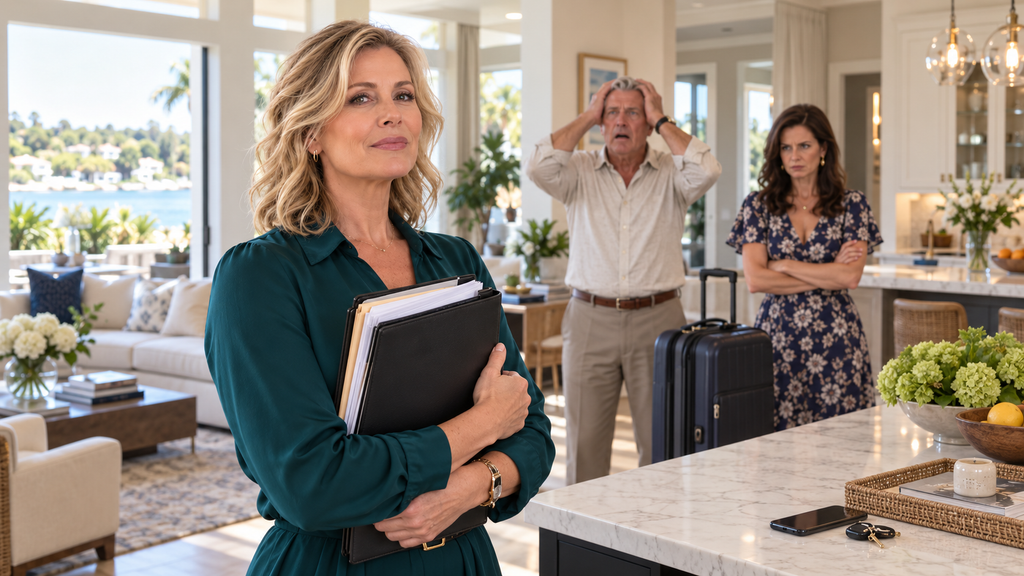
But until that night, I don’t think he had ever seen me finished.
There is a difference.
Anger still wants something.
An apology.
An explanation.
A promise.
Finished wants nothing.
Daniel stared at the folder on the kitchen table as though it were something dangerous.
“A divorce consultation?”
His voice came out quieter the second time.
“Yes.”
“You met with a divorce attorney because I canceled a vacation?”
I leaned back in my chair.
“No.”
He shook his head sharply.
“That is exactly what you’re doing.”
“No, Daniel. I met with a divorce attorney because you canceled our vacation without speaking to me, volunteered me to babysit your sister’s children, told me family comes first while you planned to leave for a golf weekend, and then acted confused when I objected.”
“That’s one argument.”
“No. That’s one evening.”
I watched his expression change.
Not much.
Just enough.
He knew exactly what I meant.
I continued.
“The argument is thirty years old.”
He laughed once, but there was no humor in it.
“Oh, come on.”
“That reaction right there.”
“What reaction?”
“The one where anything that matters to me becomes ridiculous the moment it inconveniences you.”
His jaw tightened.
“That’s not fair.”
“Neither was canceling ten days of my life because Melissa wanted a spa weekend.”
“She needed help.”
“She wanted help.”
“She has children.”
“So do millions of other people.”
His voice rose.
“She’s my sister.”
“And I’m your wife.”
Silence.
There it was.
The sentence that should never have needed saying.
Daniel looked away first.
I had spent most of my marriage believing silence meant someone was thinking.
That night I realized sometimes silence simply meant they had run out of excuses.
He walked to the counter and poured himself water.
His hands weren’t quite steady.
“This is insane.”
I didn’t answer.
“You’re really going to throw away thirty-two years?”
I looked at him.
“Do you know what’s interesting?”
“What?”
“You keep saying I’m throwing away thirty-two years.”
“You are.”
“But you don’t seem interested in asking what those thirty-two years felt like for me.”
His face tightened.
“Oh, so now our entire marriage was miserable?”
“I didn’t say that.”
“That’s what you’re implying.”
“No. Our marriage had good years. Very good years.”
That seemed to surprise him more than if I had called the whole thing terrible.
I folded my hands on the table.
“You were funny when we were young. You used to bring me coffee in bed on Sundays. You once drove four hours in a snowstorm because my father’s furnace broke. When we were first married, you couldn’t afford flowers, so you stole—”
“I did not steal them.”
Despite myself, I almost smiled.
“You cut daffodils from the median strip.”
“They were city flowers.”
“They were not your flowers.”
“They were taxpayer flowers. I paid taxes.”
For half a second, the kitchen felt like ours again.
Two young people in a tiny apartment laughing over flowers wrapped in newspaper.
Then the moment disappeared.
I looked at the man across from me.
“I remember those things, Daniel. That’s why this hurts.”
His eyes dropped.
“Then don’t do this.”
“You’re still not listening.”
“I am listening.”
“No. You’re waiting for me to stop.”
He started to speak.
I held up my hand.
“Please. Just once. Let me finish without deciding what I mean before I say it.”
That stopped him.
I took a slow breath.
“I don’t think you woke up one morning and decided to treat me badly. I think something worse happened.”
His brow furrowed.
“You got used to me.”
He stared at me.
“You got used to the bills being paid. You got used to your mother’s prescriptions being picked up. You got used to taxes being filed, insurance being renewed, tenants being handled, your invoices being sent, your appointments being scheduled, holidays being organized, gifts being purchased, and every family problem somehow finding its way to my phone.”
I swallowed.
“You got so used to me keeping everything running that eventually you stopped seeing the person doing it.”
“That isn’t true.”
“When was my last dentist appointment?”
He blinked.
“What?”
“My dentist appointment. When was it?”
“How would I know?”
“Exactly.”
“That’s ridiculous. You manage your own appointments.”
“And yours.”
“That’s different.”
“Why?”
No answer.
I continued.
“What book am I reading right now?”
He frowned.
“What does that have to do with anything?”
“What was the name of the restaurant I wanted to try for my birthday?”
“Claire—”
“What did I tell you I wanted to see most on this road trip?”
He opened his mouth.
Nothing came out.
I felt something inside me crack.
Not because he couldn’t remember.
Because he looked irritated that I expected him to.
I whispered, “Bryce Canyon at sunrise.”
His eyes shifted away.
“I told you three times.”
“I’ve been busy.”
“So have I.”
“That’s not the same.”
I looked at him for a long moment.
Then I nodded.
“There it is.”
“What?”
“The whole marriage.”
He sat down heavily across from me.
For the first time, he didn’t have an immediate answer.
After a while, he glanced at the folder.
“What did the lawyer say?”
“She explained my options.”
“You actually gave her our financial information?”
“I gave her my financial information.”
“Our finances are joint.”
“Some of them.”
His eyes narrowed.
“What does that mean?”
I pulled the folder toward me.
“You know what it means.”
“No. Apparently I don’t.”
“That’s part of the problem.”
I opened the folder.
Inside were copies Eleanor had prepared that afternoon.
Property records.
Business documents.
Estate records.
Tax filings.
The office lease.
Daniel watched me spread them across the table.
His expression grew more unsettled with every page.
“This building,” I said, touching the first document, “was inherited from my father.”
“I know.”
“The account holding what remains of his estate was kept separately.”
“I know that too.”
“These rental properties were purchased partly with money from that account.”
“So?”
“So the contributions are documented.”
His eyes sharpened.
“Are you trying to take the houses?”
“No.”
“Then what are you saying?”
“I’m saying Eleanor told me not to let you intimidate me with the idea that everything is yours because you earned more income.”
“I’ve never said everything was mine.”
“You told me tonight that I wouldn’t last six months without you.”
His mouth closed.
I slid another paper forward.
“And then there’s this.”
He glanced down.
“What is it?”
“You signed it six years ago.”
He picked it up.
I could almost see the exact moment he recognized his own signature.
“What the hell is this?”
“It was part of the refinancing package when your company expanded.”
“I signed hundreds of documents that week.”
“Yes.”
“You handled all that.”
“Yes.”
“What does it say?”
“Read it.”
His eyes moved across the page.
Then back.
Then across it again more slowly.
His face changed.
Six years earlier, when Daniel’s engineering firm needed additional financing, the bank required clean documentation of ownership.
The building his firm occupied was mine.
Not ours.
Mine.
My father had purchased the property decades earlier and left it to me through his estate.
Daniel knew that.
But because we had spent years treating nearly everything casually inside our marriage, the company’s arrangement had never bothered either of us.
The firm paid below-market rent.
I handled much of its administrative accounting.
And when the bank refinanced its expansion, lawyers had insisted that everything be formalized.
Daniel had signed an acknowledgment that the building was my separate property.
He had signed the commercial lease.
He had signed the company operating agreement confirming that we each held an ownership interest in the firm.
And he had signed a document acknowledging that certain inherited funds were not company assets and had never been contributed to the business.
At the time, he had joked that he would sign anything if I put a yellow sticker next to the signature line.
He had trusted me completely.
So completely that he never bothered to understand what I had built beside him.
He put the document down.
“So that’s your plan?”
“No.”
“You’re going to throw my company out of the building?”
“No.”
“You already sent notice!”
“I sent notice that the lease will not automatically renew under the existing terms.”
“That’s the same thing.”
“It isn’t.”
“The company can’t afford market rent there.”
“That sounds like something the owner should have considered before telling the landlord she couldn’t survive without him.”
His face flushed.
“That’s vindictive.”
“No. Vindictive would be changing the locks.”
“You can’t do that.”
“I know.”
That stopped him.
I met his eyes.
“I’m not trying to hurt you, Daniel.”
“Could have fooled me.”
“That’s because for thirty-two years, any boundary from me has felt like an attack to you.”
He pushed away from the table.
“I’m going to bed.”
“I moved your things into the guest room.”
He froze.
“You what?”
“Just the essentials. The rest are still upstairs.”
“You moved me out of my bedroom?”
“Our bedroom.”
He gave me a look I had seen hundreds of times.
The look that meant I was supposed to reconsider simply because he was displeased.
I didn’t.
After several seconds, he walked toward the stairs.
At the bottom step, he turned.
“Claire.”
“Yes?”
“If I hadn’t canceled the trip, would you have done this?”
It was the first honest question he had asked all evening.
I thought carefully before answering.
“No.”
Relief flickered across his face.
Then I continued.
“Not yet.”
The relief disappeared.
I looked at the suitcase still sitting near the hall.
“That’s what scares me most.”
He said nothing.
“If you hadn’t canceled the trip, I probably would have gone. I would have driven beside you for ten days. I would have taken pictures. I would have posted smiling photographs. We would have come home, and I would have kept doing everything exactly the same way.”
My throat tightened.
“I might have given you another five years.”
He stared at me.
“And five years after that, maybe I would have looked up and been seventy and wondered why I spent my entire adult life waiting for people to ask whether I had plans before assigning me theirs.”
Daniel looked suddenly older.
For the first time that night, I think he understood that the road trip had never been the thing I was losing.
It had simply shown me everything else I had already lost.
He went upstairs.
I stayed at the kitchen table until almost two in the morning.
I expected to cry.
Instead, I opened my road-trip binder.
I had printed everything months earlier.
Hotel confirmations.
Routes.
Restaurant names.
Hiking trails.
Notes written in blue ink.
Outside Moab, I had drawn a tiny star beside one overlook because I had wanted us to stop there before sunset.
In Colorado, I had circled a small mountain town where I’d booked a room with a balcony.
At the bottom of the final page, I had written:
ONE REAL ADVENTURE. JUST US.
I ran my finger over those words.
Then I crossed out the last two.
At 6:14 the next morning, I made coffee.
At 6:52, Melissa arrived.
By 7:03, she was gone.
By 7:15, Daniel had called eleven times.
By 8:30, I was dressed.
By noon, I was sitting across from Eleanor Shaw.
And by five that evening, for the first time in decades, I had begun separating my life from everyone else’s assumptions.
Not secretly.
Not cruelly.
Carefully.
Eleanor kept repeating the same thing.
“Documentation, Claire. No games.”
I agreed.
I didn’t want games.
Games were what people played when they still wanted to win against each other.
I wanted out.
That distinction mattered.
The following morning, Daniel went to work before I woke up.
At 9:17, he texted.
We need to talk tonight.
I read it.
Then put my phone down.
At 9:42, another message appeared.
I spoke to an attorney.
That made me pause.
At 10:05:
You have no right to freeze me out of anything.
I hadn’t frozen him out of anything.
The joint checking account remained untouched.
His business accounts remained untouched.
Our household bills remained paid.
I had simply removed his online access to an inheritance account where he had been an authorized viewer, even though the money legally belonged to me.
I replied with one sentence.
Please have your attorney contact Eleanor.
His answer came immediately.
So that’s how it is now?
I stared at those words.
Then typed:
For legal matters, yes.
He called.
I let it ring.
A minute later, he called again.
Then again.
Finally, I silenced the phone.
At eleven, Melissa called.
I didn’t answer that either.
She left a voicemail.
“Claire, I don’t know what’s going on with you and Daniel, but dragging attorneys into this because I needed one weekend of help is completely insane. You’ve always been there for us, and I don’t understand why you’re suddenly punishing everyone. The kids keep asking why they can’t come to Aunt Claire’s. Call me.”
I listened twice.
Not because I doubted myself.
Because I wanted to hear whether somewhere in that message she asked how I was doing.
She didn’t.
Not once.
By lunchtime, Daniel’s mother called.
Then one of his cousins.
Then his aunt.
Apparently our marriage had become breaking news.
I turned my phone off.
Around three, the doorbell rang.
Melissa.
Of course.
She stood on my porch with her arms crossed.
This time there were no children in the SUV.
“Can I come in?”
“I’d rather talk here.”
Her eyes widened.
“You’re serious?”
“Yes.”
She looked past me as though I were hiding something.
“Daniel said you’re divorcing him.”
“I met with an attorney.”
“Because of Saturday?”
“No.”
“That’s what he said.”
“Then Daniel still isn’t listening.”
Melissa sighed dramatically.
“Claire, marriages have arguments.”
“Yes.”
“People say things.”
“Yes.”
“You don’t blow up an entire family over babysitting.”
I looked at her.
“Why didn’t you ask me yourself?”
She blinked.
“What?”
“About your children. Why didn’t you call me?”
“Daniel said he would handle it.”
“No. He said I would handle it.”
“That’s basically the same thing.”
I actually laughed.
Melissa frowned.
“What?”
“That sentence.”
“What about it?”
“You don’t even hear it.”
She shifted impatiently.
“I knew you wouldn’t mind.”
“How?”
“Because you always help.”
“That wasn’t my question.”
She said nothing.
“How did you know I wouldn’t mind?”
“Well… you always do it.”
“Exactly.”
“I don’t understand.”
“I know.”
I leaned against the doorframe.
“You didn’t know I wouldn’t mind. You never asked. You knew I usually said yes after somebody had already arranged my time for me.”
“That’s not fair.”
“Do you know where I was supposed to be Saturday morning?”
“On that trip.”
“What trip?”
Her expression changed slightly.
“I don’t know.”
“Exactly.”
She looked away.
“Daniel said you’d been planning some driving vacation.”
“Ten days. Utah and Colorado.”
“Oh.”
“I saved for it for a year.”
That surprised her.
“You did?”
“Yes.”
“I thought Daniel paid for it.”
There was no cruelty in her voice.
That almost made it worse.
She genuinely thought anything significant in my life had probably come from Daniel.
I smiled faintly.
“No.”
Melissa looked uncomfortable.
“I didn’t know.”
“You never asked.”
“Claire—”
“I booked every hotel. Planned every route. Researched every stop. Daniel knew how much it meant to me.”
“He probably thought family was more important.”
“Then why was he going golfing?”
Her mouth closed.
I waited.
There was no answer.
Finally, she said, “Greg was already expecting him.”
“And your children were apparently expecting me.”
“That’s different.”
“Why?”
Again, no answer.
I stepped closer.
“Melissa, who was supposed to sacrifice their weekend?”
She looked annoyed now.
“I didn’t think of it like that.”
“No. You thought of it as Claire.”
Her face hardened.
“So now you’re going to hold every favor you’ve ever done over my head?”
“No.”
“Sounds like it.”
“I did those things because I loved your family.”
“Then what changed?”
“I realized love had become an expectation.”
She stared at me.
I continued more gently.
“I love your children. None of this is their fault. I have never regretted spending time with them.”
“Then why—”
“Because I am their aunt, Melissa. Not your emergency childcare department.”
Her cheeks flushed.
“You could have just said no.”
I almost smiled.
“I did.”
That silenced her.
For several seconds, neither of us spoke.
Then she whispered, “You embarrassed me.”
“At your house?”
“No. At the spa.”
I frowned.
“What?”
“I had to cancel.”
I looked at her.
She looked genuinely wounded.
Not because I had been hurt.
Not because my vacation had been canceled.
Because she had lost her spa reservation.
And something in me settled.
Any remaining guilt I had evaporated.
“I’m sorry you lost your reservation.”
She relaxed slightly.
Then I added, “Maybe next time you’ll ask before assuming someone else will give up theirs.”
Her expression hardened again.
“You’ve changed.”
“No.”
I looked back into the house.
“I think I finally stopped hiding how much I minded.”
She left without saying goodbye.
That evening, Daniel returned with flowers.
Tulips.
Not daffodils.
He set them on the counter.
“I thought we could talk.”
I stared at the bouquet.
Thirty years earlier, flowers might have saved an argument.
Twenty years earlier, they might have softened one.
Ten years earlier, I would have thanked him and put them in water even if I was still angry.
That night, I saw them for what they were.
A habit.
He had a problem with his wife.
Flowers were what husbands bought when wives were upset.
He had not bought them because he knew me.
He had bought them because he knew marriage.
There was a difference.
“They’re beautiful,” I said.
He looked relieved.
“I called the hotel.”
I looked up.
“What hotel?”
“The first one on the road trip.”
My heart gave an involuntary jump.
He saw it.
“They still have a room next month.”
I said nothing.
“I can move some meetings. We’ll do the trip.”
“Daniel.”
“No golf. No Melissa. No calls. Nothing.”
“Daniel.”
“I mean it.”
He stepped toward me.
“I screwed up. Fine. I screwed up badly. I shouldn’t have canceled it.”
I felt tears gathering behind my eyes.
Not because I wanted to go.
Because for one dangerous second, the old version of me wanted desperately to accept.
Ten days.
Mountains.
Bryce Canyon.
Maybe he meant it.
Maybe this had scared him enough.
Maybe people could change.
Maybe thirty-two years deserved another chance.
Maybe leaving was selfish.
Maybe staying was loyal.
Maybe—
Then he said, “I just need you to withdraw that lease notice first.”
Everything inside me went still.
He must have seen it on my face.
“That’s not why I’m offering the trip.”
I looked at him.
“Isn’t it?”
“No.”
“Then why mention the lease?”
“Because the company needs stability.”
“And you think the vacation is payment?”
“For God’s sake, Claire.”
He turned away.
“I’m trying here.”
“No.”
“What do you want from me?”
“I wanted you to ask before you canceled it.”
“I apologized.”
“After attorneys became involved.”
“I said I was wrong.”
“After the building became a problem.”
“You’re twisting everything.”
I shook my head.
“I’m finally seeing everything.”
He stared at me.
“What does that even mean?”
“It means you are still trying to restore the system.”
“What system?”
“The one where I make your life work.”
He laughed bitterly.
“This is unbelievable.”
“I agree.”
“You think I used you?”
“I think you depended on me so completely that you stopped respecting the cost.”
“That is not the same thing.”
“No.”
I nodded.
“It’s worse.”
His face changed.
I picked up the flowers.
For a moment, he looked hopeful.
Then I carried them to the sink, filled a vase, and arranged them carefully.
I had spent too many years turning hurt into housekeeping.
This time, I did it because the flowers were beautiful.
That didn’t mean the marriage was saved.
Daniel slept in the guest room.
Three days later, his attorney sent Eleanor a formal letter.
The language was aggressive.
Eleanor read it without expression.
Then she placed it on her desk.
“Standard opening posture.”
“He says I’m intentionally damaging the business.”
“He says your lease notice is retaliatory.”
“Is it?”
She looked at me over her glasses.
“You tell me.”
I thought about it.
“No.”
“Why change the lease?”
“Because if we divorce, I don’t want my former husband’s company operating indefinitely in my inherited building for half market rent.”
“That’s reasonable.”
“I also don’t want to throw fifty employees into chaos.”
“Also reasonable.”
“So what happens?”
“We negotiate.”
That word became the soundtrack of the next six months.
Negotiate.
The word sounds calm.
Civilized.
Two adults sitting across a table.
What it doesn’t capture is the strange grief of watching thirty-two years reduced to categories.
Assets.
Liabilities.
Equity.
Retirement.
Business valuation.
Personal property.
Separate property.
Marital property.
Furniture.
Vehicles.
Insurance.
Pensions.
Tax consequences.
You sit across from someone who once held your hand while you gave birth—or buried a parent, or sat in an emergency room—and lawyers discuss who keeps the dining table.
That table had survived three houses.
Christmas dinners.
Birthday cakes.
Daniel’s father carving a turkey badly enough that we had laughed until we cried.
Melissa’s children coloring underneath it.
My father sitting at one end during the final Thanksgiving before he died.
And suddenly it was listed on a spreadsheet.
DINING SET — ESTIMATED VALUE $1,800.
There is something almost insulting about putting a number on things that contain your life.
But the numbers came anyway.
The company was valued.
The rentals were appraised.
The office building was appraised.
Retirement accounts were examined.
Bank statements arrived.
Tax returns were copied.
And for the first time in our marriage, Daniel was forced to look directly at the financial architecture of the life we had built.
He did not enjoy what he saw.
Not because he was poor.
Daniel had earned good money.
Very good money.
But he had spent decades believing earning money and building wealth were the same thing.
They weren’t.
He earned.
I organized.
I saved.
I invested.
I kept records.
I refinanced at favorable rates.
I questioned insurance renewals.
I documented improvements.
I negotiated leases.
I remembered filing deadlines.
I chased late invoices for his company before they became bad debt.
I transferred money into retirement accounts while he joked that he would “work forever anyway.”
He had been the engine.
I had been the steering wheel.
An engine can make a lot of noise.
Without steering, it doesn’t get very far.
One afternoon, about six weeks after he moved into the guest room, he came home carrying a thick report.
He dropped it on the kitchen island.
“Did you see this?”
I looked at the cover.
BUSINESS VALUATION.
“Yes.”
He opened it.
“You own half.”
“I know.”
“You never told me this was worth that much.”
“I didn’t know the exact number until the valuation.”
“But you knew.”
“I knew the company had value.”
He paced.
“This means if you demand your share, I have to borrow money.”
“I know.”
“Or sell.”
“I know.”
“Do you want me to sell?”
“No.”
He stopped.
“What do you want?”
“I want a fair settlement.”
“You keep saying that.”
“Because it’s true.”
“You could destroy me if you wanted.”
The words hung between us.
I studied him.
He looked frightened.
Not theatrically.
Genuinely.
And for the first time, I understood something.
Daniel had spent decades assuming I needed him more than he needed me.
Now the numbers were telling him something different.
I could have enjoyed that.
A part of me wanted to.
I won’t pretend otherwise.
After years of being dismissed, there is a dark satisfaction in watching reality correct someone.
But revenge has a problem.
It still ties your life to the person you claim you want freedom from.
So I shook my head.
“I don’t want to destroy you.”
“Then let me keep the company.”
“You can.”
His expression changed.
“What?”
“If we can agree on a buyout.”
“You’d sell your interest to me?”
“At a fair value. Structured so the company survives.”
He stared.
“Why?”
“Because fifty employees didn’t cancel my vacation.”
That landed.
He looked down.
I continued.
“They have mortgages. Families. Children. Some of them have worked there twenty years.”
“You care about them.”
“Of course I do.”
He sat down.
“And the building?”
“I’ll give the company time to relocate, or we negotiate market rent.”
“For how long?”
“That’s what attorneys are for.”
He rubbed his face.
“I thought you wanted to punish me.”
“No.”
“Then why does it feel like punishment?”
I looked at him.
“Because you benefited from me having no boundaries.”
He closed his eyes.
Neither of us spoke for a long time.
Then he whispered, “That’s harsh.”
“It’s also true.”
A week later, something happened that surprised both of us.
Daniel called me from work.
Not about the divorce.
Not about the building.
Not about Melissa.
“Claire?”
His voice sounded strange.
“What happened?”
“Do you know the password to the vendor archive?”
“Yes.”
There was a pause.
“Can you give it to me?”
“No.”
“What?”
“I can give it to your office manager.”
“Why not me?”
“Because the account is tied to administrative systems I’m transitioning.”
He exhaled impatiently.
“I just need the password.”
“And I’m not going to hand over credentials casually. Have Jennifer call me.”
Another pause.
“Fine.”
He started to hang up.
Then stopped.
“Claire?”
“Yes?”
“How many of these systems were you handling?”
I looked around my home office.
The shelves.
The filing cabinet.
The folders.
The calendar.
The laptop I had used almost every night while he watched television.
“Most of them.”
“How many hours a week?”
“I never tracked it.”
“Roughly.”
I thought.
“Ten. Sometimes fifteen. More around tax season.”
Silence.
“For how many years?”
“Twenty-five.”
He was quiet so long I checked the screen to make sure the call hadn’t dropped.
Finally, he said, “Why didn’t you bill the company?”
I laughed softly.
“Because it was our company.”
Another long silence.
Then he said, “Okay.”
And hung up.
Two days later, a check arrived.
Payable to me.
I stared at it.
The memo line read:
TRANSITION CONSULTING.
I called Jennifer.
“What is this?”
She sounded uncomfortable.
“Daniel asked us to compensate you for the transition work.”
“Did he?”
“Yes.”
“How much did he authorize?”
She told me.
It was a fair hourly rate.
I sat there holding the check.
For twenty-five years, my labor had existed in the invisible space between marriage and business.
Now suddenly it had a dollar amount.
I should have felt vindicated.
Instead, I cried.
Not because the money mattered.
Because it had taken the end of my marriage for my husband to calculate what my time was worth.
That night he came home late.
I was sitting on the porch.
He stopped at the bottom step.
“Jennifer said you got the check.”
“Yes.”
“Was the rate okay?”
“Yes.”
He nodded.
Then sat several feet away.
For a while, we listened to the cicadas.
Finally, he said, “I talked to Martin today.”
Martin had been our accountant for eighteen years.
“About what?”
“Everything.”
I waited.
Daniel stared into the yard.
“He told me you caught the payroll tax error in 2014.”
“Yes.”
“I thought he did.”
“No.”
“He said you renegotiated the liability policy.”
“Yes.”
“And the equipment depreciation schedule.”
“Yes.”
“And you’re the one who pushed us to buy the second rental.”
“Yes.”
He gave a short laugh.
Not amused.
More stunned than anything.
“I told people I bought that house.”
“I know.”
He looked at me.
“You never corrected me.”
“No.”
“Why?”
I thought carefully.
“Because I didn’t want you to feel small.”
His face changed.
That sentence hurt him.
I could see it.
He looked back toward the yard.
“I made you feel small instead.”
It was the first time he said it without defending himself afterward.
I felt my eyes burn.
“Yes.”
He nodded slowly.
“I’m sorry.”
I wanted those words for years.
I had imagined them.
Craved them.
Rehearsed what I would say if he ever truly understood.
But when they finally came, they didn’t repair anything.
That was another lesson nobody tells you about apologies.
Sometimes an apology arrives after the bridge has already burned.
It can still matter.
It just can’t always rebuild the bridge.
“Thank you,” I said.
He looked at me.
“That’s it?”
“What do you want me to say?”
“I don’t know.”
“I believe you’re sorry.”
“Then maybe we can—”
“No.”
His shoulders dropped.
I hated hurting him.
That surprised me.
After everything, I still didn’t enjoy it.
“I’m not saying no because your apology means nothing,” I told him. “I’m saying no because it matters enough that I don’t want to use it as an excuse to return to the same marriage.”
“It wouldn’t be the same.”
“You don’t know that.”
“I can change.”
“I hope you do.”
His eyes met mine.
“But?”
“But you need to change because you finally see something about yourself. Not because changing is the price of keeping me.”
He looked away.
“That sounds like something Eleanor told you.”
“No.”
I smiled sadly.
“That one was mine.”
By August, Daniel moved into an apartment.
He said the guest room felt humiliating.
I almost pointed out that I had spent years being treated like household staff in my own home, but I didn’t.
Not every truth needs to be weaponized.
He rented a place fifteen minutes from the office.
Melissa helped him furnish it.
I know because she accidentally sent me a photograph meant for someone else.
Daniel stood in a living room filled with gray furniture.
The caption read:
Trying to make his new place feel like home. This is all so unnecessary.
I stared at the picture for a moment.
Then deleted it.
A few hours later, Melissa texted.
Sorry. Wrong person.
I replied:
No problem.
That seemed to annoy her more than anger would have.
A week later, she called.
“Are you really going through with this?”
“Yes.”
“Daniel is miserable.”
“I’m sorry.”
“Do you care?”
“Of course I care.”
“Then stop it.”
I closed my eyes.
“Melissa.”
“What?”
“You still think caring about someone means fixing whatever makes them uncomfortable.”
“Well, when you love someone—”
“No.”
I interrupted her.
“When you love someone, sometimes you let them experience the consequences of their own choices.”
“That sounds cold.”
“It felt cold when my vacation disappeared because you wanted a massage.”
She went silent.
I regretted the sentence immediately.
It was sharper than necessary.
But I didn’t take it back.
Eventually, she said, “I apologized for that.”
“No. You told me you didn’t know the trip mattered.”
“Isn’t that basically apologizing?”
“No.”
Silence again.
Then, very quietly:
“I’m sorry I assumed you would do it.”
I sat up.
Melissa had never apologized to me like that.
Not once.
She continued before I could answer.
“I’m sorry I acted like your plans were less important.”
I could hear something strained in her voice.
“And I’m sorry I called you selfish.”
“You called me selfish?”
She hesitated.
“Not to you.”
Despite everything, I laughed.
A small laugh escaped her too.
“I suppose I deserved that.”
“No,” I said. “You deserved honesty.”
She became serious.
“Did I really treat you that badly?”
I looked through the window.
A hummingbird hovered near the feeder I had finally remembered to refill for myself instead of rushing out to solve someone else’s emergency.
“You treated me like someone who would always say yes.”
“That doesn’t sound terrible.”
“It doesn’t until you realize nobody ever checked what saying yes was costing me.”
She was quiet.
Then she said something I didn’t expect.
“I learned it from Daniel.”
My chest tightened.
“What?”
“Our whole family did.”
I said nothing.
“You always handled things,” she continued. “If Mom needed something, Daniel said call Claire. If there was paperwork, call Claire. If the kids needed somebody, call Claire. If Dad’s insurance got messed up, call Claire. You were… the person.”
“The person.”
“The one who knew everything.”
I stared at the hummingbird.
Melissa exhaled.
“I think we thought that meant you liked it.”
That hurt in a different way.
Because there was truth in it.
“I did like helping.”
“Then how were we supposed to know?”
“By asking sometimes.”
She cried then.
Not dramatically.
Quietly.
And against my better judgment, I cried too.
Families rarely become unhealthy because everyone is evil.
Sometimes a pattern begins with generosity.
Someone helps once.
Then twice.
Then ten times.
People learn whom they can count on.
The capable person becomes the reliable person.
The reliable person becomes the expected person.
And one day everyone is shocked when the expected person says no.
Melissa and I did not become best friends after that call.
Life isn’t a movie.
She still irritated me.
I’m sure I irritated her.
But she started asking.
That mattered.
The first time happened about a month later.
She texted:
Are you free Saturday afternoon? I need someone to stay with the kids for about three hours. Totally okay if not.
I read the message three times.
Then checked my calendar.
I had no plans.
For one second, I almost said no purely because I could.
Then I realized that would make my boundaries just another form of control.
So I replied:
Yes. I’d love to see them.
At the bottom I added:
Thank you for asking.
She answered:
I’m learning.
I smiled.
Daniel was slower.
Consequences had reached every part of his life at once.
He had to learn his company.
Really learn it.
Not engineering.
He knew engineering better than anyone I had ever met.
But the mundane machinery surrounding the engineering?
Insurance.
Payroll.
Vendor files.
Benefits.
Lease negotiations.
Tax calendars.
He had spent years calling those things boring.
Now boring things controlled his week.
Jennifer told me he began arriving earlier.
He hired a full-time operations manager.
He started attending meetings I used to handle.
He stopped forwarding every administrative problem to someone else with the word “Please advise.”
Apparently, he discovered that leadership involved more than being the person whose name appeared on the sign.
One Thursday evening, he called.
“Our health plan renewed.”
I waited.
There was no question.
“Congratulations?”
He laughed.
A real laugh.
The first we had shared in months.
“I understand why you hated dealing with those people.”
I smiled.
“They’re terrible.”
“They sent me seventy-eight pages.”
“Only seventy-eight?”
“You’re enjoying this.”
“A little.”
We both laughed.
Then the silence returned.
Not hostile.
Just sad.
“I miss talking to you,” he said.
I closed my eyes.
“I know.”
“Do you miss me?”
There are moments when kindness and honesty pull in opposite directions.
For most of my marriage, I chose kindness.
That night, I chose both.
“Sometimes.”
He breathed out.
“That’s worse than no.”
“It’s the truth.”
“What do you miss?”
I looked around the quiet kitchen.
“Your laugh.”
He didn’t speak.
“The way you sing the wrong words to every song.”
A faint chuckle.
“How you always over-season eggs.”
“They need pepper.”
“Not half the container.”
“They need confidence.”
I laughed.
Then my throat tightened.
“I miss the man who used to make me feel like we were a team.”
Silence.
Finally, he asked, “When did I stop?”
I thought about it.
“I don’t know.”
“That’s terrifying.”
“Yes.”
“What if I didn’t notice?”
“You didn’t.”
“No, I mean… what if I really didn’t notice?”
I heard the fear in his voice.
The realization that no monster had possessed him.
There had been no dramatic betrayal.
No affair.
No secret second family.
No gambling debt.
No one terrible decision.
He had simply become careless with someone who kept forgiving carelessness.
Maybe that frightened him more.
“Daniel, most people don’t wake up intending to become someone their spouse stops recognizing.”
“So that’s it?”
“What?”
“Thirty-two years disappear because I got complacent?”
“No.”
I looked down at my wedding ring.
“They don’t disappear.”
“Feels like it.”
“They happened. They mattered. Some were wonderful.”
“Then why can’t the good outweigh the bad?”
“Because marriage isn’t a bank account.”
He didn’t answer.
“You don’t deposit twenty good years and then withdraw respect forever.”
He inhaled sharply.
“I deserved that.”
“I wasn’t trying to hurt you.”
“I know.”
We were both quiet again.
Then he said, “Goodnight, Claire.”
“Goodnight, Daniel.”
After we hung up, I cried for almost an hour.
Not every tear in a divorce is anger.
Some are love with nowhere left to go.
The mediation was scheduled for October.
I dreaded it.
Daniel and I had reached tentative agreements on several things, but the business remained complicated.
So did the rentals.
So did retirement.
We sat in separate rooms while our attorneys went back and forth.
At ten in the morning, Daniel proposed that I keep the house if I reduced the value of my business interest.
Eleanor looked at me.
“No.”
At eleven, we proposed a structured buyout allowing Daniel to retain the company without draining its cash.
His attorney countered.
At one, sandwiches arrived.
I couldn’t eat.
At two-thirty, we argued about the office building.
Daniel wanted a five-year extension at the old rent.
I laughed when Eleanor read it.
“Absolutely not.”
“What will you accept?”
“Eighteen months at a transitional rate, then market rent if he stays.”
Eleanor raised an eyebrow.
“That’s generous.”
“The employees need time.”
She nodded.
At four, Daniel asked to speak with me alone.
Eleanor didn’t like it.
Neither did his attorney.
But we insisted.
We sat across from each other at a conference table too large for two people.
Daniel looked exhausted.
His tie was loose.
Gray showed at his temples more than I remembered.
Maybe it had always been there.
Maybe I had been too busy to notice too.
“That business was my life,” he said.
I looked at him.
“It was part of mine too.”
“I know that now.”
I said nothing.
He slid a paper across the table.
It was his revised proposal.
He would buy my ownership interest over six years.
The price was slightly below the valuation midpoint, but the structure carried strong guarantees.
In exchange, he would stop challenging the inherited building.
The rentals would be handled separately.
Retirement divided according to the negotiated formula.
Household assets mostly agreed.
No demand for spousal support from either side.
I read everything carefully.
“Why below midpoint?”
“Cash flow.”
“Your company’s cash flow.”
He almost smiled.
“My company if you agree.”
I looked at him.
“Our company until then.”
He nodded.
“Right.”
For years, I had waited for him to say that.
Now it was simply a legal fact.
Life has a sense of irony.
I turned the page.
“What about the office?”
“Eighteen months.”
“At the transitional rate?”
“Yes.”
“And then?”
“We relocate.”
That surprised me.
“You’re leaving?”
“I found a site near the industrial park.”
“Do you like it?”
He hesitated.
“Actually, yes.”
I smiled faintly.
“Good.”
He studied me.
“You mean that.”
“Of course.”
“Why?”
I frowned.
“Why wouldn’t I?”
“Because you’re divorcing me.”
“I’m not rooting for your life to collapse, Daniel.”
He looked down.
“I think I thought you were.”
“I know.”
He rubbed his hands together.
“Can I ask you something?”
“Yes.”
“Did you ever love me as much as I loved you?”
The question stunned me.
“What?”
He looked embarrassed.
“I know how that sounds.”
“Why would you ask that?”
“Because you seem able to leave.”
For a few seconds, I couldn’t speak.
Then anger rose.
Not explosive anger.
Old anger.
Deep anger.
“You think leaving means I loved you less?”
“I didn’t say—”
“Yes, you did.”
He leaned back.
“I’m trying to understand.”
“Then understand this.”
My hands were shaking now.
“I stayed through things I shouldn’t have stayed silent about because I loved you.”
He stared at me.
“I took your mother to appointments because I loved you. I covered for you with the kids when work mattered more. I handled your company paperwork at midnight because I loved you. I tolerated your sister treating my calendar like community property because I loved you. I planned vacations you barely helped with because I still wanted experiences with you.”
My eyes filled.
“I sat beside you at your father’s funeral and held you while you cried until morning.”
Daniel looked down.
“I slept in a plastic chair for three nights when you had pneumonia.”
“I remember.”
“I helped build your company.”
“Our company,” he whispered.
I stopped.
He raised his eyes.
“Our company.”
The tears spilled then.
I hated them.
I wiped them away.
“You don’t get to measure how much I loved you by how long I’m willing to disappear inside our marriage.”
His face crumpled.
That was the first time I ever watched my husband cry because of something I said.
Not angry tears.
Not frustrated tears.
Grief.
He pressed one hand over his mouth.
“I’m sorry.”
I looked away.
“I know.”
“No.”
He shook his head.
“I keep saying that, but I don’t think I understood what I was apologizing for.”
I didn’t speak.
“You were always there.”
“Yes.”
“So I thought you always would be.”
I closed my eyes.
There it was.
The entire marriage in one sentence.
He continued.
“I thought if you complained, you were just tired.”
“Sometimes I was.”
“If you got angry, I thought you’d cool down.”
“I usually did.”
“If I forgot something, you remembered.”
“Yes.”
“If I dropped something, you caught it.”
“Yes.”
His voice broke.
“And I guess after enough years, I forgot to notice you were carrying all of it.”
I wiped my face.
He looked at the proposal between us.
“I canceled that trip because it was easier.”
I frowned.
“What?”
“Melissa called me while you were at the grocery store.”
He looked ashamed.
“She said her sitter had backed out. I told her we were leaving the next morning.”
I felt my stomach tighten.
He had never told me that.
“What did she say?”
“That she’d lose the spa deposit.”
Of course.
“I told her no.”
That surprised me.
“You did?”
“At first.”
I stared at him.
“Then she said she always thought you loved having the kids.”
“I do love them.”
“I know.”
He rubbed his forehead.
“And then she said I could still go golfing if you stayed.”
My stomach dropped.
Not because I didn’t know about the golf.
Because now I understood the sequence.
“You already planned golf?”
He shook his head.
“Greg had mentioned it. I had told him no because of our trip.”
I stared.
“So Melissa suggested I stay with the children so you could golf.”
“Yes.”
“And you agreed.”
He closed his eyes.
“Yes.”
I leaned back.
For several seconds, the room seemed distant.
That was somehow worse than I had imagined.
Daniel had originally chosen our trip.
Then someone offered him something he preferred and presented my sacrifice as the solution.
And he changed his mind.
Without asking me.
He saw my face.
“I know.”
“No,” I whispered. “I don’t think you do.”
“I canceled the hotels before I came home.”
“I know.”
“I thought you’d be mad.”
I laughed through my tears.
“You thought I’d be mad?”
“Yes.”
“But you did it anyway.”
He nodded.
“Why?”
He looked at me.
And finally gave me the ugliest, most honest answer of all.
“Because I thought you’d get over it.”
The words sat between us.
There was no cruelty in them.
That was why they hurt.
He had not wanted to injure me.
He had simply calculated my pain as manageable.
A temporary inconvenience.
Something Claire would absorb.
Like everything else.
I stood.
Daniel stood too.
“Claire—”
“No.”
“I’m sorry.”
“I know.”
“I wish I could take it back.”
“So do I.”
“I’d choose differently.”
“I believe you.”
“Then why—”
“Because you’re only being forced to choose differently now that I stopped absorbing the cost.”
His eyes filled again.
I picked up the proposal.
“I’ll have Eleanor review this.”
“That’s it?”
“What else is there?”
He looked helpless.
Thirty-two years sat between us.
Every Christmas.
Every mortgage payment.
Every inside joke.
Every argument.
Every hospital room.
Every vacation.
Every ordinary Tuesday night.
All of it.
And none of it could answer the question for us.
Finally he whispered, “Was there ever a moment I could have fixed this?”
I thought.
“Yes.”
His face lifted.
“When?”
“Before I stopped asking.”
He lowered his head.
I left the room.
We reached a settlement shortly before Thanksgiving.
Nobody won.
That is another lie people tell about divorce.
People ask, “Who got the house?”
As though that tells you who won.
I kept the house.
Daniel kept the company.
Was I the winner?
He retained a business he had spent most of his adult life building.
Was he?
I kept the inherited office property.
He bought out my company interest over time.
The two rental properties were restructured as part of the settlement in a way that recognized documented contributions and avoided a forced sale.
Retirement accounts were divided.
The furniture was divided.
Daniel took the leather chair I hated.
I kept the dining table.
He took the expensive grill he had used exactly four times.
I kept my father’s old tool chest.
He took the bedroom television.
I kept the bed.
He joked during inventory that this proved I had always been smarter.
I almost told him intelligence had nothing to do with it.
Then I smiled.
Maybe he was learning humor without dismissal.
On the day he came for the last of his things, it rained.
Not dramatically.
Just a steady November rain that made the entire neighborhood look gray.
Daniel carried boxes to his SUV.
I helped with one.
He protested.
“I’ve got it.”
“I know.”
“Then why are you helping?”
I looked at him.
“Because I can.”
He smiled sadly.
“Not because you have to.”
“No.”
He nodded.
“Right.”
That had become our strange new language.
Choice.
He loaded the box.
Then looked back at the house.
“I thought I’d die here.”
My throat tightened.
“So did I.”
“We picked that maple tree together.”
“Yes.”
“It was six feet tall.”
“Five.”
“Six.”
“Five and a half at best.”
He smiled.
“You always have to be right.”
“I have photographic evidence.”
“I rest my case.”
We both laughed.
Then the laugh died.
Daniel looked at the front door.
“Do you remember the first night?”
“Here?”
“Yes.”
Of course I did.
There had been no furniture.
We sat on the living-room floor eating Chinese food from cartons.
Daniel had opened a bottle of cheap champagne.
We toasted because after years of tiny apartments, we had finally bought a real house.
There had been boxes everywhere.
He had pulled me into his lap and said, “We did it.”
Not I.
We.
I sometimes wondered when the pronoun changed.
“Yes,” I said.
“I remember.”
He wiped rain from his forehead.
“I’m sorry this house got lonely while we were both still living in it.”
That nearly broke me.
I looked away.
He continued.
“I know I don’t get to ask you to forgive me.”
“I already do.”
His eyes widened.
“What?”
“I forgive you.”
“Then…”
I shook my head before he could finish.
“Forgiveness isn’t reconciliation.”
He swallowed.
“I know.”
“I don’t want to hate you.”
“I don’t want you to.”
“I don’t want thirty-two years to become one ugly story I tell myself so leaving feels easier.”
He stared at me.
“They weren’t ugly.”
“No.”
“They were my life.”
“Mine too.”
Rain tapped on the roof of his SUV.
Daniel looked at me for a long time.
Then he said, “I loved you badly.”
I felt my throat close.
“That doesn’t mean I didn’t love you.”
“I know.”
“I wish I had understood the difference sooner.”
“So do I.”
He stepped closer.
For one second, I thought he might hug me.
Instead, he stopped.
“Can I?”
Thirty-two years.
And he finally asked.
I nodded.
He wrapped his arms around me.
I held him.
Not as husband and wife.
Not exactly.
We were two people saying goodbye to the largest thing either of us had ever built.
I smelled his familiar soap.
Felt the same shoulder I had rested my head against thousands of times.
My entire body remembered him.
That was the cruelest part.
You can leave someone your body still recognizes as home.
When we separated, Daniel wiped his face.
“So.”
“So.”
“What are you going to do now?”
I looked toward the garage.
He followed my eyes.
Then laughed softly.
“No.”
I smiled.
“Yes.”
“The trip?”
“The trip.”
“When?”
“Tomorrow morning.”
His eyebrows shot up.
“You’re kidding.”
“No.”
“Claire, it’s November.”
“I own a coat.”
“Some of those mountain roads—”
“I changed the route.”
“Of course you did.”
“I’m the organized one.”
For once, the old phrase didn’t sting.
He smiled.
“Going alone?”
“Yes.”
He hesitated.
Then asked, “Are you scared?”
I thought about it.
“A little.”
“Good.”
I frowned.
“Good?”
“You should be.”
“Thank you for the encouragement.”
He smiled.
“I mean it’s something new.”
“Yes.”
“And you’re doing it anyway.”
I stared at him.
That might have been the kindest thing he had said to me in years.
He opened the driver’s door.
Then paused.
“Claire?”
“Yes?”
“Go see Bryce Canyon.”
My eyes filled.
“I will.”
“At sunrise.”
“You remembered.”
He nodded.
“I remember now.”
Then he drove away.
The next morning, at 5:47, I stood in my kitchen wearing hiking shoes and drinking coffee from a travel mug.
The house was silent.
My suitcase sat by the door.
For months, I had imagined that morning differently.
Daniel would complain that I overpacked.
I would ask whether he had his charger.
He would say yes.
I would find it plugged into the bedroom wall ten minutes later.
We would argue about whether to stop for breakfast or eat on the road.
Instead, there was only me.
For a moment, loneliness hit so hard that I grabbed the edge of the counter.
What was I doing?
I was sixty-one years old.
Recently separated.
Driving across multiple states alone.
I could call someone.
Invite Melissa.
Ask a friend.
Postpone.
Cancel.
That word again.
CANCEL.
I opened my email.
Months earlier, the message had appeared like a verdict.
YOUR RESERVATION HAS BEEN CANCELED.
I had saved it.
I don’t know why.
Maybe because some pain wants evidence.
I read it one last time.
Then deleted it.
Not archived.
Not moved.
Deleted.
I picked up my suitcase.
Outside, dawn had barely started.
I loaded the car.
Locked the front door.
Sat behind the wheel.
And cried.
Not elegant tears.
Not movie tears.
I cried so hard I had to sit in the driveway for fifteen minutes.
I cried for the girl who married Daniel.
For the woman who spent decades making herself useful.
For my father.
For the road trip that had never happened.
For the marriage that had.
For all the good things.
For all the bad things.
For the fact that love could be real and still not be enough.
Eventually, I wiped my face.
Started the engine.
And backed out.
No one stopped me.
That felt strange.
No one called asking where the insurance papers were.
No one asked me to pick up medicine.
No one needed me to unlock an account.
No one wanted me to babysit.
For the first hundred miles, the silence felt unnatural.
Then peaceful.
Then frightening.
Then peaceful again.
At a gas station outside a small town, I bought terrible coffee and a package of powdered donuts.
I ate two in the parking lot.
Melissa would have laughed because I had lectured her about sugar for years.
Daniel would have stolen one.
I almost texted him a picture.
My thumb hovered over his name.
Then I put the phone down.
Not every beautiful moment needs to be sent backward.
Some are allowed to belong entirely to the person living them.
That evening, I checked into a roadside hotel.
Nothing luxurious.
A clean room.
White sheets.
A humming heater.
I ordered dinner at the bar downstairs and sat alone.
The hostess asked, “Just one?”
For years, those words had sounded like pity.
That night, I smiled.
“Just one.”
A woman about my age sat two stools away.
She was traveling to see her daughter.
We started talking.
Nothing profound.
Weather.
Road construction.
Hotels.
She asked where my husband was.
The old me would have invented something easy.
“He couldn’t come.”
“Work.”
“He’s meeting me later.”
Instead, I said, “We’re divorcing.”
Her eyes widened.
“I’m sorry.”
I thought about it.
“Thank you.”
Then I added, “I’m not sure I am.”
She laughed.
“Fair enough.”
We talked for another hour.
She told me her husband had died four years earlier.
She had spent the first year turning down invitations because doing anything without him felt disloyal.
“Then one day,” she said, “I realized grief was keeping his seat reserved at every table.”
I looked at her.
She shrugged.
“So I started going anyway.”
That sentence stayed with me.
The next morning, I went anyway.
I drove through landscapes so wide they made my problems feel small without making them meaningless.
I listened to songs Daniel hated.
I stopped whenever I wanted.
I took the wrong exit once and ended up twenty-seven miles off course.
For ten minutes, I panicked.
Then I laughed.
Nobody was waiting.
Nobody was angry.
I had nowhere I had to be except where I decided.
I turned around.
On the third morning, I woke before dawn.
The air outside was brutally cold.
I layered sweaters under my coat and drove toward Bryce Canyon.
The sky was still dark when I arrived.
I wasn’t alone.
Other people stood wrapped in blankets and jackets, waiting quietly.
Couples.
Families.
Photographers.
A group of college students.
And me.
Just one.
I found a place near the edge.
The horizon slowly changed.
Black to blue.
Blue to gray.
Then the first thin line of gold appeared.
I had seen thousands of sunrises.
From kitchens.
Hospital rooms.
Airport terminals.
Bedrooms.
Parking lots.
But I had never waited for one simply because I wanted to watch it happen.
The first sunlight touched the stone.
Red.
Orange.
Gold.
The entire landscape seemed to wake at once.
My breath caught.
For months, I had imagined Daniel beside me.
I thought his absence would ruin it.
Instead, I felt something I had not expected.
Gratitude.
I was there.
I had made it.
The trip had been canceled.
The marriage was ending.
The life I expected had changed.
And still—
I was there.
A young woman standing nearby noticed I was crying.
“You okay?”
I laughed and wiped my cheek.
“Yes.”
She smiled.
“Beautiful, isn’t it?”
I looked across the canyon.
“Yes.”
My phone vibrated in my pocket.
For a second, I considered ignoring it.
Then I checked.
Daniel.
One message.
Did you make it?
I stared at the words.
Then at the sunrise.
I took a photograph.
Not a selfie.
Just the canyon.
I sent it.
Yes.
Three dots appeared.
Then disappeared.
Then appeared again.
Finally:
I’m glad.
I slipped the phone back into my pocket.
That was all.
No apology.
No argument.
No attempt to join the moment.
He simply let me have it.
Strangely, that made me cry harder.
The divorce became final four months later.
By then, snow had melted from our yard.
The maple tree had started budding.
I wore a navy dress to court.
Daniel wore the charcoal suit I bought him for our thirtieth anniversary.
We sat at separate tables.
The hearing itself was almost insultingly brief.
After everything.
Thirty-two years.
Hundreds of documents.
Months of negotiation.
Tears.
Attorneys.
Evaluations.
And then a judge asked questions in a calm voice.
Did we understand the agreement?
Yes.
Had we entered it voluntarily?
Yes.
Was the marriage irretrievably broken?
I looked at Daniel.
He looked at me.
For the first time, neither of us looked away.
“Yes,” I said.
A moment later:
“Yes,” he said.
The judge signed.
That was it.
No thunder.
No dramatic music.
No applause.
Our marriage ended with the movement of a pen.
Outside the courthouse, Eleanor hugged me.
“You okay?”
I breathed in.
Then out.
“I don’t know.”
“That’s allowed.”
Daniel walked out with his attorney.
The attorneys exchanged polite words.
Then left us alone.
For a moment, Daniel and I stood on opposite sides of the courthouse steps.
He held his hands in his pockets.
“So.”
I laughed softly.
“We keep saying that.”
“I guess we’ve run out of scripts.”
“Maybe that’s not bad.”
He nodded.
“You look nice.”
“So do you.”
“You bought this suit.”
“I remember.”
He looked down at it.
“Should I give it back?”
I smiled.
“Please don’t.”
He laughed.
Then his eyes became wet.
“Thirty-two years.”
“Thirty-two.”
“Does it feel real?”
“No.”
“Me either.”
People walked around us.
A woman rushed past carrying files.
Someone argued on a phone.
Cars moved through traffic.
The world did not care that the most important relationship of our adult lives had just legally ended.
Maybe that was comforting.
Maybe devastating.
Daniel cleared his throat.
“The new office opens next month.”
“I heard.”
“Jennifer says you drove past.”
“I did.”
“And?”
“It looks good.”
He smiled.
“Parking is better.”
“I told you that location would be better.”
“Yes.”
“You hated it when we looked there eight years ago.”
“I was an idiot eight years ago.”
“I’m not signing anything that says that.”
He laughed.
Then became serious.
“I sold the grill.”
I blinked.
“What?”
“The one I fought you for.”
“You fought for that grill for two weeks.”
“I know.”
“How much did you get?”
“Four hundred.”
I burst out laughing.
He laughed too.
“You spent three thousand dollars on it!”
“I know.”
“You used it four times!”
“Five.”
“Four.”
“One was during the playoffs.”
“You heated hot dogs.”
“That counts.”
We stood on courthouse steps laughing like old friends.
Then the laughter faded.
Daniel looked at me.
“I hope you know something.”
“What?”
“I don’t think you were a bad wife.”
My eyes burned.
“I know.”
“No. I mean…”
He swallowed.
“I spent months telling myself this happened because you changed.”
I said nothing.
“It was easier.”
“I’m sure.”
“But you didn’t suddenly change.”
“No.”
“You just stopped doing all the work required to make my version of you possible.”
I stared at him.
That sentence stunned me.
He gave a sad smile.
“Therapy.”
I raised my eyebrows.
“You’re in therapy?”
“Three months.”
I smiled.
“Good.”
“It’s terrible.”
I laughed.
“I’m sure.”
“This woman asks questions and then waits.”
“The horror.”
“She just sits there.”
“Monster.”
“And eventually I answer.”
“That does sound difficult.”
Daniel smiled.
Then looked down.
“She asked me last week why I thought your time belonged to everyone.”
My chest tightened.
“What did you say?”
“That I didn’t think that.”
He looked up.
“Then she asked why I behaved like it did.”
I waited.
He swallowed.
“I didn’t have an answer.”
“That’s probably the point.”
“I hate therapy.”
“I gathered.”
He shoved his hands deeper into his pockets.
“I’m sorry, Claire.”
“I know.”
“I’ll probably be sorry for the rest of my life.”
“Don’t.”
He looked confused.
“Don’t what?”
“Build the rest of your life around regretting our marriage.”
“But I ruined it.”
“We both lived it.”
“That’s not the same.”
“No.”
I stepped closer.
“You did things that hurt me. I stayed quiet too long. We built habits together. You benefited more from them, yes. But I don’t want you punishing yourself forever.”
“Why do you care?”
“Because thirty-two years don’t disappear.”
His eyes filled.
I touched his arm.
“I want you to be better, Daniel.”
“For who?”
I smiled gently.
“For you.”
He nodded.
Then he hugged me.
This time he didn’t ask.
Then he immediately pulled back.
“Sorry.”
I laughed.
“You get one.”
“Fair.”
We said goodbye.
I walked to my car.
Halfway there, he called my name.
I turned.
“Claire!”
“Yes?”
He smiled across the parking lot.
“Family comes first.”
For a second, I thought he had lost his mind.
Then he added:
“You were family too.”
I stood completely still.
There are apologies that arrive as words.
And apologies that arrive as understanding.
That was the second kind.
I smiled.
“Yes,” I said.
“I was.”
Then I got into my car.
A year later, Melissa asked me to watch her children for a weekend.
She called six weeks ahead.
“Before you answer,” she said, “I know you have your own life.”
I smiled.
“I do.”
“And I have backup.”
“Good.”
“And I will absolutely not book anything until you say yes.”
I laughed.
“You’re making progress.”
“I’m trying.”
I checked my calendar.
That weekend was free.
But I had learned something important.
Free did not automatically mean available.
So I thought about it.
Really thought.
Did I want to spend the weekend with the children?
Yes.
I did.
“I’d love to.”
“Really?”
“Really.”
She exhaled.
“Thank you.”
“You’re welcome.”
Then she said, “And Claire?”
“Yes?”
“I mean thank you. Not I-expected-you-to-do-it thank you. Actual thank you.”
I laughed.
“I understood.”
Daniel and I developed something strange after the divorce.
Not friendship exactly.
Not at first.
But respect.
He sent birthday cards.
I sent congratulations when his company won a major contract.
When his mother needed surgery, Melissa handled most of it.
Daniel took two days off.
I visited once.
Not because anyone asked.
Because I wanted to.
His mother held my hand and cried.
“I’m sorry,” she whispered.
“For what?”
“For all the times I called you instead of my son.”
I looked through the hospital window.
“Did Daniel tell you to say that?”
She looked offended.
“I am eighty-four years old. Nobody tells me what to say.”
I laughed.
Then she squeezed my hand.
“We leaned on you too much.”
“Yes.”
“You always seemed so strong.”
I nodded.
“I was.”
She frowned.
“Then why was it too much?”
I smiled sadly.
“Strong people still get tired.”
She cried.
So did I.
I stayed for twenty minutes.
Then went home.
Daniel’s company moved out of my building on schedule.
The final day, I went there after everyone had left.
The office was empty.
Bare walls.
Marks where desks had stood.
Small nail holes from framed awards.
Twenty-five years of a business reduced to echoing rooms.
Daniel was in his old office packing one final box.
He looked up.
“Hey.”
“Hey.”
“Didn’t expect you.”
“I own the building.”
He smiled.
“So I’ve been repeatedly informed.”
I leaned against the doorway.
“You got everything?”
“I think so.”
He held up a coffee mug.
On it were faded letters:
WORLD’S OKAYEST BOSS.
I had given it to him as a joke fifteen years earlier.
“You kept that?”
“Apparently.”
He put it in the box.
Then looked around.
“Hard to leave.”
“I imagine.”
“First office was that room.”
He pointed down the hall.
“I remember.”
“One desk.”
“One broken printer.”
“You hated that printer.”
“Everyone hated that printer.”
“I think it was possessed.”
“It printed fourteen copies of our tax return.”
“Thirteen.”
“Fourteen.”
“There you go again.”
I smiled.
He lifted the box.
Then stopped.
“You know, I was furious when you sent that lease notice.”
“I noticed.”
“I thought you were taking something from me.”
I said nothing.
“But this new building is better.”
“I know.”
He shook his head.
“Of course you do.”
He walked toward me.
“I think that’s another thing therapy is trying to teach me.”
“What?”
“Not every closed door is an attack.”
“That’s expensive wisdom.”
“Very.”
I laughed.
He looked around once more.
“You going to rent this place?”
“Eventually.”
“To who?”
“I have a prospect.”
“What kind?”
“Architectural firm.”
He looked offended.
“The enemy.”
“Apparently they pay market rent.”
“Traitor.”
“Capitalist.”
We laughed.
Then he walked out.
I stood alone in the empty building my father had left me.
For years, I thought the building represented security.
Then it became leverage.
Then conflict.
Now it was simply mine again.
I walked into Daniel’s old office.
On the wall was a rectangle where a framed photograph had hung.
Our original company team.
Daniel.
Me.
Three engineers.
Jennifer.
We had been so young.
I remembered taking that picture.
I remembered standing beside Daniel while he whispered, “Can you believe we’re doing this?”
We.
I let myself cry.
Then I turned off the lights.
Two years after the canceled road trip, I took another one.
Longer this time.
Three weeks.
I drove through Colorado, Wyoming, Montana, and Idaho.
Melissa asked whether I wanted company.
I said no.
She didn’t take it personally.
Progress.
Daniel heard about the trip through mutual friends.
The night before I left, my phone buzzed.
Have fun.
I replied:
I plan to.
A second message appeared.
Check your tire pressure.
I stared at it.
Then laughed.
Some marriages end.
Some habits apparently never do.
I sent back:
Already did.
He replied:
Of course you did.
The next morning, I loaded the car.
Coffee.
Maps.
Emergency kit.
Two books.
Too many clothes.
Not enough snacks.
I looked at my house before leaving.
The maple tree was taller.
The dining table was still there.
The guest room had become a reading room.
My wedding ring was in a small wooden box upstairs.
I had considered selling it.
I never did.
Not because I secretly hoped Daniel and I would reunite.
We wouldn’t.
I kept it because there was nothing shameful about having loved someone.
The marriage did not fail because every year had been false.
It ended because love without attention slowly becomes history.
I locked the door.
Got into the car.
And started driving.
Six hours later, I stopped at an overlook.
Mountains stretched across the horizon.
I stepped out.
Wind pushed my hair across my face.
No one was waiting for me to hurry.
No one had volunteered my evening.
No one had canceled anything.
My phone showed one bar of service.
A message from Melissa:
Kids say bring them something cool.
Another from Daniel:
Saw weather west of you. Drive carefully.
And another from Eleanor:
Final business payment cleared. Congratulations.
I looked at the three messages.
Family.
History.
Freedom.
None of them had to cancel the others.
That was the thing I had taken so long to understand.
Boundaries had not made me cold.
They had made my yes mean something again.
For decades, I had said yes before people finished asking.
Yes to emergencies.
Yes to favors.
Yes to paperwork.
Yes to children.
Yes to holidays.
Yes to inconvenience.
Yes to keeping peace.
Yes to being the organized one.
The dependable one.
The reasonable one.
The woman who would get over it.
And because my yes was automatic, nobody noticed when it stopped being generous.
Including me.
The most powerful word I learned at sixty-one was not no.
It was choose.
I could choose yes.
I could choose no.
I could help without becoming responsible.
I could love people without surrendering my calendar to them.
I could forgive Daniel without becoming his wife again.
I could love Melissa’s children without being their automatic babysitter.
I could remember my marriage without rewriting it as either a fairy tale or a nightmare.
I could be grateful for what had been good.
Angry about what had been wrong.
Sad that it ended.
Relieved that it did.
All at the same time.
Human beings are complicated enough to hold opposite truths.
So are marriages.
Before getting back into the car, I took a picture of the mountains.
For a second, instinct told me to send it to Daniel.
Then I smiled.
I put the phone into my pocket.
Some moments are meant to be shared.
Others are meant to remind you that you are still here.
I stood there until the wind became too cold.
Then I climbed behind the wheel.
On the passenger seat was my old road-trip binder.
The first one.
I still carried it sometimes.
Inside, the original itinerary remained.
So did the page where I had written:
ONE REAL ADVENTURE. JUST US.
Years earlier, I had crossed out the last two words.
That morning, at a diner, I had finally written something beneath them.
Not angrily.
Not dramatically.
Just the truth.
ONE REAL ADVENTURE.
MY LIFE.
I closed the binder.
Started the engine.
And drove west.
People sometimes ask whether I regret ending my marriage over a canceled vacation.
I always correct them.
I did not end a thirty-two-year marriage over a canceled vacation.
A canceled vacation simply showed me who had been making the sacrifices.
Daniel believed the trip was something he could take away because another person wanted my time.
Melissa believed I would babysit because I always had.
His family believed I would fix things because I always did.
And for years, I believed being needed was the same thing as being valued.
It isn’t.
Being needed can feel like love.
Sometimes it is love.
But when people only notice your value after you stop serving them, pay attention.
The night Daniel canceled my road trip, he told me:
“Family comes first.”
At the time, I thought the cruelty was that he wanted me to choose his family over myself.
It took me much longer to understand the deeper truth.
I had been his family for thirty-two years.
I had simply stopped being treated like someone whose time counted.
So yes.
Family comes first.
But that includes the quiet wife at the kitchen table.
The dependable sister-in-law.
The daughter who keeps the records.
The aunt who always says yes.
The woman everyone calls because she can handle it.
She is family too.
And sometimes the first person she finally has to choose…
is herself.
The night before our vacation, Daniel canceled my trip.
Two years later, I stood alone beneath a mountain sky with a full tank of gas, three weeks of open road ahead of me, and no one else holding my calendar.
For the first time in more than thirty years, I didn’t feel abandoned.
I felt free.
And as I pulled back onto the highway, I thought about the question that had changed everything.
“Then why aren’t you staying?”
It had sounded like anger when I first asked it.
But it wasn’t.
It was the first question I had asked in years that required Daniel to explain why my sacrifice was automatic and his was optional.
He never found a good answer.
Neither did I.
Because there wasn’t one.
And once I understood that, there was no going back.
I drove until the house, the marriage, the courthouse, the company, the arguments, the apologies, and that awful canceled reservation all became smaller in the rearview mirror.
Not erased.
Not forgotten.
Just behind me.
Ahead, the highway opened between the mountains.
I smiled.
And this time—
nobody canceled the trip.
THE END! THANK YOU FOR READING!❤️