 Reading Time: 46 minutes
“Why did you do it?” Mark stared at me for three seconds. Then he laughed. Not nervously. Not apologetically. He actually laughed.
He lifted his glass, took another swallow of scotch, and leaned one shoulder against the doorframe like we were two men discussing a football game.
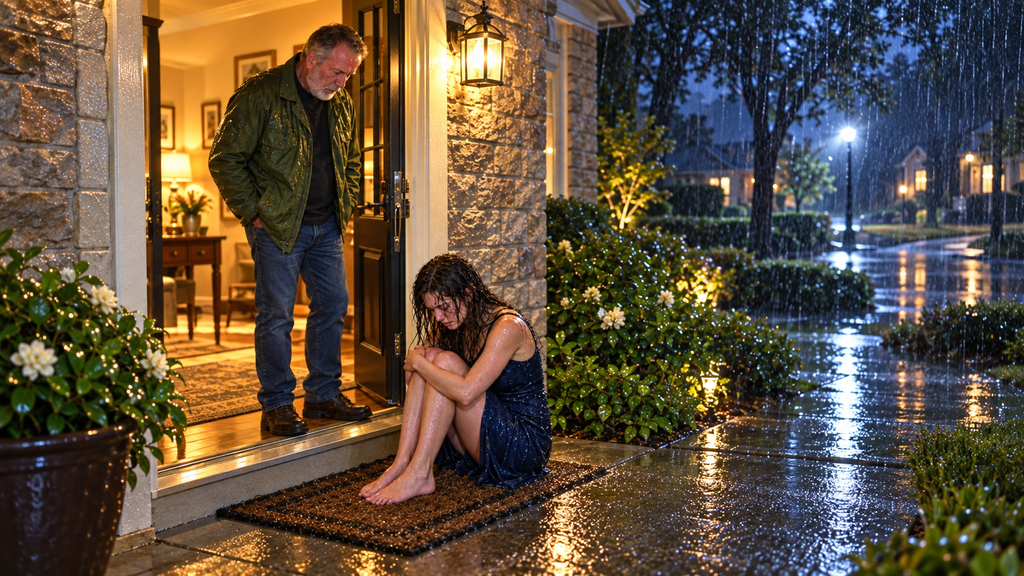
“Because she needed to learn something.”
The rain ran from my hair down the back of my neck.
I kept my shoulders rounded.
Kept my voice weak.
“Learn what?”
Mark smirked.
“Who runs that house.”
My fingers tightened around the handle of the baseball bat.
But I kept it behind my right leg.
Hidden from his view.
Mark looked past me again.
“Where is she?”
“At my house.”
“You tell her to come back.”
“She can barely walk.”
His expression didn’t change.
That was the moment I understood something that frightened me more than my anger.
Mark wasn’t ashamed.
A normal man might panic after what he had done.
A normal man might sober up when someone showed up at his door asking about a woman bleeding on a porch.
Mark was annoyed.
As if Lily’s injuries were an inconvenience.
“She’s dramatic,” he said.
I stared at the blood on his shirt.
“My daughter’s blood is on you.”
He looked down.
For the first time, his smile faded.
Then he shrugged.
“She came at me.”
I almost admired how quickly the lie arrived.
Almost.
“She came at you?”
“She was screaming. Throwing things.”
“What things?”
Mark hesitated.
Just a fraction of a second.
But I saw it.
Twenty years of mowing lawns had not erased the part of me that noticed hesitation.
“She threw a lamp.”
“What color?”
His eyes narrowed.
“What?”
“The lamp.”
I let my voice tremble.
“What color was it?”
“I don’t know. White.”
There was no white lamp in their upstairs hallway.
I had helped Lily decorate that house when they moved in.
The lamps beside the staircase were dark green ceramic.
I knew because I had repaired one six months earlier after Mark claimed a mover had cracked it.
I had believed him then.
I wondered now how many things I had believed because the alternative had been too ugly to imagine.
Mark pushed himself away from the doorway.
“Look, John, I’m not doing this with you.”
“Doing what?”
“This pathetic father routine.”
He stepped closer.
I smelled whiskey.
“You know what Lily’s problem is?”
I said nothing.
“She was spoiled.”
My jaw tightened.
“You spoiled her.”
Another step.
“You spent her whole life making her think she was special.”
“She is special.”
Mark grinned.
“To you.”
Something cold moved through my chest.
He pointed his glass at me.
“You gave her this idea that she could question her husband. Embarrass him. Tell him no. Walk away from conversations whenever she felt like it.”
His voice was getting louder.
Careless.
Good.
I wanted careless.
“Did she tell you no tonight?”
His face changed.
Just slightly.
I lowered my eyes.
“What happened, Mark?”
He laughed again.
“She embarrassed me.”
“How?”
“We had people over.”
“Who?”
“That doesn’t concern you.”
“What did Lily do?”
Mark stared at me.
I could see him deciding whether humiliating my daughter in front of me would be entertaining.
He decided it would.
“She contradicted me.”
My heartbeat slowed.
That happens sometimes when anger becomes too large.
Everything gets quiet.
“What did she contradict you about?”
“A property deal.”
“A property deal?”
“She made me look stupid in front of investors.”
“So you hit her?”
“She wouldn’t shut up.”
His voice snapped through the rain.
There it was.
Not quite a confession.
But close.
I let my hand loosen around the bat.
Not because I was calm.
Because gripping it too tightly would slow me down.
Mark saw the movement.
His eyes dropped.
He noticed the bat.
Then he laughed.
“Oh.”
He stepped fully onto the porch.
“This is adorable.”
I said nothing.
“You came here with a baseball bat?”
“It belonged to Lily.”
That part was true.
She had played softball when she was thirteen.
The Louisville Slugger had been mine first, but she had stolen it from the garage and used it to practice.
There were still three faded pink stripes around the handle from the athletic tape she once insisted made her swing faster.
Mark held out his arms.
“What are you going to do with it, old man?”
I looked at him.
Really looked at him.
Six feet two.
Maybe two hundred pounds.
Thirty-eight years old.
Gym-built shoulders.
Expensive watch.
Perfect teeth.
A man accustomed to people moving out of his way before he had to ask.
He mistook wealth for strength.
He mistook fear for respect.
And worst of all, he had mistaken my restraint for weakness.
“I asked you a question,” I said.
My voice no longer trembled.
Mark’s smile faded.
“What?”
“Did you hit my daughter?”
Something in my posture must have changed.
Because suddenly he wasn’t looking at the harmless old neighbor anymore.
I saw recognition flicker across his face.
Not recognition of who I was.
Recognition of danger.
It lasted only a second.
Then alcohol and ego buried it.
“She’s my wife.”
“That wasn’t the question.”
“I don’t owe you an explanation.”
“Did you hit her?”
Mark stepped toward me.
“You need to get off my property.”
“Did you put your hands around her throat?”
His expression froze.
There it was.
I watched his eyes.
“Who told you that?”
I didn’t answer.
His nostrils flared.
“She’s lying.”
“I didn’t tell you what she said.”
Silence.
Only rain.
Mark stared at me.
I watched him realize his mistake.
Then I asked one final question.
“Did you throw her down the stairs?”
He took a breath.
And because arrogance is stronger than intelligence in men like Mark, he gave me exactly what I had come for.
“She should’ve stayed down the first time.”
My heart stopped.
Not from surprise.
From certainty.
He had done it.
Every bruise.
Every cut.
Every terrified tremor in Lily’s body.
It had been him.
And now, in his own words, he had admitted enough.
My thumb moved.
I pressed the small button inside my jacket pocket.
Three vibrations answered.
Saved.
Uploaded.
Delivered.
Mark didn’t know that twenty minutes earlier, before leaving my house, I had set my phone to record.
He didn’t know the audio was being backed up automatically.
He didn’t know I had sent the live recording link to someone who owed me a favor from a lifetime ago.
And he definitely didn’t know that the bat had never been Plan A.
The bat was for something else.
For me.
A reminder.
A line.
Something solid to hold while every broken part of my mind begged me to become exactly what Mark believed I was.
A violent old man.
Instead, I had come for the one thing men like Mark feared more than violence.
Evidence.
His smile returned.
“Now go home.”
I remained still.
“You’re going to be arrested.”
Mark blinked.
Then he laughed so hard he nearly spilled his drink.
“For what?”
“For what you did to Lily.”
“You think anyone’s going to believe this?”
“I do.”
“You?”
He stepped closer.
His voice dropped.
“John, you really have no idea who you’re dealing with.”
“I know exactly who I’m dealing with.”
“No, you don’t.”
His confidence returned completely.
“My company employs half the people in this county. The mayor has dinner at my house. The sheriff plays golf with my father.”
He leaned toward me.
“And your daughter?”
His mouth twisted into a smile.
“My wife has a history of emotional instability.”
My stomach turned.
“What?”
“You heard me.”
“She has no such history.”
“She does now.”
I stared at him.
Mark tapped the side of his head.
“You think I haven’t prepared for this?”
That sentence frightened me.
Not for myself.
For Lily.
“What did you do?”
He shrugged.
“Nothing illegal.”
“What did you do, Mark?”
“I made sure people understood what she was like.”
I took one slow step forward.
He saw something in my face and stopped smiling.
“What does that mean?”
“It means when she started getting… difficult, I spoke to the right people.”
“Which people?”
“Doctors.”
My blood ran cold.
“She’s never seen a psychiatrist.”
Mark grinned.
“She has now.”
I realized what he meant.
Paper.
Records.
Appointments Lily may not even have understood.
Medication perhaps prescribed for anxiety he himself had caused.
Every abusive episode reframed as her instability.
Every fear as paranoia.
Every tear as proof.
He had been building a defense before Lily ever escaped.
“How long?”
He didn’t answer.
“How long have you been hurting her?”
Mark looked away.
I already knew.
Longer than tonight.
Much longer.
The signs rearranged themselves in my memory.
Lily canceling Sunday dinners.
Long sleeves in July.
The cracked phone screen.
The Christmas when she flinched after I reached past her too quickly for the salt.
Her explanation about falling in the bathroom.
The time she called me at two in the morning and said nothing for almost fifteen seconds before telling me she had dialed accidentally.
God.
I had heard my daughter screaming without hearing a sound.
For months.
Maybe years.
And I had missed it.
The guilt hit harder than any fist ever had.
“You’ve been doing this for a long time.”
Mark smiled.
Not because it was funny.
Because he saw the pain on my face.
And he enjoyed causing it.
“You really didn’t know?”
My hand tightened around the bat.
He saw it.
“Wow.”
His eyebrows rose.
“Father of the year.”
The words found their target.
I could have hit him then.
One step.
One swing.
That was all it would have taken.
I knew exactly where to strike.
I knew how much force a human body could absorb.
I knew which bones broke easily and which injuries could kill without appearing immediately fatal.
Those are terrible things to know about yourself.
People like to imagine violence as rage.
Sometimes it isn’t.
Sometimes violence is arithmetic.
Distance.
Angle.
Force.
Consequence.
And standing on Mark Sterling’s porch, I could calculate every one of them.
I raised the bat.
Mark’s face changed.
The bravado vanished.
For one glorious second, fear entered his eyes.
He stumbled backward.
“John.”
I took another step.
“Hey.”
He lifted both hands.
“John.”
The bat rose over my shoulder.
And then—
I heard Lily laughing.
Not there.
Not really.
In my memory.
Seven years old.
Missing her front teeth.
Standing in our backyard with that same bat too large for her hands.
“Daddy! Watch me!”
I heard her at thirteen after her first home run.
“I did it!”
I heard her at twenty-two on graduation day.
“You’re crying.”
“I’m not crying.”
“You’re absolutely crying.”
Then I heard her tonight.
Help me.
My daughter had crawled through a storm because she believed home was where she would be safe.
If I killed Mark, what would happen when she woke up?
Police.
Courtrooms.
A funeral.
A prison sentence.
Another man she loved disappearing because of Mark Sterling.
No.
I had already failed to see her suffering.
I would not make her carry mine too.
Slowly, I lowered the bat.
Mark saw hesitation.
And mistook it for weakness.
Again.
His expression changed.
His right hand disappeared behind the doorframe.
My instincts screamed.
I moved.
Mark came forward holding a handgun.
Everything after that happened quickly.
He raised it.
I swung the bat.
Not at him.
At his wrist.
The wooden barrel struck his forearm with a hard crack.
The gun flew across the stone porch and disappeared into the flower bed.
Mark screamed.
His glass shattered.
Then he charged me.
Thirty-eight years old.
Two hundred pounds.
Angry.
Drunk.
I was sixty-four.
And sober.
He tried to tackle me.
I stepped aside.
Used his momentum.
Caught his arm.
Turned my hips.
Mark hit the stone walkway shoulder-first.
Hard.
The air left his lungs.
He rolled over, gasping.
I kicked the gun farther into the shrubs.
Then I backed away.
I did not strike him again.
That matters.
Because thirty seconds later, red and blue lights appeared at the bottom of the driveway.
Mark heard the sirens.
His face changed instantly.
He smiled.
Actually smiled.
“You’re finished.”
I looked down at him.
“No.”
He cradled his injured arm.
“You came onto my property armed. You attacked me.”
I looked toward the approaching patrol cars.
“We’ll see.”
Two sheriff’s cruisers stopped beneath the portico.
Four deputies got out.
Mark pushed himself upright.
Then a black SUV pulled in behind them.
That wasn’t law enforcement.
I knew the vehicle.
Mark didn’t.
The driver stepped out.
Tall.
Silver hair.
Dark overcoat.
Daniel Mercer.
Forty years ago, Daniel and I had been young men in the same unit.
Later, he became a federal investigator.
Then a prosecutor.
Then, eventually, the kind of attorney whose name made very wealthy people stop talking and start reading documents carefully.
He had retired three years earlier.
Mostly.
Some men never really retire.
Daniel looked at me.
Then at Mark.
Then at the gun in the flower bed.
He sighed.
“John.”
“Daniel.”
“You really know how to ruin a quiet Tuesday.”
“It’s Thursday.”
He looked at his watch.
“So it is.”
Mark stared between us.
One of the deputies approached.
“Mr. Sterling?”
Mark immediately switched characters.
It was extraordinary to watch.
His shoulders sagged.
His voice shook.
“This lunatic attacked me.”
He pointed at me.
“He came here with a bat. He threatened to kill me.”
The deputy glanced at the bat in my hand.
“Sir, place that on the ground.”
I did.
Slowly.
“Step away.”
I stepped back.
“Hands where I can see them.”
I raised my hands.
Mark smiled.
Then another deputy retrieved the handgun.
“Whose firearm?”
Mark hesitated.
“Mine.”
Daniel spoke for the first time.
“Interesting.”
Everyone looked at him.
Mark frowned.
“Who are you?”
Daniel held up his phone.
“The man who listened to the last thirteen minutes of your conversation.”
The smile vanished from Mark’s face.
The deputy looked at him.
“What conversation?”
Daniel tapped his screen.
Mark’s own voice came through the phone speaker.
Clear.
Loud.
“She should’ve stayed down the first time.”
Nobody moved.
Rain drummed against the roof.
Then Mark’s voice played again.
“You think I haven’t prepared for this?”
Then—
“My company employs half the people in this county. The mayor has dinner at my house. The sheriff plays golf with my father.”
One of the deputies slowly looked at Mark.
Mark turned pale.
“That’s taken out of context.”
Daniel looked at him.
“I have all the context.”
“It was illegally recorded.”
“Not in this state.”
Mark opened his mouth.
Closed it.
Daniel continued.
“And before you try another argument, John sent me the recording while standing outside your front door. He asked questions. You answered them voluntarily.”
Mark looked at me.
For the first time that night, real fear settled into his face.
Then he recovered.
Barely.
“This doesn’t prove anything.”
Daniel nodded.
“You’re right.”
Mark blinked.
Daniel slipped his phone back into his pocket.
“Fortunately, the victim does.”
The deputy turned toward me.
“Where is your daughter?”
“At my house.”
“Is she safe?”
“Yes.”
“Does she need medical attention?”
That question hurt.
“Yes.”
The deputy’s expression sharpened.
“Why isn’t she at the hospital?”
Because she begged me not to call anyone.
Because she thought Mark owned everyone.
Because she was terrified.
Because I had allowed my rage to make me do one stupid thing after another.
I swallowed.
“She was terrified. I stabilized her injuries enough to keep her conscious and breathing. Then she fell asleep.”
The deputy looked at me.
“You a doctor?”
“No.”
“EMT?”
“Former combat medic.”
Daniel cut in.
“An ambulance is already on its way to John’s house.”
I looked at him.
He gave me a hard stare.
“I called after you sent me the recording.”
I nodded.
“Thank you.”
Mark laughed bitterly.
“Look at this.”
Everyone turned.
He was shaking now.
“This is insane. Lily is my wife. We had an argument.”
The deputy said nothing.
Mark kept going.
“She fell.”
I stared at him.
“You said she should have stayed down the first time.”
“I was angry.”
“You said you had prepared medical records.”
“I was drunk.”
“You pointed a gun at me.”
“You came here with a bat!”
“And yet the only person who threatened someone with a firearm was you.”
His face hardened.
“You smug old bastard.”
The deputies moved slightly closer.
Mark noticed.
He changed tone again.
“I want him arrested.”
The first deputy looked at me.
“Mr. Hale, I need you to turn around.”
Daniel immediately stepped forward.
“John, don’t say anything.”
I understood.
I turned around.
The deputy placed handcuffs on my wrists.
Mark smiled.
And for perhaps five seconds, he thought he had won.
Then the deputy walked past me.
Straight toward him.
“Mr. Sterling, turn around.”
Mark’s smile disappeared.
“What?”
“Turn around and place your hands behind your back.”
“Are you joking?”
“No, sir.”
“My arm is injured.”
“Then keep it in front and we’ll cuff you accordingly.”
“Do you know who my father is?”
The deputy’s face became completely expressionless.
“No, sir.”
“I just told you the sheriff—”
“I heard the recording.”
Mark looked at the other deputies.
None moved to help him.
“You people are making a serious mistake.”
The deputy reached for his cuffs.
Mark stepped backward.
“Don’t touch me.”
“Sir.”
“Do not touch me.”
He looked at me.
This time there was no arrogance.
Only hate.
“You did this.”
I met his eyes.
“No.”
My voice was quiet.
“You did.”
They arrested both of us.
And that was how the quiet gardener from number 42 and the most powerful real estate developer in the county ended up riding away from Mark’s mansion in separate police cars just after one in the morning.
But that wasn’t the worst night of Mark Sterling’s life.
Not even close.
Because while Mark was sitting in a booking room telling detectives that his wife was unstable—
Lily woke up.
And she finally started talking.
By sunrise, I was no longer in handcuffs.
Daniel had arrived at the station with another attorney.
I spent four hours answering questions.
Every question.
I did not hide the bat.
I did not minimize why I had taken it.
“I was angry,” I told the detective.
“How angry?”
“Angry enough to frighten myself.”
“Did you intend to hurt Mr. Sterling?”
I thought carefully.
Daniel shifted beside me.
I could feel him preparing to interrupt if I said something stupid.
I told the truth.
“When I left my house, part of me wanted to.”
Daniel closed his eyes.
The detective leaned forward.
“Wanted to what?”
“Hurt him.”
“Kill him?”
“No.”
“You’re certain?”
I looked at the tabletop.
“No.”
Daniel stared at me.
The detective said nothing.
I lifted my eyes.
“I’m certain now. I’m not certain what I was thinking in the first five minutes after finding my daughter bleeding on my doorstep.”
That answer hung in the room.
Then I continued.
“But wanting something for five minutes and doing it are different things.”
The detective nodded toward the photograph of Mark’s bruised wrist.
“You did hurt him.”
“He pulled a gun.”
“Mr. Sterling says he was protecting himself.”
“The recording includes me lowering the bat.”
“It’s audio.”
“Yes.”
“Not video.”
“No.”
The detective leaned back.
“What happened next?”
“He reached behind the door. I saw the gun. He raised it. I struck his wrist.”
“Then?”
“He charged.”
“Then?”
“I moved.”
“You threw him?”
“I redirected him.”
The detective almost smiled.
“Redirected.”
“Yes.”
“He landed hard enough to separate his shoulder.”
“He’s heavier than he looks.”
Daniel covered his mouth.
I ignored him.
The detective studied me.
“Mr. Hale, according to your military file, you have extensive close-combat training.”
I looked at Daniel.
Daniel looked at the ceiling.
Apparently my retired friend had provided more information than I expected.
“That was a long time ago.”
“You were decorated.”
“That was a long time ago too.”
“Silver Star.”
I felt something tighten inside me.
“Please don’t.”
The detective paused.
“Don’t what?”
“Turn this into a story about me.”
For the first time that morning, my voice cracked.
“This is about my daughter.”
Silence.
I looked down at my hands.
There was dried blood under one fingernail.
Lily’s blood.
“I should have seen it.”
The detective’s expression changed.
“You couldn’t have known.”
“Yes.”
I swallowed.
“I could have.”
“You were not living with them.”
“I’m her father.”
“That doesn’t make you psychic.”
“No.”
My eyes burned.
“But it should have made me curious.”
I remembered every missed sign.
Every cancelled dinner.
Every excuse.
Every time she had seemed quieter.
Every time Mark answered a question for her.
Every time he put his hand around the back of her neck in public and everyone—including me—thought it looked affectionate.
Now I wondered whether it had been a reminder.
A hand saying:
I own you.
The detective slid a box of tissues toward me.
I nearly laughed.
I had once been shot in the thigh and remained functional for six hours.
A tissue box almost destroyed me.
“Mr. Hale,” the detective said, “your daughter is alive.”
I closed my eyes.
“She’s at St. Matthew’s Medical Center.”
My head snapped up.
“Is she—”
“She’s stable.”
My lungs finally worked.
“She has a fractured rib, a concussion, extensive bruising, and injuries to her throat consistent with strangulation.”
The room blurred.
Daniel put one hand on my shoulder.
The detective continued carefully.
“There is also evidence some of the bruises are older.”
I already knew.
Still, hearing it almost knocked me out of the chair.
“How old?”
“Some days.”
He paused.
“Some weeks.”
I stared at the wall.
Weeks.
My daughter had been coming to Sunday breakfast with fingerprints hidden beneath her clothes.
“Can I see her?”
“Soon.”
“Why not now?”
“Because she is speaking with an investigator.”
“What investigator?”
“Domestic violence unit.”
I nodded.
Then he said something I will remember until the day I die.
“She asked us not to let her husband know what hospital room she’s in.”
My daughter was in a hospital.
And she was still afraid he could get to her.
Something inside my chest collapsed.
Daniel squeezed my shoulder.
I whispered, “I should’ve killed him.”
The detective’s eyes sharpened.
Daniel said quietly, “John.”
I shook my head.
“No.”
I looked at the detective.
“That’s not a threat.”
I wiped my eyes with my sleeve.
“It’s grief.”
The detective stared at me for a moment.
Then nodded.
“I know the difference.”
At eight thirty-four that morning, I walked into Lily’s hospital room.
She looked smaller than she had on my porch.
Hospitals do that to people.
They take someone you have known your whole life and reduce them to a body beneath white sheets.
Her left eye was almost completely swollen shut.
Purple bruises wrapped her neck.
There were stitches above her hairline.
Her arm rested across her ribs.
When she saw me, her good eye filled with tears.
“Dad.”
That one word almost broke me.
I crossed the room.
Then stopped.
I didn’t know where I could safely touch her.
That realization was unbearable.
She saw me hesitate.
“Come here.”
I leaned over.
She put one hand behind my neck.
I held her.
Gently.
So gently.
For a long time, neither of us spoke.
Then she whispered into my shirt.
“I’m sorry.”
I pulled back.
“What?”
“I’m sorry.”
“For what?”
“For bringing this to you.”
I stared at her.
“Lily.”
“He said if I left, he’d come after you.”
Her lips trembled.
“He knew where you lived. He knew your routine. He knew you went walking alone in the mornings.”
I felt cold.
“He told me accidents happen to old men.”
She started crying.
“So I stayed.”
There are sentences that divide your life into before and after.
That was one of them.
My daughter had not stayed because she loved him.
She had stayed because she loved me.
I sat beside her.
“Look at me.”
She tried.
“You never have to protect me from a man like that.”
“He said you were old.”
I almost smiled.
“Well, that part is unfortunately accurate.”
A tiny sound escaped her.
Half laugh.
Half sob.
I took her hand.
“He said he knew people.”
“He does.”
“He said no one would believe me.”
“I believe you.”
“You’re my dad.”
“And?”
“You have to believe me.”
“No.”
I squeezed her fingers.
“I don’t believe you because I’m your father.”
She looked at me.
“I believe you because you’re telling the truth.”
Her chin shook.
“He was so nice in the beginning.”
“I know.”
“I feel stupid.”
“No.”
“I kept explaining things away.”
“That doesn’t make you stupid.”
“I thought it was stress.”
I listened.
“He would apologize. Then he would buy me something. Flowers. Jewelry. Trips. And he’d cry.”
She gave a broken laugh.
“Dad, he cried better than I did.”
I looked away.
“He’d say he had never loved anyone enough to be afraid of losing them.”
Her voice became smaller.
“The first time he grabbed me, he said it happened because he loved me too much.”
I hated how familiar the pattern sounded.
Not because I had lived it.
Because, over the years, I had treated people who had.
In another lifetime.
On military bases.
In field hospitals.
In emergency rooms.
People with bruises and rehearsed explanations.
People protecting the person who hurt them because fear is complicated.
I should have known.
Lily squeezed my fingers.
“Stop.”
I looked at her.
“Stop what?”
“Blaming yourself.”
I tried to speak.
She shook her head.
“You’re doing it.”
“You don’t know what I’m thinking.”
“I’m your daughter.”
Despite everything, I smiled.
“Yes, you are.”
“He fooled everyone.”
“That doesn’t make me feel better.”
“It’s true.”
I lowered my head.
“I should have asked harder questions.”
“Maybe.”
That answer surprised me.
She wiped her nose.
“Maybe you should have.”
I looked at her.
She continued.
“But maybe I would’ve lied.”
That hurt because I knew she was right.
“I got good at lying.”
She looked toward the window.
“I hated it.”
“What did you lie about?”
“Everything.”
The phone.
The bruises.
The vacations she cancelled.
The holidays Mark refused to attend.
The night she missed my birthday because she was “sick.”
She hadn’t been sick.
Mark had thrown a dinner plate.
It broke against the wall beside her head.
She had spent my birthday cleaning blood from her hand after a shard cut her palm.
I remembered the gift she gave me later.
Gardening gloves.
I had joked that they were two weeks late.
She had smiled.
Now I wanted to go back in time and put my arms around that version of my daughter.
Instead, I held the one in front of me.
“How long?”
I asked.
She knew what I meant.
“Almost three years.”
Three years.
I stopped breathing.
They had been married four.
Three years.
“How often?”
“At first?”
She swallowed.
“Not often.”
There is no phrase more horrifying than that.
Not often.
As though violence becomes measurable.
Acceptable if spaced far enough apart.
“He slapped me once during our first anniversary trip.”
“Why?”
“He said I flirted with a waiter.”
“Had you?”
“No.”
Not that it would have mattered.
She kept talking.
“It was months before he touched me again.”
Then it became every few months.
Then monthly.
Then weekly.
Near the end, Lily said, Mark didn’t always need to hit her.
Sometimes all he needed to do was look at her.
Or close a door.
Or set his watch on the counter.
Apparently he removed his expensive watch before hitting her because he was afraid of damaging it.
That detail almost made me physically ill.
My daughter’s face mattered less to him than a watch.
“Why tonight?”
I asked.
Lily’s good eye shifted toward me.
“What?”
“What made tonight different?”
For the first time since I entered the room, fear entered her expression again.
“Dad.”
“What?”
“You need to go home.”
“Why?”
She pushed herself upright and winced.
“Lily, don’t—”
“You need to go home.”
“What happened?”
Her breathing accelerated.
“Dad, listen to me.”
“I am.”
“No, you’re not.”
She grabbed my wrist.
“There’s something in your house.”
My skin prickled.
“What?”
“I put it there.”
I stared at her.
“What did you put in my house?”
Her eye filled with tears.
“A flash drive.”
The hospital room seemed suddenly very quiet.
“What’s on it?”
“Everything.”
Three months earlier, Lily had decided to leave Mark.
Not emotionally.
She had emotionally left him a long time before.
She had decided to leave him physically.
Permanently.
And unlike me, Lily understood exactly who Mark was.
She knew walking out the front door would not be enough.
So she started collecting evidence.
Photographs.
Emails.
Bank records.
Text messages.
Voicemails.
Videos.
Copies of medical documents.
Records of appointments Mark had arranged without her full knowledge.
She kept notes.
Dates.
Times.
Witnesses.
Names.
Every insult.
Every threat.
Every injury.
I sat beside her hospital bed, stunned.
“You did all that?”
She nodded.
“Why didn’t you bring it to the police?”
“I was going to.”
“What happened?”
“He found out.”
My stomach dropped.
“How?”
“I don’t know.”
“He found the flash drive?”
“No.”
She shook her head.
“He found a folder.”
“What folder?”
“Copies.”
She had been keeping duplicates inside a locked drawer in her home office.
Three nights earlier, she came home and found the drawer open.
Mark never mentioned it.
That frightened her more than if he had screamed.
“So I took the drive.”
“And brought it to my house?”
She nodded.
“When?”
“Sunday.”
I thought back.
She had come over for coffee.
She stayed only twenty minutes.
Mark called twice.
She had gone upstairs to use my bathroom.
At least, that was what she told me.
“Where is it?”
“Your sewing box.”
I stared at her.
“I don’t have a sewing box.”
“Mom’s sewing box.”
Everything inside me stopped.
My wife, Anne, had died eleven years earlier.
Her old wooden sewing box still sat in the upstairs closet.
I had not opened it since her funeral.
Lily knew that.
Which was exactly why she chose it.
“Nobody touches it,” she whispered.
She was right.
Not even me.
“What’s on the drive?”
“Enough to destroy him.”
Those words sounded dramatic.
They weren’t.
I would learn later that Lily had understated it.
Because the flash drive didn’t contain evidence of one abusive marriage.
It contained evidence of a criminal enterprise.
Daniel drove to my house.
Two detectives followed.
I stayed with Lily.
For two hours, I heard nothing.
Then Daniel called.
He didn’t say hello.
He said:
“John, do not discuss that flash drive with anyone.”
I stood in the hospital hallway.
“What did you find?”
“Enough.”
“Enough for what?”
A pause.
“Do you remember Sterling Heights?”
I did.
Everyone in the county did.
A luxury development Mark had built near the lake.
Houses started at 1.4 million dollars.
“What about it?”
“Lily found payment records.”
“For the development?”
“For inspectors.”
I frowned.
“Inspectors?”
“Building inspectors.”
My stomach tightened.
Daniel continued.
“She has emails showing Mark’s company paid at least two inspectors through consulting firms.”
“For what?”
“To approve materials that never should’ve passed.”
“What materials?”
“Concrete. Structural supports. Drainage systems.”
I stared down the hallway.
Families lived in those houses.
Children.
“What else?”
“John.”
“What else?”
“Bank transfers.”
“To whom?”
“A city councilman.”
I closed my eyes.
“Anyone else?”
“Yes.”
“Who?”
Another pause.
“The sheriff.”
I remembered Mark smiling on the porch.
The sheriff plays golf with my father.
Maybe golf had not been the important part.
“How much?”
“Over eighty thousand dollars across eighteen months.”
“For what?”
“We don’t know yet.”
I looked through the hospital-room window at Lily.
She was asleep.
Tiny beneath the blanket.
“How did she get this?”
“Mark used her laptop sometimes.”
“For work?”
“Apparently.”
“And she copied files?”
“Yes.”
Daniel’s voice became quieter.
“She knew more than he realized.”
Something swelled inside me.
Pride.
And fear.
Mostly fear.
“Does Mark know she has this?”
“He knows she found something.”
“Does he know where it is?”
“I don’t think so.”
“Daniel.”
“Yes?”
“Was tonight about the property deal?”
Silence.
That told me everything.
“No,” Daniel said eventually.
“He beat her because of the drive.”
“We think so.”
I leaned against the wall.
The story Mark told on the porch had been partly true.
There had been investors at the house.
Lily had contradicted him.
But not about a normal property deal.
During dinner, Mark accused her of trying to embarrass him.
Later, after everyone left, he confronted her about accessing company records.
He demanded to know what she had copied.
She denied everything.
He took her phone.
He searched her office.
Then he locked the bedroom door.
What followed ended with my daughter tumbling down twelve stairs.
When she landed, Mark walked down behind her.
Slowly.
He stood over her.
And told her she had one final chance to tell him where the files were.
She refused.
So he put his hands around her throat.
The only reason she escaped was because someone rang the front gate.
Mark went downstairs to check the security system.
Lily ran.
No shoes.
No coat.
No phone.
She cut through the woods behind the property and reached the service road.
A delivery driver eventually saw her.
He tried to stop.
She panicked.
She thought Mark had sent him.
So she hid.
Then she walked nearly four miles through the storm to my house.
Four miles.
With a fractured rib.
A concussion.
Barefoot.
My daughter had not merely survived that night.
She had fought her way home.
When I returned to her room, she was awake.
I sat beside her.
“You always hated running.”
She stared at me.
“What?”
I smiled through tears.
“Remember softball conditioning?”
A tiny smile appeared.
“I still hate running.”
“You walked four miles.”
“Three point eight.”
I laughed.
A real laugh.
The first one since midnight.
“You counted?”
“I had a lot of time.”
Then she winced because laughing hurt her ribs.
I immediately stopped.
“Sorry.”
“It’s okay.”
I brushed hair from her forehead.
“Daniel found the drive.”
Her smile disappeared.
“What did he say?”
“That you did something incredibly brave.”
She looked frightened.
“Mark’s going to know.”
“Eventually.”
“He’ll come after me.”
“No.”
“You don’t understand.”
“Yes, I do.”
“No, Dad.”
She shook her head.
“You think last night was the worst version of him.”
Her voice dropped.
“It wasn’t.”
I took her hand.
“It doesn’t matter.”
“He has money.”
“It doesn’t matter.”
“He has people.”
“It doesn’t matter.”
“He’ll destroy you.”
I looked at her.
“Lily.”
She stopped.
“I spent half my life in places where powerful men thought nobody could touch them.”
I squeezed her hand.
“They were usually wrong.”
She stared at me.
“You never talk about the Army.”
“No.”
“Why?”
Because some memories are easier to carry when nobody asks you to unpack them.
Because I had spent years teaching myself to be gentle.
Because after Anne died, I discovered that rage could become a comfortable place to live, and I was afraid that if I told too many stories about who I had been, I would begin missing him.
The man who could walk toward danger without hesitation.
The man who slept four hours a night.
The man who reacted before thinking.
The man who knew exactly what bodies looked like when violence finished with them.
“I wanted you to know me as your father.”
She looked at me for a long time.
“That’s all I ever knew you as.”
“Good.”
She squeezed my fingers.
“But Dad?”
“Yes?”
“Next time, maybe don’t take a baseball bat to a millionaire’s house.”
I stared at her.
Then I smiled.
“You sound like Daniel.”
“Daniel sounds smart.”
“He’s unbearable.”
She laughed again.
Then winced.
Then laughed because she had winced.
And suddenly both of us were crying.
That is the strange thing about surviving something terrible.
Joy does not always return elegantly.
Sometimes it arrives while your face is bruised.
Sometimes it hurts your ribs.
Sometimes it sounds like laughter and sobbing at exactly the same time.
Mark posted bail forty-eight hours later.
That was the first moment Lily almost broke.
She was staying with me by then.
We had turned my downstairs study into a bedroom because stairs hurt too much.
The county issued a protective order.
Mark was forbidden from contacting her.
His firearms were supposed to be surrendered.
His attorneys released a statement saying there had been a “private marital disagreement complicated by misinformation and outside interference.”
I read it twice.
Then threw the newspaper away.
Lily read it online.
I found her sitting on the edge of the guest bed with her phone shaking in her hand.
“He’s saying I attacked him.”
I sat beside her.
“He can say the moon is made of cheese.”
“He posted photos.”
“What photos?”
She showed me.
Scratches on Mark’s neck.
A bruise on his jaw.
Pictures from months earlier.
Evidence, according to his attorney, of Lily’s “pattern of physical aggression.”
I looked at her.
“Did you scratch him?”
Her face collapsed.
“Yes.”
My heart sank.
Then she whispered:
“When he was choking me.”
I closed my eyes.
Mark had photographed defensive wounds.
Then saved them.
Not because he was documenting abuse.
Because he knew one day he might need to reverse the story.
That was when I finally understood the sophistication of what he had done.
Mark wasn’t merely violent.
He was methodical.
He had spent years constructing two realities.
The private reality, where Lily was frightened and controlled.
And the public reality, where he was the charming developer married to a troubled woman.
He donated to hospitals.
Sponsored youth baseball.
Paid for a wing at the library.
He smiled beside politicians.
He bought Christmas gifts for employees.
And each charitable photograph became a brick in the wall he built around my daughter.
People don’t want villains to look respectable.
It makes them uncomfortable.
We want bad people to announce themselves.
Mark never did.
That was his greatest weapon.
Until Lily began speaking.
The first person to call was Melissa Grant.
I remembered her vaguely.
She had been Mark’s assistant years earlier.
She asked to speak with Lily.
Daniel insisted on being present.
Melissa arrived at my house wearing sunglasses though the day was cloudy.
She sat at my kitchen table and wrapped both hands around a cup of tea.
For nearly ten minutes, she said nothing.
Then she looked at Lily.
“I saw the news.”
Lily nodded.
Melissa’s mouth trembled.
“I’m sorry.”
“For what?”
“I should’ve said something.”
I watched Lily’s face.
“What did you see?”
Melissa removed the sunglasses.
There was an old scar beside her eyebrow.
“Not you.”
She swallowed.
“Someone before you.”
Her name was Rachel.
Mark had dated Rachel Connors for nearly two years before meeting Lily.
Everyone had been told Rachel moved to Colorado for work.
She had.
But not voluntarily.
According to Melissa, Rachel came into the office one Monday with a broken wrist.
Mark told everyone she had fallen skiing.
It was August.
Nobody challenged him.
Three weeks later, Rachel disappeared from Mark’s life.
Melissa eventually received an email from her saying only:
I’m safe. Please don’t tell him where I am.
Melissa kept that email for seven years.
“Why didn’t you go to the police?” Lily asked.
Melissa cried.
“Because I was scared.”
Lily reached across the table.
And held her hand.
That moment stayed with me.
My daughter had every reason to be furious.
Instead, she understood fear.
Two weeks later, Rachel called.
She was living in Oregon.
Married.
Two children.
She had seen Lily’s story online.
Daniel spoke with her first.
Then Lily.
I never heard the full conversation.
It wasn’t mine to hear.
But when Lily walked out of the study, she stood in the hallway and cried for twenty minutes.
Not because Rachel had upset her.
Because Rachel had believed her.
And because seven years earlier, Rachel had survived the same man.
Then another woman came forward.
Then another.
One had only dated Mark for four months.
One had worked for him.
One had never been romantically involved with him at all.
She had been a tenant in a building his company owned and claimed Mark threatened her after she reported dangerous conditions.
Patterns began forming.
Patterns powerful enough that even Mark’s friends could not easily explain them away.
Then something happened none of us expected.
Mark’s younger brother called me.
His name was Thomas.
I had met him twice.
Quiet man.
Teacher.
Nothing like Mark.
He asked if he could come over.
Daniel said no.
So we met at his office.
Thomas entered carrying a cardboard box.
He placed it on the conference table.
“I should’ve done this years ago.”
Inside were journals.
Photographs.
And one letter.
Their mother had written it before she died.
Thomas explained that Mark had been violent since he was young.
Not constantly.
But enough.
Fights.
Threats.
A girlfriend hospitalized in college.
A classmate paid after an “accident.”
Their father handled everything.
Money.
Lawyers.
Connections.
Silence.
“He taught Mark that consequences were things poor people had.”
Thomas said it without anger.
That made it worse.
“What’s the letter?” Daniel asked.
Thomas looked at Lily.
“My mother knew.”
Lily’s expression hardened.
“Knew what?”
“That Mark hurt women.”
Thomas slid the letter across the table.
“She begged my father to stop protecting him.”
Lily did not touch it.
I did.
The paper shook in my hands.
The last lines read:
Every time we save Mark from the consequences of what he has done, we teach him that another woman can pay the price for his anger.
I folded the letter.
Thomas stared at the table.
“My father buried this after she died.”
“Why are you bringing it now?” I asked.
He looked at Lily.
“Because my brother almost killed your daughter.”
His eyes filled.
“And because my mother was right.”
Mark’s empire started collapsing quietly.
That is how powerful things usually fall.
Not with explosions.
With emails.
Bank freezes.
Subpoenas.
Audits.
People returning phone calls they once ignored.
The state opened an investigation into Sterling Heights.
Then federal investigators arrived.
Two building inspectors resigned.
A councilman hired an attorney.
The sheriff publicly denied receiving bribes.
Three days later, he announced a temporary leave of absence.
A week after that, agents searched an office connected to one of Mark’s companies.
The local newspaper stopped describing Mark as “prominent developer.”
They began calling him “embattled developer.”
I liked that word more than I should have.
Every morning, Lily sat at my kitchen table reading updates.
Some days she smiled.
Some days she shut the laptop and went outside.
Recovery was not a straight line.
People think escaping is the ending.
It isn’t.
Escaping is the door.
Then comes everything on the other side.
Fear.
Embarrassment.
Anger.
Paperwork.
Nightmares.
Phone calls.
Lawyers.
Doctors.
Questions.
The terrible silence after adrenaline disappears.
For weeks, Lily woke at exactly 2:13 in the morning.
She would check the windows.
Then the doors.
Then my room.
She never admitted she was checking whether I was alive.
I never told her I knew.
I simply began leaving my bedroom door open.
Like I used to when she was a child.
One night I woke and found her sitting on the hallway floor.
“Bad dream?”
She nodded.
I moved over.
She sat on the edge of my bed.
“What happened?”
“I was back there.”
I knew where.
“I couldn’t find the door.”
“You’re here.”
“I know.”
She stared into the darkness.
“But sometimes my body doesn’t.”
That sentence taught me more about trauma than all my medical training ever had.
Her mind knew she was safe.
Her nervous system did not.
So we sat quietly.
Eventually she said:
“Can I ask you something?”
“Anything.”
“Were you really going to hit him with the bat?”
I considered lying.
Then didn’t.
“Yes.”
She absorbed that.
“Were you going to kill him?”
“No.”
“Dad.”
“I don’t know.”
She looked at me.
I stared at my hands.
“For a few minutes, I didn’t care what happened afterward.”
She was silent.
“I’m not proud of that.”
“Did you stop because the police came?”
“No.”
“Then why?”
I looked at her.
“Because of you.”
Her brow tightened.
“I remembered you at seven.”
“What?”
“You were holding that bat.”
A tiny smile appeared.
“The pink tape?”
“The ugliest tape ever manufactured.”
“I loved that tape.”
“You had terrible taste.”
She smiled.
I continued.
“You were standing in the backyard. You kept missing the ball.”
“I remember.”
“You got so angry.”
“I cried.”
“You threw the bat.”
“You made me pick it up.”
“Yes.”
“You said quitting while angry teaches anger that it can control you.”
I stopped.
I had forgotten saying that.
Lily hadn’t.
She looked at me.
“Maybe you took your own advice.”
I felt my throat tighten.
“Maybe.”
She leaned against my shoulder.
“Thank you for not killing him.”
I closed my eyes.
She whispered:
“I need my dad more than I need revenge.”
That sentence changed me.
The divorce petition was filed on a Monday morning.
Mark responded Tuesday.
Not through an attorney.
Personally.
He violated the protective order by sending Lily an email from an unlisted account.
The subject line contained only one word.
PLEASE.
Daniel told her not to open it.
She opened it anyway.
I sat beside her.
The message was six pages long.
Apology.
Excuse.
Memory.
Manipulation.
He said he loved her.
He said alcohol had changed him.
He said business pressure had changed him.
He said losing his mother had changed him.
He said Lily had changed.
He said they both made mistakes.
He said strangers were turning them against each other.
He reminded her of Italy.
Their honeymoon.
Christmas mornings.
Private jokes.
Songs.
The dog they had lost two years earlier.
He wrote about wanting children.
He said he could become the man she married.
He said he was getting help.
Then near the end, the mask slipped.
One sentence.
After everything I have done for you, destroying my life seems unnecessarily cruel.
Lily read it twice.
Then leaned back.
For months, I had worried that a message like that might pull her backward.
Instead she laughed.
Not because anything was funny.
Because she finally saw him.
Clearly.
“Even his apology is about him.”
I nodded.
She closed the laptop.
“What do you want to do?”
“Forward it to Daniel.”
“Good.”
“And the detective.”
“Better.”
Violation number one.
Mark was warned.
Three days later, flowers arrived.
Two dozen white roses.
Lily stared at them from the doorway.
The delivery driver handed me the card.
Forgive me.
No signature.
There didn’t need to be one.
I looked at the roses.
Then at my garden.
I had spent twenty years growing roses.
Red.
Pink.
Yellow.
Peach.
I knew how to protect them from frost.
How to prune damaged canes.
How to recognize disease before it spread.
And somehow Mark had managed to turn flowers into a threat.
I hated him for that too.
I carried the bouquet to the trash.
Lily stopped me.
“Wait.”
I looked at her.
She walked over.
Pulled one white rose from the arrangement.
For a second I didn’t understand.
Then she snapped the stem in half.
Dropped it into the bin.
Then another.
And another.
She dismantled the bouquet one flower at a time.
When she finished, she wiped her hands.
“I always hated white roses.”
I stared at her.
“Why didn’t you tell me?”
“You never asked.”
The next spring, I planted purple ones.
Mark was arrested again eleven days later.
Not for the flowers.
Not for the email.
For witness intimidation.
Rachel in Oregon received a voicemail from a man offering her money to “avoid unnecessary involvement.”
Melissa discovered someone had photographed her apartment.
Thomas found an envelope beneath his windshield wiper containing copies of personal financial documents.
Mark denied everything.
Unfortunately for him, the man who called Rachel used a phone registered to a security consultant paid by Sterling Development.
That consultant decided loyalty was less important than avoiding federal prison.
He started talking.
And once he started, he apparently found talking very therapeutic.
Mark had hired him months earlier.
Not after Lily left.
Before.
The consultant had monitored Lily.
Tracked her car.
Accessed her email metadata.
Followed her to my house.
That was how Mark knew she had hidden something.
He never knew what.
He only knew she was preparing to leave.
And that terrified him.
Not because he loved her.
Because control was the only language he understood.
The consultant also admitted something else.
Mark had asked about me.
My military history.
My financial records.
My daily routine.
Whether I owned firearms.
Whether I had cameras.
I sat in Daniel’s office reading the report.
One line caught my attention.
SUBJECT WALKS BETWEEN 05:40 AND 06:20 MOST MORNINGS. FREQUENTLY ALONE.
Lily had told the truth.
Mark had been studying me.
“He was serious,” I said.
Daniel leaned back.
“Probably.”
“He was going to hurt me.”
“Maybe.”
“He threatened me to control her.”
“Yes.”
I stared at the report.
Daniel watched me.
“You okay?”
“No.”
“Good.”
I looked up.
“Good?”
“I’d be worried if you were.”
I put the report down.
“For years, I thought keeping my life quiet would protect her.”
Daniel said nothing.
“I left everything behind.”
“The Army?”
“That version of me.”
“You didn’t leave him behind.”
I looked at my old friend.
“No?”
“No.”
Daniel pointed toward my hands.
“You just taught him to grow roses.”
I smiled faintly.
“That’s annoyingly poetic.”
“I’ve gotten soft in retirement.”
“Clearly.”
Then his expression became serious.
“You know what strength was when we were twenty-five?”
“What?”
“Being the first man through a door.”
He paused.
“You know what strength is now?”
I waited.
“Knowing when not to go through it.”
I thought about Mark’s porch.
The raised bat.
Lily’s childhood voice in my head.
I nodded.
Daniel was right.
I hated that too.
Mark remained in custody pending several hearings.
His father appeared on television.
Charles Sterling was seventy-one.
Elegant.
White hair.
Tailored suits.
The kind of man who could sound reasonable while describing something monstrous.
He said his family was being targeted by “opportunists.”
He called the allegations against Mark “a coordinated attack.”
He described Lily as “deeply troubled.”
I watched the interview alone.
That was a mistake.
By the time Charles said the words “deeply troubled,” I was standing.
My fists were clenched.
Then Lily walked in.
She watched the television for ten seconds.
“Turn it off.”
I looked at her.
“Lily.”
“Turn it off.”
“He’s lying about you.”
“I know.”
“People are hearing this.”
“I know.”
“He—”
“Dad.”
Her voice stopped me.
“I spent three years caring what that family said about me.”
She walked across the room.
“I’m done.”
I looked at the television.
Charles Sterling was still talking.
Lily picked up the remote.
Clicked it off.
Silence.
Then she looked at me.
“You should be done too.”
She was right.
Mark had controlled enough rooms without being physically present.
He did not get my living room.
So from then on, we stopped watching interviews.
We stopped reading comments.
That was harder.
People online are very brave when cruelty costs them nothing.
Some believed Lily immediately.
Some didn’t.
Some asked why she stayed.
Why she never called police.
Why there were photos of Mark scratched.
Why she smiled beside him in vacation pictures.
Why she had posted “Happy Anniversary to my best friend” only six months earlier.
Lily read one comment aloud.
“If it was really that bad, why didn’t she leave?”
She looked at me.
“What should I say?”
“Nothing.”
“But I want to.”
“Then say the truth.”
“What truth?”
“That you left when you could.”
She stared at me.
“Is that enough?”
“It’s the only answer anyone deserves.”
She never posted it.
She closed the page instead.
That was stronger.
Four months passed.
Winter arrived.
The case grew.
Mark now faced charges unrelated to Lily as well.
Fraud.
Bribery allegations.
Obstruction.
Witness tampering.
The sheriff resigned permanently.
One building inspector entered a plea agreement.
The city councilman did too.
Sterling Development lost financing.
Projects stopped.
Partners vanished.
Mark’s name disappeared from charity boards almost overnight.
The same people who once wanted photographs beside him suddenly struggled to remember knowing him.
Power is funny that way.
It looks permanent right until it doesn’t.
But Lily didn’t celebrate.
Not much.
She had started therapy.
Twice a week at first.
She began driving again.
The first time she went to the grocery store alone, she called me from the parking lot.
“I did it.”
“What?”
“I came by myself.”
I smiled.
“You drove twelve minutes.”
“I know.”
“You used to drive across three states for concerts.”
“I know.”
“So?”
“So this was harder.”
I understood.
“I’m proud of you.”
“Don’t make it weird.”
“I’m allowed.”
“Dad.”
“Very proud.”
“I’m hanging up.”
“Extremely proud.”
She hung up.
Then texted:
You’re ridiculous.
I saved the message.
People imagine healing in dramatic moments.
It isn’t.
Healing is buying groceries alone.
Sleeping four uninterrupted hours.
Hearing a car outside and not checking the window.
Wearing a dress without worrying whether bruises show.
Laughing without immediately wondering if you laughed too loudly.
One night Lily burned dinner.
Completely.
Smoke filled the kitchen.
The alarm screamed.
I ran in expecting disaster.
She stood over a blackened pan.
And she was laughing.
“I forgot it.”
I opened a window.
“What was it?”
“Chicken.”
“Not anymore.”
She laughed harder.
Then suddenly stopped.
Her face changed.
“What?”
I asked.
“Nothing.”
“Lily.”
She looked at the burned pan.
“Mark once threw a chair because I burned dinner.”
My chest tightened.
She stared at me.
Then at the pan.
Then she started laughing again.
Quietly.
“I burned dinner.”
“Yes.”
“And nothing happened.”
I understood.
Nothing happened.
No door slammed.
No glass broke.
No hand rose.
No voice told her she was useless.
We opened windows.
We ordered pizza.
And the world kept turning.
Sometimes freedom looks like burnt chicken.
The divorce settlement should have been simple.
It wasn’t.
Mark fought everything.
The house.
Accounts.
Furniture.
Jewelry.
Even Lily’s grandmother’s necklace.
He claimed gifts he had given her during the marriage should be returned.
He tried to freeze accounts.
He accused her of stealing business information.
Then his attorneys changed strategy.
They offered a settlement.
A generous one.
Very generous.
Enough money for Lily to buy a house anywhere she wanted.
Enough to never worry about work for years.
There was one condition.
Confidentiality.
No interviews.
No testimony beyond what was legally required in the criminal case.
No discussion of the marriage.
No cooperation with civil claims by other women.
Lily sat in Daniel’s conference room staring at the number.
I will not write it here.
It was more money than I had earned in decades.
Daniel asked:
“What do you want to do?”
She stared at the paper.
“How long do I have?”
“Forty-eight hours.”
We drove home in silence.
That evening she sat in the garden wearing Anne’s old sweater.
I joined her.
“You want my opinion?”
“No.”
I nodded.
“Good.”
She smiled.
“You were going to give it anyway.”
“No.”
“You’re a terrible liar.”
“True.”
She picked a dead leaf from one of the rose bushes.
“What would Mom do?”
That question still hurt after eleven years.
“Your mother?”
“Yes.”
“She would make tea.”
Lily laughed.
“After that.”
“She would read every page.”
“After that.”
“She would ask you what decision lets you sleep at night.”
Lily looked at me.
“That’s very Mom.”
“Yes.”
“What would you do?”
I looked across the winter garden.
“I’d probably do something stupid with a baseball bat.”
She laughed.
Then became serious.
“Dad.”
“I don’t know.”
I meant it.
“That money could give you a fresh start.”
“I know.”
“You deserve one.”
“I know.”
“But?”
She waited.
“But money is only valuable if taking it doesn’t cost you something more important.”
She looked down.
“That’s not an answer.”
“It isn’t supposed to be.”
She went inside.
The next morning, she called Daniel.
“No.”
One word.
That was her answer.
She rejected the money.
Not because silence is always wrong.
Not because accepting a settlement would have made her weak.
Every survivor deserves to decide what peace looks like for them.
But Lily had spent three years having her voice purchased with fear.
She wasn’t willing to sell it now.
So she testified.
The preliminary hearing took place nine months after the night on my porch.
I wore a suit I had bought for Anne’s funeral.
Lily wore blue.
Not dark blue.
Bright blue.
She said she was tired of dressing like she was attending her own burial.
Mark entered wearing a charcoal suit.
No handcuffs.
His attorneys surrounded him.
He had lost weight.
His hair was shorter.
For a second, he looked almost ordinary.
Then he saw Lily.
His entire face changed.
There are expressions no courtroom camera catches.
Possession was one.
He looked at her as if she still belonged to him.
I felt my hands tighten.
Lily noticed.
She touched my wrist.
“Dad.”
I exhaled.
Mark saw that too.
Then something surprising happened.
Lily smiled.
Not at him.
At me.
It was small.
But deliberate.
And Mark looked away first.
When Lily was called to testify, I thought I might stop breathing.
She walked to the witness stand.
Raised her hand.
Swore to tell the truth.
Then did.
For almost three hours.
She described the first slap.
The apologies.
The escalation.
The threats.
The financial control.
The monitoring.
The medical manipulation.
The photographs.
The stairs.
The strangulation.
The rain.
The four-mile walk.
The porch.
She did not dramatize.
She did not exaggerate.
She did not need to.
The truth was terrible enough.
Mark’s attorney stood.
He was good.
Very good.
He asked why she stayed.
“Because I was afraid.”
Why did she post loving photographs?
“Because Mark monitored my social media.”
Why did she travel with him?
“Because he was less violent when other people were around.”
Why did she not call police?
“Because he told me police were his friends.”
Why did she scratch him?
“Because I wanted to breathe.”
The courtroom became completely silent.
His attorney paused.
Then tried another direction.
“Mrs. Sterling, isn’t it true that you removed proprietary information from your husband’s company without authorization?”
“Yes.”
“Hundreds of documents.”
“Yes.”
“Private financial information.”
“Yes.”
“You were planning to use those documents against him.”
Lily looked directly at the attorney.
“I was planning to stay alive.”
Silence.
The attorney looked down at his notes.
Nothing he asked afterward mattered quite as much.
During the break, Lily walked into the hallway.
Her legs buckled.
I caught her.
“I’m okay.”
“No, you’re not.”
“I will be.”
There is a difference.
A big one.
I held her while she cried.
Not hidden.
Not ashamed.
Reporters stood twenty feet away.
For once, Lily did not care who saw.
My turn came later.
Mark’s attorney asked about the bat immediately.
Of course he did.
“You arrived at my client’s residence carrying a baseball bat.”
“Yes.”
“You had it concealed behind your body.”
“Yes.”
“You were angry.”
“Yes.”
“You intended to frighten him.”
I thought about that.
“Yes.”
Daniel shifted behind me.
The attorney smiled.
“You wanted Mr. Sterling to believe you might hurt him.”
“Yes.”
“Because you wanted revenge.”
“No.”
“No?”
“I wanted the truth.”
“With a baseball bat?”
I looked at him.
“I wasn’t making good decisions that night.”
A few people shifted in their seats.
The attorney approached.
“Isn’t it true, Mr. Hale, that you are trained in combat?”
“Yes.”
“Highly trained?”
“A long time ago.”
“Please answer.”
“Yes.”
“Isn’t it true that you knew precisely how to injure Mr. Sterling?”
“Yes.”
“And you did injure him.”
“After he raised a gun.”
“My client says he believed you were about to attack.”
“He may have believed that.”
The attorney paused.
That answer surprised him.
“You agree his fear was reasonable?”
“I agree I should not have gone there carrying a bat.”
Mark looked pleased.
Then I continued.
“But fear does not explain why the gun appeared after I lowered it.”
The attorney turned.
“That is your version.”
“Yes.”
“And there is no video.”
“No.”
“So we have only your word.”
“And your client’s recorded words.”
His jaw tightened.
I looked toward Mark.
Then back to the attorney.
“You can make me look foolish for going there.”
I said it before he could ask another question.
“You can make me look reckless.”
Daniel started to rise.
I continued.
“I was both.”
The judge watched me.
“But none of that changes what Mark did before I arrived.”
The attorney frowned.
“Mr. Hale—”
“If you want me to say I was angry, I was.”
“Mr. Hale.”
“If you want me to say I wanted to hurt him, part of me did.”
“Your Honor.”
“But I didn’t throw my daughter down those stairs.”
The judge struck the gavel.
“Mr. Hale.”
I stopped.
My chest heaved.
The judge looked at me.
“Answer only the questions asked.”
“Yes, Your Honor.”
Mark’s attorney returned to his table.
But something had changed.
I had given him what he wanted.
I was not a perfect father.
Not a perfectly calm witness.
Not a harmless old gardener.
I was a frightened, furious man who nearly made an enormous mistake.
And none of that made Mark innocent.
Maybe that was why the truth survived.
Because we stopped pretending any of us had to be perfect for Mark to be guilty.
The criminal cases took longer than anyone expected.
There were motions.
Delays.
New charges.
Negotiations.
One trial date became another.
Sterling Development filed for bankruptcy protection.
Charles Sterling sold his lake house.
Thomas stopped speaking to him.
The former sheriff was indicted on unrelated corruption counts connected to contracts.
The story became larger than us.
For a while, reporters parked near my street.
Neighbors brought food.
Too much food.
Apparently tragedy convinces people that casseroles are medicine.
Mrs. Daugherty from number 38 brought lasagna three times.
The third time I said:
“Margaret, we cannot eat any more lasagna.”
She looked offended.
“Freeze it.”
So we froze it.
I’m still finding lasagna.
The neighborhood children stopped by too.
The bicycles kept coming.
Flat tires.
Loose chains.
Broken brakes.
For the first few months, I had stopped repairing them.
Then one Saturday, a boy named Ethan knocked on the garage.
“Mr. John?”
“Yes?”
“My chain came off.”
I looked at the bike.
Then at my workbench.
The bat was gone.
Police had returned it after the investigation.
I had placed it in a cabinet and never touched it again.
“Bring it over.”
Ethan wheeled the bicycle inside.
I showed him how to fit the chain over the gears.
His hands got covered in grease.
“So you’re like a soldier?”
I looked at him.
“Who told you that?”
“My dad.”
“I used to be.”
“Did you shoot bad guys?”
Children ask questions adults spend paragraphs avoiding.
“Sometimes.”
“Were you scared?”
“Yes.”
His eyes widened.
“All the time?”
“Enough.”
He frowned.
“My dad says brave people aren’t scared.”
“Your dad is wrong.”
He looked horrified.
I lowered my voice.
“Don’t tell him I said that.”
Ethan smiled.
“What’s brave then?”
I looked toward the house.
Lily was sitting on the porch with coffee.
Sunlight touched her face.
The bruises were long gone.
“Being scared and doing the right thing anyway.”
He considered this.
Then pointed at the bicycle.
“Is my chain done?”
I smiled.
“Yes.”
Children have excellent priorities.
A year after the night Lily came home, Mark accepted a plea agreement in the domestic violence case.
Not because he suddenly became remorseful.
Because the evidence became overwhelming.
His other legal problems were still unfolding.
But for what he had done to Lily, he stood before a judge and entered guilty pleas to several charges, including aggravated assault and violation of the protective order.
He did not look at her.
Not once.
The judge allowed Lily to give a victim impact statement.
She spent three weeks writing it.
Then deleted the entire thing.
The night before sentencing, I found her in the kitchen staring at a blank screen.
“Problem?”
“I hate everything I wrote.”
“Why?”
“It sounds like him.”
I pulled out a chair.
“How?”
“Everything is about what he did.”
I waited.
She looked at me.
“I don’t want my statement to be a biography of Mark.”
“So don’t make it one.”
“What do I say?”
I shrugged.
“Talk about yourself.”
She smiled faintly.
“That feels weird.”
“Maybe that’s the point.”
The next day, Lily stood in court.
Mark sat twenty feet away.
She unfolded a single page.
And said:
“My name is Lily Hale.”
Not Lily Sterling.
Hale.
She had already filed the paperwork to restore her name.
“For years, I measured my life by another person’s moods.
“I knew how to tell whether I was safe by the way he closed a door.
“I knew which footsteps meant I should stop talking.
“I knew when to smile.
“When to apologize.
“When to hide.
“When to pretend.
“I became very good at disappearing while still standing in the room.
“For a long time, I thought surviving meant making myself smaller.
“I know differently now.
“Surviving meant walking out.
“It meant four miles in the rain.
“It meant knocking on my father’s door.
“It meant telling strangers things I was ashamed to say out loud.
“It meant waking up every day and discovering fear had followed me—and getting out of bed anyway.
“Mark took many things from me.
“He took years.
“He took friendships.
“He took sleep.
“He took confidence.
“He made my own home feel dangerous.
“But there is one thing he does not get.
“He does not get the rest of my life.”
She looked at Mark then.
Finally.
He raised his eyes.
My daughter stood straighter.
“I am not asking you to understand what you did to me.
“I no longer need anything from you.
“Not an apology.
“Not an explanation.
“Not regret.
“I only want you to understand this:
“You were wrong about me.
“You told me I was too weak to leave.
“I left.
“You told me no one would believe me.
“They did.
“You told me you would destroy my father if I asked him for help.
“He is sitting right there.
“You told me I would be nothing without you.
“My life became mine again the moment I walked out your door.”
She folded the page.
Then said the final sentence without reading it.
“And I hope one day I go months without remembering your name.”
There was no dramatic applause.
Courtrooms do not work like movies.
There was silence.
The judge thanked her.
Lily returned to her seat.
I took her hand.
That was enough.
Mark received a prison sentence.
Not life.
Nothing dramatic enough to satisfy the people who wanted the story to end with eternal punishment.
Real justice is rarely as clean as people want.
But he lost his freedom.
His marriage.
Most of his company.
Much of his reputation.
And, eventually, the illusion that money could erase every consequence.
The corruption cases continued.
More convictions followed.
Some people paid fines.
Some went to prison.
Some made deals.
I stopped following every detail.
Mark had taken enough of our attention.
I refused to give him more.
Two years after the night on the porch, Lily bought a house.
Not a mansion.
A small craftsman-style home twelve minutes from mine.
Yellow front door.
Tiny backyard.
Terrible soil.
“Nothing grows here,” she complained.
I stood in the yard holding a shovel.
“Your soil is compacted.”
“That sounds personal.”
“It’s dirt.”
“You said it judgmentally.”
I laughed.
We spent the weekend working.
She wanted roses.
Purple.
Just like the ones I had planted after throwing away Mark’s white bouquet.
We dug six holes.
By the fourth, my back hurt.
Lily noticed.
“Old man.”
“Careful.”
“What?”
“I still have a baseball bat.”
She grinned.
“Probably shouldn’t put that on the neighborhood Facebook page.”
“Probably not.”
We planted all six.
Then sat on her porch drinking lemonade.
No husband.
No security cameras tracking her.
No phone buzzing every six minutes.
No one asking where she had been.
A car passed.
Lily didn’t flinch.
I noticed.
She noticed me noticing.
“Don’t.”
“What?”
“Do the proud-dad face.”
“I have no idea what you’re talking about.”
“You’re doing it right now.”
“I’m sitting.”
“Proudly.”
“That isn’t a thing.”
“It is with you.”
I smiled.
Then she became quiet.
“Dad?”
“Yes?”
“Do you ever wish you had hit him?”
The question surprised me.
I looked at the garden.
“At first?”
“Yes.”
I thought about the porch.
The rain.
The gun.
The bat raised over my shoulder.
The rage.
“Yes.”
“And now?”
I watched a butterfly settle on the edge of one freshly planted rose.
“No.”
She studied me.
“Why?”
“Because broken bones heal.”
I looked at her.
“But consequences last longer.”
She nodded.
Then said:
“I’m glad.”
“So am I.”
We sat there quietly.
Eventually she put her head on my shoulder.
Just like she had when she was small.
For a moment, I could almost hear Anne beside us.
Telling me not to overwater the roses.
Telling Lily she needed sunscreen.
Telling both of us she had warned us the soil would be terrible.
I missed her.
Grief never disappears.
It changes shape.
Just like fear.
Just like love.
People still think they know me.
I am John Hale.
Retired guy.
Number 42.
I mow my lawn on Tuesdays.
I grow roses.
I fix bicycles.
I wave to passing cars.
Children leave broken scooters beside my garage because apparently I now repair those too.
Mrs. Daugherty still brings food whenever she thinks I look tired.
Daniel still calls every Sunday and pretends he isn’t checking on me.
Lily comes over for dinner twice a week.
Sometimes more.
Sometimes less.
That part matters.
I don’t ask where she is every hour.
I don’t monitor her.
I don’t confuse protecting her with controlling her.
After everything that happened, that lesson became sacred.
Love does not make a cage safer.
It only paints the bars.
Lily eventually began dating again.
The first time she told me, I nearly choked on coffee.
She pointed a finger at me.
“No.”
“What?”
“No background investigation.”
“I didn’t say anything.”
“No military contacts.”
“I’m retired.”
“No Daniel.”
“I wasn’t going to call Daniel.”
“You looked at your phone.”
“I get messages.”
“You unlocked it.”
“I wanted to check the weather.”
“It’s sunny.”
“Weather changes.”
She stared at me.
I put the phone down.
“Fine.”
“Promise.”
I sighed.
“Fine.”
“Dad.”
“I promise.”
His name was Aaron.
He was a high school science teacher.
The first time we met, he arrived ten minutes early and brought a bottle of wine.
I don’t drink wine.
Neither does Lily.
He looked horrified when she told him.
“I panicked.”
I liked him immediately.
Not because he was impressive.
Because he wasn’t trying to be.
He asked Lily what she wanted.
He listened when she spoke.
Once, during dinner, she disagreed with him about something completely trivial involving a documentary.
I watched him.
He laughed.
Then said:
“You might be right.”
Lily glanced at me.
I looked down at my plate.
Later she cornered me in the kitchen.
“You were evaluating him.”
“I was eating.”
“You stared at him for thirty seconds because he admitted I might be right.”
“I appreciate intellectual flexibility.”
“You are impossible.”
Maybe.
But Aaron kept showing up.
Quietly.
Patiently.
When Lily told him about Mark, he did not promise to protect her.
I respected that.
He said:
“Tell me what you need from me.”
That was better.
Much better.
A year later, they got engaged.
Aaron came to my house beforehand.
He looked terrified.
“Sir.”
“Don’t call me sir.”
“John.”
“Better.”
“I love your daughter.”
“I know.”
He blinked.
“You do?”
“I own windows.”
He laughed nervously.
“I wanted to ask for your blessing.”
“No.”
His face went white.
Then I smiled.
“You don’t need my permission.”
He stared.
“But you have my blessing.”
His shoulders dropped.
I continued.
“Lily decides who she marries.”
“Of course.”
“She decides where she lives.”
“Yes.”
“She decides what she wears.”
“Absolutely.”
“She has friends.”
“John—”
“She can disagree with you.”
“I would expect her to.”
“She has her own money.”
“Yes.”
“She can leave any room she wants.”
He looked at me.
Then he understood.
“This isn’t about me.”
“No.”
“It’s about what happened.”
“Yes.”
Aaron nodded slowly.
Then he said something I will always remember.
“You don’t have to worry about me becoming Mark.”
I looked at him.
He corrected himself.
“Actually, that’s not fair.”
“What?”
“You probably will worry sometimes.”
I said nothing.
“I can’t ask you not to.”
He swallowed.
“I can only behave in a way that eventually makes the worry unnecessary.”
That was the right answer.
They married the following October.
Small ceremony.
Backyard.
Sixty people.
Purple roses everywhere.
When I walked Lily down the aisle, she squeezed my arm.
“You’re doing the face.”
“What face?”
“The crying face.”
“I’m not crying.”
“You said that at graduation.”
“Still true.”
“You’re terrible at this.”
Halfway down the aisle, she stopped.
Everyone looked confused.
I turned.
“What?”
She leaned toward me.
“Thank you.”
“For what?”
“For being home that night.”
My throat closed.
There are many answers I could have given.
I chose the simplest.
“Always.”
Then I walked my daughter the rest of the way.
And this time, when I placed her hand into another man’s, I did not feel like I was giving her away.
Because Lily did not belong to me.
She did not belong to Aaron.
She never belonged to Mark.
She belonged to herself.
That was the truth all of us had nearly learned too late.
Five years have passed now.
The Louisville Slugger is still in my garage.
But it is no longer hidden beneath a tarp.
It hangs above my workbench.
Not as a weapon.
As a reminder.
Three faded pink strips of tape still circle the handle.
Sometimes people ask why an old man who loves roses keeps a battered baseball bat mounted on his wall.
I usually smile.
“Family history.”
That is all they need to know.
The truth is, that bat reminds me of two different men.
The first was the man who drove through a thunderstorm believing fury made him strong.
The second was the man who stood on a porch and lowered it.
For years, I thought strength meant being dangerous enough that nobody could hurt the people you loved.
I was wrong.
You cannot control every door.
Every marriage.
Every stranger.
Every terrible choice another person makes.
Sometimes the people you love will hide their pain.
Sometimes you will miss signs.
Sometimes you will wish you could travel backward and punish yourself for not knowing what no one told you.
You can spend the rest of your life doing that.
Or you can be there when they finally knock.
That is what I know now.
Being a father did not mean preventing every wound.
It meant opening the door at midnight.
It meant believing her.
It meant cleaning the blood from her face.
It meant sitting beside a hospital bed.
It meant listening when the story became difficult.
It meant learning that my anger could not become another thing she had to survive.
It meant staying.
Mark once told Lily I was a weak old man.
Maybe I was.
I am certainly old.
My knees ache when it rains.
My hands shake slightly when I prune the smallest branches.
I need glasses to read labels.
Last month, a twelve-year-old beat me badly at chess and explained my mistakes with insulting enthusiasm.
Age humbles everyone eventually.
But Mark misunderstood something.
Gentleness is not the absence of strength.
Gentleness is strength that has learned where not to land.
I had spent twenty years mowing lawns.
Growing flowers.
Repairing children’s bicycles.
Keeping my voice low.
Mark looked at that life and thought it meant I had never known violence.
The truth was exactly the opposite.
I had known enough of it.
That was why I chose peace.
And when my daughter came home bleeding, Mark expected me either to remain harmless or become a monster.
He never imagined there was a third option.
A father.
A witness.
A man angry enough to destroy him—
but loving his daughter enough not to destroy himself.
Last Tuesday, Lily stopped by with her little girl.
My granddaughter is three.
Her name is Anne.
She has Lily’s eyes.
And apparently my stubbornness.
She ran through my garden while Lily shouted for her to stay away from the thorns.
Naturally, she ignored her mother.
I watched from the porch.
“Grandpa!”
She came running toward me carrying something.
A purple rose.
She had snapped it directly from my best bush.
“Anne!”
Lily gasped.
“I’m so sorry, Dad.”
I looked at the broken stem.
Five years earlier, I might have lectured anyone who damaged one of my prize roses.
Instead I crouched.
My granddaughter held the flower toward me.
“For you.”
I took it.
“Thank you.”
Lily shook her head.
“You’re encouraging her.”
“That is a grandfather’s job.”
Anne climbed into my lap.
“Story.”
“What story?”
“Army story.”
Lily looked horrified.
“No Army stories.”
Anne frowned.
“Baseball story?”
I glanced through the open garage.
The old Louisville Slugger hung above the workbench.
Three faded strips of pink tape.
I smiled.
“Okay.”
Lily immediately narrowed her eyes.
“Which baseball story?”
“The good one.”
Anne settled against me.
I began.
“Once upon a time, there was a little girl who thought pink tape could make her swing faster.”
Lily groaned.
“Oh no.”
“It absolutely made me faster.”
“It absolutely did not.”
Anne laughed.
I kept talking.
And while I told the story, I looked across my yard.
The grass needed mowing.
The roses needed trimming.
A bicycle waited beside the garage with a flat rear tire.
Normal problems.
Beautiful problems.
The kind I once took for granted.
For twenty years, everyone on our street thought the quiet man at number 42 was harmless.
They were right.
Eventually.
But not because I had nothing dangerous inside me.
Because I had learned something far more difficult than how to fight.
I had learned when to stop.
And on the worst night of my daughter’s life, that choice saved more than Mark Sterling could ever understand.
It saved my freedom.
It saved what remained of my family.
And most importantly—
it meant that when Lily finally escaped one violent man,
she did not have to lose her father to violence too.
So if you ever pass number 42 on a Tuesday morning, you may see an old man pushing a lawn mower beneath a row of purple roses.
He will probably wave.
Wave back.
He has earned the quiet.
And somewhere behind him, inside a warm yellow house twelve minutes away, his daughter is living the life one man told her she would never have.
A life with laughter.
A life with burnt dinners.
A life with unlocked doors.
A life where nobody checks her phone.
A life where disagreement does not end in fear.
A life where her daughter will grow up believing that love sounds like:
“What do you want?”
“What do you need?”
“I believe you.”
“You can leave if you want.”
“You can come home whenever you need.”
And sometimes—
when the night is quiet and rain taps softly against my windows—
I still remember the sound that began everything.
That small whimper outside my door.
I still see Lily curled on the welcome mat.
Still see the blood.
Still hear her whisper:
“Help me.”
For a long time, that memory haunted me.
Now I hear something else after it.
My own answer.
Not the words I said that night.
The answer I gave with everything that came afterward.
The hospital.
The police.
The testimony.
The therapy.
The burnt chicken.
The purple roses.
The wedding.
My granddaughter laughing in the yard.
All of it.
One answer.
Always, Lily.
Always.
And if there is one thing I hope my daughter remembers long after I am gone, it is this:
The night she arrived on my porch broken and terrified, she thought she was bringing disaster into my home.
She wasn’t.
She was coming home.
There is a difference.
And home was never the house.
It was never number 42.
It was never the roses, the garage, the old baseball bat, or the porch light glowing through the rain.
Home was the place where she could finally tell the truth—
and still be loved when she finished.
That is what Mark could never understand.
Fear can keep someone beside you.
Money can surround them.
Threats can silence them.
Control can make a person appear obedient for years.
But none of those things are love.
Love opens the door.
Love believes the bruises before it believes the excuses.
Love does not demand ownership.
Love does not make you smaller.
And real love—
the kind Anne taught me,
the kind Lily taught me,
the kind I hope my granddaughter grows up knowing—
never asks you to bleed in order to prove you deserve to stay.
That was the lesson behind the roses.
And it took me almost an entire lifetime to learn it.
THE END! THANK YOU FOR READING!❤️