
Officer Bell didn’t cut the lock immediately. That was the first thing I remembered clearly afterward. Not Derek’s voice still crackling through my phone.
Not the brass padlock hanging between the white closet handles. Not even the terrible thought that flashed through my mind when Lily pointed toward the hallway.
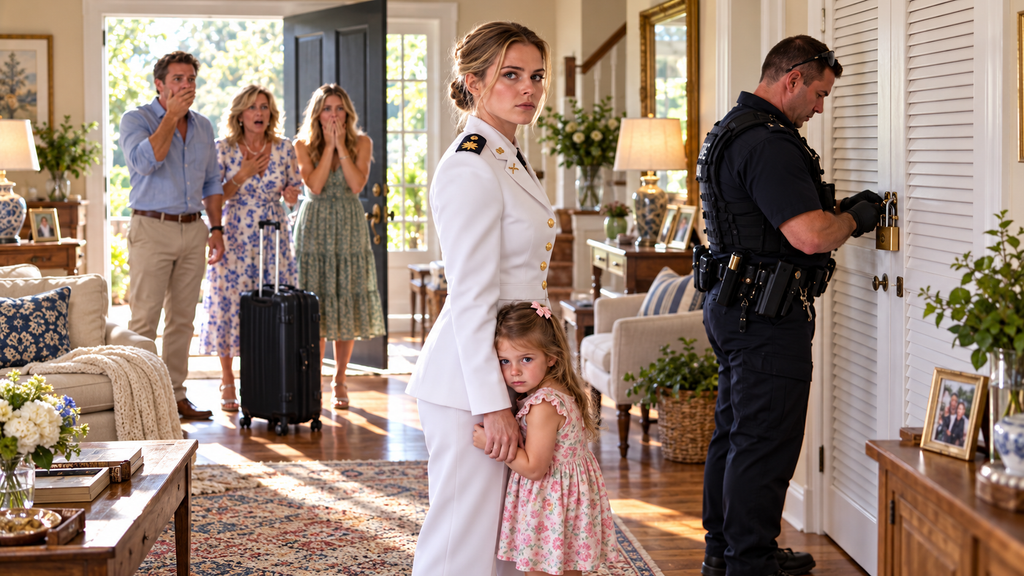
I remembered Officer Marcus Bell lowering the bolt cutters and looking at me.
“Major Nolan,” he said quietly, “before we open anything, I want to make sure we do this correctly.”
Behind him, one of the paramedics was kneeling beside Lily.
My four-year-old daughter was wrapped in a silver emergency blanket even though the house wasn’t cold.
She looked impossibly small inside it.
Her cereal bowl still sat on the floor where she had dropped it when I came through the front door.
I looked at the closet.
Then at my phone.
“Derek?”
He was still there.
I could hear him breathing.
The music on the cruise ship had vanished into the background.
“What is in the closet?”
He didn’t answer.
Officer Bell held out his hand.
“May I?”
I gave him the phone.
Bell raised it.
“Mr. Nolan, this is Officer Marcus Bell with Chesapeake Police. Your wife has given us permission to be inside the residence. Your daughter has been examined by emergency medical personnel after apparently being left without adult supervision.”
Derek immediately changed.
It was almost frightening how quickly he changed.
Thirty seconds earlier, he had been shouting.
Now his voice became controlled.
Polite.
Reasonable.
The voice he used with bank managers and teachers and people he wanted to impress.
“Officer, there’s been a misunderstanding.”
Bell glanced at me.
“What misunderstanding?”
“My wife wasn’t supposed to be home yet.”
“I understand that.”
“And arrangements had been made for our daughter.”
“There is currently no caregiver in this residence.”
“She must have left.”
“Your daughter says no adult has been here for three days.”
Silence.
Bell continued.
“And your neighbor reports being told through your doorbell camera that a babysitter was upstairs.”
Derek exhaled.
“That was my mother.”
I felt something cold move through me.
Patricia.
Of course.
Bell’s expression didn’t change.
“Your mother was monitoring the doorbell camera from the cruise ship?”
“Yes.”
“Then she knew no babysitter was physically present.”
“That isn’t what I said.”
“It’s exactly what you said.”
Derek’s voice hardened.
“This conversation is getting twisted.”
Then Bell looked toward the closet.
“Tell me what is behind this lock.”
Nothing.
“Mr. Nolan?”
Derek finally spoke.
“Private property.”
I almost laughed.
Private property.
Inside our house.
In the hallway twelve feet from our daughter’s bedroom.
Bell asked, “Does it belong to you?”
“Yes.”
“Is there anything dangerous inside?”
“No.”
“Weapons?”
“No.”
“Chemicals?”
“No.”
“Anything that could harm your daughter?”
“No.”
Bell looked at me.
I knew the question before he asked it.
“Mrs. Nolan, do you have access to this closet normally?”
“Yes.”
My voice sounded distant.
“It’s our linen closet. Towels. Sheets. Cleaning supplies. Lily’s extra blankets.”
“When did you last see it unlocked?”
“Before I deployed.”
Six months earlier.
The thought made my stomach turn.
Bell looked at the brass padlock again.
Then at the second officer standing near the kitchen.
“Photograph it.”
The officer took several pictures.
Derek heard the camera shutter through the phone.
His voice rose again.
“Stop. Hannah, stop them.”
I stared at the phone in Bell’s hand.
“Why?”
“Hannah.”
“Tell me why.”
“It doesn’t concern you.”
I actually looked around the destroyed house as if maybe I had misheard him.
Our daughter had spent three days eating dry cereal.
Nineteen thousand dollars was gone.
Police were standing in our living room.
And my husband was telling me something inside our home did not concern me.
I walked closer to the phone.
“Derek, Lily asked me if I was really here.”
He said nothing.
“She touched my face because she thought I might not be real.”
Still nothing.
“She told me she slept on the floor near the front door because she was afraid she wouldn’t hear anyone come home.”
His breathing changed.
“Hannah—”
“She has lost weight.”
“That’s not my fault.”
The entire room went still.
Even Bell looked at the phone differently.
Derek must have realized what he had said.
He tried to correct it.
“I mean, kids get picky. Lily hasn’t been eating well lately.”
The paramedic looked up sharply.
I felt my hands curl into fists.
Bell gave me the phone back.
“Don’t say anything else to him.”
But I couldn’t stop myself.
Not yet.
“Did you know the babysitter canceled?”
Derek didn’t answer.
“Before you boarded the ship, did you know?”
“Hannah, you’re emotional.”
That sentence.
After six months sleeping in temporary quarters thousands of miles from my child.
After missed birthdays and terrible internet connections.
After watching the clock every night because 2:00 a.m. for me meant Lily might still be awake back home.
After walking into my own house and finding my little girl hungry and alone.
My husband called me emotional.
Something inside me became perfectly calm.
“I’m going to ask once more.”
I spoke slowly.
“Did you know the babysitter canceled before you left?”
Derek stayed silent for five seconds.
Then ten.
Finally he said, “Mom said she had a backup plan.”
I looked at Officer Bell.
He had heard it too.
“What backup plan?”
“I don’t know.”
“You left anyway?”
“Hannah, it was a prepaid trip.”
A paramedic actually whispered, “Jesus.”
Derek continued as though the sentence made sense.
“There were twelve people going. We couldn’t just cancel everything because one sitter got unreliable.”
One sitter.
One four-year-old child.
As though those things belonged on opposite sides of a reasonable equation.
I looked down the hallway.
At the padlock.
“Open it.”
Officer Bell hesitated.
Then nodded toward the other officer.
The bolt cutters came up.
Derek heard the metal move.
His voice exploded through the speaker.
“HANNAH!”
The cutter closed.
The brass shackle snapped.
Lily flinched.
I moved instantly toward her, but the medic already had an arm around her shoulders.
Officer Bell pulled the lock free.
He didn’t open the doors immediately.
He put on gloves.
The second officer did the same.
Then Bell pulled the handles.
The closet opened.
For a moment, none of us understood what we were seeing.
Because it wasn’t a linen closet anymore.
There were no towels.
No sheets.
No vacuum cleaner.
No boxes of detergent.
Someone had removed the shelves.
A narrow metal rack stood against the back wall.
Three small monitors were mounted above it.
A laptop sat open on a folding shelf.
Wires ran through holes drilled into the wall.
There were external hard drives.
A router.
Two power banks.
A stack of folders.
And six black-and-white camera feeds.
Our living room.
Our kitchen.
The back door.
Lily’s bedroom.
The front porch.
And the hallway.
For several seconds, the only sound in the house was the faint electronic hum of the equipment.
My skin went cold.
Officer Bell stepped forward.
“Don’t touch anything.”
I couldn’t have moved if I wanted to.
One monitor showed us standing outside the closet.
A tiny timestamp glowed at the bottom.
LIVE.
I looked at Lily’s bedroom feed.
Her pink blanket.
Her stuffed rabbit.
The night-light beside her bed.
I had installed none of those cameras.
I turned toward the phone.
“Derek.”
He had gone completely silent.
“Why is there a camera in Lily’s bedroom?”
Nothing.
“Why are there cameras inside this house?”
He disconnected.
The call ended.
I stared at the screen.
CALL ENDED.
And somehow those two words frightened me more than his shouting had.
Officer Bell’s posture changed.
He spoke into the radio clipped to his shoulder.
I didn’t catch everything.
I heard “additional units.”
I heard “possible digital evidence.”
I heard “minor child.”
Then Bell looked at me.
“Major Nolan, I need you and your daughter to stay out of this hallway.”
“What is that?”
“We don’t know yet.”
“You’re looking at it.”
“We know what the equipment is. We don’t know what’s on it.”
I looked at the folders.
One had my name written across the tab.
HANNAH.
Another said LILY.
A third said FINANCIAL.
And underneath them was one marked EXIT.
I pointed.
“That’s my name.”
“I see it.”
“Open it.”
“I can’t start going through everything casually. We need detectives here.”
“This is my house.”
“I understand.”
“That is a file about me.”
“I understand.”
“Then open it.”
Bell stepped closer.
His voice softened.
“I also understand that whatever this is may become evidence.”
That word stopped me.
Evidence.
I was an intelligence officer.
I understood chain of custody.
Documentation.
Contamination.
Procedure.
I had spent my career telling people that emotion could not dictate what happened to information once that information mattered.
Now I was standing twelve feet from my daughter with my entire marriage apparently stored inside labeled folders, and every part of me wanted to tear through them with my bare hands.
But Bell was right.
So I stepped back.
The paramedic touched my arm.
“Your daughter needs to go to the hospital.”
I looked at Lily.
She was watching the closet.
Not curiously.
Fearfully.
That terrified me.
I crouched beside her.
“Sweetheart?”
She looked at me.
“Have you seen that before?”
Her eyes moved toward the monitors.
Then back to me.
She nodded.
My throat tightened.
“When?”
“Daddy goes there.”
“What does Daddy do?”
She squeezed the emergency blanket.
“He watches.”
The room became very quiet again.
“What does he watch?”
Her answer was almost a whisper.
“Me.”
I felt something break inside my chest.
Not loudly.
Not dramatically.
It just broke.
I reached for her and pulled her against me.
She buried her face against my shoulder.
“He watches when I’m bad.”
Every muscle in my body tightened.
Officer Bell crouched several feet away so he wouldn’t tower over her.
“Lily,” he said gently, “you aren’t in trouble.”
She peeked at him.
He pointed toward himself.
“My job is to make sure people are safe. Okay?”
She nodded.
“Did Daddy ever tell you about those cameras?”
Another nod.
“What did he say?”
Lily twisted the edge of the blanket around one finger.
“He said Mama can see me too.”
I closed my eyes.
No.
No, no, no.
I forced myself to breathe.
“I couldn’t see you, baby.”
She looked at me.
Her eyes filled.
“Daddy said you could.”
“I couldn’t.”
“He said you watched.”
“Lily, I swear to you, I didn’t know there were cameras.”
Her bottom lip trembled.
“But when I cried for you…”
My voice disappeared.
She finished quietly.
“You didn’t call.”
I had imagined many terrible things during deployment.
Missiles.
Attacks.
Emergency notifications.
Accidents at home.
Never this.
Never my daughter sitting alone in her bedroom crying toward a camera because her father told her I could see her.
I pulled her close enough that I could feel her heartbeat.
“I didn’t know.”
She began crying.
“I thought you were busy.”
“Never too busy for you.”
“I thought soldiers can’t call when kids are bad.”
I pulled back so I could see her face.
“Listen to me.”
She sniffed.
“You are not bad.”
Her eyes stayed on mine.
“You have never been bad because you cried.”
A tear rolled down her cheek.
“You have never been bad because you missed me.”
Another tear.
“You have never been bad because you wanted someone to hug you.”
Her face crumpled.
I pressed my forehead against hers.
“And if I had known you were crying for me, I would have moved heaven and earth to get to a phone.”
That was when my daughter finally made a sound.
Not the silent tears from when I first entered the house.
A real cry.
Deep.
Broken.
The kind a four-year-old should never have learned to hold inside.
I wrapped both arms around her and let her cry into my uniform.
Nobody in the room spoke.
Not the police.
Not the medics.
Not Evelyn.
They just let me hold my child.
Eventually the paramedic touched my shoulder.
“We need to go.”
I nodded.
As I stood, Lily wrapped her arms around my neck.
She refused the stretcher unless I sat beside her.
So I did.
As they rolled us toward the front door, I looked back once.
Officer Bell stood beside the open closet.
The monitors glowed behind him.
And on one of them, a camera pointed at the exact place where Lily had been sitting when I came home.
The cereal bowl was visible on the floor.
That meant Derek hadn’t just installed cameras.
There was a possibility that someone had been able to watch her.
Watch her hungry.
Watch her alone.
Watch her waiting.
I whispered one sentence before the front door closed.
“Find out who was watching.”
Bell met my eyes.
“We will.”
At the hospital, they weighed Lily.
I won’t tell you the number.
I still hate the number.
What mattered was the doctor’s expression when he compared it with the weight recorded at her pediatric visit five months earlier.
He asked me questions.
How long had I been overseas?
Who had primary responsibility for Lily?
Had Derek ever mentioned trouble feeding her?
Any illness?
Any stomach problems?
Any recent doctor appointments?
I answered everything.
Then a nurse brought Lily a stuffed yellow duck.
She named it Sunny.
She held Sunny through bloodwork.
She held Sunny through the examination.
She held Sunny when the social worker came in.
And when anyone asked her a question she didn’t like, she reached one hand toward me without looking.
Every time, I took it.
At 6:12 that evening, after hours of examinations and interviews, a detective named Carla Ruiz walked into the room.
She was maybe forty-five.
Short dark hair.
Tired eyes.
A navy blazer over a gray blouse.
She introduced herself and looked at Lily, who had finally fallen asleep curled beside me.
“Can we talk?”
“Here.”
She glanced at Lily.
“Some of this may be difficult.”
“I’m not leaving her.”
Ruiz nodded.
“Understood.”
She pulled a chair close.
“We obtained authorization to secure and examine the digital equipment found in the closet.”
My stomach tightened.
“What did you find?”
“We’re still working.”
“Detective.”
She studied my face.
Then she opened a notebook.
“The surveillance system appears to have been installed approximately four months ago.”
Two months after I deployed.
“There are cameras in seven locations.”
“Seven?”
“The six visible feeds plus one additional camera.”
“Where?”
She hesitated.
I knew immediately that I wasn’t going to like the answer.
“Your bedroom.”
My jaw tightened.
“Where?”
“Inside a smoke detector.”
I stared at her.
“Our bedroom?”
“Yes.”
“Was it recording?”
“It appears so.”
I felt sick.
Ruiz continued carefully.
“There is cloud access. More than one device had login credentials.”
“How many?”
“We know of at least four.”
My voice came out flat.
“Derek.”
“Yes.”
“Patricia?”
“We are not confirming individual users yet.”
That meant yes.
Or maybe worse.
I looked toward Lily.
“What did they record?”
“We’re still reviewing.”
“Did they watch her during the last three days?”
Ruiz didn’t answer immediately.
That was answer enough.
I stood so quickly the chair scraped backward.
Lily moved in her sleep.
I froze.
Ruiz lowered her voice.
“Sit down.”
“Did they watch?”
She waited until I sat.
Then she said, “The system logged remote access several times after Derek left the residence.”
My eyes burned.
“From the ship?”
“At least one login appears consistent with the ship’s network. We are verifying it.”
I stared at the wall.
For three days, my daughter had been alone.
But she had not been unseen.
There is a special kind of horror in that distinction.
If Derek had simply disappeared and assumed someone else was caring for her, that would have been unforgivable.
But this?
This meant somebody had looked through a camera and seen the house.
Seen the empty rooms.
Seen Lily.
And then continued ordering drinks beside a swimming pool.
Ruiz opened her notebook again.
“There’s more.”
Of course there was.
“There were documents in the closet.”
“The folders.”
“Yes.”
I looked at her.
“What was in the one with my name?”
She drew a breath.
“Copies of your deployment orders.”
I frowned.
“Why?”
“Copies of your pay statements. Your Social Security information. Your military ID information. Banking documents. Your life insurance documents.”
My stomach dropped.
“Life insurance?”
“Yes.”
I sat very still.
“Am I the policyholder?”
“You’re insured.”
“I know that. Derek is my beneficiary.”
“He was.”
I looked at her.
“Was?”
“Someone attempted to make changes.”
My mouth went dry.
“What changes?”
“That is part of what we’re investigating.”
“Tell me.”
“Your husband appears to have submitted documents requesting changes to several accounts while you were overseas.”
“What kind of changes?”
“Beneficiary designations. Account access. A home equity application.”
I stared at her.
“I never applied for a home equity loan.”
“We know.”
“Then who signed it?”
Ruiz looked at me.
I understood.
My signature.
Forged.
“How much?”
“Seventy-five thousand dollars was requested.”
“Approved?”
“Not yet.”
Something close to relief passed through me.
Then Ruiz added, “But there are two credit accounts opened in your name that you may not know about.”
The relief vanished.
“How much?”
“Approximately thirty-two thousand dollars in available credit. We are still tracing transactions.”
I looked toward the window.
Outside, normal people were driving home from work.
Stopping for groceries.
Complaining about traffic.
Inside that room, my marriage was becoming a criminal case one sentence at a time.
Ruiz continued.
“The EXIT folder is what concerns us most.”
I turned back.
“What’s in it?”
“A timeline.”
“What kind of timeline?”
She opened the notebook.
“Your expected return date.”
My heart slowed.
“Derek knew I was due home in three weeks.”
“Yes.”
“Keep going.”
“Notes about financial transfers. Documents related to selling or refinancing the house. Copies of Lily’s birth certificate and passport application materials.”
I stopped breathing for a second.
“Passport?”
“Did you authorize a passport application for your daughter?”
“No.”
“Did you sign one?”
“No.”
Ruiz nodded as though she expected the answer.
“There’s also correspondence with an attorney.”
“Divorce?”
“Yes.”
That hurt.
Not because I wanted the marriage anymore.
That marriage had ended the second I saw Lily on the floor.
But betrayal has layers.
You can know someone is horrible and still discover another basement underneath the first one.
“He was going to divorce me?”
“It appears he had discussed filing shortly after your scheduled return.”
“Why wait?”
Ruiz didn’t answer.
I thought about it.
Then I understood.
“He wanted me home first.”
“Yes.”
“Why?”
“There are notes.”
“What notes?”
Ruiz looked down.
One sentence had been underlined in her notebook.
She read it carefully.
“‘Need her reaction documented after return. Don’t engage unless camera is running.’”
I stared at her.
For several seconds, I couldn’t make sense of the words.
Then I did.
He had been preparing for my homecoming.
Not emotionally.
Strategically.
He knew I would discover money missing.
He knew I would discover things had changed.
He expected me to confront him.
And he wanted cameras running when I did.
Ruiz continued.
“There are several references to you being ‘unstable after deployment.’”
I almost laughed.
“That’s his plan?”
“We don’t know the entire plan yet.”
“I do.”
I could suddenly see it.
All of it.
Derek had always hated that I was better under pressure than he was.
When something went wrong, he called me cold.
When I didn’t cry during arguments, he called me detached.
When I did get angry, he called it my “military mode.”
He had spent years turning normal parts of my personality into evidence against me.
Now he had built cameras around that story.
“He was going to provoke me.”
Ruiz didn’t respond.
“He was going to empty the accounts, let me find it, record me losing my temper, then tell people deployment changed me.”
“That is one possibility.”
“No.”
I looked at her.
“That was the plan.”
And then another thought arrived.
It was worse.
“Lily.”
Ruiz’s eyes shifted.
I felt my stomach twist.
“He was going to use Lily.”
She didn’t answer.
“What was in Lily’s folder?”
Ruiz closed the notebook for a moment.
“Hannah…”
“What was in my daughter’s folder?”
“Behavior notes.”
I didn’t understand.
“What does that mean?”
“Dates. Times. Comments.”
“About what?”
“Tantrums. Crying. Bedwetting. Refusing meals. Asking for you.”
My hands began shaking.
“They kept records?”
“Yes.”
“Why?”
“One note says, ‘Document attachment problems before Hannah returns.’”
I looked at sleeping Lily.
She was holding the yellow duck under her chin.
Attachment problems.
My daughter missed her mother.
That was their evidence.
A four-year-old cried because her mother was deployed, and my husband had written it down like a symptom.
Ruiz continued.
“There are also several recorded conversations between Derek and his mother.”
“From the closet?”
“Apparently the system recorded audio from the laptop.”
“About me?”
“Yes.”
“About Lily?”
“Yes.”
My voice dropped.
“I want to hear them.”
“Not tonight.”
“Detective—”
“Not tonight.”
There was something in her expression that made me stop.
“Why?”
“Because your daughter needs you present. Not physically present while your mind is somewhere inside those recordings.”
That was probably the kindest thing anyone could have said to me.
I looked down at Lily.
Ruiz stood.
“There’s one more thing you need to know tonight.”
I waited.
“The sitter did not cancel at the last minute.”
Every hair on my arms rose.
“What?”
“She canceled nine days before the cruise.”
I stared at Ruiz.
Nine days.
Derek knew nine days before leaving.
Not nine minutes.
Not while boarding.
Nine days.
“He had time.”
“Yes.”
“To find someone.”
“Yes.”
“To cancel.”
“Yes.”
“To tell me.”
“Yes.”
“To do anything.”
“Yes.”
“But he left.”
Ruiz’s face hardened.
“Yes.”
“Why?”
“We’re still establishing motive.”
I already knew part of the answer.
Because the cruise mattered more.
Because he assumed someone else would solve it.