 Reading Time: 34 minutes
Maya sat back up and went completely still. At first, I thought the woman had simply said something cruel to her again.
From Row 14, I could only see the back of Maya’s head and the small purple stars on the straps of her backpack.
I leaned into the aisle, trying to catch her attention.
“Maya?”
She didn’t turn around.
The seat belt sign was still illuminated.
Leo shifted against my chest and released one soft, sleepy sigh.
I placed my hand over his back.
Everything in me wanted to unbuckle, walk straight up to Row 11, and demand that the woman switch seats with me immediately.
I didn’t care anymore about delays.
I didn’t care about embarrassed passengers.
I didn’t care about the flight attendant’s strained smile or the departure slot or any of the hundred tiny reasons people use to convince mothers that their discomfort is easier to tolerate than someone else’s inconvenience.
But before I could do anything, the pilot’s voice came over the intercom.
“Ladies and gentlemen, we’ve reached our initial cruising altitude. We’ll be turning off the seat belt sign shortly. We do recommend that you keep your seat belts fastened whenever you’re seated.”
The light above us clicked off.
Almost immediately, Maya stood.
My heart jumped.
She didn’t look at me first.
She looked toward the front of the cabin.
Then she raised one small hand.
“Excuse me?”
Her voice wasn’t loud.
But it carried.
Maybe because children have a certain kind of voice when they’re trying not to cry.
Maybe because half the people around us had been watching our little confrontation before takeoff and were curious about what would happen next.
Maybe because the woman beside her went pale the second Maya stood up.
A flight attendant turned from the galley.
It was the same attendant who had moved me.
“Yes, sweetheart?”
Maya swallowed.
She glanced down at the woman’s lap.
Then she said the sentence that changed the entire atmosphere of the plane.
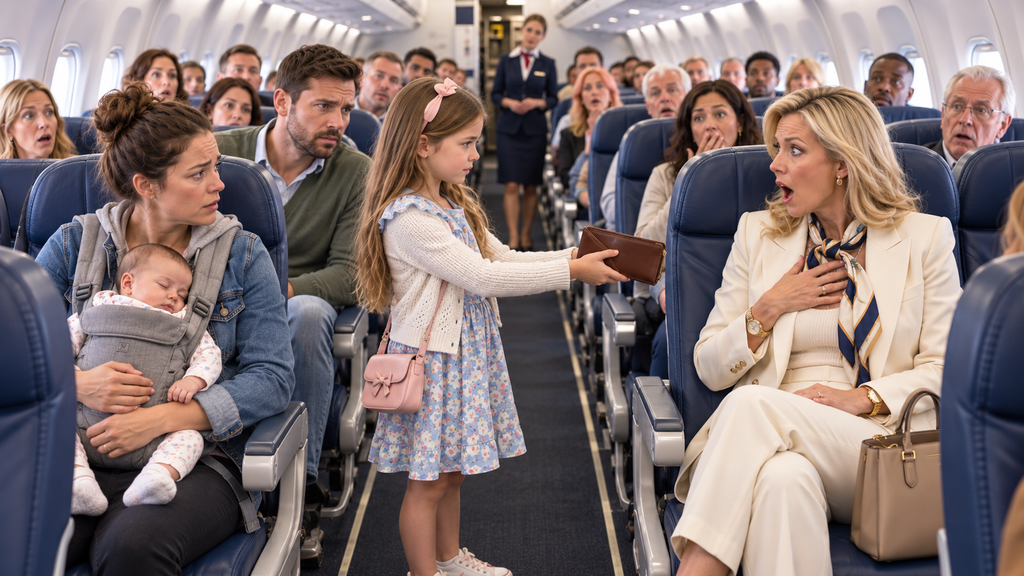
“Her real boarding pass says Row 14, and she hid it under her leg when you came to check.”
Silence.
Not the normal hush of an airplane cabin.
Not the dull quiet under the engines.
This was different.
It was the sudden, unnatural silence of dozens of strangers realizing they had just witnessed something they had misunderstood.
The man sleeping beside me opened his eyes.
The young guy on my right pulled one earbud out.
Two people in Row 12 turned around.
The woman’s face changed.
Completely.
“What did you just say?” the flight attendant asked.
The woman shot upright.
“She doesn’t know what she’s talking about.”
Maya pointed.
Not dramatically.
Not accusingly.
Just toward the seat.
“It was under her leg before.”
The woman snapped, “Sit down.”
I was already out of my seat.
“Do not speak to my daughter like that.”
Every head between Row 14 and Row 11 seemed to turn.
Leo woke at the sound of my voice and gave a small protesting cry.
I held him against me with one arm while gripping the seat backs with the other as I moved forward.
The woman looked at the flight attendant.
“This is ridiculous. You’re going to take the word of a ten-year-old?”
The flight attendant’s expression had changed too.
The tired customer-service softness was gone.
“Ma’am, please stand for me.”
The woman laughed.
It was thinner this time.
More nervous.
“Oh, come on.”
“Please stand.”
“Why?”
“Because I need to inspect the seat.”
“There is nothing there.”
“Then standing shouldn’t be a problem.”
For several seconds, the woman refused to move.
That was when I knew.
Maya hadn’t made a mistake.
She had seen something.
The woman had been sitting on it deliberately.
A second flight attendant came forward from the rear.
“What’s going on?”
The first one kept her eyes on the woman.
“I need the passenger in 11B to stand.”
Technically, Maya was in 11B.
The woman had taken 11A.
But no one corrected her.
“I’m not getting up because some child made up a story,” the woman said.
Maya’s lower lip trembled.
I reached her and placed my hand on her shoulder.
“It’s okay.”
The woman looked at me.
“You need to control your daughter.”
Something inside me snapped.
Not loudly.
Not violently.
Just enough.
“No,” I said. “What I need to do is stop teaching my daughter that rude adults get whatever they want if they’re rude enough.”
The man across the aisle whispered, “Amen.”
Someone behind us gave a quiet laugh.
Not at me.
At the woman.
Her cheeks darkened.
The second flight attendant leaned closer.
“Ma’am, I’m going to ask you one more time to stand.”
The woman shoved her tray table upward with unnecessary force.
“Fine.”
She stood.
And there it was.
A folded paper boarding pass.
Half-hidden between the seat cushion and the woman’s coat.
The flight attendant reached down and picked it up.
The woman immediately grabbed for it.
“That is mine.”
The attendant pulled it back.
“Yes, ma’am. That’s why I’m looking at it.”
She unfolded it.
Her eyes moved across the print.
Name.
Flight number.
Date.
Seat assignment.
The muscles in her jaw tightened.
Then she looked down the aisle.
Straight toward Row 14.
Toward the seat where I’d been forced to sit.
“Ma’am,” she said slowly to the woman, “your assigned seat is 14B.”
The silence deepened.
I looked toward Row 14.
14B.
The middle seat.
The exact seat they had moved me into.
The woman’s actual seat.
Not a double assignment.
Not a computer error.
Not an unfortunate mix-up.
She had taken mine.
And then she’d lied.
The young man who had helped me with the diaper bag let out a disbelieving laugh.
“You’re kidding.”
The woman folded her arms.
“No, that’s my new assignment. They changed me after boarding.”
The attendant looked at the boarding pass again.
“No.”
“Yes, they did.”
“No, ma’am. This pass was printed forty-three minutes ago.”
The woman hesitated.
Only for half a second.
But everyone saw it.
The attendant continued.
“And it shows 14B.”
The woman glanced around at all the watching faces.
Then she did something that stunned me more than the lie itself.
She doubled down.
“I had 11A originally.”
The flight attendant said nothing.
“I paid for it.”
The attendant’s eyes narrowed.
“I saw it on my phone.”
“May I see your mobile boarding pass?”
“My phone is dead.”
It was sitting on her tray table.
Screen glowing.
A message notification appeared.
Someone behind me snorted.
The woman snatched the phone up and turned the screen off.
“My battery is almost dead.”
The flight attendant took a breath.
“Ma’am, what exactly did you show me during boarding?”
The woman’s mouth opened.
Closed.
And that was when I understood what had happened.
During the confusion in the aisle, she had held up her phone.
The flight attendant had glanced at it quickly.
I remembered.
I had been balancing Leo.
Maya had been squeezed between passengers.
People behind us had been complaining.
The flight attendant had been trying to clear the aisle.
The woman had shown her something on her screen.
Not the paper boarding pass.
A screenshot.
The attendant must have seen 11A on it and assumed a double booking.
Now she extended her hand.
“Please unlock your phone and show me the boarding pass you presented before departure.”
“No.”
“Ma’am.”
“This is harassment.”
“No,” a man’s voice said from behind us.
Everyone turned.
The man was sitting in Row 12 across the aisle.
Gray hair.
Glasses.
A blue quarter-zip sweater.
He had been one of the passengers watching us before takeoff.
He held his own phone in his hand.
“This is what harassment looked like.”
He lifted the phone.
“I recorded part of it.”
The woman stared at him.
“You recorded me?”
“I started recording when you told the mother she was ‘playing the victim.’”
“You have no right—”
“I wasn’t filming you at first. I was filming my wife because this is her first flight after surgery.”
A woman beside him gave a tiny embarrassed wave.
He continued.
“But your voice is loud enough to be heard from Chicago.”
A few people laughed.
The woman looked ready to explode.
The first flight attendant held up a hand.
“Let’s stop. Everyone, please remain seated unless you need to be in the aisle.”
Then she turned to me.
“Ma’am, I’m very sorry.”
It was the first time anyone had apologized.
Not explained.
Not justified.
Not asked me to be understanding.
Apologized.
And I almost cried.
It surprised me how close the tears were.
They weren’t really about the seat.
They were about the last six weeks.
About giving birth.
About sleeping in ninety-minute stretches.
About David working hundreds of miles away.
About my mother’s death the previous year.
About standing in my kitchen at three in the morning with Leo screaming while Maya hovered in the doorway asking if I needed water.
About pretending I could handle everything because mothers are expected to handle everything.
About arriving at O’Hare with two children, four bags, a stroller, a baby carrier, bottles, diapers, snacks, wipes, boarding passes, and enough anxiety to power the aircraft itself.
And then being told that the simplest promise I’d paid for—a seat beside my own daughter—was apparently negotiable because somebody more aggressive wanted it.
I swallowed the tears.
“Thank you.”
The flight attendant looked at Maya.
“And I’m very sorry to you too.”
Maya nodded.
The woman rolled her eyes.
“This is unbelievable.”
The second flight attendant gestured toward the back.
“Ma’am, you’ll need to return to your assigned seat.”
The woman stared at her.
“What?”
“14B.”
“No.”
“I beg your pardon?”
“I am not sitting in the middle seat.”
The second attendant’s eyebrows rose.
“That is your assigned seat.”
“I have back problems.”
“Then we can discuss whether another seat is available.”
“I already found another seat.”
My jaw nearly dropped.
The gray-haired man in Row 12 laughed out loud.
“You didn’t find it. You stole it.”
“Stay out of this.”
“You made it everybody’s business thirty minutes ago.”
A few passengers murmured agreement.
The woman pointed toward me.
“She has a baby. She’s probably going to be up half the flight anyway. What’s the difference where she sits?”
Maya stiffened beneath my hand.
I felt it.
The anger returned.
But before I could answer, Maya did.
“The difference is she’s my mom.”
The woman’s head turned toward her.
Maya continued.
“She paid so I wouldn’t have to sit with someone I don’t know.”
The woman scoffed.
“You’re ten, not four.”
Maya looked at her.
She looked so small beside that woman.
Small shoulders.
Purple backpack.
Braids slightly frizzy from our long morning.
But there was something steady in her face that I had never seen before.
“I’m still a kid.”
The sentence hit me harder than the first one.
I’m still a kid.
Of course she was.
I’d been so proud of how independent Maya had become since Leo was born.
So grateful when she carried bottles.
When she held doors.
When she packed her own backpack.
When she told me, “I’ve got it, Mom,” because she could see how exhausted I was.
I had let her be helpful.
But somewhere inside my exhaustion, I had started leaning on how capable she was.
And other adults had seen the same thing and decided capable meant she needed less protection.
The woman in 11A had looked at her and said she was big enough to sit away from me.
The flight attendant had looked at her and decided she would probably be fine.
Even I had finally walked away because Maya had whispered that she could handle it.
But she was still a kid.
My kid.
I crouched slightly beside her.
“You’re right.”
She looked at me.
I repeated it.
“You’re absolutely right.”
Her face softened.
The first flight attendant looked toward the woman.
“Please gather your belongings.”
The woman didn’t move.
The attendant’s voice sharpened.
“Now.”
That did it.
She yanked her headphones from the seat pocket.
Stuffed them into her giant tote.
Grabbed her trench coat.
Jammed her feet back into her shoes without tying them.
Every movement radiated outrage.
As though she were the one being humiliated unfairly.
As though consequences were something being done to her instead of something created by her own choices.
When she bent to retrieve the paper boarding pass, the flight attendant picked it up first.
“I’ll bring this to you.”
The woman’s face went crimson.
“You cannot confiscate my boarding pass.”
“I’m not confiscating it. I’m returning you to the seat printed on it.”
The man in Row 12 coughed to hide another laugh.
The woman glared at everyone.
Then she looked at Maya.
And for one horrible moment, I saw the kind of adult anger that children remember.
The look that says:
You embarrassed me.
You caused this.
You should have stayed quiet.
I moved between them.
“Don’t.”
The woman raised both hands.
“I didn’t say anything.”
“You didn’t have to.”
Her eyes narrowed.
I had spent most of my adult life avoiding confrontation.
My mother used to tease me about it.
“You apologize to furniture after bumping into it,” she’d say.
She wasn’t wrong.
If a waiter brought me the wrong food, I ate it.
If someone cut in front of me at the grocery store, I pretended not to notice.
If a neighbor’s dog dug up my flowers, I quietly replanted them.
I liked peace.
I still do.
But my mother had also told me something else.
Something I’d forgotten until that exact moment.
Kindness without boundaries becomes permission.
I could almost hear her saying it.
I looked at the woman.
“You chose this.”
She stared back at me.
“No,” she said. “Your daughter did.”
Maya’s fingers tightened around mine.
And that was the moment I became completely calm.
The kind of calm that comes after anger has burned away everything unnecessary.
“No,” I said. “My daughter told the truth. You chose what the truth would be.”
The woman had no answer.
She pushed past me.
Walked down the aisle.
Past Row 12.
Past Row 13.
To Row 14.
To the middle seat where I had been sitting.
The young man beside it stood to let her in.
He gave me an almost apologetic smile as she approached.
Then he looked at her.
“Careful with the diaper bag.”
She froze.
My bag was still partly under the seat.
The flight attendant retrieved it and brought it forward to me.
The woman squeezed into 14B.
She looked furious.
The older man by the window leaned away from her and went back to sleep.
The young guy put both headphones on.
And just like that, the throne she had fought so hard to steal became what it had always been.
Someone else’s seat.
I slipped into 11A.
The one I’d paid for.
Maya was in 11B beside me.
Leo began fussing against my chest, perhaps sensing the tension.
I loosened the carrier and gently bounced him.
“Shh, baby.”
Maya looked at me.
“Are you mad at me?”
The question broke my heart.
“What?”
“For saying something.”
“No.”
“I thought maybe I was supposed to stay quiet because you already moved.”
I stared at her.
“No, sweetheart.”
Her eyes dropped to her hands.
“She told me I’d get you in trouble.”
My stomach tightened.
“What did she say?”
Maya hesitated.
Then she looked toward Row 14.
The woman was facing straight ahead.
“She said the flight attendant had already decided and that if I kept bothering her, they might make us get off the plane.”
My mouth went dry.
“She said that?”
Maya nodded.
“She told me people get kicked off flights for making scenes.”
I felt fresh anger rise.
Not because the woman had lied to me.
Because she had tried to frighten my daughter into silence.
“Why didn’t you tell me before takeoff?”
Maya twisted one purple backpack strap around her fingers.
“Because you looked tired.”
Four words.
That was all it took.
Because you looked tired.
I turned toward the window so Maya wouldn’t immediately see my face collapse.
Chicago was far below us now.
The clouds looked endless from above.
White and soft and peaceful.
Nothing like the morning we had just lived through.
I blinked rapidly.
Maya noticed anyway.
“Mom?”
I reached for her hand.
“You never have to protect me from something you need help with.”
She frowned.
“But you have Leo now.”
“And I still have you.”
“I know.”
“No.”
I squeezed her hand.
“I need you to really know.”
Her eyes lifted to mine.
“Having a baby doesn’t make you less my child.”
She didn’t say anything.
I continued.
“You don’t become the easy one just because your brother is little.”
Her face changed.
It was subtle.
A tiny loosening around her mouth.
A blink that lasted too long.
And I suddenly realized how much she’d been carrying.
Since Leo was born, everyone had praised her.
You’re such a big girl.
You’re such a helper.
Mommy needs you.
Be patient.
The baby needs her.
Give Mommy a minute.
You’re old enough to understand.
Every compliment had sounded kind.
But maybe, stacked together, they had started to feel like instructions.
Don’t need too much.
Don’t complain.
Don’t make things harder.
Be easy.
Be useful.
Be older than you are.
“Oh, Maya.”
She looked away.
“I don’t mind helping.”
“I know.”
“I love Leo.”
“I know you do.”
“He’s cute when he isn’t screaming.”
I laughed through my tears.
“That’s a fair review.”
She smiled.
Then her expression grew serious again.
“I just didn’t want you to have another problem.”
I lifted her hand to my mouth and kissed her knuckles.
“You are never a problem.”
She nodded.
I could see that she wanted to believe me.
I hoped I had enough years ahead to prove it.
Leo chose that moment to wake completely.
His tiny face wrinkled.
His fists tightened.
Then he screamed.
Loudly.
Impressively.
With the full outrage of a six-week-old who had apparently decided the injustice in Row 11 required his personal statement.
Several passengers laughed.
Even Maya.
“There he goes,” she said.
“Perfect timing.”
I unclipped the carrier slightly and checked him.
Hungry.
Of course.
I reached for the diaper bag.
Before I could pull it up, a hand appeared from across the aisle.
The gray-haired man.
“I’ve got it.”
He lifted the bag onto the empty space near my feet.
“Thank you.”
“No problem.”
His wife leaned across him.
“You’re doing fine.”
I nearly cried again.
Apparently my tear ducts had abandoned all professional standards.
“Thank you.”
She nodded toward Maya.
“And so is she.”
Maya smiled shyly.
The flight attendant returned a few minutes later.
She crouched beside our row.
“I’m sorry again.”
“You already apologized.”
“I know. I’m apologizing twice.”
That made me smile.
She lowered her voice.
“I should have verified the passenger information properly before asking you to move.”
I appreciated that she didn’t blame the crowd.
Or the delay.
Or the computer system.
Or the passenger.
She simply owned it.
“We were rushing,” I said.
“We were. But that’s an explanation, not an excuse.”
I looked at her.
That sentence mattered.
More than she probably realized.
She turned toward Maya.
“And you did exactly the right thing.”
Maya sat a little taller.
The attendant continued.
“If anything makes you uncomfortable on a flight, you tell one of us. Even if another adult tells you not to.”
Maya nodded.
“Okay.”
“And for the record, you are not responsible for keeping the plane on schedule.”
That earned a smile.
“Okay.”
The attendant looked at me.
“I’ve documented the seat issue. Our customer care team will follow up regarding the upgrade fee.”
“I appreciate that.”
She hesitated.
“There may also be someone meeting the other passenger after landing.”
I glanced toward Row 14.
“Because of the seat?”
“Not only the seat.”
Her eyes moved briefly toward Maya.
“It’s one thing to sit in an unassigned seat and misunderstand a boarding pass. It’s another to deliberately present false information and pressure a child after being told to move.”
I nodded.
“I don’t want Maya involved in anything else.”
“She won’t be unless you choose otherwise.”
“Thank you.”
The attendant stood.
Then Maya spoke.
“Wait.”
She reached down and pulled something from the seat pocket.
It was a folded napkin.
No.
Not a napkin.
A small white envelope.
Maya held it up.
“This isn’t ours.”
The attendant took it.
The woman’s name was written across the front.
Apparently it had slipped from her tote.
The flight attendant started down the aisle to return it.
“Of course,” I murmured.
“What?” Maya asked.
“Nothing.”
I pictured myself six weeks earlier.
Nine months pregnant.
Standing in the hospital gift shop.
Trying to choose between two baby blankets while my mother was no longer alive to answer my calls.
I had cried that day because grief has no respect for location.
A cashier had silently handed me tissues and pretended not to notice.
That woman had given me grace.
She didn’t know me.
Didn’t owe me anything.
That was the strange thing about people.
Some strangers made your worst days lighter.
Others saw that you were carrying too much and decided it made you easier to push.
Maya leaned against my shoulder.
“So what was under her leg?”
“Her boarding pass.”
“I mean why did she have that picture on her phone?”
I looked toward the front.
The flight attendant hadn’t explained that part yet.
But approximately twenty minutes later, she returned.
And she had an answer.
The woman had apparently purchased 11A on a different flight.
A flight scheduled for earlier that morning.
When her original flight was canceled, she’d been automatically rebooked onto ours.
On the canceled flight, she had indeed been assigned 11A.
On our flight, she had been reassigned to 14B.
Instead of showing the new boarding pass, she had shown the flight attendant a screenshot from the canceled flight.
Same airline.
Same route.
Same morning.
Different flight number.
During the rush, no one had caught it.
Maya had.
“How?”
I asked her.
Maya shrugged.
“The time was wrong.”
“The time?”
“The paper one said 11:20. The phone one said 8:05.”
I stared at her.
“You saw both?”
“She showed the phone really close to my face when the flight attendant was checking.”
Of course she did.
I had been bouncing Leo.
Moving bags.
Responding to people behind me.
Trying not to cry.
Maya had been watching everything.
“What made you look under her leg?”
“She dropped it.”
“The boarding pass?”
Maya nodded.
“She looked at it, then put her foot on it.”
“And then?”
“Then she picked it up and put it under her leg.”
“Why didn’t you say something right away?”
“I tried.”
I remembered.
As Maya bent down.
Excuse me, ma’am, I think you have—
Listen, kid. Don’t start.
I closed my eyes.
That was what Maya had been trying to tell her.
Not that she’d dropped something.
That Maya knew.
The woman had realized it instantly.
No wonder she’d shut her down.
No wonder she’d frightened her afterward.
I looked at my daughter.
“You are observant.”
She grinned.
“You always say I notice everything.”
“I take back every time I’ve complained about it.”
“You said it was creepy.”
“I said it was mildly unsettling.”
“You said creepy.”
“Fine. Creepy but useful.”
She laughed.
And for the first time since boarding, the tension inside me began to loosen.
The cabin settled.
Drink carts moved down the aisle.
Window shades went up and down.
People returned to movies and books and games.
Leo drank his bottle and fell asleep again.
Maya ordered apple juice.
I had coffee.
Terrible airplane coffee.
Possibly the best coffee I had ever tasted.
For a while, nothing happened.
And that felt like a gift.
Then, about an hour into the flight, the woman from Row 14 walked toward the restroom.
I saw her coming.
Maya saw her too.
Her whole body stiffened.
I placed my hand over hers.
The woman stopped beside our row.
The aisle suddenly felt smaller.
I looked up.
“Yes?”
Her face was different now.
Not apologetic.
But less certain.
“I want my envelope.”
“The flight attendant has it.”
“I know.”
She glanced at Maya.
Then back at me.
“She shouldn’t have gone through my things.”
Maya’s mouth fell open.
“She didn’t.”
“She was digging around my seat.”
“No.”
“I saw her.”
“No,” I repeated. “You saw her notice the boarding pass you were hiding.”
The woman leaned closer.
“I don’t appreciate being made out to be some kind of criminal.”
I stared at her.
“No one called you a criminal.”
“You’re all treating me like one.”
“You lied about your seat.”
“It was my seat on the other flight.”
“Which you knew.”
She folded her arms.
“I paid for a window seat.”
“So did I.”
“You had a baby.”
I waited.
Apparently that was the entire argument.
“And?”
“It was easier for you to move.”
There it was.
The truth.
Not that she was confused.
Not that the airline made a mistake.
Not that she thought 11A was hers.
It was simply easier for me to lose something than for her to be uncomfortable.
Because I had children.
Because I was tired.
Because I was juggling too much to fight.
Because women like her know exactly which people they can pressure.
I spoke softly.
“You saw me standing in that aisle with a newborn and a ten-year-old, and you decided that made me easier to displace.”
Her expression hardened.
“I decided you’d survive sitting three rows back.”
“And you decided my daughter would survive sitting beside you.”
“She did.”
Maya flinched.
I stood.
Not fully.
Just enough that my face was level with the woman’s.
“You don’t get to use the fact that she endured your behavior as proof your behavior was acceptable.”
She stared at me.
People nearby had gone quiet again.
The woman noticed.
Her cheeks colored.
“Oh, please. I didn’t hurt anybody.”
And from across the aisle, the gray-haired man’s wife said quietly:
“That’s a very low standard for being a decent person.”
The woman turned.
“This doesn’t involve you.”
The older woman smiled faintly.
“You made that argument already.”
The woman looked around.
No allies.
Not one.
So she tried another approach.
“You people love drama.”
Then Maya spoke.
Not loudly.
“Can you please stop talking to my mom?”
The woman looked at her.
Maya’s voice trembled slightly.
But she continued.
“I don’t want to sit near you anymore.”
The woman opened her mouth.
I stepped between them.
“You heard her.”
The flight attendant appeared from the galley.
“Ma’am, please return to your seat.”
“I was going to the restroom.”
“Then please continue there and return directly to your assigned seat.”
“This is insane.”
The attendant lowered her voice.
“What is going to become insane is the paperwork I will be required to complete if you continue approaching this family after being instructed not to.”
The woman stared at her.
Then walked away.
Maya exhaled.
A long, shaky breath.
“You okay?”
She nodded.
Then shook her head.
Then nodded again.
“Kind of.”
“That counts.”
“Was I rude?”
“No.”
“I told her to stop talking to you.”
“That was a boundary.”
“She looked mad.”
“People sometimes get angry when a boundary works.”
Maya thought about that.
Then she smiled a little.
“Grandma would have liked that sentence.”
I froze.
Maya immediately looked worried.
“Sorry.”
“No.”
My voice cracked.
“No, sweetheart.”
I touched the blue baby carrier.
The one Mom had bought before she died.
She’d ordered it while I was pregnant with Leo.
It arrived two days after her funeral.
I had almost returned it because looking at it hurt too much.
The gift receipt was still tucked inside.
But I couldn’t.
So I wore it.
The first time I strapped Leo into it, I cried for twenty minutes.
It felt like my mother was still helping me carry him.
I looked down at the faded blue fabric.
“She really would have liked that sentence.”
Maya smiled.
“Grandma didn’t let people boss her around.”
“No.”
“She bossed people around.”
I laughed.
“That too.”
“She told Aunt Rachel the Thanksgiving turkey was dry.”
“She absolutely did.”
“It was dry.”
“It was extremely dry.”
We both laughed.
Leo stirred between us.
For a few precious seconds, the entire ugly morning disappeared.
There was only my daughter.
My son.
My mother’s memory.
And sunlight pouring through an airplane window thirty thousand feet above the ground.
I kissed Maya’s temple.
“Grandma would have been proud of you.”
She rested her head against me.
“Do you think so?”
“I know so.”
She was quiet for a moment.
Then she whispered:
“I miss her.”
“So do I.”
I felt Maya’s shoulders shake once.
Just once.
I wrapped my arm around her.
And for the first time since my mother died, I didn’t try to make the grief smaller for my daughter.
I didn’t say Grandma was in a better place.
I didn’t tell her not to cry.
I didn’t redirect her.
I simply sat there.
“I miss her too.”
Maya cried silently against my shoulder.
Leo slept between us.
And somehow, that was the moment the trip finally became what it was supposed to be.
Not an escape.
Not a logistical challenge.
Not evidence that I could manage everything alone.
Just a mother taking her children to be surrounded by family because she needed help.
I needed help.
It shouldn’t have been so difficult to admit.
About forty minutes before landing, the lead flight attendant approached us.
She introduced herself as Elena.
She had been working in the front cabin and had only learned the full story afterward.
She crouched beside me.
“I’ve reviewed what happened during boarding.”
I prepared myself for another apology.
Instead she handed me a small card.
“This has our customer care information and a case reference number.”
“Okay.”
“The gate team in Orlando has also been notified.”
I glanced toward Row 14.
“Is she in trouble?”
Elena chose her words carefully.
“That’s not something I can discuss in detail. But she will be speaking with our ground staff.”
I nodded.
“And I want you to understand something.”
Her voice softened.
“You did not cause this.”
I almost laughed.
Apparently my face showed surprise.
She continued.
“People sometimes become embarrassed when they complain about something on a flight because they feel like they’re delaying everyone or creating a problem. You were not creating the problem.”
I looked at Maya.
“She told me not to get the flight attendant.”
Elena smiled.
“I heard.”
Maya looked sheepish.
“I thought Mom was going to yell.”
“I was not going to yell.”
Maya raised one eyebrow.
The flight attendant laughed.
“Maybe a little?”
“I was going to speak firmly.”
“Very firmly,” Maya said.
I nudged her.
Elena continued.
“Why did you tell your mom not to call us?”
Maya looked down.
“Because I wanted to see what the paper said first.”
There was a pause.
Then Elena blinked.
“You already suspected the boarding pass?”
Maya nodded.
“I thought maybe the lady was confused. Then she hid it.”
Elena glanced at me.
“You have a detective.”
“Unfortunately.”
“Fortunately today.”
Maya beamed.
Elena stood.
“We’ll be landing shortly. Keep doing exactly what you’re doing.”
“Surviving?”
“That too.”
As she walked away, I leaned toward Maya.
“You know this doesn’t mean you should investigate suspicious adults on your own, right?”
Her smile faded.
“What?”
“If you think someone is lying or something feels unsafe, you tell me or a flight attendant.”
“But I was right.”
“You were.”
“So—”
“You can be right and still need an adult.”
She considered that.
“That’s annoying.”
“Welcome to being ten.”
She sighed dramatically.
“Eight years until freedom.”
“Bad news.”
“What?”
“Adults also need help.”
She frowned.
“That seems like false advertising.”
The man across the aisle laughed so hard he coughed.
The pilot announced our descent.
We fastened our seat belts.
Maya took the window.
I sat beside her with Leo secure against me.
Florida appeared beneath the clouds.
Green.
Bright.
Lakes shining in the afternoon sun.
Palm trees became visible as we descended.
Maya pressed her forehead against the window.
“There!”
“What?”
“I saw a pool.”
“In Florida? Impossible.”
She giggled.
For the first time all day, she looked ten again.
Not brave.
Not responsible.
Not helpful.
Not mature.
Just ten.
I watched her instead of the view.
When the wheels hit the runway, the cabin filled with the usual roar.
People immediately reached for phones.
Seat backs straightened.
Messages began sending.
A few passengers applauded.
Leo slept through the entire landing.
Naturally.
The same child who could wake because I opened a granola bar too loudly at home had apparently decided a Boeing hitting pavement at high speed was relaxing.
We taxied toward the gate.
Maya turned to me.
“Is Aunt Rachel really bringing the sign?”
“She threatened to.”
“What does it say?”
“She wouldn’t tell me.”
“I bet it’s embarrassing.”
“Almost certainly.”
“Good.”
Then her smile faded.
“What happens when we get off?”
I knew what she meant.
“I don’t know.”
“What if that woman gets mad at me again?”
“She won’t get near you.”
“How do you know?”
“Because I won’t let her.”
Maya looked at me carefully.
Then nodded.
This time, she believed me.
When the seat belt sign turned off, everyone stood.
Or tried to.
You know that strange ritual passengers perform the second a plane parks, where hundreds of people rise despite having nowhere to go?
That happened.
Except this time, several people remained seated.
The gray-haired couple.
The young guy from Row 14.
Two women behind us.
They seemed to understand that I needed space.
The woman in 14B stood immediately.
She reached for the overhead bin.
Elena appeared beside her.
“Ma’am, I’m going to ask you to remain seated until the other passengers deplane.”
The woman stared at her.
“You cannot be serious.”
“I am.”
“I have a connection.”
Elena glanced at her paperwork.
“No, ma’am. Orlando is your final destination.”
The gray-haired man murmured to his wife, “She’s consistent, I’ll give her that.”
His wife elbowed him.
The woman heard.
Her face turned bright red.
“This is humiliating.”
I looked away.
Not because I felt sorry for her.
But because I didn’t want Maya watching me enjoy someone else’s humiliation.
That mattered too.
Justice and cruelty can look dangerously similar if you stare at them from the wrong angle.
People began filing out.
The man who had recorded the confrontation stopped beside us.
He leaned toward me.
“I sent the video to the airline.”
“You didn’t have to.”
“I know.”
He smiled.
“Sometimes people need to see what happened before everyone starts rewriting it.”
His wife touched Maya’s shoulder lightly.
“You were very brave.”
Maya smiled.
“Thank you.”
Then the woman added something I will always remember.
“But you know what?”
Maya looked up.
“You don’t have to be brave all the time.”
Maya’s expression shifted.
The woman smiled.
“Sometimes you get to let your mom be brave for you.”
I had to look away.
Again with the tears.
Apparently the entire plane had conspired against my mascara.
When our row finally cleared, I stood.
The young man from Row 14 had brought my diaper bag forward.
“Here.”
“Thank you.”
“No problem.”
He grinned at Maya.
“Nice catch.”
Maya smiled.
Then he looked at me.
“And for what it’s worth, when they moved you back there, you didn’t make a scene.”
“I came close.”
“You would’ve been entitled.”
I shrugged.
“I don’t know about that.”
He glanced toward 14B.
“Maybe not. But she definitely made one.”
We stepped into the aisle.
Maya put on her backpack.
I secured Leo.
Then we walked toward the exit.
When I reached the aircraft door, Elena stopped me.
“Take care of yourself.”
“I will.”
She looked at Maya.
“And you.”
“I will.”
“Remember what I said.”
“Tell an adult.”
“Exactly.”
Maya pointed toward me.
“She is one.”
Elena laughed.
“Excellent choice.”
We walked into the jet bridge.
Warm Florida air seeped through the seams.
And then I heard it.
“EMILY!”
My sister.
Only Rachel could make my name echo through an airport terminal.
We stepped out of the jet bridge.
There she was.
Holding a gigantic poster.
WELCOME TO FLORIDA, SLEEP-DEPRIVED QUEEN + TINY OVERLORDS.
Maya burst out laughing.
“I knew it!”
Rachel dropped the sign.
She ran toward us.
First she hugged Maya.
Then me.
Very carefully because of Leo.
Then she looked at my face.
“What happened?”
That’s the thing about sisters.
You can survive an entire airplane confrontation without crying properly.
Then your sister asks what happened.
And suddenly you’re five years old again.
My face crumpled.
Rachel’s expression changed instantly.
“Oh, no.”
“I’m fine.”
“You are visibly not fine.”
“I am now.”
She wrapped both arms around me.
Leo protested from between us.
Rachel pulled back.
“Sorry, tiny overlord.”
Then she looked at Maya.
“What happened?”
Maya inhaled.
“A lady stole Mom’s seat and lied to the flight attendant and then she hid her boarding pass under her leg but I saw it and then Mom had to sit three rows back and then the lady said I’d get us kicked off if I said anything and then I told everyone where her real seat was and she had to move.”
Rachel stared at her.
Then at me.
Then back at Maya.
“I leave you alone for three hours.”
“I know.”
Rachel crouched.
“You okay?”
Maya nodded.
“Mom said I wasn’t a problem.”
Rachel’s eyes moved to mine.
The airport disappeared for a moment.
Noise.
People.
Rolling suitcases.
Announcements.
Everything.
Because my sister understood.
She knew about the last six weeks.
She knew how often Maya had been “the easy one.”
Rachel stood.
“We’re fixing that.”
“What?”
“The next three weeks.”
I laughed.
“What are you talking about?”
She started counting on her fingers.
“You sleep. I hold the baby. Maya and I go to the pool. You sleep. I make dinner. Maya gets to complain about things without anyone telling her she’s mature. You sleep. We order food. And, occasionally, you sleep.”
“That sounds repetitive.”
“That’s because I’m emphasizing the part you keep refusing to do.”
Maya smiled.
“I like this plan.”
“Of course you do.”
Rachel grabbed my carry-on.
“Give me the bag.”
“I can carry it.”
She stared at me.
“I did not ask if you possessed the physical capacity to carry it.”
Maya giggled.
I surrendered the bag.
“Fine.”
“Growth.”
We had walked maybe twenty feet when two airline representatives approached.
“Ms. Carter?”
I stopped.
“Yes?”
One of them wore a navy blazer.
The other had an airline badge clipped to her shirt.
“We’d like to speak with you briefly regarding what occurred onboard.”
Maya moved closer to me.
I felt it.
The representative noticed.
“This won’t take long.”
I looked at Rachel.
She nodded.
“I’ve got Leo.”
My arms instinctively tightened around him.
Rachel raised both hands.
“Or not.”
That made me laugh.
We stepped to the side.
The airline representative apologized again.
She explained that they had already verified the woman’s correct seat assignment through the boarding system.
There had never been a double-booking.
The screenshot she’d shown belonged to her canceled morning flight.
The gate scan clearly showed she boarded using the newly issued pass assigning her to 14B.
Which meant she knew.
Absolutely.
Without question.
She knew.
The airline refunded my seat-selection fee.
They also issued a travel credit.
I wasn’t particularly interested in either by then.
“What happens to her?” Maya asked.
The representative paused.
“We’re going to have a conversation with her.”
Maya frowned.
“That’s it?”
I touched her shoulder.
“Maya.”
The representative smiled slightly.
“It’s a little more serious than the kind of conversation you’re imagining.”
“Oh.”
They asked whether I wanted to file a formal complaint documenting the passenger’s comments toward Maya.
I hesitated.
Not because I thought the woman deserved protection.
Because I was tired.
The kind of tired that makes even filling out a form feel like climbing a mountain.
I almost said no.
Then Maya looked at me.
She didn’t say anything.
She didn’t have to.
I thought about the woman leaning toward her.
People get kicked off flights for making scenes.
Don’t start.
You’ll get your mother in trouble.
I thought about how easily adults intimidate children when they believe nobody is watching.
“Yes,” I said.
“I want it documented.”
The representative nodded.
“Okay.”
It took less than five minutes.
Name.
Seat.
Basic statement.
They already had the video from the passenger in Row 12.
When we finished, I turned around.
The woman was standing near the gate.
Two airline employees were speaking with her.
Her arms were crossed.
Her face was furious.
For a second, our eyes met.
I expected anger.
Maybe contempt.
Instead, something stranger passed over her face.
Embarrassment.
Real embarrassment.
Not outrage at being moved.
Not anger at being challenged.
The painful awareness that dozens of people now knew exactly what she’d done.
She looked away first.
Maya tugged my sleeve.
“Mom?”
“Yes?”
“She’s looking at us.”
“Don’t worry about her.”
“Do you think she’ll say sorry?”
I looked toward the woman.
“No.”
Maya considered that.
“Why not?”
“Some people think apologizing makes them smaller.”
“Does it?”
“No.”
“What does?”
I thought about it.
“Knowing you’re wrong and still choosing your pride.”
Maya nodded slowly.
Then she said something that made Rachel snort.
“Grandma would’ve made her apologize.”
I laughed.
“Yes.”
Rachel nodded solemnly.
“Your grandmother would have staged a tribunal at Gate 42.”
Maya giggled.
We turned toward baggage claim.
And I thought that would be the end of it.
It wasn’t.
Because as we reached the escalator, I heard someone running behind us.
“Wait.”
I knew the voice.
I turned.
The woman.
She was approaching.
Alone.
Rachel immediately stepped beside Maya.
My entire body went rigid.
The woman stopped several feet away.
For once, she didn’t look confident.
No sunglasses on her head now.
No sprawling coat.
No headphones.
No smug smile.
Just a woman in a wrinkled beige trench coat standing under fluorescent airport lights.
“I need to say something.”
I glanced toward the airline staff.
One representative stood a short distance away, watching.
“Okay.”
The woman looked at Maya.
Then at me.
“I shouldn’t have spoken to your daughter like that.”
Maya’s eyes widened.
I said nothing.
The woman swallowed.
“And I shouldn’t have taken the seat.”
Still, I said nothing.
She looked almost irritated by how difficult the words were.
“My flight this morning was canceled.”
I waited.
“My mother is in hospice.”
That changed the temperature of the moment.
Not the facts.
But the temperature.
The woman looked down.
“She lives outside Orlando.”
Her voice softened.
“I was supposed to get there this morning. Then the flight was canceled. They put me on standby. Then they gave me that middle seat.”
Rachel shifted beside me.
The woman continued.
“I had barely slept. I’d been at the airport since five. When I saw 11A open, I thought…”
She stopped.
I knew what she had thought.
Why shouldn’t I?
I paid for a window earlier.
I deserve something.
Someone else can absorb the inconvenience.
“I thought I could just take it.”
She rubbed her hands together.
“And when you came…”
“You didn’t want to give it back.”
“No.”
Her honesty surprised me.
“I knew if I moved, I’d have to sit in that middle seat, and I was angry.”
She looked at Maya.
“I wasn’t angry at you.”
Maya said nothing.
“But I took it out on you.”
Silence stretched between us.
The airport moved around us.
Families reunited.
Children shouted.
Suitcases rolled.
An announcement called for someone named Mr. Patel to return to security.
Life continued.
The woman cleared her throat.
“My mother and I haven’t spoken in almost two years.”
Her eyes shone.
“I don’t know if she’ll still be awake when I get there.”
I felt something complicated move through me.
Compassion.
Anger.
Recognition.
Grief recognizes grief even when it doesn’t like the person carrying it.
I touched the blue carrier.
My mother.
The woman noticed.
“Your baby?”
“My mother’s gift.”
She looked at me.
“Is she…”
“She died last year.”
The woman’s face changed.
“I’m sorry.”
“So am I.”
For a moment, there was no stolen seat.
No airplane.
No argument.
Just two daughters standing in an airport with mothers they could no longer reach in the ways they wanted.
Then Maya asked:
“Why didn’t you just tell us?”
The woman looked at her.
“What?”
“That your mom was sick.”
Maya’s voice was gentle.
Not accusing.
“If you asked Mom nicely, maybe she would’ve switched.”
I looked at her.
Because the terrible thing was…
She was probably right.
If the woman had approached me before boarding and said:
My mother is dying.
I’ve had a canceled flight.
I’m falling apart.
I know this is your seat, but is there any chance you’d consider switching?
I might have.
Not automatically.
Not if it separated me from Maya.
But I would have tried to help.
Maybe we could have found another arrangement.
Maybe another passenger would have traded.
Maybe the crew could have helped.
Human beings are astonishingly generous when you ask them to choose kindness.
They become understandably resistant when you steal from them and demand they call it kindness afterward.
The woman looked at Maya.
“I didn’t think of that.”
Maya shrugged.
“You could’ve.”
I almost smiled.
The woman actually did.
Barely.
A sad, embarrassed little smile.
“Yes.”
She nodded.
“I could have.”
She looked at me.
“I’m sorry.”
I believed she meant it.
That didn’t erase what happened.
It didn’t make what she said to Maya acceptable.
It didn’t transform cruelty into a misunderstanding.
But forgiveness isn’t the same thing as pretending.
And empathy doesn’t require amnesia.
I nodded.
“Thank you for apologizing.”
She seemed to wait for more.
For it’s okay.
I didn’t say it.
Because it wasn’t okay.
Instead I said:
“I hope you get to see your mother.”
Tears filled her eyes.
“Me too.”
She looked at Maya.
“I’m sorry I scared you.”
Maya glanced at me.
I nodded once.
Not telling her what to say.
Just telling her she was safe.
Maya looked back at the woman.
“I forgive you.”
My throat tightened.
Then Maya added:
“But you were really mean.”
Rachel choked on a laugh.
The woman blinked.
Then, unbelievably, she laughed too.
Not loudly.
Not happily.
But genuinely.
“Yes.”
She wiped under one eye.
“I was.”
Maya nodded.
“Okay.”
That was it.
Children understand things adults make complicated.
She accepted the apology without rewriting history.
She forgave without pretending she hadn’t been hurt.
She didn’t perform politeness.
She simply told the truth.
The woman walked away.
Toward the exit.
Toward her mother.
I watched her disappear into the crowd.
Rachel touched my arm.
“You okay?”
“Yeah.”
Maya looked up at me.
“Would Grandma forgive her?”
I thought about my mother.
Sharp tongue.
Huge heart.
Immovable sense of justice.
“She would forgive her.”
Maya smiled.
“After making her cry?”
“Definitely after making her cry.”
Rachel laughed.
“Accurate.”
We continued toward baggage claim.
Three weeks later, I was still in Florida.
David had finished his construction project earlier than expected and joined us for the final weekend.
By then, Leo had started smiling.
Real smiles.
Not gas.
At least I chose to believe they weren’t gas.
Maya had turned brown from the Florida sun despite gallons of sunscreen and had decided she wanted to become either a marine biologist, an FBI agent, or a professional dessert critic.
Possibly all three.
I had slept.
Actually slept.
Four hours.
Then five.
One miraculous night, Rachel took Leo and I slept seven consecutive hours.
I woke up confused and briefly thought I had entered a different dimension.
One evening, we sat outside near my sister’s pool.
David held Leo.
Rachel was inside.
Maya floated on her back beneath the pink evening sky.
I watched her.
David nudged me.
“You’ve told me the plane story six times.”
“I have not.”
“Six.”
“Maybe four.”
“Maya told me twice too.”
“She probably tells it better.”
“She definitely tells it with more sound effects.”
I smiled.
Then David grew serious.
“She really told you she didn’t want to be a problem?”
I nodded.
His face fell.
“I’ve been doing it too.”
“Doing what?”
“Telling her she’s the big kid.”
I looked at him.
“When she’s upset, I tell her she’s old enough to handle it.”
“I’ve done the same thing.”
He watched Maya float.
“She is old enough to handle some things.”
“Yes.”
“But that doesn’t mean she should have to.”
“No.”
He rubbed his hand over his face.
“Parenting is terrifying.”
“That’s reassuring coming from you.”
“Why?”
“Because you normally act like you’ve got everything figured out.”
“I work construction. My entire career is discovering things someone else measured wrong.”
I laughed.
He smiled.
Then he looked at me.
“And you?”
“What about me?”
“Are you okay?”
I wanted to say yes.
Automatically.
Fine.
Tired but fine.
You know me.
I’ve got it.
Instead I looked at my husband and did something that had somehow become difficult.
I told the truth.
“No.”
He waited.
“I miss Mom.”
“I know.”
“And I’m tired.”
“I know.”
“And sometimes I feel guilty because I’m happy about Leo and devastated about Mom at exactly the same time.”
David took my hand.
“That sounds allowed.”
“I know logically.”
“But?”
“But feelings don’t care about logic.”
“No.”
We sat quietly.
Maya paddled toward the edge.
“Mom!”
“Yes?”
“Watch this.”
Every parent knows those words.
They are usually followed by either a mediocre trick or a medical bill.
Maya climbed out of the pool.
Backed up.
Ran.
And performed what I can only describe as a wildly uncoordinated half-jump, half-spin into the water.
The splash hit both of us.
She surfaced laughing.
“Did you see?”
“I saw.”
“Was it good?”
“Incredible.”
David whispered, “Lie.”
I elbowed him.
Maya climbed out again.
“I’m doing it better.”
“Please don’t injure your spine.”
“I won’t!”
I watched her run.
Ten years old.
Still a kid.
My kid.
And I thought about Row 11.
About the woman.
About the boarding pass.
About the moment Maya stood.
For days afterward, I’d told people the story as though the important part was that she had caught the lie.
But that wasn’t the important part.
Not really.
The important part happened before that.
When Maya squeezed my hand and whispered:
Don’t.
At the time, I thought she was protecting herself.
Trying to avoid conflict.
Trying to be brave.
Later, I understood.
She had already seen something I hadn’t.
Not only the boarding pass.
Me.
She had watched me spend weeks exhausted.
She had watched me juggle bottles, grief, laundry, phone calls, doctor’s appointments, and sleepless nights.
She had watched adults praise her for requiring less from me.
And somewhere along the way, my ten-year-old daughter had begun believing that loving me meant making herself smaller.
That realization hurt far more than any stolen airplane seat.
So we changed things.
Not dramatically.
No grand family meeting.
No promises written on poster board.
Just small corrections.
When Leo cried while Maya was telling me something, I stopped saying:
Give me a second.
Sometimes the baby waited.
When Maya needed help with homework, I didn’t praise her for solving everything alone.
When she was angry, I didn’t remind her that she was older.
When she complained about Leo waking her, I didn’t say:
He’s just a baby.
I said:
I know. That was frustrating.
When she wanted to sit beside me at the movies instead of beside Rachel, I didn’t tease her about being too old.
I moved my purse.
Made room.
And when she needed me, I tried not to make her calculate first whether I looked too tired to ask.
Several months after the flight, something arrived in the mail.
No return address I recognized.
Inside was a card.
The handwriting was unfamiliar.
I opened it at the kitchen counter.
Emily,
You don’t know me well and probably never wanted to.
I was the passenger from the flight to Orlando.
I wanted you to know I reached my mother.
She was awake.
We spoke for approximately twenty minutes.
It was the first honest conversation we’d had in years.
She died the following morning.
I have thought many times about what would have happened if your daughter hadn’t spoken.
I would still have reached Orlando.
But I might have arrived believing the worst thing that had happened to me that day was losing a window seat.
Your daughter reminded me, painfully, that grief does not give us permission to make other people carry our anger.
Please tell her I remember what she said.
I am still learning from it.
There was no signature.
Just one initial.
C.
I read the card twice.
Then a third time.
Maya came into the kitchen carrying a bowl of cereal.
“What?”
I looked up.
“What do you mean?”
“You’re doing the face.”
“What face?”
“The crying but trying not to cry face.”
“I do not have a face.”
“You definitely have a face.”
I handed her the card.
She read it slowly.
When she finished, she looked at me.
“She saw her mom.”
“Yes.”
“Before she died?”
“Yes.”
Maya looked relieved.
“Good.”
I leaned against the counter.
“What do you think about what she wrote?”
Maya shrugged.
“I think Grandma was right.”
“About what?”
“People should tell the truth faster.”
I frowned.
“When did Grandma say that?”
“She said it to Aunt Rachel.”
“That could refer to hundreds of incidents.”
Maya giggled.
Then she placed the card on the counter.
“Are you going to keep it?”
I thought about that.
“Yes.”
“Why?”
“Because people can change.”
Maya scooped cereal into her mouth.
“Sometimes.”
“Sometimes.”
“And sometimes they just pretend.”
“Also true.”
She chewed thoughtfully.
Then she said:
“Do you forgive her?”
I looked at the card.
“Yes.”
“Did you before?”
I thought about Orlando.
The airport.
The woman’s apology.
“I think so.”
“Then why does the card matter?”
Ten-year-olds should not be allowed to ask philosophical questions before coffee.
I poured myself a cup.
“Because forgiving someone doesn’t mean you stop hoping they become better.”
Maya considered that.
“Hmm.”
“What?”
“I think Grandma would’ve said that was too many words.”
I laughed.
“She absolutely would have.”
“What would she say?”
I imagined my mother sitting at that kitchen table.
Coffee.
Reading glasses low on her nose.
No patience for unnecessary complexity.
“She’d probably say, ‘Forgive people, but don’t be stupid twice.’”
Maya nearly spit cereal into the bowl.
“That sounds like Grandma!”
“It really does.”
I laughed so hard my stomach hurt.
And suddenly I missed her.
Terribly.
But differently.
Grief hadn’t disappeared.
I don’t think it ever does.
It changes shape.
At first, grief was an empty chair.
An unanswered phone.
A baby gift arriving from a woman who would never hold the baby.
Later, grief became stories.
Expressions.
Things Maya said that sounded exactly like her.
Advice I heard in my head.
A blue baby carrier washed so many times the fabric softened.
Love continuing after the person was gone.
I folded the card and placed it in the drawer where I kept important things.
Birth certificates.
School pictures.
Mom’s handwritten recipes.
Maya’s hospital bracelet from when she broke her arm at seven.
Leo’s newborn footprint card.
The boarding passes from Chicago to Orlando.
Yes.
I’d kept those too.
11A.
11B.
Sometimes I look at them and remember the seat.
But mostly I remember Maya standing.
Her small voice.
Her trembling hands.
The silence afterward.
Not because she humiliated someone.
Not because she proved everyone wrong.
Not because an entire airplane suddenly became interested in our problem.
I remember it because that was the day my daughter taught me something my mother had tried to teach me my whole life.
Peace bought with silence isn’t always peace.
Sometimes it’s permission.
Sometimes speaking up doesn’t make you difficult.
Sometimes asking for what you paid for isn’t entitlement.
Sometimes refusing to move isn’t stubbornness.
Sometimes a child who says, “I’m still a kid,” is reminding the adults around her to start acting like adults.
And sometimes the person causing the scene isn’t the one who finally speaks.
It’s the one who counted on everyone else staying quiet.
A year later, Maya and I flew again.
Just the two of us.
Leo stayed home with David.
This time we were heading to Denver for my cousin’s wedding.
I booked two seats together.
Window and middle.
Before leaving home, Maya checked our boarding passes three times.
“11A and 11B,” she announced.
I stared at her.
“You’re joking.”
She wasn’t.
Same row.
Same seats.
Different airline.
I laughed until I cried.
“No.”
“What?”
“We’re changing seats.”
“Mom!”
“I cannot emotionally survive Row 11 again.”
“That’s irrational.”
“Absolutely.”
“Grandma would say don’t be stupid twice.”
“That is not what she meant.”
Maya grinned.
We kept the seats.
Of course we did.
When we boarded, both were empty.
I almost applauded.
Maya slid into the window seat.
I sat beside her.
No one argued.
No one demanded anything.
No boarding passes were hidden under anyone’s leg.
It was wonderfully boring.
Before takeoff, Maya took out her book.
I watched her read.
Eleven years old now.
Still growing.
Still observant.
Still occasionally creepy.
I leaned toward her.
“You know you can always tell me when something’s wrong, right?”
She didn’t look up.
“Yes.”
“Even if I’m tired.”
“Yes.”
“Even if I’m busy.”
“Yes.”
“Even if—”
“Mom.”
“What?”
She finally looked at me.
“I know.”
I smiled.
“Good.”
She went back to her book.
Then, after a few seconds, she reached over and squeezed my hand.
The exact same way she had on that first flight.
My heart caught.
“What?”
She smiled.
“Nothing.”
I squeezed back.
Outside the window, the runway began to move.
Faster.
Faster.
Then the ground fell away.
Maya looked out at the shrinking city.
I looked at her.
And I thought about all the things we teach children intentionally.
How to tie shoes.
How to cross streets.
How to say please.
How to add fractions.
How to look adults in the eye.
How to apologize.
But children learn just as much from the things we never realize we’re teaching.
They learn what we’ll tolerate.
They learn whose comfort matters.
They learn whether politeness means silence.
They learn whether adults can admit mistakes.
They learn whether love makes room for their needs.
They learn whether home is the place where they must be easy…
or the place where they are allowed to be fully human.
That woman took my airplane seat for less than an hour.
For a few minutes, I thought that was the story.
It wasn’t.
The real story was about the seat beside me.
The one belonging to my daughter.
The one I should never have been asked to leave her in.
The one she had every right to want me beside.
I had paid extra for it.
But that wasn’t why it mattered.
It mattered because she was ten.
Because she was nervous.
Because she was my child.
Because children deserve to know that when the world tries to separate them from safety for someone else’s convenience, the adults who love them will not simply shrug and say:
You’ll be fine.
Sometimes they need us to say:
No.
She stays with me.
And sometimes, when we’re too tired or overwhelmed or trained to keep everyone else comfortable, our children become the ones who remind us.
That day, Maya did.
She stood in Row 11 with her purple backpack beside her.
She pointed toward a folded boarding pass.
And she told the truth.
The entire cabin went silent.
But what I remember most isn’t the silence.
It’s what came after.
My daughter finding her voice.
Me finding mine again.
And both of us learning that kindness does not require surrender.
Not on airplanes.
Not in families.
Not anywhere.
And if my mother had been there, I know exactly what she would have said.
She would have looked at Maya.
Then at me.
Then toward the woman being marched back to Row 14.
And with absolutely no sympathy for unnecessary drama, she would have taken one sip of coffee and said:
“Well.
Next time, check the boarding pass first.”
And Maya would’ve laughed.
I would’ve laughed.
Mom would’ve pretended she hadn’t made a joke.
And for one impossible little moment, everything would have felt exactly the way it was supposed to.
Safe.
Together.
Home.
THE END! THANK YOU FOR READING!❤️