
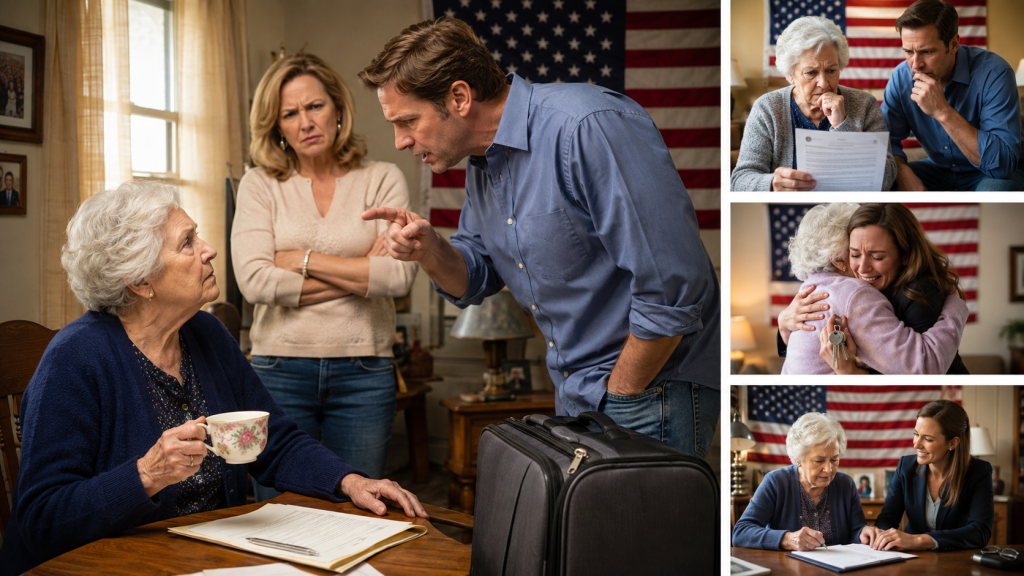
I sold my house six months ago. My son did not know. Yesterday, he set my suitcase beside the front door and said, “A nursing home has a bed for you, Mom. Sign this house over and leave by Friday.”
I sipped my tea, looked at the papers he had placed in front of me, and said, “First ask the person who owns this house.” Greg laughed. “The only man who ever owned this house was buried two years ago.”
He meant his father.

My husband, Walter.
Walter built this house with his own hands in 1974.
He was twenty-eight then, strong enough to carry two bags of cement at once and stubborn enough to believe he could build a home after working ten hours at the factory every day.
We could not afford much.
The first winter, there were blankets covering two unfinished doorways because we had run out of money for doors. Our kitchen cabinets came from a demolition sale. Walter sanded them in the garage while I painted them pale yellow.
Our son Greg was born in the upstairs bedroom three years later.
Our daughter, Melissa, had died as an infant before Greg was born, so perhaps that was why we poured everything we had into him.
Walter coached his baseball team.
I worked weekends at a grocery store to help pay for Greg’s college.
When Greg wrecked his first car, Walter took extra shifts.
When Greg got married the first time, we paid for half the wedding.
When that marriage ended, we opened our door again.
And when Greg remarried Dana, we tried to welcome her too.
Walter used to say, “Family doesn’t keep score.”
For most of my life, I believed him.
Then Walter died.
Two years ago, on a rainy October morning, my husband of fifty-two years closed his eyes in a hospital room while I held his hand.
Three days after the funeral, Greg and Dana arrived with a moving truck.
“You shouldn’t be alone, Mom,” Greg told me.
At first, I was grateful.
Grief makes ordinary things frightening.
The empty side of the bed frightened me.
The silent breakfast table frightened me.
Even taking the garbage bin to the curb alone felt strange because Walter had done it every Thursday for half a century.
So when Greg said he wanted to stay with me for a while, I thought perhaps Walter had left me one final gift.
Our son.
I should have paid more attention to the moving truck.
They were not bringing two suitcases.
They brought furniture.
Boxes.
Dana’s exercise machine.
Greg’s tools.
Two televisions.
A king-size mattress.
By the end of the first week, Dana was complaining about my bedroom.
“The guest room is too small for us,” she said.
“It was good enough when you visited,” I answered.
“That was for weekends.”
Greg looked uncomfortable.
“Mom, you don’t really need that big bedroom anymore.”
I remember staring at him.
That bedroom had been mine for forty-eight years.
Walter’s slippers were still beneath the dresser.
His reading glasses were still in the drawer beside the bed.
I was not ready to move them.
But grief had made me tired of arguments.
So I gave up the bedroom.
By the end of that month, Greg and Dana were sleeping in the room where Walter and I had grown old together.
I was sleeping on a folding bed in the sewing room.
Dana started calling it “our house” at Thanksgiving.
“My family will come to our house for Christmas,” she announced.
Our house.
I noticed it immediately.
Greg did not correct her.
At Christmas, Dana’s sister sat in Walter’s chair.
Her brother parked across my flower bed.
Nobody asked.
In January, Greg began taking three hundred dollars from my pension every month.
“Everybody pays their share, Mom,” he said, holding out his hand.
I looked through the kitchen window at the new truck shining in my driveway.
“Your father and I paid this house off fifteen years ago.”
“You still use electricity.”
“I pay the electricity.”
“And food.”
“I buy most of the groceries.”
He sighed as if I were a difficult child.
“Mom, don’t make everything complicated.”
So I gave him the money.
Three hundred dollars in January.
Three hundred in February.
Three hundred in March.
I told myself he was my son.
That sentence excuses too much when you are a mother.
Then one night in March, I learned what my son thought I was worth.
I woke around one in the morning because I was thirsty.
The sewing room was downstairs, near the kitchen. As I approached the doorway, I heard Greg talking.
He was on the phone.
I almost walked in.
Then I heard my age.
“She’s eighty-one,” he said.
I stopped.
Greg continued.
“The house is worth four hundred thousand, easy. Maybe more with the lot.”
There was a pause.
Then he said, “We list it the day she’s out.”
My hand tightened around the wall.
The person on the other end said something.
Greg laughed.
I will remember that laugh until the day I die.
It was not loud.
That somehow made it worse.
It was casual.
Comfortable.
The laugh of a man discussing an inconvenience that would soon be removed.
Me.
I was the inconvenience.
My son was waiting for me to leave my own house so he could sell it.
I went back to my folding bed without getting the water.
I did not cry.
I lay in darkness looking at the ceiling.
At first I remembered Greg as a baby sleeping on my chest.
Then I remembered his first day of school.
His scraped knees.
His graduation.
Walter teaching him to drive.
Me sitting beside his hospital bed when he had pneumonia at nineteen.
Every memory seemed to ask the same question.
How did that little boy become the man laughing in my kitchen?
By sunrise, the answer no longer mattered.
I knew what I was going to do.
That week, while Greg was working and Dana was visiting her sister, I dressed carefully.
I took the deed.
My checkbook.
Walter’s old leather folder.
Then I called a taxi.
The driver asked where I was going.
I gave him the address of an attorney named Margaret Ellis.
Walter and I had used Margaret years earlier for our wills.
She was nearly seventy now and still worked three days a week.
When I explained what was happening, she took off her glasses.
“Eleanor,” she said, “are you certain?”
“About what?”
“About what you want to do.”
“I’m certain I don’t want my son deciding where I live so he can sell my house.”
She nodded.
Then she asked something important.
“Who do you trust?”
I knew immediately.
“My granddaughter.”
Emily.
Greg’s daughter from his first marriage.
The daughter he stopped calling after marrying Dana.
Greg told people Emily had become rebellious.
He said she had disappeared.
She had not.
She sent me a birthday card every year.
She called at Christmas.
Sometimes she drove two hours just to take me to lunch.
At Walter’s funeral, Emily sat in the back row because Greg had told her she was not welcome with the immediate family.
Walter would have hated that.
I called Emily from Margaret’s office.
She answered on the second ring.
“Grandma?”
“I need to ask you something.”
When I explained, she became silent.
Then I heard her crying.
“Grandma, I don’t want your house.”
“I know.”
“I don’t want your money either.”
“I know that too. That is why I’m asking you.”
The arrangement Margaret created was simple, legal, and carefully documented.
Emily purchased the property under terms Margaret structured after reviewing everything with us. The sale was properly recorded.
But there was one condition that mattered more than anything else.
I received a lifetime lease.
One dollar a year.
As long as I lived, I had the legal right to remain in the house.
No one could throw me out.
Not Greg.
Not Dana.
Not even Emily.
The house belonged to Emily.
My home still belonged to me.
When the papers were signed, Emily hugged me.
“I wish Grandpa could see this.”
I smiled.
“Oh, I think he’d have something to say.”
Margaret laughed.
Probably for the first time that afternoon.
I returned home four hours after leaving.
Dana was sitting on the couch scrolling through her phone.
“Where were you?”
“Church luncheon.”
She barely looked up.
“Nobody misses you here anyway.”
I walked into the kitchen.
Inside the flour tin, beneath an unopened bag of baking powder, I placed my copy of the recorded documents.
Greg and Dana had never cooked anything from scratch in my kitchen.
I knew the papers were safe.
For six months, I watched them plan to sell a house that did not belong to them.
Dana selected paint colors “for the buyers.”
Greg measured the garage.
One Saturday he brought a realtor named Chuck into my living room.
Chuck walked around taking notes.
“Original floors?” he asked.
“My dad put them in.”
Greg said it proudly.
Then he pointed toward me.
“The old lady comes with the house for now, but not for long.”
Chuck laughed.
I was carrying coffee.
I set a cup in front of each of them.
“Cream?”
Neither noticed the way I smiled.
They discussed asking prices while sitting beneath a roof owned by the daughter Greg had abandoned.
Dana wanted to replace my curtains.
Greg talked about staging the house.
Once, I heard them arguing about how to divide the money.
“We need at least eighty thousand for the new place,” Dana said.
“I want the truck paid off first.”
“What about my kitchen?”
“You’ll get your kitchen.”
They had spent my house ten times before discovering it was not theirs.
Then came the suitcase.
Greg placed it by the door on Monday evening.
It was mine.
The brown one Walter and I had taken to Florida on our fortieth anniversary.
On top was a nursing home brochure.
A bed number had been circled in red ink.
Dana stood behind him with her arms folded.
“A nursing home has a bed for you, Mom,” Greg said. “Sign this house over and leave by Friday.”
I looked at the brochure.