 Reading Time: 32 minutes
For almost ten minutes, I sat there with both hands locked around the steering wheel. The engine was off. The air-conditioning was off.
I could hear nothing except the ticking sound of the cooling engine and the uneven rhythm of my own breathing. I kept replaying Nick’s words.
You were supposed to keep driving.
Again.
And again.
And again.
I looked at my reflection in the rearview mirror.
Red eyes.
Crooked tie.
A face that suddenly looked older than it had that morning.
I reached into the passenger seat and picked up my phone.
Thirty-seven notifications.
Most were messages from coworkers.
People I had known for years.
People who, apparently, had watched me get fired and then decided the safest thing they could do was wait until I was out of the building before telling me they were sorry.
The first message was from Maya, one of our designers.
Sebastian, I’m so sorry. That was horrible.
Then Daniel from analytics.
You didn’t deserve that.
Then Priya.
Nick was out of line. Call me if you need anything.
I stared at those messages until the words blurred.
Part of me wanted to throw the phone through the windshield.
Not because they had done anything wrong.
Because they had done exactly what I probably would have done if the roles had been reversed.
Stayed quiet.
Protected the paycheck.
Kept my head down.
That was the culture Nick had built.
Everyone was compassionate in private and terrified in public.
My phone rang.
My wife.
Emily.
I stared at her name for three full rings before answering.
“Hey.”
There was a pause.
She knew immediately.
“What happened?”
I closed my eyes.
“I got fired.”
“What?”
“I got fired.”
Another pause.
Longer this time.
“Why?”
I laughed, but there was nothing funny in it.
“Because I was late.”
“Sebastian.”
“I know.”
“You are never late.”
“I stopped for someone.”
“What do you mean?”
“There was a woman on the side of Route 18. She collapsed near her car. I called 911. I stayed until the ambulance came.”
Emily went quiet.
Then she asked the only question that mattered.
“Is she alive?”
“I think so.”
“You think?”
“They took her to St. Matthew’s. She was conscious by then.”
“Then you did the right thing.”
The simplicity of that answer almost broke me.
I pressed the heel of my hand against my forehead.
“Nick said I should have kept driving.”
Emily inhaled sharply.
“He said what?”
“He said the account was more important.”
There was silence.
Then my wife, who almost never swore, said something about Nick that I will not repeat.
Despite everything, I laughed.
A real laugh this time.
Just one.
It came out through the tears.
Emily softened.
“Come home.”
“I have to go back later.”
“For what?”
“My desk.”
“You’re going back there?”
“I left pictures. My notebooks. The girls’ drawings. My headphones.”
“Forget the headphones.”
“It’s not about the headphones.”
“I know.”
She sighed.
“Come home first.”
“I can’t.”
“Why?”
I looked across the parking lot at the building where I had spent three years convincing myself that exhaustion was the same thing as ambition.
“Because if I go home right now, I don’t think I’ll come back.”
“Would that be so terrible?”
“No.”
I swallowed.
“But I don’t want Nick to be the reason I’m afraid to walk through that door.”
Emily understood.
She always did.
“Okay,” she said. “Then go get your things.”
“I will.”
“And Sebastian?”
“Yeah?”
“Our daughters are going to ask why Daddy came home early.”
My stomach twisted.
“I know.”
“You tell them the truth.”
“What truth?”
“That their father lost his job because he refused to leave someone to die.”
I lowered my head.
“I don’t want them worrying.”
“They won’t.”
“How do you know?”
“Because they’re going to be proud of you.”
That was the moment I finally cried properly.
Not silently.
Not politely.
I leaned forward until my forehead rested against the steering wheel and let everything come out.
Three years of late nights.
Three years of swallowing insults.
Three years of convincing myself that the next promotion, the next campaign, the next bigger account would make all the sacrifices worth it.
And then one roadside stranger had needed me for twenty minutes.
Twenty minutes.
That was all it took for my entire professional life to disappear.
When I finally lifted my head, I wiped my face with my sleeve.
“I’ll call you.”
“I love you.”
“I love you too.”
I ended the call.
Then I sat there for another minute.
And something inside me settled.
I had no job.
No severance.
No plan.
But the woman was alive.
Whatever happened next, I knew I would make the same choice again.
At least I thought I knew.
Because I still didn’t understand who that woman was.
Or why, by the end of the week, people in expensive suits would be standing in our office asking for me by name.
THE WOMAN ON ROUTE 18
The morning had started normally.
That was the part I kept thinking about.
If there had been some warning, maybe everything would have felt less surreal.
But there hadn’t been.
I had kissed Emily goodbye at 6:55.
Our oldest daughter, Sophie, had been sitting at the kitchen table complaining about a math worksheet.
Our youngest, Lily, had asked me whether penguins had knees.
I had promised to find out.
Then I had climbed into my car with coffee in a travel mug and rehearsed the Henderson pitch at every red light.
Henderson Foods was supposed to change everything for our agency.
They operated more than eighty grocery stores across three states.
Their marketing contract was worth nearly four million dollars over three years.
For a giant company, maybe that number was ordinary.
For us, it was survival.
Nick had reminded us of that approximately twelve times a day.
“Everybody eats if we land Henderson.”
That had become his favorite phrase.
What he really meant was that he would finally be able to attract an outside investor and possibly sell the agency.
I knew that because I had accidentally seen an email on the conference room screen two weeks earlier.
Nick had closed it quickly.
But not quickly enough.
He had been quietly shopping the company around.
That probably explained why he had been more unbearable than usual.
I was driving north on Route 18 at 7:43 when I saw the silver sedan.
At first, nothing seemed unusual.
The car was pulled onto the shoulder with its hazard lights flashing.
Then I noticed the driver’s door standing open.
And a woman was bent over near the guardrail.
I slowed down.
Every practical instinct told me to continue.
Not because I was heartless.
Because I was already cutting it close.
Because plenty of other cars were on the road.
Because surely someone else would stop.
I had almost passed her when she raised one arm.
Not waving.
Reaching.
Then her knees buckled.
I hit the brakes so hard my coffee spilled down the center console.
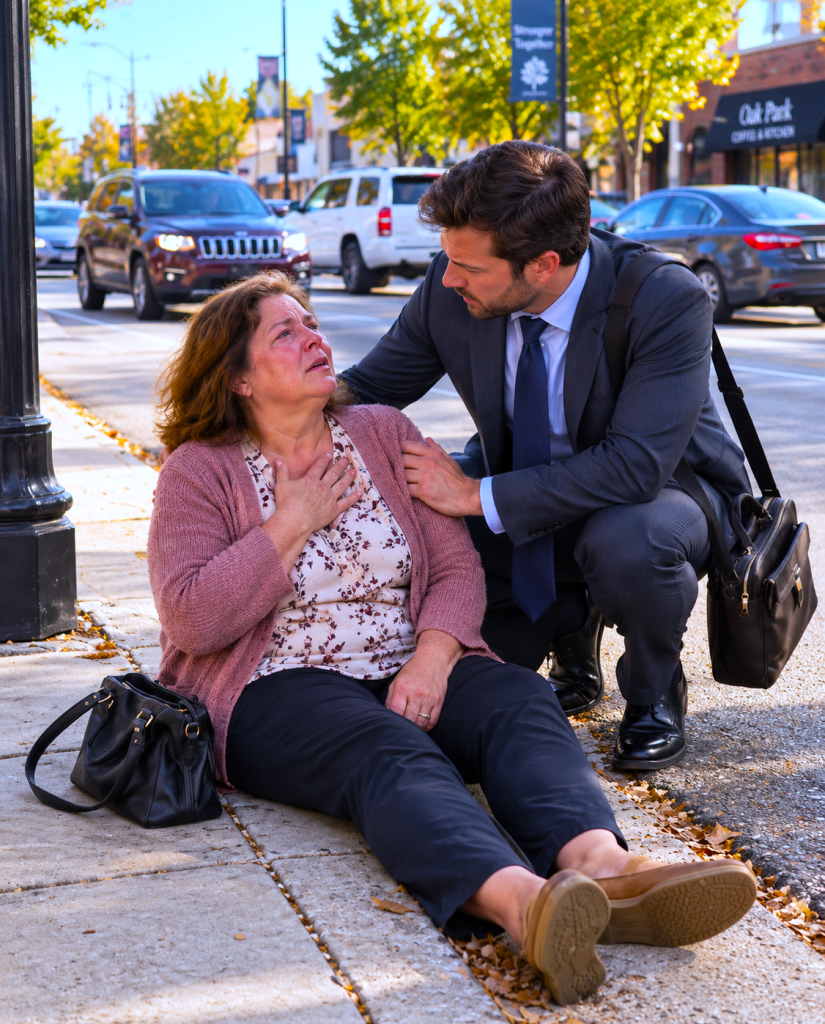
By the time I got out of the car, she was on the pavement.
She looked to be in her early sixties.
Gray-blond hair.
Dark navy coat.
A silk scarf.
One shoe had come off.
Her face had gone pale enough to frighten me.
“Ma’am?”
Her eyes fluttered.
I crouched beside her.
“Can you hear me?”
She grabbed my wrist.
Hard.
“My chest.”
I called 911.
The dispatcher told me not to move her unless necessary.
I loosened her scarf and kept talking to her.
She stared up at me with terrifying clarity.
“Don’t let me die here.”
“You’re not dying.”
I had no idea whether that was true.
But I said it like I knew.
“My name is Sebastian.”
Her breathing was shallow.
“Evelyn.”
“Okay, Evelyn. The ambulance is coming.”
“My phone.”
I searched near the car.
Found it beneath the driver’s seat.
The screen was locked.
“I can’t open it.”
She gave me a number.
I entered it.
Her emergency contact was listed simply as Thomas.
I called.
No answer.
I tried again.
Still nothing.
Then Evelyn suddenly squeezed my hand and gasped.
I honestly thought I was about to watch her die.
“Stay with me,” I said.
“I’m trying.”
Her eyes filled with tears.
“Please.”
“I’m here.”
Traffic screamed past us.
Nobody else stopped.
That detail stayed with me.
Car after car.
SUVs.
Delivery trucks.
Commuters.
People with places to be.
They slowed down to look.
Then they continued.
The ambulance arrived approximately fourteen minutes after my call.
Fourteen minutes that felt like an hour.
The paramedics took over.
One of them asked me questions.
How long had she been down?
Had she lost consciousness?
Did she hit her head?
Had she complained of pain?
I answered as best I could.
Then, as they loaded her onto the stretcher, Evelyn reached toward me.
The paramedic paused.
I stepped closer.
She took my hand again.
“Thank you.”
“You’re okay.”
“No.”
Her eyes locked with mine.
“Thank you for stopping.”
Then they closed the ambulance doors.
I stood there on the roadside with coffee drying on my shirt.
It was 8:11.
My presentation started at 8:30.
The office was twenty-five minutes away.
I called Nick immediately.
He didn’t answer.
I sent him a message.
Medical emergency. Woman collapsed. Ambulance just arrived. I’m coming as fast as I can. Start without me. Deck is loaded.
No response.
I drove faster than I should have.
I arrived at 8:47.
And twenty minutes later, I no longer had a job.
THE BOX
At noon, I returned to the office.
I had changed my shirt.
Not because I wanted to look professional.
Because the original still had coffee stains and a small smear of blood from where Evelyn had scraped her hand.
I walked through the lobby carrying a cardboard box I had taken from our garage.
The receptionist looked uncomfortable.
“Hey, Sebastian.”
“Hey.”
“Nick said you could go straight up.”
Of course he had.
As though I were asking permission to retrieve the pictures of my own family.
When the elevator doors opened, conversation died.
It was almost funny.
A floor full of people who usually never stopped talking suddenly acted as though I had entered a library.
Maya stood first.
She crossed the room and hugged me.
That changed something.
After her, Daniel came over.
Then Priya.
Someone touched my shoulder.
Someone else said, “I’m sorry.”
I thanked them.
I meant it.
But none of it changed what had happened.
My desk looked exactly as I had left it.
Two monitors.
Coffee cup.
A stack of campaign notes.
Sophie’s drawing of our family standing beneath an enormous yellow sun.
Lily’s paper snowflake taped to the divider.
A framed picture of Emily and me at the beach.
I put them carefully into the box.
Priya leaned against the next desk.
“You okay?”
“No.”
She nodded.
“Fair.”
I unplugged my headphones.
“What happened after I left?”
She looked toward Nick’s office.
“Henderson walked.”
“I know.”
“No, I mean really walked. They said they didn’t like how he handled the meeting.”
I stopped packing.
“What?”
“They asked where you were.”
“Nick told them?”
“He said you were late.”
I frowned.
“And?”
“And then Daniel mentioned there had been a medical emergency.”
I looked across the room at Daniel.
He pretended not to notice.
Priya lowered her voice.
“The Henderson woman asked what emergency.”
“What Henderson woman?”
“Their vice president. Rebecca Shaw.”
I had spoken with Rebecca by email for weeks.
She had always seemed reasonable.
“What did Nick say?”
“He said it was irrelevant.”
My stomach tightened.
“Of course he did.”
“Then he tried to continue the pitch.”
“And they left?”
“Not immediately.”
Priya hesitated.
“What?”
“She said, ‘I don’t do business with people who call medical emergencies irrelevant.’”
I stared at her.
“Seriously?”
“Seriously.”
A tiny spark of satisfaction flashed through me.
I hated that it did.
But it did.
“Did Nick lose it?”
“He waited until the elevator closed.”
“That sounds like him.”
“He threw a coffee mug.”
“Also sounds like him.”
Priya glanced toward his office.
“Sebastian, I know you probably don’t want advice right now.”
“I definitely don’t.”
She smiled faintly.
“Good. Because I don’t have any.”
I put the last notebook into the box.
Then Nick’s door opened.
He stepped out.
He looked calmer than he had that morning.
That worried me more than anger would have.
“Sebastian.”
I turned.
“I’m almost done.”
“Come into my office.”
“No.”
His eyebrows lifted.
The entire room noticed.
“I’d like a word.”
“You already gave me several.”
A few people suddenly found their screens fascinating.
Nick’s mouth tightened.
“Privately.”
“There’s nothing private left.”
He looked around.
Then back at me.
“Fine.”
I picked up the box.
He stepped closer.
“You should know that what happened this morning wasn’t personal.”
I almost laughed.
“You fired me in front of thirty people.”
“It was a business decision.”
“There it is again.”
“What?”
“That word.”
He crossed his arms.
“You jeopardized the company.”
“I stopped for a medical emergency.”
“You abandoned your professional responsibility.”
“No.”
I adjusted the box against my hip.
“I prioritized a human being over a presentation.”
“And Henderson walked because of you.”
“Priya says they walked because of you.”
Priya looked down so fast I nearly smiled.
Nick’s face changed.
Not much.
But enough.
“You’ve been discussing internal business matters?”
“I’ve been packing my desk.”
He leaned closer.
“Do not make this uglier than it needs to be.”
Something inside me finally snapped into place.
Not anger.
Clarity.
I had spent years afraid of disappointing this man.
And now there was nothing left for him to take.
“You told me I should have left a woman collapsed on the roadside.”
“I told you that you had obligations.”
“She was having a heart attack.”
“You didn’t know that.”
“She grabbed her chest and fell down.”
“You are not a doctor.”
“No.”
I looked him straight in the eye.
“I’m just someone who stopped.”
His nostrils flared.
“Goodbye, Sebastian.”
“Goodbye, Nick.”
I turned.
And that should have been the end of it.
Then the elevator doors opened.
Three people stepped out.
The first was a man in his forties wearing a charcoal suit.
The second was a woman carrying a leather portfolio.
The third was older, tall, silver-haired, and dressed in the kind of suit that looked expensive without trying to prove it.
The receptionist hurried around the corner behind them.
“Mr. Cole, I tried to tell them—”
The silver-haired man ignored her.
His eyes swept the office.
“Sebastian Reed?”
Everyone looked at me.
I slowly lowered the box.
“That’s me.”
The man walked directly toward me.
“Thomas Mercer.”
The name meant nothing for approximately two seconds.
Then I remembered.
Evelyn’s emergency contact.
Thomas.
The man held out his hand.
“My mother says you saved her life.”
EVELYN
The office disappeared.
At least that was how it felt.
People blurred around the edges.
Nick.
Priya.
The interns.
The ringing phones.
All of it.
“How is she?”
That was the first thing I asked.
Thomas Mercer’s expression softened.
“She’s stable.”
My legs nearly weakened.
“She had a serious cardiac event. The doctors said another ten or fifteen minutes without treatment could have changed the outcome.”
I looked down.
“I’m glad she’s okay.”
“She’s not exactly okay yet.”
“Right. Sorry.”
“But she is alive.”
He squeezed my shoulder.
“Because you stopped.”
“I just called an ambulance.”
“You did more than that.”
I shook my head.
“No.”
“My mother remembers you keeping her conscious. She remembers you finding her phone. She remembers you staying.”
“Anyone would have.”
Thomas looked around the office.
“Would they?”
Nobody spoke.
Nick finally stepped forward.
“I’m Nicholas Granger, managing director.”
Thomas glanced at him.
No recognition.
That seemed to irritate Nick.
“This is Granger Creative.”
“Good for you.”
Priya coughed into her fist.
Thomas turned back to me.
“My mother wants to see you when she’s stronger.”
“Of course.”
He reached into his jacket.
“I also wanted to personally return something.”
He handed me my business card.
I stared at it.
“I didn’t give her that.”
“It fell out near her car.”
I remembered kneeling beside Evelyn.
My wallet had been in my coat pocket.
Maybe the card had slipped free.
“She insisted we find you.”
“You didn’t have to come here.”
“She was very insistent.”
The woman with the leather portfolio leaned closer and whispered something to Thomas.
He nodded.
Then looked at the cardboard box in my arms.
“Are you moving offices?”
Before I could answer, Nick spoke.
“Sebastian is no longer employed here.”
Thomas looked from him to me.
“When did that happen?”
I almost smiled at the absurdity.
“This morning.”
His brows drew together.
“What happened?”
“Thomas,” I said, “it’s not important.”
Nick cut in.
“He missed an important client presentation.”
Thomas stared at him.
“Because he was helping my mother?”
Nick opened his mouth.
Closed it.
Then recovered.
“We regret the circumstances, obviously, but Mr. Reed had a professional obligation to this organization.”
Thomas’s face went still.
“What did you expect him to do?”
“This isn’t really the appropriate setting—”
“What did you expect him to do?”
Nick’s jaw tightened.
“Continue to work.”
Thomas looked at me.
Then at the box.
Then around the silent office.
“You fired the man who kept my mother alive because he was late to a meeting?”
Nick straightened his shoulders.
“There are complexities you’re not aware of.”
“I’m sure.”
Thomas handed me a card.
Not paper.
Heavy stock.
Embossed letters.
MERCER HOLDINGS.
I knew the name.
Everyone in that office knew the name.
Mercer Holdings owned a portfolio of retail chains, hospitality brands, logistics companies, regional healthcare facilities, and, as I would later learn, a significant investment fund.
The company was worth several billion dollars.
Evelyn Mercer was not simply Thomas Mercer’s mother.
She was the woman who had founded the company with her late husband forty years earlier.
Nick knew it too.
I watched the realization move across his face.
Thomas noticed.
“So,” he said quietly, “you’ve heard of us.”
Nick suddenly smiled.
It was incredible how fast the transformation happened.
His shoulders relaxed.
His tone warmed.
“Of course. Mercer Holdings is one of the most respected private companies in the region.”
Thomas did not return the smile.
Nick continued.
“In fact, I believe we’ve crossed paths at industry events.”
“We haven’t.”
The smile faltered.
Thomas looked at me.
“Please call me this afternoon.”
“For what?”
“To talk.”
“About your mother?”
“And other things.”
I frowned.
“Mr. Mercer, I appreciate it, but—”
“Thomas.”
“Thomas. I appreciate you coming here. I really do. But you don’t owe me anything.”
His expression changed.
Something almost amused.
“I didn’t say I did.”
Then he shook my hand again.
“I’ll expect your call.”
He turned to leave.
Nick followed him two steps.
“Mr. Mercer.”
Thomas stopped.
“If Evelyn needs anything, please let us know.”
Us.
I almost admired the audacity.
Thomas looked back.
“My mother needed something this morning.”
Nick’s face went pale.
“She needed someone to stop.”
And then Thomas Mercer walked out.
No dramatic speech.
No threats.
No promise of revenge.
He didn’t need any.
The silence after the elevator closed was the loudest thing I had heard all day.
Priya looked at me.
Daniel looked at me.
Half the office looked at Nick.
Nick looked at the carpet.
I picked up my box.
For the first time that morning, I walked out with dignity.
HOME
Sophie was the first to see me.
She came running down the hallway before I had even finished opening the front door.
“Daddy!”
My cardboard box almost tipped out of my hands.
Emily appeared behind her.
Lily followed wearing pink socks and one of my old college shirts.
They both stopped when they saw the box.
Children understand symbols before they understand explanations.
Sophie looked at it.
Then at me.
“Why do you have your office stuff?”
I set the box down.
“Come here.”
The four of us sat at the kitchen table.
I told them the truth.
Not every detail.
I did not tell an eight-year-old and a ten-year-old what I thought of Nick.
I did not tell them about our mortgage.
Or our emergency fund.
Or how terrified I was about health insurance.
I told them that a woman got sick on the road.
I stopped.
I was late.
My boss was angry.
And I would not be going back to that job.
Sophie frowned.
“But you helped her.”
“Yes.”
“Then why did you get in trouble?”
I looked at Emily.
She gave me the smallest smile.
Because sometimes adults have no good answer for children.
“My boss thought I should have gotten to work instead.”
Lily looked genuinely horrified.
“But she could die.”
“She could have.”
“Then your boss is stupid.”
Emily covered a laugh.
“Lily.”
“What?”
“She’s not wrong,” I said.
Sophie leaned her chin into her hands.
“Are we poor now?”
That one hit me.
“No.”
“Are we going to lose the house?”
“No.”
“Can we still get pizza Friday?”
I laughed.
“Yes.”
She nodded.
“Okay.”
Then she got up, walked around the table, and hugged me.
“I’m glad you stopped.”
Lily immediately joined her.
Within seconds, both girls were wrapped around me.
Emily stood behind them.
Her eyes were wet.
I held my family and realized something I should have understood years earlier.
No job should have enough power to make a person feel ashamed for being decent.
That afternoon, after the girls went upstairs, Emily and I opened the laptop.
We reviewed every account.
Savings.
Mortgage.
Bills.
School expenses.
Retirement.
We could survive six months if we cut back.
Eight if things became ugly.
It was more cushion than many people had.
But fear does not always respond to logic.
“I can freelance,” I said.
“You can.”
“I can call Mason.”
“You can.”
“He said his company might need a marketing director next year.”
“You can call him.”
“I can probably pick up consulting.”
Emily closed the laptop.
“You’re doing it.”
“Doing what?”
“Trying to solve the next year in the next five minutes.”
I leaned back.
“I need a plan.”
“You need dinner.”
“I’m serious.”
“So am I.”
She stood.
“Call Thomas Mercer first.”
I stared at the card on the table.
“I don’t want charity.”
“Maybe he doesn’t want to give you charity.”
“He said he wanted to talk.”
“Then talk.”
“I don’t want to look like I expect something because I helped his mother.”
Emily rested both hands on the table.
“Sebastian, if a billionaire wants to thank you for saving his mother, I promise I will personally make sure you survive the humiliation.”
I smiled.
“I hate you.”
“No, you don’t.”
“No.”
I picked up the card.
“I really don’t.”
THE CALL
Thomas answered on the second ring.
“Sebastian.”
I blinked.
“You have my number saved?”
“My mother made sure of it.”
I could hear machinery in the background.
Hospital sounds.
“How is she?”
“Complaining about the food.”
“Good sign?”
“For her, excellent.”
I laughed.
“She wants to speak with you.”
“Now?”
“If that’s okay.”
“Of course.”
There was a rustling sound.
Then Evelyn’s voice came through.
Weaker than I remembered.
But unmistakably alive.
“Roadside hero.”
I closed my eyes.
“Evelyn.”
“You found me.”
“Technically, you found me.”
She laughed softly, then coughed.
“Thomas told me what happened.”
“What happened?”
“Your job.”
I looked at Emily.
She was pretending not to listen from the kitchen counter.
“It’s okay.”
“No, it isn’t.”
“You’re alive.”
“And you’re unemployed.”
“I’ll find another job.”
“Because of me.”
“Not because of you.”
“Yes, because of me.”
“No.”
I sat straighter.
“Evelyn, please don’t do that.”
“Do what?”
“Turn what happened into a debt.”
There was a pause.
Long enough that I wondered if the call had dropped.
Then she said quietly, “That is exactly what Thomas told me you would say.”
“Thomas seems smart.”
“Occasionally.”
From the background I heard him say, “I’m standing right here.”
She ignored him.
“Would you visit tomorrow?”
I hesitated.
“Only if you’re up for it.”
“I am.”
“Then yes.”
“Eleven?”
“Eleven.”
“And Sebastian?”
“Yes?”
“Do not wear a tie.”
I smiled.
“I can manage that.”
When the call ended, Emily raised an eyebrow.
“Eleven?”
“Eleven.”
“You’re going?”
“Yes.”
“Good.”
“What?”
She shook her head.
“You spent three years jumping when Nick told you to jump. Evelyn tells you not to wear a tie and suddenly you’re obedient.”
“I like her better.”
“So do I.”
THE HOSPITAL
Evelyn Mercer looked smaller in a hospital bed.
That surprised me.
On the roadside she had seemed commanding even while terrified.
In the room at St. Matthew’s, surrounded by monitors and white sheets, she looked human in the way powerful people probably rarely get to look in public.
Thomas sat near the window.
A woman I learned was Evelyn’s daughter, Margaret, sat beside him.
When I walked in, Evelyn pointed at my shirt.
“No tie.”
“I follow instructions occasionally.”
Thomas laughed.
Margaret stood and hugged me before introducing herself.
“Thank you.”
“You don’t have to keep thanking me.”
“We do.”
“No.”
I sat beside the bed.
Evelyn studied me.
“You look terrible.”
I laughed.
“You nearly died yesterday.”
“And yet somehow you look worse.”
“She’s like this with everyone,” Thomas said.
Evelyn waved him away.
We talked for almost an hour.
Not about business.
Not at first.
She asked about Emily.
My daughters.
Where I grew up.
How long I had worked at Granger Creative.
Why I chose marketing.
I asked about her family.
Her late husband, William.
The company they had built.
The heart condition she had ignored because she thought indigestion explained the pain she had felt the previous week.
“I was driving to a board meeting,” she said.
I raised an eyebrow.
“You collapsed on the way to work?”
“Yes.”
“And you’re giving me a hard time?”
She smiled.
“Fair point.”
Then she grew serious.
“You know what bothers me most?”
“What?”
“There were dozens of cars.”
I looked down.
“I noticed.”
“Some slowed.”
“Yes.”
“They saw me.”
“Yes.”
“And they kept going.”
Thomas shifted.
“Mom.”
“No. I want to say this.”
She looked at me.
“I spent forty years building companies. I have sat on boards. I have made decisions affecting thousands of employees. And if yesterday taught me anything, it is that success can make people forget what matters.”
I did not know what to say.
“So I need to ask you something.”
“Okay.”
“If you could go back, knowing you would lose your job, would you still stop?”
I answered immediately.
“Yes.”
No hesitation.
She nodded.
“That’s what I thought.”
Then she looked at Thomas.
He stood.
The shift in atmosphere was immediate.
Business.
He picked up a folder.
I almost groaned.
“No.”
Thomas stopped.
“You don’t even know what this is.”
“If that’s a check—”
“It’s not.”
“Then what is it?”
“A problem.”
I frowned.
He handed me the folder.
Inside were market analyses.
Brand audits.
Consumer research.
I recognized several Mercer companies.
“What am I looking at?”
Thomas sat across from me.
“Mercer Retail has been trying to consolidate marketing operations for eighteen months.”
I looked up.
“We have seven brands, four agencies, three internal creative teams, and no coherent strategy.”
“You’re asking me for advice?”
“I’m asking whether you would be interested in helping.”
“As what?”
“Initially? Consultant.”
I stared at him.
“You met me yesterday.”
“Actually, I read your work last night.”
My eyebrows rose.
“How?”
“Public campaigns. Awards. Case studies. Your professional profile.”
Evelyn smiled.
“He also spoke to several former clients.”
I looked at Thomas.
“You investigated me?”
“I did due diligence.”
“That sounds nicer.”
“It usually does.”
I looked back at the documents.
“What exactly do you want?”
“A ninety-day brand and customer-acquisition audit.”
“For all seven brands?”
“Yes.”
I laughed once.
“That’s not a project. That’s a small war.”
“I know.”
“And why me?”
Thomas leaned forward.
“This isn’t because you stopped for my mother.”
I looked at Evelyn.
She said nothing.
Thomas continued.
“It is why I found you. It is not why I’m offering you work.”
I respected that answer more than I expected to.
“You could hire a major agency.”
“We have.”
“And?”
“They produce beautiful decks.”
I smiled despite myself.
“Dangerous.”
“They also charge us hundreds of thousands of dollars to tell us things our store managers already know.”
“That’s less dangerous. Mostly expensive.”
Evelyn laughed.
Thomas pointed at the folder.
“I need someone who understands customers, communicates clearly, and has enough backbone to tell executives when they’re wrong.”
I looked at him.
“You got the backbone part from one interaction with my former boss?”
“No.”
He smiled.
“I got that from the campaign you killed six months ago.”
My stomach dropped.
“You know about that?”
“I spoke to your former client.”
That campaign had almost cost me my job.
A pharmaceutical-adjacent wellness company had wanted us to use misleading language about a supplement.
I refused.
Nick had been furious.
We lost the client.
Thomas continued.
“They told me you were the only person in the room who explained why their claims were legally dangerous.”
“That was not a difficult conclusion.”
“Apparently it was.”
I closed the folder.
“What does this pay?”
Thomas named a figure.
I stared at him.
“For ninety days?”
“Yes.”
“That’s more than half my annual salary.”
“Yes.”
I looked at Evelyn.
She shrugged.
“I told you Thomas could be useful occasionally.”
I looked back at him.
“I need to think about it.”
“Good.”
He stood.
“If you had said yes immediately, I would have worried.”
THE RUMOR
By the time I got home, my old office already knew.
I learned because Daniel called me.
“Tell me you didn’t just meet with Mercer Holdings.”
I stopped halfway up the driveway.
“How do you know?”
“Nick knows.”
“How?”
“No idea.”
I had one.
Thomas’s arrival the previous day had probably started rumors.
“You didn’t accept a job, did you?”
“Not exactly.”
Daniel lowered his voice.
“Nick is losing his mind.”
“That seems healthy.”
“He thinks you set him up.”
I laughed.
“Set him up?”
“He thinks you knew who Evelyn Mercer was.”
“I found her unconscious beside a guardrail.”
“I know.”
“Did he think I arranged the heart attack?”
“I don’t know what he thinks.”
I went inside.
Emily waved from the kitchen.
Daniel continued.
“Henderson officially terminated discussions this morning.”
I stopped.
“That fast?”
“Apparently Rebecca Shaw heard about how Nick fired you.”
“How?”
“Maya posted something.”
“Maya posted?”
“Nothing confidential. Just one of those vague LinkedIn things about leadership and integrity.”
“That sounds like Maya.”
“Henderson called.”
I rubbed my forehead.
“Daniel, I don’t want the agency collapsing.”
“That’s nice.”
“I mean it.”
“Why?”
“Because thirty people work there.”
“So did you.”
“I know.”
“Sebastian, people are updating résumés.”
That bothered me.
“What about you?”
A pause.
“Maybe.”
“Daniel.”
“What?”
“If you leave, leave because it’s right for you. Not because of me.”
“This isn’t about you.”
His voice changed.
“It’s about realizing Nick would do the same thing to any of us.”
That sentence stayed with me.
Nick had not merely fired me.
He had shown everyone what he valued.
And once people see that, it is almost impossible to make them unsee it.
THE CONSULTING PROJECT
I accepted Thomas’s offer two days later.
Not because I wanted revenge.
I need to make that clear.
Revenge would have been simpler.
Emotionally satisfying.
I could have imagined myself returning to Granger Creative in some expensive suit, parking a better car in Nick’s spot, buying the building, firing him, delivering a dramatic speech while everybody applauded.
Life almost never works that way.
The truth was less cinematic.
I accepted because we had bills.
Because I liked the project.
Because after three years of being told exactly how to think, the idea of having ninety days to solve a real problem sounded almost intoxicating.
My first week at Mercer Holdings nearly destroyed me.
Thomas had not exaggerated.
Seven brands.
Seven personalities.
Seven different senior executives who all believed their particular company was completely unique.
A grocery chain.
A home-goods company.
A regional hotel group.
A healthcare-services division.
A logistics firm.
A specialty-food brand.
And a growing online marketplace.
Their marketing was chaos.
Different agencies.
Conflicting messages.
Duplicate spending.
Nobody trusted the central team.
The first meeting had twenty-two people.
Within fifteen minutes, I understood why Thomas wanted an outsider.
Everyone had an agenda.
One executive wanted a rebrand.
Another wanted influencers.
Another wanted television.
Someone used the phrase “AI-first omnichannel personalization ecosystem” and I nearly left.
Instead, I asked one question.
“What problem are we trying to solve?”
Silence.
Thomas smiled from the end of the table.
For the next ninety minutes, we talked about customers instead of trends.
It felt almost revolutionary.
Over the next month, I traveled.
Stores.
Hotels.
Warehouses.
Call centers.
I spent more time speaking with cashiers and customers than executives.
I asked hotel housekeepers which complaints appeared most often.
I asked delivery drivers what customers misunderstood.
I asked grocery managers why certain promotions failed.
I asked customer-service teams what made people angry enough to call.
Then I built the strategy from the ground up.
Not flashy.
Useful.
Revenue started improving in places faster than any of us expected.
Small changes.
Clearer messaging.
Better local promotions.
Simplified online checkout.
Better customer emails.
A redesigned loyalty program.
The work reminded me why I had loved marketing before Nick turned it into a constant emergency.
I got home for dinner more often.
Not every night.
But enough.
Sophie noticed.
“You have a new job and you’re home earlier.”
“I’m consulting.”
“What does that mean?”
“It means Daddy tells companies what they’re doing wrong.”
Emily looked up from her plate.
“So marriage prepared you well.”
The girls laughed.
I threw a napkin at her.
For the first time in years, work felt like part of my life instead of the owner of it.
Then Nick called.
NICK’S APOLOGY
I almost didn’t answer.
His name appeared on my screen at 7:16 on a Tuesday evening.
Emily looked at it.
“You going to answer?”
“No.”
The phone kept ringing.
“Answer.”
“Why?”
“Because otherwise you’ll spend an hour wondering what he wanted.”
She knew me too well.
I answered.
“Sebastian.”
Nick sounded different.
Tired.
“Hey.”
There was a pause.
“How are you?”
“Fine.”
“I heard the Mercer project is going well.”
“Who told you?”
“Industry’s small.”
It was not that small.
“What do you need, Nick?”
He sighed.
“I wanted to apologize.”
I said nothing.
“For how I handled things.”
Still nothing.
“I was under enormous pressure.”
There it was.
The explanation disguised as accountability.
“The Henderson meeting mattered.”
“I know.”
“And I reacted.”
“You fired me.”
“I reacted badly.”
“You told me I should have kept driving.”
A longer pause.
“I shouldn’t have said that.”
“No.”
“I know.”
I waited.
Nick continued.
“I’m trying to make things right.”
“How?”
“I’d like you to come back.”
I genuinely thought I had misheard him.
“What?”
“Senior vice president.”
I laughed.
He did not.
“I’m serious.”
“I don’t want to come back.”
“Twenty-five percent salary increase.”
“No.”
“Thirty.”
“No.”
“Sebastian, think about it.”
“I am.”
“We built something together.”
That irritated me.
“No, Nick. You built a company. I worked there.”
“You know what I mean.”
“Yes. I do.”
My voice hardened.
“I gave you nights and weekends. I canceled vacations. I took calls during my daughter’s birthday party. I answered emails from the emergency room when Sophie broke her wrist. And the one morning I chose a stranger’s life over your schedule, you fired me in front of everyone.”
“I said I was sorry.”
“You’re sorry now.”
“That’s unfair.”
“Is it?”
I stood and walked toward the back porch.
“You didn’t call me the afternoon you fired me. You didn’t call the next day. You called after Henderson left and Mercer hired me.”
Silence.
“That’s not why.”
“Then why now?”
He had no answer.
That was the answer.
I softened slightly.
“Nick, I don’t hate you.”
He let out a breath.
“But I will never work for you again.”
“Sebastian—”
“I hope the agency survives.”
Another silence.
“You really mean that?”
“Yes.”
“Why?”
“Because good people work there.”
He understood what I had left unsaid.
You are not one of the reasons.
“I have to go.”
“Fine.”
“Take care, Nick.”
I hung up.
Emily appeared behind the glass door.
“Well?”
“He offered me my job.”
“And?”
“I said no.”
She smiled.
“Good.”
Then she handed me a bowl.
“What’s this?”
“Ice cream.”
“Why?”
“You turned down thirty percent more money.”
“I already make more consulting.”
“That is not the point.”
We sat on the porch and ate ice cream while the sun disappeared behind the trees.
It was one of the best professional decisions I had ever made.
EVELYN’S STORY
As the weeks passed, Evelyn and I became friends.
Not the kind of fake friendship wealthy people sometimes maintain with people who owe them gratitude.
There was no debt.
That was important to both of us.
She invited Emily and me to dinner.
We invited her to Sophie’s school play.
She came.
Nobody believed Sophie when she said the lady sitting in the third row owned a hotel chain.
Evelyn loved that.
One evening she told me something I had not known.
We were sitting in her garden while Thomas argued with someone on the phone inside.
“My husband died in an ambulance,” she said.
I looked at her.
“William?”
She nodded.
“Seven years ago.”
“I’m sorry.”
“He was at home.”
She stared into the garden.
“He complained about pain. I told him we should call someone.”
“What happened?”
“He said he was fine.”
Her mouth tightened.
“He didn’t want to bother anybody.”
I knew where this was going.
“He collapsed twenty minutes later.”
I said nothing.
“The ambulance came quickly. It didn’t matter.”
“I’m sorry.”
Evelyn looked at me.
“That is why I was so afraid on the road.”
The pieces settled into place.
“Not just because I thought I was dying.”
“Because—”
“Because I knew exactly what dying from a heart attack looked like.”
She looked down at her hands.
“When I saw those cars continuing past me, Sebastian, I thought that was going to be my last memory of the world.”
I swallowed.
“People passing.”
“Yes.”
Then she smiled slightly.
“And then there was a man with coffee on his shirt telling me I was not going to die.”
“I was lying.”
“I know.”
“I had no clue.”
“I know that too.”
We both laughed.
Her expression grew serious again.
“My father used to say character is what costs you something.”
I considered that.
“If kindness is convenient, it is simply good manners. When kindness costs you something, then you learn what kind of person you are.”
I looked toward the house.
“Mine cost me a job.”
“And gave you a better one.”
“That part still feels unfair.”
“Why?”
“Because most people don’t get rewarded.”
She nodded.
“No.”
That mattered.
This story could easily become something too neat.
Do good and a billionaire appears.
Help a stranger and you become successful.
That is not the lesson.
Sometimes you do the right thing and nobody notices.
Sometimes kindness costs you money.
Time.
Opportunity.
Comfort.
Sometimes no wealthy family comes looking for you.
Sometimes there is no reward.
You do it anyway.
That was what Evelyn meant.
The reward was not Mercer Holdings.
The reward was knowing that when a frightened woman reached out her hand, I had taken it.
Everything after that was luck.
THE COLLAPSE OF GRANGER CREATIVE
Granger Creative did not disappear overnight.
Companies rarely do.
They decline slowly.
One resignation.
Then another.
Daniel left first.
He joined a software company.
Priya followed two weeks later.
Maya became freelance.
Then two account directors resigned.
Nick replaced some of them.
Others he could not afford to replace.
Without Henderson, cash flow tightened.
Two existing clients left after their account teams changed.
The outside buyer Nick had been courting withdrew.
Six months after firing me, Granger Creative moved from its polished downtown office into a smaller building near the industrial district.
I heard all of this indirectly.
I took no pleasure in it.
At least, not as much as people assumed.
Thomas once asked me whether I wanted Mercer Holdings to acquire the agency.
It was a real possibility.
We were consolidating agency contracts.
Granger had submitted a proposal.
The irony was almost absurd.
The company that had fired me might end up working for me.
I immediately removed myself from the selection process.
Thomas stared at me.
“You don’t have to.”
“Yes, I do.”
“Why?”
“Because no matter what decision I make, people will think it’s personal.”
“Is it?”
“Probably a little.”
He smiled.
“That may be the most honest answer you’ve given me.”
Mercer chose another agency.
Not because of me.
Granger’s proposal simply was not competitive.
Nick emailed me afterward.
One sentence.
Hope you’re happy.
I stared at the message for several minutes.
Then deleted it.
I was happy.
But not because he was failing.
I was happy because I no longer needed him to fail.
That difference took me a long time to understand.
THE OFFER
At the end of my ninety-day contract, Thomas called me into his office.
His office occupied the tenth floor of Mercer headquarters.
Not the top floor.
Thomas said only people insecure about power cared about being on the top floor.
Evelyn had apparently said that first.
I believed it.
Thomas closed the door.
“I hate your final report.”
I sat down.
“That’s encouraging.”
“It says we need to close two agency relationships.”
“You do.”
“Reorganize central marketing.”
“Yes.”
“Move budget away from three executives who will personally blame me.”
“Correct.”
“And invest heavily in customer data infrastructure.”
“Definitely.”
He leaned back.
“Terrible.”
“I can soften the language.”
“No.”
He smiled.
“That’s why I want you to stay.”
I stared at him.
“In what capacity?”
“Chief Customer and Brand Officer.”
I laughed.
He did not.
“You’re serious.”
“Yes.”
“Thomas, I’ve never held a C-suite position.”
“You’ve been doing the job for three months.”
“As a consultant.”
“The title is cheaper than the consulting fees.”
“I doubt that.”
He slid a folder across the desk.
I opened it.
The number inside made me close it again.
“No.”
His eyebrows rose.
“That wasn’t the reaction I expected.”
“It’s too much.”
“You may be the first executive candidate in company history to complain about compensation.”
“I’m serious.”
“So am I.”
I opened the folder again.
Salary.
Bonus.
Equity participation.
Benefits.
It represented more money than Emily and I had ever imagined earning.
“I need to talk to her.”
“Obviously.”
“And I need something changed.”
Thomas leaned forward.
“Here we go.”
“Family boundaries.”
He waited.
“No routine emails after seven.”
“Reasonable.”
“No expectation that people answer messages on vacation.”
“Fine.”
“Weekend work needs to be actual emergencies.”
“Define actual.”
“If nobody is bleeding, arrested, or on national television for the wrong reason, Monday is probably fine.”
Thomas laughed.
“Done.”
“I’m serious.”
“So am I.”
I pointed at him.
“And not just for me.”
His expression changed.
“You want that policy for the whole department?”
“Yes.”
“That’s several hundred employees.”
“Yes.”
He considered it.
“Why?”
“Because I don’t want to become Nick.”
Thomas nodded slowly.
“Done.”
I accepted the job that evening.
Emily cried.
Then I cried.
Then Sophie asked whether being a chief meant I could wear a crown.
Lily said I should.
The next morning, she made one out of construction paper.
I wore it through my first video call.
ONE YEAR LATER
A year after the roadside incident, my alarm went off at 6:15.
I almost laughed when I saw the date.
September 14.
Exactly one year.
I went downstairs.
Emily was already making coffee.
“You remember?”
“Of course.”
The girls came down twenty minutes later.
Life moved.
That was another lesson.
The thing that feels like the end of your world eventually becomes a date on the calendar.
At 7:40, my phone buzzed.
A message from Evelyn.
Route 18. Eight o’clock. Wear comfortable shoes.
I showed Emily.
“She’s kidnapping you.”
“Probably.”
“Go.”
I drove toward the location where I had found her.
A new sign stood near the shoulder.
Not a commercial sign.
A roadside public-safety marker.
A small paved turnout had been created.
Beside it stood an emergency-call station and an automated external defibrillator cabinet.
Evelyn was there with Thomas.
So were representatives from the county.
I parked.
“What is this?”
Evelyn smiled.
“The beginning.”
“Of what?”
Thomas handed me a brochure.
THE MERCER ROADSIDE RESPONSE INITIATIVE.
I stared at it.
Evelyn explained.
Her foundation was funding public-access emergency stations along rural commuter routes.
AEDs.
Emergency phones.
First-aid supplies.
Public training.
She planned to install hundreds.
“Evelyn.”
“You said you did not want a reward.”
“This isn’t a reward.”
“Correct.”
She looked at the road.
“It’s what I decided to do with the fact that I survived.”
Cars passed us.
Just like before.
But now something stood on that roadside that had not existed the year earlier.
A reminder.
Stop.
Help.
Do not assume someone else will.
I looked at the plaque beneath the emergency cabinet.
There were no names.
I liked that.
No Evelyn Mercer.
No Sebastian Reed.
Just four words:
SOMEONE HAS TO STOP.
I looked at her.
“You chose that?”
“Yes.”
“It’s good.”
“I know.”
We stood there in silence.
Exactly one year earlier, I had thought that stretch of road had destroyed my life.
Now I understood that it had divided my life into two parts.
Before I stopped.
And after.
NICK
I saw Nick again eighteen months after he fired me.
Not at a boardroom.
Not at some glamorous industry event.
At a coffee shop.
I had stopped on my way to Sophie’s soccer game.
He was sitting alone near the window.
For a moment, I considered pretending not to see him.
Then he looked up.
Our eyes met.
There was no avoiding it.
He stood.
“Sebastian.”
“Nick.”
He looked different.
Thinner.
Older.
We shook hands.
“How are you?”
“Good.”
“You?”
He gave a tired smile.
“I’ve been better.”
I knew Granger Creative had closed three months earlier.
Nick had sold the client list and intellectual property to a competing agency.
Most employees had already left.
“I heard about the company.”
He nodded.
“Yeah.”
“I’m sorry.”
His eyes narrowed slightly.
“You really are, aren’t you?”
“Yes.”
He looked down at his coffee.
“I thought you’d enjoy it.”
“I thought I would too.”
That surprised him.
We stood awkwardly.
Then Nick gestured to the empty chair.
“You have a minute?”
I checked the time.
“Five.”
I sat.
For several seconds, neither of us spoke.
Finally he said, “That morning ruined everything.”
I almost corrected him.
Then waited.
“I kept telling myself you ruined everything.”
He gave a short laugh.
“Henderson. Mercer. Employees leaving.”
I said nothing.
“But you didn’t.”
“No.”
“I did.”
There was no satisfaction in hearing him say it.
Just sadness.
Nick rubbed his face.
“My father ran a printing business.”
I had never known that.
“When I was fifteen, it almost went bankrupt.”
He stared through the window.
“He laid people off. We nearly lost the house. My mother cried every night.”
“Nick—”
“I’m not making excuses.”
He looked at me.
“I’m trying to understand myself.”
That was new.
“I promised I would never be vulnerable like that.”
“To what?”
“Failure.”
I nodded.
“So everything became numbers. Revenue. Deadlines. Clients. If I could control those things, I thought I could control everything.”
“And people?”
His mouth twisted.
“People became another resource.”
The sentence was ugly.
But true.
“You know the worst part?”
“What?”
“I remember exactly what I said to you.”
I did too.
“You were supposed to keep driving.”
He closed his eyes.
“I hear it sometimes.”
I studied him.
“Why?”
“Because after the company closed, my daughter asked what happened.”
I knew he had a teenage daughter.
“I told her the short version.”
He stared at me.
“She said, ‘Dad, you fired someone for helping a sick lady?’”
I said nothing.
“She looked at me like she didn’t know who I was.”
That hurt him.
I could see it.
“I realized I had spent twenty years trying to build something my daughter could be proud of.”
He looked down.
“And then I taught her exactly what not to become.”
For the first time, I felt compassion for Nick.
Not forgiveness exactly.
Compassion.
“I was wrong,” he said.
“Yes.”
He almost smiled.
“You’re not going to make this easy?”
“No.”
“I was cruel.”
“Yes.”
“I’m sorry.”
This time there was no Henderson account.
No job offer.
No business reason.
Just two men sitting across from each other with coffee between them.
I believed him.
“Thank you.”
“That’s it?”
“What do you want me to say?”
“I don’t know.”
“I forgive you.”
His eyes lifted.
I surprised myself.
“I don’t forget it.”
“I wouldn’t expect you to.”
“But I forgive you.”
He sat very still.
Then nodded.
“Thank you.”
I checked the time.
“I have to go.”
“Sophie’s soccer?”
I blinked.
He smiled.
“You used to talk about her constantly.”
“Yeah.”
He stood.
“Go.”
I walked toward the door.
Then Nick called my name.
I turned.
“If you saw her again…”
“Who?”
“The woman.”
“Evelyn?”
“If you could do that morning over.”
I knew the question.
“Yes.”
He nodded.
“I figured.”
Then he looked down at his coffee.
“I hope I would stop now too.”
I smiled.
“So do I.”
THE REAL COST OF KINDNESS
People who hear this story often focus on what happened afterward.
The billionaire family.
The consulting contract.
The executive job.
The salary.
The roadside initiative.
They tell me how lucky I was.
And I was.
Incredibly lucky.
But that is not the part I tell my daughters.
Because I do not want them growing up believing decency is a transaction.
Help someone and you will be rewarded.
Tell the truth and you will become successful.
Stand up for the vulnerable and life will repay you.
Sometimes it will not.
Sometimes doing the right thing will cost you.
Sometimes your boss really will fire you.
Sometimes your friends will stay silent.
Sometimes nobody important will find out.
Sometimes there will be no Thomas Mercer waiting by the elevator.
No second chance.
No better offer.
No satisfying ending.
You still stop.
That is the lesson.
A few years after everything happened, Sophie had to write a school essay about someone she admired.
I expected her to choose a scientist.
An athlete.
Her mother.
Instead, she wrote about me.
Emily showed me the essay after Sophie went to bed.
The title was:
THE DAY MY DAD GOT FIRED.
I laughed when I saw it.
Then I started reading.
She wrote about the woman beside the road.
She wrote about how I lost my job.
She wrote about Evelyn surviving.
She wrote about Mercer Holdings.
But the final paragraph was only three sentences.
I still have it in my desk.
It says:
My dad says helping people does not always work out the way it worked out for him. Sometimes you might lose something and never get it back. He says you should help anyway, because when somebody is scared and alone, they should matter more than whatever meeting you are driving to.
I sat at the kitchen table holding that piece of paper and cried harder than I had on the day Nick fired me.
Because that was when I understood what I had really gained.
Not a new job.
Not money.
Not status.
My daughters had seen the kind of man I wanted them to become.
FIVE YEARS LATER
Five years have passed since I saw Evelyn lying beside Route 18.
I am still at Mercer.
Thomas is still occasionally useful.
Evelyn is eighty now and completely impossible.
Her doctors tell her to slow down.
She responds by scheduling more meetings.
She carries heart medication everywhere.
She also calls me every September 14 at 7:43 in the morning.
Exactly the time I saw her car.
She says the same thing.
“Thank you for stopping.”
And every year I give her the same answer.
“Thank you for surviving.”
The roadside initiative now has emergency stations in four states.
More than forty documented cardiac emergencies have occurred near one of those stations.
At least eleven people were successfully resuscitated using the public AED equipment.
Eleven.
Sometimes I think about those eleven families.
Eleven breakfasts that continued.
Eleven birthdays.
Eleven sets of holiday photos.
Eleven people who got to go home.
None of them know me.
They do not need to.
That is the beautiful thing about one decent choice.
You rarely know how far it travels.
Daniel works with me now.
So does Maya.
Priya runs her own agency.
Nick teaches small-business management workshops and consults with struggling companies.
We exchange Christmas messages.
Nothing more.
Nothing less.
Emily still makes fun of executives.
Sophie is fifteen.
Lily is thirteen.
They no longer think my job sounds impressive.
Apparently that is what teenagers are for.
Last year, Lily asked me to teach her to drive.
During one of our first lessons, we passed a car pulled onto the shoulder.
A man stood beside it looking at a flat tire.
Lily immediately said, “Should we stop?”
I looked at her.
There was no danger.
Traffic was light.
The man looked older and frustrated.
I smiled.
“Yes.”
She pulled over.
We helped him change the tire.
He thanked us repeatedly.
We were late for dinner.
Emily complained that the food got cold.
Then Lily told her why.
Emily looked at me across the table.
Neither of us said anything.
We didn’t have to.
SOMEONE HAS TO STOP
I still keep the cardboard box from Granger Creative.
It sits on a shelf in our basement.
Most of the things have been removed.
The family picture is in my current office.
Sophie’s drawing is framed.
Lily’s paper snowflake disintegrated years ago.
But the box remains.
On the side, written in black marker, are two words:
SEBASTIAN — DESK.
Sometimes I see it when I go downstairs.
And I remember that morning.
The humiliation.
The anger.
The fear.
The feeling that my life had just collapsed because I had made one supposedly foolish decision.
If I could speak to the man sitting in that parked car after being fired, I would not tell him about Mercer Holdings.
I would not tell him about the salary.
I would not tell him that Nick would apologize one day.
I would not tell him everything was going to work out.
Because sometimes everything does not work out.
I would tell him something simpler.
You did not lose yourself.
That matters.
Jobs end.
Companies fail.
People disappoint you.
Money comes and goes.
Titles disappear the day you leave the building.
But you have to live with the person you become when nobody is forcing you to choose correctly.
That morning, I had a choice.
I could look at the clock.
Or I could look at the woman lying beside the road.
I looked at her.
I stopped.
It cost me my job.
And if I had to make that choice again tomorrow, knowing every painful thing that would happen afterward, I would hit the brakes exactly the same way.
Because Evelyn was right.
Someone has to stop.
And sometimes the moment that seems to ruin your life is actually the moment that shows you what your life is supposed to stand for.
THE END