 Reading Time: 18 minutes
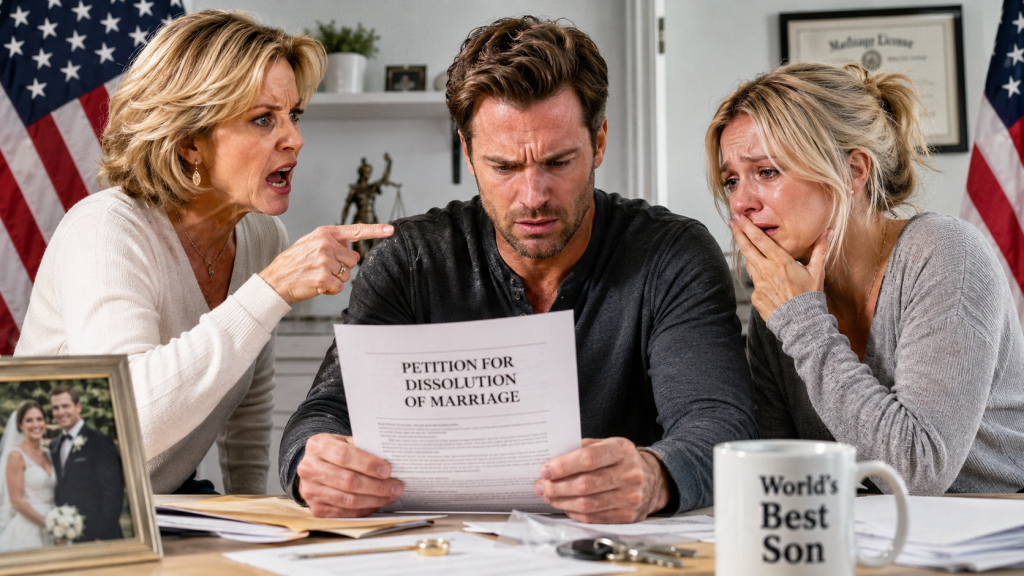
My mother stole my wife’s bank card and went shopping as if my marriage automatically made my wife’s money hers—then she called me, screaming with outrage, the second the payment was declined.
I drove home burning with anger, ready to accuse Olivia of humiliating my mother on purpose. Instead, I walked into divorce papers, sealed evidence, and a timeline that made one thing horrifyingly clear:
Olivia had never been the one losing control.
I had simply spent years believing the wrong woman.
The Call
“Son, I took that idiot wife of yours’ card—and it bounced! There was no money on it!”

My mother’s shrill voice tore through my phone so violently that I flinched.
I was standing in the break room of the auto shop where I worked in Phoenix, halfway through a sandwich and listening to two mechanics argue about Sunday football.
The room went quiet.
Everyone had heard her.
I pushed back my chair and walked outside.
“Mom, what are you talking about?”
“I went to Sprouts,” Marjorie snapped. “I picked up what I needed, used her card like I always do, and it DECLINED. Right there in front of everyone! The cashier looked at me like I was some kind of criminal.”
My stomach tightened.
“Why do you even have Olivia’s card?”
There was a pause.
Not embarrassment.
Not confusion.
Offense.
“Because she’s your wife,” Mom said. “And you’re my son. What belongs to the family belongs to the family.”
“That doesn’t answer my question.”
“I told her last month that I needed help with groceries. She ignored me. So today I stopped by your place and borrowed the card.”
Borrowed.
That word should have stopped me.
Instead, I asked the wrong question.
“Did Olivia know?”
“Of course not. She would have made one of her ridiculous scenes.”
I closed my eyes.
“Where are you?”
“In the parking lot. And I want you to call your wife right now and find out what she did.”
“What she did?”
“She obviously blocked the card to embarrass me.”
Even now, I’m ashamed of how quickly that explanation made sense to me.
Olivia had been quiet lately.
Too quiet, I had decided.
She had stopped arguing when Mom arrived without calling.
She had stopped protesting when Mom made comments about our finances.
She had stopped asking me to defend her.
That morning, Olivia had handed me coffee before work.
“Have a good day, Derek.”
She had smiled.
Not warmly.
Calmly.
I should have recognized that calm.
It was the calm of someone who had finally stopped hoping.
Instead, sitting behind the wheel of my truck ten minutes later, I convinced myself she was planning something.
She had probably transferred the money.
Maybe she had frozen the card.
Maybe she knew Mom would take it.
Maybe she wanted to humiliate her.
By the time I reached our apartment, anger had drowned out every reasonable thought.
I charged upstairs.
I jammed my key into the lock.
And I threw open the door.
“What the hell is wrong with you?” I shouted. “Have you lost your mind?”
Silence answered me.
The apartment smelled like lemon cleaner.
Sharp.
Bright.
Wrong.
The couch cushions were perfectly straight.
The television stand was bare.
And the wedding photograph that had hung beside the hallway for seven years was gone.
A pale rectangle remained on the wall.
“Olivia?”
Nothing.
Then I noticed the dining table.
My spare key was sitting in the center.
Beside it lay the credit card I had believed I’d misplaced months earlier.
There was also a small clear evidence bag containing a gold ring.
And beneath my favorite coffee mug was a stack of papers.
World’s Best Son.
Mom had given me that mug for Christmas.
I lifted it.
The first document underneath read:
PETITION FOR DISSOLUTION OF MARRIAGE.
I stopped breathing.
For several seconds, I simply stared.
Then I looked toward our bedroom.
The closet door was open.
Olivia’s clothes were gone.
Her shoes were gone.
Her grandmother’s cedar jewelry box was gone.
In the bathroom, only my toothbrush remained.
My phone buzzed.
MOM.
I rejected the call.
Then I reached for the plastic evidence bag.
Inside was her gold ring.
I recognized it immediately.
Mom wore that ring almost every day.
She liked pointing with the hand that wore it.
Especially when she was angry.
Beneath the bag was a photograph printed from our front-door camera.
The timestamp was from that morning.
Mom stood inside our apartment.
Olivia’s purse was open in her hands.
My knees suddenly felt weak.
Underneath was another document.
Draft Incident Report: Unauthorized Entry and Suspected Theft.
I sat down.
There were more pages.
Dozens.
And Olivia had arranged them chronologically.
That was when my marriage began telling me its story.
Not the version I remembered.
The version Olivia had survived.
The First Boundary I Helped My Mother Break
The timeline began almost three years earlier.
There was a screenshot of a text Olivia had sent me.
Derek, your mother came over while I was working and let herself in. I didn’t know she still had a key. Please ask her to return it.
My response was printed beneath it.
She’s my mom, Liv. She’s not some stranger. Relax.
I remembered sending it.
At the time, it seemed harmless.
Mom had been helping us water plants while we were on vacation. Apparently, she had made a copy of our key.
Olivia wanted the copy returned.
I told her she was overreacting.
A month later came another message.
Your mom went through the kitchen cabinets again and criticized what I buy. This is becoming uncomfortable.
My reply:
She’s trying to help.
Then:
She opened my mail today.
My reply:
Probably an accident.
Then:
She asked me how much money I have in savings.
I had answered:
She worries about us.
I kept reading.
Every page made me smaller.
There were photographs of drawers left open.
Screenshots of messages.
Dates.
Times.
Amounts.
Mom had borrowed $80.
Then $120.
Then $200.
Sometimes Olivia had given it voluntarily.
Other times Mom had pressured her.
“I raised Derek alone.”
“Family helps family.”
“You earn more than you need.”
“You don’t understand what mothers sacrifice.”
When Olivia eventually said no, Mom came to me.
And I became her collection agency.
“Liv, it’s only a hundred dollars.”
“Liv, she’s struggling.”
“Liv, why does everything have to become a boundary with you?”
Boundary.
I used to hate that word.
Now it was everywhere.
What I Had Refused to See
Halfway through the stack was a handwritten page.
Olivia’s writing.
March 14 — Marjorie entered at 2:10 p.m. without calling. Opened desk drawer. Asked why I keep separate savings. Derek said I was paranoid.
April 2 — Marjorie took $60 from kitchen envelope. Said she thought it was Derek’s. Derek reimbursed me and asked me not to embarrass her.
I remembered that.
Olivia had been furious.
I had taken sixty dollars from my wallet and slapped it onto the kitchen counter.
“There. Problem solved.”
She stared at the money.
“No, Derek. The money isn’t the problem.”
“Then what is?”
“Your mother took something that wasn’t hers.”
“She misunderstood.”
“She opened an envelope with my name on it.”
“So what do you want me to do? Call the police on my mother over sixty dollars?”
Olivia had gone silent.
I remembered feeling victorious.
I thought silence meant I had won.
Now I understood.
She had learned there was no point explaining herself to a husband committed to misunderstanding her.
The timeline continued.
Then I reached the page that made me physically sick.
It concerned the credit card sitting beside the divorce papers.
The one I had supposedly misplaced.
Olivia had found it six months earlier.
In Mom’s handbag.
There was a photograph.
Mom had left her bag open on our kitchen chair.
My card was visible inside.
Olivia had photographed it instead of removing it.
Then she had checked our statement.
Four purchases appeared.
A pharmacy.
A department store.
A restaurant.
A gas station.
Total: $486.17.
I remembered confronting Mom about those charges.
Not because Olivia asked me to.
Because the bank flagged them.
Mom cried.
She said she must have grabbed my card accidentally.
I believed her.
Then I accused Olivia of being heartless when she suggested canceling Mom’s access to our apartment.
The memory came back with brutal clarity.
“Your mother stole your card.”
“Stop using that word.”
“What word would you prefer?”
“She made a mistake.”
“Four times?”
“She’s getting older.”
“She’s fifty-nine.”
“You know what I mean.”
“No, Derek. I don’t.”
I had stormed out.
Mom called me afterward and said Olivia was trying to separate us.
I believed that too.
There was always an explanation.
And somehow, every explanation ended with Olivia apologizing.
The Recording
A yellow sticky note was attached to a small flash drive.
Listen before calling me.
My laptop was still in the bedroom.
I plugged it in.
There were six audio files.
The first began with Mom’s voice.
“Why do you keep your money separate?”
Olivia answered calmly.
“Because Derek and I agreed to keep personal accounts and contribute to shared expenses.”
“That’s ridiculous.”
“It works for us.”
“No. It works for you. It keeps my son from knowing what you have.”
“He knows exactly what I have.”
“Then why can’t you help me?”
“I have helped you.”
“Three hundred dollars is nothing to you.”
“That isn’t the point.”
There was silence.
Then Mom said something I had never heard her say.
“If you loved my son, you’d understand that helping me is part of being his wife.”
Olivia’s voice remained controlled.
“I married Derek. I didn’t sign over my bank account to you.”
Mom laughed.
A nasty little laugh.
“You really think you’re permanent?”
I froze.
“You’ll learn,” she continued. “Women come and go. Mothers don’t.”
The recording ended.
I stared at the laptop.
Then I opened the second file.
Mom was angrier.
“You’ve changed him.”
“No, Marjorie.”
“He never kept things from me before you.”
“He’s thirty-eight years old.”
“He’s my son.”
“And my husband.”
“You’re replaceable.”
That word landed differently.
Replaceable.
I suddenly remembered Olivia crying in our bedroom two years earlier.
I had asked what happened.
She said, “Your mother told me I’m replaceable.”
I laughed.
Actually laughed.
“Come on, Liv. She probably didn’t mean it like that.”
How else could she possibly have meant it?
The third recording was worse.
Mom had been inside our apartment while Olivia was away.
The front-door camera captured her entering.
An indoor camera Olivia had quietly installed in her office recorded Mom opening drawers.
Then Mom called someone.
Me.
I heard my own voice through the speaker.
“Hey, Mom.”
“I’m at your place. Olivia isn’t here.”
“Okay.”
“Do you know where she keeps the tax documents?”
“Probably office drawer.”
“Which one?”
“Try the bottom.”
My hands went numb.
I had forgotten that conversation.
I had given Mom permission.
Not specifically to steal.
But to enter.
To search.
To ignore Olivia’s privacy.
The person Olivia feared had not been acting alone.
She had an accomplice.
Me.
Seven Years of Marriage
Olivia and I met when I was thirty-one.
She was twenty-nine.
She worked in payroll for a construction supplier and had a laugh that could turn strangers into friends.
Our first date lasted four hours.
Our second ended because the restaurant closed.
By our fourth month together, I knew I wanted to marry her.
Mom disliked her almost immediately.
Not openly.
Not at first.
She was too clever for that.
She would compliment Olivia and poison the compliment before the sentence ended.
“You look beautiful. Derek always did like women who dress professionally.”
“You’re very independent. I suppose that’s necessary when you’re not used to relying on family.”
“You’re a good cook. Derek usually prefers mine, but this is nice too.”
Olivia noticed.
I didn’t.
Or perhaps I noticed and found ignoring it easier.
My father left when I was eleven.
Mom raised me alone.
That story became the constitution of our family.
She sacrificed.
Therefore I owed.
She struggled.
Therefore she could intrude.
She had been abandoned.
Therefore I could never choose anyone over her.
Any boundary became betrayal.
Any disagreement became ingratitude.
Olivia understood the pattern before I did.
“You don’t have to abandon your mother,” she told me once. “You just have to stop letting her run our marriage.”
I became furious.
“She doesn’t run anything.”
Olivia looked exhausted.
“Then tell her she cannot enter our apartment without permission.”
“That’s dramatic.”
“Tell her she cannot ask me for money.”
“She’s struggling.”
“Tell her she cannot insult me.”
“She jokes.”
“Tell her she cannot call you during our anniversary dinner unless it’s an emergency.”
“She was lonely.”
Olivia stared at me.
Then she asked the question I spent years refusing to answer.
“Is there anything she could do that you wouldn’t defend?”
I walked away.
Now, surrounded by evidence, I finally had my answer.
Apparently not.
The Bank Card
At the bottom of the stack was an envelope labeled:
TODAY.
Inside was a letter from Olivia.
My hands shook as I opened it.
Derek,
If you are reading this, your mother probably took my bank card.
I stopped.
She had known.
Not exactly when.
But she had known it would happen.
I continued.
I reported the card compromised last night and moved my money to a new account. I left the old card in my purse because I needed to know whether Marjorie would take it after I told her directly yesterday that she was no longer allowed to enter our home or touch my belongings.
My mouth fell open.
Yesterday?
Olivia had never mentioned that conversation.
Or maybe she knew there was no reason to.
I am not setting a trap. I am documenting a pattern. There is a difference.
For three years I have asked you to help protect the basic boundaries of our marriage. Every time your mother crossed one, you explained it away. When she took money, you reimbursed me instead of confronting her. When she entered without permission, you told me to relax. When she insulted me, you called it humor. When she searched my belongings, you called it concern.
Eventually I realized I was spending more energy proving what was happening than you were spending trying to understand me.
I had to stop reading.
My eyes blurred.
I wiped them with my palm.
Then I continued.
This morning, I left for work at 7:40. The camera recorded Marjorie entering at 8:16 using the key you told me she no longer had. She opened my purse at 8:19. She removed my bank card at 8:20.
She had no permission to enter.
She had no permission to open my purse.
She had no permission to take my card.
If your first instinct after hearing from her is to blame me, please understand that this letter was written before you knew any of this.
That sentence broke something inside me.
Olivia knew exactly what I would do.
She had predicted me.
And she had been right.
I had driven home preparing to scream at her.
My phone buzzed again.
Mom.
This time, I answered.
The First Time I Said No
“Finally!” Mom shouted. “Where have you been? Did you talk to her?”
I stared at the evidence.
“Where did you get Olivia’s card?”
“I told you.”
“No. Tell me exactly.”
“Why are you interrogating me?”
“Where did you get it?”
Mom went silent.
Then she sighed dramatically.
“I went to your apartment.”
“How did you get inside?”
“With my key.”
“You told me you returned that key.”
“I made another one.”
I closed my eyes.
“Why?”
“Because I knew someday that woman would try to keep me out.”
“You went into our apartment without permission.”
“It’s your apartment too.”
“And then?”
“What?”
“Where was the card?”
“Derek—”
“WHERE WAS IT?”
She snapped.
“In her purse!”
The silence afterward felt enormous.
I lowered my voice.
“So you entered my home without permission, opened my wife’s purse, took her bank card, went shopping, and now you’re angry because the card didn’t work?”
“Don’t twist this around.”
“I’m repeating what you told me.”
“She has poisoned you.”
“No.”
My voice cracked.
“No, Mom. She spent seven years trying not to.”
Mom laughed bitterly.
“Oh, please. You’re going to choose her over your own mother?”
There it was.
The question beneath every fight.
Choose.
As if love were a throne only one woman could occupy.
“I should have chosen my marriage a long time ago.”
Mom gasped.
“After everything I sacrificed for you?”
“I was your child.”
“You owe me respect.”
“I owe you respect. I don’t owe you Olivia’s bank account.”
“She’s your wife!”
“Exactly.”
Mom started crying.
Those tears had controlled me for decades.
That day, for the first time, they sounded different.
Not fake, necessarily.
But powerful because I had always surrendered to them.
“Where is she?” Mom demanded.
“I don’t know.”
“She left you?”
“Yes.”
“Well, good! Let her go. She was never right for you.”
I stared at the divorce petition.
“Mom.”
“What?”
“You stole from my wife.”
“I borrowed—”
“No.”
The word surprised both of us.
“No more changing the word.”
Silence.
“You stole her card.”
“You’re calling your mother a thief?”
“I’m describing what you did.”
She hung up.
Olivia’s Attorney
The divorce petition included the name of Olivia’s attorney.
I almost called Olivia.
Then I saw another note.
Please communicate through counsel until I am ready to speak directly.
Six hours earlier, I would have called that cruel.
Now I understood.
She did not trust me to hear her without trying to change her mind.
I spent that night alone.
For the first time in seven years, the apartment sounded enormous.
I sat on the floor because Olivia had taken the armchair she bought before we married.
Fair enough.
I read every page.
There were seventy-three documented incidents.
Seventy-three.
Not all were dramatic.
That was what made the record devastating.
A key used without permission.
A drawer opened.
A comment about Olivia’s salary.
A private letter read.
A package opened.
A holiday changed because Mom complained.
A dinner interrupted.
A vacation shortened.
Money borrowed.
Money taken.
Insults.
Accusations.
And beside nearly every incident was my reaction.
Derek minimized.
Derek reimbursed.
Derek asked Olivia to apologize.
Derek said Marjorie was lonely.
Derek said family comes first.
I had thought I was keeping peace.
But peace for whom?
Mom received whatever she wanted.
I avoided uncomfortable confrontations.
Olivia paid the price.
That wasn’t peace.
It was outsourcing conflict to my wife.
The Police Report
The next morning, a police officer called.
Olivia had filed the report.
Mom had been recorded entering our apartment and taking the card.
I told the truth.
For once, completely.
Yes, Mom had previously possessed a key.
No, she did not currently have permission to enter.
Yes, Olivia had asked that all copies be returned.
Yes, I believed Mom had returned hers.
No, Olivia had not authorized her to take the card.
Saying those things aloud made everything real.
Mom called seventeen times that afternoon.
I did not answer.
Then my aunt called.
“Your mother is hysterical.”
“I know.”
“She says Olivia is trying to get her arrested.”
“Olivia didn’t make Mom take the card.”
“Derek, she’s your mother.”
“I know.”
“Then fix it.”
That word.
Fix.
For years, fixing meant making Olivia surrender.
Not anymore.
“I can’t fix what Mom refuses to admit she did.”
My aunt hung up on me.
Then came my cousin.
Then another relative.
Apparently Mom had spent the afternoon telling everyone Olivia had “planted” the card.
Unfortunately for Mom, there was video.
The Meeting
Eleven days passed before Olivia agreed to see me.
Not alone.
Her attorney’s office had a small conference room with gray walls and a glass table.
Olivia entered carrying a folder.
She looked tired.
But she looked lighter too.
That hurt more than anger would have.
I stood.
“Hi.”
“Hi, Derek.”
I wanted to hug her.
I stayed where I was.
“I read everything.”
“I assumed you would.”
“I’m sorry.”
Olivia nodded.
Not accepting.
Not rejecting.
Just acknowledging.
I tried again.
“I don’t know how I didn’t see it.”
Her eyes met mine.
“You saw it.”
The words were quiet.
That made them worse.
“You just didn’t call it what it was.”
I swallowed.
“You’re right.”
She looked surprised.
Maybe because I had spent seven years telling her she wasn’t.
“I kept thinking I was caught between you and Mom.”
“You weren’t.”
“I know that now.”
“No, Derek. You need to understand this. I never asked you to stop loving your mother.”
“I know.”
“I asked you to stop offering me as the price of loving her.”
I looked down.
There was nothing I could say.
Olivia continued.
“When she needed money, you offered mine. When she needed somewhere to go, you offered our home. When she wanted information, you offered our privacy. When she insulted me, you offered my dignity because confronting her made you uncomfortable.”
My eyes burned.
“I thought I was keeping everyone together.”
“You were keeping yourself comfortable.”
That one landed.
Because it was true.
“I’m in therapy,” I said.
Olivia nodded.
“I’m glad.”
“I told Mom she can’t come to the apartment anymore.”
“Good.”
“I changed the locks.”
“Good.”
“I’m not asking you to come back.”
For the first time, Olivia’s expression softened.
“Thank you.”
That hurt too.
Because respecting her decision was apparently so unusual that she thanked me for it.
“I just need you to know I finally understand.”
She was quiet for a moment.
Then she said, “Understanding doesn’t undo anything.”
“I know.”
“And boundaries you create after I leave aren’t proof I should return.”
“I know.”
“I loved you, Derek.”
I looked at her.
“Loved?”
Her eyes filled.
“Yes.”
That single word ended my marriage more completely than the papers ever could.
Marjorie Finally Faced Consequences
Mom’s situation became serious quickly.
Olivia did not exaggerate what happened.
She did not invent charges.
She simply stopped protecting Mom from the consequences of her own actions.
The evidence established that Mom had entered without permission and taken the bank card.
The bank had already documented suspicious activity connected to previous incidents.
The earlier charges on my missing credit card became relevant too.
I cooperated.
That decision cost me relationships with several relatives.
Mom told everyone I had betrayed her.
For once, I let people believe whatever they wanted.
I was done forcing someone else to absorb the consequences just so I could look like a good son.
Eventually, the case was resolved without the dramatic courtroom spectacle Mom claimed Olivia wanted.
There were legal consequences, restitution requirements, and strict instructions that Mom stay away from Olivia and her property.
Mom hated every second of it.
But something more important happened.
She finally had to hear the word she had avoided for years.
No.
No, you cannot enter.
No, you cannot take.
No, you cannot demand.
No, motherhood does not create ownership.
No, sacrifice is not a lifetime invoice you can hand your adult child.
I wish I could say Mom transformed immediately.
She didn’t.
Real people rarely do.
For months she blamed Olivia.
Then she blamed me.
Then the police.
Then the bank.
Then “society.”
Everyone except herself.
So I kept my distance.
The Divorce
Our divorce was finalized six months later.
There was no screaming.
No revenge.
No secret fortune.
No last-minute reconciliation.
Just two people sitting across from each other, ending something one of them had spent years trying to save.
Olivia kept what belonged to her.
I kept what belonged to me.
We divided the shared account evenly.
I offered to reimburse her for every documented amount Mom had taken over the years.
Olivia initially refused.
“I don’t want money from you.”
“It isn’t to buy forgiveness.”
She studied me.
“Then why?”
“Because saying I’m sorry without repairing what I can repair is just another way of making you carry the cost.”
She eventually accepted the documented amount.
I sold my motorcycle to cover part of it.
Mom heard and exploded.
“You sold your bike for HER?”
“No,” I said. “I sold it because of me.”
That distinction mattered.
One Year Later
A year after the divorce, I moved into a smaller apartment.
No one had a spare key.
My mother had never been inside.
We spoke occasionally.
Our conversations were shorter.
Healthier.
She still tested boundaries.
“Why can’t I just stop by?”
“Because I asked you to call first.”
“I’m your mother.”
“Yes.”
“So?”
“So call first.”
Sometimes she hung up.
I stopped chasing her afterward.
Therapy helped me understand something I wish I had learned decades earlier.
A boundary does not destroy a healthy relationship.
It reveals whether the relationship can survive without control.
Mine with Mom was still being tested.
My marriage had failed that test because I never allowed Olivia’s boundaries to matter.
Then, one Thursday afternoon, I received an envelope.
The return address belonged to Olivia.
Inside was a single photograph.
She was standing in front of a small house with a blue door.
Beside her was a dog.
Olivia had always wanted a dog.
Mom hated dogs.
So somehow, during seven years of marriage, we never got one.
On the back Olivia had written:
His name is Jasper. I finally got the dog.
I laughed.
Then I cried.
There was also a short note.
Derek, I heard from my attorney that the final restitution payment cleared. Thank you for keeping your word. I hope therapy is helping. I don’t hate you. I hope someday you stop hating yourself too. What happened between us mattered, but it doesn’t have to be the only thing either of us becomes. Take care. — Olivia
I sat at my kitchen table holding that note for a long time.
Part of me wanted to call her.
I didn’t.
That was another lesson.
Love does not automatically give you access.
Regret does not automatically earn another chance.
Sometimes respecting someone means leaving the door they closed alone.
Two Years After the Bank Card
I saw Olivia again almost two years after the day Mom stole her card.
It happened at a coffee shop.
I was waiting for my order when someone behind me said, “Derek?”
I turned.
Olivia stood there.
She looked good.
Different haircut.
Blue sweater.
Calm eyes.
“Hey.”
“Hi.”
For a second, we were two strangers who happened to know nearly everything about each other.
“How are you?” she asked.
“Better.”
She smiled slightly.
“Me too.”
“How’s Jasper?”
Her smile widened.
“Spoiled.”
“Good.”
There was a pause.
Then she asked, “How’s your mom?”
“Better some days.”
Olivia raised an eyebrow.
I laughed.
“Okay. Still Mom.”
“That sounds more accurate.”
“She’s seeing a counselor now.”
Olivia looked genuinely surprised.
“Really?”
“It took a while.”
“What changed?”
I thought about it.
“People stopped rescuing her.”
Olivia nodded slowly.
“That’ll do it.”
The barista called her name.
Before leaving, she turned back.
“You look peaceful, Derek.”
I almost laughed at the irony.
For years, I had claimed I was keeping the peace.
Only after losing my marriage did I learn what peace actually felt like.
“Thank you,” I said.
She started walking away.
“Olivia?”
She turned.
“I’m sorry.”
She looked at me for several seconds.
“I know.”
Then she left.
That was enough.
What My Mother’s Declined Card Really Cost
For a long time, I thought the worst day of my marriage was the day my wife left.
It wasn’t.
The worst days happened quietly.
They happened every time Olivia told me something hurt her and I explained why she shouldn’t be hurt.
Every time Mom crossed a boundary and I made Olivia responsible for restoring peace.
Every time I confused being a loyal son with being an obedient one.
Every time I told myself I was neutral.
I wasn’t neutral.
When one person is repeatedly crossing boundaries and you pressure the other person to tolerate it, you have chosen a side.
I just refused to admit which one.
Mom stealing Olivia’s bank card did not destroy my marriage.
The declined payment did not destroy my marriage.
The police report did not destroy my marriage.
Those things simply exposed what had already happened.
By the time I came charging through our apartment door ready to accuse Olivia, she had spent three years documenting what I refused to see.
She did not leave impulsively.
She did not lose control.
She did not manipulate me.
She planned carefully because she had finally accepted a painful truth:
I was not going to protect our marriage while she was still inside it.
The divorce papers on that dining table were not Olivia’s first warning.
They were the seventy-fourth.
They were simply the first warning I could no longer dismiss.
And the object I remember most clearly from that afternoon isn’t the divorce petition.
It isn’t Mom’s gold ring.
It isn’t even the photograph of her hand inside Olivia’s purse.
It is that ridiculous mug.
World’s Best Son.
For years, I thought being a good son meant making sure my mother never felt rejected, challenged, embarrassed, or alone.
Now I know better.
Being a good son should never have required being a bad husband.
Loving my mother did not mean giving her ownership over my home.
It did not mean giving her access to my wife’s money.
It did not mean pretending theft was borrowing, intrusion was concern, or cruelty was humor.
Most of all, it did not mean asking the woman I married to become smaller so my mother could continue taking up all the space.
Olivia understood that long before I did.
She paid dearly waiting for me to learn it.
I paid dearly learning it too.
But there was one final thing Olivia gave me before she walked away.
Not another chance.
Something harder.
The truth.
And unlike all the other things my mother had taken from our marriage, that was one thing nobody could steal from me once I finally decided to face it.
Sometimes the person who walks away is not destroying the family.
Sometimes they are simply the first person brave enough to stop pretending that what is happening inside it is normal.
And sometimes the most expensive declined bank card in the world costs nothing at the checkout counter.
It costs you the marriage you should have protected years before anyone ever tried to swipe it.
THE END — THANK YOU FOR READING.