 Reading Time: 28 minutes
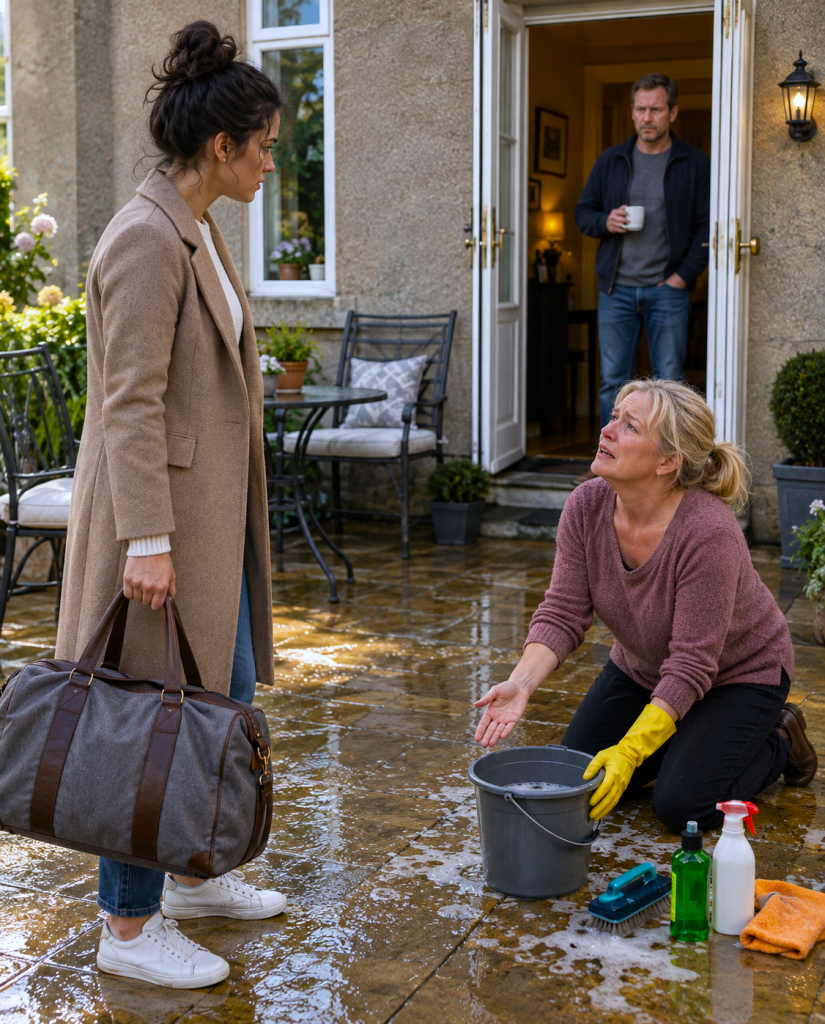
“Is this him?” Harrison asked the question without raising his voice. I looked at Julian standing on the porch in his silk robe, his glass of scotch hanging loosely at his side.
“Yes.” Harrison nodded once. Julian stared at him. “And who exactly are you?” “Harrison Vance. I represent Natalie regarding this property and several related financial matters.”
Julian gave a short laugh.
“Financial matters?”
The second vehicle opened.
A woman in a navy pantsuit stepped out carrying a laptop bag.
I recognized her immediately.
Dana Pierce.
She worked with Harrison’s firm and specialized in financial fraud and elder exploitation cases.
The white pickup belonged to a licensed locksmith Harrison had arranged to have standing by.

There was also another vehicle farther down the curb.
A marked police cruiser.
Not because the officers were there to drag anyone onto the lawn.
Harrison had requested a civil standby because he expected emotions to run high.
He had been right.
Julian’s face changed when he noticed the cruiser.
“What is this?” he demanded.
Khloe appeared behind him.
She had changed clothes.
She was wearing an expensive cream dress I had never seen before, gold earrings, and the expression of someone irritated that an inconvenience had interrupted her party.
Then she spotted Harrison.
“What are you doing?”
I walked toward the house.
“Finishing the conversation you wanted to have tomorrow.”
Khloe looked toward the guests gathered inside.
“Natalie, not tonight.”
“You were perfectly comfortable humiliating Mom today.”
“I did not humiliate Mom.”
“She was scrubbing your outdoor kitchen on her knees.”
“She wanted to help.”
“She lives here.”
Khloe’s eyes narrowed.
“So do we.”
Harrison opened the leather folder.
“That is precisely what we are here to address.”
Julian came down one porch step.
“I already told her. You can’t just remove established residents in Texas. If you’re a lawyer, you should know that.”
Harrison looked almost bored.
“I do know that.”
Julian smiled.
For about two seconds.
Then Harrison continued.
“I also know that your legal status is significantly different from what you represented to Natalie earlier.”
Julian’s smile disappeared.
“You were invited guests.”
“We’ve been here two years.”
“Duration alone does not create ownership.”
“Nobody said it did.”
“You implied you had tenancy rights sufficient to exclude the actual owner from the property.”
“I said we have rights.”
“And some occupancy rights may exist depending upon the exact facts.”
Harrison closed the folder slightly.
“That is why my client did not return this evening with a group of men to physically throw your belongings into the street. Instead, we documented the ownership, your lack of a lease, your lack of rent payments, the circumstances of your occupancy, and the allegations made by Martha regarding financial pressure.”
Khloe’s face tightened.
“What allegations?”
Dana answered that question.
“The allegation that you took possession of debit cards connected to funds Natalie sent specifically for Martha’s living expenses.”
Julian looked at Khloe.
Khloe looked at me.
I had never seen guilt move across someone’s face so quickly.
“What did Mom tell you?”
I almost laughed.
That was her first concern.
Not whether Mom was okay.
Not whether Mom was hurt.
Not whether Mom had been frightened.
What did Mom tell you?
“Enough.”
Khloe folded her arms.
“You don’t understand the arrangement.”
“Then explain it.”
“We managed the money because Mom is terrible with finances.”
I stared at her.
Our mother had balanced a household budget on one income for most of our childhood.
She had raised two daughters after our father died.
She had worked bookkeeping jobs, cleaned offices at night, stretched groceries until payday, and somehow never let us know how close to the edge we occasionally were.
“Mom managed money before you learned multiplication.”
Khloe’s cheeks reddened.
“She’s older now.”
“She’s sixty-two.”
“She forgets things.”
“Like what?”
Khloe hesitated.
I waited.
“What does she forget?”
“She forgets passwords.”
“So you took her bank cards?”
“We helped.”
“By taking them?”
“She gave them to us.”
“Because you told her she might lose the house if she bothered me.”
“That’s not what happened.”
“That is exactly what she told me.”
Julian stepped in.
“This is getting ridiculous.”
Dana turned toward him.
“Mr. Mercer, are you aware that transactions on those cards can be reviewed?”
His eyes shifted.
“Of course.”
“Good.”
She opened her laptop bag.
“Because we already began.”
That changed the temperature on the porch.
Behind Julian, the music was still playing.
Someone inside laughed.
Glasses clinked.
A man near the living-room window appeared to realize something serious was happening and moved away from the glass.
Dana continued.
“Natalie provided transfer records showing recurring monthly payments intended for Martha’s expenses. Martha has authorized us to review the accounts through which those funds were accessed.”
Khloe’s voice grew sharper.
“Mom authorized you?”
“Yes.”
“When?”
“This evening.”
“She doesn’t know what she signed.”
Dana looked at her.
“She knew exactly what she signed.”
“Mom gets confused.”
“Interesting.”
Dana tilted her head.
“Because in the forty-minute recorded interview I conducted with her before coming here, she correctly identified her bank, the last four digits of her account, the approximate monthly amount Natalie sends, the month you moved into this home, the room you originally occupied, and several stores where she says she never personally shopped despite purchases appearing on the account.”
Julian’s fingers tightened around his glass.
I watched him.
That was when I knew.
This was bigger than groceries.
Much bigger.
Harrison turned to me.
“Natalie.”
He handed me a page.
I glanced down.
The first transaction made my stomach turn.
A designer boutique.
$2,480.
Another.
A resort deposit.
$1,900.
A jewelry store.
$4,775.
Then electronics.
Restaurants.
Wine deliveries.
A private club.
Furniture.
Spa charges.
Over two years, hundreds of purchases.
Some small enough to hide.
Others shameless.
My mother had been wearing old sweatpants because my sister had been spending the money I sent to care for her.
“How much?”
I asked.
Dana answered carefully.
“We have only completed an initial review.”
“How much?”
“At least eighty-three thousand dollars of spending appears inconsistent with Martha’s personal use or household necessities.”
Khloe went pale.
Julian’s glass dropped slightly in his hand.
“Eighty-three thousand?”
I whispered.
Dana nodded.
“And that is preliminary.”
I looked at my sister.
“You stole eighty-three thousand dollars from Mom?”
Khloe shook her head.
“No.”
“Then what do you call it?”
“We live here too. We buy food. We pay for things.”
“You didn’t pay for things.”
I pointed toward the papers.
“Mom did.”
“The money came into the household.”
“The money came to her.”
“We are family.”
I heard the words and felt something inside me finally settle.
Family.
People use that word as though it automatically cleans every dirty thing they do.
Family means forgive me.
Family means don’t embarrass me.
Family means don’t call the police.
Family means don’t keep receipts.
Family means I can take from you because we share blood.
My mother had spent years believing that definition.
I was finished with it.
“Family doesn’t turn a mother into unpaid help inside a house her daughter bought for her.”
Khloe flinched.
Julian stepped forward.
“Okay. This conversation is over.”
“No,” Harrison said.
Julian looked at him.
“It is actually just beginning.”
He removed several documents.
“The first concerns occupancy.”
Julian sighed dramatically.
“Here we go.”
Harrison handed him the papers.
“My client is providing written notice consistent with advice concerning your occupancy status and the procedures required should you refuse to surrender possession voluntarily.”
Julian glanced at the first page.
“So we’re staying.”
Harrison smiled faintly.
“You may choose to force formal proceedings.”
Julian looked triumphant.
“Exactly.”
“But before you decide, you should read the second document.”
Julian turned the page.
His expression changed.
“What is this?”
“A proposed voluntary surrender agreement.”
“You expect me to sign this?”
“I expect you to consider it carefully.”
Khloe snatched a copy.
She read the first paragraph.
Then the next.
“What does ‘release contingent upon preservation of evidence’ mean?”
Dana answered.
“It means Natalie is willing tonight to separate the issue of recovering possession of her property from the larger financial issues we are investigating, provided that you preserve all financial records and do not destroy, alter, or conceal evidence.”
Julian stared at her.
“Investigating?”
“Yes.”
“For what?”
Dana paused.
“Potential unauthorized use of Martha’s funds, possible coercion, possible identity-related misuse, and any other conduct supported by the records.”
Khloe’s face lost the last of its color.
“This is insane.”
“Then the records will clear everything up.”
Julian looked toward the police cruiser.
The officer remained near the car.
Arms relaxed.
Watching.
Harrison continued.
“You have choices tonight. Nobody is forcing you to sign anything.”
Julian’s jaw tightened.
“What choices?”
“You can remain and require Natalie to pursue whatever legal process is appropriate. If you do that, evidence collection continues, account access will still be revoked, Martha’s finances will still be secured, and the legal and financial issues will proceed independently.”
“And the other choice?”
“You voluntarily surrender possession tonight, remove essential belongings, arrange retrieval of the remainder under supervised conditions, return all keys, garage openers, account cards, mail, documents, and property belonging to Martha or Natalie, and sign an acknowledgment that you claim no ownership interest in the home.”
Julian stared at the page.
“And then what?”
“Then Natalie takes immediate possession with your consent.”
Khloe laughed bitterly.
“You’re asking us to make ourselves homeless.”
I answered.
“No.”
She looked at me.
“You have a condo.”
Silence.
Mom had mentioned something about it at the hotel.
Something that made no sense at first.
I had bought this home for her.
Khloe and Julian told me they needed temporary help because their apartment building was being renovated.
That was two years ago.
Apparently, six months after they moved in, they bought a condo across town.
They rented it out.
The monthly rent became part of their spending money while they continued living in my house for free.
Khloe’s eyes widened.
“Mom told you?”
“Yes.”
“That condo has tenants.”
“Then use some of the money you saved by living here free for two years and get a hotel.”
Julian finally set his glass down on the porch railing.
“You really want to do this to your own sister?”
There it was again.
Family.
I stepped closer.
“No, Julian. I wanted to surprise my mother.”
I pointed toward the house.
“I wanted to walk through that door, hug her, and see the safe life I spent six years working to give her.”
My voice began to shake despite everything I did to control it.
“I worked holidays. I missed birthdays. I missed Christmases. I missed the anniversary of my father’s death. I lived six years on the other side of the world because I wanted enough financial security to make sure my mother never scrubbed another stranger’s floor.”
Khloe looked away.
“And today, I came home and found her scrubbing yours.”
Nobody answered.
“So don’t stand there and ask whether I really want to do this.”
I took another step.
“You already did it.”
That landed.
Even Julian had nothing to say.
Then one of the guests came outside.
A tall man in a blazer.
“Julian?”
Julian turned sharply.
“Go inside, Greg.”
Greg looked at Harrison, then at the police car.
“Is everything okay?”
“Fine.”
“It doesn’t look fine.”
Khloe snapped.
“Greg, please go inside.”
Instead, Greg looked at me.
“Are you Natalie?”
I was surprised.
“Yes.”
He gave Julian a confused look.
“I thought Natalie was your investor.”
I stared at him.
“My what?”
Julian’s entire body stiffened.
Khloe whispered.
“Greg.”
But Greg had already realized he had stepped into something.
He looked embarrassed.
“Sorry. I probably misunderstood.”
“No.”
I kept my eyes on Julian.
“What did he tell you?”
Julian picked up his drink again.
“This is irrelevant.”
Greg started backing toward the door.
“I should leave.”
I looked at him.
“Please stay for one question.”
He stopped.
“What did Julian tell you about me?”
Greg hesitated.
“That you were an overseas investor who helped finance the property.”
I felt the blood rush in my ears.
“Finance?”
“Yes.”
“And who did he say owned the home?”
Greg looked uncomfortable.
“Julian said it was a family holding.”
Harrison glanced at me.
Then at Julian.
Dana’s eyes sharpened.
“What family holding?”
Julian cursed under his breath.
Greg raised both hands.
“Look, I clearly walked into something I don’t understand.”
“Greg,” Dana said calmly, “did Mr. Mercer ever represent that this property was controlled by him or an entity connected to him?”
Julian exploded.
“Do not answer that.”
Dana looked directly at Greg.
“You are free to leave.”
Greg did not answer.
He simply walked inside, picked up his jacket, and left through the front door without saying goodbye.
Then another couple left.
Then another.
Within ten minutes, the party was unraveling.
Nobody wanted to remain in a house where lawyers, police, and accusations about stolen money had replaced cocktails.
Julian watched each guest disappear with growing fury.
“You embarrassed us.”
I stared at him.
“That’s what bothers you?”
He looked at me.
“You came here deliberately to humiliate us in front of people.”
“No.”
I glanced toward the backyard.
“You humiliated yourselves long before I landed in Austin.”
Harrison looked at his watch.
“Mr. Mercer. Ms. Bennett. Have you reviewed the voluntary surrender terms?”
Khloe clutched the papers.
“I want my own lawyer.”
“Absolutely,” Harrison said.
“You can contact one.”
“At nine o’clock at night?”
“You are not required to resolve this tonight.”
Julian looked at the locksmith.
“Then why is he here?”
“In case you do.”
Julian paced toward the door.
Khloe followed him inside.
For the next twenty-five minutes, Harrison, Dana, and I waited outside.
The police officer remained nearby.
The locksmith leaned against his truck.
I called the hotel.
Mom answered on the second ring.
“Are you okay?”
“I’m fine.”
“Are they angry?”
“Yes.”
She went quiet.
I heard fear in her breathing.
That made me angrier than shouting ever could.
“Mom.”
“Yes?”
“You are safe.”
“I don’t want Khloe arrested.”
I closed my eyes.
Even then.
Even after everything.
She was protecting her.
“I know.”
“She’s still my daughter.”
“I know that too.”
“I don’t want to lose her.”
I looked through the front windows at Khloe arguing with Julian.
“You didn’t do this, Mom.”
“What?”
“You didn’t create what happens next.”
She said nothing.
“They made choices.”
A long silence.
Then Mom whispered, “I should have told you sooner.”
“You were scared.”
“I was ashamed.”
That word hurt.
Ashamed.
My mother had been manipulated, pressured, used, and reduced to asking permission to spend money meant for her.
And somehow she had decided the shame belonged to her.
“No.”
My voice broke.
“You have nothing to be ashamed of.”
“I let it happen.”
“You were trying not to lose your daughter.”
“I should have been stronger.”
“You survived it.”
I heard her crying quietly.
“So tonight,” I said, “you let me be strong for you.”
Another silence.
Then she said something I would remember for the rest of my life.
“Bring me home.”
My eyes filled.
“I will.”
At 9:42, the front door opened.
Julian came out wearing jeans and a polo shirt.
Khloe followed in leggings and a sweater.
The robe was gone.
So was the scotch.
Julian held the papers.
“We’ll sign.”
Harrison nodded.
“Have you read everything?”
“Yes.”
“Do you understand you are not being compelled to sign?”
“Yes.”
“And that you had the opportunity to seek counsel?”
Julian looked furious.
“Yes.”
Khloe stood beside him with tears in her eyes.
I almost felt sorry for her.
Almost.
Then I remembered Mom’s hands.
Red.
Cracked.
Shaking.
The sympathy disappeared.
They signed.
Not because they had suddenly become decent people.
They signed because Julian understood what I had understood hours earlier.
The house was never his strongest position.
The paper trail was.
And he wanted to get away from it.
The agreement allowed them ninety minutes to pack immediate personal necessities.
The remainder of their property would be collected later during scheduled, supervised access.
They were required to return all house keys, gate remotes, mailbox keys, account cards, documents belonging to Mom, and anything purchased specifically for her use.
Julian tried one final time.
“What about the furniture?”
I looked at him.
“What furniture?”
“The dining set. The sectional. Outdoor grill. Bedroom pieces.”
“Who paid for them?”
He said nothing.
Dana checked her laptop.
“Several appear to have been purchased using funds from Martha’s account.”
Julian’s mouth closed.
“You can leave them.”
Khloe began crying harder.
“That sectional was mine.”
“Then show proof that you paid for it.”
“I picked it out.”
“Picking something does not mean you paid for it.”
“It was for the house.”
“Exactly.”
She looked at me like she hated me.
“You’ve changed.”
I almost smiled.
“No.”
I looked through the doorway toward the hallway leading to the little room where my mother had been sleeping.
“I finally came home.”
At 11:21 p.m., Julian carried the last suitcase out.
The police officer watched from the curb.
Harrison checked the inventory.
Dana photographed the returned cards and documents before sealing them in an evidence envelope.
The locksmith waited until Julian and Khloe were fully outside.
Then Harrison asked them one last question.
“Do either of you have any additional keys, access codes, remotes, or electronic credentials that permit entry into this property?”
Julian said no.
Khloe shook her head.
The old lock came off.
Then another.
Then the side entrance.
Garage code reset.
Alarm system reset.
Gate keypad reset.
Smart-home passwords changed.
Camera access revoked.
Wi-Fi credentials replaced.
Guest profiles deleted.
I removed Julian and Khloe from every household account they could access.
Their names came off utility authorizations.
Their emergency-contact privileges disappeared.
Delivery accounts were reset.
My mother’s phone plan was separated from the family plan Khloe controlled.
Her bank alerts were redirected directly to her new phone.
Her pharmacy contact list was updated.
Her doctor’s office removed Khloe as the person authorized to make routine changes.
By midnight, every door they had once controlled required permission from me or Mom.
But the most important change had nothing to do with locks.
I stood in the kitchen holding the final envelope Dana gave me.
Inside were Mom’s replacement bank cards.
Only her name appeared on them.
She would never again need to ask permission to buy her own groceries.
I drove back to the hotel at 12:30.
Mom was awake.
She sat in the small living area of the suite wearing a hotel robe with a cup of tea between both hands.
When she saw me, she stood.
“Well?”
I smiled.
“You ready to go home?”
Her face crumpled.
She pressed one hand over her mouth.
“Really?”
“Really.”
She cried before she even reached me.
Not loud crying.
The exhausted kind.
The kind that seems to come from years rather than minutes.
I held her while she shook.
Then I felt her whisper into my shoulder.
“Is Khloe okay?”
Of course.
My mother.
“She’s safe.”
“Where did she go?”
“I think they checked into a hotel.”
Mom nodded.
“I don’t want them sleeping in the car.”
“They’re not.”
That seemed to matter to her.
Then she asked, “Did they take everything?”
“No.”
“What about my grandmother’s china?”
“Still there.”
“My photo albums?”
“Still there.”
“Your father’s box?”
“Still there.”
Her eyes closed.
“Thank God.”
Twenty minutes later, I drove her home.
It was after one in the morning when we reached the house.
The street was quiet.
Party cars were gone.
Music gone.
Lights dimmed.
Mom stayed in the passenger seat for several seconds after I parked.
I looked at her.
“You okay?”
She stared at the front door.
“I’m scared to go inside.”
That sentence broke something in me.
This woman had lived inside that house for two years.
And she was scared to enter it.
I got out, walked around, opened her door, and held out my hand.
“Then we go together.”
She took it.
We walked up the porch.
I gave her the new key.
She looked at it.
“You open it.”
“No.”
“Natalie.”
“It’s your home.”
Her hand trembled.
I wrapped mine around it.
Together, we put the key into the lock.
She turned it.
The door opened.
And for the first time since I arrived in America, my mother entered her home without needing anyone’s permission.
She stood in the foyer.
Then she began noticing things.
The entry table she had once loved had been replaced by a marble console Khloe chose.
Family photographs were missing.
Her old lamp was gone.
My father’s framed military picture had been moved from the living room into a hallway cabinet.
She walked toward it.
Picked it up.
Held it against her chest.
“They said it looked dated.”
I swallowed my anger.
“We’ll put it back.”
She looked at me.
“Where?”
“Wherever you want.”
We hung it above the fireplace at 1:47 in the morning.
It was crooked.
Neither of us cared.
The next morning, I woke to the smell of coffee.
For one confused second, I thought I was back in Dubai.
Then I heard Mom humming.
I walked downstairs.
She was in the kitchen in clean pajamas.
No oversized work clothes.
No bucket.
No scrub brush.
She had made eggs and toast.
I leaned against the doorway.
“What are you doing?”
She smiled.
“Breakfast.”
“You’re supposed to be resting.”
“I’m cooking because I want to.”
That distinction mattered.
I sat.
She placed a plate in front of me.
Then she sat across from me.
For several minutes, we ate quietly.
Finally, she said, “Khloe called.”
I put down my fork.
“When?”
“This morning.”
“What did she say?”
“She said you’re destroying the family.”
I almost laughed.
Mom did not.
“She said I chose you over her.”
“You didn’t.”
“I told her that.”
I waited.
Mom stared at her coffee.
“I told her she made me afraid inside my own home.”
My chest tightened.
“What did she say?”
“She cried.”
“And?”
“She said she never meant for it to become like that.”
I said nothing.
Mom continued.
“She said Julian started handling the money because they were struggling. At first it was just groceries and a few bills. Then they bought things for the house. Then he said since they were taking care of me, they deserved something.”
“Taking care of you?”
Mom gave a sad smile.
“They convinced themselves of it.”
She rubbed her hands together.
“After a while, I began doing more and more. Laundry. Cooking. Cleaning. Julian said I was home all day anyway.”
My jaw tightened.
“He said that?”
“Yes.”
“Why didn’t you tell them to leave?”
“I did once.”
I stared at her.
“What happened?”
Mom looked toward the window.
“Khloe packed a suitcase.”
I understood instantly.
“She threatened to leave your life.”
Mom nodded.
“She said if I threw them out, she would never speak to me again.”
I leaned back.
There it was.
The leash.
Not money.
Not the house.
Fear.
“You believed her.”
“Yes.”
“Mom.”
“I had already spent years missing you overseas. I didn’t want to lose both daughters.”
My anger softened.
I reached across the table.
“You should never have been forced to choose.”
She squeezed my hand.
“I know that now.”
The next several weeks were not dramatic.
At least not in the way that night had been dramatic.
There were no police cars.
No lawyers standing on the porch.
No shouted accusations.
But those weeks mattered far more.
I hired a contractor to convert one downstairs room into a comfortable bedroom for Mom so her knees would not have to manage the stairs every day.
I brought in a physical therapist.
A housekeeper came twice a week.
The first time the housekeeper arrived, Mom immediately tried to help her.
I found them both wiping kitchen cabinets.
“Mom.”
She froze like a child caught sneaking cookies.
The housekeeper laughed.
“I told her to sit down.”
Mom pointed at the cabinet.
“It was sticky.”
“Mom.”
“All right.”
She walked away reluctantly.
Two minutes later, I caught her folding towels.
Recovery is strange.
Sometimes the body leaves a bad situation before the mind understands that it is free.
Mom still asked me whether she was allowed to order groceries.
She asked if she could move furniture.
She asked if she could invite her friend Lorraine for lunch.
One afternoon she stood in the living room holding paint samples.
“Do you mind if I repaint this wall?”
I looked at her.
“It’s your wall.”
“But you bought the house.”
“For you.”
She studied my face.
“You really mean that?”
“Yes.”
She chose a soft green.
I hated the color.
I told her it was beautiful.
She knew I was lying.
We laughed for ten minutes.
That laughter was the first moment I realized I had my mother back.
Not completely.
But enough to recognize her.
Meanwhile, Dana kept reviewing the accounts.
The eighty-three thousand became ninety-six.
Then one hundred and eight.
Eventually, the confirmed questionable spending reached more than $121,000.
That included charges, withdrawals, transfers, and payments tied to personal expenses that had no reasonable connection to Mom.
There was more.
Much more.
Khloe had opened a store credit account using Mom’s information.
Julian had listed Mom as a guarantor on a small business credit application.
Someone had changed the mailing address on one financial account so statements went to a post-office box.
When Dana showed me that, I felt physically sick.
“How did I miss all of this?”
“You were overseas.”
“I spoke to Mom every week.”
“And she was trying to protect you.”
“That doesn’t make me feel better.”
“It isn’t supposed to.”
Dana leaned forward.
“It explains the mechanism.”
“What mechanism?”
“Isolation does not always look like locking someone in a room.”
She tapped the records.
“Sometimes it looks like controlling information.”
I never forgot that.
Khloe and Julian controlled what Mom saw.
What I saw.
What arrived in the mail.
What story each of us heard.
I thought Mom was happily retired.
Mom thought I might sell the house if she caused trouble.
They lived between those two lies.
Eventually, Harrison arranged a formal meeting.
Khloe came without Julian.
That surprised me.
She arrived at Harrison’s office looking exhausted.
No makeup.
Hair tied back.
No expensive jewelry.
Mom came too.
At first I did not want her there.
She insisted.
“This is my life,” she said.
She was right.
We sat around a conference table.
Harrison at one end.
Dana beside him.
Me next to Mom.
Khloe across from us.
For nearly a minute, nobody spoke.
Finally, Khloe looked at Mom.
“You look better.”
Mom nodded.
“I am.”
Khloe started crying.
“I’m sorry.”
Mom’s face tightened.
I watched her fight the instinct to immediately comfort her daughter.
That instinct had cost her years.
“I love you,” Mom said.
Khloe cried harder.
“I love you too.”
Mom nodded.
“Then why were you so cruel to me?”
The room became very quiet.
Khloe wiped her cheeks.
“I don’t know.”
“Try.”
Khloe looked down.
“Julian was under pressure.”
I almost spoke.
Mom touched my hand.
She wanted to do this herself.
Khloe continued.
“His business was losing money. We were embarrassed. We thought staying with you would be temporary.”
“So you took my card?”
“At first, only for groceries.”
“And the jewelry?”
Khloe closed her eyes.
“That was later.”
“And the resort?”
“Later.”
“My store account?”
Khloe didn’t answer.
Mom leaned forward.
“I need you to look at me.”
Khloe looked up.
“I spent my whole life giving you things.”
“I know.”
“I gave you food when I went without.”
Khloe cried.
“I know.”
“I gave you my bedroom for a year when you moved back home after college.”
“I remember.”
“I paid your car insurance when you lost your job.”
Khloe covered her mouth.
“I know.”
Mom’s voice trembled.
“So why wasn’t it enough that I gave?”
Khloe stared at her.
“Why did you have to take?”
No one moved.
Even Harrison looked away for a second.
Khloe finally whispered, “Because it became easy.”
That answer was ugly.
And truthful.
Mom nodded slowly.
“Thank you.”
Khloe looked confused.
“For what?”
“For finally telling me the truth.”
She sat back.
“I kept thinking I must have failed you somehow.”
“You didn’t.”
“I know that now.”
Khloe began crying again.
“I hate myself.”
Mom shook her head.
“That won’t fix anything.”
“What do you want me to do?”
Mom took a long breath.
“Take responsibility.”
Khloe looked toward Harrison.
“What does that mean?”
Dana placed the financial summary in front of her.
“It starts here.”
Khloe stared at the total.
$121,486.
Her face crumpled.
“We can’t pay that.”
I spoke for the first time.
“You spent it.”
“We don’t have it.”
“You had enough for vacations.”
“Natalie.”
“You had enough for jewelry.”
“Natalie, please.”
“You had enough to rent out your condo while living in Mom’s house without paying rent.”
“I know.”
“No. I don’t think you do.”
Mom squeezed my arm.
I stopped.
Harrison explained the options.
Some matters were civil.
Some might have broader implications depending on proof, authorization, intent, and what outside institutions decided after reviewing evidence.
The purpose of that meeting was not for us to pretend to be prosecutors.
It was to document what could be documented and determine whether Khloe was prepared to cooperate.
She was.
Julian was not.
That became obvious within forty-eight hours.
He denied everything.
Then he blamed Khloe.
Then he claimed Mom had gifted them the money.
Then he claimed the expenses were compensation for caregiving.
Then he claimed I had verbally promised to give Khloe half the house someday.
I had not.
Then, foolishly, he sent Harrison an email threatening to release “private family information” if we continued investigating him.
Harrison read the email twice.
Then looked at me.
“That was unwise.”
“What private information?”
“Probably nothing relevant.”
“What happens now?”
“We preserve it.”
Julian’s greatest problem was not that he was clever.
It was that he thought everyone else was stupid.
The same arrogance that allowed him to call my mother a maid while standing inside my house made him believe he could talk his way through documentation.
He could not.
One month later, his business lender contacted Mom.
Then another creditor.
Then an investigator.
I kept Mom out of the details whenever possible, but because her name had been used in one application, she had to provide information.
She did.
Clearly.
Calmly.
No one who interviewed her thought she was confused.
The story Julian had built began collapsing.
Khloe separated from him three months after we returned home.
She did not ask to move back in.
That mattered to me.
Instead, she moved into a small apartment.
She got a job at a medical billing company.
She sold the jewelry.
Then a designer handbag collection.
Then a second car.
She began making monthly restitution payments into an account established through counsel.
The first payment was only $850.
Mom cried when she saw it.
Not because of the amount.
Because Khloe had finally paid something back.
“She’s trying,” Mom said.
“Yes.”
“You don’t sound convinced.”
“I’m watching.”
Mom smiled.
“You always were stubborn.”
“I got it from you.”
“Your father.”
“Definitely you.”
Six months after that night, Khloe asked if she could visit.
Mom looked at me.
“What do you think?”
“It’s your home.”
That was the answer I wanted her to learn.
Not mine.
Hers.
She invited Khloe for Sunday lunch.
Julian was not invited.
Khloe arrived carrying flowers.
She stood on the porch for nearly a minute before ringing the bell.
I opened the door.
She looked at me.
“Hi.”
“Hi.”
“Can I come in?”
I stepped aside.
“Yes.”
That small question mattered too.
Can I come in?
Two years earlier, she had acted like the house belonged to her.
Now she asked permission.
Mom waited in the kitchen.
When Khloe saw her, both women froze.
Then Mom walked forward.
Khloe began crying.
“I’m sorry.”
Mom hugged her.
I turned away.
Not because I was angry.
Because I understood something I had resisted for months.
Forgiveness does not always mean restoration.
And restoration does not always mean returning to what existed before.
Mom could love Khloe without giving her a key.
She could hug her without handing over a bank card.
She could let her sit at the table without letting her control the house.
That was the new family we were building.
Not one without boundaries.
One protected by them.
Lunch was awkward.
Then less awkward.
Khloe asked about Mom’s physical therapy.
Mom asked about her job.
Nobody discussed Julian until dessert.
Finally, I asked.
“Where is he?”
Khloe stared at her plate.
“Staying with his brother.”
“Are you divorcing him?”
She nodded.
“He blames me for everything.”
“Do you blame him?”
Khloe thought for a moment.
“No.”
That surprised me.
She looked at Mom.
“He pushed things. He justified things. He lied. But I let him.”
Mom said nothing.
“I knew what I was doing.”
Khloe wiped her eyes.
“I kept telling myself I deserved it because Natalie had everything.”
I stared at her.
“Everything?”
“You had the career. Dubai. The salary. People respected you.”
“I worked for it.”
“I know.”
“No. You resented me for something you never saw.”
Khloe looked up.
“You saw money.”
I leaned back.
“You didn’t see the hospital room when I got food poisoning and stayed there alone because I didn’t want Mom worried.”
Her eyes dropped.
“You didn’t see birthdays I spent in a company apartment eating takeout by myself.”
I felt my throat tighten.
“You didn’t see Dad’s death anniversary when I sat in a parking garage crying because my meeting ran through the time Mom and I were supposed to call each other.”
Mom stared at me.
I had never told her that.
“You saw the house.”
I continued.
“You saw three thousand dollars a month.”
I looked directly at my sister.
“You saw what my sacrifice bought.”
My voice softened.
“You never saw what it cost.”
Khloe cried silently.
“I’m sorry.”
“I know.”
“Can you ever forgive me?”
I thought about it.
I did not give her a beautiful answer.
I gave her a true one.
“I’m working on it.”
She nodded.
“I understand.”
That was the beginning.
Not a happy ending.
A beginning.
By the end of the first year, Mom’s knees were much stronger.
She joined a gardening club.
Then a church book group.
She started taking watercolor classes every Wednesday.
The woman who once asked permission to order groceries became almost impossible to find at home.
One Saturday, I walked into the kitchen and found a note.
GONE TO FREDERICKSBURG WITH LORRAINE. BACK SUNDAY. DO NOT WORRY.
Underneath, she had drawn a smiley face.
I stared at it for five minutes.
Then I laughed.
My mother had become a teenager.
She deserved it.
I had originally planned to return overseas after a few weeks.
I didn’t.
My company offered me a regional role based in Houston.
I accepted.
Austin was close enough.
For the first time in six years, I could drive to Mom’s house whenever I wanted.
I moved into a townhouse of my own.
Mom protested.
“This house is huge.”
“I know.”
“You can live here.”
“I know.”
“You bought it.”
“For you.”
She rolled her eyes.
“You’re never going to stop saying that, are you?”
“No.”
She smiled.
“Good.”
Julian’s story ended differently.
His business collapsed.
Not because I destroyed it.
I want to be clear about that.
I never called his clients.
I never contacted his employer.
I never posted accusations online.
I never stood outside his office announcing what he had done.
I did not need revenge.
I needed records.
Once creditors, investigators, and other affected parties began looking into his finances, they found problems unrelated to us.
Inflated claims.
Misrepresented expenses.
Business funds used for personal purchases.
The pattern had existed before he moved into Mom’s house.
Mom was simply the person he assumed would never fight back.
He was wrong.
Eventually, Julian entered a negotiated resolution in the financial matters that directly affected Mom.
He was required to repay money tied to documented unauthorized use and satisfy other obligations determined through the appropriate process.
I did not celebrate.
Mom didn’t either.
When I told her the matter was finally resolved, she sat quietly for a long time.
Then she said, “I hope he becomes a better man.”
That was Mom.
She had been mistreated and still hoped the person responsible learned something from the consequences.
I was not that evolved.
But I admired her for it.
Khloe’s divorce became final fourteen months after the night of the party.
She continued restitution.
Every month.
Sometimes $850.
Sometimes $1,200.
Once, after receiving a work bonus, she paid $5,000.
She never asked for the money back.
She never complained that Mom did not need it.
She simply paid.
Two years later, she had rebuilt enough trust that Mom invited her to Christmas dinner.
This time, Khloe did not come empty-handed.
She brought a small wrapped box.
Mom opened it after dessert.
Inside was an old silver bracelet.
I recognized it immediately.
It had belonged to our grandmother.
Mom gasped.
“I thought this was gone.”
Khloe nodded.
“I took it.”
The room went silent.
Mom touched the bracelet.
“When?”
“The first year we lived here.”
“Why?”
“I was going to sell it.”
I stared at her.
Khloe kept looking at Mom.
“But I couldn’t.”
“Where was it?”
“In a safe deposit box.”
Mom’s eyes filled.
Khloe swallowed.
“I should have returned it a long time ago.”
She pushed the box closer.
“I’m sorry.”
Mom picked up the bracelet.
For several seconds, she said nothing.
Then she fastened it around her wrist.
“Thank you for bringing it home.”
Khloe began to cry.
Mom reached across the table and held her hand.
I realized something in that moment.
Justice had happened quickly.
Healing had not.
Justice came in documents.
Locks.
Bank freezes.
Signatures.
Account reviews.
Legal notices.
Healing came in $850 payments.
Sunday lunches.
Returned bracelets.
Apologies repeated without demanding immediate forgiveness.
It came slowly.
Which made it more real.
Three years after I came home from Dubai, we held Mom’s sixty-fifth birthday party in the backyard.
The same backyard where I had found her on her knees.
I thought about that all morning.
The patio looked different now.
Mom had replaced Julian’s expensive outdoor furniture with a huge wooden table.
She said she wanted something people could actually eat at without being afraid of scratching it.
Her garden ran along the fence.
Tomatoes.
Rosemary.
Basil.
Lavender.
She had painted two flowerpots herself.
They were terrible.
We treated them like museum pieces.
About thirty people came.
Neighbors.
Book-club friends.
Church friends.
Lorraine.
My coworkers.
Khloe.
Even Greg, the guest who accidentally exposed Julian’s lies that first night, stopped by after Mom invited him.
At seven o’clock, Mom stood beside the outdoor kitchen holding a glass of lemonade.
I watched her laugh with Lorraine.
Same patio.
Different woman.
Khloe walked over to me.
“She looks happy.”
“She is.”
Khloe nodded.
“I almost destroyed that.”
I looked at her.
She had changed too.
Older.
Quieter.
Less interested in being impressive.
“You helped hurt her.”
Khloe nodded.
“I know.”
“But you didn’t destroy her.”
She looked toward Mom.
“No.”
“Mom is harder to destroy than either of us realized.”
Khloe smiled through wet eyes.
“That’s true.”
After the cake, Mom tapped a spoon against her glass.
Everyone turned toward her.
“I want to say something.”
I groaned.
“Mom, no speeches.”
She pointed at me.
“You be quiet.”
Everyone laughed.
She stood under string lights in the warm Austin evening.
“I spent most of my life thinking love meant making things easier for the people you care about.”
Her eyes moved toward Khloe.
“I thought love meant giving until people stopped asking.”
Khloe looked down.
“I was wrong.”
The yard grew quiet.
“Sometimes love means saying yes.”
Mom smiled.
“And sometimes love means changing the locks.”
Everyone laughed again.
Even Khloe.
Mom looked at me.
“My daughter Natalie came home three years ago expecting to surprise me.”
Her eyes filled with tears.
“Instead, she found something neither of us was prepared to face.”
I looked down.
“She protected me when I was too ashamed to admit I needed protection.”
My throat tightened.
“But the greatest thing she did was not buying me this house.”
Mom raised her hand before I could protest.
“It was reminding me I was allowed to live in it.”
That finished me.
I cried.
In front of everyone.
I did not care.
Mom came over and hugged me.
People applauded.
Khloe joined us.
For a moment, the three of us stood together.
Not pretending the past had never happened.
Not pretending every wound disappeared.
We simply stood there as three women who had survived a family becoming unhealthy and had chosen to build something different afterward.
Later that night, after everyone left, I found Mom alone on the patio.
She was sitting in a chair.
Not kneeling.
Never kneeling.
I handed her a blanket.
“Cold?”
“A little.”
I sat beside her.
For a while we listened to the insects buzzing in the garden.
Then she said, “Do you remember what you told me that first night?”
“I said a lot of things.”
“You said I would never kneel here again.”
I looked at the stone patio.
“I remember.”
She smiled.
“You kept your promise.”
I looked at her hands.
Soft now.
No cracks.
No redness.
“You kept yours too.”
“What promise?”
“To live.”
She laughed softly.
“I’m trying.”
A few months later, Mom surprised both Khloe and me.
She asked us to meet with Harrison.
The three of us sat in the same conference room where Khloe had once faced the account records.
Mom placed a folder on the table.
“I changed my estate plan.”
I looked at her.
“Okay.”
Khloe went pale.
Mom noticed.
“Relax.”
Khloe gave a nervous laugh.
“Easy for you to say.”
Mom smiled.
“I am not using my will to punish anybody.”
Harrison looked amused.
Mom continued.
“The house stays in a trust.”
I nodded.
“If Natalie survives me, she controls it.”
Khloe glanced at me.
Mom raised a finger.
“But she may not sell it immediately.”
I frowned.
“What?”
Mom grinned.
“One year.”
“Why?”
“Because I can.”
Harrison laughed.
I stared at her.
She was enjoying this.
“What happens after one year?”
“You can keep it, sell it, rent it, donate it. I don’t care.”
“Why the delay?”
Mom’s smile softened.
“Because I want you to sit in that house long enough to remember that it was never just an investment.”
I felt my eyes sting.
“What about Khloe?”
Mom turned toward her.
Khloe braced herself.
“You receive the remaining financial assets equally with Natalie after any outstanding restitution owed to me is deducted.”
Khloe stared at her.
“Equally?”
“Yes.”
“Mom.”
“You’re still my daughter.”
Khloe’s face collapsed.
“But I stole from you.”
“Yes.”
“I manipulated you.”
“Yes.”
“I treated you terribly.”
Mom nodded.
“Yes.”
“Then why?”
Mom looked at her.
“Because consequences and love can exist at the same time.”
Khloe started crying.
Mom took her hand.
“I did not protect you from the consequences.”
“No.”
“I made you pay things back.”
“Yes.”
“I refused to let you move back into my home.”
Khloe nodded.
“I know.”
“I stopped rescuing you.”
“Yes.”
Mom squeezed her fingers.
“But I never stopped loving you.”
Khloe bent forward and covered her face.
I looked away so she could have the moment privately.
On the drive home, I asked Mom whether she was sure.
“Yes.”
“You know I don’t care about inheritance.”
“I know.”
“You could leave everything to charity.”
“I know.”
“Then why equal?”
Mom looked out the window.
“Because I refuse to let the worst thing Khloe ever did become the only thing she ever was.”
I was quiet.
Mom glanced at me.
“You can disagree.”
“I don’t.”
“Really?”
“I think you’re stronger than I am.”
She smiled.
“No.”
Then she looked at me seriously.
“I just had a very good daughter remind me that strength sometimes means deciding what people are allowed to do next.”
Years earlier, I might have thought strength meant winning.
Getting the house back.
Proving the deed was mine.
Making Julian leave.
Stopping the money.
And yes, those things mattered.
But I eventually learned that getting the locks changed was the easy part.
The harder part was changing what we believed family meant.
Mom had believed family meant enduring anything so nobody left.
Khloe had believed family meant access without limits.
I had believed providing money from a distance meant I was protecting the people I loved.
All three of us were wrong.
Love without boundaries had turned into permission.
Generosity without transparency had turned into opportunity.
Silence had turned into control.
And fear had turned a sixty-two-year-old woman into a maid inside the home that was supposed to set her free.
Today, there is a small framed photograph near Mom’s front door.
It was taken at her sixty-fifth birthday.
Mom sits in the center.
Khloe stands on one side.
I stand on the other.
Behind us is the green wall Mom painted despite my objections.
Below the photograph is a little wooden sign she bought at a craft market.
It says:
HOME IS WHERE YOU ARE SAFE ENOUGH TO BE YOURSELF.
Every time I visit, I see it.
And every time, I remember the afternoon Julian opened my door wearing a silk robe and told me:
“The maid is out back.”
He had no idea who I was.
More importantly, he had forgotten who my mother was.
She was not his maid.
She was not his free childcare.
She was not his bank account.
She was not a name to put on a credit application.
She was not an old woman who should feel grateful simply because someone allowed her to remain in her own home.
She was Martha Bennett.
My mother.
A widow who had raised two daughters.
A woman who had survived grief, poverty, loneliness, and betrayal.
And the owner of her own life.
The deed may have had my name on it.
But the home belonged to her.
That was the lesson Julian learned too late.
And it was the lesson I had crossed half the world to remember.
Because by nine that night, I thought I was changing locks.
What I was really changing was the definition of family.
From that day forward, nobody received unlimited access because they shared our blood.
Nobody controlled Mom’s money because they claimed to know what was best for her.
Nobody threatened abandonment to force obedience.
Nobody used the word “family” as a shield against accountability.
If you wanted a place at Mom’s table, you treated her with dignity.
If you wanted trust, you built it.
If you broke it, you repaired it.
And if you ever confused kindness with weakness again, there was a brand-new lock on the front door to remind you of the difference.
Mom still keeps the original key.
The old one.
The key from before I changed the locks.
It sits inside a small wooden box beside my father’s photograph.
I asked her once why she had kept it.
She turned it over in her fingers.
“Because this key reminds me of the woman I used to be.”
“What woman?”
“The one who thought she had to ask permission to stay.”
Then she picked up her new key from the counter.
“And this one reminds me I don’t.”
That is why I kept the deed.
Not because I wanted control.
Because sometimes a piece of paper is more than ownership.
Sometimes it is a promise.
Six years earlier, when I bought that house, I thought the promise was simple:
My mother would always have somewhere to live.
I understand it differently now.
The real promise was this:
My mother would always have somewhere she could live without fear.
And this time, I intend to keep it.
THE END