 Reading Time: 26 minutes
“He left very specific instructions for you.” The lawyer held the thick cream-colored envelope toward my eighteen-year-old son.
For several seconds, Noah did not move. Neither did I. We were standing near the back of a quiet funeral chapel surrounded by people dressed in black, the scent of lilies hanging heavily in the air.
At the front of the room, Mr. Vance’s adult son and daughter were accepting condolences from relatives.
Neither of them seemed to notice the lawyer approaching us.
Noah finally looked at me.

“Mom?”
His voice was barely above a whisper.
I had no idea what to tell him.
“Take it,” I said softly.
The lawyer gave him a reassuring nod.
“Your neighbor wanted you to receive this immediately after the service.”
Noah slowly reached out.
The envelope looked strangely heavy in his hands.
That was the moment I realized that four years of Saturday mornings might have meant far more to an elderly man across the street than either of us had ever understood.
But to explain what happened next, I need to go back to the summer when Noah was fourteen.
Raising my son alone had never been part of my plan.
His father left before Noah was born.
There was no dramatic goodbye.
No final argument.
No promise that he would eventually come back.
He simply decided fatherhood was not something he wanted.
I remember sitting at my kitchen table seven months pregnant, staring at a message on my phone that contained only a few sentences.
“I’m sorry. I can’t do this. You’ll be better without me.”
That was it.
For years, I carried anger about those words.
Not because he had left me.
Eventually, I got over that.
What hurt was knowing my son would grow up wondering why someone who helped create him had decided he was optional.
I worked as a receptionist at a small dental office during the week and cleaned two office buildings several evenings a week.
Money was usually tight.
We were never starving, but there were months when one unexpected car repair could wipe out everything I had managed to save.
We lived in a modest two-bedroom house on a quiet street where most of the homes had been built in the 1960s.
The neighborhood was not fancy.
There were cracked sidewalks, enormous maple trees, old wooden fences, basketball hoops leaning over driveways, and neighbors who mostly knew each other by first name.
Our house sat directly across from Mr. Vance’s.
His full name was Harold Vance.
When Noah was younger, we barely knew him.
Mr. Vance lived with his wife, Margaret, and they kept mostly to themselves.
Margaret was friendly whenever we crossed paths.
She grew roses near their front walkway and sometimes gave Noah homemade oatmeal cookies when he was little.
Mr. Vance was different.
He was polite but reserved.
He was the kind of man who would lift two fingers from the steering wheel in greeting rather than wave.
He rarely attended neighborhood gatherings.
He never stayed outside talking longer than necessary.
But Margaret seemed to understand him perfectly.
Whenever Mr. Vance became too quiet, she would simply smile and say, “Harold has used up his words for the day.”
Then, when Noah was eleven, Margaret passed away.
She had been ill for months, although few people in the neighborhood had realized how serious it was.
Afterward, Mr. Vance changed.
His curtains stayed closed more often.
The flower beds Margaret had cared for began filling with weeds.
His porch light, which had once come on every evening, sometimes remained dark for days.
He stopped driving as much.
Neighbors occasionally brought food.
People asked whether he needed anything.
Mr. Vance almost always gave the same response.
“I’m managing.”
Then he would close the door.
Over time, people stopped asking.
Life continued.
Families moved.
Children grew up.
Cars came and went.
And Mr. Vance remained inside the same fading green house across the street.
Noah noticed him more than I did.
That was one of the things about my son.
He noticed people.
Not the loud people everyone noticed.
The quiet ones.
The lonely ones.
The person sitting alone at lunch.
The elderly cashier struggling to lift a heavy box.
The new student standing beside a classroom door pretending not to be nervous.
Noah rarely talked about these things.
He simply reacted.
When he was nine, I discovered he had been giving part of his lunch to another boy whose mother had lost her job.
When he was twelve, he spent three weeks helping a classmate practice reading after school because other students laughed when the boy stumbled over words.
Once, I asked where he learned to care so much about people.
He shrugged.
“I don’t know.”
I smiled.
“That isn’t an answer.”
He thought for a moment.
“Maybe because being ignored probably feels worse than people think.”
That sentence stayed with me.
The summer Noah turned fourteen was brutally hot.
By July, everyone’s lawns had started turning brown around the edges.
One Saturday morning, I was standing in our kitchen drinking coffee when Noah suddenly appeared at the back door.
“Can I use the mower?”
I glanced outside.
Our lawn did need cutting.
“Sure.”
He pulled on an old baseball cap and disappeared into the garage.
Twenty minutes later, I heard the mower.
But the sound was coming from across the street.
I walked to the window.
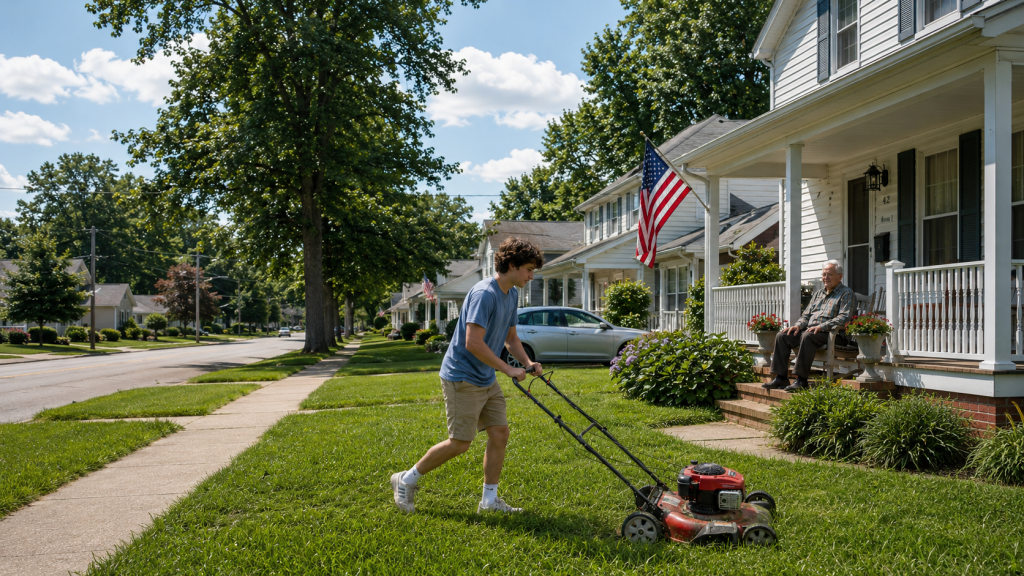
Noah was mowing Mr. Vance’s front lawn.
The grass was badly overgrown.
It had probably not been cut for nearly a month.
I watched him make slow lines from one side of the yard to the other.
Mr. Vance appeared on the porch.
He was thinner than I remembered.
He leaned heavily against the railing and stared at Noah.
For a moment, I expected him to tell my son to stop.
Instead, he lowered himself into an old metal chair.
He sat there quietly watching.
When Noah finished, he pushed the mower toward the sidewalk.
Mr. Vance raised his hand.
Noah stopped.
They spoke briefly.
When my son returned home, he was sweaty and covered in grass clippings.
“What was that about?” I asked.
Noah grabbed a bottle of water from the refrigerator.
“Mr. Vance’s lawn.”
“I noticed.”
He opened the bottle.
“I saw him trying to push his mower yesterday.”
“What happened?”
“He only made it halfway down the driveway before he had to sit down.”
Noah took a drink.
“So I did it.”
“Did he ask you?”
“No.”
“Did you ask him?”
“No.”
I laughed.
“So you just marched across the street and started mowing?”
“Pretty much.”
“What did he say?”
Noah looked thoughtful.
“He asked how much I wanted.”
“And?”
“I told him nothing.”
I leaned against the kitchen counter.
“Nothing?”
“He didn’t ask to get old.”
There was something so simple about the way Noah said it that I did not know how to respond.
That afternoon, I walked across the street.
Mr. Vance was on his porch.
I wanted to make sure Noah had not overstepped.
“Mr. Vance?”
He looked up.
“Afternoon.”
“I hope Noah didn’t bother you this morning.”
His expression changed slightly.
“He told you?”
“I heard the mower.”
For several seconds, he said nothing.
Then he looked toward his newly cut lawn.
“Your boy refused twenty dollars.”
“That sounds like Noah.”
“I told him work deserves payment.”
“He probably told you he wasn’t working.”
Mr. Vance looked almost amused.
“He did.”
I smiled.
“If he becomes annoying, send him home.”
The old man shook his head.
“He wasn’t annoying.”
Then, after a pause, he added quietly, “Tell him thank you.”
I did.
The following Saturday, Noah crossed the street again.
And the Saturday after that.
At first, I assumed it was temporary.
Maybe Mr. Vance would hire someone.
Maybe his health would improve.
Maybe one of his children would start handling the lawn.
But none of that happened.
Every Saturday morning around nine, Noah pushed our mower across the street.
During the summer, he mowed.
In autumn, he raked leaves.
During winter, whenever snow fell, Noah shoveled Mr. Vance’s walkway before doing ours.
When spring came, he cleared sticks from the yard.
Mr. Vance never became particularly talkative.
But he began waiting for Noah.
Every Saturday, the old metal chair appeared in the same place on the porch.
Mr. Vance would sit there with a cup of coffee and watch my son work.
Their conversations were usually short.
“How’s school?”
“Fine.”
“Baseball?”
“Practice Tuesday.”
“Your mother working today?”
“Yeah.”
Sometimes the exchange was barely more than a few sentences.
Yet something gradually changed between them.
One Saturday, Noah came home carrying an old wooden toolbox.
I stared at it.
“What is that?”
“Mr. Vance gave it to me.”
“Why?”
Noah set it on the kitchen table.
“He said every young man should know how to fix something without watching a video first.”
Inside were old hand tools: screwdrivers, pliers, a hammer, two wrenches, and a folding ruler.
The wooden box was scratched and stained from decades of use.
On the lid, someone had burned the letters H.V.
“Did you try to refuse it?” I asked.
“Three times.”
“And?”
“He told me refusing four times would be disrespectful.”
I laughed.
“That sounds like him.”
After that, Saturdays sometimes extended beyond lawn work.
Mr. Vance showed Noah how to sharpen mower blades.
He taught him how to replace a leaking faucet washer.
He explained why old hardwood furniture should never be sanded carelessly.
He taught him how to check oil properly and how to jump-start a car.
Noah absorbed everything.
I began seeing a side of Mr. Vance I had never known existed.
He had spent more than thirty years working as a machinist before retiring.
He had served in the Army when he was young.
He loved baseball.
He hated television news.
He could identify almost every classic car by engine sound.
Most importantly, he missed Margaret terribly.
The first time he mentioned her to Noah, my son came home unusually quiet.
“What happened?” I asked.
He hesitated.
“Mr. Vance showed me his wife’s garden.”
The garden was mostly weeds by then.
“He said she used to spend hours out there.”
Noah looked toward the window.
“He said after she died, he couldn’t touch it.”
“Why?”
“He said changing anything felt like admitting she wasn’t coming back.”
I felt a lump in my throat.
The following spring, without telling Mr. Vance beforehand, Noah bought two small rose bushes with money he had saved from working at a grocery store.
He planted them near the old garden.
When Mr. Vance saw them, he became angry.
At least that was what Noah thought.
The old man stared at the roses for almost a minute.
Then he went inside without saying anything.
Noah came home looking devastated.
“I messed up.”
“You were trying to do something kind.”
“I should have asked.”
An hour later, there was a knock at our door.
Mr. Vance stood outside.
He looked uncomfortable.
“Is Noah home?”
My son appeared behind me.
Mr. Vance looked directly at him.
“Those roses.”
Noah immediately said, “I’m sorry.”
Mr. Vance shook his head.
“No.”
His voice cracked.
He cleared his throat.
“Margaret liked red ones.”
Noah had planted red roses.
The old man looked away.
“How did you know?”
“I remembered the pictures in your hallway.”
Mr. Vance stared at him.
Then something happened I had never seen before.
He placed one hand on Noah’s shoulder.
“Thank you.”
He turned and walked home.
That evening, the porch light across the street stayed on until nearly midnight.
Years passed quietly like that.
Noah grew taller.
His voice deepened.
He learned to drive.
The child pushing a mower across the street became a young man.
Mr. Vance grew slower.
By the time Noah was sixteen, the old man needed a cane.
By seventeen, he rarely left the porch.
I worried about him.
“Do his children visit?” I asked Noah once.
“Sometimes.”
I had seen them occasionally.
His son, Robert, lived several hours away and worked in commercial construction.
His daughter, Diane, lived in another state.
They visited on holidays and sometimes during the summer.
From what I could tell, they loved their father.
They simply had lives far away.
Mr. Vance never criticized them.
Whenever Noah asked, he defended them.
“My kids have their own families. That’s how it should be.”
Still, loneliness does not disappear simply because you understand the reason for it.
One Saturday during Noah’s junior year, Mr. Vance was not sitting outside when Noah arrived.
My son knocked on the door.
No answer.
He tried again.
Still nothing.
Noah came running back across the street.
“Mom, something’s wrong.”
We called Mr. Vance’s son and then emergency services.
Paramedics found him on the bedroom floor.
He had fallen during the night and could not get up.
He had been lying there for almost ten hours.
The doctors said Noah may have saved his life simply by noticing that the porch chair was empty.
Mr. Vance spent more than a week in the hospital.
When he returned home, Robert stayed with him for several days.
I finally met Robert properly.
He was probably in his early fifties, with his father’s serious expression.
One afternoon, he knocked on our door.
“You’re Noah’s mother?”
“Yes.”
He held out his hand.
“I’m Robert Vance.”
“Nice to meet you.”
He glanced toward our driveway where Noah was washing my car.
“My dad told me what your son did.”
“He only checked on him.”
“He checked because he noticed.”
Robert’s voice became quieter.
“That matters.”
Then he looked directly at me.
“My father isn’t easy.”
I smiled gently.
“I’ve noticed.”
Robert almost laughed.
“He’s always been stubborn. My sister and I have tried to convince him to move closer to one of us.”
“He refuses?”
“Every time.”
Robert shook his head.
“He says leaving that house would feel like leaving Mom.”
I understood.
“Maybe he isn’t ready.”
“He’ll never be ready.”
Robert looked across the street.
“I worry about him constantly.”
Then he said something I would remember later.
“I’m glad your boy is nearby.”
Noah never treated Mr. Vance like an obligation.
Even after he got his first part-time job, he arranged his schedule around Saturday mornings.
When baseball practice changed, he mowed earlier.
When he started dating a girl named Emily, she learned quickly that Saturdays before noon belonged to Mr. Vance.
Once, Emily jokingly asked, “Who is more important, me or the lawn?”
Noah answered without hesitation.
“The lawn.”
She laughed so hard she nearly dropped her phone.
Eventually, even she started helping.
One autumn morning, I looked outside and saw Noah and Emily raking leaves while Mr. Vance sat on the porch supervising like a foreman.
For the first time in years, I heard him laugh loudly enough to carry across the street.
That sound stayed with me.
The summer before Noah’s senior year, Mr. Vance gave him driving lessons in his old truck.
The truck was a dark blue Ford that had probably been old before Noah was born.
It rattled.
The paint had faded.
The driver’s seat had a tear repaired with duct tape.
Noah loved it.
Mr. Vance loved complaining about modern vehicles.
“Too many computers,” he said.
Noah grinned.
“You realize your phone has more technology than most cars did when this truck was built?”
“That’s why I barely use the phone.”
One afternoon, they spent nearly five hours replacing a worn belt under the hood.
Noah came home covered in grease.
“You own clean clothes,” I reminded him.
“But then how would people know I worked on a truck?”
I rolled my eyes.
I was happy.
More than that, I was grateful.
I realized that while Noah had been helping an elderly neighbor, Mr. Vance had quietly been giving my son something too.
A man to learn from.
A man to argue with.
A man who expected him to show up.
A man who noticed when Noah made mistakes and corrected him without humiliation.
A man who sometimes said, “Good job,” in a way that made my son stand slightly taller.
I could never give Noah a father.
But life had unexpectedly placed an old widower across the street who became something close to a grandfather.
Neither of them ever called it that.
They did not need to.
Then, shortly after Noah’s eighteenth birthday, Mr. Vance’s health began declining rapidly.
He stopped sitting on the porch.
Noah still went every Saturday.
Sometimes he mowed.
Sometimes he simply sat inside with him.
I usually sent soup, casseroles, or sandwiches across the street.
One evening, Noah returned home carrying an unopened container.
“He didn’t eat.”
I looked at him.
“Is he sick?”
“He says he isn’t hungry.”
A week later, Mr. Vance was hospitalized again.
This time, the doctors found advanced heart failure.
Robert and Diane came immediately.
For nearly two weeks, family members rotated between the hospital and Mr. Vance’s house.
Noah visited twice.
The second visit lasted less than twenty minutes.
When he returned home, he went straight to his room.
I gave him some time before knocking.
“Can I come in?”
“Yeah.”
He was sitting on the edge of his bed.
I sat beside him.
“He looks really bad, Mom.”
I put my arm around him.
“Did the doctors say anything?”
“Robert said they’re trying medication.”
Noah stared at the floor.
“He asked me if I had changed the mower oil.”
I smiled sadly.
“That sounds like him.”
“I told him yes.”
“Did you?”
“No.”
Despite everything, I laughed.
Noah laughed too.
Then his face crumpled.
“I’m going to miss him.”
That was when I realized my son already knew.
Mr. Vance came home one final time.
Hospice nurses began visiting.
A hospital bed was placed in his downstairs bedroom.
Robert stayed almost constantly.
Diane came whenever she could.
Noah continued walking across the street every Saturday.
On one of those final mornings, Robert met him at the door.
“Dad’s sleeping.”
“I can come back.”
Robert shook his head.
“He wanted you to go ahead and mow.”
So Noah did.
The lawn did not really need cutting.
It had barely grown.
But Noah started the mower anyway.
He made every line carefully.
When he finished, Robert was standing on the porch.
“My father can hear it from his room,” he said.
Noah wiped his face with his sleeve.
“Is it bothering him?”
Robert smiled.
“No.”
His eyes filled with tears.
“He asked me to open the window.”
That was the last lawn Mr. Vance ever heard Noah mow.
He died eight days later.
The call came early Monday morning.
Robert called Noah directly.
I heard my son answer from the hallway.
He did not say much.
“All right.”
Pause.
“Yes, sir.”
Another pause.
“I understand.”
Then he hung up.
He stood there holding the phone.
“Mr. Vance died.”
I hugged him.
Noah did not cry immediately.
He simply stood very still.
Later that afternoon, I found him in our garage cleaning the old wooden toolbox Mr. Vance had given him years earlier.
He wiped each tool carefully.
That was how Noah grieved.
Quietly.
The funeral was scheduled for Saturday.
Of course it was.
When Noah realized the date, he stared at the obituary for several seconds.
“Saturday.”
I nodded.
“There’s something fitting about that.”
He wore the only dark suit he owned.
It had been bought for a school event the year before, and the sleeves were slightly too short now because he had grown.
I wanted to buy another one.
He refused.
“Mr. Vance wouldn’t care.”
He was right.
The chapel was nearly full when we arrived.
Noah immediately slowed.
There were relatives everywhere.
Children.
Grandchildren.
Former coworkers.
Old neighbors.
Men who had served with Mr. Vance decades earlier.
I realized then how little we had known about the full scope of his life.
Robert saw us near the entrance.
He walked over and hugged Noah.
Not a polite handshake.
A hug.
“Thank you for coming.”
Noah seemed surprised.
“Of course.”
Diane joined us.
She was crying.
“You must be Noah.”
“Yes, ma’am.”
“My dad talked about you.”
Noah looked down.
“I’m sorry.”
Diane hugged him too.
“You made him less lonely.”
That sentence almost broke my son.
He blinked hard.
“We’re going to sit in the back.”
“You can sit with us,” Diane offered.
Noah shook his head.
“No. Family should be up front.”
Diane gave him a strange look.
But she did not argue.
So we sat in the final row near the exit.
The service was beautiful.
Mr. Vance’s grandchildren spoke about fishing trips.
Robert talked about his father teaching him to build things.
Diane described the marriage between Harold and Margaret.
Then the pastor opened a small notebook.
“Harold left a few written remarks he wanted shared.”
People smiled through tears.
The pastor adjusted his glasses.
“One sentence concerns Saturdays.”
Noah looked up.
The pastor read:
“Some of the finest acts of kindness enter your life quietly, make very little noise, and never ask to be remembered.”
I felt Noah’s hand tighten around the funeral program.
The pastor continued with other remarks.
Noah never looked up again.
When the service ended, people slowly began filing into the aisle.
I was gathering my purse when I noticed a man in a charcoal suit walking from the front of the chapel.
He appeared to be in his sixties.
He carried a leather briefcase.
He passed Robert.
Passed Diane.
Passed the pastor.
Then he stopped directly in front of Noah.
“Are you Noah Bennett?”
My son stood.
“Yes, sir.”
“My name is Samuel Pierce. I represented Harold Vance for many years.”
Noah glanced toward me.
The attorney opened his briefcase and removed a thick sealed envelope.
“He left very specific instructions for you.”
Noah stared at it.
“I don’t understand.”
“You will.”
Mr. Pierce held the envelope out.
“Mr. Vance instructed me to place this directly into your hands after his funeral service. Not before.”
Noah slowly took it.
“Thank you.”
The lawyer nodded.
“There will be a reading of certain estate documents tomorrow afternoon. Your presence has been requested.”
Now I stood.
“Estate documents?”
Mr. Pierce looked at me.
“You’re Noah’s mother?”
“Yes.”
“You may attend with him.”
I was completely confused.
“We aren’t family.”
The lawyer’s expression softened.
“I believe Mr. Vance would have disagreed with that statement.”
Before I could respond, Robert approached.
“I wondered when Dad was going to spring this on you.”
Noah looked alarmed.
“You knew?”
Robert shook his head.
“Not exactly. Dad loved secrets when he thought they were funny.”
Diane joined us.
“What did he leave?”
The lawyer answered gently.
“That will be discussed tomorrow.”
Noah looked uncomfortable.
“I don’t want anything.”
Robert immediately said, “I’m sure Dad expected you to say that.”
The lawyer almost smiled.
“He did.”
That evening, Noah left the envelope unopened on our kitchen table for nearly an hour.
He walked past it several times.
Finally, I said, “Are you planning to stare at it until tomorrow?”
“I don’t know what’s inside.”
“That is usually why people open envelopes.”
He gave me a look.
“You know what I mean.”
I sat across from him.
“Whatever is inside doesn’t change why you helped him.”
“I know.”
“And accepting something he wanted you to have doesn’t make the kindness less real.”
Noah nodded.
Then he broke the seal.
Inside was a handwritten letter.
Several folded pages.
The handwriting was shaky.
Noah recognized it immediately.
He began reading aloud.
“Dear Noah.”
His voice stopped.
“Do you want me to read it?”
“No.”
He swallowed.
“I’ve got it.”
He started again.
“Dear Noah, if Pierce followed instructions, you are reading this after my funeral, which means I finally found a way to make you sit still long enough to listen without arguing.”
Noah laughed unexpectedly.
I smiled.
“That sounds exactly like him.”
He continued.
“You spent four years mowing my lawn and refusing every dollar I offered you. You said neighbors should help neighbors. I never told you this because you would have become embarrassed and probably stopped coming, but those Saturdays became the part of the week I looked forward to most.”
Noah’s voice became softer.
“After Margaret died, I stopped caring very much about what happened tomorrow. I woke up because morning came, not because I wanted it to. People were kind for a while, but grief makes others uncomfortable. Eventually, everyone returned to their lives. That is understandable. Then one Saturday, a skinny fourteen-year-old boy pushed a lawn mower across my driveway without asking permission and ruined my plan to be miserable in peace.”
I covered my mouth.
Noah laughed through tears.
The letter continued.
“You thought you were cutting grass. You were giving an old man a reason to put coffee on Saturday morning.”
Noah stopped again.
His eyes were wet.
He stared at the paper before continuing.
“You asked me questions without treating me like I was fragile. You let me teach you things. You brought back roses to Margaret’s garden. You checked on me when I fell. You sat beside me when I became too weak to sit outside. And you never once made me feel like charity.”
Noah whispered the next sentence.
“You made me feel useful.”
Silence filled the kitchen.
He continued.
“I have two wonderful children. Do not misunderstand that. Robert and Diane loved me well. They called. They visited. They tried repeatedly to convince their stubborn father to move closer. I refused because this house was the last place where I still felt Margaret beside me.”
“I know my children sometimes blamed themselves for leaving me alone. They shouldn’t. A parent raises children to build their own lives, not to remain chained to his front porch.”
“But you were already across the street.”
“You came because you wanted to.”
“And there is a difference.”
Noah wiped his face.
The final section read:
“I am leaving you several things. You will probably try to refuse them. Don’t. I am dead, and arguing with me now would be ridiculous.”
Noah actually laughed.
I laughed too.
“You earned none of these things by mowing my lawn. That is important. They are not wages. They are gifts from an old man who had more gratitude than he knew how to say while he was alive.”
“Use them wisely.”
“And when you see somebody sitting alone while the rest of the world walks past, notice them.”
“That may be the most important thing you ever do.”
“Your friend, Harold Vance.”
Noah lowered the letter.
For several minutes, neither of us spoke.
Then Noah whispered, “He called me his friend.”
I reached across the table and held his hand.
“You were.”
The following afternoon, we drove to Mr. Pierce’s office.
Robert and Diane were already there.
So were Robert’s wife and Diane’s husband.
I immediately felt awkward.
“This feels private,” I whispered to Noah.
Diane heard me.
“No.”
She pulled out a chair.
“Dad wanted you here.”
Mr. Pierce entered carrying several folders.
He began by explaining that Mr. Vance’s estate was straightforward.
The house would be sold.
Most financial assets would be divided equally between Robert and Diane.
Personal family items had been assigned according to written instructions.
Then he turned toward Noah.
“There are three specific bequests to you.”
My son immediately stiffened.
Mr. Pierce opened a document.
“First, Mr. Vance left you his 1992 Ford pickup truck.”
Noah stared.
“The blue truck?”
Robert smiled.
“The blue truck.”
“That thing barely runs.”
Robert laughed.
“Dad would haunt you for saying that.”
Mr. Pierce continued.
“Second, you are to receive all tools and woodworking equipment currently located in the detached garage workshop.”
Noah looked overwhelmed.
The garage was filled with decades of tools.
Some were old.
Some were expensive.
Every one of them meant something to Mr. Vance.
“I can’t take all that.”
Diane spoke firmly.
“Yes, you can.”
“But those belonged to your dad.”
“Exactly.”
She smiled sadly.
“He wanted someone to use them.”
Mr. Pierce raised a hand.
“There is a third item.”
The room became quiet.
He slid a document across the table.
“Mr. Vance established an educational trust in your name.”
Noah looked at him blankly.
“A what?”
“An educational trust.”
“How much?”
The lawyer paused.
“One hundred twenty-five thousand dollars.”
I genuinely thought I had misheard him.
“I’m sorry?”
“One hundred twenty-five thousand dollars.”
Noah pushed back from the table.
“No.”
Everyone looked at him.
“No, I can’t take that.”
Mr. Pierce remained calm.
“You can.”
“No.”
Noah looked at Robert and Diane.
“That money belongs to you.”
Robert shook his head.
“Our father’s money belonged to our father.”
“But—”
Diane interrupted.
“Do you think we didn’t know?”
Noah fell silent.
She leaned forward.
“Dad told us months ago that he wanted to help you with college.”
“Why didn’t you stop him?”
Her eyebrows lifted.
“Have you ever successfully stopped my father from doing anything?”
That made everyone laugh.
Even Noah.
Robert added, “We’re okay, Noah.”
“My sister and I have careers. Homes. Retirement accounts. Dad took care of us throughout his life.”
He pointed toward the document.
“This was his choice.”
Noah looked toward the lawyer.
“Can I give it back?”
Mr. Pierce smiled slightly.
“Mr. Vance anticipated that question.”
Of course he had.
“What did he say?”
The lawyer opened another page.
“He wrote, and I quote, ‘If the boy refuses, inform him that I will consider it a personal insult, and because I am deceased he will have no opportunity to apologize.’”
The room erupted in laughter.
Noah covered his face.
“That man was impossible.”
Robert nodded.
“Now you understand our childhood.”
The educational trust covered tuition, books, and approved living expenses.
Any unused amount remaining when Noah turned thirty could be transferred to him directly.
It was more money than I had ever imagined being available for his education.
For years, I had worried about college.
Noah had been accepted to a state university and planned to study mechanical engineering.
He had earned some scholarships.
He intended to work part-time.
I had quietly considered taking a loan against our house if necessary.
Now an old man across the street had changed everything.
But the money was not the most important inheritance.
The next weekend, Noah walked across the street.
Mr. Vance’s house was empty.
Robert and Diane had already begun sorting belongings.
The porch chair remained in its usual place.
Noah sat down.
I watched from our window.
He remained there almost an hour.
Then he stood, walked to the garage, and returned pushing the mower.
The lawn barely needed cutting.
He started anyway.
Straight lines.
Back and forth.
Exactly the way he had done every Saturday for four years.
When he finished, he sat in Mr. Vance’s chair.
That evening, he told me something I will never forget.
“I thought I was helping him.”
“You were.”
He shook his head.
“Not the way I thought.”
“What do you mean?”
“He was helping me too.”
I waited.
“Dad left before I was born.”
I rarely heard Noah mention his father.
“He never taught me anything.”
My chest tightened.
“Noah—”
“I’m not mad.”
He looked toward Mr. Vance’s house.
“At least not anymore.”
Then he said, “Mr. Vance taught me how to fix a faucet. How to change oil. How to build a shelf that doesn’t lean. How to sharpen a blade. How to lose without acting like an idiot when we played cards.”
I smiled.
“He taught me that sometimes old people say the same story six times because they like remembering who they used to be.”
I laughed softly.
“He taught me that too.”
Noah became serious again.
“I thought I was giving him Saturdays.”
He looked at me.
“But he gave me four years.”
A month after the funeral, Mr. Vance’s house was listed for sale.
Noah hated seeing the sign in the yard.
“I knew it was coming,” he said.
The roses beside Margaret’s old garden were blooming.
Before the house sold, Diane asked Noah to come over.
She handed him a small box.
Inside was an old wristwatch.
Noah recognized it.
Mr. Vance had worn it almost every day.
“This wasn’t listed in Dad’s estate instructions,” Diane explained.
“Then you should keep it.”
“I have Mom’s necklace.”
She closed Noah’s fingers around the watch.
“My brother has Dad’s Army watch.”
She smiled.
“This one should be yours.”
Noah shook his head.
“Diane—”
“My father once told me that family is partly who you’re born with and partly who keeps showing up.”
Her voice trembled.
“You kept showing up.”
Noah accepted the watch.
He still wears it.
A young couple eventually bought the house.
Their names were Michael and Lauren.
They had two small children.
The first Saturday after they moved in, Noah stood in our driveway watching Michael unload a brand-new lawn mower from his truck.
“I guess I’m retired,” he said.
I smiled.
“You had a good run.”
He looked toward the porch.
The old metal chair was gone.
But the roses remained.
Michael noticed him staring.
“You’re Noah, right?”
“Yeah.”
“Robert told me about you.”
Noah looked embarrassed.
“I just helped with the yard.”
Michael nodded toward the flower bed.
“He asked us to keep the roses.”
Noah smiled.
“Good.”
Michael hesitated.
“There’s something else.”
He walked into the garage and returned with a small wooden plaque.
It had apparently been mounted inside Mr. Vance’s workshop.
Noah had never seen it.
Carved into the wood were the words:
LEAVE THINGS BETTER THAN YOU FOUND THEM.
Michael handed it to Noah.
“Robert said this belonged to you.”
Today, that plaque hangs above Noah’s desk.
The money from Mr. Vance changed Noah’s opportunities.
But it did not change Noah.
That was what impressed me most.
He still worked during college.
He still drove the old blue Ford truck, even though maintaining it became almost a hobby.
He repaired the rust himself.
Replaced the seat.
Rebuilt part of the engine.
The truck still rattled.
Noah refused to replace it.
“Mr. Vance said a strange noise is only a problem when you don’t know what causes it.”
I told him that sounded dangerous.
He told me I worried too much.
Some things never change.
During his first year at university, Noah joined a volunteer program that repaired homes for elderly and disabled residents.
At first, he went once a month.
Then twice.
Soon, he became one of the student coordinators.
One Saturday afternoon, he called me.
“Guess what I did today?”
“Mowed somebody’s lawn?”
He laughed.
“No.”
“What?”
“Fixed an eighty-two-year-old woman’s porch railing.”
“Did she pay you?”
“No.”
“Mr. Vance would approve.”
There was a pause.
“That’s what I thought.”
Two years later, Noah came home from college during spring break.
The roses across the street were blooming again.
He walked over and asked Michael and Lauren whether he could trim them.
They happily agreed.
Their little daughter followed Noah around carrying a tiny plastic watering can.
I watched from my porch.
The scene felt almost impossible.
Years earlier, Noah had been the child crossing the street.
Now another child followed him.
He showed her where to water.
“Not too much,” he said.
“Why?”
“Plants need help, but too much help can hurt them too.”
The little girl nodded solemnly as if he had given her the most important lesson in the world.
Maybe, in a way, he had.
When Noah graduated from university, he wore Mr. Vance’s watch beneath his gown.
Robert and Diane attended the ceremony.
I did not know they were coming.
Noah had invited them months earlier.
When he saw them afterward, he hugged them both.
Robert looked at his diploma.
“Mechanical engineering.”
Noah nodded.
Robert smiled.
“My father would have bragged about this to every person he met.”
Noah laughed.
“He would have complained about tuition first.”
“Absolutely.”
Diane wiped tears from her eyes.
“He would have been proud.”
Noah looked down at the watch.
“I hope so.”
I touched his shoulder.
“He was proud before you ever went to college.”
Later that day, we gathered for dinner.
At one point, Robert pulled me aside.
“There’s something I’ve wanted to tell you.”
“What?”
“The last real conversation I had with my father was about Noah.”
My throat tightened.
“What did he say?”
Robert looked across the restaurant.
Noah was laughing with Diane’s family.
“Dad told me he used to worry that no one would notice when he was gone.”
I blinked back tears.
“Then he said Noah proved him wrong.”
I could not speak.
Robert continued.
“He said, ‘That boy remembered me while I was still alive. That matters more.’”
That sentence changed how I think about kindness.
We often wait until funerals to describe what people meant to us.
We bring flowers after someone can no longer smell them.
We write beautiful messages they can no longer read.
We gather in rooms and tell stories they can no longer hear.
Noah did something different.
He gave Mr. Vance his flowers while the man was alive.
Not literal flowers, although there were roses.
He gave him time.
Presence.
Consistency.
Saturday mornings.
He gave him the simple knowledge that someone would notice whether the porch chair was occupied.
And that mattered more than any grand gesture.
Years have passed now.
Noah is twenty-six.
He works for an engineering company.
He owns a small house about forty minutes from me.
The blue Ford truck is still in his garage.
It does not run every day anymore, but he refuses to sell it.
He says he will restore it properly someday.
Mr. Vance’s wooden toolbox sits on a shelf beside his workbench.
The tools are still used.
The wristwatch still works.
And every spring, Noah drives back to our old neighborhood to check the roses.
Michael and Lauren still live across the street.
Their children are older.
The little girl with the watering can is now nearly a teenager.
Sometimes she helps Noah trim the roses.
A few months ago, I sat with Noah on my porch.
We were drinking coffee.
The house across the street looked different now.
New paint.
New windows.
Different porch furniture.
But the roses remained exactly where Noah had planted them.
I asked him something I had wondered about for years.
“If you could go back to that first Saturday, knowing everything that would happen, would you do anything differently?”
Noah thought for a moment.
Then he smiled.
“I’d start earlier.”
I laughed.
“I mean it,” he said.
“I know.”
He looked across the street.
“I wasted a couple years just waving at him.”
“You were twelve.”
“Still.”
We sat quietly.
Then Noah said, “You know what bothers me?”
“What?”
“There are probably people like him everywhere.”
I nodded.
“People sitting alone while everyone assumes somebody else is checking on them.”
“That’s true.”
He stared into his coffee.
“I think about that sometimes.”
So do I.
Because loneliness does not always look dramatic.
Sometimes it looks like curtains staying closed.
A lawn growing too tall.
A porch chair occupied by one person every afternoon.
A grocery cart containing food for one.
A television playing inside an otherwise silent house.
And kindness does not always look dramatic either.
Sometimes kindness sounds like a lawn mower starting on Saturday morning.
Sometimes it looks like a teenager pushing a machine across the street.
Sometimes it is twenty minutes of conversation with an elderly man who has already told you the same story twice.
Sometimes it is remembering that someone likes red roses.
People heard about Mr. Vance’s gift and told Noah he was lucky.
And he was.
One hundred twenty-five thousand dollars changed his future.
But whenever anyone describes the inheritance as a reward for mowing the lawn, Noah corrects them.
“It wasn’t payment.”
He is very clear about that.
“If it had been payment, I wouldn’t want it.”
Mr. Vance understood that too.
That is why his letter specifically said the inheritance was not wages.
It was gratitude.
There is a difference.
Payment settles a debt.
Gratitude acknowledges a connection.
Mr. Vance owed Noah nothing.
Noah owed Mr. Vance nothing.
And perhaps that was precisely why their friendship meant so much.
Neither was there because he had to be.
They chose each other.
People sometimes ask whether Mr. Vance’s children were angry about the money.
They were not.
That surprised some people.
But Robert and Diane understood their father better than strangers did.
They knew exactly why Noah mattered to him.
In fact, Diane later told me that the educational trust had originally been smaller.
Mr. Vance had planned to leave Noah twenty-five thousand dollars.
Then Noah found him after the fall.
Mr. Vance increased it.
Later, after Noah planted Margaret’s roses and continued visiting even when Mr. Vance could no longer sit outside, he increased it again.
“He kept changing the paperwork,” Diane said.
“Mr. Pierce complained Dad was going to put him through law school a second time.”
I laughed.
“Why didn’t anyone tell Noah?”
“Because Dad threatened us.”
“Threatened you?”
“In the most Harold way possible.”
She imitated her father’s gruff voice.
“‘If that boy finds out, he’ll start acting weird around me.’”
She laughed.
“He wanted Noah’s Saturdays to stay exactly what they were.”
That makes sense to me now.
If Noah had known about the money, every visit afterward would have felt different.
Every lawn mowing would have carried a shadow.
Mr. Vance protected the purity of the friendship by keeping the gift secret.
The sealed envelope at the funeral was not the beginning of the story.
It was the final proof of something that had been happening quietly for four years.
My son thought he had been giving away his Saturday mornings.
Mr. Vance thought he had been receiving them.
The truth is, they had been trading something far more valuable.
Mr. Vance gave Noah the guidance of an older man at a time when my son had no father.
Noah gave Mr. Vance companionship at a time when the old man had lost the person who had shared almost his entire adult life.
One needed someone to learn from.
The other needed someone who still believed he had something worth teaching.
And they found each other across a quiet residential street.
I used to think raising a child meant teaching them everything important.
Now I know children sometimes teach us the lessons we need most.
Noah taught me that kindness does not need permission.
He did not form a committee before mowing Mr. Vance’s lawn.
He did not post about it online.
He did not take photographs.
He did not tell classmates what he was doing.
He did not keep score.
He saw someone struggling.
Then he helped.
And after helping once, he came back.
That last part matters.
A single act of kindness is wonderful.
Consistency can change someone’s life.
Mr. Vance did not remember Noah because of one freshly cut lawn.
He remembered four years of Saturdays.
Four years of knowing that around nine o’clock, he would hear the garage door across the street open.
Four years of seeing the same teenager pushing the same mower toward his property.
Four years of short conversations.
Four years of watching Noah become a man.
There is dignity in being remembered consistently.
The final page of Mr. Vance’s letter hangs framed in Noah’s home.
Not the part about money.
Not the part about the truck.
Just three lines:
“When you see somebody sitting alone while the rest of the world walks past, notice them.
That may be the most important thing you ever do.
Your friend, Harold Vance.”
Every time I read those words, I think of the funeral.
I think of Noah standing in the back row because he did not consider himself family.
I think of Mr. Pierce walking past everyone to reach him.
I think of the sealed envelope.
And I think Mr. Vance had one final lesson to teach my son.
Family is not always defined by blood.
Sometimes family is the person who remembers to show up.
Sometimes it is the elderly man teaching a fatherless boy how to use an old wrench.
Sometimes it is the teenage boy making sure an old widower’s lawn does not become another sign that the world has forgotten him.
Sometimes it is Saturday morning.
And sometimes the greatest inheritance someone leaves you is not money.
It is the kind of person they helped you become.
MORAL OF THE STORY
Kindness given without expecting a reward is never wasted. We may never fully understand how much a simple visit, a helping hand, or a few minutes of our time can mean to someone who feels forgotten. Noah thought he was only mowing an old man’s lawn, but in reality he was giving Mr. Vance companionship, dignity, purpose, and something to look forward to every week. In return, Mr. Vance gave Noah guidance, friendship, and lessons that money could never buy.
The most meaningful gift was not the truck, the tools, or even the college fund.
It was the reminder that sometimes changing a life begins with simply noticing the person everyone else has stopped seeing.
💬 THE END! THANK YOU FOR READING!