
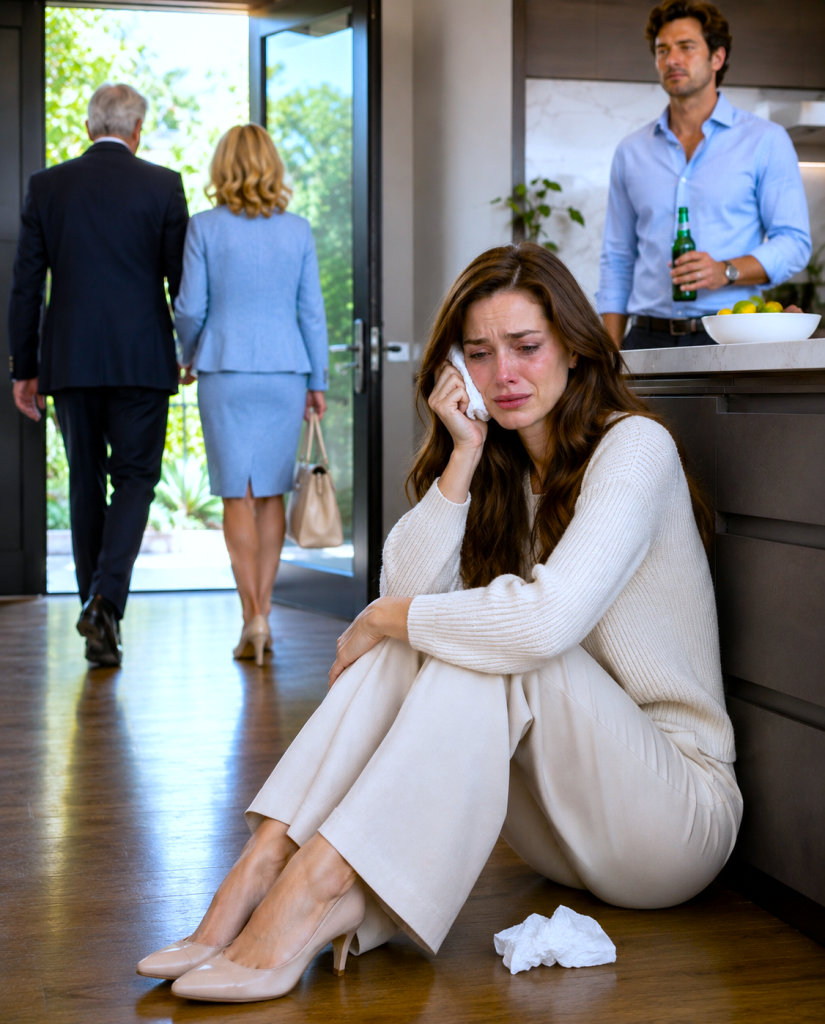
THE LOCK “Nobody leaves this house until you explain what you’re doing.”
Brandon spoke slowly, using the precise, controlled tone he always adopted seconds before losing control. Samantha held her phone firmly at eye level and kept the camera focused on him.
“We are recording everything,” she said. “And the footage is being saved remotely.”
For several seconds, Brandon stared at her.
Then he laughed.
It was not the loud, careless laugh he had used after my parents left. This one was quieter and less certain.
“You think I’m scared of a phone?”
“No,” Samantha replied. “But you should probably be concerned about what’s inside this folder.”
She lifted the thick black folder from my bed.
Brandon’s eyes moved toward it.
I saw the change immediately.
His shoulders stiffened.
The rage was still there, but now something else had entered the room.
Calculation.
For five years, I had watched him calculate everything.
How loudly he could insult me without the neighbors hearing.
How much money he could transfer before I questioned it.
How long he needed to apologize before I stopped sleeping in the spare room.
How many flowers it took to make a bruise feel like a misunderstanding.
How often he could tell me that nobody else would ever put up with me before I started believing it.
But Brandon had never calculated what would happen if I stopped protecting him.
That was what frightened him.
Not Samantha.
Not the phones.
Not the divorce papers.
The evidence.
He pointed toward the folder.
“What is that?”
I took a breath.
“My life for the last four years.”
His jaw tightened.
“Don’t be dramatic.”
There it was.
His favorite weapon.
Not his hands.
Not his shouting.
That sentence.
Don’t be dramatic.
Every insult became humor.
Every threat became frustration.
Every missing dollar became a misunderstanding.
Every bruise became an accident.
Every tear became proof that I was unstable.
But something inside me had changed.
Perhaps it had changed the moment my father saw my bruised face and decided marriage mattered more than his daughter.
Perhaps it had changed when my mother quietly placed chicken soup in my refrigerator because feeding me was easier than defending me.
Perhaps it had changed months earlier, when Samantha looked across a coffee-shop table and said, “Chloe, if you ever decide you’re ready, I will believe you the first time.”
Whatever the moment had been, the woman standing in that bedroom was no longer trying to convince Brandon of anything.
“I’m not explaining myself to you,” I said.
His smile disappeared.
He stepped closer.
Samantha immediately moved between us.
“Back up.”
Brandon looked at her as though he couldn’t believe she had spoken to him that way.
“This is my house.”
“Actually,” I said, “both our names are on the lease.”
He turned toward me.
“You think that matters?”
“It matters more than you think.”
He looked at the suitcases again.
“You’re not taking anything.”
“I’m taking my clothes, my personal documents, my laptop, and the things I owned before we married.”
“You’re taking nothing.”
Samantha spoke calmly.
“Brandon, unlock the door.”
He folded his arms.
“No.”
“Unlock it.”
“No.”
Samantha lowered her phone slightly.
“Okay.”
She touched the screen.
“What are you doing?” he asked.
“Sending the message.”
My heart started beating faster.
That message was part of the plan.
If Brandon attempted to stop us from leaving, Samantha would send a single prewritten text.
The recipient was waiting two blocks away.
Brandon didn’t know that.
For four months, we had prepared for almost every possibility.
Not because Samantha was paranoid.
Because she had volunteered at a women’s legal advocacy center during graduate school, and one of the first things she had told me was that leaving could be the most unpredictable moment.
“You don’t announce the plan,” she had said. “You prepare quietly. Documents. Money. Transportation. Somewhere safe. People who know where you are.”
At first, I had hated hearing her talk like that.
It made everything sound too serious.
I had spent years convincing myself my marriage wasn’t serious enough to require an escape plan.
Brandon had never put me in the hospital.
He had never broken a bone.
He apologized afterward.
He worked.
He sometimes cooked dinner.
He remembered our anniversary.
He bought my mother flowers every Christmas.
Surely monsters didn’t do those things.
It took me a long time to understand that I had been asking the wrong question.
I didn’t need to decide whether Brandon was a monster.
I only needed to decide whether I was safe.
I wasn’t.
Samantha placed the phone back at eye level.
“Last chance,” she said. “Unlock the door.”
Brandon looked at me.
“You called the police?”
I said nothing.
His face hardened.
“You called the cops on your own husband?”
Still, I said nothing.
Then he pointed at me.
“You’re going to regret humiliating me like this.”
The sentence hung in the room.
Samantha’s phone captured every word.
Before she could answer, there was a knock at the apartment door.
Three sharp knocks.
Brandon froze.
Then came a voice from the hallway.
“Police.”
His face changed.
It was astonishing how quickly anger became innocence.
He straightened his shoulders.
Ran one hand through his hair.
Lowered his voice.
And looked at me.
“Chloe,” he whispered, “don’t do this.”
I stared at him.
Five years earlier, that whisper would have destroyed me.
Three years earlier, I would have apologized.
A year earlier, I might have begged Samantha to leave before answering the door.
That night, I simply said:
“Unlock it.”
He didn’t move.
The officer knocked again.
“Minneapolis Police. Open the door.”
Brandon looked toward Samantha.
Then me.
Finally, he turned the lock.
And for the first time in years, the sound of a door unlocking felt like freedom.
THE OFFICERS AT THE DOOR
Two officers stood in the hallway.
Behind them was another woman.
Her name was Lena Morales.
She worked with the advocacy organization Samantha had contacted when we began preparing my exit.
Lena wasn’t a police officer.
She wasn’t my attorney.
She was simply someone who understood what frightened people often needed when they finally decided to leave.
A witness.
A calm voice.
A plan.
The older officer looked at Samantha first.
“Who called?”
“I did.”
“Is everyone safe right now?”
Before I could answer, Brandon stepped forward.
“This is ridiculous. My wife and I had an argument, and her friend is trying to turn it into something it isn’t.”
The officer held up one hand.
“I’ll speak with everyone separately.”
“There’s nothing to speak about.”
“Sir, step over here.”
“I pay rent here.”
“I understand that. Step over here, please.”
Brandon’s face flushed.
He hated being instructed.
Especially in his own home.
Especially in front of me.
But he obeyed.
The second officer came toward Samantha and me.
His eyes briefly settled on my face.
“What happened?”
My mouth opened.
Nothing came out.
It surprised me.
I had rehearsed the sentence.
Dozens of times.
Samantha and I had practiced what I would say if police ever came.
My husband struck me.
My husband prevented me from leaving.
My husband has threatened me before.
Simple sentences.
Facts.
But when the moment arrived, shame climbed into my throat.
I heard my father’s voice.
It’s between husband and wife.
I heard my mother’s silence.
I heard Brandon laughing.
Even your own parents don’t want to get involved with you.
The officer waited.
He didn’t rush me.
Lena stepped closer but didn’t touch me.
Finally, I pointed toward my face.
“My husband did this.”
The sentence was barely louder than a whisper.
But I had said it.
The officer nodded.
“When?”
“About an hour ago.”
“Was anyone else here?”
“No.”
“Did anything happen afterward?”
“He stopped me from leaving.”
“How?”
“He locked the bedroom door and said nobody was leaving.”
“Did he threaten you?”
“He said I would regret humiliating him.”
The officer glanced at Samantha.
“Do you have that recorded?”
“Yes.”
“Don’t delete anything.”
“I won’t.”
Brandon’s voice suddenly rose from the living room.
“She’s lying!”
The older officer responded firmly.
“Sir, stay where you are.”
“You need to hear my side!”
“We will.”
“You’re treating me like some criminal because she’s upset.”
I closed my eyes.
There it was again.
Upset.
Not injured.
Not frightened.
Not trapped.
Upset.
The officer beside me asked whether I wanted medical attention.
I said no.
Then I changed my mind.
“Yes.”
The word surprised even me.
I had spent years saying no to help because I thought accepting help required me to prove that I deserved it.
That night I decided being hurt was enough.
An ambulance wasn’t necessary, but the officer recommended that I have the injury documented medically.
Lena said she could take me to an urgent-care clinic after we left.
Then the officer asked about the folder.
Samantha placed it carefully on the bed.
Inside were copies.
Never originals.
That had been Lena’s advice.
Bank records.
Screenshots.
Photographs.
Threatening messages.
A timeline I had written over four months.
Dates.
Places.
What happened.
Whether anyone had witnessed the aftermath.
Whether I had sought medical treatment.
For years, I had thought keeping records was somehow dishonest.
As if love required forgetting.
As if marriage required erasing history every morning.
Brandon had counted on that.
Every argument started at zero because he insisted nothing before it mattered.
The folder proved otherwise.
The officer slowly flipped through several pages.
His expression became more serious.
“How long has this been happening?”
I looked down.
“Years.”
Brandon shouted from the other room.
“Oh, come on!”
The older officer ordered him to remain quiet.
Then came the moment I had dreaded most.
The officer asked:
“Do you want to leave tonight?”
I looked at Samantha.
She didn’t answer for me.
Lena didn’t answer for me.
Nobody told me what a good wife should do.
Nobody told me to think about appearances.
Nobody told me marriage was difficult.
Nobody told me to forgive him because he was stressed.
They waited for my decision.
“Yes,” I said.
The officer nodded.
“Then let’s make sure you leave safely.”
WALKING OUT
I had imagined leaving Brandon many times.
In some versions, I screamed everything I had held inside.
In others, I threw my wedding ring at him.
Sometimes he cried and begged.
Sometimes my parents arrived and finally defended me.
Sometimes the neighbors came into the hallway and saw who he really was.
Reality was quieter.
Samantha carried one suitcase.
I carried the other.
Lena took the backpack containing my documents.
The officers remained inside while we moved my belongings.
Brandon stood near the kitchen.
He didn’t apologize.
Not then.
He watched me with an expression I knew well.
Cold.
Controlled.
Calculating.
When I reached the doorway, he finally spoke.
“You walk out that door and we are finished.”
I stopped.
For five years, that threat had kept me inside.
Finished.
The word had terrified me.
I had built my adult life around a marriage.
We shared bills.
Furniture.
Friends.
Holiday traditions.
A Netflix account.
A favorite Thai restaurant.
We knew each other’s coffee orders.
His mother called me on my birthday.
My cousins called him family.
Ending a marriage didn’t feel like ending one relationship.
It felt like tearing apart an entire structure.
But as I stood in that doorway, I understood something.
We had already been finished.
I had simply been the last person willing to admit it.
I turned toward him.
“Yes,” I said.
His eyebrows moved slightly.
I don’t think he expected agreement.
“Yes, Brandon. We are.”
Then I walked out.
The hallway seemed brighter than usual.
The elevator arrived almost immediately.
When the doors closed, I saw Samantha watching me.
“What?”
“You’re breathing.”
I hadn’t noticed I was holding my breath.
I inhaled.
Slowly.
Then again.
When the elevator reached the lobby, my knees started shaking.
By the time we reached Samantha’s car, I could barely stand.
She opened the passenger door.
I sat down.
And then, for the first time that evening, I cried.
Not because I missed him.
Not because I regretted leaving.
I cried because I had spent years believing courage would feel powerful.
It didn’t.
It felt terrifying.
It felt like shaking hands and swollen eyes and a suitcase thrown into the back seat.
It felt like not knowing what tomorrow looked like.
It felt like understanding that the life you were returning to no longer existed.
Samantha sat beside me.
She didn’t tell me everything would be fine.
She didn’t promise it would be easy.
She simply said:
“You did it.”
I wiped my face.
“No. We did.”
She shook her head.
“I helped. You did it.”
That distinction mattered.
It would take me months to understand how much.
THE APARTMENT THAT BRANDON DIDN’T KNOW ABOUT
The apartment Samantha had rented for me was actually a small furnished studio in a building owned by one of her aunt’s longtime friends.
Nothing luxurious.
One bedroom.
A narrow kitchen.
A beige couch.
A small dining table beneath a window overlooking a parking lot.
But Brandon didn’t know the address.
That made it beautiful.
When Samantha opened the door, I stood in the entrance for nearly a minute.
“This is mine?”
“For the next three months,” she said. “After that, we figure things out.”
I walked inside.
On the kitchen counter was a small box containing toiletries.
Toothpaste.
Soap.
A toothbrush.
Shampoo.
Beside it was a handwritten note from Samantha.
WELCOME HOME, EVEN IF IT’S TEMPORARY.
I started crying again.
Samantha laughed gently.
“You’re going to dehydrate at this rate.”
I laughed too.
It was the first time I had laughed without immediately checking Brandon’s face to see whether I was laughing too loudly.
We went to urgent care.
A doctor documented the bruise and the cut on my lip.
I gave permission for photographs.
The doctor asked whether I felt safe going home.
I said:
“I’m not going home.”
The sentence hurt.
But it also felt true.
Afterward, Samantha drove me back to the studio.
At 1:17 in the morning, my phone began vibrating.
Brandon.
I ignored it.
Another call.
Then another.
Then messages.
CHLOE ANSWER ME.
YOU’VE MADE YOUR POINT.
COME HOME.
WE NEED TO TALK LIKE ADULTS.
SAMANTHA IS POISONING YOU AGAINST ME.
I KNOW YOU’RE READING THIS.
DON’T DESTROY OUR MARRIAGE OVER ONE MISTAKE.
One mistake.
I stared at those words.
Then another message arrived.
I LOVE YOU.
That one nearly broke me.
Not because I believed it.
Because a part of me still wanted to.
Samantha must have seen my expression.
“Block him.”
“I can’t.”
“Yes, you can.”
“What if he needs to contact me about the apartment? The divorce? Bills?”
“Then he contacts your lawyer.”
“I don’t have a lawyer.”
“You will tomorrow.”
I looked at her.
“You really planned everything.”
“No,” she said. “You did. I just kept reminding you that you were allowed to.”
I blocked Brandon’s number.
For the first time since leaving, my phone became silent.
And silence, I discovered, could sound different depending on where you were.
In our apartment, silence had been dangerous.
Silence meant Brandon was angry.
Silence meant I needed to guess what I had done.
In that tiny studio, silence meant nobody was coming through the door.
I slept for eleven hours.
THE MORNING AFTER
When I woke, sunlight was pouring through unfamiliar curtains.
For several seconds, I didn’t know where I was.
Then everything returned at once.
The bruise.
My parents.
The police.
The suitcase.
Brandon’s locked bedroom door.
The divorce papers.
I reached for my phone.
Seventeen missed calls from unfamiliar numbers.
His brother.
His mother.
Two coworkers.
A friend of his from college.
Then my mother.
Three times.
I stared at her name.
I didn’t call back.
At 10:43, another message appeared.
Mom:
PLEASE CALL ME. YOUR FATHER AND I ARE WORRIED.
I actually laughed.
Worried.
They had seen my bruised face less than fourteen hours earlier.
My father had told me not to involve them.
My mother had unpacked groceries.
Now they were worried.
I put the phone down.
At noon, Samantha arrived with coffee and a woman named Rachel Bennett.
Rachel was a family-law attorney.
She was in her late forties, with short gray-blond hair and the kind of calm voice that made difficult things sound manageable.
She didn’t begin by asking why I had stayed.
That mattered.
Instead she said:
“Tell me what you want your life to look like six months from now.”
Nobody had asked me that in years.
I didn’t know how to answer.
Finally, I said:
“I want to stop being afraid when I hear someone unlock a door.”
Rachel nodded.
“Good. Then we work backward from there.”
For the next two hours, we discussed the protective-order application, financial accounts, documentation, housing, divorce proceedings, and communication.
Rachel explained what evidence might be relevant and what might not.
She warned me not to expect dramatic courtroom moments like television.
Real legal processes were paperwork, dates, patience, and consistency.
“Evidence helps,” she said. “But your goal isn’t to create a movie ending. Your goal is to establish safety, financial clarity, and legal separation.”
I liked her immediately.
Before leaving, she looked at the bruise on my face.
“One more thing.”
“What?”
“You are probably going to feel guilty.”
I almost laughed.
“I already do.”
“Good people often mistake guilt for proof they’ve done something wrong. It isn’t. Sometimes guilt is simply what happens when you stop doing what everyone expects from you.”
I wrote those words down after she left.
They would become important later.
MY PARENTS CAME TO FIND ME
Three days passed.
I did not go to work.
My manager knew only that I was handling an urgent personal matter.
Fortunately, I had enough sick leave to take a week.
Samantha stayed nearby.
Rachel filed the necessary paperwork.
Brandon was instructed to communicate through legal channels.
And then my parents found out where Samantha lived.
They appeared outside her townhouse on Thursday morning.
I wasn’t there.
Samantha called me.
“Your parents are here.”
My stomach tightened.
“What do they want?”
“To see you.”
“No.”
“You want me to tell them that?”
I stared out the studio window.
Part of me wanted to hide forever.
Another part of me wanted them to see what they had done.
Not to punish them.
To stop carrying their shame for them.
“I’ll come.”
Samantha tried to persuade me to wait.
I didn’t.
Forty minutes later, I walked into her living room.
My mother stood immediately.
“Oh, Chloe.”
She rushed toward me.
I stepped back.
She stopped.
My father remained seated.
He looked older than he had three days earlier.
My mother’s eyes filled with tears when she saw the bruise had darkened.
“We heard the police came.”
I said nothing.
“Brandon’s mother called us,” she continued. “She said you’re filing for divorce.”
“Yes.”
My father finally spoke.
“You should have talked to us first.”
I stared at him.
“About what?”
“Before doing something this permanent.”
Something inside me became very still.
“Permanent?”
“Divorce isn’t something you rush into because you had one bad argument.”
Samantha shifted beside the kitchen entrance, but I lifted one hand.
I wanted to answer.
I needed to.
“He hit me.”
My father looked uncomfortable.
“I know.”
“He hit me, Dad.”
“I saw your face.”
“And you left.”
My mother began crying.
“Chloe, please.”
I looked at her.
“You left too.”
She covered her mouth.
My father stood.
“We didn’t know what to do.”
“Yes, you did.”
“That’s not fair.”
“It’s completely fair. I opened the door with a bruise under my eye. You knew exactly what happened.”
“We didn’t witness anything.”
“You needed to witness him hitting me?”
“That’s not what I’m saying.”
“Then what are you saying?”
He looked away.
And suddenly I understood.
My father wasn’t confused.
He was embarrassed.
There was a difference.
He had spent his entire life believing family problems belonged behind closed doors.
Marriage was private.
Good wives kept households together.
Good husbands paid bills.
Parents didn’t interfere.
Divorce was failure.
He had inherited those rules from his parents and carried them unquestioned into my life.
Maybe understanding that helped explain him.
It did not excuse him.
My mother whispered:
“We thought if we interfered, you might blame us later.”
I looked at her.
“So you decided it was safer to leave me there?”
Her face collapsed.
“No.”
“That’s what you did.”
“I was afraid.”
“So was I.”
The room went silent.
My father rubbed both hands over his face.
Then he said something I will never forget.
“I thought you would call if it was really serious.”
I stared at him.
“I had a bruise on my face.”
He closed his eyes.
“That was the call.”
For a long time nobody spoke.
My father sat down.
And the man I had believed incapable of crying began to cry.
Not dramatically.
Not loudly.
He simply covered his eyes.
“I failed you.”
My chest tightened.
I had imagined hearing those words.
I had imagined they would heal something.
They didn’t.
Not immediately.
Sometimes an apology is important.
Sometimes it arrives after damage has already changed the shape of a relationship.