 Reading Time: 15 minutes
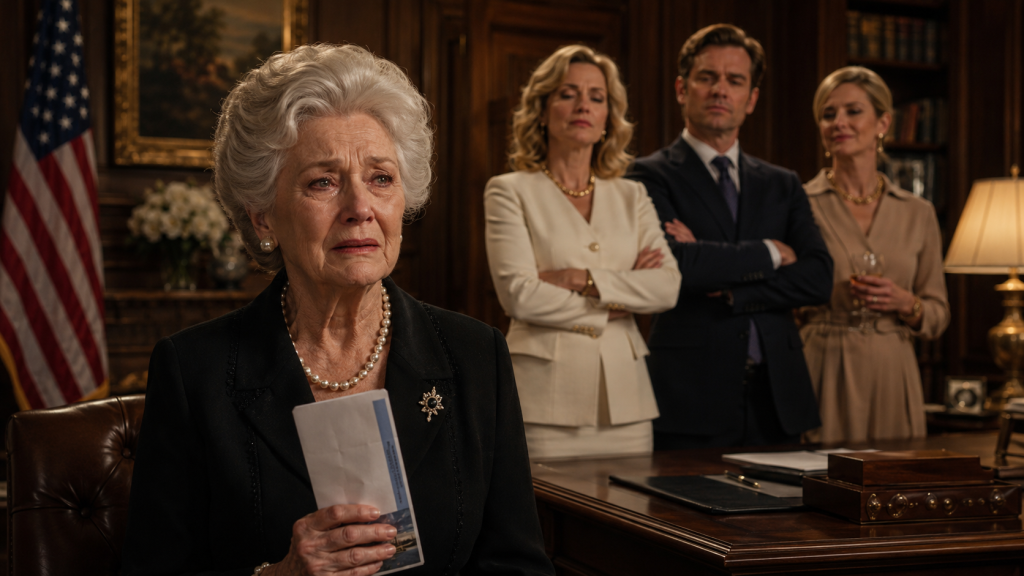
At my husband’s funeral, my children inherited the estate, the apartments, the cars, and a fortune I never even knew existed… while I was handed a folded envelope and told, “Costa Rica is perfect for someone your age.”
My children did not cry when the lawyer read Roberto’s will. They smiled. I had already cried enough for everyone in that room.For eight years, I watched my husband disappear one fragile piece at a time. I fed him. Bathed him. Lifted him when he could no longer turn himself in bed. I stitched clothes late into the night until my fingers cramped, just to help cover medicines nobody else seemed willing to pay for. And still, when it was time to divide what he left behind, everyone suddenly remembered who his children were.
No one seemed to remember who his wife had been. My daughter, Rebecca, inherited the apartments.My son, Diego, got the cars. Together, they took the estate, the land, and an amount of money so large the whole air in that office shifted. And me?
I was given one small folded envelope.
No explanation.
No kindness.
No apology.
No human warmth.
Just paper.
I still remember the sound it made when Rebecca snatched it from my hands and opened it in front of everyone, like she was unveiling a joke written especially to embarrass me.
Inside was a one-way plane ticket to Costa Rica.
That was all.
No letter.
No key.
No note.
No message in Roberto’s handwriting.
Not one line explaining why the man I had cared for until his final breath was leaving millions to them and sending me alone to another country.
That was when the smiles began.
Rebecca’s thin, satisfied smile.
Diego’s little half-laugh.
And Elvira, my daughter-in-law, who did not even bother lowering her eyes.
“Costa Rica is quiet,” Diego said, looking down at his inheritance papers again. “Perfect for someone your age.”
He used that soft, careful tone cruel people love most, the kind that pretends to be concern while it is really just a hand on your back pushing you toward the door.
I was seventy-two years old.
And for the first time in years, I did not just feel widowed.
I felt discarded.
The cruelest part was not the money.
The cruelest part was watching my children look more alive over what they had gained than heartbroken over the man they had lost.
Because Roberto did not leave this world suddenly.
He faded slowly.
And while I was the one holding his body together, his medications together, his house together, his dignity together, they came and went like distant guests.
Short visits.
Fast embraces.
Expensive perfume.
Polished shoes.
Sympathy that never stayed long enough to feel real.
Rebecca lived in comfort.
Diego lived far away.
And Elvira always looked at our home as if hardship might stain her clothes if she stood in it too long.
I was the one who kept sewing.
Sewing for groceries.
Sewing for pills.
Sewing for electricity.
Sewing for the small humiliations that old age and illness bring into a house.
At night, while Roberto drifted in and out of shallow sleep, he would reach for my hand as if he wanted to say something and never quite found the courage.
The night before he died, he did say one thing.
At the time, it sounded strange.
Almost meaningless.
“Don’t judge by appearances, Teresa. The most valuable things sometimes come in the smallest packages.”
I had leaned closer, brushing his silver hair away from his forehead.
“What do you mean, Roberto?”
His eyes moved toward the window, where the late afternoon light was turning soft and golden.
“You will understand when it hurts the most.”
I thought it was the illness speaking.
I thought pain had tangled his thoughts.
So I kissed his hand and told him to rest.
By morning, he was gone.
At the funeral, standing there with that airline ticket in my hand and those smiles around me, I told myself his words were only the confused comfort of a dying man.
But that night, alone in the house, I looked at the ticket again.
Departure in three days.
San José, Costa Rica.
Roberto and I hardly ever spoke about Costa Rica. It was not where we honeymooned. Not where we had family. Not some old dream we used to whisper about and never reached.
It made no sense.
And still, something in me would not tear it up.
Maybe it was grief.
Maybe it was pride.
Maybe it was the last stubborn piece of my heart that still refused to believe a man could spend forty-five years beside me only to humiliate me at the very end.
So I packed one small suitcase.
Three dresses.
My rosary.
A photograph from our wedding.
And the little money I had left.
Just before leaving, I opened the drawer in Roberto’s nightstand out of habit more than intention.
That was when I found the photograph.
I had never seen it before.
In it, Roberto was decades younger, standing beside a man who looked so much like him that my chest went tight. They were smiling in front of green mountains and low clouds.
On the back, written by hand, were only a few words.
Roberto and Tadeo.
Costa Rica, 1978.
I stared at that name as if it might crack open and explain forty-five years of marriage all at once.
Who was Tadeo?
Why had my husband never once spoken that name to me?
The flight was long, uncomfortable, and quieter than I imagined a plane full of strangers could be.
I wore black the entire way.
Grief sat on my chest like wet cloth. By the time I landed in San José, the air met me warm and heavy, and for one honest second, fear moved through me so sharply I almost turned around.
I was alone.
I was seventy-two.
I had a ticket I did not understand.
And a photograph with a name that would not let me breathe.
Then I saw him.
A well-dressed man in a perfectly cut gray suit stood near arrivals, watching me as if he had been expecting me for a very long time.
He did not hesitate.
He did not look uncertain.
He did not search the crowd twice.
He walked straight toward me.
“Mrs. Teresa Morales?” he asked.
I nodded, though my throat had gone dry.
“My name is Moisés Vargas,” he said. “I’m an attorney. I’ve been waiting for you.”
Not waiting for someone.
Waiting for me.
As if whatever this was had started long before I understood I belonged to it.
During the drive, I could barely speak.
He did.
He told me he had known Roberto well.
He told me my husband had planned everything carefully.
He told me my children had received exactly what they were meant to receive.
And then he looked at me through the rearview mirror and said I was about to understand something that had been hidden for years.
We drove away from the noise of San José and into roads wrapped in green mountains. Mist hung over the hills like a veil. Flowers bloomed along fences. The air smelled of rain, earth, and something sweet I could not name.
After nearly two hours, we reached a quiet estate hidden behind iron gates.
The house was not a mansion in the way my children understood wealth.
It was more beautiful than that.
White walls.
Dark wood beams.
A red roof.
Wide verandas open to the mountains.
It looked peaceful.
It looked lived in.
It looked like the kind of place where secrets could sleep for decades.
My fingers tightened around Roberto’s old photograph.
“Why am I here?” I finally asked.
Moisés stopped the car and turned toward me.
“Because your husband did not send you away, Mrs. Morales,” he said gently. “He sent you home.”
Before I could answer, the gates opened.
An elderly man stood on the steps, leaning on a cane. His hair was white. His shoulders were bent by time. But his face made the breath leave my body.
The same eyes.
The same jaw.
The same small scar over the eyebrow.
I looked at the photograph in my lap.
Then at the man.
“Tadeo,” I whispered.
The old man’s eyes filled with tears.
“Teresa,” he said, as if he had known my name for decades.
Inside the house, Moisés placed a thick folder on the table.
The room was cool and full of light. Ceiling fans moved slowly above us. On the wall hung a framed photograph of Roberto and Tadeo as young men, standing in front of the same green mountains.
My legs felt weak.
Tadeo lowered himself into a chair across from me.
“Roberto was my brother,” he said.
The words struck me harder than any insult my children had spoken.
“Brother?” I whispered. “Roberto never had a brother.”
“He did,” Tadeo said. “But not one your family wanted spoken of.”
Moisés opened the folder.
“Roberto’s parents separated the brothers when they were young,” he explained. “There were family disputes, land disputes, old pride, old shame. Tadeo stayed in Costa Rica with their mother’s relatives. Roberto was taken north with his father.”
I stared at the documents.
Birth certificates.
Old letters.
Photographs.
Property deeds.
A life I had never been told existed.
“Roberto came back when he was a young man,” Tadeo said. “In 1978. He wanted to repair what had been broken. He and I built this place together. Not from inherited money. From work. Coffee land. Rental cabins. Later, investments.”
I looked at Moisés.
“Then why did he never tell me?”
Tadeo’s face tightened with sadness.
“Because he was afraid.”
“Afraid of what?”
“Of his children,” Moisés said quietly.
That answer hurt worse than I expected.
“My children?”
Moisés nodded.
“Mrs. Morales, your husband discovered years ago that Rebecca and Diego had been pressuring him to transfer assets while he was sick. He knew they watched everything connected to the estate back home. Bank accounts. Apartments. Cars. Business interests. They believed those things were the prize.”
My stomach turned.
They had not waited until he died.
They had been reaching while he was still breathing.
Moisés continued.
“So Roberto gave them what would satisfy their greed. The estate. The apartments. The vehicles. The money they knew existed.”
I could not speak.
Tadeo leaned forward.
“But he protected what they did not know existed.”
Moisés pushed a document toward me.
“This property, the surrounding land, the coffee business, the private trust, and several investment accounts were never in Roberto’s personal name. They were held through a family structure created decades ago.”
I looked at the first page.
My name was there.
Teresa Morales.
Beneficiary.
Sole controlling heir.
My vision blurred.
“No,” I whispered. “This is impossible.”
“It is legal,” Moisés said. “And it is yours.”
The room tilted.
For years, I had stitched clothes until midnight.
For years, I had counted coins for medicine.
For years, I had listened to my children sigh when I asked for help buying their father’s prescriptions.
And all that time, Roberto had hidden another life.
Not from betrayal.
From protection.
Tadeo reached into his coat pocket and handed me a sealed letter.
“He asked me to give you this only after you arrived.”
The envelope shook in my hands.
Roberto’s handwriting was on the front.
My Teresa.
I opened it carefully, afraid the paper might break the same way my heart already had.
My Teresa,
Forgive me for letting them think they had won.
If you are reading this, then you came to Costa Rica, and that means some part of you still trusted me even after the pain I allowed you to feel.
I am sorry for that pain.
I hated knowing the will would wound you. I hated knowing Rebecca and Diego would smile. But I needed them to believe they had received everything worth taking.
They became strangers to me long before I died.
You saw it, even when you did not want to name it.
They came when they needed money. They called when they wanted decisions signed. They asked about accounts more than pain. They counted my properties while you counted my pills.
You were my wife.
You were my nurse.
You were my courage.
You were the only home I ever had.
The ticket was not exile.
It was the door.
Costa Rica holds what I built before greed learned where to look.
It holds Tadeo, my brother, who has loved you because I loved you.
It holds enough for you to live without asking anyone for mercy again.
Please do not give Rebecca or Diego the power to make you feel unwanted.
I chose you.
At the beginning.
At the end.
And in every hidden page between.
Live, Teresa.
Not small.
Not quietly.
Not as a discarded old woman.
Live as the woman who carried me when everyone else stood back and waited for inheritance.
Yours, always,
Roberto
By the time I finished reading, the paper was wet with my tears.
I did not cry because of the money.
I cried because, at last, I understood.
Roberto had not forgotten me.
He had hidden me where greed could not reach.
For three days, I stayed in that house without calling my children.
Moisés explained everything patiently.
The estate included acres of coffee land, rental villas for travelers, a small export company, and accounts that had grown quietly over decades. Tadeo had managed everything with honesty. Roberto had visited over the years when he could, but during his illness, his trips stopped.
Still, his instructions had continued.
Payments.
Legal updates.
Trust protections.
Letters to be delivered only after his death.
Everything had been arranged with the same careful love he showed when he asked me whether I had eaten, even when he could barely swallow water himself.
On the fourth day, Rebecca called.
I almost did not answer.
Then I remembered Roberto’s letter.
Live, Teresa.
Not small.
I answered.
“Mother,” she said sharply. “Where are you?”
Her voice had no concern in it.
Only irritation.
“Costa Rica.”
There was a pause.
“You actually went?”
“Yes.”
Diego came on the line next. She must have added him.
“Mamá, you need to come back and sign some documents.”
“What documents?”
“Just estate details,” he said. “Nothing complicated.”
I looked across the veranda at the mountains.
For the first time in years, I did not feel small.
“Moisés Vargas is handling my legal matters now.”
Silence.
Then Rebecca laughed.
“Your legal matters? Mother, you got a plane ticket. That is all.”
“No,” I said calmly. “That is what you were meant to think.”
The silence that followed was long and beautiful.
Diego’s voice changed.
“What does that mean?”
“It means your father knew you very well.”
Rebecca snapped, “Don’t be dramatic.”
“I am not being dramatic,” I said. “I am being informed.”
Their questions came fast after that.
Where was I staying?
Who was Moisés?
What had Roberto hidden?
What had I signed?
What had I found?
Each question peeled another layer away from the children I had raised.
Not one asked whether I was safe.
Not one asked whether I was grieving.
Not one asked if I had eaten, slept, or survived the humiliation they helped create.
Finally, I said, “Your father left you what you valued.”
“That’s not an answer,” Diego said.
“It is the only answer you deserve today.”
Then I hung up.
My hands shook afterward, but not from fear.
From freedom.
Two weeks later, Rebecca and Diego arrived in Costa Rica.
Of course they did.
Greed travels faster than love.
They came dressed as if they were attending a business meeting, not visiting their seventy-two-year-old mother in a foreign country.
Rebecca wore white linen and gold jewelry.
Diego wore sunglasses until he stepped inside, as if even the house needed to know he considered himself important.
Elvira came too, smiling like sweetness poured over poison.
“Mamá,” Diego said, opening his arms.
I did not step into them.
Rebecca looked around the house, eyes sharp.
“So this is why Dad sent you here.”
Tadeo stood beside me.
Moisés sat at the table with documents arranged neatly in front of him.
Rebecca’s gaze moved to Tadeo.
“And who are you?”
Tadeo lifted his chin.
“I am your father’s brother.”
Diego laughed.
“Our father did not have a brother.”
“Your father had many things you never bothered to know,” I said.
That quieted him.
For a moment.
Then Rebecca pointed at the folder.
“We want to see the documents.”
Moisés folded his hands.
“You are not beneficiaries of this trust.”
Rebecca blinked.
“What?”
“This property and all related assets belong to Mrs. Teresa Morales.”
“That’s impossible,” Diego said.
“It is not.”
“Our father was sick,” Rebecca said quickly. “He was confused.”
Moisés opened another folder.
“Your father created the original structure decades before his illness. His most recent confirmations were completed while he was medically evaluated as mentally sound.”
Elvira’s smile disappeared.
Diego leaned forward.
“Then we’ll contest it.”
“You may try,” Moisés said. “But your father anticipated that.”
He slid a tablet across the table and pressed play.
Roberto appeared on the screen.
Thin.
Pale.
But alert.
My hand went to my mouth.
His voice filled the room.
“If Rebecca and Diego are watching this, then they have followed Teresa to Costa Rica. I expected as much.”
Rebecca’s face drained.
Roberto continued.
“I left my children generous assets. More than enough to live comfortably. But I will not reward the way they treated their mother. Teresa gave me dignity when illness took everything else. She gave without asking. She stayed when others visited. She loved me when I could offer nothing back.”
Diego looked away.
But Roberto was not finished.
“The assets in Costa Rica belong to Teresa. They are not to be negotiated, pressured, borrowed against, or emotionally manipulated from her. Any attempt to challenge this trust will result in the suspension of additional discretionary benefits attached to the estate you already received.”
Rebecca stood so abruptly her chair scraped the floor.
“This is manipulation.”
“No,” I said, looking at my daughter with a steadiness that surprised even me. “This is your father finally speaking where you cannot interrupt him.”
Her eyes flashed.
“You’re enjoying this.”
“No,” I said. “I am mourning. You should try it.”
The words landed hard.
For the first time since Roberto died, I saw something like shame flicker across Diego’s face.
But Rebecca only hardened.
“You would choose this stranger over your children?”
I looked at Tadeo.
Then at Moisés.
Then back at her.
“I am choosing the truth over greed.”
Elvira spoke softly.
“Teresa, surely we can all share. There is no need to divide family.”
I almost laughed.
“Family was divided in that lawyer’s office when you smiled at my humiliation.”
Her face went still.
“Yes,” I said. “I saw you.”
No one spoke.
Outside, rain began tapping the veranda roof.
The same soft rhythm I used to hear on nights when Roberto could not sleep.
I stood slowly.
“I spent eight years caring for your father. Not because I expected money. Not because I knew about this. I cared for him because love is not supposed to be measured only after death. But all of you measured him while he was alive. You weighed him in apartments, cars, land, and accounts.”
Diego lowered his head.
Rebecca crossed her arms.
I continued.
“You inherited what you wanted. Take it. Live with it. But you will not take what he left me.”
Rebecca whispered, “You have changed.”
“No,” I said. “I have remembered myself.”
They left that afternoon without saying goodbye.
I watched their car disappear down the wet road.
A part of me hurt.
A mother’s heart does not stop hurting just because her children disappoint her.
But another part of me felt strangely calm.
Like a door had finally closed on a room where I had been waiting too long.
Months passed.
I stayed in Costa Rica.
At first, I told myself it was temporary.
Just until the legal matters were finished.
Just until I understood the accounts.
Just until I was strong enough to return.
But slowly, the house began to know me.
The kitchen learned my morning tea.
The veranda learned my prayers.
The garden learned my steps.
Tadeo and I spent long afternoons talking about Roberto as a boy, as a brother, as the young man I had never known. He told me stories that made me laugh and cry in the same breath.
Roberto stealing mangoes.
Roberto fixing a broken radio.
Roberto standing in the rain at twenty years old, promising he would one day build something no one could take from the people he loved.
“He kept that promise,” Tadeo said one evening.
I looked at the mountains.
“Yes,” I whispered. “He did.”
Rebecca called sometimes.
At first, only about money.
Then less often.
Diego called once after a business deal connected to the estate failed. He sounded tired.
For the first time, he said, “Mamá, I miss Dad.”
I closed my eyes.
“So do I.”
There was silence.
Then he said, “I think I made mistakes.”
I did not rush to comfort him.
Old Teresa would have.
The Teresa who stitched all night and apologized for needing help would have softened everything for him.
This Teresa stayed quiet long enough for him to feel his own words.
Finally, I said, “Then become someone who does not repeat them.”
It was not forgiveness.
Not yet.
But it was a door left unlocked.
A year after Roberto died, I stood on the veranda at sunrise with his letter in my hands.
The mountains were blue in the distance.
Mist curled over the coffee fields.
The world looked gentle, though I knew better than to believe gentleness meant nothing painful lived inside it.
Moisés had finalized everything.
The trust was secure.
The business was strong.
The rental villas were full.
I had more money than I could spend, but the strangest part was how little that mattered compared to sleeping without fear.
I no longer asked anyone permission to exist.
I no longer waited for my children to remember I had once been the woman who packed their lunches, mended their uniforms, sat beside their beds through fevers, and loved them before they learned to value things over people.
I was still their mother.
But I was no longer their victim.
On Roberto’s birthday, I planted a tree near the veranda.
Tadeo helped me choose it.
A guanacaste tree, wide and strong, the kind that would one day give shade to people I might never meet.
As we covered the roots with soil, Tadeo asked, “Do you regret coming?”
I looked toward the house.
The red roof.
The open windows.
The mountains Roberto had kept like a secret gift.
Then I thought of that lawyer’s office.
Rebecca smiling.
Diego laughing softly.
Elvira watching me like I had already been removed from the family picture.
I thought of the small folded envelope.
The plane ticket.
Costa Rica is perfect for someone your age.
They had meant it as exile.
Roberto had meant it as rescue.
“No,” I said. “I regret only that I doubted him.”
That night, I placed Roberto’s wedding photo beside the old picture of him and Tadeo.
Two lives.
Two countries.
One truth hidden long enough to protect me.
I touched the frame and whispered, “I understand now.”
The house was quiet.
But not empty.
Love lived there.
Not loud.
Not showy.
Not the kind that smiles at wills and counts what can be taken.
It lived in the careful plan of a dying man who knew greed would reveal itself.
It lived in a brother who waited decades to welcome a woman he had never met.
It lived in a ticket that looked like abandonment but was really a map.
My children inherited the estate, the apartments, the cars, and the fortune they knew existed.
They inherited the things they could name.
The things they could sell.
The things they could brag about.
But I inherited the secret Roberto protected with his last strength.
I inherited the land in the mountains.
The house behind the iron gates.
The brother he had lost and found.
The truth he trusted me to reach.
And more than all of that, I inherited the final proof that I had not wasted my life loving him.
At the funeral, they thought I was just an old widow holding a one-way ticket.
They thought Roberto had sent me away.
They thought the smallest envelope meant the smallest inheritance.
But Roberto had told me the truth before he died.
The most valuable things sometimes come in the smallest packages.
And by the time my children understood what he meant, I was no longer standing in their shadow.
I was in Costa Rica.
Under a wide morning sky.
Holding my husband’s letter.
Living in the home he had hidden for me.
And finally, after years of carrying everyone else, I was learning how to live for myself.
THE END! THANKS FOR READING!