 Reading Time: 43 minutes
For sixteen years, my husband and I prayed for a child. Then, three weeks after our miracle son was born, Richard left me for an eighteen-year-old girl.
I was forty-one. Still recovering from a difficult C-section. Still waking every two hours to feed our newborn. Still sleeping with a pillow pressed against my abdomen because sometimes simply standing up made the incision burn.
And my husband looked at me one morning and told me that he wanted a different life.
That sentence destroyed twenty-two years of marriage in less than ten seconds.
But the worst part was not losing Richard.
The worst part was looking down at the tiny baby sleeping against my chest and realizing that the man who had spent sixteen years begging God for a child had decided he no longer wanted the one we finally received.
His name was Ethan.
He weighed six pounds, nine ounces.
He had Richard’s dark eyes and my mother’s stubborn little chin.
The first time I held him in the hospital, Richard cried harder than I did.
He bent over the bed, pressed his forehead against mine, and whispered, “We did it, Claire.”
I remembered laughing weakly through my tears.
“No. He did it.”
Richard touched Ethan’s tiny hand.
When Ethan’s fingers curled around his thumb, Richard actually sobbed.
“I’m going to be the best father in the world.”
I believed him.
Why wouldn’t I?
We had spent almost our entire marriage trying to become parents.
There had been fertility specialists.
Needles.
Hormones.
Surgeries.
Tests.
Procedures.
Hope.
Disappointment.
More hope.
More disappointment.
Every month seemed to begin with cautious optimism and end with me crying behind a locked bathroom door.
Richard always found me.
He would sit on the floor beside me.
Sometimes he held me.
Sometimes neither of us spoke.
After our fourth failed fertility treatment, I told him he should leave me.
I was thirty-six.
He stared at me as though I had slapped him.
“Why would you say that?”
“Because you want children.”
“I want you.”
“You deserve a family.”
“You are my family.”
I cried harder.
He held my face between his hands.
“If we never have children, I’m still choosing you.”
Those words lived inside me for years.
They became proof whenever doubt came.
Proof that my marriage was safe.
Proof that Richard loved me.
Proof that some promises survived disappointment.
Then, at forty, I became pregnant naturally.
I thought the pregnancy test was defective.
I bought three more.
All positive.
When I showed Richard, he sank onto the kitchen floor.
Actually sank.
His knees simply gave out.
I thought something was wrong with him.
Then he started laughing.
And crying.
He pulled me down beside him.
We sat on the kitchen floor holding four pregnancy tests like fools.
“Our baby,” he whispered.
Our baby.
For nine months, Richard behaved exactly like the man I believed him to be.
He attended every appointment.
He assembled the crib.
He painted the nursery pale blue.
He spent an entire Saturday researching car seats.
He talked to my stomach at night.
“Your mother thinks I’m ridiculous,” he would tell Ethan before he was born. “But when you get here, you and I are going to outnumber her.”
I would laugh.
Sometimes I would watch him with his hand on my stomach and think:
This is why we waited.
Maybe all those painful years had been leading here.
Maybe this was our reward.
Ethan arrived three weeks early.
The delivery became complicated.
His heart rate dropped.
Doctors rushed me into surgery.
The last thing I remembered before the anesthesia took over was Richard squeezing my hand and saying, “I’m right here.”
When I woke, my first word was Ethan’s name.
Richard brought him to me.
Our baby was healthy.
Small.
Perfect.
For two days, we lived inside that hospital room as though nothing outside it existed.
Richard took photographs of everything.
Ethan sleeping.
Ethan yawning.
Ethan wrapped in a blanket.
Me holding Ethan.
Our hands beside Ethan’s tiny hand.
When we came home, Richard carried our son across the threshold.
My mother had filled the refrigerator.
Neighbors had left casseroles.
Flowers covered the dining table.
For the first week, Richard seemed exhausted but happy.
Then something changed.
He began checking his phone constantly.
He stepped outside to answer calls.
He volunteered to buy groceries and disappeared for two hours.
When I asked where he had been, he became irritated.
“Claire, I can’t spend every second trapped in this house.”
Trapped.
The word surprised me.
“You wanted this.”
“I know.”
“Then why are you acting like—”
“Like what?”
I stopped.
I was exhausted.
My body hurt.
Ethan had been crying for forty minutes.
I told myself Richard was tired too.
New parents struggled.
People became short-tempered.
Marriage did not collapse because of a few bad days.
Then, one Thursday morning, I woke and found half of Richard’s clothes gone.
His toiletries were gone.
His laptop was gone.
His wedding ring sat on the dresser.
Beside it was a note.
Four words.
I need some space.
I stared at those words until they blurred.
I called him seventeen times.
No answer.
On the eighteenth attempt, he picked up.
“Richard?”
My voice sounded pathetic.
I hated that.
“Where are you?”
“I told you. I need space.”
“You left your wife and three-week-old child.”
“Don’t make this dramatic.”
I looked down at Ethan sleeping in the bassinet.
“Dramatic?”
“Claire.”
“Come home.”
Silence.
“Please.”
Another silence.
Then Richard sighed.
“I can’t.”
My knees weakened.
“Is there someone else?”
He said nothing.
And because he said nothing, I knew.
“Who?”
“Claire, this isn’t productive.”
“Who?”
His voice became colder.
“Her name is Madison.”
I gripped the edge of the dresser.
“How old is she?”
Again, silence.
Something inside me already knew the answer would hurt.
“How old is she, Richard?”
“Eighteen.”
I thought I had misheard him.
“What?”
“She’s eighteen.”
Richard was forty-six.
For several seconds, I could not form words.
Then I whispered, “Our marriage is older than she is.”
“Don’t do that.”
“Do what?”
“Make this ugly.”
I laughed.
The sound frightened me.
“I’m not making anything ugly.”
Ethan stirred.
A tiny cry came from the bassinet.
Richard heard it through the phone.
He went quiet.
For one stupid second, I expected something paternal to awaken in him.
Concern.
Love.
Regret.
Instead he said, “I have to go.”
The call ended.
I stood alone in the bedroom with the phone still pressed to my ear.
Ethan began crying harder.
And because babies do not care whether your marriage has just ended, I picked him up.
I changed him.
Fed him.
Burped him.
Held him against my shoulder.
My tears fell into his soft hair.
“I’m sorry,” I whispered.
I wasn’t sure what I was apologizing for.
Choosing Richard?
Trusting him?
Failing to see what was happening?
Bringing Ethan into a family that had broken before he was old enough to recognize his father?
Then Ethan stopped crying.
His tiny hand rested against my chest.
I looked at him.
And something inside me hardened—not into anger, but determination.
Whatever Richard had decided to become, I still knew who I needed to be.
Ethan’s mother.
That had to be enough.
Three days later, Richard came back.
Not to apologize.
Not for Ethan.
He came for the house.
There were three slow knocks.
I opened the door.
Richard stood there.
He wasn’t alone.
A young woman sat in his car at the curb.
Madison.
Eighteen years old.
Perfect hair.
Designer sunglasses despite the gray afternoon.
She looked toward the house with the detached expression of someone waiting for a restaurant table.
I held Ethan more tightly.
Richard glanced at him.
Then at me.
“I need some things.”
“Your belongings are packed in the garage.”
“Not those.”
He stepped inside without asking.
I stared after him.
“Richard.”
He kept walking.
“This isn’t your house anymore.”
He stopped beside the staircase.
Then turned.
“That’s actually what I came to discuss.”
My stomach tightened.
“What?”
“I’m taking the house.”
For one second, I thought he was joking.
Then I laughed.
Not because anything was funny.
Because sometimes shock comes out sounding like laughter.
“The house is in both our names.”
“I’ve spoken to my attorney.”
“Richard, I just had a baby.”
He looked at me.
“And?”
That word changed something inside me forever.
Not the affair.
Not Madison.
Not even leaving.
That one word.
And?
As though my surgery did not matter.
As though Ethan did not matter.
As though twenty-two years could be erased because Richard had discovered a younger woman who made him feel like a different man.
“What exactly do you expect me to do?”
“Move.”
“Move where?”
He shrugged.
“That’s your problem.”
Ethan stirred against me.
His face scrunched.
I instinctively rocked him.
Richard watched.
For a moment, his expression softened.
Then it disappeared.
“Claire, be realistic. You can’t keep this house.”
“I’ll find a way.”
“You don’t have a job.”
“I’ll get one.”
“You haven’t worked full-time in years.”
“I’ll still get one.”
He looked me up and down.
I was wearing sweatpants.
My hair had not been washed in two days.
There were dark circles beneath my eyes.
My body still carried the swelling of pregnancy and surgery.
Then Richard smiled.
It was a small smile.
Cruel because he knew exactly where to place the knife.
“You’re forty-one.”
I looked at him.
“And?”
His smile widened slightly.
“Exactly.”
For a moment, the room became completely silent.
Then I opened the front door.
“Get out.”
“Claire—”
“Get out of my house.”
“You need to be reasonable.”
“No.”
My voice was shaking.
But I kept the door open.
“I spent sixteen years being reasonable. I survived injections, surgeries, failed pregnancies, grief, and the humiliation of believing my body had failed you. I spent twenty-two years believing every promise you made. I just had your child cut out of my body three weeks ago.”
My eyes filled with tears.
“But I will not stand here while you tell me I’m worthless because I’m forty-one.”
Richard stared at me.
I pointed toward the door.
“Leave.”
He did.
I stood there as he climbed into the car beside Madison.
She said something.
He laughed.
Then the car pulled away.
Ethan opened his eyes.
Dark.
Curious.
Completely unaware that his father had abandoned him twice before he was a month old.
I touched his cheek.
“You don’t need him,” I whispered.
But my voice broke.
Because I still did.
Or at least I thought I did.
PART 2 — THE WOMAN HE THOUGHT COULDN’T SURVIVE
Nine days later, a letter arrived from Richard’s attorney.
He intended to force the sale of the house.
There were custody papers too.
Richard requested limited visitation.
Two weekends each month.
No overnight stays.
I sat across from his attorney with Ethan asleep against my chest.
“Why no overnights?”
The man shifted uncomfortably.
“Mr. Carter feels overnight care would disrupt his current lifestyle.”
I looked at him.
“Our son is twenty-six days old.”
“I understand.”
“No.”
I shook my head.
“You don’t.”
The attorney waited.
“Richard spent sixteen years trying to have this child.”
The words came faster now.
“He attended every appointment. He held my hand after every failed treatment. He cried when the pregnancy test finally turned positive. He painted Ethan’s room. He assembled the crib. He promised he would never miss a birthday.”
The attorney lowered his eyes.
“And now our son sleeping beneath his roof would disrupt his lifestyle?”
He said quietly, “I can only advise you regarding the legal proposal.”
That was when I finally understood.
Richard was not simply leaving me.
He was editing us out.
His new life needed to look clean.
Young.
Uncomplicated.
It could not contain a forty-one-year-old wife with a healing surgical scar.
It could not contain bottles drying beside the sink.
It could not contain midnight crying.
Or diapers.
Or exhaustion.
Or sixteen years of infertility reminding him that this child had once been the center of everything he wanted.
He wanted a reset.
And Ethan and I were evidence of the life he wanted to pretend had never existed.
I left the attorney’s office and sat in my car for twenty minutes.
Ethan woke.
I looked at him in the rearview mirror.
“Your father is leaving,” I whispered.
My throat tightened.
“But I’m not.”
That became my promise.
Not that life would be easy.
Not that I would never fail.
Not that I would be enough for every missing piece.
Only this:
I would stay.
The house was sold.
After lawyers, fees, and debts, I walked away with far less than I expected.
Six weeks later, at forty-one years old, I moved back into my childhood bedroom with a newborn baby.
I thought it would feel like failure.
My mother opened the front door before I could knock.
She looked at the suitcase.
The diaper bag.
The portable crib.
Then she looked at me.
“You and Ethan are home.”
That was all.
No questions.
No pity.
No lecture about choosing the wrong man.
She simply took my suitcase.
That night, after Ethan finally fell asleep, I sat on the floor beside his crib and cried silently.
My mother found me.
She lowered herself beside me.
“You don’t have to be strong every minute.”
“I don’t know how I’m going to do this.”
“Neither do I.”
I looked at her.
She smiled.
“We’ll learn.”
And we did.
I found part-time remote work first.
Customer accounts.
Scheduling.
Invoices.
Anything I could do while Ethan slept.
Then I took bookkeeping courses at night.
My mother watched him while I studied.
Eventually, a small logistics company hired me full-time.
The salary was not impressive.
To me, it felt like oxygen.
I learned to stretch fifty dollars across a week.
I learned which supermarket discounted meat on Wednesday evenings.
Which pharmacy sold the cheapest diapers.
How to balance a sleeping baby against my shoulder while typing with one hand.
How to take a work call from the bathroom because Ethan had finally fallen asleep in the bedroom.
How to smile when people asked, “Where’s his father?”
“He’s not involved.”
Four words.
No explanation.
No apology.
No shame.
Ethan’s first smile came when he was three months old.
His first real laugh came at six months.
I was making ridiculous noises while folding laundry.
He laughed so suddenly that I froze.
Then I did it again.
He laughed harder.
Soon I was laughing too.
I laughed until my stomach hurt.
It was the first time since Richard left that joy did not feel like betrayal.
At eleven months, Ethan took his first steps between my mother and me.
At one year, we bought him a tiny blue cake.
There were only three people at his birthday party.
My mother.
Me.
And Ethan.
He did not know parties were supposed to be bigger.
He did not know someone was missing.
He clapped while we sang.
Then he shoved both hands into the cake.
Blue icing covered his cheeks.
His hair.
His nose.
My mother laughed until she cried.
I took a photograph.
For years, that picture stayed on our refrigerator.
Underneath it, I wrote:
He chose life.
At first, I meant Ethan.
Later, I realized I meant myself too.
Richard disappeared almost completely.
Occasional child-support payments came.
Sometimes late.
Sometimes only after my attorney contacted his.
No birthday cards.
No Christmas presents.
No phone calls asking whether Ethan was sick.
No messages asking whether he had started walking.
No curiosity about his first word.
Nothing.
I stopped waiting.
That was harder than it sounds.
At first, every unfamiliar car made me look toward the window.
Every unknown number made my heart jump.
Every birthday, some foolish part of me thought:
Maybe today.
Then one birthday became two.
Two became three.
And hope became embarrassing.
Shortly before Ethan turned three, Richard appeared again.
I opened my mother’s front door and almost did not recognize him.
He looked successful.
Expensive coat.
New watch.
Perfect haircut.
Madison stood beside him.
She was twenty now.
They were married.
The diamond on her finger was enormous.
Richard smiled.
“We’re taking Ethan for the weekend.”
I stared at him.
“No.”
His smile disappeared.
“You don’t get to decide that.”
“You haven’t seen him in almost two years.”
“He’s my son.”
“You don’t know what cereal he eats.”
His jaw tightened.
“You’re being difficult.”
“No. I’m being his mother.”
“I have rights.”
“And responsibilities. Do you remember those?”
Madison exhaled.
“We’re not here to fight.”
I looked at her.
She was barely more than a girl.
For years, I had imagined screaming at her.
Calling her every ugly word available.
But standing there, I felt strangely tired.
Richard had been my husband.
Richard had made vows to me.
Whatever Madison had done, his choices belonged to him.
“You’re right,” I said.
I stepped aside.
“Come in.”
Richard looked surprised.
“I’m not stopping Ethan from knowing his father.”
He entered.
“Where is he?”
“In the backyard.”
Richard walked outside.
Ethan was sitting in the grass with toy trucks.
I watched from the kitchen window.
Richard crouched.
Ethan looked up.
Richard said something.
Ethan smiled.
Then, within minutes, they were pushing trucks through the dirt together.
Richard laughed.
Ethan laughed.
My heart twisted.
Because for one fragile moment I allowed myself to imagine something impossible.
Maybe Richard had changed.
Maybe fatherhood had finally reached him.
Maybe mistakes did not have to become permanent.
Then Madison called from the patio.
“Richard, come look at this.”
She held one of Ethan’s drawings.
Three figures stood beneath a yellow sun.
One was me.
One was Ethan.
The third was a tall stick figure beside a huge blue house.
Richard pointed.
“Who is that?”
Ethan beamed.
“Daddy.”
Richard’s face changed.
Not with joy.
With discomfort.
He looked at Madison.
Madison lowered her voice, but I heard her.
“He’s going to get attached.”
Richard looked at Ethan again.
And in that moment, I knew exactly what he was thinking.
Not:
My son loves me.
Not:
Look what I have missed.
He was thinking:
This could become complicated.
The weekend visit never happened.
Richard took Ethan to lunch.
Three hours later, they returned.
Ethan was crying.
He ran directly to me.
I lifted him.
“What happened?”
“He kept asking for you,” Richard said.
“He’s three.”
“I know.”
“You expected him not to?”
Richard rubbed his forehead.
“I don’t think this arrangement is going to work.”
“What arrangement?”
“Visits.”
I stared at him.
“You came back after nearly two years, and you’re quitting after three hours?”
“He was upset.”
“Because you are a stranger.”
His face hardened.
“Maybe we should let him forget me.”
My whole body went cold.
“What did you say?”
“It might be easier.”
“For whom?”
He did not answer.
“For Ethan?”
Silence.
“Or for you?”
Richard looked away.
I shifted my son higher against my shoulder.
“You don’t get to decide whether your child remembers you because remembering him is inconvenient.”
Richard shrugged.
“Then don’t blame me if he grows up hating me.”
I looked directly into his eyes.
“I won’t have to.”
He left.
Ethan watched from my arms.
“Daddy coming back?”
My heart cracked.
I kissed his forehead.
“I don’t know, sweetheart.”
Richard did not come back.
Not for years.
PART 3 — THE QUESTION NO MOTHER WANTS TO HEAR
Without Richard, life became quieter.
Not easy.
But predictable.
And I discovered that predictable pain is sometimes easier than unpredictable hope.
Ethan grew into a gentle child.
Curious.
Funny.
Quiet around strangers.
Fearless around questions.
At four, he wanted to know why the moon followed our car.
At five, he disassembled a broken alarm clock because he wanted to know “where the morning was stored.”
At six, he announced that gravity was unfair because birds got exceptions.
My mother adored him.
I did too.
He loved books more than toys.
Puzzles more than cartoons.
He would sit on the kitchen floor surrounded by pieces of dismantled electronics while I cooked.
“Ethan.”
“Yes?”
“Why is my toaster open?”
“I’m improving it.”
“It toasted bread perfectly yesterday.”
“Exactly.”
I would stare at him.
He would stare back with Richard’s dark eyes and my mother’s stubborn chin.
Then we would both laugh.
But there were questions I could not laugh away.
The hardest came when he was seven.
We were sitting at the kitchen table.
Rain tapped softly against the windows.
His homework was finished.
He had been unusually quiet.
“Mom?”
“Yes?”
“Did Dad leave because of me?”
My pencil stopped moving.
“What?”
“He doesn’t visit.”
I slowly put the pencil down.
“Why would you think that means he left because of you?”
Ethan stared at his hands.
“Maybe I cried too much when I was a baby.”
My heart broke so quickly it almost felt physical.
“No.”
“Maybe I was bad.”
“You were a newborn.”
“Maybe I was stupid.”
I reached across the table.
“Ethan.”
He looked at me.
“Who told you that?”
“Nobody.”
“Then why are you saying it?”
His lower lip trembled.
“Because people don’t leave things they want.”
There are sentences children say that stay with you forever.
That was one of them.
I moved to the chair beside him.
I took his face between my hands.
“You listen to me carefully.”
He nodded.
“You were wanted.”
“By you.”
“By your father too.”
He looked confused.
“He wanted you for sixteen years. We both did.”
“Then why did he leave?”
How do you explain selfishness to a seven-year-old?
How do you explain a middle-aged man terrified of aging?
An affair?
Vanity?
Cowardice?
How do you tell a child that sometimes an adult can desperately want something and still fail to deserve it once he has it?
So I gave Ethan the cleanest truth I had.
“Sometimes grown-ups make selfish choices.”
“Did Dad?”
“Yes.”
“Was it because I wasn’t enough?”
“No.”
“Are you sure?”
I pressed my forehead against his.
“I have never been more sure of anything.”
His eyes filled with tears.
“So he lost me?”
I swallowed.
“Yes.”
Ethan was quiet.
Then he asked a question I would remember seventeen years later.
“Does he know what he lost?”
I looked at my son.
At the boy who thought his father’s absence must somehow be proof of his own inadequacy.
And I said, “Maybe not yet.”
Ethan wiped his eyes.
“Will he someday?”
“I don’t know.”
The truth was, I hoped so.
I was ashamed of that hope.
Not because I wanted Richard back.
By then, I didn’t.
But part of me wanted him to witness Ethan.
To know.
To see the child he had rejected become impossible to dismiss.
Life kept moving.
At nine, Ethan built a crude weather station from discarded electronics.
At ten, he won a school science fair.
At eleven, he began borrowing textbooks written for high-school students.
At twelve, his science teacher called me.
“Mrs. Carter?”
“Yes?”
“I think Ethan needs more advanced material.”
I laughed.
“He already reads my old college textbooks for fun.”
The teacher did not laugh.
“I’m serious. He’s exceptional.”
Exceptional.
I hung up and cried in the supply closet at work.
Not because I believed intelligence made Ethan more worthy.
He had always been worthy.
I cried because I remembered Richard standing in our old hallway.
You’re forty-one.
Exactly.
As though my age made both of us obsolete.
At thirteen, Ethan won a regional engineering competition.
At fourteen, a university professor invited him to spend Saturdays in a youth research program.
I drove him every week.
Two hours there.
Two hours home.
I waited in coffee shops.
Answered work emails.
Read books.
Sometimes I watched other parents arrive in expensive cars.
Husbands and wives together.
Fathers throwing arms around their children after competitions.
For years, scenes like that hurt.
Eventually they stopped.
Not because I stopped noticing.
Because I stopped measuring our family by what it lacked.
Ethan and I had something complete even if it was not traditional.
My mother had taught me that.
Love is not counted by chairs at a table.
It is counted by who stays when the table gets difficult.
When Ethan was fifteen, something happened that changed everything.
He came home from school carrying a thick cream-colored envelope.
No stamp.
No return address.
Only his name.
ETHAN CARTER
“What’s that?”
“I don’t know.”
“Where did you get it?”
“My locker.”
My stomach tightened.
“Someone put it inside your locker?”
He nodded.
“Did you tell the school?”
“Yes. They’re checking cameras.”
I turned the envelope over.
One sentence was written across the back in black ink.
He deserves to know.
I looked at Ethan.
“Know what?”
“I haven’t opened it.”
We stood in the kitchen staring at each other.
Finally, I slid my finger beneath the seal.
Inside was a photograph.
It was old.
Richard stood outside a brick office building.
I recognized the place immediately.
The headquarters of the development company he had worked with before Ethan was born.
Beside Richard stood an older man.
Gray hair.
Wire-framed glasses.
Serious face.
I had never seen him.
Behind them was a sign.
THE CEDAR FOUNDATION
I turned the photograph over.
Four words were written on the back.
ASK HIM ABOUT THE FOUNDATION.
“What foundation?” Ethan asked.
“I don’t know.”
But something about the picture felt wrong.
Richard had talked constantly about business during our marriage.
I knew the names of his partners.
His clients.
His major projects.
His accounts.
At least, I thought I did.
I had never heard him mention the Cedar Foundation.
Inside the envelope was also a photocopy of a bank document.
Most numbers were blacked out.
One transfer remained visible.
$425,000.
Richard’s signature appeared beneath it.
Ethan looked at me.
“Mom?”
“Yes?”
“Why are you scared?”
Because I was.
I had spent years teaching myself not to fear Richard’s shadow.
Yet one photograph brought the old feeling back.
“I don’t know what this is.”
“Do you think Dad did something?”
“I don’t know.”
“Should we call him?”
“No.”
The answer came too quickly.
Ethan noticed.
“Why?”
“Because first we find out whether any of this is real.”
I locked the envelope in my desk.
Three days later, my phone rang.
Unknown number.
“Hello?”
“Claire.”
My entire body froze.
Richard.
I had not heard his voice in years.
“How did you get this number?”
“I know how to find my own family.”
I almost laughed.
“Your family?”
He ignored that.
“I heard Ethan won another competition.”
“He did.”
“What is he working on?”
I frowned.
“Why do you care?”
“I’ve been hearing things.”
“What things?”
“That he’s talented.”
“You needed someone to tell you?”
Silence.
Then Richard said, “Has anyone contacted him?”
My hand tightened around the phone.
“What?”
“Strangers. Former business associates. Anyone.”
My pulse quickened.
“Why?”
“Claire.”
His voice had changed.
There was something underneath it.
Fear.
Real fear.
“Why are you suddenly interested in who talks to Ethan?”
Another silence.
Then he said, “I don’t want either of you asking questions about my past.”
I stopped breathing.
“About the Cedar Foundation?”
Nothing.
Not even a breath.
And that silence told me more than a denial would have.
“Richard?”
His voice became low.
“Stay out of my past, Claire.”
The line went dead.
I stood in the kitchen staring at the phone.
Ethan had come into the doorway.
“That was him?”
I nodded.
“What did he say?”
I looked at my son.
For years, Richard had treated Ethan’s existence as an inconvenience.
Yet one mysterious photograph had brought him back instantly.
That could mean only one thing.
Whatever someone wanted Ethan to discover mattered to Richard.
A lot.
“He told us not to ask questions.”
Ethan’s eyes narrowed.
“Then we should probably ask questions.”
Despite everything, I almost smiled.
He really was my son.
PART 4 — THE FOUNDATION
We did not become detectives overnight.
We did something less dramatic.
We researched.
Ethan found archived corporate filings.
I searched newspaper databases.
We discovered that the Cedar Foundation had existed for only six years.
On paper, it funded scholarships and small technology grants for disadvantaged students.
Richard had served as a financial officer.
The older man in the photograph was named Samuel Whitaker.
A founding board member.
Then the trail became strange.
The foundation had dissolved shortly before Richard left me.
Several grant recipients listed in its public filings appeared not to exist.
Addresses led to empty lots.
Businesses had been registered and closed within months.
Large “program expenses” flowed through consulting companies.
Ethan sat beside me one night staring at the screen.
“Mom.”
“What?”
“This isn’t normal.”
“How do you know?”
He pointed.
“Look.”
Three different companies shared the same mailing address.
All three received foundation payments.
One had been incorporated by a man who had worked with Richard.
Another had been dissolved twelve days after receiving nearly two hundred thousand dollars.
The third listed Madison’s mother as a former officer.
I stared at the name.
My stomach tightened.
“This started before your father left us.”
“How much before?”
“Years.”
Ethan leaned back.
“So Madison wasn’t random.”
I did not answer.
Because suddenly Richard’s affair felt less like the beginning of his betrayal and more like one visible piece of something much older.
We stopped investigating alone.
A professor from Ethan’s university program connected us with a retired forensic accountant willing to review public records.
He was careful.
“I’m not saying fraud occurred,” he told us. “I’m saying these records raise questions.”
“What kind?”
“Where the money originated. Where it went. Whether the listed programs existed.”
“And Richard?”
He looked at the documents.
“Your former husband appears frequently.”
That was enough.
Ethan wanted to confront Richard immediately.
I stopped him.
“No.”
“He deserves to answer.”
“Yes. But you deserve not to walk into something you don’t understand.”
“I’m not a child.”
“You’re fifteen.”
“Exactly.”
I stared at him.
“That sentence proves my point.”
He almost smiled.
Then his face became serious.
“Mom, what if the reason he left had something to do with this?”
I had wondered the same thing.
“I don’t know.”
“What if Madison knew?”
“I don’t know.”
“What if he only came back when I was three because he was checking whether you knew something?”
That thought chilled me.
“I don’t know.”
Ethan looked frustrated.
“You keep saying that.”
“Because sometimes ‘I don’t know’ is the most honest answer.”
He looked down.
Then quietly asked, “Do you still love him?”
The question surprised me.
“No.”
“Did you?”
“Yes.”
“A lot?”
“More than I should have.”
He frowned.
“I don’t think loving someone can be too much.”
“It can when you love your idea of them more than you pay attention to who they are.”
Ethan absorbed that.
Then he asked, “Do you hate him?”
I thought carefully.
“No.”
“Really?”
“Hatred requires maintenance.”
He laughed.
I smiled.
“I spent too many years maintaining your diapers, your school projects, your braces, the roof, the car, my job, and everything else. I don’t have the energy to maintain hatred.”
He laughed harder.
Then his expression softened.
“I’m glad you stayed.”
The words almost broke me.
I reached across the table.
“So am I.”
The person who sent the photograph contacted Ethan again when he was sixteen.
This time, it was an email.
One sentence.
If you want the truth, ask Samuel Whitaker why your father was afraid of an audit in 2009.
Samuel Whitaker.
The older man.
We found him in a retirement community two states away.
I wanted to contact him myself.
Ethan insisted we do it together.
Samuel answered our video call.
The moment he saw Ethan, his face changed.
Not because he recognized him.
Because he recognized Richard.
“You’re his son.”
Ethan nodded.
Samuel closed his eyes.
“I wondered when this day would come.”
“What day?”
“The day Richard’s past finally found someone he couldn’t intimidate.”
I felt cold.
“Mr. Whitaker, did you send Ethan the photograph?”
“Yes.”
“Why?”
“Because I’m old.”
He gave a tired smile.
“And age makes cowardice difficult to justify.”
For almost two hours, Samuel told us the story.
The Cedar Foundation had begun legitimately.
Scholarships.
Equipment grants.
Community programs.
Then money started disappearing.
Richard and two other executives created shell vendors.
Invoices were inflated.
Grant funds were redirected.
Board members asked questions.
Records vanished.
Samuel discovered discrepancies.
He confronted Richard.
Richard threatened to destroy his career.
Samuel kept copies.
“Why didn’t you go to the authorities?”
“I did.”
“What happened?”
“Not enough evidence. Too many records missing. Too many people protecting each other.”
He looked at Ethan.
“Then the recession hit. Companies collapsed. The foundation dissolved. Everyone scattered.”
“And Dad?”
“Your father rebuilt his life with money that should never have belonged to him.”
Ethan’s face tightened.
“How much?”
“Enough.”
Samuel’s expression darkened.
“Possibly several million.”
I felt sick.
“Why contact Ethan?”
Samuel looked at me.
“Because I learned Richard had a son who was entering an academic program funded by one of the successor institutions created after the foundation dissolved.”
Ethan looked surprised.
Samuel nodded.
“I recognized the name.”
“And you decided to send this to a kid?”
“I decided to send a clue.”
His voice softened.
“I didn’t know whether you would want more.”
Ethan stared at him.
“I do.”
I interrupted.
“Ethan.”
“No, Mom.”
He looked at me.
“For my whole life, he got to disappear. He got to leave and rewrite the story. I don’t want his money. I don’t want revenge. But I want the truth.”
Samuel nodded slowly.
“That is why I chose you.”
Over the next year, Samuel shared records with attorneys and investigators.
Not Ethan.
That mattered to me.
I would not allow my son to become responsible for prosecuting his father.
Evidence went to professionals.
Old financial records were subpoenaed.
Former employees were interviewed.
Accounts were traced.
What started as a family mystery became part of a renewed investigation.
Richard called twice.
The first time, I ignored him.
The second time, I answered.
“What have you done?” he demanded.
“Nothing illegal.”
“You spoke to Whitaker.”
“Yes.”
“You have no idea what that man is.”
“What is he?”
“A liar.”
“Then why are you afraid of him?”
Richard went silent.
I continued.
“Why did you leave us?”
“What does that have to do with this?”
“Everything.”
“You know why.”
“No. I know you told me you wanted freedom. I know you had Madison. I know you thought I was too old and too dependent to survive without you. But now I’m asking whether there was another reason.”
His breathing changed.
“You’re imagining things.”
“Were you afraid I would discover the money?”
“Claire.”
“Did you force the house sale because documents were stored there?”
“Stop.”
My heart started pounding.
That one word answered me.
“You weren’t just erasing us.”
I whispered it.
“You were cleaning up.”
Richard hung up.
I sat very still.
For seventeen years, I had believed his cruelty was simple.
A selfish man chasing youth.
The truth was worse.
He had been selfish in ways I never knew.
But strangely, discovering that did not reopen the wound.
It closed something.
Because now I finally understood:
His abandonment had never measured my worth.
It measured his character.
PART 5 — THE BOY WHO BECAME MORE
At seventeen, Ethan received an early scholarship invitation from one of the most prestigious engineering programs in the country.
I read the letter three times.
Then I cried.
Ethan laughed.
“Mom.”
I wiped my face.
“What?”
“It’s just an offer.”
“No.”
“It literally says offer.”
I swatted his shoulder.
“You know what I mean.”
He grinned.
My mother was older now.
Her hands shook slightly.
She read the letter at the kitchen table.
When she finished, she looked at Ethan for a long time.
Then she said, “Your grandfather would have carried this around showing strangers.”
Ethan smiled.
“Really?”
“Gas station attendants. Cashiers. Mailmen. People trapped beside him in elevators.”
We laughed.
Then my mother began crying.
Ethan hugged her.
I watched them.
My mother had given us a bedroom when I thought I had lost my life.
She had babysat when I worked.
Sat beside Ethan through fevers.
Attended every school play.
Every competition.
Every award ceremony.
Richard had contributed biology.
My mother had contributed time.
And time, I had learned, was the more expensive gift.
A week before graduation, Ethan asked me something.
“Do you think Dad will come?”
I stopped folding laundry.
“Do you want him there?”
Ethan thought for a long time.
“I don’t know.”
That answer hurt more than hatred would have.
Hatred still contained attachment.
Uncertainty meant Richard had become a historical fact.
Like a place Ethan had once lived but could barely remember.
“I don’t want him there because I need him,” Ethan said.
“Then why?”
He looked toward the window.
“I want him to see.”
“See what?”
He smiled faintly.
“That he was wrong.”
I knew what he meant.
But I said, “You know you don’t need to prove anything to him.”
“I know.”
“Your success isn’t revenge.”
“I know.”
“You would matter even if you had never won a science competition.”
“I know, Mom.”
I studied his face.
“Then what do you want him to see?”
Ethan looked at me.
“You.”
I froze.
“What?”
“He thought you’d collapse.”
My throat tightened.
“He thought forty-one meant finished. He thought leaving you with me would ruin your life.”
Ethan’s eyes glistened.
“But you built one anyway.”
I could not speak.
“And I want him to see what that life looks like.”
The morning of graduation, I woke before sunrise.
Ethan was already at the kitchen table.
His cap and gown hung over a chair.
He had not touched his breakfast.
“You nervous?”
“A little.”
“About the speech?”
He nodded.
Ethan had been selected to give a student address.
I knew the approved version.
He had thanked teachers.
His grandmother.
Me.
He talked about curiosity and perseverance.
Nothing about Richard.
Or the foundation.
At least that was what I believed.
Then he reached into his backpack.
He placed a thick envelope on the table.
On the front was Richard’s name.
Underneath, in bold black letters:
FINAL NOTICE — EVIDENCE ENCLOSED
My heart accelerated.
“What is that?”
“Copies.”
“Of what?”
“Documents Samuel’s attorney said Dad is allowed to receive.”
“Ethan.”
“I’m not publishing them.”
“Then what are you doing?”
“Giving them to him.”
“At graduation?”
“Yes.”
“Why?”
“Because he’s coming.”
“How do you know?”
“I invited him.”
I stared at my son.
“You what?”
“I emailed him.”
“Why didn’t you tell me?”
“Because you would worry.”
“I am your mother. Worry is one of my professional skills.”
He smiled.
I did not.
“What exactly are you planning?”
“Nothing illegal. Nothing crazy.”
“Those are very low standards.”
He laughed quietly.
Then his face became serious.
“I want to look at him once.”
“Why?”
“Because I’ve spent years imagining him as something bigger than he is.”
I understood immediately.
Children can turn an absent parent into a giant.
Even an evil giant is still a giant.
Ethan wanted the man reduced to human size.
“I want to see him,” he said, “and know I’m not seven anymore.”
My eyes filled.
He continued.
“And I want to give him this.”
He touched the envelope.
“He gets a copy. Investigators already have everything.”
“So this isn’t revenge.”
“No.”
“Then what is it?”
Ethan looked at the envelope.
“A receipt.”
“For what?”
His eyes met mine.
“For every choice he thought nobody would ever make him account for.”
PART 6 — GRADUATION DAY
The auditorium was packed.
Families crowded the rows carrying flowers, balloons, cameras, and signs.
I sat near the front beside my mother.
There was one empty chair on my other side.
I had not saved it for Richard.
It simply happened to be empty.
But as the lights dimmed, I found myself staring at it.
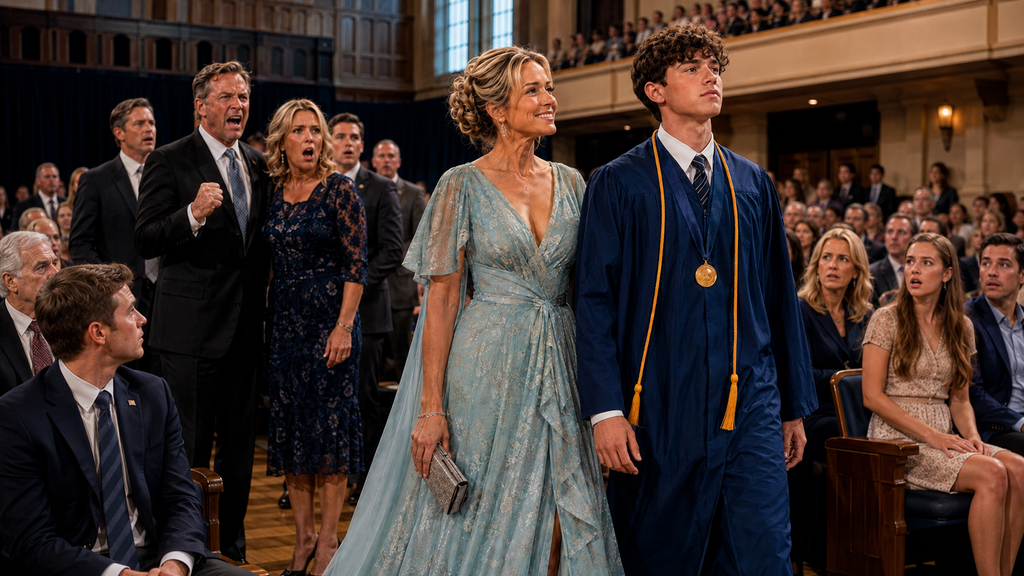
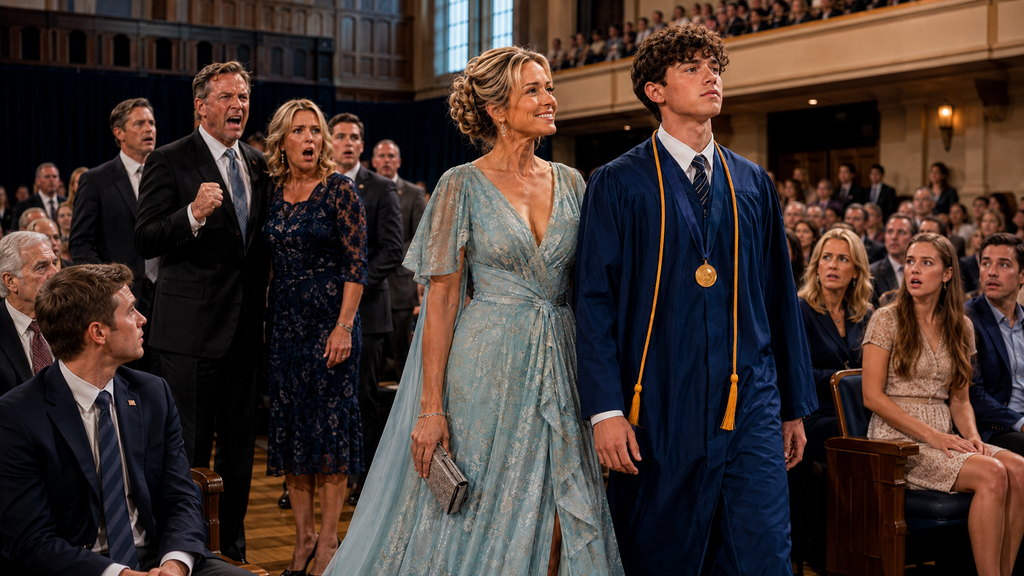
Then the graduating class entered.
Everyone stood.
And there he was.
Ethan.
My son.
Black graduation gown.
Blue stole.
Hair refusing to stay flat beneath the cap.
Seventeen years vanished.
For a moment, I did not see the young man walking toward his seat.
I saw the newborn sleeping against my chest while Richard packed his belongings.
I saw the toddler with blue icing in his hair.
The seven-year-old asking whether he had been bad.
The nine-year-old dismantling electronics.
The thirteen-year-old holding his first science medal.
The fifteen-year-old opening the mysterious envelope.
Then I saw him as he was now.
Tall.
Confident.
Kind.
Whole.
I pressed my fingers against my mouth.
My mother touched my hand.
“You did good.”
I shook my head.
“We did.”
She smiled.
Then a voice behind me said, “Claire.”
Every muscle in my body tightened.
I turned.
Richard stood at the end of the row.
For one second, I barely recognized him.
Gray touched his temples.
Lines cut deeply around his mouth.
He wore an expensive suit.
But something about him looked tired.
Madison stood beside him.
She was no longer eighteen.
She was thirty-five.
Beautiful still.
Elegant.
But tense.
Richard gestured toward the empty seats behind us.
“May we?”
I faced forward.
“It’s a public ceremony.”
They sat.
My pulse beat painfully in my neck.
Richard leaned slightly forward.
“Where is he?”
I pointed.
Third row of graduates.
Richard followed my hand.
He found Ethan.
His face changed.
Shock first.
Then something that looked almost like pride.
“That’s Ethan?”
I looked at him.
“No.”
Richard frowned.
“What?”
“That’s the son you abandoned.”
He flinched.
It was a small thing.
Years earlier, I would have taken satisfaction in it.
Now I only felt tired.
The ceremony began.
Names.
Awards.
Speeches.
Applause.
Then the principal stepped toward the microphone.
“Our final student speaker is someone whose academic accomplishments are extraordinary, but whose teachers asked me to mention something else.”
I already started crying.
“His kindness.”
The principal smiled toward Ethan.
“In addition to representing this school at national science and engineering competitions, he has spent hundreds of volunteer hours tutoring younger students and helping establish our community technology program.”
My mother squeezed my hand.
“Please welcome Ethan Carter.”
The auditorium erupted.
Ethan stood.
Richard leaned forward.
I did not watch Richard.
I watched my son.
Ethan reached the podium.
He unfolded his speech.
Then he looked directly toward me.
“I was going to begin with a quotation.”
A few people laughed.
“But my mother hates when people use quotations to sound wiser than they are.”
More laughter.
I covered my face.
That was absolutely something I had said.
“So instead, I’m going to begin with the person who taught me what perseverance actually looks like.”
His eyes met mine.
“My mother.”
The applause came quickly.
I shook my head, crying.
Ethan continued.
“She became a single mother at forty-one.”
Richard went still behind me.
“She started over when most people around her expected her to break. She worked. She studied. She raised me. She cared for my grandmother. She attended every school conference, every competition, every ridiculous presentation I made about weather stations and robots.”
Laughter.
“She never taught me that success means proving someone else wrong.”
His voice softened.
“She taught me that success means refusing to let someone else’s decision become the definition of your life.”
I could barely breathe.
“When I was seven, I asked my mother whether my father had left because I was bad.”
The room became quieter.
Richard shifted.
“My mother could have taught me to hate him.”
Ethan paused.
“She didn’t.”
I closed my eyes.
“She told me something simple. Adults sometimes make selfish choices.”
A few people murmured.
“For years, that answer frustrated me because I wanted something bigger. I wanted a reason dramatic enough to explain why a parent could disappear.”
Ethan looked toward Richard.
Then he said, “Eventually, I learned there is not always a dramatic explanation for abandonment.”
Richard stared at him.
“Sometimes people leave because they choose themselves.”
Ethan took a breath.
“And the child who is left behind spends years trying to solve a question that was never theirs to answer.”
Silence.
“If anyone here has ever been abandoned, rejected, underestimated, or made to believe someone else’s absence proves something about your value, I hope you remember this.”
His voice remained steady.
“Their absence is information about them.”
He paused.
“It is not a verdict on you.”
The applause began slowly.
Then spread.
I was crying openly now.
Even my mother had both hands over her face.
Ethan continued.
“I used to want my father to see what I became.”
Richard looked down.
“I thought that would be victory.”
Another pause.
“But standing here today, I realize I don’t need anyone who left me to approve of the person who stayed.”
He looked at me.
“My mother stayed.”
Then at my grandmother.
“My grandmother stayed.”
Then toward his teachers.
“My teachers stayed. My friends stayed. People who had no obligation to love me showed up again and again.”
His voice cracked for the first time.
“And I learned that family is not the person whose name appears on your birth certificate.”
He swallowed.
“Family is the person who keeps showing up after showing up becomes inconvenient.”
The entire auditorium stood.
I could not hear anything except applause.
Richard sat behind me.
He did not stand.
When Ethan finished, he stepped away from the podium.
For a moment, his eyes met Richard’s.
Then Ethan smiled.
Not triumphantly.
Not cruelly.
Just calmly.
And walked back to his seat.
That was when I understood.
Richard had already lost.
Nothing that happened with the investigation could punish him more deeply than this:
His son no longer needed him.
PART 7 — THE ENVELOPE
After the ceremony, families poured into the courtyard.
Flowers exchanged hands.
Parents cried.
Students took photographs.
My mother hugged Ethan first.
Then I did.
I held him so tightly he laughed.
“Mom.”
“I know.”
“Breathing.”
“I know.”
“Still need it.”
I finally released him.
His eyes were wet.
“Was the speech too much?”
“Yes.”
His face fell.
I touched his cheek.
“Perfectly too much.”
He laughed.
Then his expression changed.
He looked over my shoulder.
Richard was approaching.
Madison followed several steps behind.
Ethan became still.
I touched his arm.
“You don’t have to do this.”
“Yes, I do.”
“No.”
I looked at him carefully.
“You want to.”
He thought about that.
Then nodded.
“I want to.”
Richard stopped a few feet away.
For the first time in seventeen years, father and son stood face-to-face long enough to study each other.
Richard spoke first.
“Congratulations.”
“Thank you.”
“You’ve done well.”
Ethan almost smiled.
“I’ve done more than well.”
Richard flinched.
Then nodded.
“Yes. You have.”
Silence stretched between them.
Richard glanced at me.
“You raised him well.”
I answered quietly.
“He raised parts of himself.”
Richard looked back at Ethan.
“I know I made mistakes.”
Ethan’s face remained calm.
“No.”
Richard frowned.
“You made choices.”
My breath caught.
Those were the exact words I had once said to Richard when Ethan was three.
I had forgotten them.
Ethan had not.
Richard swallowed.
“I was young.”
“You were forty-six.”
Madison looked away.
Richard’s jaw tightened.
“I mean I was in a different place emotionally.”
Ethan nodded.
“I understand.”
Richard seemed relieved.
Then Ethan continued.
“Understanding is not the same as excusing.”
The relief disappeared.
“I don’t expect you to forgive me.”
“I already did.”
That stopped Richard completely.
“You did?”
“Yes.”
“When?”
“I don’t know.”
Ethan shrugged.
“Somewhere between being angry and getting busy.”
Despite myself, I almost laughed.
Richard stared at him.
Ethan reached into his graduation bag.
He removed the thick envelope.
He handed it to Richard.
“What is this?”
“Something you should read.”
Richard saw the words on the front.
FINAL NOTICE — EVIDENCE ENCLOSED
His face lost its color.
Madison stepped closer.
“What is that?”
Richard did not answer.
He opened the envelope.
Inside were copies of records.
Transfers.
Corporate filings.
Emails.
A letter from Samuel Whitaker.
Richard’s hands began trembling.
His eyes snapped toward Ethan.
“Where did you get these?”
“The originals are not mine.”
“Whitaker.”
“Yes.”
Richard looked at me.
“You let him do this?”
I felt something almost like disbelief.
“He is not three years old anymore, Richard.”
“You don’t understand what you’ve involved him in.”
Ethan answered.
“She didn’t involve me.”
Richard looked back at him.
“I found you.”
The words seemed to strike Richard harder than shouting would have.
Ethan continued.
“You spent years thinking nobody would ever connect everything because the foundation was dead and the companies were dissolved.”
Richard lowered his voice.
“You have no idea what those documents mean.”
“Then explain them.”
“This is not the place.”
“I’m not asking you to confess to me.”
“Then what do you want?”
Ethan was quiet.
People moved around us.
Graduates laughing.
Families taking photographs.
A child chasing a balloon across the grass.
Finally, Ethan said, “I wanted to see whether you would lie to my face.”
Richard stiffened.
Ethan looked at the papers.
“You did.”
“I haven’t said anything.”
“Exactly.”
Madison reached for the envelope.
“Richard, what is this?”
“Nothing.”
One word.
Nothing.
I felt the past hit me so hard I almost stopped breathing.
Nothing.
The word people use when the truth is too expensive.
Madison looked at him.
“This doesn’t look like nothing.”
“Stay out of it.”
Her expression changed.
“What do you mean?”
“Madison.”
She grabbed one of the pages.
Her eyes scanned it.
Then widened.
“This account has my name.”
Richard snatched the page away.
“Not here.”
Her voice rose.
“Why does this account have my name?”
People nearby began looking.
I stepped toward Ethan.
“We’re leaving.”
Richard looked at me.
“You think you won?”
I stopped.
Seventeen years earlier, that question might have mattered.
I turned around.
“No.”
He seemed surprised.
“This was never a competition.”
“You wanted me destroyed.”
I almost laughed.
“Richard, I spent years wanting you to regret leaving.”
I looked at Ethan.
“Then I got busy living.”
His face tightened.
“You don’t understand what happens next.”
“Neither do you.”
That was when two people in plain clothes approached from across the courtyard.
They did not handcuff Richard.
There was no dramatic public arrest.
Real life was quieter than that.
One introduced himself and asked Richard to contact counsel regarding an ongoing financial inquiry.
The other handed him a card.
Richard stared at it.
His shoulders dropped.
Just slightly.
But I saw it.
The great, frightening man who had occupied so much space in my memories suddenly looked ordinary.
Old.
Tired.
Afraid.
Ethan saw it too.
Richard looked toward him.
“Did you do this?”
Ethan shook his head.
“No.”
“Then who?”
“Your choices.”
Richard stared.
Ethan continued.
“I didn’t create the transfers.”
“I didn’t create the shell companies.”
“I didn’t sign anything.”
“I didn’t hide records.”
His voice softened.
“I just stopped protecting you from the truth.”
Madison stepped away from Richard.
A visible physical step.
It was almost symbolic.
She stared at the papers.
“Did you use my accounts?”
Richard turned.
“Madison, not now.”
“Did you?”
“Not now.”
Her eyes filled with something between fear and fury.
For the first time, I wondered whether she knew everything.
Probably not.
People can share a life while living inside completely different versions of it.
I knew that better than anyone.
Richard looked at me again.
“Claire.”
I waited.
“I was wrong.”
Four words.
Once, I had imagined them thousands of times.
During sleepless nights.
During birthdays he missed.
During school events where fathers stood beside their children.
During every moment Ethan asked questions I could not answer.
I had dreamed of Richard appearing at my door and saying:
I was wrong.
I thought hearing it would heal something.
Now the words reached me and found nothing open.
The wound had already scarred.
“I know,” I said.
His eyes filled.
“I mean about you.”
“I know.”
“And Ethan.”
I looked at my son.
“I know.”
Richard turned toward him.
His voice broke.
“Son.”
Ethan’s face tightened slightly.
“I’m sorry.”
Ethan nodded.
“I believe you.”
Richard looked surprised.
“Do you?”
“Yes.”
“Then maybe we can—”
“No.”
The word was gentle.
Richard stopped.
Ethan took a breath.
“I forgive you.”
Richard’s eyes filled with hope.
“But forgiveness doesn’t mean you get the years back.”
The hope disappeared.
“It doesn’t mean you get to become my father because you finally regret choosing not to be one.”
Richard looked down.
“I don’t know what you want me to say.”
“Nothing.”
Ethan’s voice trembled now.
“For once, I don’t need you to say anything.”
Richard looked at him.
“I grew up without you.”
A tear slipped down Ethan’s cheek.
“And I became someone anyway.”
Richard’s face crumpled.
Ethan wiped his cheek.
Then corrected himself.
“No.”
He glanced at me.
“At seven, I would have said ‘anyway.’”
He looked back at Richard.
“But I understand now.”
His voice steadied.
“I didn’t become someone despite not having you.”
He took a breath.
“I became myself because of the people who actually stayed.”
Richard could not answer.
Neither could I.
PART 8 — WHAT THE INVESTIGATION FOUND
The investigation lasted more than a year.
There was no single dramatic courtroom confession.
No judge slamming a gavel while Richard suddenly admitted everything.
Truth arrived the way truth often does.
Slowly.
Through records.
Depositions.
Bank statements.
Emails.
Old witnesses.
People who finally decided silence was more expensive than speaking.
The Cedar Foundation had indeed been used to move money.
Some transfers were legitimate.
Others were not.
Several shell companies received funds for services that investigators could not verify.
Richard had benefited directly and indirectly.
Madison had been tied to accounts created when she was young, though investigators ultimately concluded she had not understood the full structure at the time many of them were opened.
She cooperated.
That ended her marriage to Richard.
I did not celebrate.
By then, I had learned that another woman’s humiliation did not restore anything stolen from me.
Samuel testified.
Former employees testified.
Accountants reconstructed old transactions.
Eventually, Richard entered a negotiated agreement involving financial penalties, restitution, and criminal consequences related to specific fraudulent transactions.
The newspapers covered it briefly.
To everyone else, he became a headline.
To me, he had been a twenty-two-year marriage.
To Ethan, he had been an unanswered question.
Headlines could never explain that.
One afternoon, months after the graduation, Richard wrote Ethan a letter.
Ethan brought it into the kitchen.
“Do you want to read it?”
“No.”
He looked surprised.
“You don’t?”
“It’s yours.”
“What if he lies?”
“Then you’ll know.”
“What if he doesn’t?”
“Then you’ll know that too.”
Ethan sat at the table.
He opened the letter.
I made coffee.
He read silently for almost ten minutes.
When he finished, he folded it.
“What did he say?”
Ethan stared at the paper.
“He said he remembers holding me in the hospital.”
I waited.
“He said for years he told himself leaving was better because I was too young to remember him.”
His eyes filled.
“He said eventually that became the excuse he needed because coming back would mean admitting what he had done.”
I sat beside him.
“What else?”
“He said Madison made him feel young.”
I almost smiled sadly.
“That sounds like him.”
“He said you made him feel responsible.”
I nodded.
“That sounds like him too.”
Ethan looked angry.
“He wrote that like responsibility was a bad thing.”
“For some people, responsibility feels like a mirror.”
“What does that mean?”
“It shows them who they really are.”
Ethan looked down.
“He said he kept thinking he would contact me when he got his life together.”
“And?”
“He never did.”
“No.”
“He said every year made it harder.”
“That part I believe.”
Ethan stared at the letter.
“Should I write back?”
“Do you want to?”
“I don’t know.”
“Then don’t decide today.”
A week later, he wrote Richard three sentences.
He showed them to me before mailing the letter.
I received your apology.
I hope you become someone who no longer needs excuses.
I am building my own life now.
Nothing else.
No cruelty.
No promise.
No invitation.
No hatred.
Just a boundary.
I looked at my son and realized he had done something I had struggled to do at forty-one.
He had learned that closure does not require reopening the door.
PART 9 — THE LIFE HE THOUGHT I COULDN’T BUILD
Ethan left for university that fall.
I cried for three days.
Not continuously.
I had some dignity.
But enough that my mother finally said, “Claire, he went to college, not war.”
“I know.”
“You have called him six times today.”
“Five.”
“He told me six.”
I stared at her.
“You’re conspiring with him?”
“Yes.”
I laughed.
The house became quieter.
For the first time in seventeen years, my life did not revolve around school schedules.
Lunches.
Science competitions.
Permission slips.
Doctor visits.
Homework.
Applications.
I did not know what to do with myself.
Then something unexpected happened.
I began to remember the woman I had been before Richard.
Not the wife.
Not the mother.
Claire.
I joined a weekend hiking group.
The first time I climbed a hill, my knees reminded me that I was no longer twenty.
I climbed it anyway.
I enrolled in an advanced accounting course.
Then another.
Within two years, I was promoted to financial operations manager.
The woman Richard had dismissed because she was forty-one and unemployed eventually managed a department of thirty-two people.
The irony was not lost on me.
But it was no longer the reason I smiled.
I smiled because I liked my life.
That was better.
My mother became frailer.
Ethan called her every Sunday.
Sometimes he called me afterward.
“Grandma says you’re dating.”
I nearly dropped the phone.
“I am not.”
“She said a man from your hiking group brought you coffee.”
“That is not dating.”
“She sounded confident.”
“Your grandmother believes two people exchanging beverages constitutes engagement.”
Ethan laughed.
There was a man eventually.
His name was Daniel.
A widower.
Kind.
Patient.
Nothing like Richard.
The first time he stayed for dinner, I was terrified.
Not because I expected betrayal.
Because peaceful love felt unfamiliar.
There were no dramatic promises.
No declarations that he could not live without me.
Daniel simply showed up.
When my mother became ill, he drove her to appointments.
When Ethan came home, Daniel never tried to behave like his father.
He asked about university.
Listened.
Helped carry boxes.
That was all.
One evening, Ethan pulled me aside.
“I like him.”
I stared.
“You do?”
“Mom, he fixed Grandma’s porch rail without announcing it.”
“That’s your standard?”
“It’s a strong standard.”
I laughed.
“Also, he looks at you like he actually likes you.”
My throat tightened.
“I would hope so.”
“No.”
Ethan became serious.
“Dad looked at people like he was always measuring what they did for him.”
I had never heard anyone describe Richard so accurately.
Ethan shrugged.
“Daniel looks at you like he’s glad you’re there.”
That became enough for me too.
Years passed.
Ethan graduated university.
Then completed graduate research.
He worked on energy-storage technology.
He became exactly what he had always been:
Curious.
Persistent.
Kind.
Not famous.
Not a billionaire.
Not some ridiculous revenge fantasy where the abandoned child becomes the richest man in the country.
Something better.
Happy.
He had friends.
Work he cared about.
A small apartment filled with books and half-dead plants.
A terrible habit of forgetting laundry in the washing machine.
A girlfriend named Maya who laughed at his science jokes even when nobody else understood them.
A life.
A real one.
And that, more than awards or degrees, became the answer to the question he asked at seven.
Does Dad know what he lost?
Eventually, yes.
But by the time Richard understood, it no longer mattered.
PART 10 — THE DAY RICHARD FINALLY UNDERSTOOD
Five years after Ethan’s high-school graduation, Richard asked to meet him.
Not me.
Ethan.
He had completed the legal consequences connected with the foundation case and had been living quietly.
He sent no demands.
Only a letter.
If you are willing, I would like one hour.
Ethan called me.
“What do you think?”
“What do you think?”
“That’s why I called you.”
“I know.”
“Mom.”
I smiled.
“You’re twenty-two.”
“So?”
“So you’re old enough to make bad decisions without permission.”
“Very comforting.”
“I worked hard on that parenting philosophy.”
He laughed.
Then became serious.
“I think I want to see him.”
“Then see him.”
“Are you upset?”
“No.”
“Really?”
“Yes.”
“Why?”
Because seventeen years earlier, I would have been terrified.
I would have worried Richard could hurt Ethan again.
But children eventually become adults.
Protecting them changes.
Sometimes protection means standing between them and danger.
Sometimes it means trusting them to recognize it.
“You know who you are,” I said.
“Yes.”
“Then he can’t take that from you.”
They met in a small coffee shop.
Ethan told me about it later.
Richard arrived early.
He looked older.
Not defeated.
Just human.
For years, Ethan had imagined him as powerful.
The man who decided who stayed.
Who left.
Who mattered.
Who didn’t.
But when Ethan sat across from him, he saw a sixty-eight-year-old man holding a coffee cup with both hands.
Richard spoke first.
“Thank you for coming.”
Ethan nodded.
Richard looked at him for a long time.
“I’ve followed your work.”
“That’s strange.”
Richard accepted the rebuke.
“I know.”
“What do you want?”
“To know you.”
“You don’t.”
“I’d like to.”
Ethan was silent.
Richard continued.
“I don’t expect you to call me Dad.”
“Good.”
“I don’t expect holidays.”
“Good.”
“I don’t expect forgiveness.”
“I already told you I forgave you.”
Richard nodded.
“I think I finally understand that forgiveness isn’t what I thought it was.”
“What did you think?”
“A way back.”
Ethan looked at him.
“And now?”
“A way for you to move forward without carrying me.”
For the first time, Ethan felt something besides anger or indifference.
Not love.
Not yet.
Maybe never.
But recognition.
Richard finally understood one thing correctly.
They talked for an hour.
Richard asked about Ethan’s childhood.
That hurt.
Because every answer was a reminder of something he had missed.
“My first science fair was in fifth grade.”
Richard nodded.
“What did you build?”
“A filtration system.”
“Did you win?”
“No. It leaked all over the table.”
Richard laughed.
Then his laughter disappeared.
“I wish I’d been there.”
Ethan looked at him.
“You could have been.”
“I know.”
That answer mattered.
No excuse.
No explanation.
Just:
I know.
Richard asked about college.
About Maya.
About my mother.
When Ethan told him Grandma had died the previous winter, Richard covered his face.
“She was good to me once.”
“She was good to everybody.”
“Did she hate me?”
“No.”
Richard looked surprised.
“She thought hating you would take time away from loving us.”
Richard cried.
Quietly.
Ethan let him.
At the end of the hour, Richard said, “There’s one thing I need you to know.”
“What?”
“When I left your mother, I told myself she was old.”
Ethan’s jaw tightened.
“I know.”
“I told myself forty-one was too late for her to rebuild.”
Richard stared at the table.
“I needed that to be true.”
“Why?”
“Because if Claire could survive me, then leaving her wouldn’t make me powerful.”
Ethan said nothing.
“It would only make me cruel.”
Richard looked up.
“And she survived.”
“Yes.”
“More than survived.”
“Yes.”
Richard smiled sadly.
“So did you.”
Ethan shook his head.
“You still don’t understand.”
Richard frowned.
“What?”
“We weren’t waiting seventeen years to prove we survived you.”
Ethan stood.
“We were living.”
Richard stared up at him.
“That’s the part you missed.”
Then Ethan left.
When he told me that story, I cried.
Not because Richard finally understood.
Because Ethan did.
PART 11 — THE PHOTOGRAPH ON THE REFRIGERATOR
After my mother died, I cleaned out her house.
It was the same small house where Ethan and I had moved when he was six weeks old.
The same bedroom.
The same kitchen.
Different paint.
New appliances.
But when I walked inside, I could still hear echoes.
Ethan laughing.
My mother singing badly while washing dishes.
Me crying quietly after Richard’s attorney called.
The sound of a baby monitor.
The exhaustion.
The fear.
The love.
While clearing the kitchen, I found an old photograph tucked behind a drawer.
Ethan’s first birthday.
Blue cake covered his face.
My mother laughing in the background.
Me kneeling beside him.
On the bottom of the picture, in faded ink, were the words I had written seventeen years earlier.
He chose life.
I sat down on the kitchen floor.
And for the first time, I understood those words completely.
Richard had chosen escape.
Madison had chosen excitement.
I had chosen something less glamorous.
Morning feedings.
Work.
Bills.
Diapers.
Exhaustion.
School lunches.
Doctor appointments.
Night classes.
Parent-teacher conferences.
Broken appliances.
Science projects.
College applications.
Ordinary Tuesdays.
Richard thought freedom meant having no obligations.
I learned that love often looks exactly like obligation willingly carried.
Not resentment.
Not martyrdom.
Choice.
Again and again.
I chose Ethan.
My mother chose us.
And eventually, I chose myself.
That was the life Richard never understood.
I took the photograph home.
Years later, it still sits on my bookshelf.
Not because it reminds me of Richard.
It doesn’t.
It reminds me of the moment when everything looked ruined but wasn’t.
There is a difference between a life breaking and a life changing shape.
At forty-one, I could not see that.
I thought Richard had taken my future.
He had taken the house.
The marriage.
The plan.
The version of old age I had imagined.
But he had not taken my future.
He had simply removed himself from it.
The rest belonged to me.
PART 12 — THE ONLY REVENGE I EVER NEEDED
People sometimes ask whether I considered Ethan’s graduation revenge.
No.
Revenge would have required Richard to remain the center of our story.
He wasn’t.
The graduation was not powerful because Richard sat there watching.
It was powerful because Ethan would have walked across that stage exactly the same way if Richard had never come.
That is freedom.
For years, I thought the greatest punishment Richard could receive would be losing money.
Losing Madison.
Facing investigators.
Watching his reputation collapse.
I was wrong.
The most painful consequence was simpler.
He eventually became capable of understanding what he had thrown away.
He had wanted youth.
Freedom.
A life without diapers.
Without midnight feedings.
Without responsibility.
Without a forty-one-year-old wife whose body had changed after pregnancy.
He looked at me and saw age.
He looked at Ethan and saw obligation.
Then he spent seventeen years discovering something neither money nor youth could replace.
Time.
He missed Ethan’s first steps.
His first day of school.
His first science fair.
The missing front tooth.
The broken wrist from falling off a bicycle.
The seventh birthday when Ethan insisted dinosaurs could still be alive “if they were extremely organized.”
The eighth-grade dance he was terrified to attend.
The first competition.
The scholarship.
The ordinary dinners.
The arguments.
The laughter.
The boring moments.
Especially the boring moments.
Because those are the moments that become a childhood.
Richard thought parenthood was something he could postpone until he felt ready.
But childhood did not wait.
Ethan grew.
And the little boy who once stood at a window asking whether Daddy was coming back became a man who no longer needed an answer.
That was not revenge.
It was consequence.
As for me?
Richard told me forty-one was too old to start again.
I am grateful I believed him for only one night.
Because at forty-one, my life was not over.
It was beginning.
I raised a son.
Built a career.
Cared for my mother.
Found friends.
Learned.
Failed.
Started again.
Loved again.
Became stronger.
Became softer too.
I learned that strength is not becoming cold enough that nobody can hurt you.
Strength is remaining capable of love without volunteering to be destroyed by it.
I learned that forgiveness does not mean pretending something did not happen.
It means refusing to keep drinking poison because someone else poured it.
I learned that age is not a verdict.
Abandonment is not a verdict.
Divorce is not a verdict.
Another person choosing someone else is not proof that you were lacking.
And I learned something else.
Children remember who shows up.
Not perfectly.
Not extravagantly.
Consistently.
Years after graduation, Ethan came home one Sunday with Maya.
He was carrying groceries.
She was carrying flowers.
Daniel was outside arguing with the lawn mower.
My mother was gone by then, but her old mixing bowl sat on the kitchen counter.
Ethan put the groceries down.
“What are you making?”
“Dinner.”
“What kind?”
“The kind you will eat without criticizing.”
“That sounds fictional.”
Maya laughed.
Daniel shouted from outside.
“Ethan! Your mother says you know engines!”
“I work in energy storage!”
“Close enough!”
Ethan rolled his eyes and went outside.
I stood at the kitchen window watching them.
Daniel opened the lawn mower.
Ethan crouched beside him.
They argued.
Maya began arranging flowers.
The house filled with noise.
Ordinary noise.
Beautiful noise.
And suddenly, I remembered the day Richard drove away.
I remembered standing in the doorway holding newborn Ethan.
The street empty after his car disappeared.
I remembered whispering:
“You don’t need him.”
Back then, I had been trying to convince myself.
Now I knew I had been wrong in one important way.
A child does need love.
A child needs guidance.
Safety.
Consistency.
Someone who keeps showing up.
Ethan needed all those things.
He simply did not need them from Richard specifically.
Love found him anyway.
Through me.
Through my mother.
Teachers.
Friends.
Mentors.
Later, through Daniel.
Through the family he built for himself.
That evening, we ate dinner around my table.
Ethan told a ridiculous story about one of his coworkers.
Maya laughed so hard she spilled water.
Daniel pretended not to notice that Ethan had fixed the mower in ten minutes after he spent two hours failing.
I looked around.
And I thought about Richard.
Not with anger.
Not with sadness.
Just briefly.
He had once believed leaving us would give him a better life.
Perhaps for a while, he believed it had.
But the life he abandoned did not freeze in place waiting for him.
It grew.
It changed.
It became full.
And that, finally, was the lesson.
When someone leaves you, you may believe they have taken the ending with them.
They haven’t.
They have only removed themselves from the next chapter.
You still get to write the rest.
Later that night, after everyone left, Ethan lingered near the door.
“Mom?”
“Yes?”
“Do you ever wish things had happened differently?”
I knew what he meant.
Richard.
The marriage.
His childhood.
All of it.
I thought carefully.
“I wish you had never been hurt.”
He nodded.
“And you?”
“I wish I had recognized certain things sooner.”
“Do you wish Dad stayed?”
I looked at him.
“No.”
Ethan seemed surprised.
“Really?”
“If the man he became had stayed in our house, I don’t know whether staying would have been kinder.”
He considered that.
“So you’re glad he left?”
“No.”
I smiled.
“I’m glad we didn’t stop living after he did.”
Ethan smiled back.
Then he hugged me.
He was taller than Richard now.
Taller than me.
For a moment, I could still feel the weight of the six-pound baby I had once carried against my chest.
“Love you, Mom.”
“I love you too.”
He started toward his car.
“Ethan?”
He turned.
“Yeah?”
“Do you remember asking me when you were seven whether your father knew what he lost?”
He laughed softly.
“Kind of.”
“I think I finally know the answer.”
“What?”
“Yes.”
He waited.
I smiled.
“He knows.”
Ethan looked toward the ground.
Then back at me.
“And does that make you happy?”
I thought about it.
Once, it would have.
Once, Richard’s regret would have felt like justice.
But now?
“No.”
Ethan smiled.
“Good.”
“Why good?”
“Because it means he doesn’t get to decide whether you’re happy anymore.”
My eyes filled.
“You know, for someone who used to dismantle perfectly good kitchen appliances, you became annoyingly wise.”
“They were not perfectly good.”
“My toaster never recovered.”
“It was limiting itself.”
I laughed.
He hugged me again.
Then he drove away.
I stood beneath the porch light until his taillights disappeared.
Seventeen years earlier, I had watched another car disappear down another street.
That night had felt like an ending.
This one did not.
Because now I understood the difference.
Some departures leave emptiness.
Others leave room.
Richard left me at forty-one because he believed my best years were behind me.
He believed youth was something you could steal by standing beside someone younger.
He believed responsibility was a cage.
He believed a newborn child was something he could walk away from and return to when convenient.
He believed I would fail without him.
He was wrong about all of it.
The greatest revenge was never his investigation.
It was never his lost money.
It was never Madison leaving.
It was never hearing him admit, “I was wrong.”
The greatest revenge was waking up one ordinary morning and realizing I no longer wanted revenge.
I had something better.
A son who knew he was loved.
A home filled with memories.
A career I built myself.
People who stayed.
A heart that survived without becoming hard.
And a life that belonged completely to me.
Richard had spent years believing he escaped a burden.
What he actually abandoned was the best part of his own life.
And while he was chasing a younger face in the hope of escaping age, I was learning something he discovered far too late:
Growing older is not the tragedy.
Growing older without appreciating the people who loved you is.
I was forty-one when Richard walked away.
He thought that was the end of my story.
It wasn’t.
It was the first page I finally wrote without him.
And seventeen years later, when our son crossed that graduation stage, I did not look at Richard to see whether he regretted leaving.
I looked at Ethan.
My miracle.
My little boy.
My grown son.
The child who once asked whether his father left because he was not good enough.
The child who grew into a man who knew better.
And as he stood beneath those lights with his diploma in his hand, I finally understood something I wish I could have whispered to the frightened woman I had been at forty-one.
You are going to survive this.
But survival will only be the beginning.
One day, you will stop measuring your life by the man who left.
One day, your son will stop wondering why he wasn’t chosen.
One day, this pain will become a story you can remember without bleeding.
One day, you will understand that being abandoned does not make you disposable.
And one day, the person who underestimated you may finally understand exactly what they lost.
But by then…
you will be far too busy loving the life you built to care.
I closed the front door.
Turned off the porch light.
And walked back into my home.
Not Richard’s home.
Not the house he once threatened to take.
Mine.
On the bookshelf sat Ethan’s first birthday photograph.
Blue icing.
Tiny hands.
A ridiculous smile.
Beneath it were the three words I had written when I was still frightened, broke, exhausted, and uncertain of almost everything.
He chose life.
I touched the frame.
Then I smiled.
“So did I.”
And that was the only ending I ever needed.