 Reading Time: 9 minutes
When my fifteen-year-old daughter, Lucy, came home with red, puffy eyes, I knew something was wrong before she said a word. Lucy was not the kind of girl who cried easily. She was soft-hearted, yes, but she had a quiet strength about her. She was the girl who helped younger kids find their classrooms on the first day of school. The girl who saved half her lunch money to buy birthday gifts for friends. The girl who apologized to spiders before carrying them outside.
But that afternoon, she walked through the front door with her backpack hanging off one shoulder and her face blotchy from crying.I was standing at the kitchen sink rinsing strawberries.
The moment I saw her, my hands went still.
“Lucy?” I asked. “What happened?”
She shook her head like she did not want to answer.
That scared me more than anything.
She dropped her backpack by the hallway table and wiped her cheek with the sleeve of her hoodie.
“It’s stupid,” she whispered.
“If it made you cry, it isn’t stupid.”
She looked at me then, and her lower lip trembled.
My heart clenched.
For the past week, Lucy had been babysitting for our neighbor, Mrs. Carpenter.
Mrs. Carpenter lived three houses down in the yellow colonial with the white porch swing and the perfect hydrangeas. She had two children, ages four and seven, and she was known around the neighborhood for being very particular.
Particular about her lawn.
Particular about where people parked.
Particular about whose dogs barked too much.
But she had always been polite enough to us.
A week earlier, she had stopped Lucy on the sidewalk and asked if she wanted to earn some money before school started again.
Eleven dollars an hour, she said.
Four hours a day.
Monday through Friday.
Lucy was thrilled.
She had been saving for a used laptop, one that could handle the art programs she loved. I was proud of her for wanting to earn the money herself, and Mrs. Carpenter’s house was close enough that I felt comfortable letting her go.
Every day, Lucy came home tired but smiling.
She told me how she made sandwiches for the kids, cleaned up toys, read bedtime stories, and even folded laundry because Mrs. Carpenter seemed overwhelmed.
On Friday evening, she was supposed to be paid.
Two hundred and twenty dollars.
To a grown adult, maybe it was not life-changing money.
To Lucy, it was proof that her effort mattered.
Now she stood in front of me, crying.
“What happened?” I asked again, more gently this time.
Lucy swallowed hard.
“Mrs. Carpenter didn’t pay me.”
I blinked.
“What do you mean she didn’t pay you?”
“She said…” Lucy’s voice cracked. “She said it was a life lesson.”
My fingers tightened around the strawberry bowl.
“A life lesson?”
Lucy nodded.
“She said I should have gotten things in writing and that I should never trust someone’s word. Then she said hard work was payment enough because I learned responsibility.”
For a moment, I could not speak.
The kitchen felt suddenly too quiet.
“What exactly did she say?” I asked.
Lucy hugged her arms around herself.
“She said, ‘Honey, in the real world, nobody owes you anything just because you think they do. Next time, be smarter.’ Then she closed the door in my face.”
My vision sharpened.
There are many kinds of anger.
There is loud anger that makes you yell.
There is hot anger that makes you shake.
Then there is the cold kind.
The kind that settles deep and still inside your chest.
That was the kind I felt.
Because this was not just about money.
This was about an adult woman choosing to humiliate a child who had trusted her.
A child who had worked.
A child who had done everything right except assume that a grown woman’s promise meant something.
Lucy whispered, “I’m sorry, Mom. I should have asked her to write it down.”
I crossed the kitchen and pulled her into my arms.
“No,” I said firmly. “You did nothing wrong.”
“But she said—”
“She said what cheaters always say when they get caught in their own ugliness. She tried to make you feel foolish because she didn’t want to feel guilty.”
Lucy started crying harder.
I held her until the shaking eased.
Then I went to my purse, counted out two hundred and twenty dollars, and placed it in her hands.
Her eyes widened.
“Mom, no. That’s not your fault.”
“It’s not your fault either,” I said. “You earned this.”
She stared down at the money like she was afraid to touch it.
“But Mrs. Carpenter—”
“Mrs. Carpenter is going to learn her own lesson.”
Lucy’s face changed.
“Please don’t make it worse.”
I brushed hair away from her face.
“Sweetheart, sometimes silence makes it worse. People like her count on good kids being too embarrassed to fight back.”
That night, after Lucy went to bed, I sat at the dining room table with my laptop open.
I was not reckless.
I did not storm over there screaming.
I did not post angry messages online.
I gathered facts.
First, I opened Lucy’s phone with her permission.
Mrs. Carpenter had texted her the schedule.
Monday through Friday, 1 p.m. to 5 p.m.
Thank you so much, Lucy. You’re a lifesaver.
The texts did not mention the hourly rate, but they confirmed the workdays.
Then I checked our doorbell camera.
There was Lucy leaving each day at 12:52 and coming back around 5:08.
Next, I remembered something important.
Mrs. Carpenter had a camera on her front porch.
So did Mr. Avery across the street.
And Mrs. Diaz next door.
Our little neighborhood had more cameras than a jewelry store.
I printed the screenshots from the texts.
I printed the time stamps from my doorbell app.
Then I searched the neighborhood group chat.
There it was.
On Wednesday evening, Mrs. Carpenter had posted:
Huge thanks to sweet Lucy for helping with my kids this week. Couldn’t survive without her!
Several neighbors had liked it.
I printed that too.
By midnight, I had a folder.
By morning, I had a plan.
At breakfast, Lucy barely touched her cereal.
“Are you really going over there?” she asked.
“Yes.”
“Mom…”
“I’m not going to scream. I’m not going to embarrass you. But I am going to show you something important.”
“What?”
“That kindness does not mean letting people steal from you.”
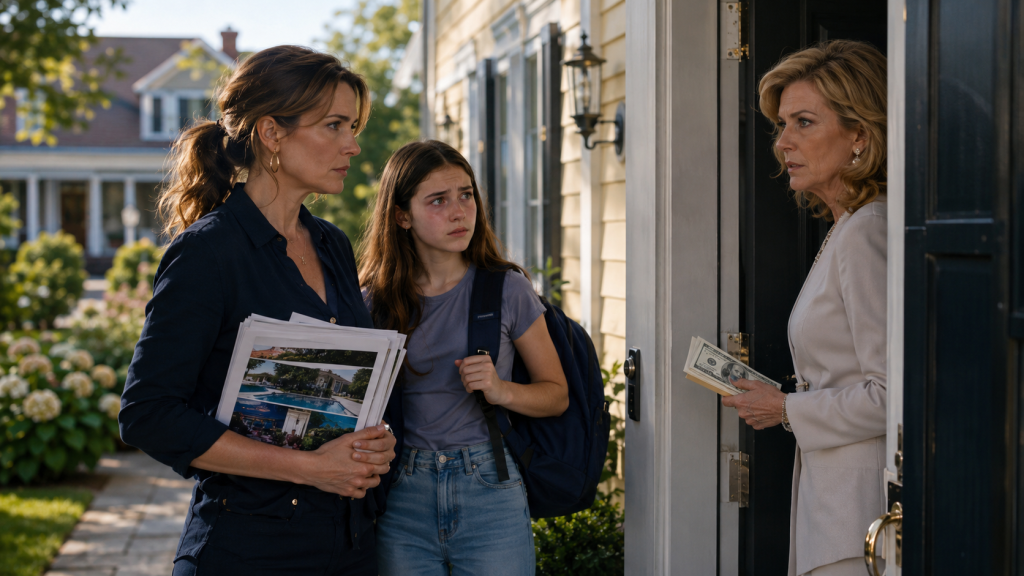
At nine o’clock, I walked down the street with the folder under my arm.
Lucy followed reluctantly, staying half a step behind me.
Mrs. Carpenter’s house looked perfect in the morning sun.
Freshly swept porch.
Two hanging baskets.
A cheerful welcome mat.
It annoyed me how pretty it all looked.
I rang the bell.
A few seconds later, Mrs. Carpenter opened the door.
She was wearing yoga pants, pearl earrings, and the expression of a woman who already believed she was right.
When she saw us, her mouth tightened.
“Oh,” she said. “This again.”
I smiled.
“Yes. This again.”
She glanced at Lucy, then back at me.
“If this is about your daughter, I already explained it to her. She learned a valuable lesson.”
“I agree,” I said.
Mrs. Carpenter blinked, surprised.
“She learned that some adults lie,” I continued. “And she learned that smart women keep records.”
Her face changed slightly.
I opened the folder.
“Lucy worked for you five days, four hours a day, at eleven dollars an hour. That is two hundred and twenty dollars.”
Mrs. Carpenter laughed sharply.
“Do you have a contract?”
“No written contract,” I said. “But I have your texts confirming the schedule. I have video time stamps showing Lucy leaving for and returning from your house. I have your neighborhood post publicly thanking her for helping with your children. And I have Lucy’s written statement.”
Her eyes flicked to the papers.
For the first time, she looked uncertain.
“That proves she helped,” she said. “It doesn’t prove payment.”
“No,” I replied. “But it proves enough for a small claims filing. And it proves enough for the neighborhood to understand what happened.”
Her chin lifted.
“Are you threatening me?”
“I’m giving you a choice.”
I pulled out the final paper.
“This is a small claims complaint I can file Monday morning. And this is a draft message for the neighborhood page. I have not posted it because I wanted to give you the opportunity to do the right thing privately.”
Mrs. Carpenter’s cheeks flushed.
“You would humiliate me over two hundred dollars?”
I stared at her.
“You humiliated a fifteen-year-old over two hundred dollars.”
For a moment, neither of us spoke.
Behind Mrs. Carpenter, I could hear cartoons playing in the living room.
One of her children laughed.
That sound made me even angrier.
Lucy had taken care of those children.
She had fed them, played with them, cleaned up after them, comforted them.
And this woman had looked her in the face and decided her labor was worthless.
Mrs. Carpenter crossed her arms.
“Teenagers need to understand the real world.”
I stepped closer.
“They do. But the real world also has consequences.”
Her eyes narrowed.
“What do you want?”
“I want you to pay my daughter what you owe her.”
“Fine.”
She turned and disappeared into the house.
Lucy grabbed my sleeve.
“Mom, let’s just go after she pays.”
“No,” I whispered.
“What do you mean?”
“You’ll see.”
Mrs. Carpenter returned with cash in her hand.
She tried to give it to me.
I did not take it.
I looked at Lucy.
“You earned it. She pays you.”
Mrs. Carpenter sighed dramatically and held the money out toward Lucy.
“There.”
Lucy reached for it, but I gently stopped her.
“And the apology,” I said.
Mrs. Carpenter looked at me like I had slapped her.
“Excuse me?”
“You heard me.”
“I’m not apologizing.”
“Then I’ll see you in small claims court, and the neighborhood can decide what to think when they read the post.”
Her lips pressed together.
The silence stretched.
Finally, she looked at Lucy.
“I’m sorry,” she said stiffly.
I tilted my head.
“For what?”
Mrs. Carpenter glared at me.
Then, through clenched teeth, she said, “I’m sorry I didn’t pay you when I said I would.”
Lucy stared at her.
Mrs. Carpenter shoved the cash toward her again.
This time Lucy took it.
Her hands were shaking, but she held her head higher.
“Thank you,” Lucy said quietly.
Then she added, “And I won’t babysit for you again.”
Mrs. Carpenter’s mouth fell open.
I almost smiled.
We turned to leave.
But the story did not end there.
By noon, Mrs. Carpenter had posted in the neighborhood group.
Some people really need to teach their children not to exaggerate private matters. Sad how entitled teens are these days.
She did not name Lucy.
But everyone knew.
Lucy saw it first.
She came into my room with her phone in her hand and tears in her eyes again.
“I knew she would do this,” she whispered.
This time, I did not feel cold anger.
This time, I felt done.
I took a breath and wrote one calm reply.
Then I attached the screenshots.
Not all of them.
Just enough.
I wrote:
Since this appears to refer to my daughter, I’ll clarify. Lucy worked five days caring for Mrs. Carpenter’s children after being promised payment. When she asked to be paid, she was told it was a “life lesson” and that hard work was payment enough. Payment was only made this morning after evidence was presented. I am proud of Lucy for working hard, telling the truth, and standing up for herself.
I posted it.
Then I closed my phone and made lunch.
Within twenty minutes, the group chat exploded.
Mrs. Diaz commented first.
I saw Lucy there every day. She was wonderful with the kids.
Mr. Avery wrote:
I have porch footage confirming arrival and departure times if needed.
Another mother wrote:
This is disgusting. Teenagers deserve to be paid for work.
Then another:
Mrs. Carpenter asked my son to mow last summer and “forgot” to pay him too.
Then another.
And another.
By evening, there were six families sharing similar stories.
Small jobs.
Small amounts.
A lawn mowed.
A garage cleaned.
A dog walked.
A teenager “taught a lesson.”
Mrs. Carpenter had not just cheated Lucy.
She had built a habit out of using young people who were too polite to challenge her.
The next morning, someone knocked on our door.
It was Mrs. Carpenter’s husband.
He stood there looking embarrassed, holding an envelope.
“I wanted to apologize,” he said. “I didn’t know she had done this.”
I did not know if I believed him, but I listened.
He handed Lucy the envelope.
Inside was another two hundred and twenty dollars.
Lucy frowned.
“She already paid me.”
“I know,” he said. “This is from me. Not for the work. For the way you were treated.”
Lucy looked at me, unsure.
I nodded.
She accepted it.
Then Mr. Carpenter looked at her and said, “You deserved better from an adult.”
That sentence mattered more than the money.
For the first time since it happened, Lucy smiled.
Not a big smile.
But a real one.
By the end of the week, Mrs. Carpenter had left the neighborhood group.
Parents started making written agreements for teen babysitters, lawn mowing, dog walking, and tutoring.
Mrs. Diaz even created a shared list of trusted neighborhood helpers, with clear rates posted beside each name.
Lucy’s name was at the top.
Babysitting: $15/hour. References available.
Within a month, Lucy had earned enough for her laptop.
Not just from babysitting.
From parents who trusted her.
From families who respected her.
From neighbors who had watched her handle humiliation with grace.
One evening, I found her sitting at the kitchen table, setting up her new laptop.
The screen glowed across her face.
She looked older somehow.
Not hardened.
Just wiser.
“Mom?” she said.
“Yes?”
“I think I understand what you meant.”
“About what?”
“Kindness doesn’t mean letting people steal from you.”
I smiled.
“That’s right.”
She looked down at the laptop, then back at me.
“I still want to be kind.”
My throat tightened.
“Good,” I said softly. “Never let people like Mrs. Carpenter take that from you.”
Lucy nodded.
“But next time,” she said, “I’m getting it in writing.”
I laughed then.
So did she.
And in that moment, the anger I had carried all week finally loosened.
Because Mrs. Carpenter had tried to teach my daughter a cruel lesson.
But she had failed.
Lucy did learn something.
She learned that her work had value.
She learned that her voice mattered.
She learned that being young did not mean being powerless.
And Mrs. Carpenter?
She learned that if you try to cheat someone’s child, you should make sure that child does not have a mother with a printer, screenshots, and absolutely no fear of knocking on your door.
THE END! THANKS FOR READING!