 Reading Time: 39 minutes
PART 3: THE WOMAN IN THE EMPTY CASKET => The morning of my funeral, I stood in front of a hospital mirror and watched a nurse fasten the last button on a black dress.
For several seconds, I did not recognize the woman staring back at me. My face was thinner. There was a healing cut near my temple. Dark shadows sat beneath my eyes.
My body still carried bruises from Ravenstone Cliff, and every time I moved too quickly, pain pulled beneath my ribs.
But I was alive.
That was the part Evan had failed to plan for.
I placed one hand against my stomach by instinct.
Then I remembered.
For nine months, Noah had lived beneath my heart.
Now he was upstairs in the neonatal intensive care unit, sleeping beneath a soft blue blanket, surrounded by monitors and nurses who had fought almost as hard as he had to keep him alive.
My son.
My beautiful, stubborn son.
The son Evan had tried to bury before he had even taken his first breath.
Behind me, Richard Whitmore stood silently.
My father.
Even thinking the word still felt unfamiliar.
Father.
I had spent twenty-nine years believing my biological father had abandoned my mother before I was born.
Now I knew the truth.
Richard had never known she was pregnant.
His father had intercepted letters, destroyed messages, and convinced my mother that Richard had chosen his wealthy family over her.
By the time Richard discovered the truth years later, my mother had disappeared from the life he knew.
He had searched.
She had hidden.
Then life had moved forward without either of them understanding how badly they had been deceived.
And now, after nearly three decades, we had found each other on the side of a mountain while I was bleeding into the snow.
Life had a strange sense of timing.
Richard stepped closer.
“You don’t have to do this today.”
I looked at his reflection in the mirror.
“Yes, I do.”
“The police have enough to arrest Evan.”
“Not everyone.”
Richard was silent.
That was the problem.
Evan had not acted alone.
We had spent the previous two days watching him.
Not physically.
Financially.
Digitally.
Legally.
Every claim request.
Every phone call.
Every authorization.
Every attempt to pressure Whitmore Atlantic Insurance into releasing fifty million dollars before my body had even been recovered.
Somebody inside Richard’s company had been helping him.
And Evan had finally revealed who.
His name was Marcus Hale.
Senior vice president of claims authorization.
A man Richard had trusted for eleven years.
A man who had secretly accumulated more than two million dollars in offshore accounts over the previous eighteen months.
A man who had personally approved unusual policy amendments connected to me only six weeks before my supposed death.
Evan thought he was committing murder for fifty million dollars.
Marcus thought he was stealing ten million of it.
Celeste thought she was about to become the wealthy new woman beside my widowed husband.
They had all planned their futures around my funeral.
So we decided to attend.
Richard watched me carefully.
“Your doctors still think this is too much.”
“My doctors also thought I would need another week before I could walk down a hallway.”
“You nearly collapsed yesterday.”
“I didn’t.”
“You grabbed the wall.”
“That is not collapsing.”
For the first time that morning, the corner of Richard’s mouth moved.
It was almost a smile.
“You are extremely stubborn.”
“My mother used to say the same thing.”
His expression softened.
For a moment, neither of us spoke.
The mention of her always changed the room.
Richard had loved my mother.
I could see that now.
Not with the nostalgic affection of someone remembering an old girlfriend.
With grief.
With regret.
With twenty-nine years of questions that could never fully be answered.
He reached inside his coat and removed something.
A small velvet box.
“What is that?”
“Something that belonged to your mother.”
My breath caught.
He opened it.
Inside was a delicate gold necklace with a tiny sapphire pendant.
I had seen it before.
Not in person.
In photographs.
My mother had worn it when she was nineteen.
Richard lifted it carefully.
“I gave this to her the summer we met.”
“How do you have it?”
“She mailed it back after my father convinced her I was marrying someone else.”
He swallowed.
“I kept it.”
I touched the sapphire.
“She never knew.”
“No.”
“She never knew you wanted her.”
His voice became quieter.
“No.”
That hurt more than I expected.
There are tragedies that come from cruelty.
And then there are tragedies that come from two people being denied the truth.
Those can be even harder to forgive.
Richard held the necklace out.
“I thought you should have it.”
I turned.
He placed it around my neck.
When the sapphire settled against my skin, I closed my eyes.
For one second, I could almost smell my mother’s lavender hand cream.
I could almost hear her singing while washing dishes.
I could almost feel her fingers brushing my hair away from my face when I was little.
I opened my eyes before the tears could fall.
“Let’s go to my funeral.”
The Cathedral of Saint Michael sat at the center of the city like something carved from another century.
Gray stone.
Tall stained-glass windows.
Wide marble steps.
Black iron gates.
By eleven o’clock, satellite trucks were already parked outside.
That was Evan’s idea.
Of course it was.
My disappearance had become national news almost immediately.
Pregnant heiress missing in mountain tragedy.
Beloved husband waits for miracle.
Search suspended after severe weather.
Then, finally:
Husband mourns wife and unborn son.
Evan had spent three days becoming famous for grieving me.
He had given interviews.
He had cried on camera.
He had stood beside rescue workers and thanked them for “bringing dignity to the search.”
He had released one of our wedding photographs to the press.
He had even posted a statement online.
Madison was the center of my world. I will spend the rest of my life loving her and the son we never got to meet.
I had read it from my hospital bed while Noah slept two floors above me.
I had never hated him more.
The man who had pushed me from a cliff had turned himself into the grieving husband of the year.
Richard’s car stopped behind the cathedral, out of sight of reporters.
Detective Sarah Moreno was waiting near a private entrance.
She had been assigned to my disappearance before anyone realized there had been a crime.
The moment Richard informed her I was alive, everything changed.
Now she had an audio recording taken from my smartwatch.
Evan’s voice.
Celeste’s voice.
The wind.
My scream.
And the words that had come before I fell.
Fifty million reasons to stop pretending this marriage matters.
Evan did not know the watch had automatically synchronized thirty-seven seconds of audio to my phone before losing connection.
Thirty-seven seconds.
That was all it took to destroy his version of events.
Moreno looked me over.
“You still sure?”
“Yes.”
“We can arrest him without the theater.”
“This isn’t theater.”
I looked toward the cathedral wall.
“It’s evidence.”
She nodded.
Because she understood.
Evan believed he had won.
Marcus believed the payment was coming.
Celeste believed she had inherited my life.
If we arrested Evan quietly, they might all turn on each other immediately.
But if we allowed them to believe the money was about to be released?
They might expose everything themselves.
And they had.
Earlier that morning, Marcus had sent Evan a message from a private number.
Settlement authorization complete after memorial. Funds available within seventy-two hours.
Evan had responded:
Finally. Celeste is losing patience.
Marcus:
She should be grateful. Without me you’d both be broke and under investigation.
Evan:
You’ll get your ten.
Marcus:
Make sure I do.
It was almost disappointing how easy greed made people careless.
Moreno touched her earpiece.
“Everyone is in position.”
Richard offered me his arm.
I stared at it.
“You don’t have to walk me in.”
His expression changed.
“I missed your first steps.”
The words hit me so hard I stopped breathing.
He continued softly.
“I missed your first day of school.”
My eyes filled.
“I missed every birthday.”
He looked toward the cathedral doors.
“I missed the day you got married because I didn’t know you existed.”
His voice cracked slightly.
“But if you’re going to walk into that building and take your life back, Madison…”
He extended his arm again.
“Please let me be there for this one.”
I placed my hand through his arm.
“Okay.”
His hand covered mine.
And together, father and daughter waited outside the doors of my funeral.
Inside, Evan Vale was performing the greatest role of his life.
I learned later that more than six hundred people had attended.
Business associates.
Neighbors.
Reporters.
Politicians.
People I had not spoken to since college.
People Evan had never met.
He had turned my death into an event.
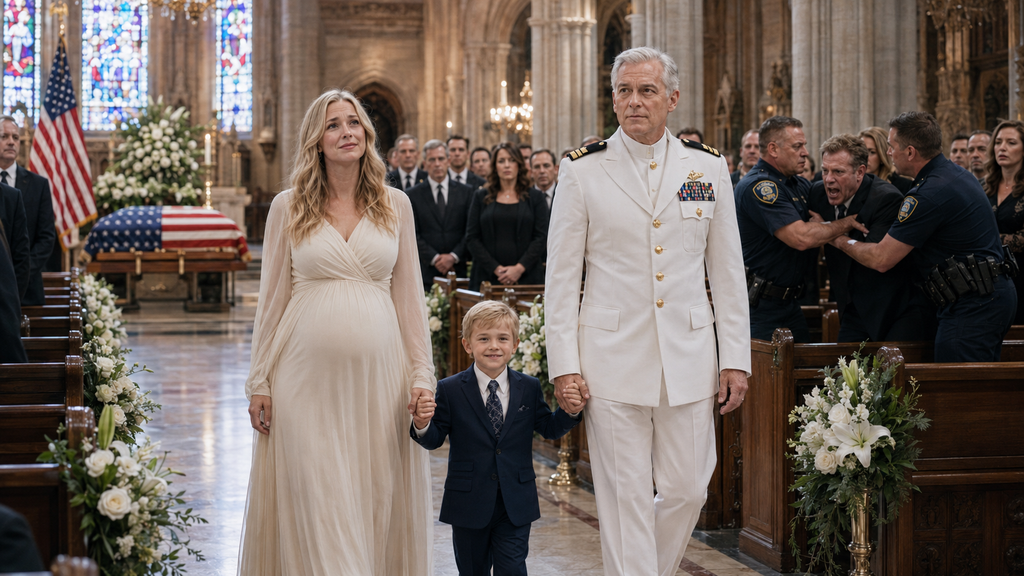
At the front of the cathedral sat a polished white casket.
Empty.
Because my body had supposedly been swallowed by the mountain.
A framed photograph of me rested beside it.
Pregnant.
Smiling.
Alive.
Flowers covered the platform.
White roses.
Lilies.
Hydrangeas.
The flowers from our wedding.
That detail had apparently made several journalists cry.
Evan stood beside the casket wearing a perfectly tailored black suit.
His head was bowed.
His shoulders shook occasionally.
From a distance, he looked destroyed.
Anyone who knew him better would have noticed he kept checking his phone.
Waiting for the insurance confirmation.
Celeste sat in the second row.
Not the first.
Even Evan knew putting his mistress beside him at his wife’s funeral might be considered inappropriate.
She wore black.
Large sunglasses.
Diamond earrings.
And my bracelet.
The bracelet had belonged to my grandmother.
My mother gave it to me on my wedding day.
I had worn it almost every day since.
Two months earlier, it disappeared from my jewelry drawer.
Celeste apparently decided my funeral was the perfect occasion to wear it.
That bracelet nearly broke my self-control more than anything else.
Not the casket.
Not Evan.
Not the photographs.
The bracelet.
Because suddenly I could imagine her standing inside my bedroom after I was supposedly dead.
Opening my drawers.
Touching my clothes.
Choosing what she wanted.
Taking pieces of my life as though I had already been erased.
I squeezed Richard’s arm.
He looked down at me.
“Are you all right?”
“No.”
He waited.
I took a breath.
“But I will be.”
Evan walked toward the lectern.
The cathedral became silent.
He unfolded a sheet of paper.
My husband had written a eulogy for the woman he murdered.
“Madison believed in love.”
His voice trembled.
I almost laughed.
“From the day I met her, I knew she was different.”
That part, at least, might have been true.
“She made people feel safe. She made people feel seen.”
Behind the closed doors, I felt Richard stiffen.
Evan continued.
“When we learned we were expecting our son, I thought life had given me everything.”
He stopped.
Covered his mouth.
Looked down.
Perfect timing.
Perfect grief.
Several people in the cathedral began crying.
“I keep thinking about all the moments we will never have.”
My nails dug into my palm.
“Our son’s first steps.”
Richard’s breathing changed beside me.
“His first word.”
My vision blurred.
“His first day of school.”
I pressed my lips together.
Evan’s voice cracked.
“I would give anything to have them back.”
That was enough.
I leaned toward the cathedral attendant.
“Open the doors.”
She hesitated.
Richard nodded.
The heavy wooden doors began to move.
Slowly.
The hinges groaned.
Cold daylight spilled into the cathedral.
At first, nobody understood what was happening.
People turned casually.
Then someone screamed.
Not dramatically.
Not loudly.
Just a sharp, shocked sound from somewhere near the back.
Evan looked up.
His face emptied.
Every trace of grief disappeared.
I stood between the open doors wearing black, one hand resting on Richard Whitmore’s arm.
For several seconds, nobody moved.
Six hundred people stared at a dead woman.
Then whispers erupted.
“Oh my God.”
“That’s Madison.”
“She’s alive.”
“Is that—”
“That’s Richard Whitmore.”
“Her father?”
Evan gripped the lectern.
His mouth opened.
Nothing came out.
Celeste ripped off her sunglasses.
Her face turned white.
I looked directly at Evan.
Then at the empty casket.
Then back at him.
“You started without me.”
A gasp moved through the cathedral.
Cameras came up.
Reporters surged from their seats.
Detective Moreno’s officers immediately stepped into the aisles.
“Remain seated!”
Evan stumbled backward.
“Madison?”
I walked forward.
Every step hurt.
I did not care.
“Hello, Evan.”
His eyes moved over me as though searching for proof that I was not real.
“You’re…”
“Alive?”
He swallowed.
“How?”
There were so many answers I could have given him.
Because you failed.
Because my son fought.
Because the mountain did not want me.
Because fate has a cruel sense of humor.
Instead, I smiled faintly.
“You should have checked.”
A ripple of shocked laughter moved through the room.
Evan’s expression hardened for half a second.
There he was.
The real man.
Then he remembered the cameras.
His face collapsed into relief.
He came down from the platform.
“Oh my God.”
He opened his arms.
“Madison.”
I stopped.
“Don’t.”
He froze.
People were recording everything now.
“I thought you were dead.”
“I know.”
“I searched for you.”
“No.”
His eyes flickered.
“The rescue teams—”
“You left me.”
“That’s not what happened.”
“You watched me fall.”
“Madison, you were confused. There was a storm.”
He started toward me again.
Detective Moreno stepped into his path.
Evan stared at her.
“What is this?”
I answered.
“This is the part of the funeral you didn’t plan.”
Celeste stood.
“I’m leaving.”
Two officers immediately moved toward her.
“Ms. Laurent, remain where you are.”
Her face changed.
“I haven’t done anything.”
I looked at her wrist.
“My bracelet says otherwise.”
She covered it automatically.
The gesture was so instinctive that half the room noticed.
“This?”
She laughed nervously.
“Evan gave it to me.”
The cathedral erupted.
Celeste’s eyes widened.
She realized what she had admitted.
I turned toward Evan.
“That was quick.”
He looked furious.
Not ashamed.
Not frightened.
Furious.
At her.
At me.
At the entire situation for refusing to follow his script.
He lowered his voice.
“Madison, whatever you think happened, we should discuss this privately.”
“We were private on Ravenstone Cliff.”
His jaw tightened.
“I never pushed you.”
The cathedral became completely still.
He had made the mistake himself.
Nobody had publicly accused him of pushing me yet.
Not until then.
Detective Moreno noticed.
So did every reporter in the building.
I raised an eyebrow.
“Interesting.”
Evan’s face changed.
“What?”
“I only said we were on Ravenstone Cliff.”
Silence.
“You’re the one who mentioned pushing.”
Celeste whispered something I could not hear.
Evan turned toward her.
“Shut up.”
There it was again.
The mask slipping.
I looked toward Richard.
He nodded.
A large screen behind the altar flickered on.
Evan turned.
“What are you doing?”
Richard finally spoke.
His voice filled the cathedral without effort.
“My name is Richard Whitmore.”
As if anyone needed the introduction.
“I am the chairman and chief executive of Whitmore Atlantic Insurance Group.”
Marcus Hale sat twelve rows from the front.
I saw him immediately.
He had been invited as the senior executive representing the company handling my policy.
He started to stand.
Two officers moved beside him.
Richard continued.
“Three days ago, my company received a claim related to the presumed death of Madison Vale.”
Evan looked around wildly.
“This is insane.”
Richard ignored him.
“The policy value was fifty million dollars.”
Another wave of whispers filled the cathedral.
“Mr. Vale requested expedited payment within hours of the search being suspended.”
Evan shouted, “My attorney handled that!”
Richard looked at him.
“Your attorney denies that.”
Evan stopped.
“And unfortunately for you,” Richard continued, “our internal audit discovered irregular activity surrounding the policy.”
Marcus turned toward the aisle.
“Sir, I think this conversation should happen through counsel.”
Richard’s gaze moved to him.
“Hello, Marcus.”
Marcus froze.
Richard looked almost disappointed.
“You worked for me for eleven years.”
“Richard—”
“You attended my birthday dinners.”
Marcus said nothing.
“You sat across from me after my bypass surgery and told me loyalty mattered more than money.”
“Richard, whatever you think—”
“Ten million dollars.”
Marcus’s face went gray.
The entire cathedral reacted.
Richard continued.
“That was your price?”
Marcus looked toward Evan.
Evan immediately shook his head.
“No.”
Marcus stared at him.
Evan said louder, “I don’t know what he’s talking about.”
Marcus’s expression changed.
And there it was.
The beautiful moment when criminals realize loyalty was never part of the agreement.
Marcus laughed once.
It sounded almost broken.
“You son of a bitch.”
Evan pointed at him.
“I barely know this man.”
Marcus lunged halfway into the aisle.
“You called me twenty-three times in two months!”
Officers caught him.
The cathedral exploded into noise.
Evan shouted, “He’s lying!”
Marcus shouted back.
“I rewrote the beneficiary safeguards for you!”
Richard did not move.
Neither did I.
Marcus was destroying himself faster than any prosecutor could have hoped.
“You told me she’d be dead before February!”
Evan’s face became colorless.
Celeste started crying.
Not grieving.
Panicking.
“Stop talking!”
Marcus turned toward her.
“You knew too!”
“I knew nothing!”
“You picked the mountain!”
Celeste screamed.
“I DIDN’T KNOW HE WAS ACTUALLY GOING TO PUSH HER!”
Silence.
Absolute silence.
Even Marcus stopped.
Celeste covered her mouth.
I stared at her.
She stared back.
Then her knees gave out.
She collapsed into the pew.
Detective Moreno looked toward one of her officers.
“Got that?”
He nodded.
Every camera in the cathedral had gotten it too.
Evan began walking backward.
Slowly.
Like a trapped animal.
“This is a setup.”
Nobody answered.
He pointed toward me.
“She planned this.”
I almost smiled.
“Yes, Evan.”
His eyes widened.
“I planned being pushed off a mountain nine months pregnant.”
“That’s not what I meant.”
“What did you mean?”
“You’re manipulating everyone!”
He turned toward the crowd.
“She’s always done this! She makes herself the victim!”
Something inside me went very still.
Because I had heard that language before.
Not from him.
From people like him.
People who hurt you and then become offended by your bleeding.
I stepped toward him.
“My son almost died.”
Evan’s mouth closed.
The cathedral seemed to shrink around us.
“My son was delivered by emergency surgery because his heart rate collapsed after I spent two hours bleeding in the snow.”
Evan looked away.
“Noah weighs five pounds, two ounces.”
His eyes snapped back to mine.
For the first time, genuine emotion crossed his face.
Not guilt.
Shock.
“Noah?”
“Yes.”
“Our son?”
I felt rage rise so quickly I almost shook.
“No.”
His face changed.
I repeated it.
“No.”
“Madison—”
“You lost the right to call him yours when you stood above his mother on a cliff and laughed while she fell.”
“He’s my biological child.”
“You tried to kill him.”
His mouth moved.
Nothing came out.
I stepped closer.
“You tried to kill your own son for money.”
He shook his head violently.
“No.”
“Yes.”
“It wasn’t supposed to happen like that.”
A collective gasp filled the cathedral.
Evan froze.
Detective Moreno’s expression sharpened.
I whispered, “How was it supposed to happen?”
He realized his mistake.
“Nothing.”
“No, Evan.”
I moved closer.
“How was my death supposed to happen?”
He stared at me.
“You don’t understand.”
“Explain it.”
“I loved you.”
I laughed.
The sound surprised even me.
“You loved me?”
“Yes.”
“You took out fifty million dollars on my life.”
“That was financial planning.”
“You changed the accidental-death clause.”
“My adviser—”
“You started sleeping with Celeste.”
He said nothing.
“You stole my bracelet for her.”
“I didn’t steal anything.”
“You invited cameras to my funeral.”
“That wasn’t—”
“You filed an insurance claim before rescue teams finished searching.”
He looked away.
“And then you stood in front of an empty casket and told six hundred people you would spend the rest of your life loving me.”
My voice broke.
I hated that.
I wanted to stay strong.
But strength does not mean you stop feeling.
Sometimes strength means your voice shakes and you keep speaking anyway.
I touched the sapphire at my neck.
“You know what I was doing while you wrote that speech?”
Evan stared at me.
“I was sitting beside an incubator asking a nurse whether our baby would survive the night.”
A woman near the front began crying.
“I was watching his tiny chest rise and fall.”
My own tears came now.
“I was counting every breath because I was terrified one of them would be his last.”
Evan’s eyes dropped.
“And while I was doing that…”
I pointed toward Celeste.
“You were giving her my jewelry.”
Celeste tore the bracelet from her wrist.
It fell onto the marble floor.
The diamonds struck stone with a sound strangely small for something that had once meant so much to me.
I looked at it.
Then back at Evan.
“I don’t want it anymore.”
Celeste stared.
“That bracelet belonged to my grandmother.”
I swallowed.
“My mother gave it to me on my wedding day because she believed I was marrying a man who would protect me.”
I looked at Evan.
“That version of my life is dead.”
And for the first time, I realized it was true.
I did not want the bracelet back.
I did not want my marriage back.
I did not want the house.
The photographs.
The memories.
The promises.
I wanted Noah.
I wanted truth.
I wanted whatever came after survival.
Everything else could remain on the floor.
Richard stepped beside me.
Evan looked at him.
“You have no right to interfere in my marriage.”
Richard’s face became cold.
“My daughter stopped being your marital property the moment you attempted to murder her.”
Evan blinked.
“Your daughter?”
Richard turned toward the crowd.
There was no hesitation.
No embarrassment.
No attempt to protect his reputation.
“Madison Vale is my biological daughter.”
The cathedral erupted again.
Evan stared at me.
“You knew?”
“For three days.”
Richard glanced at me.
“I should have known for twenty-nine years.”
His voice softened.
“But I know now.”
Something warm moved through my chest.
Evan began laughing.
Not because anything was funny.
Because his mind was breaking under the weight of everything he had failed to predict.
“So that’s it?”
He pointed between us.
“You survive and suddenly discover your billionaire father?”
Nobody answered.
He laughed harder.
“This is absurd.”
Richard’s expression did not change.
“You pushed the daughter of the man whose company insures her life.”
Evan’s laughter stopped.
Richard continued.
“You attempted to collect fifty million dollars from me for murdering my own child.”
Even I had never heard it framed that way.
Evan looked sick.
Richard stepped forward.
“And you bribed one of my executives to help you do it.”
Marcus shouted from the aisle, “He approached me!”
Evan spun.
“You came to me!”
Marcus laughed bitterly.
“You were the one looking for a way around the death verification!”
“Shut up!”
“You said the mountain would make body recovery impossible!”
“I said shut up!”
“You promised me ten million!”
Officers pulled Marcus toward the doors.
He continued shouting.
“I have every message!”
Evan lunged toward him.
Police immediately restrained him.
The audience screamed.
Evan fought.
For the first time, the elegant grieving husband disappeared completely.
“Get off me!”
Two officers pushed him against the end of a pew.
His face twisted with rage.
“You can’t arrest me!”
Detective Moreno approached.
“Evan Vale, you are under arrest for attempted murder, conspiracy to commit insurance fraud, attempted insurance fraud, and conspiracy to commit murder.”
“It was an accident!”
Moreno continued reading him his rights.
He looked at me.
“Madison!”
I did not answer.
“Madison, tell them!”
“Tell them what?”
“That you slipped!”
The words hung between us.
I stared at the man I had married.
The man whose surname I had taken.
The man whose child I had carried.
The man who once kissed my stomach at night and whispered that he could not wait to become a father.
Maybe some of those moments had been real.
That was what made betrayal so difficult.
Monsters rarely behave like monsters every minute.
Sometimes they cook breakfast.
Sometimes they remember your birthday.
Sometimes they hold your hand while crossing the street.
Sometimes they tell you they love you.
And sometimes, when the right amount of money appears, they decide your life has a price.
I walked toward him.
The officers allowed me to stop several feet away.
“Do you remember what you said before you pushed me?”
His face changed.
“I didn’t—”
“I remember.”
Wind had been screaming around us.
Snow striking my face.
My hands protecting Noah.
Evan smiling beside Celeste.
The cliff behind me.
Fifty million reasons to stop pretending this marriage matters.
I repeated the words.
Evan stared.
Then I reached into my bag.
Detective Moreno looked toward me.
I nodded.
She gestured toward the sound technician.
The cathedral speakers crackled.
Wind filled the room.
Harsh.
Violent.
Then Celeste’s recorded voice.
“Evan, she knows.”
My recorded voice followed.
“Please. I’m pregnant.”
Then Evan.
Calm.
Clear.
Cold.
“Exactly.”
The cathedral became still.
My voice again.
“Evan, please take me home.”
His recorded laugh.
Then:
“Fifty million reasons to stop pretending this marriage matters.”
A struggle.
My scream.
Wind.
Then silence.
The recording ended.
Evan stopped fighting.
No argument remained.
No performance.
No grief.
No story.
Only the truth.
Detective Moreno tightened the handcuffs.
Evan looked at me.
And suddenly he seemed very small.
Not powerful.
Not clever.
Not dangerous.
Just small.
A man who had traded everything for money he would never touch.
“Madison.”
His voice cracked.
I almost hated him more for sounding human.
“Please.”
I said nothing.
“Please don’t do this.”
That sentence nearly made me laugh.
“Don’t do this?”
“I made a mistake.”
“A mistake?”
“I panicked.”
“You pushed me off a mountain.”
“I wasn’t thinking.”
“You had a fifty-million-dollar policy.”
His face crumpled.
“Celeste pressured me.”
Celeste screamed from the pew.
“What?”
He turned toward her.
“You wanted the money!”
“You planned everything!”
“You chose Ravenstone!”
“Because you said you wanted somewhere private to talk to her!”
He stared at her.
She stared back.
Their love affair ended in less than thirty seconds.
I watched without satisfaction.
There was something deeply pathetic about it.
Two people who had risked everything for each other now desperate to make the other responsible.
Celeste pointed at Evan.
“He said he would divorce her!”
Evan shouted, “You said we couldn’t wait!”
“I never told you to kill her!”
“You knew!”
“I thought you were going to scare her!”
“You helped modify the policy!”
“I introduced you to Marcus!”
Marcus, halfway toward the door, shouted, “And I wish you hadn’t!”
The cathedral became chaos.
Reporters shouted questions.
Officers moved people back.
Phones were held in the air.
Camera flashes exploded.
And through all of it, I simply stood there.
Alive.
That was my revenge.
Not screaming.
Not humiliation.
Not even prison.
Life.
I was alive.
Noah was alive.
And Evan had to see it.
As officers began leading him away, Evan twisted around.
“What about Noah?”
I stiffened.
“Madison!”
I turned.
He looked desperate.
“I want to see my son.”
Every instinct in my body rejected the words.
My son.
“You will speak through attorneys.”
“I’m his father!”
Richard stepped between us.
Detective Moreno pulled Evan toward the aisle.
“Madison!”
He struggled again.
“I have rights!”
I looked at him.
“So did Noah.”
He stopped.
I continued softly.
“He had the right to be born without his father trying to kill him.”
Evan’s face collapsed.
I did not know whether guilt finally reached him.
Maybe it did.
Maybe it never would.
It no longer mattered.
“You will never hold him without a judge deciding it is safe.”
“Madison—”
“You will never come near him because you want something.”
His eyes filled.
“And you will never teach him that love means ownership.”
Police pulled him toward the doors.
I watched until he disappeared.
Celeste followed twenty minutes later in handcuffs.
Marcus was already gone.
The funeral was officially over.
The dead woman had survived it.
The cathedral emptied slowly.
Some people came toward me.
Most did not know what to say.
Neither did I.
What do you say to a woman whose husband attempted to murder her, whose funeral you accidentally attended while she stood thirty feet away?
Congratulations on not being dead?
I’m sorry about the casket?
Eventually, Detective Moreno cleared the building.
Reporters remained outside.
Richard’s security team blocked every entrance.
I sat alone in the first pew.
The empty casket remained in front of me.
Richard approached quietly.
“You did well.”
I laughed softly.
“I attended my own funeral.”
“Yes.”
“That feels like something a therapist will have opinions about.”
He smiled.
“Probably several.”
I stared at the casket.
“You know what’s strange?”
“What?”
“I thought seeing him arrested would feel bigger.”
Richard sat beside me.
“It doesn’t?”
“No.”
I thought about it.
“I just feel tired.”
“That is allowed.”
“I spent so much time imagining what I would say.”
“You said plenty.”
“I thought I would feel victorious.”
Richard looked toward the empty casket.
“Maybe survival is not victory yet.”
I looked at him.
“What is it?”
“The chance to have one.”
That stayed with me.
I leaned my head against the pew.
For the first time in three days, I allowed myself to stop.
No plans.
No evidence.
No police.
No Evan.
Just silence.
Then suddenly I stood.
Richard looked startled.
“What?”
“Noah.”
“What about him?”
“I want my son.”
We returned to the hospital through the private entrance.
The moment the elevator doors opened onto the neonatal floor, everything else disappeared.
Evan.
Celeste.
The funeral.
The reporters.
The fifty million dollars.
None of it mattered here.
The NICU smelled faintly of sanitizer and warm plastic.
Machines hummed softly.
Nurses moved quietly between tiny beds.
Dr. Elena Cruz met me near Noah’s incubator.
She looked at my dress.
“How was your funeral?”
“Crowded.”
She smiled despite herself.
“I never thought I’d ask a patient that question.”
“Hopefully you never have to again.”
“How are you feeling?”
“Like I walked into a cathedral full of six hundred people who thought I was dead.”
“So exhausted?”
“Very.”
She touched my shoulder.
“Then I have some good news.”
My heart immediately started pounding.
“What?”
“Noah’s oxygen levels have been excellent since this morning.”
I looked toward the incubator.
“And?”
“If he continues this way, we can remove the additional respiratory support tomorrow.”
My knees weakened.
Richard caught my elbow.
I covered my mouth.
“Really?”
“Really.”
Tears came immediately.
Dr. Cruz continued.
“He is doing much better than we expected considering the circumstances.”
I walked to the incubator.
Noah’s eyes were closed.
One tiny fist rested beside his cheek.
I slipped my hand through the opening.
His fingers moved.
Then wrapped around my index finger.
That tiny grip shattered me.
I bent forward.
“Hi, baby.”
My voice broke.
“Mommy came back.”
Richard stood behind me.
I looked over my shoulder.
He was crying.
Not dramatically.
Silently.
A grandfather meeting his grandson.
I smiled through my own tears.
“Do you want to touch him?”
Richard hesitated.
“Can I?”
“Of course.”
He approached slowly.
I watched one of the most powerful businessmen in the country become terrified of a five-pound baby.
“What do I do?”
“Give him your finger.”
Richard slipped one hand inside.
Noah’s fingers opened.
Then closed around his grandfather’s fingertip.
Richard stopped breathing.
For several seconds, he could not speak.
Finally he whispered,
“Hello, Noah.”
I looked at them together.
Something inside me repaired itself.
Not completely.
Maybe never completely.
But enough.
Family had been stolen from us once.
I would not let fear steal what remained.
Richard looked toward me.
“He’s strong.”
“Yes.”
“Like his mother.”
I smiled.
“Maybe like his grandmother.”
His eyes filled again.
“Yes.”
“Like her too.”
The next morning, the story was everywhere.
DEAD WOMAN WALKS INTO OWN FUNERAL.
BILLIONAIRE INSURANCE CEO REVEALS MISSING HEIRESS IS HIS DAUGHTER.
HUSBAND ARRESTED AFTER SHOCK CATHEDRAL CONFESSION.
MISTRESS IMPLICATES ALLEGED CO-CONSPIRATORS.
I refused every interview.
Richard’s communications team released one statement.
Madison Whitmore Vale and her infant son are alive and recovering. Our family asks for privacy while law enforcement continues its investigation.
The word family made me cry when I read it.
Evan’s attorneys immediately tried to control the damage.
They claimed emotional distress.
Misunderstanding.
Unreliable audio.
Improper police pressure.
Then Marcus Hale accepted a plea agreement.
Everything changed.
Marcus handed prosecutors thousands of messages.
Bank records.
Policy drafts.
Encrypted emails.
He explained how Evan had approached him eight months earlier.
At first, the fraud had been theoretical.
Evan wanted to know what would happen if I died before Noah was born.
How quickly the policy would pay.
Whether an unrecovered body could delay settlement.
Whether pregnancy complicated beneficiary rights.
Marcus answered questions he should never have answered.
Then Evan offered money.
Ten million dollars.
Marcus agreed.
That was when the real planning began.
Evan increased my life insurance.
Changed classifications.
Moved assets.
Created shell accounts.
And began building a financial future that required my death.
The most horrifying evidence was a spreadsheet.
A spreadsheet.
Rows.
Columns.
Numbers.
Our mortgage.
Investment accounts.
Insurance.
Expected inheritance.
Estimated media value of my death.
At the bottom:
Projected available capital after M.V. death: $63,480,000.
My life had become a line item.
Noah’s too.
I stared at that document for a long time when prosecutors showed it to me.
Then I closed the folder.
“I don’t want to see it again.”
Detective Moreno nodded.
“You don’t have to.”
And I realized something important.
Knowing every detail was not the same as healing.
I did not need to understand exactly how Evan became capable of killing me.
I only needed enough truth to protect myself and my son.
The rest belonged to the courts.
Celeste accepted a deal four months later.
She pleaded guilty to conspiracy to commit insurance fraud, evidence tampering, and accessory charges connected to the attempted murder.
She insisted she never expected Evan to push me.
Prosecutors believed that part might actually be true.
But she had known there was a plan to manufacture an accident.
She had helped select Ravenstone.
She had helped Evan create fake messages suggesting I was emotionally unstable.
She had even drafted one that was supposed to appear as if I had written it:
I don’t know if I’m ready to become a mother. Sometimes I wish I could disappear.
I had never written those words.
But Evan planned to release them if investigators became suspicious.
Celeste had helped prepare my character assassination before my murder.
That was harder to forgive than the bracelet.
Sometimes people destroy you twice.
First your body.
Then your reputation.
She received eight years.
Marcus received eleven.
Evan refused every plea deal.
He wanted a trial.
Of course he did.
Somewhere inside him, he still believed he could perform his way out.
Noah came home before the trial began.
Forty-three days after his emergency delivery, I carried my son out of the hospital.
The morning was warm.
Spring had begun.
For nearly six weeks, my entire world had been hospital corridors, legal meetings, physical therapy, and photographs of the cliff I tried not to look at.
Then suddenly I walked through glass doors into sunlight holding my baby.
No cameras.
No reporters.
Just me.
Richard waited beside the car.
He had purchased half the baby store despite my objections.
“Why are there three car seats?”
“Safety.”
“One car needs one car seat.”
“What if you change vehicles?”
“Then we move the seat.”
He looked horrified.
“That seems unnecessarily risky.”
I laughed.
It was the first completely natural laugh I had made since the mountain.
Richard smiled.
“What?”
“You sound ridiculous.”
“I have never been responsible for transporting an infant.”
“You raised companies worth billions.”
“Companies do not unexpectedly vomit.”
“Fair point.”
We buckled Noah in.
Richard checked the straps four times.
I finally pushed his hands away.
“He can breathe.”
“I’m confirming.”
“You’re annoying him.”
“Noah and I understand each other.”
Noah immediately started crying.
I raised an eyebrow.
Richard sighed.
“Apparently we’re having a disagreement.”
I laughed again.
And for the first time, the future did not feel impossible.
I did not return to the house Evan and I shared.
I never wanted to sleep beneath that roof again.
Richard offered me one of his properties.
I refused.
Then accepted a smaller guesthouse on his estate after he made the surprisingly effective argument:
“You have a newborn, recovering injuries, an attempted-murder prosecution, and no functional support system. Pride can visit on weekends.”
So Noah and I moved into a quiet stone cottage near the lake behind Richard’s main house.
It had three bedrooms.
A fireplace.
Tall windows.
A garden my mother would have loved.
The first night there, I placed Noah’s bassinet beside my bed.
For two hours, I simply watched him sleep.
Every small sound woke me.
Every pause between breaths terrified me.
At 2:17 in the morning, I picked him up.
He opened his eyes.
Dark blue.
Sleepy.
Trusting.
I sat in the rocking chair.
“You almost didn’t get this life.”
My voice trembled.
“Neither did I.”
He yawned.
I kissed his forehead.
“So we are going to use it.”
I began making promises.
Not the dramatic promises people make when they think life can be controlled.
Simple ones.
“I will listen when you are scared.”
“I will never make you earn my love.”
“I will tell you the truth even when it is uncomfortable.”
“I will teach you that kindness is not weakness.”
His eyes closed.
“And when you are old enough, I will tell you about your father.”
That promise hurt.
“But I will not teach you to hate him.”
I took a breath.
“I will tell you what he did.”
Another.
“And I will let you decide what that means.”
Noah slept against my chest.
I rested my cheek against his hair.
“You will not inherit my anger.”
That became the hardest promise to keep.
And the most important.
The trial began fourteen months later.
By then, I was physically healed.
Mostly.
The scar near my temple had faded.
The ribs had healed.
My C-section scar became another line in the map of survival across my body.
The psychological injuries took longer.
Snowstorms still triggered panic.
I could not stand near high balconies.
For months, I woke from dreams where I was falling while Noah cried somewhere above me.
Therapy helped.
Time helped.
Motherhood helped.
Richard helped.
But healing was not a straight line.
Some days I felt powerful.
Other days I cried because I saw a black coat that looked like Evan’s.
Both were recovery.
The courthouse was surrounded by reporters when the trial began.
I walked inside holding Richard’s arm.
Not because I needed help walking anymore.
Because I wanted him there.
Noah stayed home with his nanny and Dr. Cruz, who had somehow become part of our extended family.
Evan sat at the defense table.
I had not seen him in over a year.
He looked older.
Thinner.
His hair was shorter.
There were lines around his eyes.
For one dangerous second, my mind remembered him before Ravenstone.
Evan cooking pancakes.
Evan assembling Noah’s crib.
Evan dancing with me barefoot in our kitchen.
That was the cruelty of memory.
It does not erase good moments simply because you later discover evil ones.
I sat down.
Evan looked at me.
I looked away.
The prosecution presented everything.
The insurance records.
The offshore accounts.
The text messages.
Marcus’s testimony.
Celeste’s testimony.
Security footage showing Evan purchasing climbing equipment two weeks before Ravenstone.
Search history from his laptop:
Survival time in subzero temperatures.
Body recovery after avalanche.
Insurance payout missing person presumed dead.
Probability of fetal survival after maternal trauma.
That last search silenced the courtroom.
I stared straight ahead.
Richard’s hand found mine.
I squeezed it.
The prosecution saved the smartwatch recording for last.
I had heard it before.
Still, when my own scream filled the courtroom, my entire body went cold.
I closed my eyes.
The mountain returned.
Snow.
Wind.
Evan’s face.
Celeste’s perfume.
The edge behind my heels.
Noah moving inside me.
Then falling.
I opened my eyes.
Evan was watching me.
For the first time since his arrest, he looked ashamed.
I did not know whether it was real.
And I no longer needed to know.
Then I testified.
The prosecutor asked me to describe Ravenstone Cliff.
I did.
The argument.
The policy.
Celeste.
Evan’s words.
The push.
The fall.
The ledge.
Two hours in the snow.
My hands over my stomach.
“I kept talking to Noah.”
The prosecutor paused.
“What did you say?”
I swallowed.
“I told him to stay.”
The courtroom became quiet.
“I told him Mommy was there.”
My voice shook.
“I told him I was sorry.”
“For what?”
“For taking him onto that mountain.”
“You didn’t know what was going to happen.”
“I know that now.”
The prosecutor waited.
“What else did you tell him?”
I looked toward the jury.
“I promised that if one of us had to stop fighting…”
My voice broke.
Richard lowered his head.
“I wanted it to be me.”
Several jurors began crying.
I continued.
“I kept telling him he had to live.”
The prosecutor allowed silence to sit for several seconds.
Then asked,
“And did he?”
I smiled through tears.
“Yes.”
She smiled faintly.
“Yes, he did.”
Evan’s attorney approached for cross-examination.
He tried to suggest confusion caused by hypothermia.
He questioned my memory.
He questioned Richard’s influence.
He suggested the smartwatch audio might have been misunderstood.
Then he made a mistake.
“Mrs. Vale, you have financially benefited from these events, haven’t you?”
I stared at him.
“How?”
“You are now publicly acknowledged as Richard Whitmore’s daughter.”
“I didn’t know Richard was my father when Evan pushed me.”
“Nevertheless, you stand to inherit significant wealth.”
The prosecutor objected.
The judge allowed limited questioning.
The attorney continued.
“Isn’t it true that your current financial position is dramatically better than before your disappearance?”
I almost smiled.
“Yes.”
He seemed pleased.
“So there is substantial financial benefit to your version of events.”
“No.”
His expression shifted.
“You just said—”
“My financial position improved because my father found me.”
“Yes.”
“My husband did not push me because he knew Richard was my father.”
The attorney hesitated.
“No.”
“He pushed me because he wanted fifty million dollars.”
“Yes, but—”
“So if we are discussing who had a financial motive to lie about what happened on that mountain…”
I looked toward Evan.
“It wasn’t me.”
The courtroom murmured.
The attorney changed subjects quickly.
The jury deliberated for seven hours.
Seven hours.
After surviving the mountain, seven hours should have been easy.
They were not.
I sat inside a courthouse conference room while Richard paced.
“You’re making me nervous.”
“I am already nervous.”
“Sit.”
“I cannot.”
“You run a multinational company.”
“This is worse.”
I almost smiled.
Finally, the bailiff entered.
“They have a verdict.”
My legs became weak.
Richard offered his arm.
Just as he had outside the cathedral.
I took it.
We walked back into the courtroom.
Evan stood.
The jury entered.
The foreperson held a sheet of paper.
I stopped breathing.
“On the charge of attempted first-degree murder…”
A pause.
“Guilty.”
My eyes closed.
Richard squeezed my hand.
“On the charge of conspiracy to commit first-degree murder…”
“Guilty.”
“Conspiracy to commit insurance fraud…”
“Guilty.”
“Attempted insurance fraud…”
“Guilty.”
Count after count.
Guilty.
Guilty.
Guilty.
When the final verdict was read, Evan sat down.
No dramatic outburst.
No performance.
He simply collapsed into the chair.
I thought I would feel joy.
I did not.
I felt release.
That was different.
Joy belongs to beginnings.
Release belongs to endings.
At sentencing, the judge gave Evan thirty-eight years.
He would be eligible for review only after serving the majority of the sentence.
Before sentencing, victims were allowed to speak.
I had almost refused.
Then I changed my mind.
I stood at the podium.
Evan sat behind the defense table.
I unfolded a page.
Then folded it again.
I did not need it.
“You tried to kill me because you decided my life was worth fifty million dollars.”
Evan lowered his eyes.
“You tried to kill Noah before he was born.”
Silence.
“For a long time, I thought I needed to understand how the man I married became capable of doing that.”
I looked at him.
“I don’t anymore.”
His eyes lifted.
“I spent months asking myself whether our entire marriage was fake.”
My voice remained steady.
“Maybe it was.”
I paused.
“Maybe parts of it weren’t.”
That surprised him.
“It doesn’t matter.”
He stared.
“Because whatever good man you might once have been does not erase what you chose to become.”
His face changed.
“I do not forgive you.”
I heard several people shift behind me.
“And I’m not going to pretend forgiveness is required for healing.”
The judge watched silently.
“But I also refuse to spend my life hating you.”
Evan’s eyes filled.
“You don’t get that much of me anymore.”
My own eyes burned.
“You already took enough.”
I thought about Noah.
“He is walking now.”
Evan’s face broke.
I continued.
“He says ‘Mama.’”
A tear slid down his cheek.
“He loves strawberries.”
Another tear.
“He thinks every dog is named Buddy.”
A tiny laugh moved through the courtroom.
“He is stubborn.”
I glanced toward Richard.
“Very stubborn.”
Richard smiled through tears.
“And he is happy.”
I looked back at Evan.
“That is what you failed to take.”
Evan covered his mouth.
“You failed to take his life.”
My voice softened.
“You failed to take mine.”
I stepped away from the podium.
“And you will not take our future.”
I walked out of court without looking back.
Outside, reporters shouted.
“Madison!”
“How do you feel?”
“Do you forgive your husband?”
“What will happen to the insurance policy?”
“Will your son ever meet Evan?”
Richard’s security team formed a path.
I stopped once.
The crowd became louder.
I looked at the cameras.
For years afterward, people quoted the sentence I said.
But in that moment, it did not feel memorable.
It simply felt true.
“My survival is not his story.”
The reporters became quiet.
“It’s mine.”
Then I left.
Three years later, Ravenstone Cliff looked different.
Or maybe I did.
It was summer.
No snow.
No storm.
Wildflowers grew along the mountain path.
The sky stretched endlessly blue.
I stood several hundred yards from the overlook holding Noah’s hand.
He was four.
Curious.
Energetic.
Completely unimpressed by adult trauma.
“Mommy, are there bears?”
“Probably.”
“Big bears?”
“Yes.”
“Can we get one?”
“No.”
“Why?”
“Because bears are not pets.”
“What if it’s a nice bear?”
Richard laughed behind us.
Noah turned.
“Grandpa says I can have a dog.”
I looked at Richard.
Richard suddenly found the mountains very interesting.
“Grandpa says many things.”
Noah pulled my hand.
“Come on!”
We walked toward a memorial platform constructed near the rescue station.
Not for me.
For the rescuers.
After everything ended, Richard funded a permanent mountain emergency-response program.
Two new helicopters.
Thermal equipment.
Winter shelters.
Medical training.
The program had already saved eleven people.
Richard named it the Evelyn Project.
My mother’s name.
I cried when he told me.
He said it was for everyone who deserved to be found before it was too late.
At the dedication ceremony, I stood beside Noah while Richard spoke.
Wind moved through the trees.
Warm wind.
Gentle.
Nothing like that night.
Afterward, we walked alone toward the safer observation platform.
The actual cliff remained restricted.
I was grateful.
Noah pointed toward the valley.
“Mommy, you fell down there?”
I froze.
Richard looked toward me.
We had always promised not to lie.
But truth had to match a child’s age.
“Near there.”
Noah looked serious.
“Did it hurt?”
“Yes.”
“Were you scared?”
I crouched in front of him.
“Very.”
He thought about this.
“Was I in your tummy?”
“Yes.”
He touched my stomach.
“You were right here.”
He frowned.
“How did I get out?”
Richard coughed.
I glared at him.
Noah repeated,
“How?”
“A doctor helped.”
“Oh.”
Thankfully, that was enough.
Then Noah asked the question I had been preparing for since he was born.
“Was Daddy there?”
My heart tightened.
“Yes.”
He watched my face.
“Did Daddy hurt you?”
Richard started to move away.
I shook my head.
He remained.
I looked into my son’s eyes.
“Yes.”
Noah became quiet.
Children understand more than adults give them credit for.
“But why?”
I took his hands.
“Because your father made a terrible choice.”
“Was he bad?”
There it was.
The impossible question.
I could have said yes.
Part of me wanted to.
But children eventually grow into adults, and one day Noah would have to build his own understanding.
So I answered carefully.
“He did something very bad.”
Noah looked confused.
“But people are more complicated than one word.”
“Is he sorry?”
“I don’t know.”
“Do you hate him?”
I looked toward the valley.
Years earlier, hatred would have been automatic.
Now?
“No.”
“Do you love him?”
“No.”
Noah accepted both answers.
“What do you feel?”
I smiled faintly.
“That he is part of what happened to us.”
I touched Noah’s cheek.
“But he is not the most important part.”
“What is?”
“You.”
He grinned.
“Me?”
“You lived.”
I kissed his forehead.
“So did I.”
He wrapped his arms around my neck.
“That’s good.”
I laughed through tears.
“Yes.”
“That is very good.”
Richard stood a few feet away, pretending not to cry.
Noah noticed.
“Grandpa, are you crying?”
“No.”
“Yes, you are.”
“It’s windy.”
“There’s no wind.”
Richard wiped his eye.
“You are very observant.”
“I’m four.”
“As I said.”
I stood.
Noah ran toward him.
Richard caught him.
Watching them together still felt miraculous.
My father had missed my childhood.
He refused to miss Noah’s.
He attended preschool plays.
Doctor appointments.
Birthday parties.
Halloween.
Christmas.
He showed up with wildly inappropriate quantities of presents and pretended not to understand why I complained.
Noah adored him.
And slowly, painfully, beautifully, Richard and I learned how to be father and daughter.
Not by trying to reclaim twenty-nine missing years.
Those were gone.
We learned by building new ones.
Coffee on Sunday mornings.
Arguments about work.
Family dinners.
Stories about my mother.
Long walks around the lake.
He told me everything he remembered about Evelyn.
How she laughed.
How she hated tomatoes.
How she could read three books in one weekend.
How she once climbed through his dormitory window because he forgot their anniversary and she wanted to yell at him privately.
I laughed so hard I cried.
“That sounds like her.”
“She terrified me.”
“She terrified everyone.”
“I loved her.”
“I know.”
That sentence no longer hurt the same way.
Because now someone besides me remembered her.
That was another gift I never expected.
Grief shared becomes different.
Not smaller.
But less lonely.
I eventually changed my name.
For a while, I considered becoming Madison Whitmore.
Richard told me there was no pressure.
Then one afternoon, I realized I did not want to erase every version of myself that existed before the mountain.
Madison Vale had survived.
That name had belonged to a wife who trusted the wrong man.
But it also belonged to a mother who protected her baby in the snow.
I kept Madison.
I dropped Vale.
And I took my mother’s surname.
Hart.
Madison Hart.
When I signed the paperwork, Richard asked,
“Not Whitmore?”
I smiled.
“You got me back.”
He looked confused.
“So did Mom.”
His eyes filled.
I touched the sapphire necklace.
“This feels right.”
He nodded.
“Madison Hart.”
“Yes.”
He smiled.
“Your mother would love that.”
Whitmore Atlantic denied Evan’s insurance claim.
Obviously.
But something unexpected happened with the policy.
Because of the fraud investigation, the company was legally required to unwind several premium payments and contractual adjustments.
Richard offered to return every dollar connected to the policy.
I refused.
Instead, we created a foundation.
The Evelyn and Noah Foundation.
Its first purpose was simple.
Help women and children escape financially abusive relationships.
Emergency housing.
Legal assistance.
Medical care.
Security planning.
Childcare.
Transportation.
The things people always say victims should arrange before leaving, as if everyone has unlimited money and support.
We funded them.
Later, the foundation expanded into fraud education, domestic violence prevention, and emergency rescue grants.
I spent years believing survival had given me a responsibility.
Eventually I understood it had given me a choice.
And this was what I chose.
Not revenge.
Usefulness.
Pain transformed into something that protected somebody else.
That became the closest thing to meaning I could find.
Five years after the funeral, I received my first letter from Evan.
Prison mail.
I almost threw it away.
Instead, I placed it in a drawer for three weeks.
Then one night, after Noah fell asleep, I opened it.
Madison,
There is no version of this letter where I can ask forgiveness without sounding selfish.
So I won’t.
I have spent years trying to understand how I became the man who stood on that mountain.
I blamed money.
Celeste.
Marcus.
You.
Pressure.
Fear.
None of those explanations survive anymore.
I did it.
I chose it.
There is no sentence I can write that changes what I did to you or Noah.
I think about him every day.
I know I do not deserve photographs.
I know I do not deserve updates.
I know I do not deserve to be called his father.
But I am sorry.
Not because I am in prison.
Because you lived long enough for me to understand what I almost destroyed.
Evan.
I read it twice.
Then folded it.
I did not cry.
I did not feel relief.
I did not feel rage.
I simply placed it back in the envelope.
The next morning, I locked it inside a box containing documents Noah could choose to read when he became an adult.
I never replied.
Some apologies belong to the person giving them.
Acceptance is not always owed.
Years passed.
Noah grew.
The premature baby who once fit between my hands became a boy who ran too fast, asked too many questions, and believed every kitchen appliance could be improved by pressing every button.
He learned to swim.
He lost his first tooth.
He started school.
On his first day, Richard arrived forty minutes early with a camera.
I stared at him.
“What are you doing?”
“Documenting.”
“You’ve taken eighty-six photographs.”
“It’s historically significant.”
“Noah is entering kindergarten.”
“Exactly.”
Noah emerged wearing a backpack almost as large as he was.
“Mom!”
I crouched.
“Ready?”
“No.”
I smiled.
“Me neither.”
He looked nervous.
“What if nobody likes me?”
“They will.”
“What if my teacher is mean?”
“Then we’ll deal with it.”
“What if I miss you?”
My throat tightened.
“Then remember I’m coming back.”
He looked toward Richard.
“Grandpa too?”
Richard immediately said,
“I will be standing exactly here.”
I laughed.
“You absolutely will not stand outside the school for six hours.”
“I have cleared my schedule.”
“No.”
Noah giggled.
Then the school doors opened.
Children began walking inside.
I squeezed his hand.
For a second, I remembered Evan’s eulogy.
Our son’s first steps.
His first word.
His first day of school.
The moments he said we would never have.
I looked at Noah.
And suddenly the past felt very far away.
“Go,” I whispered.
He hugged me.
Then Richard.
Then ran toward the doors.
Halfway there, he turned.
“Mom!”
“Yes?”
“Love you!”
“I love you too!”
He disappeared inside.
Richard stood beside me.
Neither of us spoke.
Then he quietly handed me a tissue.
“I don’t need that.”
“You’re crying.”
“It’s windy.”
He looked at the perfectly still trees.
“Of course.”
I laughed.
Then cried harder.
That evening, Noah asked about my funeral.
Not because we brought it up often.
Because a classmate had found an old video online.
Children eventually discover everything.
“Mom?”
“Yes?”
“Did you really walk into your own funeral?”
I closed the dishwasher.
“Yes.”
He stared at me.
“That is awesome.”
I laughed.
“It did not feel awesome.”
“Did everybody scream?”
“Some people.”
“Was Grandpa there?”
“Yes.”
“Did he fight Dad?”
“No.”
Noah looked disappointed.
“He should’ve.”
Richard, sitting at the kitchen island, said, “I considered it.”
“Dad.”
“What?”
Noah grinned.
Then he asked,
“Why did you go?”
That question made me pause.
Why had I?
Evidence.
Justice.
Anger.
Exposure.
But years later, the answer felt simpler.
“Because everyone in that room believed your father’s version of what happened.”
Noah listened.
“And I needed to tell my own.”
He nodded.
“Was that scary?”
“Yes.”
“But you did it.”
“Yes.”
He thought about that.
Then returned to his cereal.
Children have an incredible way of accepting truths adults spend years analyzing.
I sat beside him.
“Do you know what the best part was?”
“What?”
“You were alive.”
He smiled.
“And you?”
“And me.”
He leaned against my shoulder.
“Then it was a good funeral.”
Richard choked on his coffee.
I laughed so hard I nearly fell off the stool.
“Yes, Noah.”
I kissed his hair.
“In a very strange way, I suppose it was.”
Sometimes people ask when my old life ended.
Was it when Evan pushed me?
When I hit the ledge?
When the helicopter found me?
When Noah cried in the operating room?
When Richard told me he was my father?
When I walked into the cathedral?
When the handcuffs closed around Evan’s wrists?
I used to think there had to be one moment.
Now I don’t.
Lives do not divide themselves that cleanly.
We end gradually.
We begin gradually.
Sometimes the woman you used to be stays beside you for years.
I still carry pieces of the woman who married Evan.
She was not stupid.
She was not weak.
She was not responsible for what happened.
She simply loved someone who eventually valued money more than humanity.
I no longer hate her for failing to see it sooner.
I am her.
And she is me.
The woman who trusted.
The woman who fell.
The woman who survived.
The mother who whispered to her unborn son in the snow.
The daughter who found her father.
The woman who walked into her own funeral.
All of them belong to me.
Ten years after Ravenstone, Richard and I returned to the cathedral.
Not for a funeral.
For Noah’s school choir performance.
The building looked smaller than I remembered.
Maybe trauma magnifies places.
Noah stood with forty other children beneath the same stained-glass windows.
I sat beside Richard.
The empty casket was long gone.
The flowers.
Cameras.
Police.
Evan.
All ghosts.
The children began singing.
Richard leaned toward me.
“You all right?”
I looked around.
“Yes.”
And I meant it.
Halfway through the performance, sunlight moved through the stained glass.
Blue.
Red.
Gold.
It fell across Noah’s face.
For one second, my chest hurt with gratitude so intense it almost felt like grief.
This child had once been a heartbeat flickering on a monitor.
Now he stood beneath cathedral lights singing badly and enthusiastically.
I covered my mouth.
Richard whispered,
“You’re crying.”
“Be quiet.”
“He’s also completely off-key.”
“I know.”
“He gets that from your mother.”
I elbowed him.
He laughed.
Noah spotted us from the stage.
He grinned.
I waved.
And suddenly I remembered walking through those cathedral doors years earlier.
Everyone had turned toward me as if they were seeing a ghost.
Maybe they were.
The woman Evan tried to kill had entered that cathedral.
But she did not leave it.
Someone else did.
Someone freer.
Someone angrier.
Someone stronger.
Someone unfinished.
After the performance, Noah ran toward us.
“Did you hear me?”
“Unfortunately,” Richard said.
“Grandpa!”
“I’m kidding.”
Noah hugged him.
Then me.
Outside the cathedral, evening sunlight covered the stone steps.
I stopped near the doors.
Noah noticed.
“What?”
“Nothing.”
I looked back once.
At the cathedral.
At the place where an empty casket once waited for me.
At the place where my husband believed he had successfully buried my future.
Then I turned away.
Noah took my hand.
Richard walked on my other side.
Three generations.
A father who thought he had lost a daughter before knowing she existed.
A daughter who nearly lost everything.
A boy who had been declared dead before taking his first breath.
We walked down the steps together.
Alive.
That word still meant everything.
People love stories about revenge because revenge feels clean.
Someone hurts you.
You hurt them back.
Balance restored.
Real life was messier.
Evan lost his freedom.
Celeste lost years of hers.
Marcus lost his career and reputation.
But none of that restored the hours I spent on the mountain.
None of it erased Noah’s premature birth.
None of it gave Richard the twenty-nine years he lost with me.
Justice matters.
Consequences matter.
But revenge was never the ending.
The ending was Noah laughing while chasing fireflies behind our house.
The ending was Richard teaching him chess and pretending not to let him win.
The ending was learning my mother had been loved.
The ending was sleeping through a snowstorm without waking in terror.
The ending was standing near a cliff years later and realizing my knees no longer shook.
The ending was looking into a mirror and seeing myself instead of Evan’s victim.
The ending was ordinary life.
Beautiful.
Boring.
Sacred ordinary life.
On Noah’s twelfth birthday, we held a party near the lake.
Friends filled the garden.
Music played.
Richard attempted to grill hamburgers and nearly started a fire.
I took the spatula away.
“You own six restaurants.”
“I own companies that own restaurants.”
“That explains everything.”
Noah ran past.
“Mom! Come look!”
“What?”
He pulled me toward the dock.
A group of kids had built a ridiculous cardboard boat.
“You are not putting that in the lake.”
“Why?”
“Because it will sink.”
“That’s the experiment.”
“Your experiment will happen while wearing life jackets.”
Noah groaned.
“Mom.”
“Life jackets.”
Richard whispered to him,
“She survived a mountain. You will not win this argument.”
“I heard that.”
“You were intended to.”
Noah rolled his eyes.
But he put on the life jacket.
I watched him push the cardboard boat into the water.
It sank instantly.
The children screamed with laughter.
I laughed too.
Sunlight reflected across the lake.
Richard stood beside me.
“You happy?”
I thought about the question.
Years earlier, happiness felt like something large people had to achieve.
Now I understood it differently.
Happiness was not the absence of scars.
It was what grew around them.
“Yes.”
Richard smiled.
“So am I.”
We watched Noah climb out of the lake.
“Mom!”
“Yes?”
“It sank!”
“I predicted this!”
“It was awesome!”
He ran toward me soaking wet.
Before I could stop him, he wrapped both arms around me.
“Noah!”
He laughed.
I pretended to be annoyed.
Then hugged him tighter.
Because once, on the coldest night of my life, I had begged this child to stay.
And he had.
That night, after everyone left, I sat alone on the porch.
Noah was asleep.
Richard had gone home.
The lake was still.
Stars reflected on the water.
I held my mother’s sapphire pendant between my fingers.
“Mom,” I whispered.
I did not know whether I believed dead people could hear us.
Maybe that wasn’t important.
“You were right about one thing.”
Silence.
“I am stubborn.”
I smiled.
Then my eyes filled.
“I wish you could see him.”
Noah.
Richard.
Us.
“I wish you could see what we made out of everything.”
A breeze moved across the lake.
Soft.
Warm.
I closed my eyes.
For years, I had imagined my life as something Evan almost took.
That night, I understood it differently.
It had never belonged to him.
Not before Ravenstone.
Not during the fall.
Not afterward.
My life belonged to me.
My son’s belonged to him.
Love was not possession.
Marriage was not ownership.
Family was not blood alone.
And survival was not merely continuing to breathe.
Survival was returning to yourself after someone tried to convince the world you were gone.
Years ago, my husband stood beside an empty coffin and told hundreds of people that he would spend the rest of his life mourning me.
He was wrong.
He would spend much of his life remembering that I survived.
He thought the mountain had buried me.
It did not.
He thought the snow would erase the evidence.
It preserved it.
He thought fifty million dollars could buy him freedom.
It bought him prison.
He thought Celeste would replace me.
She testified against him.
He thought Marcus would protect him.
Marcus handed over every message.
He thought my father was a stranger.
Richard became the man who walked me back into my own life.
And he thought our unborn son would disappear with me.
Noah survived.
That was the greatest failure of Evan Vale’s plan.
My son lived.
I lived.
And eventually, we did more than survive.
We became happy.
If I could return to Ravenstone Cliff and speak to the woman lying broken on that ledge, I know exactly what I would tell her.
I would kneel beside her.
I would place my hand over hers where she protected Noah.
And I would say:
Keep talking to him.
The helicopter is coming.
Your father is inside it.
Yes, your father.
You have many questions.
There will be time.
Your son is going to cry when he enters the world.
It will be the most beautiful sound you have ever heard.
He will be small.
He will fight.
He will grow.
One day he will call every dog Buddy.
One day he will start school.
One day he will ask whether there are bears on this mountain.
You will laugh again.
Not fake laughter.
Not polite laughter.
Real laughter.
You will sleep again.
You will love your life again.
You will walk into a cathedral where hundreds of people believe you are dead.
Do not be afraid.
Your knees will shake.
Walk anyway.
Your husband will look at you as if he has seen a ghost.
Let him.
Celeste will be wearing your bracelet.
Do not worry about the bracelet.
You will realize you no longer need anything connected to that marriage.
Your father will stand beside you.
Take his arm.
He has waited twenty-nine years without knowing he was waiting.
When the doors open, keep walking.
You are not entering your funeral.
You are leaving it.
And years from now, when people ask how you survived, you will think they mean the mountain.
But that was only the beginning.
You will survive betrayal.
You will survive grief.
You will survive anger.
You will survive becoming someone you no longer recognize.
Then slowly, day by day, you will become yourself again.
Different.
Scarred.
Stronger.
Softer in unexpected places.
And one evening, many years from now, your son will fall asleep safely inside your home.
Your father will call just to complain that you never answer quickly enough.
The lake outside your window will be quiet.
And you will realize you have not thought about Evan all day.
Then one day it will become a week.
Then a month.
Then his name will stop feeling like a wound.
That is when you will understand.
The opposite of love is not hatred.
It is freedom.
So hold on.
The helicopter is coming.
Your baby is still fighting.
And so are you.
The world once gathered to mourn Madison Vale.
They filled a cathedral.
They brought flowers.
They placed my photograph beside an empty casket.
My husband stood before them and performed his grief.
His mistress wore my diamonds.
His accomplice waited for his money.
And somewhere inside a hospital across the city, my newborn son fought for every breath.
They thought our story was ending.
They were wrong.
That funeral did not mark the day I died.
It marked the day Evan’s lies did.
And when those cathedral doors opened and my father walked beside me into a room full of people who believed I was gone, I finally understood something I would carry for the rest of my life.
Being alive is sometimes an accident.
Living is a decision.
I chose to live.
For Noah.
For my mother.
For Richard.
But eventually, most importantly…
For myself.
And that was the one thing Evan could never take from me.
THE END! THANK YOU FOR READING!❤️