
“I apologize for the delay, sweetheart,” Harrison said. His deep, steady voice carried effortlessly through the silent chapel. “Our daughter insisted on stopping to pick out her grandfather’s favorite white lilies on the way here.”
Every head in the room turned. Our two-year-old daughter, Clara, looked up at me with bright blue eyes, a soft giggle escaping her lips as she stretched both tiny arms in my direction.
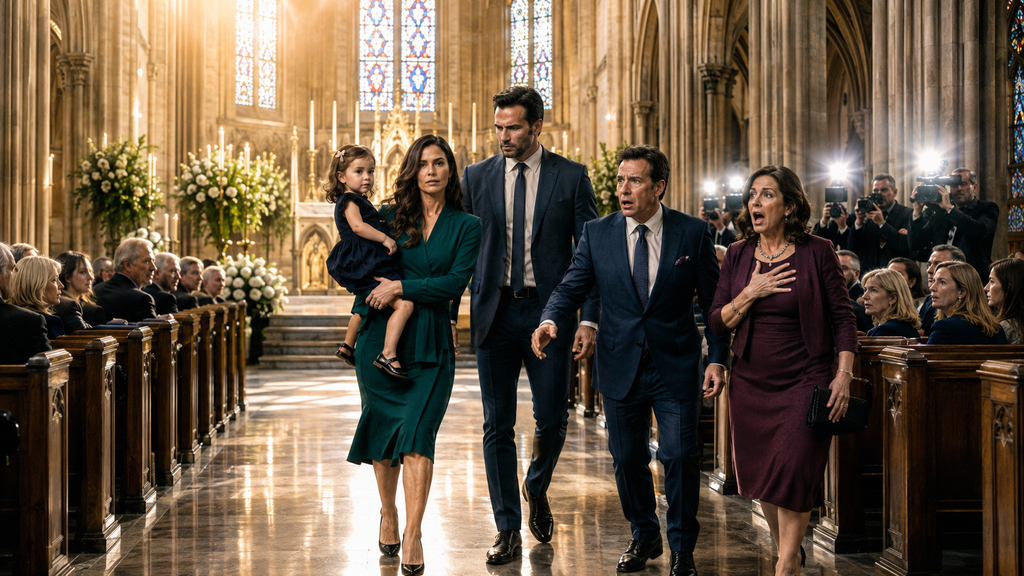
“Mommy!”
Her little voice echoed through the chapel.
“I brought flowers for Grandpa!”
Something inside my chest tightened.
I reached for her immediately, lifting her into my arms and pressing a long kiss against her warm cheek.
Clara wrapped her small arms around my neck and rested her head against my shoulder, still clutching several white lilies between her fingers.
For one brief second, the cruelty of the morning disappeared.
Then I heard Julian.
His breathing had become sharp and uneven.
Almost desperate.
I turned toward him.
His face had gone completely pale.
His eyes darted wildly between Harrison, Clara, and me as though his mind simply could not accept what was standing directly in front of him.
“M-Mr. Sterling…”
Julian’s voice trembled so violently that he barely sounded like the arrogant man who had been mocking me only moments earlier.
“This…”
He swallowed.
“This has to be some kind of mistake.”
Nobody spoke.
Julian pointed toward me with a shaking hand.
“Evelyn is just an ordinary corporate accountant!”
A few people in the chapel exchanged uncomfortable glances.
Julian continued, panic rising in his voice.
“She’s not…”
His eyes widened.
“She can’t possibly be your wife!”
Harrison slowly turned toward him.
The warmth that had been in his expression when he looked at Clara vanished instantly.
What replaced it was something colder.
Controlled.
Powerful.
Unforgiving.
“You are addressing Evelyn Sterling,” Harrison said calmly.
Julian froze.
Harrison took one deliberate step forward.
“My wife.”
The words landed like a hammer.
Vanessa’s mouth fell open.
Several relatives gasped.
But Harrison wasn’t finished.
“Evelyn Sterling is the majority managing partner of the Sterling-Vance Global Fund.”
The silence deepened.
“She is also the chief executive officer and controlling shareholder of her late father’s industrial conglomerate.”
Vanessa made a strangled sound.
Her fingers suddenly tightened around Julian’s arm as if it were the only thing keeping her upright.
“Wait…”
Her voice came out barely above a whisper.
Then her eyes widened with horror.
“Evelyn owns the industrial conglomerate?”
Harrison looked at her.
Vanessa’s face drained of color.
“But…”
She struggled to breathe.
“Our company’s multimillion-dollar distribution agreement was signed with that firm.”
I said nothing.
I simply held Clara closer.
That was when Vanessa finally understood.
The woman she had spent the morning humiliating…
The woman Julian had repeatedly dismissed as insignificant…
The woman they had treated like an embarrassment at her own father’s funeral…
Controlled one of the most important contracts keeping their company alive.
Harrison’s expression did not change.
“Yes,” he said.
One word.
Calm.
Final.
Vanessa stumbled backward half a step.
Julian caught her arm.
Then Harrison continued.
“And that distribution agreement contains a strict executive character, conduct, and ethics clause.”
Julian stopped breathing for a moment.
I watched the realization slowly spread across his face.
Harrison reached inside his suit jacket.
He removed a thin black folder.
Julian stared at it.
His arrogance was gone now.
Completely.
In its place was fear.
Pure fear.
“My wife and I,” Harrison said, “have spent the last seventy-two hours reviewing your company’s internal financial records.”
Julian’s lips parted.
Harrison opened the folder.
“Fraudulent billing.”
Julian flinched.
“Unauthorized diversion of commercial equipment.”
Vanessa covered her mouth.
“Falsified transportation invoices.”
Julian shook his head.
“No…”
Harrison continued as though he hadn’t heard him.
“Undisclosed related-party payments.”
Another page turned.
“And multiple transactions that appear to have been deliberately concealed from your board and business partners.”
Julian’s face collapsed.
The arrogant smirk he had worn only minutes earlier had disappeared so completely that it was almost impossible to believe it had ever been there.
Now he looked terrified.
Not embarrassed.
Not angry.
Terrified.
Because for the first time that morning, Julian finally understood who he had been insulting.
And more importantly…
He understood exactly how much power the woman he had called ordinary actually held over his future.
PART 3 — THE WOMAN THEY THOUGHT HAD NOTHING
Julian’s arrogant smirk was entirely gone.
In its place was something I had never seen on his face before.
Fear.
Real fear.
The kind no expensive suit, rehearsed confidence, or carefully cultivated social status could hide.
His mouth opened, but for several seconds, nothing came out.
Around us, the cathedral remained so quiet that I could hear Clara softly crinkling the paper around the white lilies she had carried inside.
Vanessa clutched Julian’s sleeve.
“What fraudulent billing records?” she whispered.
Harrison’s expression didn’t change.
He reached into the inside pocket of his charcoal jacket and removed a slim black folder.
Julian stared at it as though it were a weapon.
Perhaps to him, it was.
Harrison opened the folder.
“Fourteen months ago,” he said calmly, “Vance Meridian Logistics began billing Evelyn’s manufacturing group for freight routes that were never completed.”
Julian swallowed.
“That’s impossible.”
“No,” Harrison replied. “It was quite possible. You did it repeatedly.”
A murmur spread through the executives standing nearby.
Harrison continued.
“Your company billed for commercial equipment transfers between Pennsylvania, Ohio, and New York. Several shipments were reported as delivered even though the receiving plants had no record of them.”
Julian shook his head rapidly.
“That has to be an accounting mistake.”
I almost laughed.
Seven years earlier, he had told me I was too obsessed with spreadsheets to be a proper wife.
Now he desperately wanted the spreadsheets to be wrong.
They weren’t.
Harrison turned a page.
“Then there are the fuel surcharges charged twice.”
Another page.
“The subcontracting payments made to companies registered to people connected to your board.”
Another.
“And commercial machinery valued at more than eleven million dollars that temporarily disappeared from verified transit records before appearing at privately owned warehouses.”
Vanessa’s face drained of color.
She looked at Julian.
“You told me those warehouses were part of an expansion.”
Julian ignored her.
“Harrison, listen to me.”
His voice cracked.
Not Mr. Sterling anymore.
Harrison.
As if they were equals.
As if familiarity might save him.
Harrison’s eyes hardened.
“You will address me properly.”
Julian lowered his gaze.
“Mr. Sterling.”
I felt Clara move against my shoulder.
She had no understanding of contracts or fraud.
She only knew that she was in a large quiet room filled with sad flowers and unfamiliar people.
Her tiny fingers curled around the collar of my black suit.
“Mommy?”
I immediately turned my attention to her.
“Yes, sweetheart?”
“Can Grandpa smell the flowers?”
My throat tightened.
Everything happening around me disappeared for one painful second.
My father.
The casket.
The lilies.
The years we had lost.
The things we had repaired before it was too late.
I kissed Clara’s forehead.
“I think he would have loved them.”
She smiled.
Then she whispered, “I miss Grandpa.”
My eyes burned.
“So do I.”
Harrison’s hand rested gently at the base of my back.
He knew.
He always knew when I was trying too hard not to break.
He leaned closer.
“You don’t have to handle this now,” he whispered.
I looked toward the casket.
My father had spent the final months of his life telling me the same thing in different ways.
Stop carrying everyone.
Stop believing silence is strength.
Stop confusing survival with peace.
For years, I had assumed walking away from Julian and Vanessa meant I had completely healed.
I hadn’t.
I had rebuilt myself.
That was different.
Healing came later.
Slowly.
Unexpectedly.
With Harrison.
With Clara.
With my father.
With the realization that revenge was not the same thing as justice.
I looked back at Julian.
“No,” I said quietly. “I want this finished.”
Harrison gave a small nod.
That was one of the many reasons I loved him.
He never fought my battles for me unless I asked.
He stood beside me while I fought them myself.
Julian straightened his shoulders.
He seemed to remember that hundreds of important people were watching.
He adjusted his jacket.
“This is completely inappropriate,” he said, trying desperately to regain authority. “We are standing at a funeral.”
I stared at him.
“You approached me.”
He froze.
“You came to my father’s memorial service,” I continued, “walked across a cathedral filled with his friends, employees, and business partners, and decided that humiliating me would entertain you.”
Vanessa looked away.
I stepped closer.
“You wanted an audience, Julian.”
My voice remained calm.
“Now you have one.”
Someone behind him inhaled sharply.
Julian’s face reddened.
“I was joking.”
“No,” I said.
“You were celebrating.”
His eyes flickered.
I remembered that expression.
Seven years ago, I would have interpreted it differently.
I would have wondered whether I had been too sensitive.
Whether I had misunderstood.
Whether I had somehow deserved what he did.
Time gives certain memories sharper edges.
Now I recognized that look for what it was.
Calculation.
He was searching for the correct version of events.
One that made him innocent.
One that made me unreasonable.
One that made everyone forget what they had just witnessed.
Vanessa stepped forward.
“This is ridiculous,” she snapped. “Whatever business problem exists has nothing to do with me.”
I turned toward her.
“No?”
She lifted her chin.
“No.”
“You’re chief financial officer of Vance Meridian.”
Her confidence flickered.
“Only formally.”
Several people nearby exchanged glances.
I almost felt embarrassed for her.
Almost.
“You signed the quarterly certifications,” I said.
She blinked.
“What certifications?”
“The statements confirming that the freight invoices submitted to our companies accurately represented completed commercial services.”
Vanessa’s lips parted.
“I sign hundreds of documents.”
“That is not a defense.”
“I didn’t know.”
“You signed your name underneath a sentence stating that you personally certified the information.”
Julian turned toward her sharply.
“Stop talking.”
Vanessa whipped around.
“Don’t tell me to stop talking!”
“Vanessa.”
“You told me everything had been reviewed!”
“It was.”
“By who?”
“Enough.”
“No!”
Her voice echoed through the cathedral.
Several guests turned fully toward them.
Vanessa lowered her voice, but the panic remained.
“You said the audits were clean.”
Julian’s jaw clenched.
“They were internal audits.”
Harrison looked almost bored.
“Conducted by a consulting company owned by your former college roommate.”
Julian stared at him.
For the first time, even Vanessa seemed to understand the scale of what had been uncovered.
She took a shaky step backward.
Her heel struck the designer handbag she had dropped moments earlier.
She nearly stumbled.
I watched her steady herself against the pew.
Seven years ago, Vanessa had stood inside my bridal suite with my engagement ring on her finger.
She had smiled while telling me that Julian needed a real woman.
I remembered every detail.
The champagne-colored bridesmaid dress she had originally intended to wear.
The perfume.
The way sunlight had reflected off the engagement ring that had been mine only minutes earlier.
The casual cruelty in her voice.
I had wondered how someone raised beneath the same roof as me could enjoy another person’s humiliation so completely.
But grief teaches you strange things.
So does age.
Vanessa had never actually wanted Julian.
Not at first.
She wanted what she believed winning him represented.
Proof that she was more desirable.
More feminine.
More valuable.
More loved.
My stepmother had spent years comparing us.
Vanessa was beautiful.
I was serious.
Vanessa was spontaneous.
I was responsible.
Vanessa attracted attention.
I earned trust.
And somehow, every difference had been turned into a competition I never agreed to enter.
By stealing Julian, she believed she had won the ultimate prize.
The problem with living your life as a competition is that eventually, you have to keep proving you’re ahead.
The jewelry becomes larger.
The vacations become more expensive.
The house has to impress strangers.
The marriage has to appear perfect.
The children have to attend the best schools.
Every photograph becomes evidence.
Every dinner becomes a performance.
Every other woman becomes a threat.
I had stopped competing seven years ago.
Vanessa never had.
Now she looked exhausted.
Not just frightened.
Exhausted.
And for the first time, I saw what her victory had cost her.
Julian pointed at Harrison’s folder.
“You cannot make accusations like this without proof.”
Harrison closed it.
“We already provided the evidence to federal investigators.”
Julian’s face went blank.
Vanessa made a sound somewhere between a gasp and a sob.
“What?”
Harrison didn’t repeat himself.
He didn’t need to.
Julian stared at him.
Then at me.
“You reported us?”
I looked directly into his eyes.
“My legal department reported irregularities uncovered during a contract review.”
“You knew what would happen.”
“Yes.”
“You could have called me.”
“I could have.”
His expression twisted.
“You could have warned me.”
I almost admired the entitlement.
“Why would I warn you?”
“We have history.”
The words hit differently than he intended.
I remembered four years of history.
Four years of supporting him.
Four years of believing him.
Four years of transferring money from my savings when payroll was tight at his startup.
Four years of nights when he came home after midnight and told me investors needed entertaining.
Four years of convincing myself his growing emotional distance was stress.
Four years of making excuses for a man who eventually replaced my name on our wedding program twenty-four hours before I was supposed to walk down the aisle.
“Yes,” I said. “We do.”
His face softened slightly, as if he believed he had found the correct path.
He stepped closer.
“Evelyn, whatever happened between us was years ago.”
“I know.”
“Then you understand.”
“I understand exactly.”
I shifted Clara higher on my hip.
“You taught me something very important.”
Julian waited.
“You taught me that history does not create entitlement.”
His face hardened again.
“You don’t get access to someone forever just because they once loved you.”
Silence.
“You don’t get advance warning because I once trusted you.”
I took another breath.
“And you certainly don’t get immunity from the consequences of your business decisions because seven years ago I almost became your wife.”
A few feet away, one of my father’s oldest board members lowered his head, hiding what looked suspiciously like a smile.
Julian noticed.
His humiliation deepened.
He leaned closer to me.
“This is revenge.”
“No.”
“It obviously is.”
“If I wanted revenge, Julian, I would have gone looking for you years ago.”
“You expect me to believe this is a coincidence?”
“I expect you to understand that your company became a vendor to businesses controlled by my family.”
His mouth opened.
I continued before he could interrupt.
“You spent years telling people that Evelyn Hart disappeared after you left her.”
I smiled faintly.
“The truth is that I became busy.”
That was the simplest version.
I became very busy.
Three months after the canceled wedding, my father suffered his first major health crisis.
Not the illness that eventually killed him.
That came later.
But a cardiac event severe enough to put him in intensive care.
For years, our relationship had been complicated.
My father loved me.
I knew that.
But love alone doesn’t erase mistakes.
After my mother died when I was twelve, he remarried too quickly.
Vanessa’s mother, Celeste, moved into our home with a fourteen-year-old daughter who immediately learned exactly how to earn my father’s sympathy.
Celeste rarely insulted me directly.
She was too intelligent for that.
Instead, she created comparisons.
“Vanessa has such an easy warmth.”
“Evelyn has always been rather intense.”
“Vanessa knows how to enjoy life.”
“Evelyn gets that seriousness from you.”
My father laughed.
Not cruelly.
Carelessly.
That distinction matters to the person laughing.
Not always to the child listening.
I became the dependable daughter.
The one who never caused trouble.
The one who earned scholarships.
The one who joined the company after graduate school.
The one who understood production forecasts, acquisition models, labor negotiations, and debt structures.
Vanessa became the daughter who needed rescuing.
By twenty-five, she had changed careers three times.
By twenty-seven, my father had paid off two of her credit cards.
By twenty-nine, he had bought her an apartment after she announced that renting was “emotionally draining.”
I resented it.
But I rarely said anything.
Being responsible had become my identity.
Then Julian happened.
My father never liked him.
That was another truth I had refused to see.
The day I told my father that Julian had left me for Vanessa, he did not say, “I warned you.”
He sat beside me in his hospital room and cried.
Actually cried.
I had only seen my father cry twice before.
At my mother’s funeral.
And when I graduated from college.
“I failed you,” he whispered.
I didn’t understand.
“Dad—”
“I saw what was happening in this family.”
His voice broke.
“I saw Celeste compare you girls. I saw Vanessa compete with you. And because you were strong, I assumed you could handle it.”
He closed his eyes.
“That was cowardice disguised as confidence in you.”
I remember staring at him.
He reached for my hand.
“I rewarded the child who demanded attention and relied on the child who never asked for it.”
Those words changed something inside me.
Not immediately.
Healing rarely happens in one conversation.
But they opened a door.
When my father recovered, he changed.
Not dramatically.
Not theatrically.
Consistently.
He stopped rescuing Vanessa financially.
He amended company governance.
He placed me on the executive committee.
He insisted that I stop doing invisible work while less qualified men presented my analysis as their own.
And for the first time in my adult life, my father began asking me a question no one in our family had ever asked before.
“What do you want?”
At first, I didn’t know how to answer.
Then I learned.
I wanted independence.
I wanted authority equal to my responsibility.
I wanted to build something that belonged to me.
And eventually, through a joint investment project, I met Harrison Sterling.
Not at a gala.
Not at a private island.
Not through some cinematic accident.
We met because he disagreed with me about freight automation.
Aggressively.
Our first conversation lasted forty-eight minutes.
We spent thirty-five of those minutes arguing.
He thought one of our manufacturing divisions was wasting capital maintaining an outdated distribution network.
I thought his proposal underestimated the labor consequences and regulatory exposure of restructuring too quickly.
He called my model conservative.
I called his projection irresponsible.
He stared at me across the conference table.
I stared back.
Afterward, one of my colleagues whispered, “Do you know who you just argued with?”
Of course I knew.
Everyone knew Harrison Sterling.
His firm controlled investments across technology, transportation, medicine, energy, commercial property, and industrial manufacturing.
Financial magazines estimated his net worth at numbers so ridiculous they hardly sounded real.
But inside that conference room, he was simply a man presenting assumptions I believed were wrong.
Three days later, flowers appeared in my office.
Not roses.
White tulips.
Attached to them was a note.
You were right about the regulatory timeline.
Still wrong about the automation.
Dinner?
I declined.
He sent no second bouquet.
No grand gesture.
No pressure.
At the next meeting, he treated me exactly as professionally as before.
Six weeks later, I asked him to dinner.
When I reminded him of that years afterward, he would grin.
“You made me wait six weeks.”
“You survived.”
“Barely.”
We dated quietly.
Very quietly.
Not because Harrison was ashamed of me.
The opposite.
He understood what it was like to have strangers consume pieces of your private life.
He had spent twenty years watching headlines turn every dinner companion into a potential bride and every disagreement into a corporate war.
I had already lived through one relationship where appearances mattered more than truth.
Neither of us needed another audience.
We married three years later in my father’s garden.
Twenty-eight guests.
No magazines.
No photographers except an old family friend.
My father walked me down a short aisle beneath maple trees.
Halfway to Harrison, he squeezed my hand.
“I’m proud of you.”
I smiled.
“You already said that.”
“I know.”
He swallowed.
“I should have said it more when you were younger.”
I almost cried before reaching the altar.
Clara was born eighteen months later.
My father became unbearable.
In the best possible way.
The man who once scheduled meetings during Christmas Eve because he claimed holidays were inefficient suddenly canceled board calls because Clara wanted to show him how she could stack wooden blocks.
He bought her ridiculous gifts.
I returned half of them.
He bought more.
When she learned to say “Grandpa,” he replayed the video so often that his assistant threatened to hide his phone.
Then the illness came.
Slowly.
Quietly.
Cancer.
We fought it.
My father fought harder than anyone.
For two years, there were treatments.
Remissions.
Setbacks.
Hope.
Bad scans.
Good mornings.
Terrible nights.
And eventually, one afternoon while Harrison was reading financial reports beside the hospital window and Clara was asleep against my chest, my father asked everyone else to leave.
I knew.
You always know.
The room became quiet after Harrison carried Clara into the hallway.
My father looked thinner than I had ever seen him.
His hands trembled.
But his eyes were clear.
“Evelyn.”
“I’m here.”
“There’s something I need you to promise.”
I sat beside him.
“What?”
“Don’t let my death drag you backward.”
I frowned.
He took my hand.
“People will come after the estate.”
“Dad—”
“They will.”
He gave a tired smile.
“I’ve spent fifty years around wealthy people. Death turns grief into arithmetic.”
I looked away.
He squeezed my fingers.
“Vanessa will come.”
My chest tightened.
“She hasn’t visited you in eight months.”
“I know.”
There was no anger in his voice.
That somehow hurt more.
After he stopped financing Vanessa’s lifestyle, she became increasingly distant.
Then, when my father amended his trust years earlier, removing several automatic distributions and converting them into conditional provisions, she had practically disappeared.
She sent birthday messages.
Christmas baskets.
Occasional photographs of her children.
But she rarely came.
My father knew why.
“She’ll believe she deserves half,” he said.
I didn’t answer.
“She doesn’t.”
“Dad.”
“Listen.”
His voice strengthened.
“I have provided generously for her children because they are innocent. Their education is protected. Their medical needs are protected. They will have trusts when they become adults.”
He paused.
“But Vanessa receives no ownership in Hartwell Industrial.”
I stared at him.
Hartwell Industrial had been our family business for three generations.
I had expected control.
Not complete ownership.
My father looked at me.
“You built half of what the company is today.”
“Not half.”
He smiled weakly.
“Still arguing percentages.”
I laughed through tears.
“There she is,” he whispered.
Then his smile faded.
“Evelyn, your mother would be proud.”
That broke me.
I lowered my head against his hand.
For several minutes, neither of us spoke.
Finally, he said, “There’s something else.”
“What?”
“I’m sorry.”
I closed my eyes.
“You already apologized.”
“Not enough.”
“You changed.”
“I tried.”
“That matters more.”
He looked toward the door.
“Harrison loves you.”
“Yes.”
“I was prepared to hate him.”
A wet laugh escaped me.
“I know.”
“I researched him for three months.”
“I also know.”
“He has an irritatingly clean record.”
I laughed harder.
My father smiled.
“And Clara…”
His face softened completely.
“That little girl saved the final years of my life.”
“She loves you.”
“I know.”
He stared at me for a long moment.
Then he whispered, “You got your family, sweetheart.”
I couldn’t speak.
“You spent so many years believing people leaving meant something was wrong with you.”
My tears fell freely now.
My father shook his head.
“It never did.”
Those were among the last coherent words he ever said to me.
Three days later, he died.
And now, standing inside the cathedral where his funeral was being held, listening to Julian accuse me of revenge, all I could think about was my father’s final warning.
Don’t let my death drag you backward.
So I wouldn’t.
Julian pointed toward me.
“You think because you married Harrison Sterling you can destroy people?”
Harrison moved slightly.
I touched his arm.
He stopped.
This answer was mine.
“I did not marry Harrison for power.”
Julian laughed bitterly.
“Of course not.”
I looked at him with something dangerously close to pity.
“That’s the difference between us.”
He frowned.
“You still think everyone chooses relationships the way you do.”
His face darkened.
I continued.
“You chose Vanessa because you believed she made you look successful.”
Vanessa flinched.
“You wanted charm. Beauty. Social access. Someone impressed by everything you said.”
Julian’s eyes narrowed.
“And Vanessa chose you because taking you from me made her feel like she had won.”
“Shut up,” Vanessa whispered.
I turned toward her.
“I’m not insulting you.”
“You’re enjoying this.”
“No.”
I meant it.
There was no joy in that moment.
Satisfaction, perhaps.
Relief.
But not joy.
This was my father’s funeral.
I would have traded every revelation, every contract, every dollar, and every moment of their humiliation for one more afternoon with him.
“I wish none of this were happening today,” I said.
Vanessa scoffed.
“Then stop it.”
“You started it.”
“I came to my stepfather’s funeral.”
“You came to ask about his estate.”
Her eyes widened.
That landed.
Several guests looked toward her.
Vanessa shook her head.
“That isn’t true.”
“You called his attorney four hours after his death.”
Her lips parted.
Julian looked at her.
“You did what?”
She ignored him.
“How do you know that?”
“Because Martin told me.”
My father’s attorney, Martin Ellis, stood three pews away.
He stepped forward.
Seventy years old.
Silver hair.
Dark suit.
The same leather briefcase he had carried for as long as I could remember.
Vanessa stared at him.
Martin’s expression was polite.
“I informed Mrs. Sterling because she is executor of your stepfather’s estate.”
Vanessa’s eyes widened.
“Executor?”
“Yes.”
“But I’m family.”
“So is she.”
“I’m his daughter.”
“Stepdaughter,” Martin corrected.
Vanessa visibly recoiled.
For years, she had insisted no distinction existed when it benefited her.
Now the legal distinction mattered.
Martin continued.
“Your children are beneficiaries of protected educational trusts established by Mr. Hartwell.”
Vanessa’s voice dropped.
“And me?”
Martin glanced at me.
Then back at her.
“Your inheritance will be formally explained at the reading.”
“When?”
“Tomorrow.”
“I want to know now.”
“This is neither the place nor the time.”
Vanessa’s breathing quickened.
“You already told Evelyn.”
“She is executor.”
“That’s favoritism.”
Martin’s eyebrows lifted.
I almost smiled.
Even at thirty-nine, Vanessa could turn inheritance law into sibling rivalry.
Julian grabbed her elbow.
“We’re leaving.”
She jerked away.
“No.”
His voice dropped.
“We need lawyers.”
“Why?”
He stared at her.
“Vanessa.”
She looked around.
For the first time, perhaps she truly saw the room.
The executives.
The board members.
The attorneys.
The cameras outside.
The people who had spent years greeting Julian because he was useful.
The people now studying him as a liability.
Her gaze returned to Harrison.
“You’re canceling our contract?”
Harrison answered calmly.
“The contract was suspended this morning pending investigation.”
Julian closed his eyes.
That single sentence did what all the accusations hadn’t.
It destroyed whatever denial remained.
Vance Meridian relied heavily on our distribution network.
Without our contracts, they could survive.
Perhaps.
Without Harrison’s conglomerate’s newly acquired shipping divisions?
Probably not.
Especially once lenders learned about the investigation.
Julian opened his eyes.
“You can’t suspend without notice.”
“Our agreement allows immediate suspension when documented fraud threatens regulated shipments.”
“You planned this.”
“The investigation began six weeks ago.”
Julian looked at me.
My expression must have told him something.
His face changed.
“Six weeks?”
“Yes.”
“You knew before your father died?”
“Yes.”
“And you never contacted me.”
“No.”
He actually looked wounded.
The absurdity of it almost took my breath away.
“You really hate me that much.”
I shook my head.
“No, Julian.”
And finally, I said the sentence I should have understood seven years earlier.
“I don’t hate you at all.”
His face went still.
“Hating you would require far more space in my life than you occupy.”
No one spoke.
His eyes flickered.
I continued softly.
“For years, you probably imagined I was somewhere mourning the life you took from me.”
His jaw tightened.
“But you didn’t take my life.”
I looked at Harrison.
Then at Clara.
“You removed yourself from it.”
My daughter smiled at me without understanding.
My heart softened.
“I survived.”
I looked at Julian again.
“Then I built something better.”
He seemed physically smaller somehow.
Seven years ago, his approval had felt enormous.
Now I couldn’t understand how I had ever allowed one man’s opinion to determine my worth.
Vanessa bent down suddenly, grabbing her handbag.
Her hands shook so badly that she fumbled with the clasp.
She pulled out her phone.
“Who are you calling?” Julian demanded.
“Our attorney.”
“Not here.”
She ignored him.
“Vanessa.”
“Don’t tell me what to do!”
Her voice cracked.
One of the cathedral ushers stepped closer.
Harrison’s security officers remained still.
They didn’t need to move.
Julian lowered his voice.
“We are leaving.”
“I need to know what’s happening.”
“So do I.”
“You said the company was fine.”
“It is.”
“Then why are you panicking?”