 Reading Time: 39 minutes
I stared at the bottle in my hand. For several seconds, I couldn’t move. Couldn’t breathe. Couldn’t even process what Victor had just told me. The liquid inside looked almost exactly like his medication. Clear. Colorless. Ordinary. But it wasn’t medicine. It was water.
My mother had emptied the morphine prescribed to control the unbearable pain of a dying man and replaced it with tap water because she thought spending money on him was a waste.
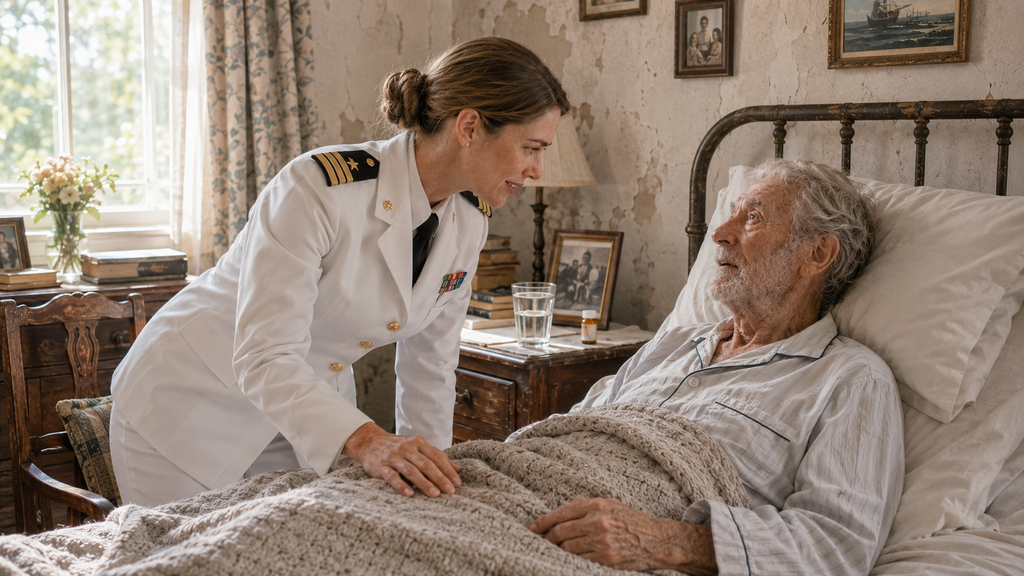
My fingers tightened around the bottle.
“Maya.”
Victor’s voice was barely more than air.
I looked at him.
His face had gone gray.
Sweat glistened across his forehead.
Every breath seemed to scrape through him.
I had treated combat injuries.
I had stabilized sailors after catastrophic accidents.
I had stood inside medical bays while alarms screamed and blood soaked through gauze faster than our hands could replace it.
I knew how to stay calm when things were terrible.
That training had been drilled into me until it became instinct.
But standing beside Victor’s bed, I wasn’t Lieutenant Commander Maya Reynolds.
I wasn’t a physician.
I wasn’t a naval officer.
I was eight years old again.
Eight years old and staring at the man who had knelt in front of me on the first day he moved into our house and promised he would never try to replace my biological father.
“I’m not asking you to call me Dad,” he had said.
“You call me whatever feels right. I just want you to know that if you ever need somebody standing beside you, I’ll be there.”
And he had been.
Every single time.
Now he was dying in a cold bedroom because the people who were supposed to care for him had decided a cruise mattered more.
I placed the bottle carefully on the nightstand.
Then I picked up my phone.
Victor’s eyes opened slightly.
“What are you doing?”
“Calling hospice.”
His fingers moved weakly across the blanket.
“Maya…”
“And an ambulance.”
“No hospital.”
The words came fast despite how weak he was.
I turned toward him.
“Victor—”
“No more hospitals.”
His eyes were clear now.
Tired, but clear.
“I signed the papers.”
“I know what you signed.”
He had a do-not-resuscitate order.
He had elected comfort-focused treatment.
He had spent months deciding that he wanted whatever time remained to be peaceful.
I respected that.
But comfort-focused care required actual comfort.
It required medicine.
Heat.
Water.
Food.
Human dignity.
Not abandonment.
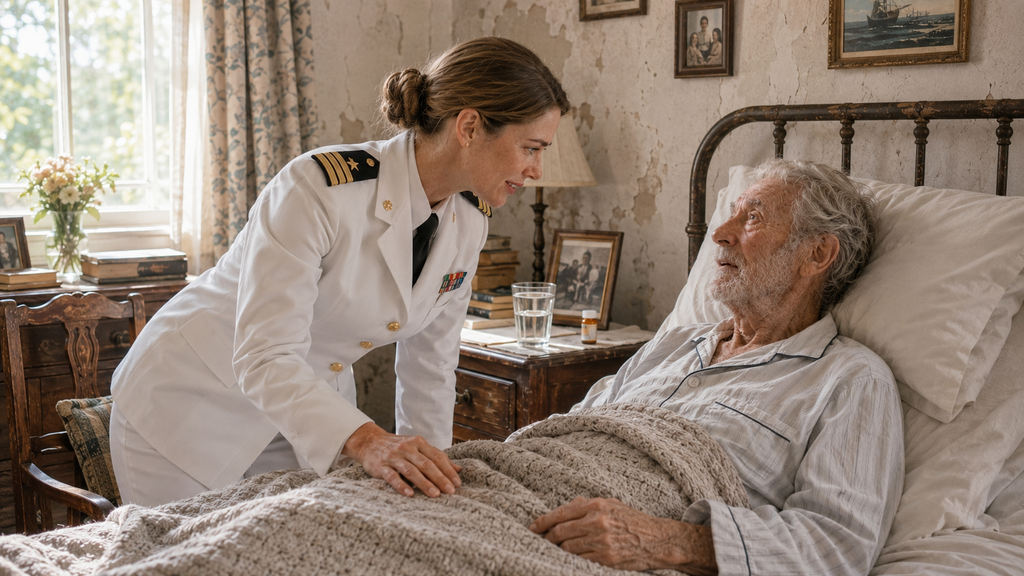
“You’re severely dehydrated,” I said. “You haven’t had adequate pain control in days. Your medication has been tampered with. You need medical evaluation.”
He tried to smile.
Even now, he was trying to make me feel better.
“You sound like a doctor.”
“I am a doctor.”
“You’re my kid first.”
That broke something in me.
I sat on the edge of the bed.
“You’re right.”
I swallowed.
“So listen to your kid.”
Victor closed his eyes.
For a long moment, neither of us spoke.
Then he whispered, “All right.”
I made the call.
The hospice nurse arrived before the ambulance.
Her name was Teresa.
She had been one of Victor’s regular nurses, and the moment she stepped into the bedroom, I saw confusion cross her face.
Then horror.
“Mr. Hale?”
She hurried to the bed.
“Victor, what happened?”
Victor looked away.
Teresa checked his pulse.
His blood pressure.
His temperature.
His skin.
Then she turned toward me.
“When was his last dose?”
“That’s complicated.”
I handed her the bottle inside a clear plastic bag I had found in the kitchen.
She looked at me.
“What’s this?”
“Supposedly morphine.”
She uncapped it carefully.
Then she frowned.
She looked at the label.
Looked at the liquid.
Looked at Victor.
“Who has been administering his medication?”
“My mother.”
Teresa’s expression changed.
Not dramatically.
Professionals learn to control their faces.
But I saw it.
I saw the instant when this stopped being a difficult hospice situation and became something else entirely.
“I need you to tell me exactly what happened.”
So I did.
I told her about the note.
The cruise.
The empty account.
The lack of groceries.
The cold house.
The missing decorations.
The diluted medication.
Teresa listened without interrupting.
When I finished, she took a slow breath.
“I have to report this.”
“I know.”
Victor opened his eyes.
“To who?”
“Adult Protective Services, for one.”
Teresa’s voice was gentle.
“And given the medication issue, possibly law enforcement.”
Victor stared at the ceiling.
His face didn’t show fear.
It showed embarrassment.
That hurt worse.
He was ashamed.
Not because of anything he had done.
Because someone had treated him like this.
He whispered, “I never wanted this to become a circus.”
I leaned closer.
“You didn’t make it a circus.”
His eyes turned toward me.
“They did.”
The ambulance arrived twelve minutes later.
While the paramedics prepared Victor for transport, I walked through the house.
Actually walked through it.
Not as a daughter returning home.
As a physician.
As someone documenting a scene.
The refrigerator held half a carton of expired milk, mustard, three bottles of water, and an open container of applesauce.
The pantry was almost empty.
The thermostat had been turned down to fifty-six degrees.
Victor’s prescribed nutritional supplements were gone.
His medication organizer contained several missed doses.
The linen closet had no clean bedding.
There were stains on the mattress beneath the sheet I had changed.
I photographed everything.
Every room.
Every bottle.
Every empty shelf.
Every receipt.
Every piece of evidence that told the story my family would later try to deny.
Then I returned to the kitchen.
The note was still lying on the counter.
We took the treatment money for the cruise.
You can handle Victor when you get back.
We’re sick of taking care of him.
My mother’s handwriting.
There was even a little heart drawn after her name.
As if cruelty became lighter when written beside a heart.
I slid the note into a plastic document sleeve.
Then I heard Victor calling for me.
“Maya.”
I rushed down the hall.
The paramedics had transferred him onto a stretcher.
He looked impossibly small beneath the blankets.
Victor had once been six feet two.
Broad shoulders.
Marine posture.
The kind of man who entered a room and somehow made everybody stand a little straighter.
Cancer had reduced him to sharp cheekbones and thin wrists.
But when he saw me, something familiar returned to his face.
Authority.
“Maya.”
“I’m here.”
“Come closer.”
I bent beside him.
He lifted his right hand.
There was a ring on his finger.
I knew that ring.
He had worn it for as long as I could remember.
Heavy gold.
Dark red stone.
A tiny Marine Corps eagle, globe, and anchor etched into one side.
His initials on the other.
V.H.
Victor Hale.
He struggled to pull it off.
I stopped him.
“Don’t.”
“I need you to take it.”
“Victor.”
“Take the damn ring, Lieutenant Commander.”
Despite everything, I almost laughed.
He had always used my rank when he wanted me to stop arguing.
I helped slide the ring from his finger.
It was warm from his skin.
He closed my hand around it.
“Look inside.”
I turned the ring.
There was engraving on the inner band.
I had never noticed it before.
Three characters.
B-317.
“What is that?”
Victor looked toward the paramedics.
Then back at me.
His voice dropped.
“Safe deposit box.”
My heartbeat changed.
“What?”
“First Atlantic Bank. Downtown branch.”
He swallowed.
“Box three-seventeen.”
I stared at him.
“What’s in it?”
Victor gave me a tired smile.
“My insurance policy.”
“Victor, you already have insurance.”
“Not that kind.”
The paramedic glanced toward us.
“We need to move.”
Victor ignored him.
His fingers closed over mine.
“The trust.”
“What trust?”
His eyes held mine.
“The one Evelyn doesn’t know exists.”
We rode to the hospice inpatient center in separate vehicles.
Teresa stayed with Victor in the ambulance.
I followed in my car.
Every traffic light felt personal.
Every red light felt like an insult.
My phone began vibrating before I reached the first intersection.
Mason.
I let it ring.
Then Chloe.
Then my mother.
I ignored all three.
Finally a message appeared.
MOM: Heard you’re home! Surprise! We took a little family vacation. Hope you’re not mad. Victor has been dramatic lately but he’ll survive a few days.
I nearly drove off the road.
He’ll survive a few days.
My mother had written those words about a man with terminal pancreatic cancer after taking away his medication.
A second message arrived.
MOM: There should be frozen meals somewhere. If he complains about pain, just give him what’s on the nightstand. Don’t let him guilt you.
I pulled into a gas station.
Parked.
And stared at the screen.
Then I took screenshots.
Every message.
Every timestamp.
Every word.
I didn’t reply.
That was the moment I made a decision.
I would not scream.
I would not threaten them.
I would not give them the emotional explosion they could later twist into evidence that I had overreacted.
I had spent years watching people destroy themselves by talking when silence would have protected them.
So I did what my training had taught me.
I documented.
I preserved.
I waited.
And I started making calls.
The first was to my commanding officer.
The second was to Victor’s hospice physician.
The third was to Adult Protective Services.
The fourth was to the Norfolk Police Department.
The fifth was to First Atlantic Bank.
The bank representative refused to discuss anything over the phone without proper authorization.
That was fine.
I had the ring.
I had the box number.
And apparently, somewhere inside that building, Victor had left something intended for me.
But before I could reach the bank, Victor’s condition worsened.
His blood pressure fell.
The hospice physician believed dehydration had accelerated his decline.
They were able to get his pain under control.
They gave him fluids carefully, not as aggressive life-prolonging treatment, but enough to ease the physical suffering caused by days of neglect.
When I finally entered his room that evening, Victor was sleeping.
Warm blankets covered him.
Clean blankets.
His face was peaceful for the first time since I had arrived home.
I sat in the chair beside his bed.
And I cried.
Quietly.
I didn’t sob.
I didn’t collapse.
I just let the tears fall.
One after another.
I cried for the man in that bed.
For the little girl I had once been.
For every birthday Victor had shown up to.
Every school recital.
Every scraped knee.
Every science project he helped me build badly at midnight.
Every letter he mailed while I was at the Naval Academy.
Every phone call after brutal exams.
Every Thanksgiving when he had quietly set aside the turkey leg because he remembered it was my favorite.
Every time he told strangers I was his daughter without ever adding the word “step.”
And I cried because the people who shared his house had reduced him to a burden.
At some point, his eyes opened.
“You always were an ugly crier.”
I laughed through the tears.
“Cancer hasn’t improved your personality.”
“Nope.”
I wiped my face.
“You scared me.”
“I’m sorry.”
“Don’t apologize.”
He studied me.
“Did you call them?”
“My family?”
He nodded.
“No.”
“Why?”
“Because I don’t have anything to say to them yet.”
Victor gave a faint smile.
“Smart.”
I looked at the ring on my finger.
It was too large, so I had put it on my thumb.
“Tell me about the trust.”
He became serious.
For nearly a minute, he said nothing.
Then he looked toward the door.
“Close it.”
I did.
When I returned to the chair, Victor spoke slowly.
“My father wasn’t rich.”
I waited.
“But he bought land.”
“Where?”
“Outside Virginia Beach. Back when half of it was marsh, scrub, and bad roads.”
I smiled.
“Sounds like him.”
“You remember him?”
“A little.”
Victor’s father had died when I was eleven.
A terrifying old Marine with enormous hands who secretly fed neighborhood cats.
Victor continued.
“He bought several parcels over the years. Never sold them. By the time he died, developers had started moving east.”
My stomach tightened.
“How much land?”
“Enough.”
“That’s not an answer.”
“It’s the only one you’re getting until you talk to Eleanor.”
“Who’s Eleanor?”
“My lawyer.”
Of course Victor had a lawyer named Eleanor.
It somehow fit him perfectly.
“What did you do?”
“I created a trust.”
“When?”
“Fourteen years ago.”
I stared at him.
Fourteen years.
Long before his cancer.
Long before the cruise.
Long before any of this.
“Why?”
His eyes drifted toward the window.
“Because I started noticing things.”
“What things?”
“Your mother liked money.”
There was no anger in his voice.
Just exhaustion.
“She liked having it more than she liked understanding where it came from.”
I didn’t speak.
“She started borrowing against things without telling me. Credit cards. Personal loans. Refinancing conversations. Every problem had the same solution.”
“Spend.”
Victor nodded.
“I loved her.”
The words surprised me.
Not because I doubted it.
Because even now, after everything she had done, he still said it without bitterness.
“I probably loved her longer than was wise.”
My throat tightened.
“She wasn’t always like this.”
“No.”
He looked at me.
“That’s what makes it harder.”
I knew exactly what he meant.
Cruel people are easier to hate when they have always been cruel.
But my mother hadn’t always been this woman.
At least I didn’t think she had.
There had been Christmas mornings.
Family camping trips.
School lunches.
Birthdays.
Laughing photographs.
Moments that felt real.
Maybe they had been real.
Maybe greed didn’t erase the past.
Maybe it simply revealed what someone was willing to become.
Victor continued.
“When the land started becoming valuable, I put it into a trust.”
“Who controls it?”
“My attorney serves as independent trustee while I’m alive.”
“And after?”
His gaze settled on me.
“You.”
I stopped breathing.
“No.”
“Yes.”
“Victor.”
“Maya.”
“You have Mason and Chloe.”
“I know.”
“They’re your children too.”
“Not by blood.”
“Neither am I.”
Victor smiled.
“That’s never mattered to me.”
My eyes burned.
He went on.
“The trust doesn’t only contain land. There are investment accounts. Royalties from a development partnership. A life insurance policy. Some other assets.”
“How much?”
He looked almost amused.
“Eleanor will explain.”
“Victor.”
“Maya.”
“How much?”
He sighed.
“Last statement I saw put total trust assets a little over eight million.”
The room went silent.
I actually thought I had misheard him.
“Eight…”
“Million.”
I stood up.
Then sat down again.
Then stood back up.
Victor watched me with the faintest hint of amusement.
“You okay, Doc?”
“No.”
“Good.”
“Eight million dollars?”
“Approximately.”
“And Mom doesn’t know?”
“No.”
“Mason?”
“No.”
“Chloe?”
“No.”
“Why didn’t you tell anyone?”
His smile disappeared.
“Because money changes the temperature in a room.”
I looked at him.
“And I wanted one place in this family where nobody knew there was something to take.”
That sentence stayed with me.
One place where nobody knew there was something to take.
Victor closed his eyes.
“I knew Evelyn was spending from our regular accounts. I knew Mason borrowed money. I knew Chloe expected help. But I told myself there were limits.”
His voice broke slightly.
“I thought there were things people wouldn’t do.”
I reached for his hand.
He continued.
“I was wrong.”
I squeezed his fingers.
“Why me?”
Victor opened his eyes.
“You really need to ask?”
“Yes.”
“Because you’ve been depositing money into that emergency account for years and never once asked me what you’d get back.”
“That’s what family does.”
“Exactly.”
His eyes filled.
“And because when everybody else saw my illness as a countdown to inheritance, you kept seeing me.”
I looked down.
A tear landed on our joined hands.
Victor whispered, “The ring gets you into the box. Eleanor has the documents. The bank has instructions to contact her when the box is opened.”
“What’s inside?”
“Copies. Letters. Recordings.”
“Recordings?”
“And something else.”
“What?”
He turned his face toward the pillow.
“You’ll know when you see it.”
The next morning, I went to First Atlantic Bank.
I brought identification.
Victor’s notarized authorization, which Eleanor’s office emailed after I spoke with her.
The ring.
And a stomach full of dread.
Eleanor Price met me in the lobby.
She was in her late sixties, silver-haired, sharply dressed, and carried herself like someone who had never wasted a word in her life.
“Maya.”
“Yes.”
She shook my hand.
“I’ve heard a great deal about you.”
“I wish I could say the same.”
“Victor preferred it that way.”
We went downstairs.
A bank employee verified everything.
Then they brought out box 317.
Eleanor left me alone in a private viewing room.
The box was longer than I expected.
Inside were several folders.
A small flash drive.
A sealed envelope with my name.
A stack of photographs.
And one object wrapped carefully in faded green cloth.
My hands trembled as I unfolded it.
It was a medal.
A Silver Star.
Victor’s Silver Star.
I stared at it.
Confused.
His shadow box had been sold.
His decorations were gone.
But this medal had been hidden separately.
Behind it was a handwritten note.
Maya,
The medals in the case were important to me.
This one was different.
Not because of what I did to earn it.
Because of who I became afterward.
I used to think courage meant running toward danger.
Then I raised a daughter.
I learned courage also means staying when leaving would be easier. Telling the truth when silence costs less. Protecting people who may never understand what you sacrificed for them.
If you are reading this, I need you to do something harder than anything the Navy ever asked of you.
Do not let guilt turn you into an accomplice to people who chose cruelty.
You are allowed to walk away.
Love,
Dad
Dad.
Not Victor.
Not your stepfather.
Dad.
I covered my mouth.
The tears came immediately.
I sat there in the quiet little room beneath a bank while my entire childhood seemed to fold inward around me.
He had never asked me to call him Dad.
Not once.
He had given me the choice for twenty-eight years.
And in a letter he might never have expected me to read, he had signed it himself.
Dad.
I pressed the paper against my chest.
Then I opened the folders.
The trust documents were meticulous.
Victor had created the Hale Family Legacy Trust fourteen years earlier.
Eleanor explained the structure when she returned.
The valuable land had been transferred to the trust.
Several investment accounts had been added.
There was a life insurance policy payable directly into it.
The Norfolk house itself had been placed into the trust seven years earlier.
I looked up sharply.
“The house?”
“Yes.”
“My mother thinks they own it jointly.”
“They do not.”
I stared at Eleanor.
“How?”
“Victor purchased the home before marrying your mother. Several years ago, following some financial concerns, he transferred ownership into the trust with her written acknowledgment.”
“She signed?”
“Yes.”
“She knows?”
“She knows she signed estate documents.”
“That’s not what I asked.”
Eleanor’s mouth tightened slightly.
“No. I doubt she understood them.”
That sounded exactly like my mother.
She signed anything if she believed money waited on the other side.
“What happens now?”
“Victor remains the beneficiary during his lifetime. The trust pays for his care and living expenses. Upon his death, there are specific distributions.”
“To who?”
Eleanor slid a page toward me.
I read it.
My name appeared first.
I would become successor trustee.
I would receive Victor’s personal effects, his military memorabilia, and a designated education and housing fund.
The remainder would stay within the trust.
Some would fund scholarships for children of wounded or deceased service members.
Some would go toward pancreatic cancer research.
Some would support veteran hospice programs.
Mason and Chloe each had smaller conditional trusts.
They weren’t cut out entirely.
Victor had left provisions for them.
But those provisions had conditions.
No direct lump-sum distributions.
No access to principal before age forty-five without trustee approval.
No payments toward gambling debts.
No distributions while facing credible claims of financial exploitation against Victor.
And Evelyn?
I found her name.
The trust provided a modest monthly housing allowance after Victor’s death.
But only if she had remained his caregiver and had not been found to have committed financial exploitation, abuse, medication diversion, or intentional neglect.
My hands went cold.
Eleanor watched me carefully.
“So if what happened is proven…”
“She receives nothing from the trust.”
“Nothing?”
“Nothing.”
I sat back.
Victor hadn’t created that provision this week.
Or this month.
It had been there for years.
A boundary.
A line.
And my mother had crossed it without ever knowing it existed.
“What about the emergency fund they drained?”
“That account is separate.”
“I deposited into it.”
“You have records?”
“Every transfer.”
“Preserve them.”
“I already have.”
The faintest smile appeared on Eleanor’s face.
“Victor described you accurately.”
“What did he say?”
“That when everyone else starts yelling, you start making copies.”
For the first time in forty-eight hours, I laughed.
Then Eleanor nodded toward the flash drive.
“You should see that.”
“What’s on it?”
“Victor began keeping recordings several months ago.”
My smile disappeared.
“Why?”
“Because he suspected things were getting worse.”
I inserted the drive into the bank’s secure laptop.
There were seventeen audio files.
The first was dated five months earlier.
Victor’s voice came through the speakers.
Weak, but unmistakable.
Then my mother’s.
“You don’t need another private nurse visit this week.”
“I’m having trouble getting out of bed.”
“Well, they charge almost three hundred dollars every time somebody walks through the door.”
“The insurance covers part of it.”
“Not enough.”
A cabinet slammed.
Then Mom said something that made my stomach turn.
“You’re dying, Victor. We have to think about the people who are going to still be here.”
The recording ended.
I clicked another.
Mason’s voice.
“Dad, just sign the transfer. Chloe and I are trying to help Mom.”
“What transfer?”
“The home-equity thing.”
“The house isn’t available for that.”
“Why not?”
“Because I said so.”
“You’re making everything difficult.”
Then Chloe.
A different recording.
“Dad, those old medals are just sitting there.”
“They’re mine.”
“You don’t even look at them.”
“That doesn’t make them yours.”
“Mom said some collectors pay crazy money.”
“Then your mother should sell something that belongs to her.”
The audio ended.
I looked at Eleanor.
“You knew about these?”
“Some.”
“Why didn’t you stop it?”
Her expression hardened.
“I tried.”
That answer surprised me.
“What do you mean?”
“Victor refused to pursue legal action against your mother.”
“Why?”
“You’ll have to ask him.”
I already knew.
Love.
Shame.
Hope.
Take your pick.
All the reasons people stay silent when the person hurting them is someone they once trusted.
The final recording was from three days before the cruise.
My mother’s voice was unmistakable.
“We’re going.”
Victor sounded exhausted.
“Then go.”
“We need the money.”
“The account is for my treatment.”
“You’re not using ten thousand dollars in one week.”
“That money belongs to Maya too.”
“She won’t care.”
“She will.”
“She makes military money. She’ll replace it.”
Silence.
Then Victor asked, “What about my medication?”
A long pause.
Mom answered.
“You have enough.”
“No, I don’t.”
“You have enough to get through the week.”
“My refill is due tomorrow.”
“We’re not paying another four hundred dollars.”
“That medication keeps me from screaming.”
My mother laughed.
Not loudly.
Not cruelly in some theatrical way.
Worse.
Dismissively.
As if Victor had made an inconvenient joke.
Then she said:
“Maybe you should learn to tolerate a little discomfort. The rest of us have tolerated this cancer for months.”
I stopped the recording.
I couldn’t listen anymore.
Eleanor closed the laptop.
Neither of us spoke.
Finally she said, “Maya.”
I looked at her.
“Whatever happens next, understand something.”
“What?”
“You did not create this situation by discovering it.”
I nodded.
But I wasn’t sure I believed her yet.
The police investigation moved faster after they heard the recordings.
So did Adult Protective Services.
The hospice agency confirmed discrepancies in Victor’s medication.
His prescription records showed the liquid morphine bottle should have contained substantially more medication than what remained when I arrived.
A field test could not conclusively establish everything, so the bottle was sent for laboratory analysis.
The result came back two days later.
The liquid contained only trace residue of morphine.
The rest was water.
My mother started calling me constantly.
Twenty-three calls the first day.
Thirty-one the second.
She began with cheerful messages.
MOM: Call me when you get a chance.
Then irritation.
MOM: Maya, this is childish.
Then concern.
MOM: Is Victor okay? Mason says you contacted hospice.
Then anger.
MOM: You had no right to discuss private family matters with strangers.
Then panic.
MOM: What did you tell the bank?
That one told me everything.
She didn’t ask what I had told the police.
She asked what I had told the bank.
I still didn’t respond.
Mason sent me a voice message from St. Thomas.
I listened once.
“Maya, whatever Victor told you, understand he’s been confused lately. Mom has been doing everything for him. We all needed this vacation. You’ve been gone nine months, so you don’t get to come home and judge everybody after Mom spent months dealing with him.”
Dealing with him.
Not caring for him.
Dealing with him.
Chloe was more aggressive.
CHLOE: You better not freeze the account. I have bills coming out of there.
I actually stared at that message for several seconds.
Bills.
Coming out of the account meant for Victor’s cancer care.
Then another arrived.
CHLOE: Also, the medal sale was Mom’s decision, not mine, so don’t drag me into that.
I hadn’t mentioned the medals.
Not once.
She had volunteered the information.
I took another screenshot.
By the time their cruise returned to Norfolk, I had enough evidence to fill two binders.
But I still hadn’t confronted them.
I didn’t intend to.
Instead, I prepared the kitchen table.
The same table where Mom had left her note.
I placed the note in the center.
Beside it, I put printed bank statements.
Cruise charges.
Casino withdrawals.
Designer purchases.
Spa treatments.
Premium drink packages.
I added photographs of Victor’s empty refrigerator.
The thermostat.
His unwashed bedding.
The medication bottle.
The lab report.
Copies of the hospice records.
Screenshots of Mom’s texts.
Mason’s voice-message transcript.
Chloe’s admission about the medals.
And one final document.
A notice from Eleanor.
The Hale Family Legacy Trust had formally revoked Evelyn’s occupancy permission for the Norfolk property due to documented abuse and exploitation of its beneficiary.
She would be allowed supervised access to retrieve personal belongings.
Nothing more.
I didn’t sit at the table.
I stood by the window.
At 6:42 that evening, a rideshare SUV pulled into the driveway.
The first thing I heard was laughter.
My mother climbed out wearing a wide straw hat.
Mason followed carrying duty-free shopping bags.
Chloe was filming herself on her phone.
They looked tanned.
Rested.
Happy.
For one strange moment, I watched them as if they were strangers.
Maybe that was the hardest part.
They looked normal.
Cruelty rarely arrives wearing a villain’s face.
Sometimes it wears resort clothes and carries souvenir bags.
Mom opened the front door.
“Maya?”
She stepped inside.
“Maya, are you here?”
Mason rolled a suitcase behind her.
“Why is it so warm in here?”
Chloe laughed.
“Because Maya thinks the Navy’s paying the electric bill.”
Then they walked into the kitchen.
And stopped.
My mother saw the table first.
Her smile disappeared.
Mason looked from one document to another.
Chloe lowered her phone.
Nobody spoke.
I remained beside the window.
Mom looked at me.
“What is this?”
I didn’t answer.
She picked up the note.
Her own note.
Her face changed.
“Maya.”
Silence.
Mason moved closer to the table.
He saw the bank records.
“Why did you print our transactions?”
Still I said nothing.
Chloe picked up the lab report.
I watched her eyes move across the page.
Her face went white.
“What is this?”
Mom snatched it from her.
Then she looked at me.
“Maya, this isn’t what you think.”
That was the first thing I said.
“What do I think?”
She opened her mouth.
Nothing came out.
I walked toward the table.
Calmly.
No screaming.
No tears.
No threats.
I tapped the note.
“You wrote this.”
Mom swallowed.
“It was a joke.”
I looked at her.
“A joke.”
“We were frustrated.”
“You wrote that you took Victor’s treatment money for a cruise.”
“It wasn’t all treatment money.”
I tapped the bank statement.
“Eighty-three percent of the deposits in that account during the last two years came from me.”
Mom’s jaw tightened.
“You always said the money was for family.”
“For Victor’s medical care.”
“Victor is family.”
“And casino chips are medical care?”
Mason stepped forward.
“Okay, that was me.”
I turned to him.
“At least you admit something.”
He folded his arms.
“It was twelve hundred dollars. I won most of it back.”
“You withdrew two thousand four hundred.”
“That doesn’t mean I lost it.”
“Where is it?”
He said nothing.
I turned to Chloe.
“Three thousand one hundred dollars in designer purchases.”
She flushed.
“Some of that was my own money.”
“Then show me.”
“What?”
“Show me your bank statement proving reimbursement.”
She stared at me.
I nodded.
“That’s what I thought.”
Mom slammed the report onto the table.
“Enough.”
Her voice rose.
“I took care of that man every day while you were gone.”
I felt something hot move through my chest.
But I kept my voice level.
“Then tell me why he was lying in his own waste.”
She recoiled.
“That is disgusting.”
“Yes.”
“You don’t understand how difficult he became.”
“Then tell me why the house was fifty-six degrees.”
“The heating bill is outrageous.”
“Tell me why there was no food.”
“He stopped eating.”
“Tell me why he was dehydrated.”
“He refused water sometimes.”
“Tell me why his morphine bottle contained tap water.”
Silence.
Absolute silence.
Mason looked at Mom.
Chloe stepped backward.
Mom’s face emptied.
Then rearranged itself.
I watched the lie being built in real time.
“I don’t know anything about that.”
I almost admired the speed.
Almost.
I reached into the binder.
Pulled out the prescription documentation.
Then a transcript.
Then the lab result.
“I never said you did.”
Mom froze.
That was deliberate.
A physician learns the value of silence.
A prosecutor probably learns it too.
I had simply left space.
And she had filled it with a denial before I accused her.
Her eyes narrowed.
“You’re trying to trap me.”
“No.”
I looked at the table.
“You trapped yourself.”
Mason shook his head.
“This is insane. Mom didn’t poison anybody.”
“No one said poison.”
“She watered down medicine. That’s not—”
He stopped.
Too late.
I looked at him.
Chloe looked at him.
Mom looked at him.
Mason’s face changed.
I spoke quietly.
“How did you know it was watered down?”
He turned pale.
“I…”
I waited.
He looked at Mom.
That told me more than words could.
Chloe whispered, “Mason?”
He shook his head.
“I assumed.”
“No,” I said. “You knew.”
Mom stepped between us.
“Leave him alone.”
“You left Victor alone.”
Her face twisted.
“For six days!”
“He has terminal cancer.”
“He had hospice!”
“Home hospice assumes there is a caregiver in the home.”
“I needed a break!”
There it was.
Not denial.
Not confusion.
The truth.
She needed a break.
And the man she had once promised to love in sickness and in health had become an obstacle between her and a tropical vacation.
My voice dropped.
“So you emptied his medication.”
Her eyes flashed.
“It cost hundreds of dollars!”
Chloe whispered, “Mom.”
But Mom had started.
And once anger opens the door, truth often rushes through.
“He barely knew what day it was half the time! He was sleeping constantly. Do you know what it’s like watching somebody die for months? Do you? He moaned. He complained. He needed something every hour. Water. Blankets. Pills. Help to the bathroom. I couldn’t live like that anymore.”
I stared at her.
“You could have called me.”
“You were deployed.”
“I would have come home.”
“You would have judged me.”
“I am judging you now.”
Her mouth opened.
Then closed.
Tears filled her eyes.
For a moment, I saw my mother.
Not the woman from the cruise photos.
My mother.
And some stupid wounded part of me wanted her to say she was sorry.
Wanted her to collapse.
Wanted her to finally understand.
Instead she looked around the room and asked:
“Where is Victor?”
I almost felt relief.
Finally.
A question about him.
“At inpatient hospice.”
Her expression sharpened.
“Then why are we talking here? I should be with my husband.”
I nodded.
“You should have been.”
That landed.
She looked away.
Then her eyes fell on the legal notice.
She picked it up.
Read the first page.
Read it again.
“What is this?”
I said nothing.
“What trust?”
Mason moved closer.
“What trust?”
Mom looked at me.
“The house is in a trust?”
“Yes.”
Her eyes widened.
“Since when?”
“Seven years.”
“That’s impossible.”
“It’s recorded.”
“This is my house.”
“No.”
“I am his wife.”
“Yes.”
“You cannot throw me out.”
“I’m not.”
I pointed toward the document.
“The trustee is revoking your permission to occupy a property owned by the trust.”
Mom laughed.
A sharp, disbelieving sound.
“Trustee? Who is the trustee?”
“Currently, Eleanor Price.”
Mom stopped breathing for a moment.
She knew the name.
I could see it.
“Victor’s lawyer?”
“Yes.”
Mason leaned over the paperwork.
“Wait.”
His eyes moved quickly.
“What happens to the house if Dad dies?”
Nobody answered him.
That was when I knew Victor had been right.
Money changes the temperature in a room.
Victor was alive.
Barely.
His son had just returned from vacation after abandoning him.
And Mason’s first question after learning about the trust was what happened to the house after Victor died.
I looked at him.
“Go see your father.”
He frowned.
“What?”
“Go see him.”
“I will.”
“When?”
“Tomorrow.”
“Why not tonight?”
“We’ve been traveling all day.”
Something inside me went very still.
Nine months earlier, I had left the other side of the world after a seventeen-hour duty stretch because Victor had called me sounding scared after his diagnosis.
Mason had just spent a week drinking on a ship.
And he was too tired to drive twenty minutes.
I nodded slowly.
“Of course.”
Chloe suddenly started crying.
“I didn’t know it was this bad.”
I turned toward her.
She hugged herself.
“I swear, Maya. Mom kept saying he was exaggerating.”
“You sold his decorations.”
Her face crumpled.
“Mom said he agreed.”
“He didn’t.”
“I didn’t know.”
“You listed them.”
She looked down.
“I thought…”
“What?”
She wiped her cheeks.
“I thought they were going to be mine eventually.”
The room became silent again.
Chloe realized what she had said.
She covered her mouth.
I stared at her.
“Eventually.”
She shook her head.
“That came out wrong.”
“No.”
My voice was almost gentle.
“It came out exactly right.”
Mom slammed her hand on the table.
“Stop interrogating everybody!”
I looked at her.
“You think this is an interrogation?”
“Yes!”
I glanced toward the front hallway.
“No.”
A knock sounded at the door.
Mom froze.
I walked over.
Opened it.
Two detectives stood outside.
Behind them was an Adult Protective Services investigator.
I looked back at my family.
“This is.”
My mother was not arrested that night.
Real life rarely moves as neatly as people imagine.
Investigations take time.
Evidence must be verified.
Statements must be collected.
Medical records reviewed.
Intent established.
But detectives separated all three of them.
Mason talked first.
Of course he did.
He insisted the cruise had been Mom’s idea.
Then admitted he knew Victor’s refill had not been picked up.
Then admitted he heard Mom complain that the medication was costing too much.
Then, after being confronted with evidence from his own messages, admitted he knew she had “stretched” what remained in the bottle.
Chloe cried for nearly three hours.
She admitted selling the shadow box through her online marketplace account.
The buyer had paid nine hundred dollars.
The money went toward her shopping budget.
Mom denied everything important.
Until investigators played Victor’s recordings.
After that, she asked for a lawyer.
I drove to hospice after midnight.
Victor was awake.
Barely.
I sat beside him.
He looked at me.
“They home?”
“Yes.”
“How was the cruise?”
I almost laughed.
“Expensive.”
“Figures.”
I took his hand.
“They know about the trust.”
His mouth twitched.
“I imagine that went well.”
“Mom says you betrayed her.”
Victor closed his eyes.
“I probably did.”
“No.”
He opened them again.
“I hid millions of dollars from my wife.”
“You protected assets from someone who was trying to drain them.”
“I did both.”
I didn’t know what to say.
Victor stared toward the dark window.
“I keep thinking about when I met your mother.”
His voice softened.
“She had this yellow coat.”
I smiled faintly.
“I remember that coat.”
“Horrible thing.”
“She loved it.”
“Looked like a school bus.”
I laughed.
Victor did too.
It became a cough.
Then a grimace.
I reached for the nurse call button.
He stopped me.
“Wait.”
I waited.
When the pain passed, he whispered, “I loved her.”
“I know.”
“I need you to know that.”
“I do.”
“What she did doesn’t erase everything that came before.”
I looked at him.
“Maybe not.”
“But it changes everything that comes after.”
That sounded like Victor.
Balanced even with his heart broken.
He squeezed my hand.
“Don’t hate them forever.”
I looked away.
“I don’t know what I feel.”
“That’s okay.”
“I’m furious.”
“Good.”
“I want Mom to understand what she did.”
“She may never.”
“I want Mason to feel ashamed.”
“He might.”
“I want Chloe to give back every stupid thing she bought.”
Victor smiled.
“That would be nice.”
I looked at him.
“And I want you not to die.”
The smile disappeared.
My voice broke.
“That’s the part I can’t fix.”
Victor stared at me for a long time.
Then he lifted his hand to my face.
His palm was thin.
Warm.
Familiar.
“No.”
He whispered.
“You can’t.”
I started crying.
“I’m a doctor.”
“You’re not God.”
“I should have come home sooner.”
“No.”
“I should have checked more.”
“No.”
“I should have noticed.”
“Maya.”
“I sent money. I called. I asked if you were okay, and you kept saying you were fine.”
“That was my lie.”
I looked at him.
His eyes were wet.
“Don’t make it yours.”
I bowed my head.
Victor’s thumb brushed my cheek.
“You gave me twenty-eight years of daughter.”
His voice trembled.
“That’s enough.”
“No.”
“It has to be.”
“No.”
He smiled.
“Stubborn.”
“You made me that way.”
“Damn right.”
I put my forehead against his hand.
For a long time, we stayed like that.
Then Victor whispered:
“Did you open my letter?”
“Yes.”
“You mad?”
“About what?”
“I signed Dad.”
I laughed through my tears.
“You waited twenty-eight years to get presumptuous.”
“I figured I’d earned one.”
“You earned it a long time ago.”
His eyes closed.
I leaned toward him.
“Dad.”
They opened again.
He looked at me.
I had never called him that before.
Not once.
Not because he hadn’t deserved it.
Because the word had always felt too complicated.
My biological father had died when I was young.
Victor had respected that grief so much that he never asked for the title.
And somewhere along the way, I had mistaken his patience for permission to keep the word locked away forever.
“Dad.”
I said it again.
Victor’s face crumpled.
A tear slid into his gray hair.
“Well.”
His voice shook.
“Took you long enough.”
I kissed his forehead.
“I love you.”
“Love you too, kid.”
Victor lived another nine days.
Nine days.
That was all.
But they were different from the six days before I came home.
He was warm.
He was clean.
He had pain medication.
He had nurses checking him.
He had music.
He had the old Johnny Cash playlist he loved.
He had coffee he wasn’t supposed to drink but insisted on smelling every morning.
And he had visitors.
Not many.
The right ones.
Marines he had served with decades earlier came wearing jackets that no longer fit around their stomachs.
A former sergeant major named Frank drove six hours from North Carolina.
He entered Victor’s room, stood beside the bed, and saluted.
Victor lifted two fingers weakly.
Frank’s mouth trembled.
“You still owe me twenty bucks.”
Victor whispered, “Die mad.”
Frank laughed so loudly a nurse opened the door.
The old Marines brought stories.
Embarrassing ones.
Beautiful ones.
Stories about Victor carrying a wounded corporal through gunfire.
About Victor staying awake three nights after a hurricane to help evacuate families.
About him giving away his only dry socks to a nineteen-year-old private who had developed blisters so bad he could barely walk.
The man lying in that hospice bed wasn’t useless.
He wasn’t a burden.
He was a human life with decades behind him.
A life my mother had reduced to an expense.
On the fourth day, something unexpected happened.
The man who bought Victor’s military shadow box contacted me.
His name was Harold Mercer.
Retired Army.
He had seen the news after court records connected Chloe’s account to the investigation.
He called Eleanor.
Then me.
“I bought the decorations,” he said.
My grip tightened around the phone.
“How much do you want?”
There was silence.
“Ma’am?”
“To return them.”
Another pause.
“I don’t want anything.”
I closed my eyes.
“Mr. Mercer—”
“I collect military memorabilia.”
His voice became rough.
“But I don’t collect stolen memories.”
He drove to Norfolk the next morning.
The shadow box sat across the back seat of his truck wrapped in a blanket.
I carried it into Victor’s room.
He was half-asleep.
“Dad.”
His eyes opened.
I turned the frame toward him.
For a moment, he didn’t understand.
Then he saw the medals.
His ribbons.
His unit insignia.
The old photograph of him at twenty-one.
His eyes widened.
“Where…”
“Someone brought them home.”
He stared.
Then covered his face.
I had seen Victor cry maybe four times in my entire life.
That was one of them.
Harold stood awkwardly near the doorway.
Victor looked at him.
“You buy these?”
“Yes, sir.”
“How much?”
“Nine hundred.”
Victor looked at me.
I knew that look.
“No.”
“Maya.”
“No.”
“Pay the man.”
Harold shook his head.
“Absolutely not.”
Victor frowned.
“Then you made a bad investment.”
Harold smiled.
“Wouldn’t be my first.”
Victor motioned weakly toward him.
“Come here.”
Harold stepped closer.
Victor held out his hand.
They shook.
Two old service members.
Different branches.
Different wars.
Same understanding.
“Thank you,” Victor whispered.
Harold nodded.
“Welcome home, Marine.”
After he left, I hung the shadow box where Victor could see it from bed.
He stared at it for hours.
That night he whispered, “Funny.”
“What?”
“Spent years thinking those medals proved who I was.”
I pulled the blanket higher over him.
“And?”
“They don’t.”
“What does?”
He looked at me.
“You.”
I turned away because I couldn’t let him see me cry again.
He saw anyway.
He always did.
Mason came to visit on Victor’s fifth day.
He stood outside the hospice room for almost ten minutes before entering.
No designer sunglasses.
No cruise shirt.
No girlfriend.
Just Mason.
He looked younger than thirty-five.
Scared.
Victor opened his eyes.
“Hey.”
Mason swallowed.
“Hey, Dad.”
Then he began crying.
Not elegant crying.
Not movie crying.
He folded.
Sat beside the bed and covered his face.
“I’m sorry.”
Victor watched him.
Mason kept talking.
“I’m sorry. I’m sorry. I knew Mom was overwhelmed, but I didn’t know…I mean, I knew some things, but I didn’t think…”
He stopped.
There it was.
The sentence people use when the truth is worse than the excuse.
I didn’t think.
Victor looked at him.
“You knew enough.”
Mason bowed his head.
“I did.”
“Why’d you go?”
Mason stared at the floor.
“I wanted the trip.”
Simple.
Ugly.
True.
Victor nodded.
“That’s better.”
Mason looked up.
“What?”
“The truth.”
Victor breathed slowly.
“Keep using it.”
Mason wiped his face.
“Can you forgive me?”
Victor’s eyes drifted toward the ceiling.
“I love you.”
Mason waited.
Victor looked back at him.
“That’s not the same thing.”
Mason broke again.
I stepped out of the room.
Some moments didn’t belong to me.
Chloe came the next day.
She brought nothing.
No flowers.
No excuses.
She sat beside Victor and placed an envelope on his table.
“What’s that?” he asked.
“Everything I have left from the medal money.”
Victor looked at her.
“Everything?”
She nodded.
“I returned the clothes.”
“Good.”
“I sold the handbag.”
“Good.”
“I canceled the cosmetic appointment.”
Victor raised an eyebrow.
“What cosmetic appointment?”
Chloe looked embarrassed.
“Never mind.”
He almost smiled.
Then she took his hand.
“I’m sorry.”
Victor studied her.
“You thought my things were yours because I was dying.”
Chloe’s face crumpled.
“Yes.”
“That hurt.”
“I know.”
“No.”
His voice was weak but firm.
“You know now.”
She nodded.
“You’re right.”
Victor closed his eyes.
After several seconds he said, “Do better after I’m gone.”
Chloe whispered, “I will.”
“Don’t promise me.”
He opened his eyes.
“Show yourself.”
She leaned down and kissed his hand.
My mother didn’t come.
Not because she didn’t ask.
Because after the investigation intensified, Eleanor obtained a temporary protective order limiting her contact with Victor.
Mom sent letters.
Victor refused them.
She requested supervised visits.
Victor declined.
On his seventh day, I asked whether he was sure.
He looked at me.
“I don’t want my last conversation with your mother to be about money.”
“That doesn’t mean it would be.”
“Yes.”
He smiled sadly.
“It does.”
I didn’t push.
On the ninth night, rain tapped softly against the hospice window.
Victor had been sleeping most of the day.
His breathing had changed.
I knew what it meant.
The nurse knew too.
She dimmed the lights.
Asked if I wanted anyone called.
I called Mason.
Chloe.
Frank.
They came.
We gathered around Victor’s bed.
Mason held one hand.
Chloe held the other.
I sat nearest his head.
Frank stood at the foot of the bed.
Nobody talked much.
There wasn’t much left to say.
At 2:11 in the morning, Victor opened his eyes.
He looked confused for a moment.
Then he saw us.
Mason.
Chloe.
Frank.
Me.
His gaze settled on me.
“Maya.”
“I’m here.”
“Ring?”
I held up my hand.
Still on my thumb.
His eyes softened.
“Good.”
I leaned closer.
“You’re okay.”
He gave me a faint smile.
“You’re a terrible liar.”
I laughed quietly.
“So are you.”
He tried to breathe deeply.
Couldn’t.
I brushed his hair back.
“It’s okay.”
He stared at me.
“Take care…”
His voice faded.
I leaned closer.
“Of what?”
He tried again.
“Yourself.”
My throat closed.
“I will.”
“Promise.”
“I promise.”
His eyes moved toward Mason and Chloe.
“Each other.”
Mason nodded frantically.
“We will.”
Chloe sobbed.
Victor looked at Frank.
“Twenty bucks.”
Frank choked on a laugh.
“You cheap bastard.”
Victor smiled.
Then he looked at me one final time.
I put my forehead against his.
“Love you, Dad.”
His lips moved.
Love you.
No sound came out.
But I understood.
His next breath was shallow.
The one after that barely came.
Then there was silence.
The nurse waited.
Placed her stethoscope against his chest.
And looked at me.
I already knew.
Time of death:
2:17 a.m.
I sat beside Victor for another hour.
Nobody made me leave.
I held his hand until it became cold.
Not because I couldn’t accept that he was gone.
Because for six days, before I came home, he had been left cold and alone.
I refused to let his last night end that way.
Victor’s funeral was held eleven days later.
The chapel overflowed.
Marines came in dress uniforms.
Veterans came with canes.
Neighbors came.
Nurses came.
People I had never met came because Victor had once helped them, coached their sons, repaired their fence, lent them money, driven them to a hospital, or simply remembered their names when others didn’t.
His shadow box stood beside the urn.
The Silver Star from the bank was placed in front.
My mother attended.
She sat in the last row.
Not because I put her there.
Because she arrived late and no one moved to make room near the front.
For the first time in my life, I saw Evelyn look small.
She had no hat.
No jewelry.
No dramatic makeup.
She stared at Victor’s photograph through the entire service.
Mason spoke.
His voice shook.
“My father taught me a lot of things when he was alive.”
He stopped.
Swallowed.
“I’m ashamed that I learned the most important one while he was dying.”
The chapel became silent.
“He taught me that being family is not something you inherit. It’s something you prove.”
Mason looked toward me.
Then toward Chloe.
“I failed that test.”
His voice cracked.
“But he gave me enough time to understand that failure doesn’t have to become identity.”
He stepped away from the microphone crying.
Chloe didn’t speak.
She placed a handwritten letter beside Victor’s urn.
Frank gave the final tribute.
He stood in uniform.
His voice boomed across the chapel.
“Victor Hale spent twenty-two years as a United States Marine.”
He looked around.
“He received commendations for courage under fire. He received medals for service. He saved men whose grandchildren are alive today because Victor refused to leave somebody behind.”
Frank paused.
“But if you asked Victor what he was proudest of, he wouldn’t talk about combat.”
He looked at me.
“He’d talk about his daughter.”
I lowered my head.
Frank continued.
“He used to carry Maya’s Naval Academy photograph in his wallet. Showed it to everybody. Waitress brought coffee? Saw the picture. Mechanic changed his oil? Saw the picture. Random guy at a gas station looked friendly enough? Saw the picture.”
Laughter moved gently through the chapel.
I laughed too.
Through tears.
Frank smiled.
“He’d say, ‘That’s my girl. Smarter than me. Tougher too, but don’t tell her I said that.’”
More laughter.
Then Frank’s expression softened.
“Victor understood something many people never learn.”
He looked toward the urn.
“The people we love are not possessions.”
“They are assignments.”
“We are entrusted with each other for whatever time we get.”
“And if we are lucky, when our time is finished, someone can say we made their life safer, warmer, kinder, or more bearable simply because we were there.”
Frank saluted.
“Semper Fi, brother.”
There wasn’t a dry eye in the room.
After the service, I walked outside.
My mother was waiting near the parking lot.
“Maya.”
I stopped.
We hadn’t spoken since the night investigators came.
She looked older.
Weeks older.
Her attorney stood several yards away.
“I’m not supposed to discuss the case,” she said.
“Then don’t.”
“I just…”
She looked toward the chapel.
“I wanted to tell you something.”
I waited.
Tears filled her eyes.
“I did love him.”
I believed her.
That was the tragedy.
“I know.”
She seemed surprised.
“You do?”
“Yes.”
Her lip trembled.
“Then maybe someday you’ll understand—”
I raised one hand.
“No.”
She stopped.
“Don’t turn love into an excuse.”
“I’m not.”
“You are.”
My voice remained quiet.
“You loved him.”
I looked back toward the chapel.
“And then you failed him.”
She flinched.
“Both things can be true.”
Mom started crying.
“I was exhausted.”
“I believe you.”
“I was angry.”
“I believe you.”
“I felt like my whole life had become his cancer.”
“I believe you.”
She looked at me desperately.
“Then why can’t you forgive me?”
I stared at her.
“Because understanding why you did something does not erase what you did.”
She covered her mouth.
I continued.
“You could have asked for help.”
“I know.”
“You could have called hospice.”
“I know.”
“You could have called me.”
Her shoulders shook.
“I know.”
“You could have walked out of the house and never come back.”
She looked up.
“Even that would have been kinder than taking his medicine.”
Her face collapsed.
For the first time, she didn’t defend herself.
She just cried.
And I let her.
Not because I enjoyed it.
Because some pain cannot be rescued.
Some guilt belongs to the person carrying it.
I started walking away.
“Maya.”
I stopped.
Mom whispered, “Did he hate me?”
I looked at her.
“No.”
She closed her eyes.
Somehow that hurt her more.
“He still loved you.”
Mom began sobbing.
I swallowed.
“But he didn’t want to see you.”
Then I walked away.
The criminal case took months.
There was no dramatic courtroom moment where a judge slammed a gavel and declared my family monsters.
Reality was slower.
Messier.
My mother eventually entered a plea agreement on charges related to neglect of an incapacitated adult, financial exploitation, and tampering with prescribed medication.
The exact legal language mattered to attorneys.
The truth mattered to me.
She had chosen money over Victor’s comfort.
And for once, a consequence followed.
She received a combination of incarceration, supervised probation, mandatory counseling, restitution, and a prohibition against serving as caregiver or financial agent for a vulnerable adult.
She also lost every benefit the trust might have provided.
The house was never hers.
The investment accounts were never hers.
The land was never hers.
The fortune she might have inherited if she had simply cared for her husband with basic human decency passed completely beyond her reach.
Mason was not charged with medication tampering.
Investigators concluded there wasn’t enough evidence that he physically altered it.
But he admitted knowing the refill had been withheld and admitted using funds intended for Victor’s care.
He repaid what he could.
The trust suspended his distributions pending review.
For the first time in his adult life, Mason had to live on what he earned.
It changed him.
Slowly.
Not magically.
He didn’t become a saint.
He became accountable.
There’s a difference.
He sold his car.
Moved into a smaller apartment.
Broke up with the girlfriend who kept asking when his inheritance was coming.
And started attending counseling.
A year after Victor died, Mason volunteered with a veterans’ transportation program.
He never advertised it.
I only learned because Frank saw him driving an elderly Marine to a medical appointment.
Maybe that was Victor’s influence.
Maybe guilt.
Maybe both.
I decided not to question it.
Chloe returned every item she could.
The rest she sold.
She paid restitution.
More importantly, she stopped treating inheritance like a future paycheck.
She took a job with a medical billing company.
Finished a certification program.
Moved out of Mom’s orbit.
And, two years later, became the person who called me every Sunday.
Not because Victor told her to.
Because she wanted to.
Our relationship never returned to what it had been.
It became something more honest.
Less comfortable.
More real.
And my mother?
She served her sentence.
When she was released, she moved into a small apartment outside Chesapeake.
The trust gave her nothing.
I gave her nothing.
Not because I wanted her to suffer.
Because Victor’s last letter had told me exactly what to do.
Do not let guilt turn you into an accomplice to people who chose cruelty.
For years, I had helped finance my family because I thought generosity was the same thing as love.
Victor taught me the difference.
Love can give.
Love can sacrifice.
Love can forgive.
But love can also say no.
Sometimes no is the most honest form of love left.
Six months after Victor’s death, Eleanor called me into her office.
There was one final trust matter.
Victor had left instructions for a portion of the Virginia Beach property.
I assumed he wanted it sold.
Instead, Eleanor handed me architectural plans.
I unfolded them across her conference table.
At first, I didn’t understand what I was looking at.
Then I saw the title.
Hale House Veterans Hospice Residence.
I looked at Eleanor.
“What is this?”
“Victor began planning it two years before his diagnosis.”
The designs showed a twelve-room residential hospice center overlooking a preserved strip of wetlands.
Private rooms.
Family spaces.
A garden.
Counseling offices.
A small chapel.
Respite-care suites.
Housing specifically intended for terminally ill veterans whose families could not provide safe in-home care.
My throat tightened.
“He planned this?”
“Yes.”
“Before he knew he was sick?”
“Yes.”
“Why?”
Eleanor smiled.
“He believed veterans were very good at surviving wars and very bad at asking for help afterward.”
That sounded exactly like him.
Funding had already been designated.
The trust would donate the land.
A foundation would operate the center.
Victor had left one request.
He wanted me to serve on the medical advisory board.
I laughed.
“Of course he did.”
Eleanor slid another envelope toward me.
I knew the handwriting immediately.
Maya.
Inside was a single page.
Kid,
If Eleanor is showing you the plans, then I’m gone and she has probably already annoyed you.
I laughed aloud.
Eleanor looked offended.
I kept reading.
Good. That means things are moving.
I don’t want my name on a building because I need strangers remembering me.
I want it there because maybe one sick old bastard will get warm blankets, good medicine, and somebody sitting beside him when things get bad.
I stopped reading.
My vision blurred.
I wiped my eyes.
Then continued.
If Hale House becomes anything, make it a place where nobody is treated like dying makes them less human.
And don’t spend the rest of your life being angry for me.
That would be a waste of a perfectly good daughter.
Love,
Dad
I pressed the letter flat against the table.
Eleanor gave me a moment.
Then she asked, “Will you serve?”
I looked at the architectural plans.
At the garden.
The family rooms.
The medication rooms.
The quiet bedrooms.
I imagined Victor shivering beneath that threadbare blanket.
Then imagined someone else’s father lying in a clean room with sunlight coming through the window.
Someone’s mother.
Someone’s husband.
Someone’s wife.
Someone who had served.
Someone who needed to know their life still mattered at the end.
“Yes.”
My voice shook.
“Yes, I’ll serve.”
Hale House opened eighteen months later.
The morning of the ceremony was bright and windy.
A huge American flag snapped above the entrance.
Veterans stood beside nurses, physicians, donors, and families.
Frank wore his Marine Corps cap.
Mason came early and helped set up chairs.
Chloe brought flowers.
My mother was not invited.
I struggled with that decision.
Then stopped struggling.
Boundaries are not revenge.
They are doors we finally decide we are allowed to close.
Before the ribbon cutting, Eleanor asked me to speak.
I hadn’t planned much.
I stood at the podium with Victor’s ring hanging on a chain beneath my uniform.
For several seconds, I looked at the building.
Then at the people.
“My stepfather once told me that courage changes as you get older.”
I paused.
“When he was young, courage meant running toward gunfire.”
“When I was young, courage meant leaving home and learning how to stand on my own.”
“And near the end of his life, I learned that courage can mean something much quieter.”
The crowd remained still.
“It can mean telling someone you are afraid.”
“Asking for help.”
“Setting a boundary.”
“Admitting that a person you love has hurt you.”
“Or sitting beside someone when you cannot save them.”
My voice thickened.
“I spent years believing being a doctor meant fixing things.”
I shook my head.
“Victor taught me that some things cannot be fixed.”
“Cancer cannot always be cured.”
“Families cannot always be repaired.”
“Regret cannot rewrite yesterday.”
“But dignity can still be protected.”
“Pain can still be treated.”
“Truth can still be spoken.”
“And no person becomes disposable simply because their life is approaching its end.”
I looked toward the first row.
Mason was crying.
Chloe held his hand.
Frank stared straight ahead.
I touched the ring beneath my uniform.
“This house exists because Victor Hale believed nobody should die believing they were a burden.”
My voice broke.
“And because when his own final days were stripped of dignity, he still chose to build dignity for strangers.”
I stepped away from the microphone.
People stood.
I hadn’t expected applause.
I didn’t really hear it.
For just a second, I could almost hear Victor instead.
Kid.
Don’t get dramatic.
Then the ribbon was cut.
The doors opened.
And Hale House began.
Three years later, I was walking through the hospice garden when one of the nurses called my name.
“Dr. Reynolds?”
I turned.
“There’s a family asking for you.”
I entered room seven.
An elderly Navy veteran lay in bed.
His daughter sat beside him.
She looked exhausted.
Scared.
Maybe forty.
Maybe younger.
Hard to tell.
Grief ages people quickly.
She stood when I entered.
“I’m sorry to bother you.”
“You’re not.”
“My father keeps saying he doesn’t want to be a burden.”
I looked at the man in the bed.
His eyes were closed.
His chest rose slowly beneath a warm blanket.
Something inside me tightened.
The daughter whispered, “I don’t know what to say to him.”
I pulled a chair beside her.
For a moment, I thought about clinical language.
Comfort.
End-of-life anxiety.
Caregiver reassurance.
Then I remembered Victor.
So I told her the truth.
“Tell him that needing care does not erase every year he spent caring for other people.”
She started crying.
I continued.
“Tell him that being loved at the end is not a debt.”
“It’s not charity.”
“It’s not weakness.”
“It’s simply his turn to be carried.”
The veteran’s eyes opened.
He looked at me.
“You believe that?”
I smiled.
“Yes, sir.”
“How do you know?”
My hand moved automatically to the chain around my neck.
To the ring hidden beneath my uniform.
“Because somebody taught me.”
That evening, after my shift, I drove to the cemetery.
Victor’s grave sat beneath a large oak.
I brought coffee.
Black.
The way he liked it.
I sat on the grass beside his headstone.
“House is doing good, Dad.”
Wind moved through the branches.
“We’re full again.”
I smiled.
“Mason still owes Frank twenty dollars, apparently. Frank says the debt transferred after you died.”
I laughed.
“Chloe’s getting married next spring.”
A pause.
“She picked a decent guy.”
Another pause.
“You would hate his beard.”
I looked down at the ring in my palm.
Its gold had been scratched over the years.
The red stone wasn’t particularly valuable.
I knew that now.
I had once taken it to a jeweler because Eleanor needed an insurance inventory.
The jeweler told me the stone was garnet.
Nice.
But ordinary.
The ring’s monetary value was less than a thousand dollars.
I remember laughing when he told me.
Eight million dollars in a trust.
Land.
Investments.
Insurance.
And the thing Victor gave me with his own hand was worth almost nothing compared with all of it.
Yet if someone offered me every dollar in the trust for that ring, I would refuse before they finished the sentence.
Because value and price had never been the same thing.
My family had spent years confusing them.
They saw bank accounts and vacations.
Cars and handbags.
Houses and inheritances.
They calculated what people could provide.
Victor calculated something else.
Who showed up.
Who stayed.
Who carried you when your legs failed.
Who told you the truth.
Who sat beside you when the room grew dark.
I looked at his name carved into the stone.
VICTOR JAMES HALE.
UNITED STATES MARINE CORPS.
HUSBAND.
FATHER.
FRIEND.
I ran my fingers across the word father.
“You know what still makes me angry?”
The cemetery, predictably, offered no answer.
“You could have told me.”
I smiled sadly.
“About the money.”
“The trust.”
“The house.”
“All of it.”
I shook my head.
“But I think I understand why you didn’t.”
Because if we had known about the money, every kindness would have become suspicious.
Every visit might have carried a price tag.
Every hug could have hidden an expectation.
Victor wanted to know what remained when nobody expected a reward.
And the answer had been painful.
But clear.
Some people left.
Some people took.
Some people failed.
And one daughter came home.
Not because of a trust.
Not because of a house.
Not because of eight million dollars.
I came home because Victor was my father.
I just hadn’t said the word yet.
I poured a little coffee into the grass beside his marker.
“Don’t complain.”
I smiled.
“It’s the expensive kind.”
The wind moved again.
I sat there until sunset.
And for once, thinking about my mother didn’t make my chest tighten.
Neither did the cruise.
Or the emptied account.
Or the medicine bottle filled with water.
Those things happened.
They mattered.
There were consequences.
But they were not Victor’s whole ending.
That was the final thing I had to learn.
Cruelty had been part of his last chapter.
It did not get to become the title of his life.
His life was twenty-two years in the Marines.
A little girl he chose to raise.
A Silver Star hidden in a bank box.
A terrible sense of humor.
Sunday coffee.
Christmas mornings.
Letters mailed to the Naval Academy.
A shadow box returned by a stranger.
An old Marine saluting beside a hospice bed.
A son learning accountability too late but not entirely too late.
A daughter learning that apologies mean nothing without change.
A house where dying veterans now slept beneath warm blankets.
And a gold ring hanging over my heart.
That was Victor’s legacy.
Not what was stolen from him.
What he gave.
I stood.
Brushed the grass from my uniform.
And touched the headstone one final time.
“Love you, Dad.”
Then I walked toward my car.
Behind me, the cemetery grew quiet beneath the evening sky.
Ahead of me, my phone buzzed.
A nurse from Hale House.
One of our patients had taken a turn.
His family was frightened.
They wanted someone there.
I looked back once at Victor’s grave.
Then answered.
“This is Dr. Reynolds.”
I listened.
“All right.”
I opened the car door.
“I’m coming.”
And as I drove back toward Hale House, I finally understood what Victor had been trying to teach me from the beginning.
Family was never the people who shared your blood.
It wasn’t the people whose names appeared beside yours on a bank account.
It wasn’t the people who waited beside a deathbed calculating what they might inherit.
Family was the person who showed up when there was nothing left to gain.
The person who stayed when staying was difficult.
The person who protected your dignity when you were too weak to protect it yourself.
And sometimes, the greatest inheritance a parent leaves behind is not a house.
Not land.
Not money.
Not even a secret trust worth millions.
Sometimes it is one simple truth.
That love without loyalty is only a word.
That forgiveness without boundaries becomes permission.
And that no amount of money can make a selfish person rich in the ways that matter.
My mother took Victor’s treatment money because she thought he was almost gone.
She sold his medals because she thought dead men no longer owned memories.
She diluted his medicine because she believed comfort was wasted on someone who would not live long enough to repay the cost.
She was wrong.
Victor left this world with less money than he could have had.
Less time than we wanted.
And more pain than he ever deserved.
But he also left behind something my mother could never spend.
A daughter who knew his worth.
A family forced to face what it had become.
A hospice where strangers would be treated with the dignity he had been denied.
And a legacy built not from what people took from him…
but from everything they could never take away.
His courage.
His name.
His love.
And the lesson engraved deeper than any words inside that old gold ring:
When someone is at their weakest, the way you treat them reveals who you truly are.
Victor died knowing exactly who had failed him.
But more importantly…
he died knowing who had come home.
THE END! THANK YOU FOR READING!❤️