 Reading Time: 12 minutes
My husband took our kids overseas for his wedding. Then he came home and found the house gone. The message arrived at exactly 2:13 in the morning.
I know because I was already awake, staring at the ceiling fan as it turned in slow, tired circles above me. My husband, Adrian Vance, was overseas with our children, his family, and the woman he planned to marry at a private resort.
I was the only person not invited. Then my phone lit up. Be gone when we return. I hate old things. I worked hard for a new life. I read it once. Then again.
Then a third time, hoping the words would become less cruel if I stared long enough.
They did not.
Before I could breathe, another message came through.
Don’t embarrass yourself. The children will be with us.
That one did not sound angry.
It sounded like instruction.
Like my life had already been erased and filed away.
Nineteen years of marriage had taught me one thing about Adrian.
He did not argue with life.
He edited it.
Short sentences.
Clean exits.
No emotional mess.
Three weeks earlier, he sat across from me at our kitchen island and told me about Kendra.
Twenty-six years old.
A colleague from his firm.
“She makes things feel different,” he said calmly, like he was discussing a business upgrade.
I remember looking at his hands.
The same hands that had held mine when our son was born.
The same hands that had signed birthday cards and mortgage forms and school permission slips.
Now they were folded neatly in front of him as if he were presenting quarterly results.
“What does that mean?” I asked.
“It means I’m done pretending.”
“Pretending what?”
“That this life still fits me.”
This life.
Our marriage.
Our children’s routines.
The garden I kept alive through drought.
The kitchen where I packed lunches for nearly two decades.
The home my father had built with my grandfather before him.
The life he had entered as a guest and slowly began calling his own.
Then Adrian told me he had “handled everything.”
A destination wedding.
Private resort.
Family invited.
Clients invited.
Our children invited.
Marcus, seventeen, who had recently begun standing like his father.
Lila, fifteen, who had started answering me in half-sentences because someone had taught her distance before she understood pain.
And me?
Not forgotten.
Excluded.
“You can’t marry her while you’re still married to me,” I said.
He sighed, as if I had raised a boring technical issue.
“The ceremony is symbolic for now. The legal parts will follow after the divorce.”
Symbolic.
That was Adrian’s gift.
He could make cruelty sound elegant if he chose the right word.
I asked about the children.
He said Marcus and Lila were old enough to decide what kind of family they wanted to be part of.
I asked if he had told them the truth.
He said, “Truth is complicated.”
No.
Truth was simple.
He wanted Kendra.
He wanted the children to accept her.
He wanted the house.
He wanted me gone.
What was complicated was how long I had let him believe I was too tired to fight.
That night, after the messages from overseas, I sat alone in the dark living room of the house Adrian called his.
The old wood creaked around me.
The hallway smelled faintly of lemon oil and rain.
This was the home where I had raised our children, cooked birthday breakfasts, folded school uniforms, waited through nights when Adrian said work mattered more than coming home, and held my father’s hand during the last Christmas he was strong enough to sit by the fireplace.
But the house had never belonged to Adrian.
That was the mistake he made.
The land had been my father’s.
Generational.
Protected.
Placed in a trust six years before he died, when he looked Adrian in the eye and said, “A man who loves a home should know the difference between living in it and owning it.”
Adrian laughed about that for years.
He stopped laughing when my attorney answered the phone at 3:04 a.m.
Her name was Marianne Bell.
She had been my father’s trust attorney, then mine.
She was seventy-two, wore pearl earrings to construction sites, and could make a judge feel underdressed with one raised eyebrow.
When I read Adrian’s messages to her, she said only one thing.
“Do you want him out, or do you want him unable to come back?”
I stared into the dark hallway.
“I want my children protected.”
“Then we start there.”
By sunrise, I had signed the first document.
By noon, the second.
By the time Adrian was standing barefoot on a beach beside Kendra, promising her a beautiful new life, the county had already recorded the transfer he never bothered to check.
The house itself was not the trust’s most valuable asset.
The land was.
The structure had been movable.
An old timber-frame farmhouse my father restored decades earlier, designed in sections because he had never trusted permanence that could not be relocated.
Adrian knew none of that.
He thought old meant weak.
He thought roots meant stuck.
He thought because he had slept there, eaten there, hosted clients there, and posed for Christmas cards on the front steps, the house had become his.
It had not.
I did not cry.
I did not beg.
I did not pack my things into trash bags like he wanted.
I simply moved what mattered.
My mother’s piano.
My father’s books.
The height marks from the kitchen doorway, carefully cut and saved.
The quilts.
The photographs.
The cedar chest.
The stained-glass window my grandmother chose.
The pieces of home Adrian had called old because he could not understand anything with roots.
A private crew arrived the next morning.
Not noisy.
Not chaotic.
Professional.
Careful.
Men my father had known.
Men who understood that removing a home was not demolition.
It was preservation.
By the second evening, the farmhouse was lifted, separated, and transported to the north property beyond the ridge, land also held in the family trust.
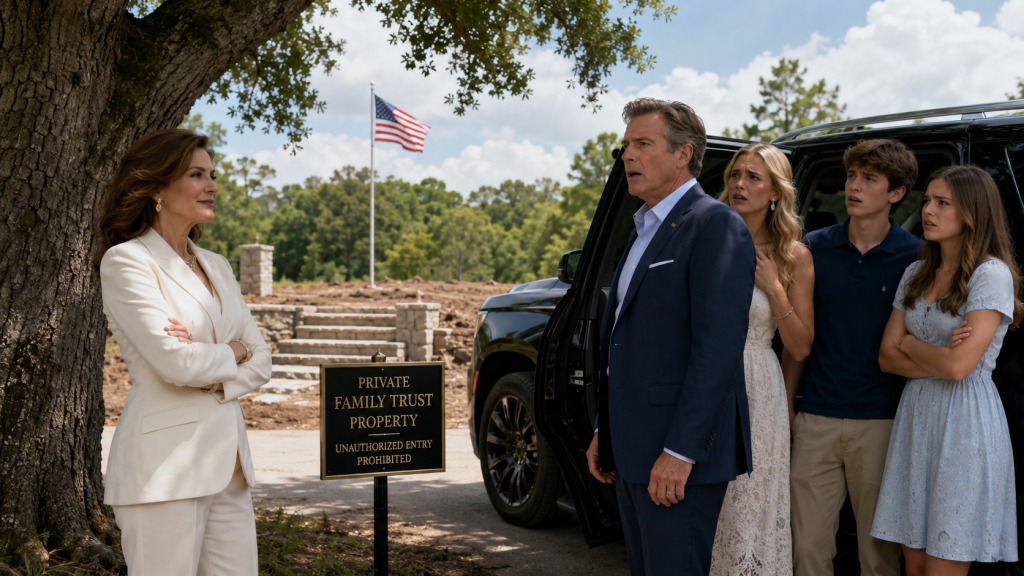
By the third morning, only the stone steps remained.
Steps leading to empty air.
Beside them stood a sign from Marianne’s office.
PRIVATE FAMILY TRUST PROPERTY. UNAUTHORIZED ENTRY PROHIBITED.
Three days later, Adrian’s plane landed.
I waited down the road in my car as his black SUV turned into the driveway.
Kendra sat beside him in sunglasses, smiling like a queen arriving at her estate.
Marcus and Lila were in the back seat, quiet and confused.
Then the SUV stopped.
Adrian stepped out first.
And his face went white.
The house was gone.
Not damaged.
Not burned.
Gone.
Only the stone steps remained, clean and absurd under the afternoon sun.
Kendra screamed first.
“What is this?”
Adrian walked forward slowly, as if the house might reappear if he approached with enough authority.
He turned and saw me standing beside the old oak tree.
“You destroyed my house,” he said.
I smiled.
“No, Adrian. I removed mine.”
Marcus opened the car door.
His face was twisted between shock and anger.
“Dad,” he said slowly, “what did you tell us Mom did?”
Adrian looked at our son.
Then at me.
For the first time in nineteen years, he had no sentence ready.
Lila climbed out next, clutching her phone.
“You said she abandoned us.”
Her voice trembled.
“You said she sold the house behind your back because she wanted revenge.”
Kendra ripped off her sunglasses.
“Adrian, where are we supposed to live?”
I looked at my children, not him.
“Your rooms are safe. Your things are safe. I moved everything that belonged to you into the guesthouse on the north property.”
Lila’s eyes filled.
“You didn’t throw our stuff away?”
“Never.”
Marcus turned on his father.
“Then why did you say she didn’t want us anymore?”
Adrian snapped, “Because she was trying to control me!”
That was when Marianne stepped from behind the oak tree, holding a folder.
I had almost forgotten how much theater she enjoyed when justice was involved.
“Actually, Mr. Vance,” she said, “your wife also filed an emergency custody petition after receiving your message stating the children would be kept from her.”
Adrian went pale.
Kendra whispered, “You texted that?”
I smiled faintly.
“The house was only wood, Adrian. The real mistake was thinking my children were yours to erase.”
Adrian lunged for the sign.
Marianne’s voice cracked like a whip.
“I would not recommend that.”
He froze.
Two sheriff’s deputies stepped out from a vehicle parked behind the tree line.
Adrian looked around, humiliated.
“You brought police?”
“No,” Marianne said. “We brought witnesses.”
One deputy approached and handed Adrian an envelope.
Temporary order.
Notice of hearing.
Restraining conditions regarding removal of the children from the state without written consent.
Emergency review of custody due to parental alienation and threat of concealment.
Adrian stared at the papers.
“This is ridiculous.”
“Taking minor children overseas for a ceremonial wedding while telling their mother they would not be returned is not ridiculous,” Marianne said. “It is evidence.”
Marcus looked at his father.
“You told us Mom didn’t want to come.”
Adrian’s jaw tightened.
“She didn’t belong there.”
Lila’s tears spilled over.
“She’s our mother.”
Kendra shifted beside him.
For the first time, her confidence cracked.
“Adrian, you told me the divorce was finished.”
I almost felt sorry for her.
Almost.
Adrian had edited her life too.
“No,” I said. “It was not.”
Kendra looked at me, then at him.
“You said the house was yours.”
Marianne smiled without warmth.
“Also false.”
Adrian turned on me.
“What was I supposed to do? Stay trapped in your family museum forever?”
I looked at the empty steps.
“No one trapped you, Adrian. You were free to leave. You were not free to take my children, my home, and my father’s land on your way out.”
He laughed bitterly.
“You think moving a house makes you powerful?”
“No,” I said. “Knowing what is mine does.”
The deputies allowed Marcus and Lila to choose whether they wanted to come with me or leave with Adrian for the evening under the temporary order’s terms.
Neither child moved toward him.
Marcus came first, stiff and silent.
Then Lila ran to me so hard I nearly lost my balance.
She wrapped her arms around my waist and sobbed into my shoulder.
“I thought you didn’t want us,” she whispered.
I closed my eyes.
Those words hurt more than every message Adrian had sent.
“I always wanted you,” I said into her hair. “Always.”
Marcus stood a few feet away, blinking fast, trying not to cry.
I reached for him.
He hesitated.
Then he stepped into my arms too.
For years, he had been growing away from me, or so I thought.
Now I realized someone had been pulling him.
Adrian watched us with a face I could not read.
Anger.
Panic.
Possession.
Maybe grief.
Kendra stood beside the SUV, suddenly looking less like a bride and more like a woman who had arrived at a locked door with the wrong key.
I took the children to the north property.
The guesthouse stood beside the relocated farmhouse, surrounded by pines and the faint smell of fresh earth.
It was not perfect yet.
The porch steps were temporary.
The kitchen was still disconnected.
Boxes lined the hallway.
But when Lila saw her room, with her posters stacked carefully and her stuffed bear on the pillow, she cried again.
Marcus found his guitar leaning safely against the wall.
He did not say anything.
He just sat on the bed and held it.
That night, we ate takeout on the floor of the guesthouse living room.
No one had much appetite.
Finally, Marcus spoke.
“Dad said you wanted the divorce because you hated us choosing him.”
I set my food down.
“Did you choose him?”
He looked ashamed.
“I thought I had to.”
Lila hugged her knees.
“Kendra kept saying you were bitter. She said Dad deserved happiness.”
“I wanted your father to be happy,” I said. “But not by making you believe I disappeared.”
Marcus stared at the floor.
“He said the house made you selfish.”
I almost laughed.
The house.
The old villain in Adrian’s new-life story.
“No,” I said. “The house made him honest.”
They both looked at me.
“He never understood that a home is not something you possess. It is something you protect.”
The custody hearing happened five days later.
Adrian arrived in a dark suit and a wounded expression.
Kendra came too, though her lawyer probably advised against it.
She sat behind him, twisting a new wedding band that had no legal meaning.
Marianne laid out the facts with surgical calm.
Adrian’s messages.
His overseas trip.
His attempt to exclude me from the children’s return.
His false statements to Marcus and Lila.
His lack of ownership in the property.
The trust documents.
The emergency relocation of the house to protected family land.
The judge read Adrian’s 2:13 a.m. text aloud.
Be gone when we return. I hate old things. I worked hard for a new life.
Then the second.
Don’t embarrass yourself. The children will be with us.
The courtroom went very still.
Adrian’s attorney tried to argue that the messages were “emotional.”
The judge looked at him over his glasses.
“Emotional does not mean harmless.”
Then Marcus asked to speak.
My heart stopped.
He was seventeen, old enough for the judge to hear him directly.
He stood with his hands clenched.
“My dad told us Mom didn’t want us anymore,” he said. “He said she was trying to punish him by keeping the house. He said if we loved him, we would accept Kendra as part of our family.”
Adrian whispered, “Marcus.”
Marcus did not look at him.
“He made me feel like protecting Mom was childish. I believed him. I hate that I believed him.”
Lila did not speak in open court.
She submitted a written statement instead.
Later, Marianne let me read it.
Dad told me Mom was jealous because Kendra was younger and better for his new life. I thought Mom was quiet because she didn’t care. Now I know she was being lied about. I want to live where nobody asks me to choose who to love.
I cried in the hallway after reading that.
Not loudly.
Just enough that Marianne handed me a tissue and pretended to inspect a vending machine.
The judge granted me primary temporary custody pending full evaluation.
Adrian received structured visitation.
No overnight travel.
No removing the children from the state.
No unsupervised involvement of Kendra until the family counselor approved it.
Adrian looked stunned.
Men like him are always shocked when control stops working.
The divorce became uglier after that.
Adrian demanded half the house.
Marianne enjoyed that part.
She presented the trust records, the land history, the preservation agreement, my father’s transfer documents, and the clause excluding marital claims to ancestral property.
Adrian’s attorney grew quieter with every page.
Then came the financial review.
That was when we learned the house was not the only thing Adrian had lost.
For years, he had used marital funds to support Kendra.
Rent.
Jewelry.
Travel.
A luxury car lease placed under a business expense.
The resort wedding deposit paid from an account connected to our family savings.
He had not simply left me for a new life.
He had funded that life with ours.
When Kendra learned that some of the money came from accounts subject to divorce review, her loyalty thinned quickly.
She stopped attending hearings.
Then she moved out of the apartment Adrian had leased for her.
Then, according to Marcus, she blocked him.
Adrian called me one evening from an unknown number.
I should not have answered.
But I did.
His voice sounded hollow.
“Are you happy now?”
I looked through the window at Lila painting porch chairs while Marcus tuned his guitar nearby.
“No,” I said. “But I am honest.”
“You turned my children against me.”
“No. You used them as props in your escape.”
He was silent.
Then he said, “I loved that house too.”
I closed my eyes.
“No, Adrian. You loved being seen in it.”
That was the last private conversation I had with him.
Everything after went through attorneys, parenting apps, and court schedules.
The relocated farmhouse took six months to restore fully.
Piece by piece, it became itself again.
The kitchen doorway with the height marks was installed in the new hall.
Marcus stood beside it one afternoon and found his mark from age twelve.
He touched it with two fingers.
“I thought it was gone.”
“I saved it.”
He swallowed.
“Why?”
“Because your childhood mattered, even when your father tried to rewrite it.”
Lila painted her room green.
Then changed her mind and painted it pale yellow.
Then apologized for being indecisive.
I laughed and handed her another roller.
“Walls can change, sweetheart. Love should not.”
She smiled then.
A real smile.
The kind I had not seen in months.
Adrian’s ceremonial marriage to Kendra collapsed before our legal divorce finalized.
His reputation at work suffered after the financial disclosures.
His family, who had flown overseas for the wedding and smiled through champagne toasts, suddenly claimed they had not known “the details.”
People rarely know the details when consequences arrive.
The final divorce hearing came almost a year after the house moved.
I wore my mother’s pearl earrings.
Adrian wore the same dark suit from the first hearing, though it hung looser now.
He asked for shared custody.
The evaluator recommended otherwise.
Not because he had an affair.
Courts do not punish heartbreak neatly.
But because he had manipulated the children, threatened to withhold them, involved them in adult deception, and lied repeatedly about their mother.
The judge’s ruling was clear.
Primary custody with me.
Structured visitation for Adrian.
Financial restitution for marital funds used on Kendra.
No claim to the trust property.
No claim to the relocated farmhouse.
Adrian stared at the table when it was over.
For once, he did not edit the moment with a sentence.
He had none left.
Outside the courthouse, Marcus and Lila waited with Marianne.
Lila hugged me first.
“Is it done?”
“The legal part is.”
Marcus looked toward the doors where Adrian would eventually exit.
“Do we have to hate him?”
“No,” I said. “You don’t have to hate anyone. You only have to see clearly.”
He nodded.
That night, we returned to the farmhouse.
Our farmhouse.
The porch lights glowed warm against the trees.
The piano sat in the front room.
My father’s books lined the shelves.
The quilts were folded over the sofa.
The kitchen smelled like tomato soup and fresh bread.
Home does not always need to be grand.
Sometimes it only needs to be safe.
After dinner, Lila stood by the hallway doorway and traced the saved height marks.
“Will we add new ones?” she asked.
“If you want.”
She stood straight against the wood.
Marcus grabbed a pencil.
“Fifteen and still short,” he teased.
She shoved him.
He laughed.
I watched them mark the wall and felt something inside me finally unclench.
Adrian had called the house old.
He had called me old.
He had said he worked hard for a new life.
But he never understood that old things are not worthless.
Old things hold memory.
Old things have roots.
Old things survive storms because they were built before convenience taught people to abandon what required care.
My husband took our kids overseas for his wedding.
Then he came home and found the house gone.
He thought he could erase me with one text.
He thought he could replace nineteen years with a younger woman, a resort ceremony, and a clean sentence about a new life.
He thought the children were his audience.
He thought the house was his prize.
He thought I would be gone when he returned.
And I was gone.
But not the way he meant.
I was gone from the version of myself that waited to be chosen.
Gone from the silence that made his lies easier.
Gone from the marriage where he edited pain into convenience.
In my place stood a woman my father had prepared for without telling me.
A woman with trust papers, an attorney, protected land, and enough love for her children to stop begging and start acting.
The house was not destroyed.
It was saved.
My children were not taken.
They were told the truth.
And Adrian’s new life?
It began exactly where he deserved.
At the bottom of empty stone steps, staring into the space where a home used to stand, finally understanding the difference between living in something and owning it.
THE END! THANKS FOR READING!