 Reading Time: 46 minutes
“Can you come here?” I asked. There was a brief silence on the other end of the phone. Then Evelyn Parker, my attorney, answered without hesitation.
“I’m already on my way.” I looked across the driveway at the U-Haul parked beside my late wife’s cabin. “You’re coming from Charlotte?” “Yes.” “That’s more than an hour away.”
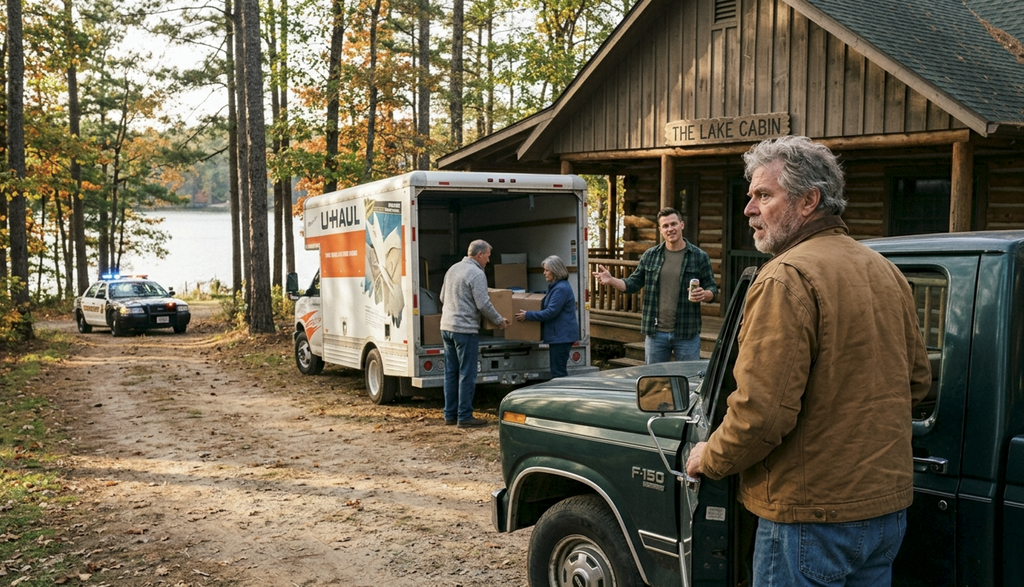
“I know.”
Her voice changed.
It became lower.
More serious.
“And Tom?”
“Yes?”
“Do not leave that property.”
The call ended.
I slowly lowered my phone.
For several seconds, I simply stood there beneath the pine trees, listening to the wind move through the branches.
The lake glittered beyond the cabin exactly as it always had.
Calm.
Beautiful.
Almost cruelly peaceful.
Nothing about the water suggested that my family was beginning to come apart twenty feet away.
Deputy Mills was still studying the document Ron Mercer had handed him.
The supposed deed.
The piece of paper that claimed my dead wife had somehow transferred the cabin out of our family trust.
Ron stood several feet away with his arms folded across his chest.
His beer bottle hung loosely from one hand.
When I first arrived, he had been smug.
Almost entertained.
He had acted like I was an old man who had shown up too late to stop something already decided.
Now?
He wasn’t smiling.
His wife, Linda, had moved closer to him.
She looked from the deputy to me and then back to the paper.
“What does it say?” she asked.
Deputy Mills raised his eyes.
“I’m not an attorney, ma’am. I’m not going to make a final determination about ownership based on one document.”
Ron pointed toward me immediately.
“Exactly. So he needs to stop acting like this place belongs to him.”
Deputy Mills looked at him.
“Sir, that is not what I said.”
Ron’s mouth tightened.
The deputy turned toward me.
“Mr. Hale, you said the cabin is held in a family trust?”
“Yes.”
“Do you have the original trust documents?”
“Yes.”
“Can you access them?”
“I can.”
“Good.”
He handed the questionable deed back only long enough to photograph it carefully from several angles.
“Do not hand over your originals to anyone. Bring me copies. Electronic records are fine too.”
I nodded.
Then another question rose in my mind.
A question that should have occurred to me earlier.
“Deputy?”
“Yes?”
“Can I ask you something?”
“Of course.”
I pointed toward the large U-Haul.
“Who hired the moving company?”
Deputy Mills frowned.
“What do you mean?”
“Who arranged for that truck?”
Ron answered before anyone else could.
“Derek.”
My stomach tightened at the sound of my son-in-law’s name.
“Where is Derek?”
Ron looked away.
“He’s working.”
“Where?”
“Charlotte.”
“What company?”
Ron sighed dramatically.
“Why does that matter?”
I stepped closer.
“Because I want to understand how my son-in-law managed to move his parents into my dead wife’s cabin while I’m standing here with trust documents proving he doesn’t own one square inch of it.”
Ron lifted his beer bottle and took another drink.
“Derek told us everything was settled.”
“Settled how?”
“He said your daughter inherited the place.”
I stared at him.
“My daughter does not inherit this cabin until after I die.”
He shrugged.
“That’s not what he told us.”
The casualness of his answer made something hot move through my chest.
I looked at Linda.
“And you believed him?”
Her eyes dropped.
“He showed us paperwork.”
“What paperwork?”
“The deed.”
“The same one you just showed the deputy?”
“Yes.”
I took one step toward her.
“Did you see Margaret sign it?”
Linda’s face changed.
“No.”
“Did you speak to Margaret when this document was supposedly signed?”
She swallowed.
“No.”
“Could you have?”
She frowned.
“What?”
“Could you have spoken to Margaret on the date printed on that document?”
She looked confused.
I answered for her.
“No.”
My voice came out quieter than I expected.
“Because Margaret has been dead for three years.”
Linda looked at the ground.
Ron stepped between us.
“We trusted Derek.”
I stared at him.
“That isn’t an answer.”
“It is to us.”
“No.”
I shook my head.
“It’s an excuse.”
Deputy Mills cleared his throat.
“Let’s keep this civil.”
I looked at him.
“I’m trying.”
And I was.
God knew I was.
Because every instinct inside me wanted to walk into that cabin, pick up every box those people had carried into Margaret’s home, and throw it back onto the driveway.
They had hung clothes in her closets.
Set boxes on her floors.
Opened her kitchen cabinets.
Probably walked through her bedroom.
Probably touched things she had touched.
Things I had left exactly where they were because moving them had once felt too much like admitting she would never come back.
I looked toward the cabin.
“Deputy, I want them removed from the property.”
Ron gave a nervous laugh.
“You can’t just throw us out.”
“I can if you don’t have permission to be here.”
“You don’t get to decide that.”
Deputy Mills raised a hand.
“That’s enough.”
Ron stopped.
The deputy studied the cabin, the U-Haul, the questionable deed, and then me.
“I’m going to make a temporary determination based on the information available right now.”
He pointed toward the porch.
“Mr. and Mrs. Mercer, until ownership is clarified, you need to remain outside the residence.”
Ron stared at him.
“Our belongings are inside.”
“They stay where they are.”
“This is ridiculous.”
“I didn’t create the situation, sir.”
Ron’s face hardened.
Then he looked at me with such open hatred that the expression surprised me.
“This isn’t over.”
I met his eyes.
“No.”
For the first time that morning, my voice felt completely steady.
“It isn’t.”
He thought I meant there would be a legal fight over the cabin.
At that moment, I probably thought the same thing.
Neither of us understood how much larger the truth was about to become.
Evelyn arrived forty-seven minutes later.
I know the exact number because I checked the time three times.
Every minute felt stretched thin.
Her black sedan came around the curve beside the lake and stopped behind my truck.
Evelyn stepped out carrying a leather folder beneath one arm and a tablet in her other hand.
She was in her early fifties, sharp-eyed, calm, and incapable of wasting time when something mattered.
She didn’t greet Ron.
She didn’t greet Linda.
She barely greeted me.
“Where is the deed?”
I pointed toward Deputy Mills.
“He photographed it.”
The deputy showed her the document.
Evelyn examined it.
She leaned closer.
Then her expression changed.
Not dramatically.
That wasn’t her style.
But I had known Evelyn for almost twenty years.
I saw the change immediately.
“What?” I asked.
She didn’t answer.
Instead, she studied the document again.
“Where did this come from?”
“Ron had it.”
“Did he hand it voluntarily to the deputy?”
“Yes.”
“Good.”
She glanced toward the Mercers.
Then back at me.
“Tom, I need you to understand something.”
“I’ve had an unusually strange morning already.”
I tried to smile.
I couldn’t.
“Go ahead.”
“This isn’t simply someone printing a fake quitclaim deed off the internet.”
My stomach tightened.
“What is it?”
“It appears to be a copy of a recorded instrument.”
I frowned.
“Recorded where?”
“At the county register of deeds.”
For one second, I thought I had misunderstood her.
“You’re telling me this was actually recorded?”
“I need to verify it.”
She pulled out her phone.
Her fingers moved quickly across the screen.
Nobody spoke.
Even Ron watched her.
A few seconds later, Evelyn’s face became very still.
“Yes.”
My heart began pounding.
“Yes what?”
“The document was recorded twenty-three days ago.”
I stared at her.
“That’s impossible.”
“I know.”
“Margaret has been dead for three years.”
“I know.”
“The trust owns the cabin.”
“Yes.”
“Margaret couldn’t legally transfer something out of the trust after she died.”
“No.”
“Then how was a deed with her signature recorded twenty-three days ago?”
Evelyn locked her phone.
“That is exactly what we’re going to find out.”
Ron stepped forward.
“Maybe Margaret signed something before she died.”
I turned slowly.
“What did you say?”
He lifted his shoulders.
“People make plans before they die.”
“She died three years ago.”
“You weren’t with her every second of her life.”
My hands curled into fists.
Evelyn moved slightly between us.
“Mr. Mercer.”
He looked at her.
“Stop talking.”
Ron scoffed.
“This is a family matter.”
“No.”
Evelyn’s voice was quiet enough to make him stop.
“It stopped being a family matter when someone recorded a property deed using the purported signature of a deceased woman.”
Silence.
Even the wind seemed quieter.
Deputy Mills looked again at the document.
Evelyn turned toward me.
“Do you have Margaret’s death certificate?”
“At home.”
“Anywhere closer?”
I thought.
Then remembered.
“Yes.”
“Where?”
“In my truck.”
I had carried copies of Margaret’s death certificate during the first year after she died.
Banks wanted it.
Insurance companies wanted it.
The hospital wanted it.
The accountant wanted it.
Death, I learned, came with paperwork.
Even grief needed documentation.
One copy was still inside my glove compartment.
I walked toward the truck.
When I opened the compartment, an old receipt fell onto the floor.
Underneath it was the folded envelope containing the certified copy.
I stared at Margaret’s name printed across the document.
MARGARET ANNE HALE.
For one painful second, none of the cabin mattered.
None of the money mattered.
None of the forged documents mattered.
I remembered signing forms beside her hospital bed.
Remembered her fingers growing cold in mine.
Remembered a nurse touching my shoulder and saying words I never wanted to hear.
I closed my eyes.
Then carried the certificate back.
Evelyn took it.
She looked first at Margaret’s date of death.
Then at the deed.
Then back again.
Her eyes narrowed.
“Tom.”
“What?”
“Look at the execution date.”
I stepped beside her.
The deed stated that Margaret had supposedly signed it on October 14.
I looked at the death certificate.
Margaret had died on October 3.
Eleven days earlier.
My hands began to shake.
For a moment, I could hear nothing except my own heartbeat.
“That’s not possible.”
“No.”
“She was already buried.”
Evelyn looked toward Deputy Mills.
“This needs to be preserved.”
He nodded.
“I agree.”
“This is potentially evidence of fraud, forgery, and unlawful use of a deceased person’s identity.”
Ron shook his head.
“You people are making a mountain out of nothing.”
Evelyn turned toward him.
“Where did you get the document?”
“Derek.”
“From where?”
“He gave it to us.”
“When?”
“Last week.”
“Did he tell you who prepared it?”
“No.”
“Did he tell you which attorney handled it?”
“No.”
“Which notary?”
“I don’t know.”
“Did he explain how his mother-in-law signed a deed eleven days after her death?”
Ron’s face reddened.
“No.”
“Did he give you anything else?”
Ron glanced at Linda.
Linda glanced back at him.
It lasted barely a second.
But there are conversations people have without words.
That was one of them.
Evelyn saw it.
So did I.
“Mrs. Mercer?” Evelyn asked.
Linda’s mouth tightened.
“What?”
“Did Derek give you anything else connected to this property?”
She looked at her husband.
Ron gave a small shake of his head.
Linda looked frightened.
Then she whispered, “A key.”
My chest tightened.
“To what?”
“The upstairs office.”
Every hair on my arms seemed to rise.
I stared at her.
“What office?”
“The one at the end of the hallway.”
Margaret’s office.
The room I hadn’t entered since shortly after the funeral.
Not because it was locked.
Not because I wasn’t allowed.
Because every time I stood outside that door, I remembered her sitting behind the desk with her reading glasses low on her nose.
I remembered her humming while writing Christmas cards.
I remembered her calling down the stairs.
“Tom, have you seen my blue pen?”
I remembered answering, every single time, “Which blue pen? You own forty.”
And I remembered her laughing.
That room had belonged to her.
“What key?” I asked.
Linda pointed toward the U-Haul.
“It’s in one of the boxes.”
“Why would Derek have a key to Margaret’s office?”
“I don’t know.”
Ron snapped, “Linda.”
She turned toward him.
“What?”
“You don’t have to explain every damn thing.”
Evelyn looked at him.
“Actually, right now, she probably should.”
“This is harassment.”
“No.”
Evelyn’s eyes hardened.
“This has become an investigation.”
Deputy Mills stepped closer.
“Mr. Mercer, I’d strongly advise you not to interfere.”
Ron took a step backward.
But before he turned away, he muttered something.
Something I almost missed.
“You’re all looking in the wrong place.”
I stared at him.
“What does that mean?”
He didn’t answer.
“Ron.”
Nothing.
He lifted the beer bottle again.
But his hand was trembling now.
For the next two hours, nobody moved anything.
The U-Haul remained in the driveway.
The cardboard boxes remained inside the cabin.
Deputy Mills photographed the deed.
He photographed the trust documents Evelyn pulled from an electronic archive.
He photographed Margaret’s death certificate.
He recorded statements from me, Ron, and Linda.
Evelyn contacted the county recorder.
I did almost nothing.
I stood on the porch and stared through the window at Margaret’s chair.
It sat exactly where it had for years.
Beside the large front window overlooking the lake.
She used to sit there every morning with coffee and complain that I made it too weak.
Every morning.
Thirty-one years of marriage had been built from moments like that.
Not grand anniversaries.
Not expensive vacations.
Not dramatic declarations.
Coffee.
Arguments about the thermostat.
Grocery lists.
Her feet under my legs on the couch.
The way she always fell asleep fifteen minutes into every movie she insisted on watching.
The way she would come onto the porch at sunset and rest her chin on my shoulder.
I remembered the first day we saw the cabin.
We were twenty-nine.
Young enough to think thirty was old.
The house had been cheap because almost everything was wrong with it.
Two small bedrooms.
A leaking roof.
A kitchen barely big enough for one person.
A porch that leaned slightly toward the lake.
Margaret walked through the front door.
She turned in one slow circle.
Then looked at me.
“Tom.”
“What?”
“I think I could grow old here.”
I laughed.
“You’re already planning my retirement?”
“No.”
She walked toward me.
Wrapped both arms around my neck.
“I’m planning ours.”
Then she kissed me.
She never got to grow old there.
Cancer made sure of that.
But after she died, I believed I could preserve what she loved.
The cabin became the last place where the version of us I remembered still seemed to exist.
And now strangers had carried boxes through it.
Someone had forged her name.
Someone had turned her memory into an opportunity.
Evelyn appeared behind me.
“Tom.”
I looked around.
“Yes?”
“I need you to come inside.”
I stared at the front door.
“Why?”
“There’s something we need to check.”
I looked toward Deputy Mills.
He nodded.
“I’ll come with you.”
The three of us entered.
The smell hit me first.
Cardboard.
Beer.
A floral perfume I didn’t recognize.
Other people’s lives.
I hated it.
There were kitchen boxes on the floor.
Two suitcases beside the stairs.
A framed photograph of Ron and Linda sitting on Margaret’s side table.
That small detail almost hurt more than the deed.
Someone had put their family photograph where Margaret kept ours.
I walked over.
Picked it up.
Set it facedown.
Then followed Evelyn upstairs.
At the end of the hall waited the white door.
Margaret’s office.
I stopped in front of it.
Evelyn glanced at me.
“You don’t have to be the one to open it.”
“Yes.”
I placed my hand on the knob.
The metal was cool.
For a second, I was back three years earlier.
The funeral had ended.
The flowers were dying.
Everyone had gone home.
I had stood in this exact hallway unable to walk through that door.
Because her glasses were still on the desk.
Her sweater was still over the chair.
A half-finished crossword puzzle was waiting beside a coffee mug.
I had closed the door.
And left it closed.
Until now.
I turned the knob.
The door opened.
Dust covered most of the room.
But not all of it.
Evelyn stepped inside.
Her gaze moved immediately toward the desk.
A clean rectangle marked the dusty surface.
Something had recently been removed.
“What was there?” she asked.
My mouth went dry.
“A laptop.”
“Margaret’s?”
“Yes.”
“Where is it?”
“I don’t know.”
I moved faster now.
The desk drawers were open.
Papers lay across the floor.
Photographs had been removed from envelopes.
A small wooden organizer had been dumped upside down.
Someone had searched the room.
Not casually.
Methodically.
I crouched beside the desk.
One drawer had been completely emptied.
Another contained only photographs.
I picked up one.
Claire at seven years old.
Missing front tooth.
Red swimsuit.
Margaret behind her laughing.
My throat tightened.
Then something caught the light beneath the desk.
A small brass key.
I reached down.
Picked it up.
There was a tiny letter engraved near the top.
M.
Margaret.
Evelyn crouched beside me.
“Do you recognize that?”
I nodded.
“Yes.”
“What does it open?”
I stared at the key.
“The metal box.”
“What metal box?”
“Margaret kept important documents in a small metal box.”
“Where?”
“Here.”
“Inside the office?”
“No.”
I stood.
“In the basement.”
Evelyn’s expression sharpened.
“Show me.”
We went downstairs.
The basement smelled like old wood and lake dampness.
At the back wall was a heavy shelf Margaret and I had installed twelve years earlier.
I walked directly toward it.
Then stopped.
The shelf was empty.
Not completely.
But the place where the box had sat was empty.
A clean rectangle surrounded by dust showed exactly where it had been.
I touched it.
My fingers came away gray.
“Someone took it.”
Evelyn stood beside me.
“When were you last here?”
“Three weeks ago.”
“Did you see the box then?”
I closed my eyes.
I tried to reconstruct the afternoon.
I had come down to check the water heater.
The light had flickered.
I remembered setting my flashlight on the shelf.
Beside…
Beside the metal box.
My eyes opened.
“Yes.”
“You’re sure?”
“Yes.”
“It was here?”
“It was right there.”
Evelyn’s jaw tightened.
“Then it disappeared recently.”
Deputy Mills looked at the shelf.
“What did it contain?”
“Estate documents.”
“Anything else?”
“Insurance records. Copies of identification. Old tax papers.”
Evelyn turned toward me.
“Signature samples?”
I frowned.
“What?”
“Cards, notarized documents, signed financial forms?”
“Probably.”
Her expression became serious.
“Then whoever took that box may have had access to exactly what they needed.”
“To do what?”
“To study Margaret’s signature.”
The words landed heavily.
“And the trust?”
“Yes.”
“Could somebody just use the trust documents to transfer the property?”
“Not legally.”
“Then why steal them?”
“To find out how ownership was structured.”
She paused.
“To find weaknesses.”
I stared at the empty rectangle in the dust.
My chest felt cold.
“Someone planned this.”
“That appears increasingly possible.”
“For how long?”
“I don’t know.”
Then a name entered my mind.
Derek.
I didn’t want it there.
I pushed it away.
It returned.
“Do you think Derek did this?”
Evelyn didn’t answer immediately.
“Do you?”
“Tom, I don’t know who forged the deed.”
“But he arranged the move.”
“Yes.”
“He gave his parents the document.”
“Yes.”
“He had a key to Margaret’s office.”
“Apparently.”
“He knew about the trust.”
“Yes.”
I shook my head.
“No.”
Evelyn watched me.
“No what?”
“Derek wouldn’t do this.”
“Why?”
“Because he’s my daughter’s husband.”
Her expression didn’t change.
“That does not make him incapable of fraud.”
“He’s been in our family eight years.”
“I know.”
“He stood beside Claire at Margaret’s funeral.”
“I know.”
“He helped me clean out her house.”
“I know.”
“He hugged me.”
My voice cracked unexpectedly.
“He told me I wasn’t alone.”
Evelyn’s face softened.
But she said nothing.
And in that silence, memories began changing shape.
Derek asking me two years earlier where Margaret kept the original trust documents.
At the time, I had assumed he was curious about estate planning.
Derek asking whether the cabin had a mortgage.
I had told him it was paid off.
Derek asking whether Claire would automatically inherit it.
I had explained the trust.
Derek asking who had authority to sell property from the trust.
I had explained that too.
At the time?
Each question had seemed harmless.
Responsible, even.
Now they sounded different.
Like a man measuring doors before a robbery.
There are moments when truth arrives like lightning.
This wasn’t one of them.
This truth arrived like a crack spreading across glass.
Thin at first.
Barely visible.
Then wider.
Wider.
Until suddenly you realized the whole surface had been broken for a long time.
At 4:18 that afternoon, my phone rang.
Claire.
My daughter.
I stared at her name on the screen.
A part of me wanted to ignore it.
Not because I didn’t love her.
Because I already knew whatever she told me would make the day worse.
Evelyn saw the screen.
“Answer.”
I did.
“Claire?”
“Dad?”
Her voice was shaking.
“Where are you?”
“At home.”
“Is Derek there?”
A pause.
“No.”
“Where is he?”
“I don’t know.”
My stomach sank.
“What happened?”
“Dad, why are you asking me like that?”
“Your in-laws are at the cabin.”
Silence.
“What?”
“They arrived with a U-Haul.”
Another silence.
Longer.
“What?”
“They say Derek gave them permission to move in.”
“No.”
“Claire—”
“No. That doesn’t make any sense.”
“I know.”
Then I heard it.
Her breathing.
Short.
Uneven.
She was crying.
“Claire?”
“Dad…”
“Yes?”
“There’s something I need to tell you.”
My grip tightened around the phone.
“What?”
“I didn’t know.”
“Know what?”
“About the cabin.”
“What do you mean?”
“I thought you gave it to us.”
Everything inside me went still.
“What?”
“Derek told me you changed the trust.”
“When?”
“Months ago.”
“He told you I changed your mother’s trust?”
“Yes.”
“Did he show you anything?”
“Paperwork.”
“What kind?”
“I don’t know.”
“Claire.”
“I didn’t study it, Dad!”
Her voice broke.
“He said you wanted it to be a surprise. He said Mom had always intended for the cabin to become ours and that you finally decided to transfer it early.”
I closed my eyes.
“Claire, your mother and I never changed that trust.”
“I know that now.”
“Did you sign anything?”
Silence.
My eyes opened.
“Claire?”
“I signed something.”
Evelyn looked at me sharply.
“What did you sign?”
“I thought it was related to refinancing our house.”
My throat tightened.
“What exactly did Derek tell you?”
“He said the bank needed my signature on some estate and marital-property forms because some of our assets might be used for the refinancing.”
Evelyn held out her hand.
I placed the phone on speaker.
“Claire,” she said, “this is Evelyn Parker.”
“I know.”
“Do you remember where you signed those documents?”
“At home.”
“Was a notary present?”
“I don’t think so.”
“Did you sign blank pages?”
A sob escaped her.
“Maybe one.”
I shut my eyes again.
“Claire.”
“I know how that sounds!”
“No. I’m not blaming you.”
“I should have read everything.”
“We’ll deal with that later.”
I forced myself to keep my voice calm.
“Where is Derek?”
“I don’t know.”
“When did you last see him?”
“This morning.”
“What did he say?”
“Nothing unusual.”
“Did he mention the cabin?”
“No.”
“Did he say where he was going?”
“No.”
I looked at Evelyn.
She nodded once.
“Claire, listen to me carefully.”
“Okay.”
“Do not contact him.”
A pause.
“Why?”
“Because I think he may be involved in something serious.”
“No.”
“Claire—”
“No, Dad.”
She was crying harder now.
“You don’t understand.”
“What?”
“He called me.”
“When?”
“Twenty minutes ago.”
“What did he say?”
“He told me to pack a bag.”
My heart stopped.
“A bag?”
“Yes.”
“Why?”
“He said we were leaving tonight.”
“Leaving for where?”
“He wouldn’t tell me.”
“Did he sound angry?”
“No.”
“Scared?”
“I don’t know.”
“Claire.”
She whispered, “Desperate.”
Evelyn’s eyes met mine.
Then Claire spoke again.
“Dad… there’s something else.”
“What?”
“Before he hung up, he said something strange.”
Every nerve in my body tightened.
“What did he say?”
“He said…”
She stopped.
“Claire.”
“He said, ‘If your father finds the blue ledger, we’re finished.’”
Nobody moved.
I stared at Evelyn.
She stared back.
“What blue ledger?” I asked.
“I don’t know.”
“Have you ever seen a blue notebook? A ledger? Anything belonging to your mother?”
“No.”
I slowly turned toward Margaret’s office.
Blue.
The word echoed through me.
Blue.
Margaret loved blue.
Blue scarves.
Blue ink.
Blue coffee mugs.
That stupid blue raincoat she wore even when the weather was too warm because she claimed it made her look mysterious.
I climbed the stairs again.
Evelyn followed.
“Dad?” Claire said through the phone.
“I’m here.”
I entered Margaret’s office.
My eyes moved across every shelf.
Every photograph.
Every book.
Then they stopped.
A framed photograph sat on the desk.
Margaret and me.
Fifteen years earlier.
Standing on the dock.
Her hair blowing across her face.
My arm around her waist.
I picked up the frame.
Something was written on the back.
Margaret’s handwriting.
My breathing stopped.
I read it aloud.
“Tom, if you ever need to understand what happened, don’t trust the papers.”
Evelyn stepped closer.
I continued.
“Trust the blue book.”
Claire gasped through the phone.
My fingers shook.
Evelyn whispered, “Open the frame.”
I removed the backing.
Behind the photograph was a narrow hidden compartment.
Inside it lay a small blue notebook.
No bigger than my hand.
Plain cover.
Elastic band.
Margaret’s handwriting on a small white label.
PRIVATE.
My knees nearly gave out.
I sat at her desk.
Evelyn stood over my shoulder.
Claire was still on speaker.
I pulled the elastic band away.
Opened the cover.
The first page was dated two years before Margaret died.
There was one sentence beneath the date.
I read it.
Then read it again.
Because my mind refused to accept the words.
Finally Evelyn whispered, “Tom?”
My voice came out barely audible.
“Derek doesn’t know I found out.”
Claire made a sound like someone had struck her.
“Dad…”
I stared at Margaret’s handwriting.
And suddenly I understood.
The forged deed wasn’t the beginning.
It wasn’t even the middle.
It was the last move in something Margaret had discovered years earlier.
My wife had been watching my son-in-law.
Investigating him.
Protecting us from him.
And she had died before she could tell me why.
Except she had told me.
She had written everything down.
I turned the page.
For several seconds, the words blurred.
I knew that handwriting too well.
I had spent thirty-one years reading it.
Grocery lists.
Birthday cards.
Christmas notes.
Reminders taped to the refrigerator.
Apology notes after stupid arguments.
Little messages tucked into my lunch.
DON’T FORGET YOUR DENTIST APPOINTMENT.
BUY MILK.
CALL YOUR BROTHER.
I LOVE YOU EVEN WHEN YOU’RE ANNOYING.
That handwriting had been ordinary.
Comforting.
Domestic.
Now it looked like evidence.
I read.
October 12.
I don’t know whether I’m being paranoid anymore.
Derek came by today.
He asked again about the cabin.
My stomach tightened.
I kept going.
He said Claire deserves something secure after we’re gone.
I told him the cabin belongs to Tom and me and will remain in the family trust.
He smiled.
Then he said something that bothered me.
Trusts can be changed.
I stopped.
Claire was silent.
Evelyn whispered, “Keep reading.”
I turned the page.
October 28.
Derek came again.
This time he asked where Tom keeps the original trust documents.
I lied.
I told him Evelyn has them.
I looked up at Evelyn.
“You?”
She nodded slowly.
“She did call me around that time.”
“You knew?”
“Not everything.”
“What did she tell you?”
“Keep reading first.”
My heart began pounding harder.
I continued.
November 6.
I checked the bank account connected to the cabin.
There is a withdrawal I didn’t authorize.
November 7.
The withdrawal was not made by Tom.
It was made using information that should only have been accessible to me.
I have asked the bank to investigate.
I haven’t told Tom yet.
My voice cracked.
“Why wouldn’t she tell me?”
Evelyn’s expression softened.
“Maybe she thought she was protecting you.”
“From our own son-in-law?”
Nobody answered.
I turned page after page.
The withdrawals began small.
Four hundred dollars.
Seven hundred.
Twelve hundred.
Amounts that could disappear inside ordinary expenses.
Then they grew.
Two thousand.
Five thousand.
Eight thousand.
Together, Margaret had calculated more than thirty-eight thousand dollars missing from accounts connected to the cabin and trust expenses.
She had written dates.
Transaction numbers.
Names.
Questions.
Then one page contained only a sentence.
I know who is doing it.
My hands trembled.
I turned the page.
One word.
Derek.
Claire began sobbing.
“No.”
I closed my eyes.
“Claire.”
“No, no, no.”
“I’m sorry.”
She inhaled shakily.
“Keep reading.”
I opened my eyes.
The next lines were written more heavily.
Almost as if Margaret had pressed the pen into the paper.
I don’t know how far this goes.
I don’t know whether Claire knows.
I don’t believe she does.
But I have discovered something worse.
The next page was missing.
Torn out.
A jagged strip remained near the binding.
Evelyn leaned down.
“Someone removed it.”
“Maybe Margaret?”
I shook my head.
“No.”
“How do you know?”
I flipped backward.
“Look.”
Every page had a small handwritten number in the corner.
Then the torn page.
Then 44.
“Page forty-three.”
Claire whispered through the phone, “What was on it?”
“I don’t know.”
I felt suddenly cold.
Someone had found the notebook before us.
Or found part of it.
Or Margaret herself had removed the page and hidden it somewhere else.
I turned to page forty-four.
If anything happens to me, Tom must know this.
The cabin isn’t the only thing Derek wants.
I stopped breathing.
The next page.
He wants control of the trust.
Next.
He believes Claire will eventually inherit everything.
Next.
He has been telling people Tom is getting old and won’t manage the property forever.
My jaw tightened.
Next.
He has been asking questions about Tom’s health.
I stared at the sentence.
For some reason, that one frightened me more than the stolen money.
“What kind of questions?” I whispered.
Evelyn didn’t answer.
I kept reading.
I don’t know what he is planning.
But I have stopped trusting him.
Then another entry.
I spoke to Evelyn today.
My head snapped toward my attorney.
“You?”
Evelyn went completely still.
“You spoke to Margaret?”
“Yes.”
“When?”
“Several times.”
“You never told me.”
“She asked me not to.”
“Why?”
“She didn’t want to frighten you.”
My anger rose suddenly.
“She was dying, Evelyn.”
“I know.”
“She was carrying this alone.”
“I know.”
“You should have told me.”
Her expression tightened.
“Maybe I should have.”
The simple admission took some of the anger out of me.
“What did she say?”
Evelyn sat opposite me.
“She told me she believed Derek had been pressuring her about changing the trust.”
“And?”
“She said she had noticed unusual financial activity.”
“And?”
“She suspected he had obtained personal information without permission.”
“And you kept that from me?”
“She told me she was gathering proof.”
I looked at the notebook.
“She was sick.”
“Yes.”
“She was going through chemotherapy.”
“Yes.”
“And she was investigating my son-in-law.”
“Yes.”
Something inside me collapsed.
Every memory of Margaret’s final months changed.
The days when she seemed distracted.
The nights she sat awake.
The afternoons when she told me she was tired and needed time alone.
I had assumed it was fear of dying.
Pain.
Medication.
The exhaustion of treatment.
Maybe some of it had been.
But she had also been trying to protect us.
I had been making soup.
Changing dressings.
Driving her to appointments.
Holding her when she cried.
And behind my back, she had been fighting another war.
I turned another page.
The next entry was dated three days before Margaret died.
I have made arrangements.
If Derek tries to take the cabin after I am gone, there will be evidence.
I have placed copies of everything in a secure location.
Tom doesn’t know where.
He will know when he needs to.
I turned the page.
Blank.
Another.
Blank.
Then, near the bottom of the final written page, there was one sentence.
The key is where we promised never to look.
I stared at it.
Evelyn leaned closer.
“What does that mean?”
I knew immediately.
“The fireplace.”
“What?”
I stood.
“The old stone fireplace downstairs.”
Claire’s voice came through the phone.
“Dad?”
“I need to call you back.”
“No.”
Her voice became terrified.
“Please don’t hang up.”
I stopped.
She whispered, “I don’t want to be alone right now.”
My chest broke.
“Okay.”
I kept the phone connected.
We went downstairs.
The fireplace stood at the far end of the living room.
Margaret and I had discovered the loose stone shortly after buying the cabin.
Behind it was a narrow cavity.
Too small to be useful.
Too hidden to ignore.
We joked about it for years.
If we ever became spies, we said, that was where we would hide the evidence.
If we ever won the lottery, that was where we would hide the ticket.
If we ever wrote embarrassing love letters, that was where they would go.
Then one night Margaret had laughed and said, “We should make a promise.”
“What promise?”
“That neither of us ever looks back there.”
“Why?”
“So if one of us needs to hide something from the other, we have one place.”
“That sounds unhealthy.”
“It sounds mysterious.”
“It sounds like you’ve been watching too many detective shows.”
She had slapped my arm.
“Promise.”
I promised.
Then forgot.
Until now.
I knelt beside the fireplace.
Pressed my fingers against the stone.
It moved.
My heartbeat accelerated.
I pulled.
Behind it sat a small metal container.
I stared.
Evelyn crouched beside me.
“Tom.”
I reached inside.
The container was cold.
Heavy.
I opened it.
Inside lay a small silver key.
Beneath the key was a folded piece of paper.
I recognized Margaret’s handwriting before I opened it.
Evelyn read over my shoulder.
Tom,
If you’re reading this, I’m gone.
My vision blurred immediately.
I stopped.
Claire began crying quietly through the speaker.
I continued.
I’m sorry.
Don’t blame yourself for not seeing what was happening.
I tried to protect you.
The key opens the safety deposit box at First Carolina Bank.
The box is in both our names.
Everything you need is inside.
Trust Evelyn.
And whatever you do, don’t let Derek know you found this.
I closed my eyes.
For three years I had thought Margaret died leaving unfinished conversations between us.
Questions I could never ask.
Things she never had time to say.
Now, suddenly, she was speaking again.
Not through ghosts.
Not through imagination.
Through preparation.
Through handwriting.
Through a little silver key.
My wife had known she might die before the truth came out.
And she had prepared for that possibility.
The thought shattered me in a way I wasn’t ready for.
I pressed the note against my chest.
“I’m sorry,” I whispered.
Evelyn touched my shoulder.
“For what?”
“For not seeing.”
“Tom.”
“She was doing this alone.”
“She didn’t want you to know yet.”
“I was her husband.”
“And she loved you.”
“That should have meant she trusted me.”
“Maybe it meant she knew you.”
I looked at her.
Evelyn’s voice softened.
“She knew you would confront Derek immediately.”
I wanted to deny it.
I couldn’t.
“She may have believed staying quiet was the only way to gather evidence without putting Claire at risk.”
I looked down at Margaret’s note.
She had known me.
Of course she had.
Better than anyone.
The next morning, we drove to First Carolina Bank.
Deputy Mills met us there.
So did a bank manager who had apparently been contacted by investigators.
The safety deposit box required the silver key and identification.
When the manager placed the long metal box on the table in the private room, my hands trembled.
I stared at it.
For three years, this box had existed.
Three years.
While I grieved.
While Claire remained married to Derek.
While Derek visited my home, ate my food, celebrated birthdays, shook my hand, and called me Dad.
The truth had been sitting behind a steel door.
Waiting.
I inserted the key.
The lock clicked.
Inside were folders.
Bank statements.
Printed emails.
Photographs.
Copies of identification.
A USB drive.
A second certified copy of the original trust.
Notarized statements.
And one small envelope.
My name was written across the front.
For Tom, if Derek lies.
My throat closed.
I opened it.
Inside was a letter.
Tom,
If Derek ever tells you I changed the trust, he is lying.
If he ever produces a deed bearing my signature after my death, it is fraudulent.
If he claims Claire knew what he was doing, believe me when I tell you she did not.
I stopped.
Claire.
Even dying, Margaret had been trying to protect our daughter.
I continued.
I have spent months documenting what he has done.
He has been moving money.
He has been using Claire’s name.
He has been manipulating documents.
And he has been trying to convince people that I am mentally incapable of managing my affairs.
I looked at Evelyn.
“What?”
She nodded.
“There were indications he was laying groundwork to challenge Margaret’s decisions.”
“By claiming she was incompetent?”
“Possibly.”
I looked back at the letter.
He needs the cabin because he believes it is worth enough to solve his financial problems.
But the cabin is only part of it.
He owes money.
A lot of money.
He believes that once he gains control of the trust, he can sell the cabin, borrow against other assets, pay his debts, and disappear.
My hand shook.
I don’t know what he will do if he realizes I discovered everything.
That is why I am writing this instead of confronting him directly.
Please protect Claire.
She loves him.
That is what makes her vulnerable.
I lowered the paper.
For several seconds, nobody spoke.
Then Evelyn pointed toward the USB drive.
“Margaret mentioned documentation.”
I nodded.
We connected it to a secure laptop.
Folders appeared.
BANK.
TRUST.
EMAILS.
AUDIO.
DEREK — 2023.
I opened the last folder.
Inside were recordings.
Scanned documents.
Photographs.
And email screenshots.
Evelyn clicked the first audio file.
Static.
Then Margaret’s voice filled the room.
Alive.
Clear.
So familiar that every muscle in my body tightened.
“Derek, I’m not changing the trust.”
Then his voice.
The same voice that had toasted us at Christmas.
The same voice that had called me Dad.
“You don’t understand what I’m trying to do.”
Margaret answered.
“I understand perfectly.”
“Claire deserves security.”
“She has security.”
“She deserves more.”
Margaret paused.
Then said, “You mean you deserve more.”
Silence.
Derek laughed.
Not warmly.
“You’ve always thought you were smarter than everyone.”
“I know what you’ve been doing.”
“What?”
“The withdrawals.”
Silence again.
Then his voice changed.
“You can’t prove anything.”
“I don’t need to prove it to you.”
“You’re going to tell Tom?”
“Yes.”
“You shouldn’t.”
My blood ran cold.
Margaret’s voice sharpened.
“Is that a threat?”
“No.”
“Then what is it?”
A pause.
Then Derek said, “I’m asking you to think about Claire.”
Margaret answered instantly.
“Don’t use my daughter as a shield.”
The recording ended.
I stared at the laptop.
My wife had confronted him.
Not fully.
Not recklessly.
But enough.
And Derek had known she was onto him.
Evelyn opened an email.
From Derek.
To a man named Victor Lang.
Subject:
NEED THE HALE PROPERTY MOVED QUICKLY.
The message read:
Once the deed is recorded, I’ll have access to the property. We can sell within thirty days.
Another email.
My mother-in-law is the trustee, but we’re working around that.
Another.
My wife doesn’t know the details.
Another.
The old man won’t fight it.
I stared at those words.
The old man.
That was me.
I almost laughed.
Not because it was funny.
Because something inside me suddenly became very clear.
For years, Derek had mistaken kindness for weakness.
I had welcomed him because Claire loved him.
I had lent him money once when his business struggled.
I had helped them with the down payment on their first home.
I had invited his parents to holidays even when I didn’t particularly enjoy their company.
I had treated him as family.
And somewhere along the way, he had decided that meant I could be used.
That I was soft.
Confused.
Old.
Easy to manipulate.
He had studied my generosity and interpreted it as stupidity.
He was about to discover the difference.
By that afternoon, Detective Sarah Collins had joined the investigation.
She was younger than I expected.
Quiet.
Focused.
She asked questions twice when answers seemed incomplete.
By sunset, the evidence had begun forming a picture.
The deed had been recorded using Margaret’s forged signature.
The execution date occurred after her death.
The listed notary had questionable records.
Two supposed witnesses denied ever witnessing Margaret sign anything.
Financial transactions showed unauthorized withdrawals.
Emails connected Derek to attempted property transfers.
Documents suggested Claire’s signature may have been obtained under false pretenses.
The stolen metal box suggested someone had searched the cabin for original records.
And Margaret’s blue notebook showed the conduct had begun years earlier.
There was only one problem.
Derek was gone.
So was Claire.
Her phone went straight to voicemail.
His phone was off.
His car wasn’t at their house.
Detectives checked the office where he claimed to work.
He hadn’t been there.
They checked addresses connected to friends.
Nothing.
At 8:42 that night, my phone rang.
Claire.
I answered before the second ring.
“Claire?”
“Dad?”
Her voice was barely above a whisper.
“Where are you?”
“I don’t know exactly.”
My heart stopped.
“What do you mean?”
“We’re driving.”
“Who is driving?”
“Derek.”
I stood.
Evelyn looked at me immediately.
Detective Collins moved closer.
“Put him on the phone.”
“No.”
“Claire.”
“He told me not to call you.”
“Where are you?”
“I don’t know.”
“Look for signs.”
“I can’t.”
“Why?”
“He’ll notice.”
I forced myself to breathe.
“Okay.”
“Dad…”
“I’m here.”
“I know something is wrong.”
“Listen to me carefully. Do not confront him.”
“I already asked about the cabin.”
My stomach dropped.
“What did he say?”
“He told me you were confused.”
I nearly laughed.
Of course.
The old man.
“He said you’ve been having trouble since Mom died.”
Detective Collins wrote something down.
“What else?”
“He said Evelyn is manipulating you.”
“What else?”
“He said the cabin belongs to us.”
“What else?”
Claire began crying.
“He said Mom wanted him to fix everything.”
I closed my eyes.
“Claire, your mother documented what happened.”
Silence.
“What do you mean?”
“She knew.”
A sob.
“She knew what he was doing.”
“Dad…”
“And she knew you weren’t involved.”
Claire inhaled sharply.
“What?”
“She wrote that you didn’t know.”
The sound that came from my daughter was pure pain.
Not relief.
Not yet.
Pain.
“Where is he taking you?”
“I don’t know.”
Then she whispered, “I think we’re heading toward the lake.”
I grabbed my keys.
Detective Collins held out her hand.
“Ask her to share her location.”
“Claire, can you send me your location?”
A pause.
“Yes.”
My phone buzzed.
A map appeared.
I stared.
The marker was moving toward Lake Norman.
Toward the cabin.
We arrived less than twenty minutes after Derek.
His car sat near the porch with the driver’s door still slightly open.
Lights glowed inside the cabin.
Claire’s phone location moved.
Upstairs.
Downstairs.
Then toward the back of the house.
Deputy Mills and two detectives approached first.
I stayed several yards behind them.
Every instinct told me to run toward the door.
Every warning told me not to.
Then the front door opened.
Derek stepped outside.
For eight years, I had known him as polished.
Controlled.
The kind of man who ironed casual shirts.
The kind of man who smiled while angry.
The man standing in front of me looked different.
His hair was disordered.
His face was pale.
His eyes were bloodshot.
He looked desperate.
Claire stood behind him.
“Dad!”
She moved toward me.
Derek grabbed her wrist.
Every part of me went cold.
“Claire, stay here.”
She jerked away.
“Don’t touch me.”
He reached again.
Detective Collins stepped forward.
“Keep your hands where I can see them.”
Derek stopped.
Claire ran toward me.
I opened my arms.
She hit my chest hard enough to knock me backward.
I held her.
My daughter was thirty-five years old.
But for one second, she was five again.
Terrified after falling off her bicycle.
Running toward me because Dad was where safety lived.
Derek stared at us.
Then his eyes shifted toward my face.
“You found it.”
I said nothing.
“The book.”
Still nothing.
His mouth twisted.
“She always thought she could outsmart me.”
I stepped slightly in front of Claire.
“You betrayed my daughter.”
“I did everything for her.”
“No.”
“You have no idea what I was facing.”
“You stole money.”
“I borrowed it.”
“You forged documents.”
“I was going to fix everything.”
“You used Margaret’s signature after she died.”
His eyes flickered.
He looked away.
I took one step closer.
“She was buried when that deed says she signed it.”
Derek’s jaw tightened.
“She was going to destroy my life.”
Claire stared at him.
“What?”
He looked at her.
Nothing came out.
I understood before she did.
“You knew Margaret had discovered what you were doing.”
“Yes.”
Claire’s hand tightened around my sleeve.
“You knew?”
Derek looked at her.
“Claire, this isn’t what you think.”
“What do I think?”
“I was under pressure.”
“What pressure?”
“Debts.”
“What debts?”
“It doesn’t matter now.”
“How much?”
He didn’t answer.
Claire’s voice rose.
“How much, Derek?”
“Enough.”
She stared at him as if he were becoming a stranger in front of her.
“You used my name.”
“I had to.”
“No.”
“I was trying to protect us.”
“You forged my mother’s signature.”
“I was going to replace the money.”
“My mother was dead!”
Her scream echoed across the lake.
Derek flinched.
Claire’s entire body shook.
“You used my dead mother.”
“I didn’t have a choice.”
“There is always a choice!”
He stepped toward her.
Detective Collins moved immediately.
“Stop.”
Derek stopped.
Then he looked at me.
“This is your fault.”
For a second, I genuinely wondered if I had heard him correctly.
“My fault?”
“You people sat on millions in property and accounts while I was drowning.”
I stared at him.
“So you stole.”
“I was going to pay it back.”
“You forged a dead woman’s signature.”
“I was buying time.”
“You lied to your wife.”
“I was protecting her.”
Claire laughed.
It was a broken sound.
“You were protecting me?”
“Yes.”
“You told me my father was confused.”
Derek swallowed.
“You told me Mom wanted this.”
“I—”
“You told me to sign papers you said were for our house.”
“I needed your signature.”
Claire’s face changed.
Something inside her seemed to harden.
“You didn’t need your wife.”
He stared at her.
“You needed access.”
“No.”
“You needed my name.”
“Claire.”
“You needed Dad’s trust.”
“That’s not true.”
“You needed Mom dead.”
Silence.
The sentence seemed to frighten even Claire.
Derek’s face changed.
I stepped forward.
“What did she say?”
“Dad—”
I didn’t look at Claire.
I looked at him.
“Did you need Margaret dead?”
His eyes widened.
“No.”
“Did you hurt her?”
“No!”
Detective Collins raised a hand.
“Mr. Mercer, stop talking.”
Derek’s breathing became heavy.
“I never touched Margaret.”
I stared at him.
“You threatened her.”
“No.”
“We heard the recording.”
His face drained of color.
Claire whispered, “Recording?”
I looked at her.
“Your mother recorded him.”
Derek closed his eyes.
That was when I knew.
Not that he had harmed Margaret physically.
There was no evidence of that.
But he knew exactly how much she had discovered.
And exactly how much evidence she had created.
Detective Collins stepped forward.
“Derek Mercer, turn around and place your hands behind your back.”
He stared at her.
“You’re arresting me?”
“Yes.”
“For what?”
“You’ll be advised of the charges.”
He looked at Claire.
“Tell them.”
She didn’t move.
“Claire.”
Nothing.
“Tell them you knew.”
Her face went pale.
“I didn’t.”
“You signed the documents.”
“I thought they were for our house.”
“You knew about the cabin.”
“I knew what you told me!”
“You benefited from it.”
“I never asked for it!”
“You knew!”
Derek suddenly screamed.
“I WAS TRYING TO SAVE US!”
The words tore through the night.
Nobody spoke.
Claire took a step backward.
Then another.
Her face crumpled.
“You weren’t trying to save us.”
Derek’s expression changed.
“You were trying to save yourself.”
For the first time since he stepped out of the cabin, he looked afraid.
Not of the police.
Not of prison.
Of her.
Because she finally saw him.
Not the husband she had loved.
Not the man she had defended.
Not the father-approved son-in-law who brought wine on Thanksgiving and helped carry chairs after dinner.
She saw the man who had used every relationship around him as leverage.
The detective turned him around.
Handcuffs closed around his wrists.
As they led him toward the vehicle, Derek twisted to look at me.
“You think you’ve won?”
I stared at him.
“No.”
He smiled bitterly.
“You haven’t.”
I looked at Claire.
She stood beside me.
Crying.
Shaking.
But free.
I turned back toward him.
“I already did.”
His smile faded.
“You don’t know what that means.”
“Yes.”
I put my arm around my daughter.
“I do.”
Then I said the one thing he could never understand.
“My daughter is standing beside me.”
His face changed.
And I watched the detectives put him into the car.
The investigation lasted months.
There was no dramatic final day when everything suddenly made sense.
Real consequences rarely arrive that neatly.
Instead, the truth came in folders.
Interviews.
Court dates.
Forensic examinations.
Bank records.
Subpoenas.
Phone logs.
Expert handwriting analysis.
Document histories.
Financial transfers.
Derek was eventually charged with multiple offenses connected to fraud, forgery, identity misuse, financial theft, and falsified property records.
The deed was invalidated.
The cabin remained in the Hale Family Trust.
Investigators traced much of the missing money through several accounts.
Some funds were recovered.
Some had disappeared into debt.
Some had been sent to businesses connected to Victor Lang.
Victor turned out not to be a friend casually helping Derek.
He had participated in several questionable transactions.
The forged cabin deed was only one piece of something larger.
The blue notebook became crucial evidence.
So did Margaret’s audio recordings.
So did her notarized statement.
So did the bank documents she had hidden.
But none of that was the hardest part.
The hardest part was Claire.
Watching your child discover that the person she built her life around has betrayed her is a particular kind of helplessness.
When children are small, you can fix things.
Scraped knee?
Bandage.
Nightmare?
Leave the hallway light on.
Broken toy?
Glue it.
Bullies?
Talk to the teacher.
But Claire was thirty-five.
There was no bandage for eight years of lies.
No hallway light could chase away that darkness.
She moved into my house.
At first, she barely spoke.
She slept late.
Then barely slept at all.
Some days she sat at the kitchen table staring at coffee until it went cold.
Other days she cleaned obsessively.
Drawers.
Closets.
Cabinets.
Anything she could control.
Because her life had become a place where she no longer trusted her own memories.
One evening, I found her sitting on the back porch.
Margaret’s blue raincoat rested across her lap.
I stopped in the doorway.
She didn’t look at me.
“I should have known.”
I walked outside.
“No.”
“He lied to me for years.”
“He lied to everybody.”
“I married him.”
“Yes.”
“I slept beside him.”
I said nothing.
“I defended him.”
“Yes.”
“I got angry at you once because he said you didn’t respect him.”
I remembered.
Two Christmases earlier.
Claire had accused me of treating Derek like a child because I questioned a business plan he wanted me to invest in.
At the time, I had apologized.
Now I wondered whether Derek had orchestrated that argument too.
Claire looked at me.
“I was stupid.”
“No.”
“I believed everything.”
“You believed your husband.”
“That sounds stupid now.”
“It sounds like marriage.”
She shook her head.
“You and Mom would never have done this to each other.”
“No.”
“But you knew what real love looked like.”
“We learned.”
“How?”
“By getting things wrong.”
She frowned.
“Your mother and I had terrible fights.”
“You?”
I laughed softly.
“Your mother once threw a dinner roll at my head.”
Claire almost smiled.
“Why?”
“I told her we didn’t need another bookshelf.”
“What happened?”
“She bought two.”
A tiny laugh escaped her.
Then disappeared.
“I should have known.”
I sat beside her.
“No.”
“He lied to me for years.”
“He practiced lying for years.”
“I loved him.”
“Yes.”
“That doesn’t make me stupid?”
“No.”
She looked at me.
“What does it make me?”
I thought about Margaret’s letter.
About the sentence she had written while dying.
She loves him. That is what makes her vulnerable.
“Human.”
Claire’s face crumpled.
She started crying.
I put my arm around her.
She leaned into me the way she hadn’t since she was a teenager.
For a long time, we listened to the crickets.
Then she whispered, “Mom knew.”
“Yes.”
“She knew he was lying.”
“Yes.”
“She tried to protect me.”
“Yes.”
“I wish she had told me.”
“I know.”
“Why didn’t she?”
“I think she was afraid you’d confront him.”
“I would have.”
“So would I.”
Claire wiped her eyes.
“Do you think she was disappointed in me?”
I turned toward her.
“No.”
“How do you know?”
“Because she wrote about you more than anyone.”
Claire looked at me.
“What did she say?”
I went inside.
Returned with a copy of Margaret’s letter.
I handed it to her.
Claire read silently.
When she reached the words Please protect Claire, her hand moved to her mouth.
She tried to keep reading.
Couldn’t.
Then she cried.
Not politely.
Not quietly.
She folded forward as though grief itself had weight.
I held her.
And suddenly I was crying too.
Not only because Margaret was gone.
Because for three years, Claire and I had grieved separately.
She lost her mother.
I lost my wife.
We had lived inside the same loss while somehow remaining on opposite sides of it.
Now, finally, we were grieving the same woman together.
Six months after Derek’s arrest, the cabin was repaired.
The porch roof had been leaking for years.
I finally replaced it.
Claire repainted the upstairs hall.
We restored some of Margaret’s furniture.
The locks were changed.
The questionable boxes were removed.
Every item belonging to Ron and Linda left the property.
For a while, I considered selling the cabin.
I didn’t tell Claire.
I would stand in the living room and think:
Maybe there has been too much pain here.
Margaret’s illness.
Her secrets.
Derek’s fraud.
The U-Haul.
The police.
Maybe home could absorb too much grief.
Then Claire started coming with me.
At first, she helped because the place needed work.
Then she stayed because something in her needed work too.
We cleaned Margaret’s office together.
Not quickly.
One drawer at a time.
Inside, we found thirty years of ordinary life.
Old receipts.
Christmas cards.
Photographs.
Recipes written on index cards.
Birthday candles.
A dried flower Claire had given her mother in elementary school.
A hotel key from our twentieth anniversary trip.
A piece of paper on which Margaret had written:
Tom hates olives.
After thirty-one years of marriage, she apparently believed this fact required permanent documentation.
I laughed until I cried.
Claire laughed too.
Then one afternoon, while crawling under Margaret’s desk to unplug an old lamp, Claire became very still.
“Dad?”
“What?”
“There’s something under here.”
She reached upward.
Pulled away a small envelope taped beneath the desk.
Her name was written on the front.
FOR CLAIRE.
Neither of us moved.
Claire stared at me.
“Did you know about this?”
“No.”
Her fingers trembled as she opened it.
Inside was one page.
My beautiful girl,
If you’re reading this, then something happened that I hoped never would.
Claire stopped.
Took a breath.
Continued.
I don’t know what the future holds.
But remember this.
Never let someone convince you that love means surrendering your judgment.
Love should make you feel safe enough to ask questions.
It should never make you afraid of the answers.
Claire’s lips began trembling.
And if you ever find yourself standing alone after trusting the wrong person, remember that you are not alone.
Your father will be there.
He always will be.
Claire lowered the note.
Her eyes filled.
“She knew.”
“Yes.”
“She knew you’d come.”
I looked toward the lake through the office window.
“She knew me.”
Claire laughed through her tears.
“She definitely knew you.”
I looked at her.
“What’s that supposed to mean?”
“You’d fight a bear for me.”
“I would not.”
“You threatened my eighth-grade soccer coach.”
“He was an idiot.”
“He benched me for being late.”
“You were never late.”
“I was twenty minutes late.”
“That’s not the point.”
Claire laughed.
A real laugh.
The sound filled Margaret’s office.
For one second, I imagined my wife standing in the doorway smiling.
Not because I believed in ghosts.
Because memory can become so strong that absence almost feels physical.
I looked at Margaret’s desk.
Then at Claire.
Maybe that was what Margaret had wanted.
Not preservation.
Continuation.
One year after the day of the U-Haul, Claire and I stood on the cabin porch.
Autumn had turned the trees gold.
The lake barely moved.
The air smelled like leaves and cold water.
I had installed a new keypad.
The old code had been Margaret’s birthday.
Too obvious.
Too painful.
Too easy to guess.
Claire stood behind me with grocery bags.
“What did you make the new code?”
“Something important.”
“That narrows it down.”
I entered six digits.
The lock clicked.
“What date?”
“Your mother’s favorite.”
Claire frowned.
“The day you bought the cabin?”
“No.”
“The day you married?”
“No.”
“The day you met?”
“No.”
“She had a favorite day?”
“Yes.”
“What?”
I opened the door.
“The first day she brought you here.”
Claire blinked.
“I don’t remember that.”
“You were four.”
“I was four when I came here?”
“Yes.”
“What happened?”
“You ran directly into the lake.”
She stared at me.
“I did not.”
“You absolutely did.”
“No four-year-old just runs into a lake.”
“You saw ducks.”
“So?”
“You wanted one.”
She burst out laughing.
“I tried to catch a duck?”
“You announced it belonged to you.”
“What did Mom do?”
“She screamed.”
“And you?”
“I jumped after you.”
Claire smiled.
“You saved me.”
I shook my head.
“No.”
“What?”
“Your mother did.”
“How?”
“She grabbed the back of my shirt because I forgot I still had my wallet and phone in my pockets.”
Claire laughed harder.
“Then what?”
“She went in after both of us.”
“All three?”
“All three.”
“Did we catch the duck?”
“No.”
“What a disappointing childhood.”
I looked at her.
“You cried for forty-five minutes.”
“That sounds more accurate.”
We carried the groceries inside.
Then Claire stopped.
“Dad?”
“Yes?”
“Can we keep this place?”
I looked around.
At the walls.
At the repaired porch.
At the stairs Margaret used to climb.
At the kitchen where she burned pancakes almost every Sunday and blamed the stove.
At the window where her blue raincoat still hung on a hook.
“What do you mean?”
“I know you’ve thought about selling.”
I looked at her.
“How did you know?”
“You’re my father.”
“That doesn’t answer the question.”
“You get quiet when you’re planning something you think might upset me.”
I smiled.
“Your mother used to say the same thing.”
Claire looked toward the lake.
“I know this place hurts.”
“Yes.”
“It hurts me too.”
“I know.”
“But I don’t want Derek to be the last important thing that happened here.”
I stared at her.
She continued.
“I don’t want what he did to become the ending.”
My throat tightened.
“What do you want?”
She looked around the cabin.
“Birthdays.”
“Birthdays?”
“Christmas sometimes.”
“Your mother hated Christmas at the lake.”
“She hated your artificial tree.”
“It was practical.”
“It looked like green toilet brushes tied together.”
“That is exactly what she said.”
Claire laughed.
“I want dinners.”
She looked back at me.
“I want mornings.”
“Coffee?”
“Yes.”
“Your coffee is terrible.”
“Mom said yours was worse.”
“Your mother was wrong.”
“She left written evidence.”
I smiled.
Claire’s expression softened.
“I want this place to keep belonging to us.”
I looked around again.
Then nodded.
“Together?”
She held out her hand.
“Together.”
I took it.
And for the first time in years, the cabin stopped feeling like a place where Margaret had disappeared.
It started feeling like the place where she had loved us.
There was a difference.
A huge one.
Derek’s case continued moving through the courts.
I attended more hearings than I wanted.
Claire attended only when necessary.
She filed for divorce.
He fought over money.
Then stopped when financial discovery made his position worse.
His parents called her twice.
The first time, Linda cried.
The second time, Ron blamed me.
Claire blocked both numbers.
That decision hurt her.
I could tell.
People sometimes assume leaving betrayal behind is empowering every second.
It isn’t.
Sometimes freedom feels empty before it feels good.
Sometimes choosing yourself means mourning everyone who preferred the version of you that tolerated being mistreated.
Claire went through that.
Slowly.
Painfully.
She started seeing a therapist.
Went back to school.
Changed careers.
Made new friends.
Learned to answer questions without imagining what Derek would think.
One afternoon, nearly eighteen months after his arrest, we were having lunch when she ordered lemon pie.
I stared at her.
“What?”
“You hate lemon.”
“No, Derek hated lemon.”
I said nothing.
She looked at the pie.
Then laughed softly.
“I actually have no idea whether I hate it.”
She took a bite.
Chewed.
Her eyes widened.
“I like lemon pie.”
I laughed.
She laughed too.
Then she started crying.
Right there in the restaurant.
I reached across the table.
“What?”
She shook her head.
“I’m thirty-six years old and I didn’t know I liked lemon pie.”
It sounded ridiculous.
It wasn’t.
That was the damage.
Not only the forged documents.
Not only the stolen money.
Not only the lies.
Derek had quietly occupied so much space inside her life that Claire had stopped knowing where his preferences ended and hers began.
She took another bite.
“I really like this.”
“Then order another.”
She laughed.
“Dad.”
“What?”
“We’re celebrating.”
“Celebrating what?”
“You finding lemon pie.”
The waitress probably thought we were insane.
We ordered another slice anyway.
Two years after I found the blue notebook, Derek was sentenced.
I won’t pretend hearing the sentence gave me joy.
It didn’t.
I thought it would.
For months, I imagined that moment.
I imagined satisfaction.
Vindication.
Some enormous sense that justice had arrived.
Instead, when the judge finished speaking, I looked at Derek.
He seemed smaller.
Not physically.
Just smaller.
All the manipulation.
All the lies.
All the schemes.
All the documents.
All the money.
Everything he had risked his marriage and freedom to obtain.
And for what?
He lost Claire.
His reputation.
His career.
His freedom.
His future.
The cabin still stood.
The trust still existed.
Margaret’s name was still ours.
Nothing he had tried to steal truly became his.
He looked back at us while officers prepared to take him away.
For one second our eyes met.
There was no triumph inside me.
Only sadness.
What a waste.
A complete waste of a life that might have been good.
Claire stood beside me.
Her hand found mine.
“Ready?” I asked.
She nodded.
We walked out.
Neither of us looked back.
EPILOGUE — THE LAST PAGE
On the second anniversary of finding the notebook, I sat at Margaret’s desk again.
The blue book rested in front of me.
Its cover had become soft at the edges from being handled.
Forensic investigators had returned it after the case.
I kept it in the cabin.
Not hidden anymore.
Not secret.
Just safe.
Claire arrived that afternoon with flowers.
I brought coffee.
We carried both onto the porch.
The lake glowed orange beneath the sunset.
For a while, we said nothing.
We had become good at silence.
Not the painful kind.
The comfortable kind.
The kind Margaret and I once had.
Eventually Claire looked toward me.
“Dad?”
“Yes?”
“Did Mom leave anything else?”
I smiled.
“You’ve read almost everything.”
Her eyes narrowed.
“Almost?”
I looked at the blue notebook.
“There was one page I never showed you.”
She sat straighter.
“What page?”
“The missing one.”
Her mouth opened.
“You found it?”
“Not exactly.”
“What do you mean?”
“Evelyn did.”
“When?”
“Months after Derek was arrested.”
“And you never told me?”
“I wasn’t ready.”
“For what?”
I opened a drawer.
Inside was a photocopy.
“Margaret mailed a copy to Evelyn before she died.”
Claire stared at it.
“Page forty-three?”
I nodded.
“What does it say?”
I handed it to her.
“Read it.”
She looked at me.
“Out loud?”
“Yes.”
Claire unfolded the paper.
Her eyes moved across Margaret’s handwriting.
Then she began.
“If Tom ever finds this, tell him something important.”
Her voice cracked immediately.
She swallowed and continued.
“I don’t want him to spend the rest of his life protecting the past.”
I looked toward the lake.
Claire kept reading.
“The cabin was never supposed to become a museum for our memories.”
My eyes burned.
“I wanted it to remain a place where our family could make new ones.”
Claire stopped.
A tear rolled down her cheek.
I nodded.
“Keep going.”
She took a breath.
“So, Tom, if you’re sitting in this cabin without me, open the windows.”
Her voice trembled.
“Let the sunlight in.”
Another breath.
“Make coffee.”
She laughed through tears.
“Invite our daughter.”
Now I was crying.
“Laugh loudly.”
Claire looked at me.
Then read the last two words.
“And live.”
Silence.
The lake moved gently against the shore.
A bird called somewhere across the water.
Claire lowered the page.
“That’s exactly what we’re doing.”
I wiped my face.
“Yes.”
“She knew.”
“Yes.”
“She knew you’d turn this place into a shrine.”
I laughed.
“She knew I might.”
“She knew you’d keep her raincoat.”
I looked through the window.
Margaret’s blue raincoat still hung beside the door.
“I almost threw it away.”
“When?”
“About a year after she died.”
“Why didn’t you?”
“I picked it up.”
I paused.
“It still smelled like her.”
Claire’s eyes filled again.
“I put it back.”
We sat quietly.
Then she stood.
“Come on.”
“Where?”
“Inside.”
“Why?”
“I’m making coffee.”
I groaned.
“Your coffee is terrible.”
“You’ve been drinking it for two years.”
“I’m polite.”
“You complained yesterday.”
“I’m selectively polite.”
She laughed.
That laugh followed her through the doorway.
I remained on the porch for another moment.
The sunset was fading.
For years, I had believed grief meant protecting everything.
Keeping Margaret’s chair exactly where she left it.
Leaving her office untouched.
Keeping windows closed against dust.
Saving clothes no one would ever wear.
Preserving every object because losing even one felt like losing another piece of her.
But grief had taught me something eventually.
A house can become so protected that nobody gets to live inside it.
A memory can become so guarded that it stops bringing comfort.
Love was never meant to be embalmed.
Margaret understood that before I did.
I walked inside.
Claire had opened the windows.
Cool evening air moved through the living room.
The curtains lifted.
The cabin breathed.
For three years after Margaret died, I had been afraid of open windows.
It sounds foolish now.
But I thought changing the smell of the room would erase something.
I thought sunlight would fade the furniture.
I thought moving her belongings would somehow move her farther away.
I finally understood.
Memories do not escape through open windows.
They breathe.
They change.
They join new ones.
Claire stood in the kitchen measuring coffee.
“Too much,” I said.
She looked at me.
“You haven’t even tasted it.”
“I can see what you’re doing.”
“Mom taught me.”
“Your mother intentionally made yours too strong because she knew it annoyed me.”
“She had good instincts.”
I sat at the table.
“You’re becoming exactly like her.”
Claire stopped.
For a second, emotion crossed her face.
Then she smiled.
“Good.”
She made the coffee.
It was too strong.
I drank it anyway.
A little later, she stood by the stove laughing because she had forgotten to turn off one burner.
I stared at her.
The same way Margaret used to laugh.
Head slightly tilted.
Eyes narrowing.
One hand against the counter.
And suddenly I understood something I had missed for years.
Margaret was not gone from the cabin.
Not entirely.
She was in Claire’s laugh.
In the smell of coffee.
In the stubborn blue raincoat.
In the recipes inside the kitchen drawer.
In the scratches on the porch where Claire once dragged a toy wagon.
In the dock where Margaret and I danced one summer night when no music was playing.
In me.
In every ordinary thing she had touched and changed.
Derek had wanted the cabin because he saw its value in dollars.
He saw acreage.
Lake frontage.
Property appreciation.
Collateral.
Money.
That was all.
He never understood what made it valuable.
Margaret did.
The cabin held the evidence of a family having lived.
Loved.
Fought.
Forgiven.
Ate terrible breakfasts.
Raised a child.
Buried people they loved.
Came back anyway.
No forged signature could steal that.
No fraudulent deed could transfer it.
No court filing could assign ownership to it.
Those things belonged to whoever remembered.
Claire placed a cup of coffee in front of me.
“What are you thinking about?”
“Your mother.”
She sat down.
“Good things?”
I looked toward the blue raincoat.
“Mostly.”
“Mostly?”
“She still owes me an apology for buying that second bookshelf.”
Claire laughed.
“She definitely doesn’t.”
“She absolutely does.”
“You were wrong.”
“The first one was enough.”
“Mom filled both.”
“That proves nothing.”
Claire shook her head.
Then her expression softened.
“Do you miss her every day?”
I considered the question.
“Yes.”
“Does it ever stop hurting?”
I looked into my coffee.
“No.”
Her face fell slightly.
“But.”
She looked up.
“The hurt changes.”
“How?”
“At first, missing her was the only thing I could feel.”
I paused.
“Then one day, I could remember something funny without crying afterward.”
“Like what?”
“She once locked herself out of the cabin wearing only a towel.”
Claire burst out laughing.
“What?”
“Your mother would kill me for telling you.”
“Too late.”
“She went outside because she thought she heard a raccoon.”
“In a towel?”
“She was getting ready for a shower.”
“Why didn’t she just ignore the raccoon?”
“Your mother believed the raccoons were personally targeting her tomatoes.”
Claire covered her mouth.
“What happened?”
“The door locked behind her.”
“Where were you?”
“Fishing.”
“You left Mom outside in a towel?”
“I didn’t know!”
“How long?”
“Forty-five minutes.”
Claire nearly fell out of her chair laughing.
“Dad!”
“She broke into the kitchen window.”
“No.”
“She absolutely did.”
“What did she say when you came back?”
“She made me change every lock on the cabin.”
Claire laughed until tears ran down her face.
And I laughed with her.
Then something extraordinary happened.
For several minutes, Margaret’s memory was not sad.
It was just funny.
Warm.
Alive.
When the laughter faded, Claire wiped her eyes.
“I wish I remembered more things like that.”
“You will.”
“How?”
“I’ll tell you.”
“Everything?”
“Everything I can remember.”
She reached across the table.
“Promise?”
I took her hand.
“Promise.”
Later that night, Claire went to bed upstairs.
I remained in the kitchen.
The cabin was quiet.
Not empty.
Quiet.
There is a difference.
I walked toward the blue raincoat.
Touched the sleeve.
The fabric had faded.
One pocket still contained an old paper tissue.
The zipper always caught halfway up.
Margaret had refused to replace it.
“It still works,” she used to say.
“It leaks.”
“Only when it rains.”
“That is precisely when a raincoat is supposed to work.”
She would roll her eyes.
Now I smiled.
For years, that coat had been a symbol of absence.
That night, it felt different.
A reminder.
Not of what had disappeared.
Of what remained.
I touched it gently.
Then whispered the words I had wanted to say for three years.
“We’re okay, Margaret.”
The lake was quiet outside.
The trees moved softly in the wind.
I waited.
Not for an answer.
I didn’t need one anymore.
For the first time since she died, I didn’t feel as though I were talking to someone lost.
I felt as though I were releasing something.
Not her.
Never her.
The grief.
The part of grief that had convinced me moving forward meant leaving her behind.
Margaret was not behind me.
She was woven through everything ahead.
Through Claire.
Through me.
Through every story we would tell.
Every cup of bad coffee.
Every open window.
Every laugh that filled that cabin.
I switched off the kitchen light.
Then stopped.
The moon reflected across the lake through the window.
For once, I didn’t close the curtains.
I left them open.
Exactly as Margaret had asked.
The next morning, I woke to voices downstairs.
At first, I thought something was wrong.
Then I heard Claire laughing.
Another voice answered.
A man’s.
I put on my robe and walked downstairs.
Claire stood at the front door talking to one of the neighbors.
He had brought over blueberry muffins.
Nothing dramatic.
Nothing important.
Just breakfast.
Claire turned.
“Dad, coffee?”
“Yes.”
“Strong?”
“No.”
She smiled.
“Strong it is.”
I shook my head.
The neighbor laughed.
The windows were open again.
Morning light spread across the floor.
The blue notebook sat on Margaret’s desk upstairs.
The legal case was finished.
The forged deed was gone.
Derek’s lies had lost their power.
The cabin belonged where Margaret intended.
But more importantly, so did we.
We belonged to ourselves again.
That was the inheritance Derek had never understood.
Money can be stolen.
Signatures can be forged.
Property records can be manipulated.
Trust can be abused.
Homes can be invaded.
But love?
Real love?
The kind built over decades from tiny moments nobody else sees?
That survives in strange ways.
A note beneath a desk.
A ridiculous raincoat.
A daughter laughing in a kitchen.
A husband finally opening a window.
A blue notebook hidden behind a photograph.
Margaret had spent her final months believing she was protecting property.
Maybe she had.
But she protected much more than that.
She protected Claire from believing the lies were her fault.
She protected me from doubting what she wanted.
She protected our family from allowing one man’s greed to rewrite the meaning of everything we had built.
Derek tried to forge Margaret’s signature.
But the truth was written in something he could never imitate.
Her voice.
Her choices.
Her love.
Years after she was gone, she was still guiding us toward the truth.
I poured myself coffee.
Too strong.
Of course.
Claire watched me taste it.
“Well?”
I grimaced.
“Terrible.”
She smiled.
“You’re drinking it.”
“I’m seventy years old. I’ve survived worse.”
She laughed.
And there it was again.
Margaret.
Not literally.
Not magically.
But unmistakably.
I looked at my daughter.
At the lake.
At the sunlight pouring through the open windows.
Then I thought about those words from the missing page.
Open the windows.
Let the sunlight in.
Make coffee.
Invite our daughter.
Laugh loudly.
And live.
For three years, I had understood surviving.
That morning, finally, I understood living.
Surviving is waking up after the person you love dies.
Living is eventually wanting breakfast.
Surviving is keeping their belongings because touching them hurts.
Living is laughing when you discover they kept a note saying you hate olives.
Surviving is protecting the house.
Living is filling it again.
Surviving is remembering the dead.
Living is allowing those memories to accompany you instead of imprison you.
I looked toward Margaret’s raincoat.
And smiled.
Derek had almost stolen the cabin.
Almost.
He forged documents.
Manipulated my daughter.
Invaded our home.
Used Margaret’s name.
Treated grief like weakness.
But he never understood the most important thing.
The cabin was never the treasure.
We were.
Margaret knew it.
Eventually, Claire knew it.
And finally…
so did I.
That evening, I walked down to the dock alone.
The lake was perfectly still.
The cabin lights glowed behind me.
Through an open window, I could hear Claire talking on the phone.
Then laughing.
I stood at the end of the dock where Margaret and I had once watched our four-year-old daughter chase ducks.
I remembered being twenty-nine.
Margaret standing inside the empty cabin.
“I think I could grow old here.”
She didn’t.
Not the way we planned.
But maybe growing old somewhere doesn’t always mean spending every year there yourself.
Maybe sometimes it means leaving enough love behind that the people who remain can continue.
I looked toward the sky.
“I kept it,” I whispered.
The wind moved across the lake.
“Our home.”
Another breeze.
“Our girl.”
My throat tightened.
“Your promise.”
I stood there until the last sunlight disappeared.
Then I turned toward the cabin.
Claire stood in the doorway.
“Dad!”
“What?”
“Coffee!”
“It’s eight at night!”
“So?”
“I’m trying to sleep sometime this week.”
She laughed.
“Come inside.”
I started walking.
Not toward the past.
Toward the light.
Toward my daughter.
Toward the open windows.
Toward whatever came next.
And for the first time since Margaret died, I didn’t feel guilty about that.
Because my wife’s final gift had never been the cabin.
It had never been the trust.
It had never been the evidence.
Her final gift was permission.
Permission to stop guarding yesterday.
Permission to trust tomorrow.
Permission to laugh without apologizing.
Permission to love what remained.
Permission to live.
I stepped through the door.
Claire handed me a cup.
I took one sip.
Made a face.
“This is terrible.”
She laughed.
“You say that every time.”
“I mean it every time.”
“Then stop drinking it.”
I looked around the cabin.
At Margaret’s chair.
At the windows.
At the photographs.
At the blue raincoat.
Then at my daughter.
“No.”
I smiled.
“I think I’ll keep drinking it.”
Claire rolled her eyes.
Exactly like her mother.
And I laughed.
Loudly.
Just as Margaret had asked.
The windows were open.
The sunlight had faded, but the warmth remained.
The cabin was alive.
So were we.
And somewhere between grief and memory, between betrayal and forgiveness, between everything we had lost and everything we still possessed, I finally understood the one truth Derek could never forge.
A signature can be stolen.
A deed can be falsified.
Money can disappear.
A house can be taken.
But the love inside a family does not belong to whoever holds the paperwork.
It belongs to the people who keep showing up.
The people who remember.
The people who protect one another.
The people who come home.
Margaret had come home in a hundred small ways.
Through her notebook.
Through her warnings.
Through her letters.
Through Claire.
Through me.
Her physical life had ended.
Her love had not.
And in the end, that was the only inheritance that truly mattered.
No thief could take it.
No forged deed could transfer it.
No lie could erase it.
No judge needed to validate it.
It had survived death.
It had survived betrayal.
It had survived grief.
It had survived us.
I looked through the open window toward the dark lake.
Then I whispered one last time,
“We’re okay, Margaret.”
And this time, the words did not hurt.
They felt true.
Because we were not the same.
We would never be the same.
But we were here.
Claire was laughing.
Coffee was getting cold on the table.
The windows were open.
Life was moving through the house again.
And Margaret had been right.
The cabin had never been meant to become a museum.
It was meant to become a home.
Again.
And again.
And again.
As long as there was someone left to open the door.
Derek tried to steal a cabin with a forged signature.
Margaret defeated him with the truth she left behind.
But her greatest victory wasn’t saving the property.
It was saving us.
Her love survived.
And in the end, that was worth more than the cabin ever could be.
THE END! THANK YOU FOR READING!❤️