 Reading Time: 43 minutes
“She took the blast.” Caleb’s voice was not loud. That was what made it land so hard. He did not shout. He did not pound the table again.
He simply stood beside me in his dress blues with that scorched challenge coin beneath his palm and said the five words my mother had spent nine years pretending did not matter.
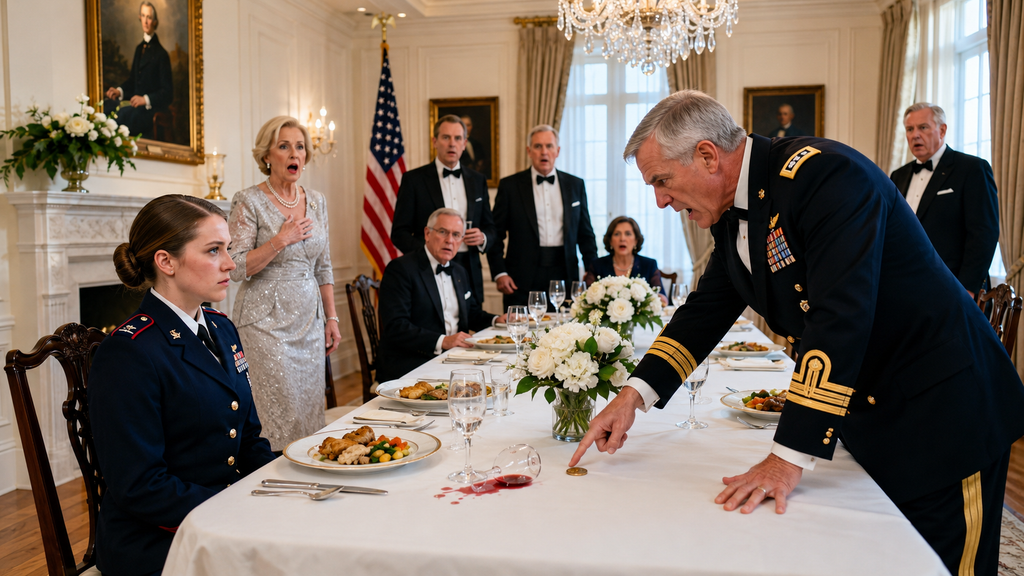
“She took the blast.”
No one in the dining room moved.
The room had been filled with noise only minutes earlier.
Silverware.
Wineglasses.
Polite laughter.
Vivian Carter’s practiced voice floating above everyone else.
Now I could hear the grandfather clock ticking from the hallway.
Tick.
Tick.
Tick.
My mother stared at Caleb as though the problem was not what he had said.
The problem was that he had said it in front of witnesses.
Her fingers tightened around the stem of her wineglass.
“I don’t know what kind of dramatic performance you think you’re giving,” she said, “but I will not have military stories used to excuse disrespect in my home.”
Caleb blinked once.
Then he looked at me.
For nine years, I had known Gunnery Sergeant Caleb Stone as a man who could remain calm while buildings burned around him.
I had watched him hold pressure on an arterial wound while bullets struck concrete twenty feet away.
I had watched him crawl through smoke to drag a radio operator out of an overturned vehicle.
I had watched him receive news that two Marines in our convoy had died and still continue giving clear orders because fourteen others needed him functional.
Caleb did not anger easily.
But I saw anger then.
Not wild anger.
Controlled anger.
The kind forged into a blade.
“Your home?” he repeated.
My mother raised her chin.
“Yes.”
Caleb gave a slow nod.
“Then maybe somebody in your home should finally tell the truth.”
“Caleb.”
I said his name quietly.
It was not an order.
Not quite.
More like a plea.
Please don’t make me relive this here.
Please don’t make me become the center of the room.
Please don’t make fifty strangers look at me like the worst night of my life is an exhibit behind glass.
His expression softened when he looked at me.
But only for a second.
Then his gaze dropped to the scar visible above the collar of my uniform.
I knew what he remembered.
The smell.
The fire.
The screaming.
The moment before everything changed.
“Major,” he said gently, “you’ve protected everybody long enough.”
My throat tightened.
Across the table, Maya looked at me.
She had gone completely pale.
Her hands were no longer folded neatly in her lap.
One was gripping the edge of the table so tightly that her knuckles were white.
“What blast?” she whispered.
I closed my eyes.
There it was.
The question I had spent almost a decade avoiding.
Not because the answer was classified anymore.
Not because I was ashamed.
Because I had learned something during recovery.
Trauma has two lives.
There is the life it has inside you.
And there is the life it has in other people once you tell them.
Inside me, the explosion was sensory fragments.
Heat.
Metal.
Dust.
A pressure wave that seemed to punch through my bones.
A screaming radio.
Caleb’s blood on my gloves.
The taste of dirt.
The impossible weight of someone trapped beneath me.
But once other people heard the story, they turned it into something else.
Heroism.
Tragedy.
Inspiration.
Pity.
A headline.
A lesson.
A conversation piece.
My mother had chosen a different version.
Inconvenience.
Embarrassment.
Ugly scars.
Weight gain.
A daughter who no longer photographed correctly beside her.
I opened my eyes.
Maya was still watching me.
“What blast?” she asked again.
This time my mother interrupted.
“Enough.”
Her voice cracked across the room.
Maya flinched.
I saw it.
So did Caleb.
So did Colonel Grant, seated three chairs down.
My mother placed her wineglass carefully on the table.
“This dinner is meant to benefit rehabilitation services,” she said. “Not become some grotesque reenactment of Andrea’s military career.”
Grotesque.
The word hung there.
Something inside me shifted.
For years, people had praised my discipline.
My ability to stay calm.
My ability to endure.
My ability to walk into a room while hurting and still function.
They called it strength.
Sometimes it was.
Sometimes silence was simply the last defense of someone who had been taught that speaking would make everything worse.
I looked at my mother.
“Grotesque?”
Vivian’s eyes moved to mine.
She knew immediately that something had changed.
I had used that tone in briefings before.
Quiet.
Flat.
Finished.
“Andrea,” she said.
I pushed back my chair.
The sound of wood scraping against the floor made several guests jump.
I stood.
The scars beneath my collar pulled slightly with the movement.
They always did when I straightened fully.
“Nine years ago,” I said, “my convoy was returning from a medical logistics site outside Lashkar Gah.”
No one interrupted.
Even Vivian.
Maybe because she finally realized she could not stop this without making herself look worse.
Maybe because she believed I would keep it vague.
I didn’t.
“We had six vehicles.”
I looked toward Caleb.
He was staring at the table now.
“The second vehicle was carrying two corpsmen and additional trauma supplies. Caleb was in the fourth.”
A retired officer near the end of the table slowly set down his fork.
I continued.
“We had intelligence that the road had been cleared that morning.”
My voice sounded steady.
I did not feel steady.
“Intelligence was wrong.”
The room disappeared.
Not literally.
But suddenly I could see another road.
A different sky.
A row of military vehicles under brutal heat.
Dust coating every surface.
The inside of my mouth dry despite the water pack strapped behind my seat.
I remembered the radio crackling.
I remembered Sergeant Moreno complaining about the coffee.
I remembered laughing.
That was the detail people never expected.
Five minutes before everything changed, we were laughing.
“We hit the first device under the lead vehicle.”
Maya covered her mouth.
I continued because stopping would have been worse.
“It disabled the vehicle but didn’t penetrate the main compartment.”
My heart was pounding now.
“Then small-arms fire started from the ridge.”
Caleb spoke without lifting his eyes.
“It was a funnel.”
I nodded.
“Yes.”
Colonel Grant whispered something under his breath.
I couldn’t hear it.
“We started returning fire. Marines dismounted. I moved forward because one of the corpsmen in vehicle two had been injured when the lead vehicle stopped.”
I could smell it again.
Fuel.
Burnt rubber.
Dust.
Someone shouting for ammunition.
Someone else yelling coordinates.
“My driver told me to stay behind cover.”
Caleb finally looked at me.
“And you ignored him.”
A small, broken smile touched my mouth.
“I outranked him.”
A few people almost smiled.
Almost.
Then the silence returned.
“There was a second device.”
My voice weakened on the sentence.
I hated that.
I breathed in and forced the next words out.
“It was hidden inside a drainage culvert.”
Caleb’s hand closed over the blackened coin.
“He saw the wire,” I said, nodding toward him. “Caleb saw it maybe two seconds before detonation.”
Caleb’s jaw tightened.
“I yelled.”
“You did.”
“You didn’t move.”
“I did.”
He shook his head.
“No.”
His eyes were glassy now.
“You moved toward us.”
I stopped.
For the first time all evening, I felt the room tilt.
Memory returned not as a story.
As impact.
Caleb shouting.
Stone.
Turn.
A metallic flash.
Three Marines exposed beside the disabled vehicle.
No cover close enough.
Not enough time.
I remembered one thought.
Only one.
Not them.
Then I ran.
Not away.
Toward them.
“I had maybe three seconds,” I said.
Caleb looked at the guests.
“She had less.”
“Caleb.”
“She had less than three seconds.”
His voice broke.
I had never heard that before.
Not from him.
“She grabbed Lance Corporal Peters by his vest and shoved him behind the axle. She knocked Moreno down. Then she got between the culvert and us.”
My mother stared at him.
Caleb lifted the coin.
“This was in my chest pocket.”
The coin looked insignificant in his hand.
A charred piece of metal no bigger than his palm.
“She gave this to me two days before the convoy because I got promoted.”
He turned it over.
The reverse side was nearly smooth from heat damage.
“When the blast hit, this folded.”
A woman near the far end of the table whispered, “Oh my God.”
Caleb pointed toward my shoulder.
“Major Carter caught fragments in the neck, shoulder, back, hip, and abdomen. The pressure wave ruptured her eardrum. She had burns across thirty percent of her body.”
My mother’s face had changed.
Not with grief.
Not even horror.
With calculation.
Her eyes flicked toward the guests.
That made something cold spread through me.
Even now.
Even hearing it.
She was checking the room.
Checking how people were reacting.
Checking what this might do to her reputation.
I looked at Maya instead.
Tears were running silently down her cheeks.
She had no idea.
Of course she didn’t.
Mother had controlled the story.
I had been medically evacuated overseas, then transferred stateside.
By the time Maya was old enough to understand what had happened, Vivian had reduced my recovery to vague phrases.
Andrea had an accident overseas.
Andrea needed some procedures.
Andrea gained weight after coming home.
Andrea became difficult.
That was the history my sister had been given.
Caleb continued.
“She stayed conscious after the blast.”
I closed my eyes.
Please don’t.
“She kept giving commands.”
“Caleb.”
“She was bleeding through her uniform.”
“Gunny.”
“She held Moreno’s airway open until the corpsman reached him.”
My nails dug into my palms.
“She kept me from trying to stand because I had shrapnel in my thigh.”
His voice shook harder.
“And when the evacuation bird came, she refused to be loaded first.”
I could no longer stop the memory.
A medic yelling at me.
Ma’am, you’re going now.
Take Peters.
Ma’am—
TAKE PETERS.
My own hand.
Burned.
Shaking.
Blood running between my fingers.
Someone crying.
Maybe me.
I never remembered.
“She was the last critical casualty evacuated from that site,” Caleb said.
He lowered the coin.
“And three Marines who were standing near her when that device detonated are alive because she moved toward the blast instead of away from it.”
No one looked at my scars anymore.
Not the way they had before.
The change was immediate.
And strange.
I should have felt vindicated.
Instead, I felt exposed.
I hated that too.
I did not want my scars to become beautiful because people learned how I got them.
They were not ugly before.
They were not honorable now.
They were simply part of my body.
Proof that skin had torn and healed.
Proof that I had survived.
That should have been enough without the story.
Vivian inhaled slowly.
Then she said the worst possible thing.
“Well.”
Every head turned toward her.
She dabbed the corner of her mouth with a napkin.
“That was certainly dramatic.”
I stared at her.
Maya whispered, “Mom.”
Vivian ignored her.
“I have never denied Andrea served honorably.”
Caleb made a sound that was almost a laugh.
My mother’s gaze sharpened.
“But military service does not exempt someone from maintaining herself.”
The room seemed to freeze all over again.
Colonel Grant stood.
“Vivian.”
She looked genuinely surprised.
He had been one of her favorite guests.
Retired colonel.
Local business owner.
Board member of two veterans’ organizations.
The kind of man Vivian loved having at her table because his presence made her dinners seem important.
He placed his napkin beside his plate.
“That is enough.”
Vivian’s mouth tightened.
“This is between me and my daughter.”
“No,” Grant said. “You made sure it wasn’t when you humiliated a decorated Marine in front of fifty people.”
Her cheeks colored.
“I did not humiliate anyone.”
Maya laughed.
It was a terrible sound.
Small.
Sharp.
Almost hysterical.
Everyone looked at her.
She stared at our mother.
“You pushed her plate.”
Vivian’s expression shifted.
“Maya.”
“You called her ugly.”
“Maya, stop.”
“You called her a stain on the family.”
“Maya.”
“And then you compared me to her.”
My sister stood.
The chair wobbled behind her.
She caught the edge of the table.
For one terrifying second, I thought she might faint.
I moved instinctively.
“Maya?”
“I’m fine.”
She wasn’t.
Her face was bloodless.
Her shoulders looked painfully narrow beneath the pale green dress.
Then I noticed something I should have noticed sooner.
Much sooner.
The dress was not elegant.
It was loose.
Deliberately loose.
Hiding how thin she had become.
My stomach tightened.
Maya looked at me.
“Do you know why she keeps comparing us?”
I said nothing.
Vivian answered.
“Maya, sit down.”
My sister’s eyes did not leave mine.
“She’s been doing it since you came home.”
“Maya.”
“When I was fifteen, she showed me a photograph of you before deployment.”
I felt something drop inside my chest.
“What?”
“She put it beside a picture of you from rehab.”
Vivian stood.
“That is completely out of context.”
Maya was crying openly now.
“She told me that was what happened when women stopped taking care of themselves.”
Caleb’s eyes closed.
I turned slowly toward my mother.
“You did what?”
Vivian lifted both hands.
“You were on steroids. You were retaining fluid. The doctors themselves said—”
“You used pictures of my recovery to scare a fifteen-year-old girl about gaining weight?”
“It was not like that.”
Maya laughed again.
“It was exactly like that.”
She gripped the table.
“She weighed me every Monday.”
The room became impossibly still.
My mother’s face lost color.
I looked at Maya.
“She what?”
Maya stared at the tablecloth.
“Every Monday before school.”
My skin went cold.
“She had a scale in her bathroom.”
“Maya,” Vivian said, softer now, “you were struggling with discipline.”
“I was sixteen.”
“You were developing unhealthy habits.”
“I was hungry.”
Vivian swallowed.
Maya’s voice dropped.
“I was always hungry.”
That sentence broke something in me more completely than Caleb’s story had.
I had survived an explosion.
I had survived surgeries.
Skin grafts.
Months of physical therapy.
Nightmares.
Nerve pain.
The first time I saw my reflection after the bandages came off.
The first time my own mother looked at me and then looked away.
But hearing my little sister say I was always hungry made me feel a fury so clean and absolute that everything else disappeared.
I stepped around my chair.
Vivian immediately stiffened.
I stopped six feet from her.
“What did you do to her?”
She stared at me.
“Don’t be absurd.”
“What did you do?”
“I encouraged healthy habits.”
Maya shook her head.
“You locked the pantry after eight.”
A murmur moved through the guests.
Vivian’s head snapped toward her.
“You had no reason to eat late at night.”
“You counted almonds.”
My mother’s lips parted.
Maya kept going.
“You made me text you pictures of lunch when I left for college.”
“Maya.”
“You said if I ever looked like Andrea after the blast, no man would want me.”
The room vanished.
I heard nothing for several seconds.
Not the clock.
Not the guests.
Not Caleb.
Nothing.
Only the words.
If I ever looked like Andrea.
No man would want me.
I looked at Vivian.
She had finally stopped pretending she wasn’t afraid.
“Tell me she’s lying.”
My mother said nothing.
“Tell me.”
“Andrea—”
“Tell me Maya is lying.”
Vivian’s eyes filled.
For one irrational second, a child inside me responded.
My mother is going to cry.
Fix it.
Don’t upset her.
Don’t cause a scene.
Be good.
Be quiet.
Make it easier.
Then I remembered lying in a hospital bed nine years earlier with bandages across half my torso.
I remembered Vivian walking in.
Her perfume filling the room before she did.
I had been so happy to see her.
That is the humiliating part.
Even after everything she had been before, I had wanted my mother.
I remembered reaching my uninjured hand toward her.
She never took it.
She looked at me.
At the dressings.
At the swelling.
At the shaved section of hair above my ear.
And the first thing she said was,
“They told me your face would be spared.”
Not I love you.
Not thank God you’re alive.
Not sweetheart.
They told me your face would be spared.
I had spent nine years pretending that sentence had not shattered me.
Now I saw Maya.
And understood it had never stopped with me.
“You did it,” I whispered.
Vivian’s mouth trembled.
“I wanted better for both of you.”
Maya backed away from the table.
“No.”
My mother looked at her.
“I sacrificed everything for you girls.”
“No.”
“I gave you the best schools, proper clothes, opportunities—”
“No.”
“You have no idea how difficult it is raising daughters alone after your father—”
“Stop.”
This time it was me.
My voice came out like a command.
The Marine Corps had trained that voice into me.
Sharp enough to cut through chaos.
Vivian stopped.
I looked at her and realized I was no longer afraid of her.
Not even a little.
That realization was so quiet I almost missed it.
All my adult life, I had believed I was not afraid.
I deployed.
I commanded.
I made decisions under fire.
I briefed generals.
But there were different kinds of fear.
There was fear that made you duck when bullets snapped overhead.
And there was fear that began when you were six years old and learned that your mother could withdraw love as punishment.
I had carried the second kind much longer.
Not anymore.
“You don’t get to use Dad,” I said.
Vivian’s face hardened.
I continued.
“He died when I was seventeen. Maya was eight. Everything that happened after that was yours.”
“I kept this family together.”
“You controlled it.”
“I protected you.”
“You punished us for becoming people you couldn’t display.”
Her eyes widened.
I pointed toward my chest.
“When I came home from Afghanistan, you did not ask if I could sleep.”
“Andrea—”
“You asked whether plastic surgery could fix my shoulder.”
She flinched.
“You asked whether the medication causing weight gain was really necessary.”
“Andrea, please.”
“You told me not to wear sleeveless dresses because people would stare.”
Guests were staring now.
At Vivian.
Not me.
The irony was almost unbearable.
I kept going.
“You stopped putting me in family Christmas photos unless I stood in the back.”
“That is not true.”
“It is.”
“You are twisting—”
“At Aunt Helen’s wedding, you asked the photographer to crop my left side.”
Her mouth closed.
“At Maya’s graduation, you told me not to wear my uniform because my neck scar would show above the collar.”
Maya looked at me, horrified.
“I didn’t know that.”
“I know.”
Vivian’s composure cracked.
“I was trying to spare you pity!”
“No.”
My voice softened.
“You were trying to spare yourself discomfort.”
That hit.
Her shoulders dropped.
I could almost see the sentence finding its target.
Vivian Carter cared deeply about appearances.
But the thing she feared more than a bad appearance was being accurately understood.
I stepped closer.
“My scars made people ask questions.”
She looked away.
“And those questions forced you to talk about a daughter you could not reshape into your idea of perfection.”
Her eyes returned to mine.
“I was proud of your service.”
“Were you?”
“Yes.”
“Then why did you tell people I worked in administration?”
Her lips parted.
Caleb looked sharply toward her.
Colonel Grant frowned.
Vivian glanced around the room.
I nodded.
“That’s right.”
My voice shook now, but I no longer cared.
“For years, she told people I worked administrative support.”
My mother whispered, “You were a logistics officer.”
“I was a logistics officer who commanded convoy operations.”
“There is nothing wrong with administrative service.”
“That wasn’t why you said it.”
Silence.
“You said it because ‘office work’ explained why your daughter came home alive without forcing you to talk about what happened.”
Vivian sat down slowly.
For the first time all night, she looked older.
Not fragile.
Just stripped of presentation.
Maya sank back into her chair too.
I immediately went to her.
“Hey.”
She waved me off.
“I’m okay.”
“No, you’re not.”
“I’m just dizzy.”
That was enough.
I dropped into a crouch beside her.
“When did you last eat?”
Her eyes darted toward Vivian.
My body went rigid.
“Maya.”
She swallowed.
“Lunch.”
“What did you have?”
“A yogurt.”
I stared at her.
“Maya, it’s almost nine.”
“I had coffee.”
My anger transformed into fear.
I took her wrist.
Her pulse was fast.
“Caleb.”
He was already moving.
“What do you need?”
“Juice. Something with sugar.”
A woman near the buffet jumped up.
“There’s orange juice in the kitchen.”
“Bring it, please.”
Vivian stood again.
“She’s fine. She gets dramatic when she’s emotional.”
I turned my head.
“Sit down.”
The command came out before I could soften it.
Vivian froze.
I had never spoken to my mother that way.
Neither had Maya.
Neither had half the people in the county, probably.
She sat.
The woman returned with juice.
I handed it to Maya.
“Small sips.”
“I’m not diabetic.”
“I know.”
“I’m not going to faint.”
“Humor me.”
Her mouth twitched.
For one second I saw the little girl who used to sneak into my bedroom during thunderstorms.
She drank.
Caleb crouched on her other side.
“You want me to call EMS?”
Maya shook her head hard.
“No.”
“Okay,” I said. “But we’re leaving.”
Vivian straightened.
“No one is leaving.”
I looked at her.
She corrected herself.
“This is my event. There are speeches scheduled.”
Colonel Grant stared at her in disbelief.
“You are worried about the speeches?”
My mother’s eyes flashed.
“This fundraiser has been planned for six months.”
Grant picked up his phone.
“Then consider it canceled.”
Her face changed.
“You can’t cancel my fundraiser.”
“It is being held on behalf of the Grant Veterans Recovery Foundation.”
“I organized it.”
“And I chair it.”
He looked around the room.
“I will personally contact every donor tomorrow and explain that any pledges made tonight remain valid, but the foundation will no longer accept events hosted under Mrs. Carter’s name.”
Vivian’s mouth opened.
No sound came out.
That was the first consequence she understood immediately.
Not losing me.
Not harming Maya.
Not humiliating a wounded veteran.
Losing status.
Losing the foundation.
Losing invitations.
Losing her public role.
Her eyes filled with panic.
“Colonel, that is ridiculous.”
“No,” he said. “It’s overdue.”
A few guests stood.
Then another.
Then three more.
Someone quietly collected a coat.
A chair scraped.
Then another.
My mother watched the evening she had curated for months collapse around her.
She had spent all afternoon arranging flowers.
She had personally approved the seating chart.
She had chosen ivory linen because white, she said, looked cheap beneath warm lighting.
She had worried about whether the salmon appetizers were plated correctly.
And now her guests were leaving without dessert.
I wish I could say I enjoyed it.
I didn’t.
I was too tired.
Too worried about Maya.
Too aware that something much bigger than one ugly dinner had finally split open.
Caleb helped Maya stand.
I reached for her arm.
She stiffened.
Not because of me.
Because Vivian said her name.
“Maya.”
My sister stopped.
I felt her muscles tighten beneath my hand.
My mother stood beside her chair.
Her mascara had not run.
Of course it hadn’t.
Vivian always bought waterproof.
“Do not walk out of this house over a misunderstanding.”
Maya looked at her.
“A misunderstanding?”
“You are emotional.”
Maya laughed softly.
“I learned that sentence from you too.”
“Maya.”
“You say it whenever I remember something correctly.”
Vivian’s lips tightened.
“You have always been sensitive.”
“And you have always used that against me.”
My mother’s face became almost expressionless.
“What exactly do you want me to say?”
Maya stared at her.
There was so much pain in that look that I had to look away.
“I wanted you to say you were sorry.”
Vivian’s expression softened instantly.
Too instantly.
“I am sorry you feel hurt.”
Maya closed her eyes.
There it was.
The apology that was not an apology.
The careful sentence Vivian had used our entire lives.
I’m sorry you feel that way.
I’m sorry you misunderstood.
I’m sorry you’re upset.
Never—
I was wrong.
Never—
I hurt you.
Never—
I’m sorry for what I did.
Maya opened her eyes.
“No.”
My mother blinked.
“No?”
“That doesn’t work anymore.”
Vivian stared.
Maya lifted her chin.
For the first time that evening, I saw something return to my sister’s face.
Not confidence.
Not yet.
But the beginning of it.
A tiny refusal.
“No,” she repeated.
Then she walked toward the door.
I followed.
So did Caleb.
Behind us, Vivian called my name.
“Andrea.”
I stopped in the hallway.
I should not have.
But some instincts take time to die.
I looked back.
My mother stood beneath the chandelier alone.
Most guests had moved toward the foyer.
The elegant room behind her looked wounded.
Spilled wine.
Stained linen.
Half-eaten dinners.
An overturned water glass.
The blackened challenge coin still resting beside my abandoned plate.
Vivian looked toward it.
Then at me.
“I am your mother.”
My throat tightened.
A thousand answers came to mind.
I chose the simplest.
“I know.”
Her face crumpled slightly.
Maybe she expected more.
Maybe she expected the title to save her.
Mother.
The word that had excused everything.
The word she believed entitled her to access, obedience, forgiveness, and silence.
I looked at her for several seconds.
“Being my mother is why I gave you more chances than I would have given anyone else.”
She went still.
“And you used every one of them.”
Then I turned away.
Caleb touched my elbow.
“The coin.”
I stopped.
He went back to the table.
For nine years, he had carried it.
He picked it up.
Then he returned and held it toward me.
I shook my head.
“It’s yours.”
“It started as mine.”
“It still is.”
He looked down at it.
“Major.”
“Gunny.”
For the first time that night, he smiled.
Tired.
Sad.
Real.
Then he slipped it into my palm and folded my fingers around it.
“I think you need to carry it for a while.”
I looked at the scorched metal.
One side still showed the faint outline of the Marine Corps emblem.
The bent edge pressed into my scarred palm.
I almost gave it back.
Instead, I placed it in my uniform pocket.
And left my mother’s house.
The first thing Maya said in my truck was,
“I’m sorry.”
I stared at her.
She sat in the passenger seat with Caleb’s suit jacket draped around her shoulders.
He had insisted.
My sister looked very small beneath it.
I shut the driver’s door.
“For what?”
She looked straight ahead.
“For ruining your dinner.”
I almost laughed.
Then I realized she was serious.
Something inside me broke all over again.
“Maya.”
“I should’ve waited until people left.”
“No.”
“I didn’t mean to make it about me.”
“It is about you.”
She turned toward me.
I reached across the console.
“Listen to me.”
Her eyes filled instantly.
I kept my voice steady.
“You did not ruin anything.”
“But—”
“Nothing.”
She swallowed.
“You understand?”
A tear slipped down her cheek.
I brushed it away with my thumb.
“You told the truth.”
She looked down.
“That doesn’t usually go well in our family.”
“No.”
I started the engine.
“It hasn’t.”
Caleb leaned into the open rear door.
“You two okay?”
I nodded.
“I’m taking her to the emergency room.”
Maya groaned.
“I said I’m fine.”
“And I outrank you.”
She looked at my shoulder insignia.
“You don’t outrank civilians.”
“Tonight I do.”
Caleb laughed.
Maya stared at both of us.
Then, unexpectedly, she laughed too.
It was small.
But genuine.
The sound nearly undid me.
Caleb closed the door.
“I’ll follow.”
“You don’t have to.”
“I know.”
That was Caleb.
The most meaningful things he did were usually things no one asked him to do.
Maya was not fine.
Not dangerously ill.
But not fine.
Her blood pressure was low.
She was dehydrated.
Her potassium level was off.
The emergency physician asked her several questions about food.
Maya lied through the first three.
I knew because I had interrogated Marines who lied more convincingly.
The doctor knew too.
She was kind about it.
That helped.
When she asked whether Maya had been restricting food intentionally, my sister’s face changed.
“No.”
Then she looked at me.
“I mean…”
I stayed silent.
The doctor waited.
Maya stared at the hospital blanket.
“My mother likes thin women.”
The doctor nodded as though Maya had said something clinically ordinary.
Maybe she had.
“Does your mother decide what you eat?”
“I’m twenty-seven.”
“That wasn’t my question.”
Maya’s cheeks reddened.
“Sometimes.”
“How often?”
She shrugged.
The doctor waited.
Maya whispered, “Most days.”
My chest tightened.
“You live with her?”
The doctor asked.
Maya nodded.
I looked at my sister.
“You told me you moved back because you were saving for an apartment.”
“I was.”
“When?”
“Two years ago.”
Two years.
I had visited three times.
I had noticed she was thin.
I had noticed she picked at food.
I had noticed Vivian criticized what everyone ate.
I had seen all of it and understood none of it.
Guilt came fast.
Maya saw my face.
“Don’t.”
I looked at her.
“Don’t what?”
“Do that thing.”
“What thing?”
“Decide this is your fault.”
I almost smiled.
“You know me too well.”
“You’ve been doing it my entire life.”
The doctor glanced between us.
“I’m going to recommend some follow-up resources.”
Maya tensed.
“Like therapy?”
“Possibly.”
She looked embarrassed.
The doctor continued gently.
“And a nutrition specialist who understands disordered eating. I’m not diagnosing you with anything tonight. But restriction, anxiety around food, and family control are worth taking seriously.”
Maya nodded.
After the doctor left, silence settled over the room.
Caleb had gone downstairs for coffee.
I sat beside Maya’s bed.
She picked at the tape holding her IV.
I touched her hand.
“When did it start?”
She shrugged.
“Maya.”
“High school.”
“How bad?”
Another shrug.
I waited.
She sighed.
“Worse after college.”
“Why didn’t you tell me?”
She looked at me.
The answer was already there.
Because you were surviving too.
She did not say it.
I heard it anyway.
“I thought you had enough.”
My eyes burned.
“You don’t protect me by suffering quietly.”
She gave me a pointed look.
“That’s rich coming from you.”
I stared at her.
Then laughed once.
Fair.
“Okay.”
She smiled faintly.
“Okay.”
I leaned back in the chair.
“We’re both idiots.”
“Speak for yourself, Major.”
I squeezed her hand.
Then she became serious.
“What happens now?”
“With what?”
“Mom.”
I had no answer.
That surprised me.
All evening, I had been certain.
Angry people often mistake certainty for clarity.
Now, under fluorescent hospital lighting, with my sister attached to an IV, everything felt less dramatic and more difficult.
“I don’t know.”
“She’ll call.”
“I know.”
“She’ll cry.”
“I know.”
“She’ll tell Aunt Patricia we attacked her.”
“Definitely.”
Maya smiled weakly.
“She’ll say Caleb threatened her.”
“Probably.”
“And she’ll send me a long text about everything she’s sacrificed.”
“Yes.”
My sister looked at me.
“What if I believe her?”
That question hurt more than I expected.
I leaned forward.
“Then you call me.”
“What if you’re deployed?”
“Call me.”
“What if it’s three in the morning?”
“Call me.”
“What if—”
“Maya.”
She stopped.
“You call me.”
Her eyes filled.
I reached for her.
She came into my arms carefully because of the IV.
The last time I had held her like that, she had been eighteen, sobbing because Dad’s old dog had died.
I pressed my cheek against her hair.
She whispered,
“I thought you were perfect.”
I almost pulled back.
“What?”
“Mom made you the warning and the impossible standard at the same time.”
I closed my eyes.
“She said you had no discipline about your body anymore, but she also talked about your rank constantly when people asked what you did.”
Maya’s voice trembled.
“She acted ashamed of you and proud of you depending on who was in the room.”
That was so accurate it hurt.
“I never knew which version I was supposed to believe.”
“Neither did I.”
She pulled back.
“What?”
I looked toward the hospital window.
Outside, the parking lot lights glowed against the dark.
“For years, I thought if I could just recover enough, she’d become my mother again.”
Maya stared at me.
“I had surgery after surgery.”
My voice lowered.
“Every time something improved, I thought maybe this would be the thing.”
“What thing?”
“The thing that made her comfortable looking at me.”
My sister’s face crumpled.
I continued because I had never said it aloud before.
“When they repaired my shoulder, I thought maybe.”
I touched the scar near my neck.
“When the grafts healed.”
I looked down at my uniform trousers.
“When I could walk without the brace.”
My voice broke.
“When I stopped needing pain medication.”
I laughed softly at myself.
“Then the medication changed my metabolism. I gained weight. She focused on that instead.”
“Andrea.”
“I spent years believing if I looked enough like the daughter who left for Afghanistan, she might love the daughter who came back.”
Maya grabbed my hand.
“She did love you.”
I looked at her.
She immediately understood.
Or corrected herself.
“She loved something.”
I nodded.
“Maybe.”
That was the most generous answer I had.
My mother called seventeen times before sunrise.
I did not answer.
At 6:13 a.m., she texted:
WE NEED TO DISCUSS WHAT YOU DID.
At 6:17:
You embarrassed me publicly.
At 6:26:
Colonel Grant has no right to punish the foundation over a private family disagreement.
At 6:43:
Maya is vulnerable and you are manipulating her.
At 7:02:
I cannot believe you would turn your sister against her own mother.
Then at 7:19:
I hope you are proud of yourself.
I stared at the final message for a long time.
Then I deleted the entire thread.
Not because I wanted to erase evidence.
Because I finally understood the bait.
Every sentence invited me into a courtroom where Vivian was judge, witness, and victim.
If I answered, I would have to prove things.
Explain things.
Defend things.
I had spent too much of my life defending wounds I had not inflicted.
Maya was asleep beside me.
The hospital had kept her for observation until morning.
Caleb had fallen asleep in a waiting-room chair outside.
His arms were folded.
His chin rested against his chest.
Nine years earlier, I had once found him sleeping almost exactly like that in a field hospital after seventy-two hours with barely any rest.
Some people are familiar to your nervous system.
Caleb was one of mine.
I walked into the hallway.
He woke immediately.
“Major?”
“Go home.”
He blinked.
“What time is it?”
“Seven-thirty.”
He stretched his neck.
“How’s Maya?”
“Better.”
“Good.”
He stood.
There was a crease across his cheek from where he had slept against the wall.
It made him look younger.
I smiled despite myself.
“What?”
“Nothing.”
“You’re laughing at my face.”
“A little.”
“Rank abuse.”
“File a complaint.”
He grinned.
Then his expression changed.
“How are you?”
The question irritated me instantly.
Which meant the answer was bad.
“I’m fine.”
“Major.”
“Gunny.”
“You know I hate that answer.”
“I know.”
He looked at the empty hall.
“You want coffee?”
I nodded.
We walked downstairs.
The hospital cafeteria smelled like burnt coffee and disinfectant.
Caleb bought two cups.
He remembered I took mine black.
That almost made me cry.
Grief is strange that way.
A person can survive public humiliation, family revelations, and a hospital visit.
Then someone remembers how you take coffee and suddenly your heart becomes impossible to manage.
We sat beside the window.
For a while, neither of us spoke.
Then I placed the scorched coin on the table.
Caleb looked at it.
“I thought you were keeping that.”
“I am.”
“Then why put it down?”
I rotated it between my fingers.
“Why did you really keep it?”
He looked at me.
“I told you.”
“No.”
His expression closed slightly.
“Caleb.”
He sighed.
Then stared at his coffee.
“Because I was angry.”
“At who?”
“You.”
I blinked.
“Me?”
“For about a year.”
I almost laughed.
“You hid it well.”
“I was a professional.”
“Why were you angry?”
He rubbed his thumb along the edge of the paper cup.
“Because you almost died.”
I stared.
He continued without looking up.
“You made a decision that saved people.”
“That’s the job.”
“No.”
His eyes lifted.
“Don’t do that.”
“Do what?”
“Turn everything into duty so you don’t have to admit you mattered.”
I said nothing.
He leaned back.
“For months after the blast, I kept thinking you should have gone the other direction.”
“There was no time.”
“I know.”
“You know what would have happened.”
“I know.”
“So what are we arguing about?”
His jaw tightened.
“I’m saying part of me wished you’d chosen yourself.”
The sentence silenced me.
Caleb looked toward the window.
“That coin was in my pocket because you gave it to me. Then you took most of the blast that should’ve hit three of us.”
He swallowed.
“I kept looking at it and thinking I didn’t deserve it.”
“You did.”
“I know that now.”
“Then why keep it for nine years?”
He looked at me.
“Because eventually it stopped feeling like guilt.”
“What did it feel like?”
“A reminder.”
“Of what?”
“That somebody once thought my life was worth running toward danger for.”
My eyes burned.
Caleb continued.
“And I figured if I ever saw you forgetting your own worth, I’d give it back.”
I looked down at the coin.
“You carried this for nine years waiting to lecture me?”
“I’m patient.”
I laughed.
A real laugh.
It escaped before I could stop it.
Caleb smiled.
“There she is.”
I shook my head.
“Don’t.”
“What?”
“Get sentimental.”
“Too late.”
We drank our coffee.
For the first time in years, the scar at my neck did not feel like something everyone could see.
It just felt like skin.
Maya moved into my house that afternoon.
There was no dramatic confrontation.
No police.
No screaming.
I drove to Vivian’s with Maya while Caleb followed in his truck.
My mother’s car was in the driveway.
The curtains moved when we pulled up.
Maya saw it.
“She’s watching.”
“I know.”
“I don’t want to go in.”
“You don’t have to.”
“My stuff is inside.”
“I’ll go.”
She shook her head.
“No.”
I looked at her.
“I need to.”
So we went together.
The front door was unlocked.
Of course it was.
Vivian was waiting in the foyer.
She wore beige trousers, a cream blouse, and makeup.
Full makeup.
At two in the afternoon after the worst night our family had ever had.
Her face was swollen around the eyes.
She had clearly been crying.
I almost felt something.
Then she looked at Maya and said,
“You look terrible.”
My sister froze.
Vivian immediately tried to fix it.
“I mean tired.”
Maya stared at her.
I stepped forward.
“We’re getting her things.”
My mother’s eyes shifted to me.
“This is ridiculous.”
I did not answer.
“She has a home here.”
Maya spoke.
“I’m leaving.”
Vivian looked at her.
“For how long?”
“I don’t know.”
“Where are you going?”
“With Andrea.”
“Absolutely not.”
My sister flinched.
I stepped between them.
“Do not tell her where she can live.”
“I am her mother.”
“She’s twenty-seven.”
“She is not emotionally stable.”
Maya’s face fell.
I felt anger rise.
Then my sister surprised both of us.
“I am emotionally unstable around you.”
Vivian went still.
Maya’s voice shook.
“But I think I’d like to find out who I am somewhere else.”
My mother’s eyes filled.
“Maya.”
“I’m going upstairs.”
“Maya, wait.”
My sister walked past her.
Vivian turned toward me.
I lifted one hand.
“Don’t.”
She lowered her voice.
“You are enjoying this.”
“No.”
“Yes, you are.”
“I promise you I am not.”
“You finally have a chance to punish me.”
I stared at her.
“You still think this is about you.”
“You humiliated me.”
“You humiliated yourself.”
Her nostrils flared.
“I made one comment.”
“One?”
“You know what I mean.”
“No, I really don’t.”
“You are acting as though I abused you.”
I stared at her for several seconds.
Then I said,
“You did.”
Vivian recoiled as though I had struck her.
“How dare you.”
There was the old reflex again.
The injured queen.
I had seen it my entire life.
She could call me ugly.
Mock my injuries.
Control Maya’s food.
But if someone named the behavior accurately, that was cruelty.
I no longer had energy for the game.
“Emotional abuse is still abuse.”
“I never touched you.”
I looked toward the dining room.
My plate had been removed.
The tablecloth was gone.
Everything had already been cleaned.
Evidence erased.
“Last night you shoved my plate hard enough to split my lip.”
Her mouth tightened.
“I moved it.”
“You weaponized food against Maya for years.”
“I encouraged discipline.”
“You insulted my body after multiple reconstructive surgeries.”
“I was concerned about your health.”
“No.”
I shook my head.
“You don’t get to rewrite it while I’m standing here.”
Her face hardened.
For the first time, the tears vanished.
“Then what do you want?”
There it was again.
The question of transaction.
Tell me the punishment.
Tell me the price.
Tell me what performance restores access.
I answered carefully.
“I want distance.”
Her eyes narrowed.
“For how long?”
“I don’t know.”
“Days?”
“No.”
“Weeks?”
“I don’t know.”
“Andrea.”
“You’re not listening.”
My voice remained calm.
“I am not giving you a countdown.”
Her face paled.
“You cannot cut your mother out of your life.”
“I can.”
“You wouldn’t.”
I looked at her.
Something passed between us.
She finally saw it.
I would.
Not to punish her.
To save myself.
That difference mattered.
Her voice became smaller.
“After everything I did for you?”
I almost answered with anger.
Instead, I thought of all the true things.
She had done things for me.
She attended parent-teacher meetings.
She packed school lunches.
She drove me to swim practice.
She paid for SAT prep.
She sat beside Dad’s hospital bed with us while he died.
She bought my first dress uniform alterations when I became an officer.
Abusive parents are not cruel every second.
That is why children become confused.
If cruelty were constant, leaving would be simple.
It is the good memories that become hooks.
I looked at her.
“You did things for me.”
Her eyes brightened with hope.
Then I continued.
“And some of them were loving.”
Her expression shifted.
“But love does not erase harm.”
“Andrea.”
“And harm does not become harmless because it came from my mother.”
Her shoulders slumped.
For once, she had no immediate answer.
Footsteps sounded upstairs.
Maya came down carrying a suitcase.
Then another.
Caleb appeared behind her carrying two boxes.
Vivian’s expression changed when she saw him.
“You.”
Caleb stopped.
“Ma’am.”
“You have no business in my house.”
He set the boxes down.
“You’re right.”
That took the wind from her.
He turned toward Maya.
“Anything else?”
She nodded.
“One more bag.”
“I’ll get it.”
He went upstairs.
Vivian looked at Maya.
“You’re really leaving.”
Maya’s mouth trembled.
“Yes.”
“You’ll come back.”
My sister did not answer.
“Maya.”
Still nothing.
Vivian’s voice sharpened.
“You cannot live with your sister forever.”
“I’m not trying to.”
“You can’t afford an apartment.”
“I’ll figure it out.”
“You don’t know how.”
Maya’s face changed.
There.
The old wound.
You can’t.
You need me.
Without me, you’ll fail.
Vivian had fed those messages as carefully as she had withheld food.
I watched my sister almost fold.
Then she inhaled.
“I can learn.”
My mother’s expression cracked.
It might have been the bravest thing Maya had ever said.
Not I know how.
Not I’m not afraid.
Simply—
I can learn.
Caleb returned with a duffel bag.
We carried everything outside.
Vivian followed us to the door.
When Maya reached the driveway, my mother called,
“If you walk out now, don’t expect me to keep paying your car insurance.”
Maya stopped.
My stomach dropped.
That was Vivian’s real language.
Control hidden as support.
My sister turned.
Her face was wet with tears.
“Okay.”
Vivian blinked.
“What?”
“Okay.”
“You can’t afford it.”
“Then I’ll sell the car.”
“Maya.”
“I’ll take the bus.”
“You hate buses.”
“I’ll hate them for free.”
Caleb coughed into his fist to hide a laugh.
Even I smiled.
Vivian did not.
Maya opened the passenger door of my truck.
Then she looked back one final time.
“I love you, Mom.”
Vivian’s face softened.
Maya continued.
“But I don’t think loving you is supposed to make me disappear.”
Then she got into the truck.
I stood frozen.
There are moments when someone you love says something so true that it changes the architecture of a room.
Or a life.
Vivian looked at me.
I had nothing to add.
So I left.
The aftermath moved quickly.
Faster than Vivian expected.
Colonel Grant called me two days later.
I almost ignored it.
Then answered.
“Sir.”
“Major.”
Despite being retired, he still sounded like he was in an office with a flag behind him.
“I wanted to inform you before you heard through someone else.”
“That sounds ominous.”
“The board voted this morning.”
My stomach tightened.
“About?”
“Vivian.”
I leaned against my kitchen counter.
Maya was upstairs sleeping.
The doctor had ordered a follow-up appointment, and she had actually agreed to go.
Grant continued.
“She has been removed from all hosting and fundraising responsibilities.”
I closed my eyes.
“Sir, I didn’t ask for that.”
“I know.”
“I don’t want this to look like retaliation.”
“It isn’t.”
His voice hardened.
“The foundation supports wounded veterans.”
I stayed silent.
“Allowing someone who publicly degrades a wounded service member for changes caused by combat injuries to represent us would be hypocrisy.”
I had no argument.
He continued.
“We are also returning her individual donation from last quarter.”
“That seems unnecessary.”
“It was restricted.”
I frowned.
“To what?”
A pause.
“Cosmetic rehabilitation.”
I straightened.
“What?”
“Your mother specifically requested that her donation only support procedures she described as appearance restoration.”
My stomach turned.
Grant sighed.
“At the time, we interpreted it as reconstructive surgery. After last night, the language feels different.”
Of course it did.
My mother had managed to turn even philanthropy into an extension of her worldview.
Fix the visible damage.
Make people comfortable to look at again.
I looked toward the hallway.
“Can I make a request?”
“Anything.”
“Redirect my speaking fee.”
“What speaking fee?”
“For the event.”
“You were not booked to speak.”
“I know.”
He was quiet.
“Then what are you talking about?”
I smiled faintly.
“Consider it retroactive.”
He laughed.
“What do you want done?”
“Set up a fund.”
“For?”
I thought of Maya.
Then of myself at thirty-one, standing in a rehabilitation bathroom, unable to look at my body.
“For service members recovering from injuries that change weight, skin, mobility, or appearance.”
Grant said nothing.
“Nutrition counseling,” I continued. “Trauma therapy. Adaptive clothing. Reconstructive care. Body-image support.”
I swallowed.
“The things nobody tells you you’re allowed to struggle with because surviving is supposed to make you grateful.”
His voice softened.
“I like that.”
“So do I.”
“What should we call it?”
I looked toward the scorched challenge coin resting on my counter.
“The Forward Fund.”
“Forward?”
I touched the bent edge.
“For people learning how to move toward their lives again.”
Grant was silent for several seconds.
Then said,
“Done.”
The story from the dinner spread.
Of course it did.
Not the full story.
Stories never travel whole.
They break apart and become whatever the next person needs them to be.
At the country club, Vivian had insulted a war hero.
At church, her daughter had publicly attacked her.
Among retired Marines, Caleb Stone had nearly flipped a table defending his former commander.
He denied the table part.
Mostly.
Someone had taken a photograph of the scorched challenge coin.
That annoyed me.
Someone else posted about the event online without using my name.
That annoyed me more.
For several days, my phone filled with messages.
People from my past.
Old unit members.
Women I barely knew from high school.
A cousin I had not spoken to in seven years.
Some were supportive.
Some were curious.
Some wanted details.
I answered very few.
One message stopped me.
It came from Lance Corporal Peter Hall.
Peters.
The Marine I had shoved behind the axle seconds before the explosion.
He was not a lance corporal anymore.
He had left the Corps years ago.
He lived in Oregon.
Had a wife.
Two daughters.
I knew all of that from social media but we had not spoken in a long time.
His message read:
Stone told me what happened at your mom’s house.
I stared at the screen.
Another message came.
I need you to know something.
Then a photograph.
A little girl, maybe six years old, wearing rain boots and holding a frog.
Another photograph.
A younger child missing two front teeth.
Then:
These are Ava and Sophie.
My throat tightened.
I kept reading.
Ava exists because I came home.
Sophie exists because Ava got a sister.
My wife exists in the life she has because I came home.
Whatever anybody says about your scars, my girls call them the reason they have a dad.
I put the phone down.
Then picked it back up.
Then put it down again.
I made it to the kitchen sink before I started crying.
Not dignified tears.
Not one cinematic tear sliding beautifully down my cheek.
I folded over the counter and sobbed.
Maya found me.
She stopped in the doorway.
“Andrea?”
I couldn’t answer.
She hurried over.
“What happened?”
I handed her the phone.
She read the messages.
Then sat down beside me.
Neither of us spoke.
After a while, she rested her head against my shoulder.
“I think your scars are pretty.”
I laughed through tears.
“That is absolutely not the lesson.”
“I know.”
She smiled.
“I just wanted to annoy you.”
“Mission accomplished.”
She looked at the photograph again.
Then whispered,
“Two little girls.”
“Yeah.”
“You never told me.”
“I don’t know them.”
“But you’re part of why they exist.”
I stared at the screen.
“That’s a dangerous way to think.”
“Why?”
“Because then you start pretending every bad thing was necessary because something good came after.”
She considered that.
“That’s very therapy-sounding.”
“I’ve had a lot of therapy.”
She smiled.
“So the blast was still horrible.”
“Yes.”
“And your scars still hurt sometimes.”
“Yes.”
“And good things happened anyway.”
I looked at her.
“Yes.”
She nodded.
“I like that better.”
So did I.
Three weeks passed before Vivian came to my house.
She did not call first.
That alone told me she was not ready.
I opened the door but did not invite her in.
She wore sunglasses despite the cloudy afternoon.
Her hair was pulled back.
No pearls.
No lipstick.
For my mother, it was practically sackcloth.
“Andrea.”
“Mom.”
She looked past me.
“Is Maya here?”
“Yes.”
“I want to see her.”
“She doesn’t want to see you today.”
Her jaw tightened.
“You speak for her now?”
“No.”
“Then let her tell me.”
“She already did.”
Her lips pressed together.
“I raised her.”
“Yes.”
“She cannot simply decide I no longer exist.”
“She hasn’t.”
“Then why won’t she answer me?”
“Because you sent her forty-three messages in two days.”
Vivian looked startled.
“How do you know?”
“She showed me.”
“I was worried.”
“You called her ungrateful fourteen times.”
“That was in context.”
I nearly laughed.
“Everything is always in context with you.”
She removed her sunglasses.
Her eyes were red.
“I am losing both my daughters.”
The sentence landed hard.
I wished it didn’t.
But it did.
Because I loved her.
That was the ugliest truth.
After everything, some part of me still loved my mother.
Love does not always die when it becomes unsafe.
Sometimes it remains, deprived of access.
“I don’t want you to lose us,” I said.
Hope flashed across her face.
“But that is not the same as saying things go back to normal.”
Her expression fell.
“What do you want from me?”
I exhaled.
“The truth.”
“I have told you—”
“No.”
She stopped.
I leaned against the doorframe.
“Not explanations.”
Her eyes dropped.
“Not reasons.”
Silence.
“Not why Dad dying made things hard.”
Her face tightened.
“Not how stressed you were.”
Nothing.
“Not how you wanted the best for us.”
Her eyes filled again.
“I want you to say what you did without adding a sentence that makes it someone else’s fault.”
Vivian looked at me for a long time.
Then whispered,
“I don’t know how.”
I had expected denial.
Anger.
Manipulation.
Not that.
For a second, I had no answer.
She looked suddenly small.
Not innocent.
Small.
There is a difference.
“I genuinely don’t know how,” she repeated.
I believed her.
And believing her did not absolve her.
That was another lesson therapy had taken years to teach me.
Understanding why someone became harmful does not obligate you to remain available for harm.
I nodded slowly.
“Then learn.”
She looked up.
“How?”
“With someone who isn’t me.”
Her face tightened.
“A therapist.”
“Yes.”
“I don’t need therapy.”
“Then we have nothing else to discuss.”
I started closing the door.
“Andrea.”
I stopped.
She was crying now.
Really crying.
No careful dab of tissue.
No performance.
“I’m afraid.”
I waited.
“Of what?”
She laughed shakily.
“That if I go, they’ll tell me everything was my fault.”
I looked at her.
“A good therapist probably won’t.”
She swallowed.
“But they may tell you some things were your responsibility.”
She wiped her cheek.
“I don’t know if I can do that.”
“Then do it afraid.”
Her face changed.
I had said those words to young Marines countless times.
Do it afraid.
Courage was never lack of fear.
It was movement with fear still present.
My mother nodded once.
Then looked toward the hallway.
“Tell Maya…”
I waited.
She struggled.
Finally she said,
“Tell her I won’t text tonight.”
It was not an apology.
But it was the first time she had ever voluntarily surrendered control.
“I’ll tell her.”
Vivian put her sunglasses back on.
Then walked toward her car.
At the bottom of the porch steps, she stopped.
She turned around.
“Your scars never made you ugly.”
I held very still.
She continued.
“My reaction to them did.”
My breath caught.
Vivian’s mouth trembled.
Then she left.
I stood in the doorway long after her car disappeared.
Maya appeared behind me.
“I heard.”
I turned.
She leaned against the wall.
“How much?”
“All of it.”
I nodded.
“What do you think?”
She shrugged.
“I think saying one correct thing doesn’t fix nine years.”
“No.”
“But…”
She rubbed her arms.
“It was correct.”
“Yes.”
She looked toward the road.
“Do you think she’ll actually go to therapy?”
“I don’t know.”
“Do you want her to?”
I thought about it.
“Yes.”
“Because you want her back?”
I looked at Maya.
“No.”
Then I corrected myself.
“Not exactly.”
“What do you mean?”
“I want her to become someone she can live with.”
Maya nodded slowly.
“And if that person can eventually be in our lives safely…”
I let the sentence trail off.
My sister finished it.
“Then we decide.”
“Yes.”
“We decide.”
There was power in that pronoun.
Not Vivian.
Not obligation.
Not family reputation.
We.
My mother did go to therapy.
I know because six weeks later she mailed me a letter.
Not a text.
Not an email.
A letter.
My therapist told me not to send this until I could write it without defending myself.
I almost stopped reading.
Then continued.
I was cruel to you after you came home.
No explanation.
No but.
My hands started shaking.
I read on.
I told myself I was worried about your health, but much of what I said was about appearance.
I made your body into a problem when your body had already fought to keep you alive.
I used your recovery to frighten Maya.
I controlled her food and called it discipline.
I made both of you believe my approval was something you had to earn.
I read those lines four times.
Then the next.
I am ashamed.
Not ashamed of you.
Ashamed of me.
I sat down.
The page blurred.
There was more.
I have been trying to understand why I cared so much about what other people thought.
My therapist says reasons are not excuses.
I hate that sentence.
I assume that means I need it.
Despite everything, I laughed.
That sounded like Vivian.
The letter continued.
I do not expect forgiveness.
I do not expect invitations.
I will not come to your house without asking again.
I will not contact Maya unless she tells me I may.
I am still learning what an apology looks like when I cannot use it to get something.
I hope this is one.
Then the final lines.
You were not a stain on this family.
You survived something terrible and came home.
I should have been grateful for every piece of you that came back.
I am sorry I made you believe otherwise.
Mom.
I cried for almost an hour.
Then I folded the letter and placed it in a drawer.
I did not call her.
Not yet.
An apology can be real without instantly earning reconciliation.
That matters.
Especially for people raised to believe forgiveness requires renewed access.
It doesn’t.
I told Maya about the letter.
I did not show it to her.
That was between my mother and me.
Maya had received her own.
She kept hers private too.
We respected that.
Another new thing in our family.
Boundaries without punishment.
Three months after the dinner, I stood in a ballroom again.
For a moment, the symmetry made me nervous.
Another veterans event.
Another uniform.
Another room filled with people.
But this time, I had chosen to be there.
The Grant Veterans Recovery Foundation was announcing the Forward Fund.
There were no ivory tablecloths.
No floral centerpieces worth more than a junior enlisted Marine’s weekly paycheck.
No seating charts designed around status.
Just veterans.
Families.
Doctors.
Therapists.
Donors.
People who understood that recovery was rarely photogenic.
Maya sat in the front row.
She looked different.
Not because she had gained a dramatic amount of weight.
Not because she suddenly looked “healthy” in the simplistic way people use that word.
She looked present.
Her eyes were brighter.
She ate when she was hungry.
She had moved into a small apartment twelve minutes from my house.
She had sold the car Vivian threatened to stop paying for and bought an older Honda herself.
She hated the upholstery.
She loved the payment being hers.
Her therapist called these things autonomy.
Maya called them expensive.
Caleb sat beside her.
He had tried to sit in the back.
I ordered him forward.
Rank had privileges.
Colonel Grant introduced me.
I walked toward the podium.
Applause filled the room.
I hated applause.
Still did.
But I had learned to tolerate it.
I looked at the audience.
Then at the prepared speech.
Then set it aside.
“I was supposed to talk to you tonight about resilience.”
A few people smiled.
“I hate that word.”
More laughter.
Good.
“I don’t hate what it means. I hate what people sometimes do with it.”
The room quieted.
“They use resilience to turn survivors into comfortable stories.”
I looked at a young veteran seated near the aisle with a prosthetic leg.
“They say someone is strong so they don’t have to ask what hurts.”
A woman near the front nodded.
“They call survival inspiring so they don’t have to talk about loneliness.”
I touched the scar at my neck.
“And sometimes they praise the sacrifice while quietly wishing the damage were easier to look at.”
No one moved.
“For nine years, I thought recovery meant getting closer to who I was before I was injured.”
I shook my head.
“I was wrong.”
Maya’s eyes filled.
“Recovery is not a return.”
My voice strengthened.
“It is a negotiation with reality.”
“You learn what stayed.”
“What changed.”
“What hurts.”
“What works differently.”
“What you miss.”
“And what new things become possible.”
I reached into my pocket.
The scorched challenge coin rested in my palm.
Caleb looked down when he saw it.
“This coin was once gold.”
I held it up.
“It was damaged in the same explosion that injured me.”
A photograph appeared on the screen behind me.
The coin before the blast.
Bright.
Perfect.
Ceremonial.
Then another photograph.
Blackened.
Bent.
Cracked.
I heard a few murmurs.
“For years, the man who owned it carried the damaged version.”
I looked at Caleb.
“He could have replaced it.”
Caleb smiled faintly.
“He didn’t.”
I turned back to the audience.
“If I gave you a choice between those two coins, most people would instinctively choose the clean one.”
I paused.
“But only one has lived a story.”
The room was silent.
“That does not mean damage is beautiful.”
I wanted that clear.
“We do survivors a disservice when we romanticize suffering.”
I turned the coin over.
“This was harmed.”
I touched my scar.
“So was I.”
My voice softened.
“But harmed is not ruined.”
Maya covered her mouth.
“Changed is not less.”
A man in the second row wiped his eyes.
“And a body does not owe anyone beauty, thinness, symmetry, or comfort in exchange for the privilege of being treated with dignity.”
The applause began before I finished.
I waited.
Then continued.
“The Forward Fund will provide counseling, nutrition support, adaptive services, reconstructive resources, and body-image care to injured service members.”
I glanced at Grant.
“Not because anyone needs to be fixed.”
Then toward the veterans.
“But because people deserve support while learning how to live inside a life that changed.”
This time, when the applause came, I let it.
Not for me.
For all of us.
After the ceremony, Caleb found me alone beside the stage.
“You stole my coin for your speech.”
“You gave it to me.”
“Temporary custody.”
I smiled.
“You want it back?”
He considered.
“No.”
I placed it in his palm anyway.
His eyebrows rose.
“What are you doing?”
“You carried it until I needed it.”
He looked at me.
“I think I’m done needing it the same way.”
He closed his fingers around the coin.
“You sure?”
“Yes.”
“What should I do with it?”
I looked toward the ballroom.
Maya was talking to a dietitian she had met through the foundation.
Grant was speaking with a group of donors.
A young Marine with facial burns stood beside his wife.
I smiled.
“Carry it until someone else needs to see it.”
Caleb nodded.
“Fair.”
Then his eyes shifted past me.
His expression changed.
I turned.
My mother stood near the back of the ballroom.
I froze.
She was wearing a navy dress.
Simple.
No pearls.
She had not approached.
Had not waved.
Had not tried to make herself part of the event.
She simply stood beside the door holding a small envelope.
My first emotion was anger.
Then fear.
Then something softer.
Caleb noticed.
“You want me to get Grant?”
“No.”
“Maya?”
“No.”
“You want me to throw her out?”
I looked at him.
He shrugged.
“Offering options.”
I almost laughed.
“It’s okay.”
I walked toward Vivian.
She watched me approach.
When I stopped several feet away, she held out the envelope.
“I asked Colonel Grant if I could attend.”
That mattered.
She had asked.
“He said it was your decision.”
I looked toward Grant.
He suddenly became very interested in a conversation across the room.
I turned back.
“I didn’t know.”
“I told him not to tell you unless you asked.”
Another boundary respected.
I nodded toward the envelope.
“What is that?”
“A donation.”
I hesitated.
She immediately added,
“Unrestricted.”
I almost smiled.
She did too.
Barely.
“I’m learning.”
“I can tell.”
Her eyes moved toward my neck.
For once, she did not look away.
“You were good.”
“Thank you.”
“Your speech.”
“I know.”
She swallowed.
“I’m trying not to compliment your appearance when I mean I’m proud of something you did.”
That surprised a laugh out of me.
Vivian looked embarrassed.
“My therapist gave me homework.”
“I’m starting to like your therapist.”
“I’m not.”
“That’s probably a good sign.”
Her mouth twitched.
For several seconds, we stood there like strangers who happened to know every injury the other carried.
Then she looked toward Maya.
“She looks happy.”
“She’s doing well.”
“I know I’m not supposed to ask for details.”
“Correct.”
Vivian nodded.
“I won’t.”
I studied her.
There was grief in restraint.
I could see it.
But she was beginning to understand that missing someone did not entitle her to them.
“I read your letter,” I said.
Her breath caught.
“I wasn’t sure.”
“I read it.”
She nodded.
“Thank you.”
“I haven’t forgiven everything.”
“I know.”
“I may never.”
Her eyes watered.
“I know.”
“But I believe the apology.”
Vivian pressed her lips together.
That seemed to matter more than forgiveness.
She looked down.
“I’m sorry I came to the event without telling you directly.”
“You asked.”
“Yes.”
“And you stayed in the back.”
“Yes.”
“That’s okay.”
Her head lifted.
“Okay?”
“Okay.”
The word felt enormous.
Not reunion.
Not absolution.
Permission for one evening.
Nothing more.
But not nothing.
Vivian smiled.
Small.
Careful.
Then Maya noticed us.
She stopped talking.
I saw panic flash across my mother’s face.
Not fear for herself.
Fear she had violated something.
That was new too.
Maya looked at me.
I gave her a tiny nod.
Your choice.
Her eyes shifted to Vivian.
My mother did not move.
Did not call her name.
Did not approach.
Maya stood still for several seconds.
Then she excused herself from the conversation.
She walked slowly across the ballroom.
Vivian started crying before Maya reached us.
She immediately wiped her cheeks.
“Sorry.”
Maya stopped in front of her.
Neither spoke.
Then Vivian said,
“You don’t have to hug me.”
Maya began crying too.
“I know.”
“I won’t ask.”
“I know.”
“I’m glad you’re here.”
Vivian’s face crumpled.
“Thank you.”
They stood there.
No hug.
No cinematic reconciliation.
No music swelling behind us.
Just three women learning how to occupy the same space without pretending nothing had happened.
And somehow, that felt more hopeful than a perfect ending.
Six months later, Maya invited Vivian to coffee.
Not dinner.
Not home.
Coffee.
Public place.
Forty-five minutes.
Her rules.
She told me afterward it went okay.
“Okay good or okay bad?” I asked.
“Okay complicated.”
“That’s probably real.”
“Yeah.”
Vivian asked about work.
Did not mention weight.
Did not ask what Maya ate.
Did not criticize her clothes.
When Maya ordered a muffin, Vivian apparently stared at it for half a second.
Then caught herself and looked away.
We both laughed when Maya told me.
Progress can be absurdly small.
Sometimes healing looks like a mother successfully minding her own business about a muffin.
A year after the dinner, I received new orders.
Not deployment.
Promotion.
Colonel.
When I opened the notification, I sat alone in my office for nearly ten minutes.
Then called Maya.
She screamed so loudly I pulled the phone away.
Then Caleb.
He said,
“About damn time.”
Then I called Vivian.
I stared at her name before pressing the button.
She answered on the second ring.
“Andrea?”
“I got promoted.”
Silence.
Then a shaky breath.
“To colonel?”
“Yes.”
Another silence.
I waited for the old Vivian.
The one who would immediately ask when the ceremony was.
What I would wear.
Who would attend.
Whether photos would be taken.
Instead she whispered,
“You worked very hard for that.”
My eyes filled.
“Yes.”
“I’m proud of you.”
I closed my eyes.
“Thank you.”
Then she said,
“Andrea?”
“Yeah?”
“May I come to the ceremony?”
Not—
I’m coming.
Not—
Of course your mother will be there.
May I.
I looked out the office window.
A year earlier, I would never have imagined the question could make me cry.
“Yes.”
Her breath caught.
“Yes?”
“Yes, Mom.”
“I’ll be there.”
Then she paused.
“And I will not organize anything.”
I laughed.
“Now that may be asking too much.”
She laughed too.
It sounded rusty.
But real.
At the promotion ceremony, I wore my uniform.
Of course I did.
The scars rose above the collar.
I made no effort to hide them.
Maya stood on one side of me.
Vivian stood three chairs back.
Caleb held the new rank insignia because I had requested him.
When the ceremony ended, people crowded around.
Photographs.
Handshakes.
Congratulations.
Then came the family picture.
For one second, old instinct returned.
I remembered being placed in the back.
Angled.
Cropped.
Hidden.
The photographer raised his camera.
“Colonel Carter in the middle.”
I stepped forward.
Maya moved beside me.
Vivian hesitated.
I saw it.
She was waiting to be asked.
I held out my hand.
“Mom.”
Her eyes filled.
She came forward.
She stood on my other side.
The photographer adjusted his lens.
Vivian looked at my scars.
Then at the camera.
Then at me.
“Is this side okay?”
I knew exactly what she meant.
Not which side made me look thinner.
Not which side hid damage.
Is this where you want me?
I nodded.
“It’s fine.”
The shutter clicked.
For the first time since Afghanistan, my mother did not ask to see the photograph before anyone else.
She did not ask for another angle.
She did not suggest edits.
She just stood beside me.
That picture is still on my desk.
My scars are visible.
Maya’s smile is crooked.
Caleb is half in frame because he refused to move fast enough.
Vivian’s eyes are red.
It is not a perfect picture.
Which is why I love it.
People sometimes ask whether I forgave my mother.
They usually expect a yes.
A clean ending.
A lesson about family.
I never know what to tell them.
Forgiveness is not a door you walk through once.
For me, it became a series of smaller decisions.
I forgave one apology.
Not every wound.
I trusted one conversation.
Not every promise.
I allowed one visit.
Then another.
I kept boundaries.
I watched behavior.
I believed change only when it repeated long enough to become a pattern.
And I stopped measuring healing by whether Vivian felt comfortable with the consequences.
That might have been the hardest part.
Maya learned the same thing.
She and our mother have a relationship now.
Different from before.
More careful.
Less automatic.
More honest.
Sometimes awkward.
Sometimes warm.
Vivian still makes mistakes.
She once commented that Maya looked “so healthy lately.”
The entire table went silent.
Vivian’s eyes widened.
Then she said,
“That was about appearance. I’m sorry. Let me try again.”
Maya waited.
Vivian swallowed.
“You look happy.”
Maya smiled.
“I am.”
That was enough.
People can change.
But change is not proven by regret.
It is proven by what someone does the next time the old habit is available.
Vivian began choosing differently.
Not always.
But often enough that trust slowly grew where obligation used to live.
As for the blackened challenge coin, Caleb kept his word.
Two years after my promotion, he gave it to a nineteen-year-old Marine recovering from severe burns after a training accident.
The young man had stopped seeing friends.
Stopped answering messages.
Stopped looking in mirrors.
Caleb visited him at the rehabilitation center.
He placed the coin in his hand.
The Marine asked what happened to it.
Caleb told him.
Not all of it.
Just enough.
Then he said,
“Bent isn’t finished.”
Months later, the young Marine returned it.
Caleb tried to give it back to me.
I refused.
“No.”
“What do I do with it?”
“You know.”
So the coin kept moving.
From one person to another.
Never as a symbol that pain was noble.
Never as proof suffering happened for a reason.
Only as a reminder.
Damaged things still have weight.
History.
Purpose.
Value.
People too.
On the anniversary of the dinner, Maya and I went to lunch.
Not at Vivian’s house.
Not anywhere fancy.
A small diner near the river.
She ordered a burger.
Fries.
A milkshake.
Then stared at the plate.
I noticed.
She noticed me noticing.
“Don’t.”
“I didn’t say anything.”
“Your eyebrows did.”
I raised them deliberately.
She laughed.
Then took a fry.
No fear.
No glance over her shoulder.
No imaginary voice counting calories.
Just hunger.
Food.
Choice.
Across the diner, a television showed a military ceremony.
A Marine in dress blues crossed the screen.
Maya glanced at my neck.
The scar was visible above my T-shirt.
She reached across the table.
“Can I ask you something?”
“Always.”
“Do you still hate them?”
I knew what she meant.
My scars.
I considered the question.
“Some days.”
She nodded.
“Some days I don’t think about them.”
“Better.”
“Some days they hurt.”
“Not better.”
“Some days I look at them and feel proud.”
She smiled.
“And some days I look at them and just see skin.”
Her smile widened.
“I think that might be the best one.”
I looked down at my hands.
One knuckle carried a small graft scar.
The skin there had always healed differently.
I turned my hand over.
“Yeah.”
I looked back at her.
“I think it is.”
The waitress brought extra napkins.
Maya stole half my fries even though she had her own.
I complained.
She stole another.
My phone buzzed.
A text from Vivian.
Thinking of you both today. No need to reply. I love you.
Maya saw the name.
“What does she want?”
“Nothing.”
She looked suspicious.
I handed her the phone.
She read it.
Then gave it back.
“Huh.”
“What?”
“She’s learning.”
“Yes.”
Maya took another fry.
Then pointed at me.
“If you tell her I ate these, I’ll deny everything.”
I laughed so hard the waitress looked over.
And in that ordinary diner, over an ordinary plate of food, I realized something.
For years, I thought the explosion was the moment that changed my life.
In many ways, it was.
It changed my body.
My career.
My sleep.
My pain.
My understanding of survival.
But the explosion had not made me ashamed.
People did that afterward.
And if shame could be taught, maybe freedom could be learned.
Maya was learning.
So was I.
Even Vivian, painfully and imperfectly, was learning.
The night she shoved my plate, my mother thought she was exposing everything wrong with me.
My weight.
My scars.
My body.
My refusal to fit the image she had created.
Instead, she exposed the truth about herself.
But that was not the only truth that came out.
The blackened coin told another.
Caleb told another.
Maya told another.
And eventually I finally told my own.
My scars were never proof that I had become less.
They were never evidence of failure.
They never needed a heroic story to make them acceptable.
They were simply mine.
My body was mine.
My life was mine.
My boundaries were mine.
My forgiveness was mine to give or withhold.
And the family I chose to keep in my life would never again get to love me only on the condition that I made myself smaller.
Not smaller in size.
Not smaller in voice.
Not smaller in truth.
I had spent years surviving quietly.
That night at my mother’s table, silence had finally stopped protecting me.
So I spoke.
Maya spoke.
Caleb spoke.
And once the truth had entered that room, no amount of perfect table settings, expensive wine, or carefully managed appearances could force it back out.
The old version of our family ended beside a shattered dinner.
What came after was harder.
Messier.
Slower.
But it was real.
And for the first time in my life, real was enough.
Because I had already learned the lesson that mattered most.
Nine years earlier, when the road exploded beneath us, I moved toward the people I loved.
For years afterward, I kept doing the same thing.
Toward my Marines.
Toward Maya.
Even toward my mother when she did not deserve unlimited access to me.
But eventually I learned there was one more person I was allowed to move toward.
Myself.
And that may have been the bravest direction of all.
THE END