 Reading Time: 38 minutes
I had imagined my homecoming a thousand times. In every version, Phedra was standing at the front door. Sometimes she cried before I even reached the porch.
Sometimes she ran toward me laughing. Sometimes she simply wrapped her arms around my neck and whispered, “You’re finally home.”
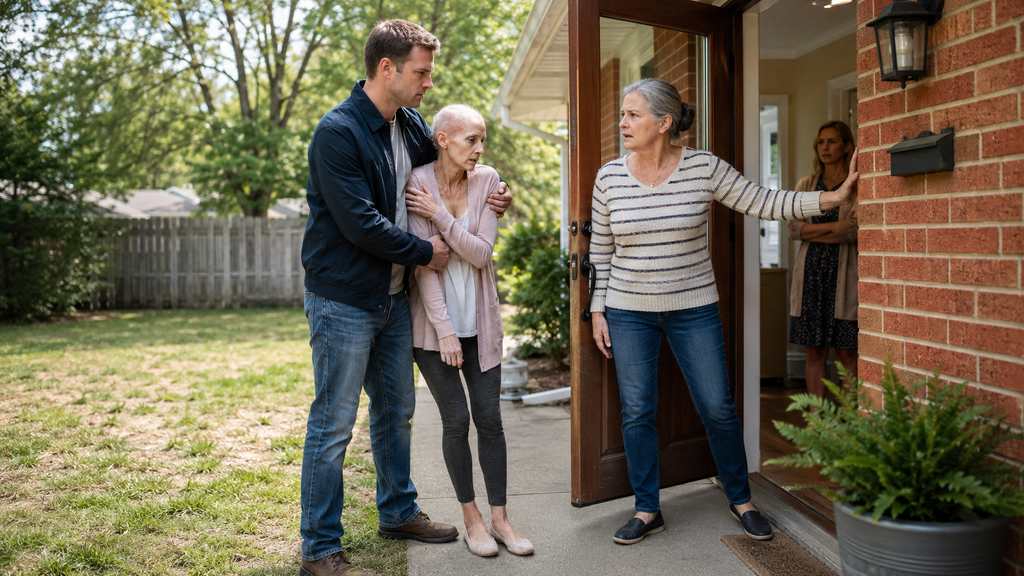
Never—not once—did I imagine I would find my wife on her knees in the dirt, painfully thin, her head shaved, collecting shards of a broken plate while my own family watched her like she was a servant.
And never did I imagine that, before the week was over, my mother and brother would learn exactly how expensive cruelty could become.
It started with a voice from the backyard.
“That bald woman shouldn’t let herself be seen when we have company!”
I stopped walking.
The suitcase in my right hand suddenly felt heavier.
I was still outside the fence.
No one knew I had arrived.
Four years.
Four long years in Canada.
Four winters that seemed determined to freeze every memory of warmth out of me.
Four years of twelve-hour shifts inside a Calgary metalworking plant where the air smelled like scorched steel, hydraulic oil, and sweat.
Four years of eating reheated noodles at midnight.
Four years of sharing cramped apartments with men who missed their wives just as badly as I missed mine.
Four years of working through birthdays, anniversaries, holidays, and weekends because every extra shift meant another few hundred dollars I could send home.
I had missed two Christmases entirely.
I missed Phedra’s thirty-fourth birthday.
I missed my mother’s sixty-fifth.
I missed my niece’s graduation.
But every time loneliness started eating at me, I reminded myself why I was there.
The house.
Our future.
My wife.
Every month, I sent between two and three thousand dollars home.
Sometimes more.
Altogether, it was close to one hundred thousand dollars.
That didn’t include the December bonuses.
That didn’t include the occasional money I sent when my mother said the roof needed repairing.
Or when Godfrey said the family car had broken down.
Or when Selina told me grocery prices had risen again.
I never argued.
I never questioned them.
I believed family was family.
I believed my mother would protect my wife as if Phedra were her own daughter.
I believed my brother would help around the house while I was gone.
And most of all, I believed Phedra was safe.
My mother always told me she was.
“Don’t worry about anything here, Damian,” Selina would say during our calls. “Work hard. Build your future. I’ll take care of home.”
Godfrey said the same.
“You’ve got enough on your plate over there, brother. We’ve got things handled.”
Even Phedra reassured me.
“I’m fine, my love.”
Those were the words she used.
Always.
I’m fine.
Don’t worry.
Keep working.
Come home when you can.
For the first three years, we video-called almost every evening.
Then, around eleven months before I came home, something changed.
Phedra stopped switching on the camera.
At first, she said the internet was bad.
Then she said the camera on her old phone was broken.
Later, she told me she was tired from helping my mother around the house.
I offered to send money for a new phone.
She refused.
“I don’t need one,” she said.
There was something strange in her voice.
I heard it.
I asked about it.
But she laughed softly and told me I was imagining things.
And because I trusted her…
because I trusted my family…
because the human heart often believes the explanation that hurts the least…
I let myself believe her.
Then the metalworking plant shut down temporarily.
There had been another safety investigation following several violations, and management announced that some departments would remain closed for several weeks.
Most of my coworkers complained.
I nearly cried from happiness.
Within three hours, I had bought a ticket.
I didn’t call anyone.
I wanted it to be a surprise.
I imagined walking through the door carrying flowers.
I imagined Phedra screaming.
I imagined sleeping next to my wife for the first time in years.
Instead, I stood behind my own fence listening to my brother humiliate her.
I moved closer.
Slowly.
Quietly.
Through a narrow gap between the wooden boards, I could see part of the backyard.
At first, my mind refused to understand what my eyes were seeing.
Phedra was kneeling beside the outdoor table.
Her head…
God.
Her beautiful hair was gone.
Phedra had always loved her hair.
It had fallen halfway down her back when we married.
Thick.
Dark.
Soft enough that sometimes, while we watched television, I would sit behind her and run my fingers through it until she fell asleep.
Now her head was nearly bare.
Not stylishly shaved.
Not deliberately cut.
There were thin patches of new growth over pale skin.
Her face was hollow.
Her cheekbones stood out sharply.
Her wrists looked small enough for me to close my fingers around twice.
She was wearing an old blouse I recognized from six years earlier.
Her sandals were broken.
Beside her sat a bucket of brown, filthy water.
A plate had shattered near her knees.
She was picking up the pieces with her bare hands.
My brother Godfrey stood a few feet away.
He looked healthy.
More than healthy.
He looked prosperous.
Designer shirt.
New watch.
Imported shoes.
In one hand, he held a glass of scotch.
The SUV parked beside the house gleamed in the afternoon sun.
I had never seen it before.
Godfrey pointed toward the broken plate.
“Pick it all up. We need the good dishes tonight.”
Phedra reached for another shard.
Her fingers were shaking.
“I’m trying.”
“Try faster.”
She attempted to stand.
Her knees buckled.
She caught herself against the table.
Godfrey laughed.
Not nervously.
Not awkwardly.
He laughed like her weakness entertained him.
“I feel dizzy,” Phedra whispered.
“What now?”
“I haven’t eaten since yesterday.”
Godfrey took a sip of his drink.
“Well, after everything you stole, maybe you should buy yourself something.”
Stole?
I tightened my grip on the fence.
For one violent second, everything inside me screamed to go through that gate.
I imagined my fist connecting with Godfrey’s jaw.
I imagined dragging him across the lawn.
I imagined breaking every expensive object he had apparently purchased while my wife starved.
But something stopped me.
Years around machinery had taught me patience.
When a machine begins failing, you don’t immediately swing a hammer at it.
First, you listen.
You follow the sound.
You understand where the damage began.
So I stayed where I was.
And listened.
Phedra bent down again.
One of the broken pieces sliced her finger.
She flinched.
A small bead of blood appeared.
Godfrey barely noticed.
“I told Mom I need to call Damian,” she said.
“No.”
“He has a right to know.”
“He has a right to work without your constant drama.”
“I’m sick, Godfrey.”
He rolled his eyes.
“So?”
“The doctor said I need to continue treatment.”
Before he could answer, another voice came from inside.
My mother.
“Doctors say anything when they want money.”
Selina stepped through the back door.
The woman who raised me.
The woman whose rent I paid.
The woman I called every Sunday from Canada.
She was wearing a new dress.
Gold earrings.
And around her neck…
I forgot how to breathe.
A gold hummingbird.
Phedra’s necklace.
I had given it to her on our fifth wedding anniversary.
It wasn’t extremely expensive.
But I had saved for months to buy it.
A delicate gold chain.
A tiny hummingbird with green stones in its wings.
Phedra cried when I gave it to her.
She wore it everywhere.
Even when she slept.
Now it hung around my mother’s throat.
Phedra looked at Selina.
“Please let me call him.”
My mother folded her arms.
“No.”
“He needs to know I’m getting worse.”
“You are not calling my son and distracting him.”
“I’m his wife.”
“And he’s working to get this family ahead.”
“I need treatment.”
“We’ve discussed this.”
“No, you decided for me.”
Selina’s expression hardened.
“My son sends the money into my bank account. Therefore, I decide how it is used.”
Phedra stared at her.
“What about the money for my doctor?”
“You’ve already seen a doctor.”
“Twice.”
“And that should be enough to know what’s wrong with you.”
“The oncologist said I need chemotherapy.”
Selina waved one hand dismissively.
“And what does that guarantee?”
Phedra’s mouth trembled.
“A chance to live.”
The words went through me like a knife.
Selina sighed.
“You always make everything dramatic.”
Phedra’s eyes moved toward the SUV.
Then toward the back of the house.
“The new vehicle wasn’t too expensive.”
“That’s different.”
“Godfrey’s auto shop wasn’t too expensive.”
“He needed something to build his future.”
“The marble floors weren’t too expensive.”
“This family needed a decent home.”
“But keeping me alive is?”
Silence.
Godfrey looked away.
Selina did not.
She simply stared at Phedra.
Then she said the sentence I would hear in my nightmares for years.
“You should have thought about all this before you got sick.”
My vision narrowed.
Phedra lowered her head.
There was no anger in her anymore.
That frightened me more than anything.
Only exhaustion.
The kind of exhaustion that comes after someone has spent so long begging for basic kindness that they no longer expect to receive it.
She whispered, “I can’t keep sleeping in the shed.”
The shed.
My eyes moved toward the far corner of the property.
There was a storage shed behind the garage.
Small.
Tin roof.
No air-conditioning.
Barely any ventilation.
I had bought it years earlier to store tools and garden supplies.
My wife had been sleeping there.
My cancer-stricken wife.
In a storage shed.
While my mother slept inside the renovated house.
While Godfrey drank imported scotch.
While they drove an SUV purchased with my money.
Something inside me became very still.
Not calm.
Still.
The stillness that comes just before a storm tears a roof away.
Phedra placed another piece of broken ceramic into the bucket.
My hand reached for the gate.
I pushed it open.
The hinges squealed.
Godfrey turned first.
His glass slipped from his fingers.
It landed in the grass.
Selina’s mouth opened.
Phedra did not immediately move.
She stared at me.
For a moment, she looked confused.
Almost frightened.
Like her mind was trying to decide whether I was real or just another thing exhaustion had created.
My suitcase dropped from my hand.
“Damian?” Godfrey whispered.
My mother clutched her chest.
“My son?”
Phedra’s lips parted.
No sound came out.
I walked toward her.
Every step felt unreal.
“Damian…”
Her voice finally reached me.
So weak.
So small.
I dropped to my knees.
She touched my face.
Her fingers shook against my cheek.
“You’re here.”
“I’m here.”
“You’re really here?”
“I’m here, honey.”
Then she broke.
She fell against my chest and sobbed.
Not neat tears.
Not quiet crying.
Her entire body shook.
She clutched my shirt with both hands like she was terrified someone would pull me away.
I wrapped my arms around her.
And that was when I understood how bad things truly were.
She weighed almost nothing.
I could feel bones beneath her blouse.
Her shoulder blades pressed against my forearm.
She smelled faintly of medicine, damp clothing, bleach, and the dust of the shed.
I buried my face against the side of her head.
For four years, I had imagined holding my wife again.
Now that I finally was…
I was afraid I might break her.
“I’m sorry,” she whispered.
I pulled back.
“What?”
“I’m sorry you had to see me like this.”
That sentence nearly destroyed me.
I held her face between my hands.
“Never apologize to me for surviving.”
She looked at me.
Behind us, Selina suddenly found her voice.
“Damian, before you start assuming things, you need to understand that this situation is complicated.”
I did not turn around.
I kept looking at Phedra.
“What happened to your hair?”
Her eyes dropped.
“Treatment.”
Selina rushed in.
“She refused to take care of herself properly. We tried everything.”
I looked over my shoulder.
“Everything?”
“Yes.”
Phedra’s fingers tightened around my sleeve.
Godfrey stepped closer.
“Brother, you’ve been gone a long time. You don’t know how difficult things have been.”
“I can see some of it.”
Selina raised her chin.
“Phedra changed when she got sick.”
“How?”
“She became demanding.”
Phedra flinched.
“She constantly wanted money.”
“For treatment?”
“For everything!”
My gaze moved to the hummingbird necklace.
My mother noticed.
Her hand flew to it.
I stood slowly.
“Where did you get that?”
Selina blinked.
“This?”
“Yes.”
She touched the pendant.
“Oh. Phedra gave it to me.”
Phedra spoke from behind me.
“No, I didn’t.”
Selina turned sharply.
“Don’t start.”
I looked at Phedra.
She swallowed.
“I tried to sell it.”
“Why?”
“To pay for an appointment.”
My chest tightened.
“Then what happened?”
“Your mother took it.”
Selina snapped, “Because she was acting irrationally! Selling family jewelry when there were other options!”
“What other options?”
Silence.
“Mom.”
She stiffened.
I stepped closer.
“What illness does my wife have?”
Phedra answered before anyone else could.
“Cancer.”
The backyard disappeared.
The house disappeared.
Godfrey disappeared.
There was only that word.
Cancer.
I turned toward her.
She touched the upper part of her chest.
“It started here.”
My knees almost weakened.
“When?”
“Eleven months ago.”
Eleven months.
For eleven months, I had been welding steel in Canada.
For eleven months, I had been sending money.
For eleven months, I had ended calls with, “I love you, honey. I’ll be home soon.”
And the woman on the other end was fighting cancer.
Alone.
“How many treatments?”
Phedra looked down.
“Not enough.”
I turned to Selina.
“How much of my money went toward her medical care?”
She immediately became defensive.
“You have no idea how expensive this disease is.”
“That wasn’t my question.”
“The house had expenses.”
“How much?”
“Damian—”
“How much?”
Godfrey stepped between us slightly.
“Brother, calm down.”
I looked at him.
He stopped moving.
I asked again.
“How many appointments did you pay for?”
Selina’s jaw tightened.
“A few.”
Phedra whispered, “Two.”
I looked at her.
“Two?”
She nodded.
“In eleven months?”
“Yes.”
My mother raised her voice.
“The doctors wanted ridiculous amounts of money, Damian! There were no guarantees! We had to think about the whole family.”
I looked around.
And suddenly, every object became evidence.
The granite countertops through the kitchen window.
The new leather sofa.
The enormous television.
The renovated flooring.
Godfrey’s watch.
The SUV.
The necklace.
My wife’s broken shoes.
One hundred thousand dollars.
I had believed I was building a home.
Instead, I had financed a prison.
I crouched beside Phedra.
“We’re going to the hospital.”
Selina immediately stepped in front of the doorway.
“You can’t just walk in here after four years and start making decisions.”
I stared at her.
“I’m taking my wife to a doctor.”
“She lives under this roof.”
“No. Apparently she lives in my storage shed.”
Selina crossed her arms.
“You disappeared for four years.”
I slowly rolled up my sleeve.
Old burns marked my forearm.
Small scars from metal shavings.
A deeper one near my elbow from an accident eighteen months earlier.
“I worked nights.”
Nobody spoke.
“I slept in a room with four men because apartments were expensive.”
I rolled my sleeve higher.
“I ate the cheapest food I could find.”
Godfrey looked at the ground.
“I spent Christmas alone.”
Selina’s lips tightened.
“I missed my wife’s birthday.”
My voice shook now.
Not with rage.
With grief.
“I stood outside in minus twenty-degree weather waiting for a bus after twelve-hour shifts so I could save another fifty dollars every week.”
I looked at my mother.
“And every time I wanted to quit, I remembered I was doing it for the people in this house.”
Selina muttered, “And we didn’t lack anything.”
I looked at Phedra.
“She did.”
Silence.
Godfrey suddenly said, “You left her too.”
I looked at him.
His face was pale, but he continued.
“You want to blame us for everything, but you were the husband. You left.”
The accusation struck because there was truth buried inside it.
I had left.
I had trusted.
I had not asked enough questions.
That guilt would stay with me.
But guilt was not going to become an escape route for them.
“I left to provide.”
“You still left.”
“And you stayed.”
I pointed toward Phedra.
“So tell me which one of us had more chances to help her.”
Godfrey said nothing.
Selina muttered, “She brought some of this on herself.”
Phedra’s fingers closed around the back of my shirt.
She was waiting for me to explode.
Maybe they all were.
Instead, I reached into my pocket.
My phone showed seventeen missed calls.
All from a Canadian number.
There was also an email.
The message had arrived while I was flying home.
I stared at it for several seconds.
Then an idea formed.
Not revenge.
Not exactly.
Something colder.
Accounting.
I turned toward Selina.
“You’re right.”
Her eyebrows lifted.
“What?”
“I said you’re right.”
Godfrey looked confused.
“About what?”
“Yelling won’t fix this.”
Selina’s shoulders lowered slightly.
I put the phone away.
“We’re family.”
“Yes,” she said quickly. “Exactly.”
“And families should be able to talk.”
“Of course.”
I almost admired how quickly her tone softened.
Godfrey even stepped forward and attempted a smile.
“That’s all we’re saying.”
I placed one arm around Phedra.
“I actually came home with news.”
Selina’s eyes sharpened.
“What news?”
I looked down at my phone again.
The email confirmed what the seventeen calls were about.
Two years earlier, I had been injured during an industrial accident.
Management blamed employee error.
But eventually, investigators uncovered ignored safety complaints, falsified inspection records, and a series of violations.
The case had dragged on.
I had almost forgotten about it.
Now the company’s insurance group had reached a settlement.
One million dollars.
I looked at my mother.
“The Canadian firm settled.”
She stared at me.
“For your accident?”
“Yes.”
“How much?”
Godfrey tried to sound casual.
But his body leaned forward.
I waited.
“One million dollars.”
The silence was extraordinary.
Phedra looked up at me.
She had never known the possible amount.
Selina’s face transformed.
The anger vanished first.
Then the defensiveness.
Then came concern.
Warmth.
Almost love.
All within three seconds.
“One million?”
I nodded.
“My God, Damian.”
Godfrey whistled softly.
“That changes everything.”
“Yes,” I said.
“It certainly does.”
Selina immediately moved toward Phedra.
“My poor daughter.”
Phedra actually recoiled.
Selina pretended not to notice.
“If we had known this was coming, we could have arranged private treatment immediately.”
I stared at her.
“You mean treatment matters now?”
“That’s not what I mean.”
Godfrey stepped in.
“Brother, things got out of hand. Mom was under pressure. Phedra was under pressure. Everybody was stressed.”
“Were you stressed when you bought the SUV?”
His smile disappeared.
Selina interrupted.
“The important thing is that you’re home now. We can fix this together.”
“Can we?”
“Of course.”
I pretended to think.
Then I said, “There is one complication.”
Godfrey’s face tightened.
“What complication?”
“The settlement is being held temporarily.”
My mother frowned.
“Why?”
“Taxes. International transfer regulations. Because my banking history is split between Canada and here.”
Neither of them understood what I was saying.
That was useful.
“The primary lump sum will remain in a temporary revocable escrow arrangement for seventy-two hours.”
Godfrey nodded slowly like he understood.
He didn’t.
“What does that mean?”
“It means the bank wants my local financial records cleaned up.”
Selina swallowed.
“What records?”
“The money I sent home.”
Her face changed slightly.
I continued before she could interrupt.
“The house.”
I pointed toward the driveway.
“The SUV.”
Then toward Godfrey.
“The money invested in the auto shop.”
Godfrey’s eyebrows rose.
“What about them?”
“The bank wants everything purchased with my international transfers consolidated into a family holding agreement.”
My mother stared at me.
“Meaning?”
“Meaning all assets connected to my money need to be placed under one legal structure before the settlement is released.”
Godfrey’s greed arrived faster than Selina’s.
“So… if we put everything together, we’re all part of the holding company?”
I paused.
“That’s the idea.”
His eyes brightened.
Selina caught on.
“And the million dollars?”
“Would become easier to manage.”
“How much would be available?”
“I don’t know yet.”
That answer made them hungrier.
Godfrey suddenly placed a hand on my shoulder.
“Brother, why didn’t you say this first?”
I looked at his hand.
He removed it.
Selina smiled.
“We can sign whatever the bank needs.”
“Tomorrow?”
“Tonight if necessary.”
“Tomorrow is fine.”
I looked toward Phedra.
“Tonight, I’m taking my wife to a private hospital.”
Selina nodded immediately.
“Absolutely.”
The woman who had refused treatment hours earlier was now overflowing with generosity.
“In fact,” she said, “let me come.”
“No.”
Her smile stiffened.
“Damian—”
“No.”
I lifted Phedra into my arms.
She gasped softly.
“You don’t have to carry me.”
“Yes, I do.”
I walked toward the front door.
Selina followed.
“What should we prepare for tomorrow?”
“Property documents.”
She nodded.
“Vehicle title.”
Another nod.
“Godfrey’s business registration.”
Godfrey said, “Done.”
“All transfer records.”
Selina hesitated.
“For what?”
“The bank wants everything transparent.”
That word frightened her.
Transparent.
I looked directly into her eyes.
“Unless there’s a problem.”
“No,” she said quickly.
“No problem.”
“Good.”
I carried my wife through the house.
As I passed the living room, I saw what four years of my labor had bought.
A seventy-inch television.
New couches.
Decorative lighting.
Imported rugs.
A glass dining table.
Everything gleamed.
Everything except the woman in my arms.
At the front door, Phedra whispered, “My medicine.”
“Where?”
“The shed.”
My mother said, “I can get it.”
“No.”
I carried Phedra outside.
Opened the shed.
And the last fragile piece of my heart broke.
There was a thin mattress on the floor.
One blanket.
Two plastic bottles of water.
Several medication boxes.
A bucket.
A small battery-powered fan.
A Bible.
And one photograph.
Our wedding picture.
Phedra had placed it beside her mattress.
I stared at it.
Two people smiling.
Healthy.
Young.
Certain that love would protect them from anything.
I picked up the photograph.
Phedra began crying again.
“I used to talk to it.”
I looked at her.
“What?”
“When I couldn’t call you.”
My throat closed.
“What did you say?”
She gave me the faintest smile.
“I told you goodnight.”
I closed my eyes.
Then I kissed her forehead.
“I’m sorry I wasn’t there.”
“You didn’t know.”
“I should have.”
“You trusted them.”
“I should have trusted the silence in your voice more.”
She rested her head against me.
Behind us, nobody spoke.
I carried her out of that shed.
She never slept there again.
PART TWO — THE MILLION-DOLLAR LIE
An hour later, Phedra was lying inside a private oncology unit.
The transformation in care was immediate.
Nurses moved quickly.
Fluids.
Blood tests.
Nutrition support.
Pain medication.
Scans.
A doctor examined her and asked how long she had gone without proper treatment.
Phedra couldn’t answer at first.
I did.
“Months.”
The doctor looked at me.
“Months?”
I nodded.
His expression remained professional.
But his eyes changed.
That was enough.
I sat beside her while an IV slowly dripped into her arm.
Under the hospital lighting, she looked even more fragile.
Her skin had a grayish undertone.
Her lips were dry.
Bruises marked her arms.
I hated myself for every call I had ended too soon.
Every time she said, “I’m tired,” and I replied, “Get some sleep.”
Every time she said the camera wasn’t working and I accepted it.
Every time I sent money without asking for receipts.
Phedra opened her eyes.
“Stop.”
I looked at her.
“What?”
“Blaming yourself.”
I almost laughed bitterly.
“How do you know what I’m thinking?”
“Because I know you.”
I took her hand.
“I should have come home sooner.”
“You were working.”
“I should have noticed.”
“They made sure you didn’t.”
I looked at her.
“Why didn’t you tell me?”
Tears collected in her eyes.
“I tried.”
“When?”
“Several times.”
My stomach tightened.
“What happened?”
“Your mother started keeping my phone.”
I stared at her.
“She said I became emotional after treatment and that hearing my voice would distract you.”
“Why didn’t you leave?”
Phedra looked toward the window.
“I tried that too.”
She swallowed.
“Godfrey told neighbors I was unstable. Your mother told people the cancer had spread to my brain and I sometimes got confused.”
My jaw tightened.
“They said if I ran away, they would tell you I had abandoned the family and taken money.”
She looked at me.
“They made me believe you might hate me before I could explain.”
I squeezed her fingers.
“There is nothing they could have said that would have made me hate you.”
“I know that now.”
The door opened.
A doctor entered.
He sat across from us.
His voice was careful.
“Mrs. Sterling is severely malnourished and dehydrated.”
My grip tightened around her hand.
“She also has an active malignancy that appears to have progressed due to inconsistent treatment.”
I felt Phedra tense.
“Can you help her?”
“We’re going to try.”
Not a promise.
Try.
The most frightening word in medicine.
I leaned forward.
“Money isn’t an issue.”
The doctor nodded.
“We’ll need comprehensive imaging before I can give you a clearer prognosis.”
“Do everything.”
Phedra looked at me.
“Damian—”
“Everything.”
The doctor left.
For a while, neither of us spoke.
Then Phedra whispered, “A million dollars?”
I looked at her.
“Yes.”
“You really got that?”
“Yes.”
“Then why did you tell them?”
I leaned back.
“Because greed makes people predictable.”
Her eyes narrowed slightly.
“What are you doing?”
I looked toward the hospital door.
“Finding out how much of our life they’re willing to return voluntarily.”
Phedra studied me.
For the first time that day, I saw something besides pain in her face.
A tiny spark.
“Damian.”
“Yes?”
“You have that look.”
“What look?”
“The one you get before you do something frighteningly calm.”
Despite everything, I smiled.
She almost smiled back.
Then her expression softened.
“Don’t destroy yourself trying to destroy them.”
I raised her hand to my lips.
“I’m not interested in destroying anyone.”
“What are you interested in?”
“Giving them exactly what belongs to them.”
“And what’s that?”
I looked at her.
“The consequences.”
That night, while Phedra slept, I met Arthur Vance.
Arthur had been recommended by a lawyer in Canada who handled part of my settlement.
He was in his late fifties, silver-haired, neatly dressed, and had the unsettling habit of listening without interrupting.
We met in a small conference room on the hospital’s administrative floor.
I placed everything I had on the table.
Bank transfers.
Messages from my mother.
Receipts.
Copies of documents.
Tax records.
Photographs.
And the video I had recorded from behind the fence before entering.
Arthur watched the recording once.
Then again.
He removed his glasses.
“How long has your wife been ill?”
“Eleven months.”
“How much money did you send during that period?”
I told him.
“And before that?”
I told him again.
He began making notes.
“Was there an explicit purpose attached to the transfers?”
“Home expenses. Property improvements. My wife’s needs. Savings.”
“Any written messages?”
“Hundreds.”
I unlocked my phone.
Messages from years earlier filled the screen.
Mom, use this for the roof.
Godfrey said plumbing needs repair.
Please make sure Phedra has everything.
Another:
If Phedra needs anything medical, use the money. Don’t ask first.
Arthur read silently.
Then another:
This bonus is for the house and Phedra. Please don’t spend it on anything unnecessary.
Arthur looked up.
“This is useful.”
“Can I get the property back?”
“That depends on how it is titled and what can be traced.”
“The SUV?”
“Likely.”
“Godfrey’s shop?”
“If your transfers financed it and we can document misrepresentation, possibly.”
I leaned forward.
“What about what they did to Phedra?”
His expression hardened.
“That goes beyond a financial dispute.”
He tapped the video.
“You have evidence of abuse.”
My stomach turned.
Hearing the word spoken by someone else made it real in a different way.
Abuse.
My mother abused my wife.
My brother abused my wife.
Arthur continued.
“Medical neglect. Coercive control. Possible theft. Depending on local statutes and evidence, there may be additional charges.”
“I want everything investigated.”
“It will be.”
I slid another document across the table.
“The settlement.”
He looked at it.
“One million?”
“Yes.”
“Does your family have any legal access?”
“No.”
“Good.”
I explained what I had told Selina and Godfrey.
The escrow story.
The family holding arrangement.
Arthur’s mouth curved slightly.
“Interesting.”
“Can we make something that sounds enough like what I told them?”
“We can prepare legitimate documents.”
“What would they do?”
Arthur thought for a moment.
“If they are willing to acknowledge that the major assets were purchased using your funds, a consolidation and restitution agreement could transfer their interests.”
“To me?”
“Yes.”
“And the debts?”
“Depends how it is drafted.”
I leaned back.
“What if they believe signing gives them access to the settlement?”
Arthur looked directly at me.
“We cannot misrepresent the legal effect of the documents.”
“Understood.”
“But if they fail to read a properly drafted agreement because they are distracted by assumptions of their own making…”
He let the sentence remain unfinished.
I understood.
The trap did not require fraud.
Only greed.
Arthur gathered the documents.
“I’ll have my team start immediately.”
I stood.
He remained seated.
“Mr. Sterling.”
I stopped.
“One piece of advice.”
“Yes?”
“Do not make this about revenge.”
I looked at him.
“Why?”
“Because revenge makes people careless.”
I thought of Phedra on her knees.
The shed.
The necklace.
The hunger in her voice.
Then I nodded.
“This isn’t revenge.”
“What is it?”
“An audit.”
The following morning, Selina arrived at Arthur’s office wearing pearls.
Godfrey wore a suit.
A suit.
The same man who had mocked my starving wife less than twenty-four hours earlier had dressed for wealth.
Phedra remained at the hospital.
I refused to expose her to them.
Selina entered smiling.
“My son.”
She tried to hug me.
I stepped aside.
Her arms dropped awkwardly.
Godfrey pretended not to notice.
“So,” he said, rubbing his hands together, “how does this work?”
Arthur sat behind his desk.
“Please sit.”
They did.
Several documents waited in front of them.
Arthur spoke calmly.
“These agreements concern assets acquired wholly or substantially with funds remitted internationally by Mr. Damian Sterling.”
Godfrey nodded impatiently.
“Yes, yes.”
Arthur continued.
“The documents establish the source of funds, acknowledge beneficial ownership interests, consolidate specified property, and assign associated obligations.”
Selina frowned.
“What does that last part mean?”
“Financial obligations attached to the assets remain with the responsible parties unless specifically transferred.”
Godfrey leaned closer.
“And after this, Damian’s settlement can move?”
Arthur did not answer the question they thought they were asking.
He simply said, “These documents resolve the local asset irregularities Mr. Sterling asked us to address.”
Godfrey smiled.
“Perfect.”
Selina looked at me.
“And after seventy-two hours?”
“We’ll know where everything stands.”
Technically true.
She picked up a pen.
Arthur said, “I strongly recommend reading every page carefully.”
Godfrey laughed.
“If Damian trusts you, we trust you.”
Arthur’s expression did not change.
“I am Damian’s attorney.”
That should have warned them.
It didn’t.
Selina began signing.
Godfrey followed.
Page after page.
Asset acknowledgment.
Transfer.
Restitution.
Debt assignment.
Business inventory.
Vehicle.
Property.
Land.
They barely slowed down.
At one point, Selina whispered to Godfrey, “Imagine what we can do with even two hundred thousand.”
I heard her.
So did Arthur.
Neither of us reacted.
Godfrey whispered back, “I’m expanding the shop.”
My mother smiled.
“I’ve always wanted to redo the upstairs.”
I looked out the window.
Phedra was lying under hospital lights while my family discussed renovations.
When the last page was signed, Arthur collected everything.
Godfrey slapped his hands together.
“Done.”
Selina looked at me.
“When will the money arrive?”
“Soon enough.”
“How much are you keeping in Canada?”
“I haven’t decided.”
“You should bring most of it here.”
“Why?”
“So the family can help you manage it.”
I almost admired her consistency.
I stood.
“I need to go back to the hospital.”
Selina rose too.
“Tell Phedra I’m praying for her.”
I stared at her.
She looked away first.
At the hospital, Phedra was awake.
Her scans were complete.
She looked nervous.
I sat beside her.
“How did it go?”
“They signed.”
“All of it?”
“All of it.”
She closed her eyes.
“I don’t understand them.”
“Neither do I.”
“That isn’t true.”
“What?”
“You understand them perfectly now.”
Maybe she was right.
A doctor entered before I could answer.
He carried a tablet.
Phedra took my hand.
The next fifteen minutes were the longest of my life.
The cancer was serious.
Advanced.
But not hopeless.
There were treatment options.
Targeted therapy.
Chemotherapy.
Nutritional rehabilitation.
Potential surgery depending on response.
The doctor spoke carefully about survival rates.
Possible complications.
Uncertainty.
I listened.
Phedra cried silently.
When he finished, I asked one question.
“Can she fight?”
The doctor looked at her.
“Yes.”
I turned toward Phedra.
“Then we fight.”
She whispered, “I’m tired.”
“I know.”
“So tired.”
“I know.”
“What if I can’t?”
I moved closer.
“Then I’ll carry you until you can walk again.”
Tears ran down her face.
“And if I never can?”
“Then I keep carrying you.”
She leaned into me.
For the first time since I had come home, I let myself cry.
Quietly.
Into her shoulder.
Not because I thought I was losing her.
But because I finally understood how close I had come to arriving too late.
PART THREE — THE TRAP CLOSES
Selina called me six times that evening.
I ignored the first five.
On the sixth, I answered.
“When is the money coming?”
No greeting.
No question about Phedra.
No “How is she?”
Only the money.
I leaned against the hospital corridor wall.
“Tomorrow morning.”
Selina became breathless.
“Really?”
“Yes.”
“Should we come to the bank?”
“No.”
“Where?”
“Hospital conference room.”
“The hospital?”
“Yes.”
“Why?”
“The attorney wants everything finalized near me so I don’t have to leave Phedra.”
“Of course.”
Then, almost as an afterthought, she asked, “How is she?”
“Still alive.”
Silence.
“That’s good.”
I closed my eyes.
“Yes.”
“It is.”
Godfrey took the phone.
“Brother, should I bring my business documents?”
“No.”
“Any bank information?”
“No.”
“So what happens tomorrow?”
“You find out.”
He laughed.
“You always liked surprises.”
I looked through the glass toward Phedra’s room.
“Yes.”
“I do.”
The next morning, Selina and Godfrey arrived early.
Twenty minutes early.
Greed, apparently, was punctual.
Selina wore her best dress.
Godfrey carried a leather folder.
They entered the private conference room smiling.
Then stopped.
Arthur was there.
So were two uniformed officers.
A state investigator.
And a prosecutor.
My mother’s smile vanished.
Godfrey’s face drained of color.
Selina looked at me.
“Damian?”
I sat at the far end of the table.
“What is this?”
Arthur stood.
“Please close the door.”
Godfrey didn’t move.
One of the officers closed it for him.
Selina’s hand flew to her chest.
“My son, what is happening?”
I looked at Arthur.
He opened a thick file.
“This meeting concerns the disposition of assets acquired through funds remitted by Mr. Sterling and the initiation of several criminal investigations.”
Godfrey turned toward me.
“What?”
Arthur continued.
“As of this morning, property documentation signed yesterday has been filed.”
Selina’s eyes darted toward him.
“What documentation?”
“The documents you executed.”
“You said those were for the family holding structure!”
Arthur remained calm.
“I explained precisely what the documents did.”
Godfrey slammed one hand onto the table.
“You tricked us!”
One officer immediately stepped closer.
“Lower your voice.”
Godfrey backed down.
Arthur placed copies in front of them.
“The agreement acknowledges that the house improvements, vehicle, and substantial portions of Mr. Godfrey Sterling’s business inventory were financed using transfers made by Damian Sterling.”
Selina looked at the first page.
Her hands began shaking.
Arthur continued.
“You transferred your ownership interests as partial restitution.”
“To Damian?”
“Yes.”
“No!”
“Yes.”
Selina looked at me.
“You said this was necessary for the million dollars!”
“I said the assets needed to be consolidated.”
“You lied!”
“Did I?”
She opened her mouth.
Nothing came out.
Arthur continued.
“The settlement itself remains in Mr. Sterling’s independent financial structure and has no connection to you.”
Godfrey stood.
“What does that mean?”
I answered.
“It means you get nothing.”
His face twisted.
“Nothing?”
“Not one dollar.”
Selina began shaking her head.
“No.”
“Yes.”
“You cannot do this to family.”
I almost laughed.
But there was nothing funny left.
“You want to talk about family?”
“Damian—”
I stood.
“You put my wife in a shed.”
“She was difficult!”
“You starved her.”
“We fed her!”
“She told the hospital she went entire days without food.”
“That’s a lie!”
One investigator opened a folder.
“We have statements from neighbors.”
Selina froze.
The investigator continued.
“We also have photographs, medical documentation, recordings, bank statements, and video evidence.”
Godfrey looked at me.
“Video?”
I took out my phone.
Pressed play.
His own voice filled the conference room.
That bald woman shouldn’t let herself be seen when we have company.
Godfrey’s face collapsed.
Then came Phedra’s voice.
I haven’t eaten since yesterday.
Then his laughter.
I stopped the video.
Silence.
Selina whispered, “You were spying on us.”
“No.”
I put the phone down.
“I came home.”
She looked away.
Arthur slid another document across the table.
“An emergency protective order has also been issued preventing either of you from contacting Phedra Sterling directly.”
Selina’s eyes filled with rage.
“This is her doing.”
I slammed my palm against the table for the first time.
Everyone flinched.
“No.”
My voice filled the room.
“This is yours.”
I pointed at her.
“Every single piece of this is yours.”
My mother stared at me.
“You made the choices.”
My voice became quieter.
“You stole the money.”
I looked at Godfrey.
“You drank while she starved.”
Back to Selina.
“You wore her necklace.”
Her hand instinctively reached toward her throat.
The necklace wasn’t there.
She looked confused.
I reached into my pocket.
The hummingbird rested in my palm.
Police had accompanied me to the house earlier that morning while evidence and property were inventoried.
We found it on Selina’s nightstand.
Phedra’s necklace.
I held it up.
“This belongs to my wife.”
Selina’s face turned red.
“You’re humiliating your own mother over jewelry?”
“No.”
I closed my fingers around the pendant.
“I’m holding you accountable for what you became.”
Godfrey shook his head.
“What about my shop?”
Arthur answered.
“Temporarily frozen pending asset tracing and court review.”
“You can’t take my business!”
“How much of the startup capital was yours?”
Godfrey said nothing.
I answered for him.
“None.”
He turned on me.
“I built that place!”
“With my money.”
“I worked there!”
“So did I.”
He stared at me.
“From Canada.”
His jaw clenched.
“I sent money while you called it yours.”
Selina began crying.
Real tears this time.
Or perhaps real fear.
“Where are we supposed to go?”
I looked at her.
“Where did you expect Phedra to go?”
“That’s different.”
“How?”
“She had somewhere to sleep!”
“The shed?”
Selina said nothing.
I stepped closer.
“You slept in the house I paid for.”
She looked down.
“You watched television on furniture I paid for.”
Nothing.
“You drove a vehicle I paid for.”
Nothing.
“You wore my wife’s jewelry.”
Her mouth trembled.
“And while she fought cancer, you decided treatment cost too much.”
Selina whispered, “I was trying to protect the family’s money.”
I stared at her.
“No.”
“You were protecting your comfort.”
I leaned down slightly.
“The money was never yours.”
Her tears continued.
“You’re throwing your mother into the street.”
“For her?”
There it was.
For her.
As though my wife were some outsider.
As though marriage meant nothing.
As though Phedra were disposable and Selina permanent.
I looked at my mother for a long time.
Then I said quietly, “Yes.”
She gasped.
I continued.
“If choosing my wife means losing the people who tortured her while I was gone, then yes.”
My voice hardened.
“I choose her.”
Godfrey whispered, “You’ll regret this.”
I looked at him.
“No.”
“For the rest of your life, brother.”
“No.”
He leaned forward.
“You think Phedra is going to live forever?”
The room changed.
One officer moved quickly.
Arthur stood.
But I raised one hand.
I walked toward Godfrey.
For the first time, fear appeared in his eyes.
I stopped inches away.
“You should be very grateful that the woman you mocked taught me what kindness looks like.”
He swallowed.
“Because without her influence, this conversation would be very different.”
I stepped back.
“Take them.”
The officers moved forward.
Selina began shouting.
“Damian!”
I turned away.
“Damian! I am your mother!”
I stopped at the door.
Looked back.
“Yes.”
Her face changed.
For one moment, she looked hopeful.
Then I finished.
“That’s why it hurts this much.”
I walked out.
Phedra was sitting upright when I returned.
A scarf covered her head.
The afternoon sun reached across her blanket.
She looked at my face.
“It’s done?”
“Yes.”
“Are they arrested?”
“An investigation is underway. Some charges are moving immediately.”
She nodded slowly.
“Do you feel better?”
I thought about it.
“No.”
She looked surprised.
“I thought you would.”
“So did I.”
I sat down.
“I feel sad.”
“About your mother?”
“Yes.”
“That’s allowed.”
I looked at her.
“She hurt you.”
“She did.”
“So why don’t you hate her?”
Phedra considered the question.
“Maybe I do a little.”
I almost smiled.
She continued.
“But hate is expensive.”
“What does that mean?”
“It takes energy.”
She looked at the IV line.
“I don’t have much to waste.”
That was Phedra.
Even after everything.
Still wiser than me.
I placed the necklace into her hand.
She stared.
Her fingers closed around the hummingbird.
“You found it.”
“Yes.”
She cried.
Not violently.
Quietly.
She ran her thumb over the green stones.
“I thought I’d never see this again.”
I helped fasten it around her neck.
For the first time since I had returned, something looked familiar.
The tiny hummingbird rested against her chest.
Exactly where it belonged.
She touched it.
Then looked at me.
“I don’t want the house.”
“I know.”
“I never want to go back.”
“You don’t have to.”
“Sell it.”
“That was my plan.”
“What about Godfrey’s shop?”
“That depends on the court.”
“If anything comes back to us…”
She hesitated.
“Yes?”
“Put it toward treatment.”
I shook my head.
“Our settlement already covers treatment.”
“Then help someone else.”
I stared at her.
“Someone else?”
“A patient who doesn’t have a Damian in Canada.”
I looked away because my eyes filled immediately.
She squeezed my hand.
“That’s what I want.”
“You nearly died because people stole from you, and your first thought is helping strangers?”
She shrugged weakly.
“Maybe that’s how I make sure they didn’t change me.”
I leaned forward.
Pressed my forehead against hers.
“They didn’t.”
THE MONTHS THAT FOLLOWED
Cancer did not disappear because justice arrived.
That was the part nobody tells you in dramatic stories.
There was no magical courtroom victory followed by instant healing.
Phedra still had to fight.
There were mornings when she vomited until nothing remained.
Nights when her fever spiked.
Days when she could not tolerate food.
Weeks when the treatments made her so weak that walking from the bed to the bathroom felt like crossing a desert.
I stayed.
Every day.
I shaved my own head after her first major treatment cycle.
She stared at me in horror.
“What did you do?”
I rubbed my scalp.
“Fashion statement.”
“You look ridiculous.”
“That bad?”
“Terrible.”
I grinned.
It was the first time I heard her laugh in weeks.
A real laugh.
Weak, but real.
I would have shaved my eyebrows too if I thought it would make her laugh again.
I learned medications.
Schedules.
Foods she could tolerate.
How to read the tiny changes in her expression when pain started.
How to help her shower without making her feel helpless.
How to sit quietly when she didn’t want encouragement.
How to stop telling her, “You’re strong,” on the days when she wanted permission to be tired.
Sometimes love is not a speech.
Sometimes it is holding a bowl while the person you love is sick.
Sometimes it is waking at three in the morning to check whether they’re breathing comfortably.
Sometimes it is learning which blanket doesn’t irritate sensitive skin.
Sometimes it is silence.
And sometimes it is whispering, “I’m still here,” even when the person beside you is too exhausted to answer.
The settlement transferred successfully.
Most of it went into protected accounts.
A large portion was dedicated to Phedra’s medical care and long-term financial security.
Another portion remained invested.
I did not buy a sports car.
I did not buy watches.
I did not purchase the giant house Godfrey had once joked about.
After watching greed hollow out my family, expensive objects looked different to me.
Comfort mattered.
Security mattered.
Time mattered most.
Arthur handled the legal proceedings.
The financial investigation uncovered more than I expected.
My mother had lied repeatedly about expenses.
Several home repairs had never occurred.
Godfrey’s shop had been funded almost entirely through my transfers.
The SUV was purchased using money I had sent after Selina told me Phedra needed “urgent household support.”
There were withdrawals the same weeks Phedra missed oncology appointments.
That detail stayed with me.
On one date, I had transferred $3,200 after my mother told me the household was facing an emergency.
Three days later, Godfrey made a deposit on specialized equipment for his shop.
That same week, Phedra canceled treatment because she could not pay the medical fee.
When Arthur showed me the timeline, I had to leave the room.
I walked into the hallway.
Pressed my hands against the wall.
And cried.
Not because of the money.
Money can return.
Time does not.
Cancer had been allowed to advance while my brother bought machinery.
That was the theft I could never recover.
Months of Phedra’s life.
Months of treatment.
Months of hope.
That was what they had stolen.
The criminal cases moved slowly.
Then suddenly.
Neighbors testified.
One woman admitted she occasionally passed food through the fence when Selina wasn’t watching.
Another remembered seeing Phedra washing clothes outside in the rain.
A delivery driver had seen her sleeping in the shed when he arrived early one morning.
There were hospital records documenting interrupted care.
Messages.
Bank statements.
Audio.
Video.
Godfrey tried to claim Phedra had refused treatment voluntarily.
The medical records contradicted him.
Selina claimed she believed natural remedies were safer.
Her bank records showed she had used my transfers for luxury purchases during the same period.
Their lawyer tried to portray the situation as a family misunderstanding.
The prosecutor called it something else.
Exploitation.
Neglect.
Theft.
Cruelty.
For once, the correct words were being used.
Phedra never attended the trial.
She didn’t want to.
“I’ve already given them enough of my life,” she told me.
I respected that.
I went when necessary.
Not every day.
When the verdicts finally came, I did not cheer.
Selina was convicted on multiple counts tied to financial theft, coercive abuse, and medical neglect.
Godfrey faced convictions involving theft, fraud, and his role in the abuse.
The exact sentences mattered less to me than the fact that neither could rewrite what happened anymore.
There was a court record.
A legal record.
The truth existed somewhere they could not erase it.
Selina received several years of incarceration followed by supervision.
Godfrey received a shorter custodial sentence but lost his business assets as part of restitution.
The SUV was sold.
The house was sold.
The proceeds attributable to my funds were returned through the restitution process.
I never went inside the house before it sold.
I couldn’t.
The last image I had of that property was Phedra kneeling in the backyard.
I wanted it to remain the last.
SIX MONTHS LATER
The ocean sounded different in the morning.
Softer.
Almost like breathing.
We had rented a small recovery villa on the California coast while Phedra continued follow-up treatment with a specialized oncology team.
It wasn’t enormous.
We didn’t need enormous.
Two bedrooms.
A kitchen.
A terrace facing the water.
Large windows that filled the living room with sunlight.
For Phedra, the best part was the garden.
Flowers lined the stone path.
Hummingbirds visited almost every afternoon.
The first time one appeared, she touched the necklace at her throat.
“Look.”
I did.
A tiny bird hovered above a red flower.
Its wings moved too quickly to see.
Phedra smiled.
For several seconds, we said nothing.
Some things don’t need explanation.
That morning, six months after I found her in the backyard, she sat on the terrace wrapped in a light blanket.
Her hair had begun growing back.
Soft.
Short.
Uneven.
Beautiful.
Her cheeks were fuller.
Color had returned to her face.
Her hands no longer trembled constantly.
I carried two cups of herbal tea outside.
“One for the lady.”
She looked suspicious.
“What did you put in it?”
“Nothing.”
“You said that yesterday.”
“That vitamin powder was medically approved.”
“It tasted like grass.”
“Healthy grass.”
She laughed.
I placed the cup beside her.
She reached for my hand.
Her grip was strong now.
That still surprised me sometimes.
After months of holding fingers that felt like fragile twigs, every small sign of strength seemed miraculous.
“How was your call with Arthur?” she asked.
“Finished.”
“What’s finished?”
“Everything.”
She looked at me.
“The legal case?”
I nodded.
“The final restitution orders were processed this morning.”
Phedra lowered her eyes.
“And Selina?”
“Her appeal on the financial portion was denied.”
“Godfrey?”
“Same.”
She stared toward the ocean.
For a while, neither of us spoke.
I expected relief.
Instead, she looked sad.
“Do you miss them?” she asked.
I knew who she meant.
“My family?”
“Yes.”
I considered lying.
But Phedra had survived too many lies.
“Sometimes.”
She squeezed my hand.
“I’m sorry.”
“Don’t be.”
“You loved them.”
“I did.”
“You probably still do.”
I looked at her.
“That’s the worst part.”
She nodded.
People think betrayal makes love disappear.
It doesn’t always.
Sometimes love stays.
And that makes betrayal hurt more.
My mother had rocked me to sleep when I was sick as a child.
She had walked three miles to school meetings when we couldn’t afford transportation.
She taught me to cook rice.
She cried when I left for Canada.
Those memories still existed.
So did the woman who told my cancer-stricken wife she should have thought about the consequences before getting sick.
Both were real.
That was difficult to accept.
Phedra seemed to read my thoughts.
“You can remember who she used to be without forgiving what she became.”
I looked at her.
“When did you become so wise?”
“I had a lot of time in that shed.”
The joke hit me wrong.
My face changed.
Phedra immediately regretted it.
“Sorry.”
“No.”
I forced a breath.
“No, it’s okay.”
I still could not hear the word shed without seeing her on that mattress.
She rested her head against my shoulder.
“Damian?”
“Yes?”
“I’m happy.”
I looked down at her.
“Really?”
“Yes.”
“After everything?”
“Not because of everything.”
She watched the waves.
“In spite of everything.”
That distinction mattered.
I kissed the top of her head.
A few minutes later, her phone rang.
She looked at the screen.
Doctor.
My stomach tightened.
It always did.
She answered.
“Hello?”
I watched her face.
Her eyes narrowed.
Then widened.
She covered her mouth.
My heart stopped.
“What?”
She listened.
Tears appeared.
“Thank you.”
She ended the call.
I had already stood.
“What did they say?”
She looked at me.
For several seconds, she couldn’t speak.
“Phedra.”
Her lips trembled.
“The scans.”
I grabbed her hand.
“What about them?”
“No active disease.”
I stared at her.
“What?”
“They said…”
She started crying.
“The doctor said I’m in complete remission.”
I did not react immediately.
My brain refused to trust the words.
“Say it again.”
She laughed through tears.
“Complete remission.”
“Again.”
“Damian—”
“Please.”
She placed both hands on my face.
“I’m in remission.”
Something broke open inside me.
I pulled her from the chair.
Carefully.
Still carefully.
Always carefully.
And held her.
She laughed.
I cried.
Then she cried.
Then both of us were laughing because neither of us could decide which emotion belonged where.
I buried my face against her shoulder.
“Thank God.”
She held the back of my head.
“Thank God.”
We stayed like that while the ocean rolled toward shore.
Minutes passed.
Maybe longer.
Eventually, she whispered, “You’re squeezing me.”
I immediately released her.
“Sorry.”
She laughed.
“I didn’t say stop.”
So I held her again.
That evening, we walked along the beach.
Slowly.
Phedra still tired easily.
But she insisted on walking barefoot.
She wanted to feel the sand.
The sky turned orange near the horizon.
Small waves rolled over our feet.
She held my hand.
“Do you remember our first apartment?”
I smiled.
“The one with the leaking roof?”
“And the neighbor who practiced trumpet at midnight.”
“He only knew three songs.”
“He didn’t know any songs.”
I laughed.
She looked toward the water.
“We were happier there than everyone in that big house.”
I knew exactly what she meant.
“We had nothing.”
“We had enough.”
I squeezed her hand.
“We have enough now.”
She stopped walking.
Turned toward me.
“There’s something I want.”
My stomach tightened.
“What?”
“A home.”
I smiled.
“We can buy one.”
“No.”
She shook her head.
“I don’t mean a huge house.”
“What do you mean?”
“Something small.”
She looked up at me.
“A place with a kitchen where we cook together.”
“Okay.”
“A garden.”
“Definitely.”
“A guest room.”
“For who?”
“People we actually like.”
I laughed.
She continued.
“And no shed.”
My smile faded.
She touched my arm.
“No shed,” I repeated.
“Ever.”
“Ever.”
We started walking again.
After a while, Phedra said, “And I want to start the fund.”
“What fund?”
“The one we talked about.”
I remembered.
Cancer patients who could not afford treatment.
“You’re serious?”
“Yes.”
“We can.”
“I don’t want our names everywhere.”
“Fine.”
“I don’t want cameras.”
“Fine.”
“I don’t want people calling us heroes.”
“Definitely fine.”
She smiled.
“I just want someone who’s sitting in a hospital wondering whether they can afford the next appointment to hear, ‘It’s covered.’”
My eyes burned.
“All right.”
She looked at me.
“All right?”
“We’ll do it.”
Her smile widened.
“Together?”
I raised her hand.
Kissed her fingers.
“Everything from now on is together.”
ONE YEAR LATER
We bought a small house.
Three bedrooms.
A white kitchen.
A garden.
No luxury gate.
No marble entrance.
No enormous television.
Phedra planted herbs by the back steps.
Tomatoes grew badly the first season.
She blamed the soil.
I blamed her watering schedule.
We argued about it for three weeks.
It was wonderful.
Ordinary arguments felt like gifts.
The Phedra Sterling Patient Assistance Fund quietly began covering transportation, medication, and treatment gaps for people facing serious illnesses.
We never attached my name.
Phedra didn’t want hers there either at first.
Eventually, the hospital convinced her that patients might find hope in knowing the fund had been created by a survivor.
So she agreed.
Not because she wanted attention.
Because she wanted frightened people to know that a diagnosis was not always the end of the story.
One afternoon, we received a letter from a woman named Andrea.
Her husband had lost his job.
Their insurance had delayed coverage.
The fund paid for three oncology appointments.
Andrea wrote:
You gave us time.
Phedra read that sentence three times.
Then she put the letter down.
“What?”
I asked.
She wiped her eyes.
“That’s what your family took from me.”
I knew.
She touched the page.
“And this is what we give back.”
I sat beside her.
She leaned against me.
For the first time, the money from my settlement felt like something other than the aftermath of an injury.
It became medicine.
Transportation.
Meals.
Time.
Maybe even life.
Greed had taken money and turned it into suffering.
Phedra took the same money and turned it into mercy.
That was the difference between them.
I never saw Godfrey again.
He wrote once.
A year and a half after the trial.
The letter arrived without warning.
He apologized.
Or tried to.
There were many sentences about pressure.
Misunderstandings.
Mom’s influence.
Financial stress.
Poor decisions.
There was only one sentence that mattered.
I know what I did to Phedra was wrong.
I showed her the letter.
She read it.
Then folded it.
“What do you want to do?”
I asked.
“Nothing.”
“Do you forgive him?”
She thought.
“I don’t know.”
“That’s fair.”
“Maybe someday.”
She handed the letter back.
“But forgiveness doesn’t mean access.”
I nodded.
She was right.
Some doors close because anger controls you.
Others close because wisdom finally does.
I never responded.
Selina wrote more often.
At first, the letters were angry.
Then defensive.
Then religious.
Then apologetic.
Then angry again.
Eventually, there was one that felt different.
No excuses.
No accusation.
No demand.
She wrote that she thought about the shed every night.
She wrote that greed had made her believe money sent to her account belonged to her.
She wrote that she resented Phedra long before the cancer because she believed my wife had “taken” me away.
She admitted that when I left for Canada, control over the household gave her a sense of importance.
Then Phedra became ill.
And instead of seeing a frightened woman…
she saw an expense.
That line stayed with me.
I saw an expense where I should have seen a human being.
I showed the letter to Phedra.
She read it slowly.
When she finished, she placed it on the table.
“She understands now.”
“Maybe.”
“Are you going to write back?”
“I don’t know.”
Phedra nodded.
“You don’t owe her forgiveness.”
I looked at her.
“Neither do you.”
“I know.”
Weeks later, I sent my mother one letter.
Only one.
I told her Phedra was alive.
I told her she was in remission.
I told her we had built a peaceful life.
I told her I hoped she used the rest of her life to become the kind of woman she once taught me to respect.
I did not promise reconciliation.
I did not invite contact.
I did not say I hated her.
I simply signed my name.
Damian.
That was enough.
EPILOGUE
Two years after I came home from Canada, Phedra stood in our garden wearing a wide-brimmed hat and arguing with a hummingbird.
I watched from the kitchen window.
“You’re going to scare it away!”
I called.
She turned.
“It keeps stealing from my flowers!”
“That is literally what flowers are for.”
“Not those flowers.”
I walked outside carrying two cups of tea.
Her hair had grown to her shoulders.
She wore it loose now.
Sometimes she still touched it unconsciously, as though checking that it was really there.
The afternoon sun warmed the garden.
She sat on the wooden bench beside me.
I handed her a cup.
“Any word from Arthur?”
she asked.
“Final paperwork came through.”
“Everything finished?”
“Everything.”
The last funds recovered from the old property had been transferred into the patient assistance trust.
There was nothing left tying us financially to the house.
Nothing left to litigate.
Nothing left to recover.
The chapter was closed.
Phedra rested her head against my shoulder.
A hummingbird hovered above the flowers.
For a while, we watched it.
“Do you ever think about that day?”
she asked.
“The day I came home?”
“Yes.”
“Every day.”
Her fingers intertwined with mine.
“What do you remember first?”
I thought about it.
Not the shouting.
Not Godfrey.
Not my mother.
Not even the shed.
“You.”
She lifted her head.
“Me?”
“You touching my face.”
She smiled faintly.
“I thought you were a hallucination.”
“I know.”
“I hadn’t eaten.”
“I know.”
“I was sure if I blinked you’d disappear.”
I swallowed.
“I almost arrived too late.”
“But you didn’t.”
I looked at her.
“That’s the part I hold onto.”
She leaned back against me.
For four years, I believed providing money was the same as protecting someone.
I learned the difference.
Money can build walls.
It can purchase cars.
It can renovate kitchens.
It can create businesses.
It can fund treatment.
But money cannot notice fear in someone’s voice.
Money cannot ask the second question.
Money cannot hold someone at three in the morning.
Money cannot recognize when “I’m fine” actually means “Please keep asking.”
I worked hard because I loved my family.
But love cannot be outsourced.
Trust should never mean blindness.
And family is not defined by who shares your blood.
Family is defined by what people do when you are weak enough to need them.
My mother and brother looked at Phedra when she was sick and saw someone they could control.
Someone inconvenient.
Someone whose dignity they could take piece by piece.
They thought my distance made me powerless.
They thought her illness made her worthless.
They thought my silence meant weakness.
They were wrong about all three.
Silence is not always weakness.
Sometimes it is observation.
Patience is not surrender.
Sometimes it is preparation.
And kindness is not an invitation to cruelty.
Sometimes kindness is simply the reason a man chooses a courtroom instead of violence.
My family expected me to come home and scream.
Instead, I listened.
They expected me to fight them in the backyard.
Instead, I gave them documents.
They expected the million dollars to rescue them.
Instead, their own greed signed away everything they had stolen.
But in the end, their punishment was not the important part of the story.
Phedra was.
Her survival was.
Her laughter returning was.
The first meal she finished without nausea.
The first afternoon she walked without help.
The first scan showing improvement.
The first new strands of hair.
The first night she slept through until morning.
The phone call that said remission.
Those were the victories that mattered.
Not the house.
Not the SUV.
Not the money.
Not even the convictions.
Her.
I looked down at my wife.
“You know something?”
“What?”
“I used to think coming home meant returning to a place.”
She raised one eyebrow.
“That sounds philosophical.”
“I’ve matured.”
“Dangerous.”
I laughed.
Then I took her hand.
“But I was wrong.”
“About what?”
“Home isn’t the house.”
Her expression softened.
“It never was.”
“No.”
I kissed her forehead.
“You were home.”
Her eyes filled.
“Damian.”
“I spent four years trying to build us a future.”
I looked around at the small garden.
The modest house.
The woman beside me.
“And the whole time, the most important part of that future was the person waiting for me.”
She pressed her cheek against my shoulder.
“Thank you for coming back.”
The words took me back to the hospital terrace in California.
The same sentence.
Different life.
I wrapped one arm around her.
“I should have come sooner.”
She shook her head.
“No.”
I looked at her.
“You came when you could.”
“I almost lost you.”
“But you didn’t.”
A hummingbird flew close enough that we could hear its wings.
Phedra smiled.
Then she touched the gold pendant resting against her chest.
The same necklace my mother had taken.
The same hummingbird I once gave her as a promise of love.
Its stones caught the afternoon light.
“Do you know why I never sold this after we got it back?”
she asked.
“Sentimental value?”
“That too.”
“What else?”
She touched the little bird.
“Because it reminds me that something can be stolen from you and still come home.”
I looked at her.
She smiled.
I couldn’t answer.
So I kissed her.
Slowly.
Gently.
The way I had imagined kissing her when I first booked that plane ticket from Calgary.
Only now, I understood something I had not understood then.
I had spent years believing I was coming home to surprise my wife.
In reality, I came home to discover the truth.
I came home to learn what my absence had hidden.
I came home to see greed without its mask.
I came home to protect the woman I should never have assumed was protected simply because family stood around her.
Most importantly…
I came home in time.
And after almost losing everything that mattered, I stopped measuring wealth in bank transfers, square footage, vehicles, settlements, or property.
Wealth became much simpler.
Phedra humming while she cooked.
Her shoes beside mine at the door.
Her hair clogging the shower drain again.
Her laughter coming from the garden.
Two cups of tea cooling on a bench.
A doctor saying the word remission.
A warm hand resting inside mine.
A quiet house where nobody was afraid.
That was wealth.
That was success.
That was everything.
Phedra looked toward the sunset.
“Promise me something.”
“Anything.”
“If you ever have to work overseas again…”
I immediately shook my head.
“Not happening.”
She laughed.
“Let me finish.”
“No.”
“Damian.”
“I’m listening.”
“If life ever pulls us apart for a while…”
I tightened my fingers around hers.
“Then?”
“Don’t believe me the first time I say I’m fine.”
My throat tightened.
I looked directly into her eyes.
“I won’t.”
“Ask again.”
“I will.”
“And again.”
“As many times as it takes.”
She nodded.
“Good.”
I lifted her hand to my lips.
“And you promise me something.”
“What?”
“Never protect me from the truth because you think I’m working too hard.”
Her smile faded.
“I promise.”
“Even if it hurts.”
“Even then.”
“Especially then.”
She nodded.
“Especially then.”
We sat quietly as the sun disappeared.
Somewhere beyond the garden, a car passed.
A dog barked.
The hummingbird vanished between the trees.
Ordinary sounds.
Ordinary life.
The kind of ordinary life I once took for granted.
Now every peaceful moment felt sacred.
For years, my mother and brother thought they understood me.
They believed distance had made me weak.
They believed hard work made me easy to manipulate.
They believed my loyalty to family guaranteed my silence.
What they never understood was that hard work had taught me patience.
Machines had taught me diagnosis.
Distance had taught me sacrifice.
And Phedra had taught me the most important lesson of all.
Love without courage is only a feeling.
Real love acts.
It protects.
It asks questions.
It stays.
It fights when fighting is necessary.
And sometimes, when the people hurting the person you love are waiting for you to lose your temper…
real love stays perfectly calm…
puts the truth on paper…
hands them a pen…
and lets greed do the rest.
Phedra squeezed my hand.
“What are you thinking about?”
I smiled.
“Nothing important.”
She gave me a suspicious look.
“You get quiet when you’re thinking about something important.”
I kissed her temple.
“I was thinking about home.”
She looked around.
“Our home?”
I shook my head.
Then I looked at her.
“You.”
Her eyes softened.
I wrapped my arm around her shoulders.
And as darkness settled over the garden, I listened to her steady breathing beside me.
No coughing.
No frightened whispering.
No sounds of weakness from a storage shed.
Just breathing.
Strong.
Steady.
Alive.
For a man who once had a million dollars placed in his name, it was still the most valuable sound I had ever heard.
Phedra closed her eyes against my shoulder.
“Goodnight, Damian.”
I smiled.
For years, she had whispered those words to a photograph because I was thousands of miles away.
This time, I was beside her.
I held her closer.
“Goodnight, honey.”
She smiled.
And I whispered the promise I intended to keep for the rest of my life.
“I’m home.”
THE END! THANK YOU FOR READING!❤️