 Reading Time: 34 minutes
My daughter had never sounded afraid of anything. Not when she broke her arm at eleven. Not when her mother died. Not even on the morning of her wedding, when she stood beside me in a white dress with trembling hands and whispered that she was terrified of making the wrong choice.
Audrey had always been stronger than she knew. That was why the sound of her voice that night frightened me more than the scream that came after it. My phone rang at 9:17. I remember the time because I had just poured coffee I had no business drinking that late. The television was on with the sound muted.
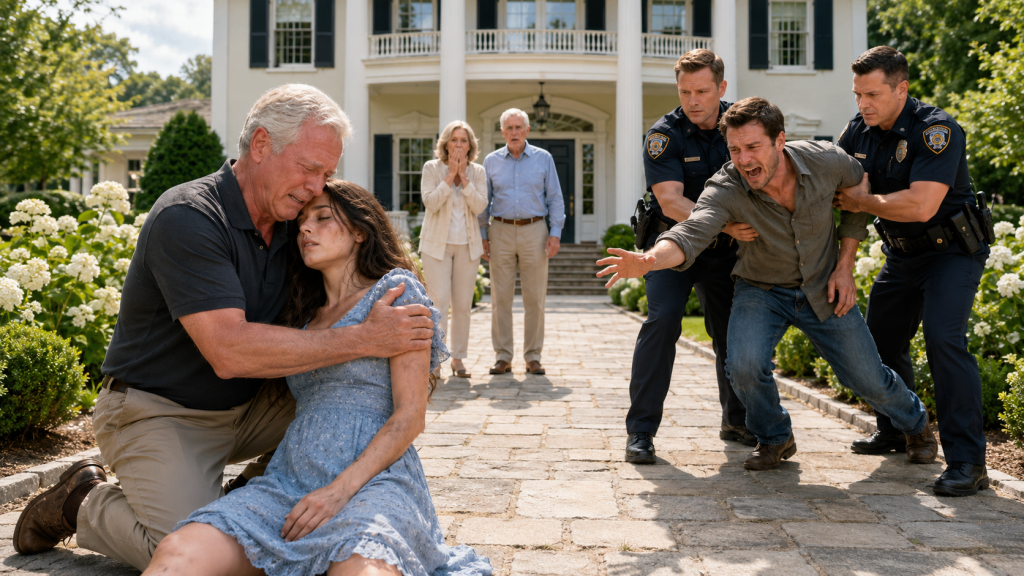
Rain tapped against the kitchen window.
I saw Audrey’s name and smiled automatically.
Then I answered.
“Hey, sweetheart.”
For two seconds, there was nothing.
Just breathing.
Fast.
Shallow.
Terrified.
“Audrey?”
Something scraped across the other end.
Then her voice came through.
So quiet I almost missed it.
“Dad…”
I stood immediately.
“What happened?”
“Dad, help.”
A man shouted somewhere behind her.
Then Audrey gasped.
There was a crash.
The phone struck something hard.
And my daughter screamed.
“Audrey!”
The connection didn’t end.
That was worse.
I could hear movement.
A door slammed.
Someone cursed.
Another voice said something I couldn’t understand.
Then silence.
“Audrey!”
Nothing.
“Audrey, answer me.”
I was already reaching for my coat.
Then I heard three faint taps through the phone.
Knock.
Knock.
Knock.
Every hair on my arms rose.
Because Audrey and I had a signal.
An old one.
She had been nine when her mother first became seriously ill.
Hospitals became part of our lives that year.
Waiting rooms.
Tests.
Whispered conversations adults thought children couldn’t hear.
One night Audrey crawled into my bed because she’d overheard a doctor use the word “dangerous.”
She wouldn’t speak.
She just lay beside me trembling.
So I taught her something simple.
“If you’re ever scared and you can’t talk,” I told her, “knock three times.”
She had frowned at me.
“Why three?”
“Because one could be an accident. Two could be anything. But three means you’re talking to me.”
“What does it mean?”
I touched her nose.
“It means, Dad, I’m here.”
Years later, after her mother died, Audrey changed the meaning slightly.
Three knocks meant yes.
Three meant danger.
Three meant—
Dad, I’m still here.
I heard them through the phone that night.
Three knocks.
Then nothing.
I grabbed my keys.
Audrey lived twenty-seven minutes away.
I made it in seventeen.
I don’t remember most of the drive.
I remember rain.
I remember the windshield wipers moving too slowly.
I remember calling her three times and getting no answer.
I remember calling Daniel Mercer.
Daniel had worked beside me for almost eight years in the attorney general’s office before I retired.
He knew things about my past Audrey didn’t.
Things Julian certainly didn’t.
And he knew that when I called at night and said only, “Something’s wrong,” I wasn’t being dramatic.
“What happened?” he asked.
“My daughter called me from Thorne House.”
Silence.
Then his voice changed.
“Arthur Thorne’s house?”
“Yes.”
“What did she say?”
“Dad, help.”
That was all Daniel needed.
“I’m coming.”
“No.”
“David—”
“Listen to me. Don’t enter the property unless I tell you.”
“You’re going alone?”
“I’m already almost there.”
“That is a very bad idea.”
“I know.”
“Then turn around.”
“No.”
He sighed.
Somewhere beneath the sound of my tires on wet pavement, I heard him moving.
Keys.
A door.
“Send me your location.”
“I already did.”
“Keep your phone recording.”
“It is.”
“And David?”
“What?”
“If you lose contact, I’m not waiting for permission.”
I tightened my grip on the steering wheel.
“Understood.”
Thorne House appeared beyond the trees like something the storm had uncovered.
Three stories of dark stone.
Tall windows.
Black roof.
Two enormous columns framing the entrance.
The first time I’d seen it had been at Audrey and Julian’s wedding reception.
Back then the place had been covered in white flowers and gold lights.
Music had spilled through the open doors.
People had laughed beneath chandeliers.
Audrey had danced with me in the foyer.
I remembered telling her how beautiful she looked.
I remembered her laying her head against my chest.
“I’m happy, Dad.”
I had believed her.
God help me, I had believed her.
Tonight there were no flowers.
No music.
No laughter.
Just rain sliding down the windows.
I parked crookedly near the steps.
Before I reached the front door, it opened.
Julian stood there.
My son-in-law was wearing a gray shirt with one sleeve partly rolled up.
His hair was wet.
His breathing was too fast.
And in his right hand he held a baseball bat.
Behind him stood his father, Arthur Thorne.
Arthur looked exactly as he always looked.
Expensive.
Controlled.
Untouchable.
He wore dark trousers, a pressed white shirt, and held a bourbon glass as though my appearance were nothing more than an inconvenience interrupting his evening.
A woman stood beside him.
Miriam.
At least, I thought she was Miriam.
I had met Julian’s mother only a handful of times.
She had always been private.
Arthur often explained her absence by saying her health made public events difficult.
Tonight she wore a long dark dress.
Her hands were folded neatly over her waist.
Her expression was calm.
Almost bored.
As if she had watched this scene happen before.
As if she already knew how it ended.
I stopped at the bottom of the steps.
“Where is she?”
Julian’s jaw tightened.
“Go home.”
I stared at him.
“What did you say?”
“Go home, David.”
My eyes dropped to the bat.
Then back to his face.
“My daughter called me screaming.”
“She’s upset.”
“Then I’ll talk to her.”
“No.”
That single word changed everything.
I climbed one step.
Julian lowered the bat.
“Don’t.”
“Where is Audrey?”
“She doesn’t want to see you.”
I almost laughed.
“She called me seventeen minutes ago and said, ‘Dad, help.’”
Arthur took a slow sip of bourbon.
“You are creating a scene.”
I looked at him.
“There isn’t anyone here to see it.”
His mouth tightened.
Good.
He didn’t like that.
I climbed another step.
“Audrey!”
No answer.
“Audrey, it’s Dad!”
Julian glanced back toward the hall.
It was quick.
Barely half a second.
But I saw it.
Then a sound came from somewhere inside the mansion.
Not a scream.
Not a voice.
Three faint knocks.
Knock.
Knock.
Knock.
My stomach dropped.
Julian’s face changed.
Only slightly.
But enough.
I looked him directly in the eyes.
“You heard that.”
He forced a shrug.
“Old house.”
“Old houses don’t know our signal.”
Miriam’s eyes flickered.
Arthur stopped drinking.
I stepped closer.
“Audrey!”
Three more knocks.
Fainter this time.
My heart began pounding hard enough to hurt.
I pointed at Julian.
“Move.”
He didn’t.
Miriam finally spoke.
“Mr. Vale, you should leave.”
There was something strange about her voice.
Familiar.
Not enough for me to place it.
But enough to make me look at her twice.
“Your son is blocking me from my daughter with a baseball bat.”
“She is not in danger,” she said.
“Then let me see her.”
“No.”
Clean.
Immediate.
That was when I knew.
Whatever was happening inside Thorne House, they were terrified of me seeing it.
I slipped my phone into my coat pocket.
The recorder was still running.
My thumb found the screen.
Two presses.
A signal to Daniel.
Hold position.
Document everything.
Be ready.
Daniel would understand.
We had spent too many years communicating without words for him not to.
Julian tightened his grip on the bat.
I studied him more carefully.
His right knuckles were swollen.
There was dried blood beneath his thumbnail.
A cut ran along his cheek.
And when the porch light flickered, I saw a thin red mark around his wrist.
Like rope.
Or a plastic restraint.
That didn’t fit.
If Julian had attacked Audrey, why did he look as though someone had restrained him too?
I shifted my attention to Arthur.
His bourbon glass trembled.
Just once.
Very slightly.
But Arthur Thorne was not a man whose hands trembled.
Interesting.
“Where is Mrs. Bell?”
Julian frowned.
“What?”
“Your housekeeper.”
Miriam’s head turned sharply.
Arthur answered before Julian could.
“She resigned.”
“Tonight?”
“She left.”
“Why?”
“That is none of your concern.”
“It became my concern when my daughter called me from this house screaming.”
Arthur’s eyes hardened.
“She became a Thorne when she married my son.”
The words hit something cold inside me.
“No,” I said.
Arthur lifted an eyebrow.
“No?”
“She became Julian’s wife.”
I climbed another step.
“She never stopped being my daughter.”
Arthur smiled.
There was no warmth in it.
“You always were sentimental.”
My breathing slowed.
That sentence bothered me.
Not because of what he said.
Because of how he said it.
As if he had known me longer than Audrey and Julian’s marriage.
As if he knew things about me.
I took out my phone.
“I’ve already contacted the police.”
That wasn’t entirely true.
But it wasn’t entirely false.
Daniel was coming.
And Daniel had friends.
Arthur’s eyes moved toward the phone.
Julian looked at Arthur.
Miriam looked toward the second floor.
Then I saw it.
A pale hand pressed against an upstairs window.
Five fingers against the glass.
The hand disappeared.
“Audrey!”
A faint voice answered.
“Dad…”
Every thought in my head stopped.
She was alive.
Barely audible.
But alive.
“I’m coming!”
I moved.
Julian swung the bat.
There are moments when the body decides before the mind does.
My military training was decades behind me.
Most days I felt every year of my age when I stood too quickly or climbed too many stairs.
But fear does strange things to memory.
And nothing in this world makes a father remember what his body is capable of faster than someone trying to stand between him and his child.
I stepped inside Julian’s swing.
Caught his wrist.
Turned.
The bat struck the porch railing instead of my skull.
Wood cracked.
Julian cursed.
I drove my shoulder into his chest.
He stumbled.
The bat clattered onto the marble.
Arthur shouted.
Miriam screamed.
But not in fear.
“Stop!”
Julian came at me again.
I caught his shirt and drove him against one of the columns.
His head struck stone.
Not hard enough to knock him unconscious.
Hard enough to stop him.
I leaned close.
“Where is my daughter?”
His eyes opened.
For the first time that night, the arrogance was gone.
There was fear.
But not fear of me.
His gaze slid over my shoulder.
Toward the darkness behind me.
“You don’t understand,” he whispered.
“What?”
“You think I’m the monster.”
Arthur stepped forward.
“Julian.”
Julian ignored him.
“You have no idea what she brought into this house.”
My blood went cold.
“What did Audrey bring?”
“Julian!”
Arthur’s voice cracked like a whip.
Julian closed his eyes.
Then looked at me.
“Ask her.”
A crash came from upstairs.
Glass shattered.
Audrey screamed.
I released Julian and ran.
Nobody stopped me.
The mansion swallowed me whole.
The first thing I noticed was the smell.
Bleach.
Disinfectant.
Something chemical.
Too strong.
The foyer looked almost exactly as I remembered it from the wedding, yet completely different.
Same marble floor.
Same enormous staircase.
Same paintings of dead Thornes staring down from gilded frames.
But the house felt stripped of life.
Only one lamp was burning.
The chandelier was dark.
Rainwater ran from my coat and marked the marble behind me.
“Audrey!”
“Dad!”
Her scream came from above.
I took the stairs two at a time.
Halfway up, someone grabbed the back of my coat.
I turned ready to strike.
Julian.
Blood ran from a cut near his hairline.
“Don’t go up there.”
I shoved him away.
“Get away from me.”
“You don’t understand.”
“My daughter is screaming.”
“I know!”
Something in his voice stopped me.
Not authority.
Desperation.
I grabbed his shirt.
“Then tell me what I’m walking into.”
His eyes moved toward the second floor.
“Because that’s what they want.”
“Who?”
He said nothing.
“Who, Julian?”
His jaw worked.
“My father…”
He stopped.
Then shook his head.
“No. It’s bigger than him.”
A door slammed upstairs.
Audrey began crying.
Quietly.
That sound was worse than the screaming.
Screaming meant strength.
Crying like that meant exhaustion.
I released Julian and climbed the remaining stairs.
The hallway was darker than I remembered.
Six doors.
I stopped.
At the wedding, there had been five.
I was certain.
Five white doors.
Tonight there was a sixth at the far end.
Narrow.
Black.
No handle.
No visible lock.
“Audrey?”
“Dad.”
Her voice came from behind it.
I moved quickly.
“I’m here.”
“Don’t open it.”
I froze.
“What?”
“Please.”
Her voice shook.
“Don’t open anything until you listen to me.”
I stepped closer.
There was a small ventilation grille high in the wall.
“Are you hurt?”
Silence.
“Audrey?”
“Yes.”
My heart squeezed.
“How badly?”
“I don’t know.”
“Who hurt you?”
Another silence.
Then:
“Dad, I need you to promise me something.”
“Anything.”
“Don’t trust Julian.”
I looked behind me.
He was no longer on the stairs.
“Okay.”
“And don’t trust Arthur.”
“That won’t be difficult.”
Despite everything, Audrey gave one broken little breath that almost sounded like a laugh.
Then her voice changed.
“And Dad…”
“What?”
“Don’t let Mom come here.”
I stared at the door.
For several seconds I genuinely wondered whether I had heard her incorrectly.
“What did you say?”
“Don’t let Mom come downstairs.”
My mouth went dry.
“Audrey.”
No answer.
“Audrey, your mother has been dead for six years.”
Silence.
Then laughter came through the vent.
A man.
Low.
Soft.
Close.
I stepped back.
“Audrey?”
Nothing.
Footsteps moved behind the wall.
Then a voice whispered through the grille.
“Hello, David.”
My entire body went cold.
I knew that voice.
Or thought I did.
A warehouse rose out of my memory.
Cold concrete.
Buzzing fluorescent lights.
Eleven years earlier.
A frightened informant.
A missing evidence box.
A case that had nearly destroyed half the attorney general’s office before it mysteriously collapsed.
A man who had vanished three days before he was supposed to testify.
A name I had forced myself not to think about for more than a decade.
“Elias Voss.”
The man behind the wall laughed.
“So you do remember.”
I moved closer.
“Where is Audrey?”
“She’s close.”
“If you hurt her—”
“I didn’t.”
“Open this door.”
“You still give orders like somebody is listening.”
My hands tightened.
“Open it.”
“You came faster than I expected.”
I looked toward the staircase.
“What do you want?”
“You.”
“Then let Audrey go.”
A pause.
Then Elias said something that turned my blood to ice.
“She was bait.”
“No.”
“She knew you would come.”
My thoughts raced.
Audrey’s emergency app.
The automatic recording.
The secure upload.
I pulled out my phone.
The recording light still glowed.
Then another notification appeared.
One I had never seen before.
EVIDENCE SERVER CONNECTION COMPROMISED.
I stared at the words.
The emergency system wasn’t a normal phone app.
Daniel and I had built it years earlier after Audrey moved away for college.
If she triggered it, the phone began recording and automatically sent an encrypted copy to a remote server.
Very few people knew it existed.
Daniel.
Me.
Audrey.
And my wife, before she died.
Someone had known.
Someone had been waiting.
I looked down the hall.
Julian stood at the staircase.
Arthur was behind him.
Miriam had disappeared.
Julian stared at the warning on my screen.
“You understand now?”
“No.”
His face looked exhausted.
“You will.”
A click sounded beside me.
Part of the wall moved.
I stepped back.
A narrow section swung inward, revealing a staircase descending into blackness.
Cold air rose through the opening.
Along with the same sharp chemical smell.
Then I heard a woman’s voice from somewhere below.
Weak.
Terrified.
“David?”
My knees almost failed.
No.
Impossible.
I knew that voice.
I had heard it beside me in bed for twenty-three years.
I had heard it laugh across our kitchen.
I had heard it whisper my name the morning Audrey was born.
I had heard it become weaker in the months before death stole it from me.
For six years, I had heard that voice only in dreams.
My wife.
“David?”
I stepped toward the hidden staircase.
My hand trembled.
Behind me, Julian whispered:
“Now you know why Audrey called you.”
I turned.
“What is down there?”
He looked at the darkness.
His face had gone completely pale.
“Everything your family has been hiding from you.”
The lights went out.
Total darkness.
For one second, nobody moved.
Then Audrey screamed.
“DAD, RUN!”
Something heavy began climbing the hidden stairs.
One step.
Then another.
I reached inside my coat.
My fingers found the emergency flashlight I carried out of habit.
The beam came alive.
It shook in my hand.
The stairs were empty for perhaps ten feet.
Then a shadow appeared.
Shoes first.
Black trousers.
A dark coat.
A man climbed slowly toward me.
He was older than the photograph in my memory.
His hair had gone almost completely gray.
His face was thinner.
There were deep lines around his mouth.
But the eyes were the same.
Cold.
Patient.
Intelligent.
Elias Voss reached the top step and stopped.
“Hello, David.”
I stared at a dead man.
“You’re alive.”
He almost smiled.
“So people keep telling me.”
I stepped toward him.
“What have you done to my daughter?”
“Nothing.”
“She’s bleeding.”
“She was hurt before I reached her.”
“Open the door.”
“Not yet.”
I grabbed his coat.
Eleven years of questions exploded inside me.
“Open it.”
Elias didn’t resist.
Instead, he looked past me.
“Your anger has always been your worst weakness.”
“My daughter is locked in a room.”
“And your love for her has always been your greatest one.”
I shoved him back.
“I am not interested in riddles.”
“Then you came to the wrong house.”
Behind me, Julian whispered:
“Tell him.”
Elias looked at him.
Arthur had disappeared.
That frightened me more than if he had stayed.
“Tell me what?”
Elias studied my face.
“You spent years investigating corruption,” he said. “Judges. Police officers. Contractors. Politicians. Shell corporations. Offshore accounts.”
I said nothing.
“You came closer than anyone else.”
“That investigation ended.”
“No.”
His eyes hardened.
“It was killed.”
Old memories returned with painful clarity.
Witnesses changing statements.
Documents disappearing.
Search warrants delayed just long enough for offices to be emptied.
Bank accounts closing hours before we froze them.
Informants vanishing.
My own supervisors asking me to “reconsider priorities.”
And Elias Voss.
The one witness who had claimed he could prove everything.
He was supposed to testify.
Then his car was discovered abandoned beside a river.
Blood on the driver’s seat.
No body.
Everyone assumed he had been murdered.
I hadn’t.
Not at first.
I searched for him for months.
Then my wife got sick.
Then she died.
And whatever remained of David Vale the investigator died with her.
I looked at Elias.
“You disappeared.”
“I had to.”
“You let me think you were dead.”
“I needed them to think I was dead.”
“Who?”
His eyes moved toward the staircase.
“Arthur Thorne, for one.”
My jaw tightened.
Julian looked away.
Elias continued.
“Your office was compromised. Your police task force was compromised. People you trusted were feeding Arthur information.”
“Arthur was part of the network?”
Elias gave me a tired smile.
“Part of it?”
He shook his head.
“Arthur financed half of it.”
The hallway suddenly seemed smaller.
I remembered Arthur’s words on the porch.
You always were sentimental.
As if he’d known me.
“Why didn’t I find his name?”
“Because Arthur never used his name.”
Elias stepped toward me.
“You were tracing companies. Payments. Construction contracts. Judicial favors. Evidence-room thefts. But Arthur understood something the others didn’t.”
“What?”
“The safest criminal is the man who never touches the crime.”
A sound came from behind Audrey’s door.
“Dad?”
I turned immediately.
“I’m here.”
“Please hurry.”
I looked back at Elias.
“If you want me to listen, open that door.”
Elias nodded toward the hidden panel.
“There’s a release under the molding.”
I found it.
Pressed.
A metallic click sounded.
I pulled the black door open.
Audrey sat on the floor.
For a moment, I forgot every other person in the house.
I forgot Elias.
Forgot Julian.
Forgot Arthur.
Forgot the investigation.
My daughter was alive.
That was all that existed.
“Audrey.”
I dropped beside her.
She threw herself into my arms.
I held her so tightly I felt her heartbeat against my chest.
She smelled like sweat and dust and the lavender shampoo she had used since college.
There was a shallow cut at her temple.
Her wrists were bruised.
One ankle was swollen.
But she was breathing.
She was alive.
I pressed my face into her hair.
“You scared ten years off my life.”
She laughed once.
Then broke.
Her body shook against me.
“I thought you weren’t going to hear me.”
“I heard you.”
“I couldn’t reach the phone.”
“You knocked.”
“I didn’t know if the microphone would pick it up.”
“I heard every one.”
She pulled back.
Tears streaked her face.
“I knew you would.”
I touched the cut near her temple.
“Who did this?”
Her expression changed.
She glanced toward Julian.
He stood several feet away.
His eyes were red.
Then she looked at Elias.
Then toward the hidden staircase.
“Arthur.”
Julian closed his eyes.
Something inside me went very still.
“Your father-in-law did this?”
Audrey swallowed.
“He didn’t hit me.”
Her voice trembled.
“He had someone grab me when I tried to leave. I fought. I hit the wall.”
I stood.
“Where is he?”
“Dad.”
“Where is Arthur?”
Audrey grabbed my sleeve.
“Please listen first.”
“I’m listening.”
“No. You’re getting angry.”
“I am far beyond angry.”
“That’s what he wants.”
Those words stopped me.
She held my wrist.
“Please.”
I forced myself back down beside her.
“What happened?”
Audrey looked at Julian.
“Tell him.”
Julian took a breath.
“I’ve known something was wrong with my father for years.”
“That’s not an answer.”
“I know.”
He looked like a man standing at his own execution.
“My mother found documents three years ago.”
“Miriam?”
His face twisted.
“My mother died three years ago.”
I looked toward the empty hallway.
The woman from the porch.
“No.”
Julian nodded.
“Yes.”
“I saw her tonight.”
“That wasn’t Miriam.”
I rose slowly.
“Then who was she?”
A voice behind me answered.
“Me.”
The woman stepped out of the hidden passage.
She had removed the dark wig.
Without it, silver-streaked brown hair fell around her shoulders.
She wiped makeup from one cheek.
The transformation was subtle.
But as I stared at her, something in my mind shifted.
A photograph.
My wife’s old album.
Two girls standing near a lake.
One was the woman I would later marry.
The other had been identified only as Clara.
Her estranged older sister.
Clara had supposedly died before Audrey was born.
I looked at the woman standing before me.
“No.”
Her eyes filled.
“I wondered whether you would recognize me.”
My mouth went dry.
“Clara?”
She nodded.
I stepped backward.
“You’re dead.”
“So was Elias.”
“That isn’t funny.”
“No.”
Her face softened.
“It isn’t.”
Audrey stood carefully.
“I found her six months ago.”
I turned.
“What?”
“In Mom’s things.”
“Your mother’s things have been in storage for years.”
“I know.”
Audrey looked ashamed.
“I finally started going through them.”
I understood immediately.
After her mother died, neither of us could do it.
Boxes had been packed.
Labeled.
Put away.
Not because we didn’t care.
Because we cared too much.
Audrey continued.
“There was a sewing box.”
I remembered it.
Small.
Wooden.
Her mother had used it to repair everything from Audrey’s school uniforms to my shirts.
“There was a false bottom.”
My chest tightened.
“Inside it, I found letters.”
“From Clara?”
She nodded.
“And a key.”
“To what?”
“A bank box.”
Elias answered.
“The ledger.”
I looked at him.
“What ledger?”
“The proof you spent twelve years looking for.”
Audrey reached beneath her blouse and removed a thin chain.
Hanging from it was a small metal drive.
She placed it in my palm.
It weighed almost nothing.
Yet somehow it felt heavier than anything I had ever held.
“This?”
“A copy,” Audrey said.
“Of what?”
“Accounts. Payments. Names. Dates. Medical records. Photographs. Recorded conversations.”
She swallowed.
“And Mom’s notes.”
I looked at her.
“Mom’s?”
Audrey nodded.
“Dad, Mom knew.”
My chest tightened.
“Knew what?”
“About Arthur.”
I couldn’t breathe properly.
Elias spoke quietly.
“Your wife discovered what we couldn’t prove.”
I stared at him.
“You knew my wife.”
“Yes.”
“How?”
“She found me.”
The answer made no sense.
“When?”
“After I disappeared.”
“No.”
“David—”
“My wife was sick.”
“Not then.”
Elias shook his head.
“That came later.”
The hallway blurred around me.
I remembered the package.
A photograph delivered to our house eleven years ago.
Elias standing beside Arthur Thorne and two other people.
My wife had opened it before I came home.
When I walked into the kitchen, she had been sitting at the table staring at it.
She had gone pale.
I asked what was wrong.
She said nothing.
Two weeks later she collapsed.
Doctors called it an aneurysm.
I had spent six years trying to believe them.
I stared at Elias.
“You were there the night my wife died.”
His expression changed.
“Yes.”
The word barely came out.
My hands began shaking.
“What happened?”
Elias looked at Clara.
Clara closed her eyes.
Then she spoke.
“Your wife was murdered.”
Sometimes grief doesn’t arrive like pain.
Sometimes it arrives as silence.
The kind that empties the world.
I heard Audrey gasp.
I saw Julian lower his head.
I saw Clara crying.
But everything seemed impossibly far away.
“No.”
Clara stepped toward me.
“David.”
“No.”
“I’m sorry.”
“You don’t get to say that.”
My voice broke.
“You don’t get to stand in front of me after six years and say you’re sorry.”
She stopped.
I looked at Elias.
“They said aneurysm.”
“It was made to look like one.”
“How?”
“We don’t know everything yet.”
“Then how can you tell me she was murdered?”
Audrey reached for me.
I stepped away.
“How?”
Clara wiped her face.
“Because she knew someone had poisoned her.”
I stared at her.
“She knew?”
“She called me.”
The words cut deeper than anything else.
“She called you?”
Clara nodded.
“Not me?”
“I was the one who could disappear.”
“She called you and not me?”
“David, she was trying to protect you.”
I laughed.
It sounded ugly.
“Protect me?”
“Yes.”
“She died without telling me she was dying, and you call that protecting me?”
Clara’s face crumpled.
“She believed your office was compromised. She believed somebody close to you was reporting every move you made.”
I looked at Elias.
He nodded.
“We later confirmed it.”
I thought of Daniel.
A dozen prosecutors.
Investigators.
People who had eaten at my house.
People Audrey had called uncle.
“Who?”
“Several people,” Elias said. “Some are dead now. Some are still alive.”
Clara stepped closer.
“Your wife knew if she told you everything, you would do exactly what you’re doing tonight.”
“What?”
“Walk straight toward the danger.”
I looked at Audrey.
Her eyes were full of tears.
Clara continued.
“She knew you would never stop.”
My voice dropped.
“She was right.”
“Yes.”
Clara almost smiled through her tears.
“She usually was.”
For one terrible second, I heard my wife laugh in my memory.
Then I understood the voice from below.
The one that had called my name.
I looked at Clara.
“That was you.”
She nodded.
“The voice.”
“Yes.”
“You sound like her.”
Clara’s expression broke.
“We always did.”
I turned away.
For six years I had begged for one more chance to hear my wife say my name.
Tonight the sound had come out of darkness.
And it had belonged to her sister.
I didn’t know whether to feel relieved or destroyed.
Audrey wrapped both arms around herself.
“Dad, there’s more.”
Of course there was.
There was always more.
“What?”
She looked toward Julian.
He spoke quietly.
“My father killed my mother too.”
I stared at him.
“Miriam discovered his private accounts.”
Julian’s mouth trembled.
“She confronted him.”
“What happened?”
“He told everyone she was ill.”
Julian looked at the floor.
“She disappeared two weeks later.”
“Disappeared?”
“I believed she went to a treatment center.”
His eyes filled.
“For almost a year, that’s what he told me.”
Audrey took his hand.
It surprised me.
After everything, she still reached for him.
Julian continued.
“I found her death certificate eighteen months ago.”
My stomach turned.
“Cause?”
“Accident.”
He laughed bitterly.
“She supposedly drove her car into a ravine in another state.”
“But?”
“There was no car.”
Silence.
“No body.”
I stared at Arthur Thorne’s son and finally understood the fear I had seen in his eyes.
Not fear of me.
Fear of his father.
“Why the bat?”
Julian looked directly at me.
“Because he told me if you entered the house, Audrey would die.”
Audrey closed her eyes.
“He had cameras everywhere,” Julian said. “He told me to stand outside. He told me exactly what to say.”
“You swung at me.”
“I know.”
“You could have killed me.”
“I know.”
His voice cracked.
“I aimed for the railing.”
I remembered the angle.
The hesitation before the swing.
The way Julian had moved just slightly too wide.
At the time, I had thought I was faster.
Maybe he had never intended to hit me.
Maybe.
That didn’t make everything disappear.
But it changed the shape of it.
“Why didn’t you tell me?”
“Because I didn’t know who was listening.”
Julian held up his wrist.
The red mark.
“My father restrained me downstairs when I tried to get Audrey out.”
Audrey looked at me.
“Julian fought him.”
“Then why did you tell me not to trust him?”
“Because I didn’t know what he would choose.”
Julian flinched.
Audrey’s voice softened.
“I love him.”
She looked at her husband.
“But tonight I didn’t know whether he would choose me or spend the rest of his life being afraid of his father.”
That hurt Julian more than anything I could have said.
He nodded slowly.
“You were right.”
“No,” Audrey whispered. “I wish I wasn’t.”
A floorboard creaked behind us.
Elias turned first.
Arthur stood at the other end of the hallway.
His bourbon was gone.
A pistol hung beside his leg.
Everything in his face had changed.
The civilized mask had disappeared.
“Touching,” he said.
Julian moved in front of Audrey.
Arthur almost looked amused.
“Move.”
“No.”
“Julian.”
“No.”
Arthur raised the weapon.
I moved slightly toward Audrey.
Elias watched Arthur’s hand.
Clara froze.
Arthur looked at me.
“I should have dealt with you twelve years ago.”
My voice was steady.
“You dealt with my wife instead.”
For the first time, something like irritation crossed his face.
“She made herself a problem.”
Audrey made a broken sound.
I saw red.
Not metaphorically.
My vision actually narrowed.
Elias touched my arm.
“Don’t.”
Arthur smiled.
“There he is.”
I looked at him.
“The famous temper.”
He knew.
He had studied me.
Probably for years.
Arthur continued.
“Your wife was smarter.”
“Don’t say another word about her.”
“She understood risk.”
“She understood you were a murderer.”
“Such an ugly word.”
Julian stared at his father.
“You killed Mom.”
Arthur looked at him almost sadly.
“Your mother was weak.”
Julian’s fists tightened.
“She loved you.”
“She feared me.”
Arthur shrugged.
“People often confuse the two.”
Audrey stepped forward.
“You are sick.”
Arthur pointed the gun at her.
I moved in front of my daughter.
He laughed.
“Of course.”
“What do you want?” I asked.
“The drive.”
“No.”
“It belongs to me.”
Audrey’s voice hardened behind me.
“You mean the evidence belongs to you?”
Arthur’s eyes moved toward her.
“You should have left things buried.”
“You killed my mother.”
“She was already dying.”
The words detonated inside the hallway.
Audrey inhaled sharply.
My hands shook.
Arthur continued.
“We merely accelerated an inevitable outcome.”
Julian whispered:
“God.”
I stepped forward.
Elias grabbed my shoulder.
Arthur raised the pistol.
“There.”
His eyes brightened.
“That is exactly why you never beat us, David.”
“Because I care?”
“Because you react.”
He smiled.
“Men like me plan.”
I stared at him.
Then suddenly I smiled too.
Arthur’s expression changed.
“What?”
“You think I came alone.”
His eyes narrowed.
I continued.
“You’ve been watching me since I entered the property.”
“Yes.”
“You compromised the evidence server.”
“Yes.”
“You shut down my phone’s connection.”
He said nothing.
“But there’s something you never understood about me.”
Arthur’s smile faded.
“I stopped trusting single systems twelve years ago.”
Elias looked at me.
So did Audrey.
I tapped the phone inside my coat.
“The server you compromised was the visible one.”
Arthur’s face changed.
Only slightly.
But I saw it.
“Audrey’s emergency app mirrors every file.”
I was bluffing about one part.
Daniel and I had discussed building the mirror.
I had no idea whether he had ever finished it.
But Arthur didn’t know that.
“Two locations,” I said.
Arthur’s jaw tightened.
“And when one is touched, Daniel gets an alarm.”
Silence.
Then, faintly, far beyond the walls—
sirens.
Audrey began crying.
Arthur’s face emptied.
Julian looked toward the windows.
Elias smiled.
“Well, David.”
He glanced at me.
“Apparently you still have a few tricks.”
Arthur swung the gun toward Julian.
“If I go down, you all go with me.”
“Dad.”
Julian raised both hands.
“It’s over.”
“Move.”
“No.”
“I will shoot you.”
Julian swallowed.
Then he did something I will remember for the rest of my life.
He stepped closer to his father.
“No.”
Arthur’s hand trembled.
“You ungrateful little—”
“My whole life, I thought being your son meant becoming strong enough that you’d finally respect me.”
Julian’s voice shook.
“I copied you.”
Another step.
“I lied for you.”
Another.
“I let you convince me fear was loyalty.”
“Julian.”
“I let Audrey become afraid of me because I was too afraid of you.”
Audrey began sobbing silently.
Julian looked back at her.
“I’m sorry.”
Arthur raised the gun higher.
“Stop.”
Julian faced him again.
“You killed my mother.”
Arthur’s finger tightened.
“You tried to kill my wife.”
Another step.
“You murdered David’s wife.”
“Move!”
“No.”
The gunshot exploded through the hallway.
Julian spun.
Audrey screamed.
“JULIAN!”
He hit the floor.
I grabbed Audrey and pulled her behind the wall.
A second shot cracked.
Wood exploded near my head.
Elias rushed Arthur.
Clara dropped.
Julian groaned.
Arthur tried to fire again.
Elias hit his wrist.
The pistol flew across the marble.
Arthur drove a fist into Elias’s face.
Elias fell against the wall.
I moved.
Arthur saw me coming.
He reached for the gun.
I reached him first.
I hit him.
Once.
Twenty-three years of marriage.
I hit him again.
Six years of grief.
Again.
Every night wondering whether I had missed something.
Again.
Every morning waking to the empty half of my bed.
Arthur fell.
I grabbed his shirt.
“You poisoned her.”
He smiled through blood.
That smile nearly made me kill him.
I pulled back my fist.
Then Audrey screamed:
“Dad!”
Not fear.
A plea.
I looked at her.
She was kneeling beside Julian.
Her face was wet with tears.
“Don’t.”
That single word reached me where nothing else could.
Don’t.
I looked down at Arthur.
He wanted me to do it.
He wanted my anger.
He wanted the final act of my wife’s story to be me becoming exactly what he believed I was.
I released him.
Arthur collapsed onto the floor.
“No.”
I stood over him.
“You don’t get to die tonight.”
His smile vanished.
“You’re going to live.”
Sirens screamed outside.
“You’re going to sit in a courtroom.”
Red and blue light flashed across the windows.
“You’re going to hear every name.”
Boots thundered downstairs.
“Every account.”
Arthur tried to rise.
I kicked the pistol farther away.
“Every person you hurt.”
Voices shouted.
“STATE POLICE!”
I looked down at him.
“And when they say my wife’s name, you are going to be alive to hear it.”
Arthur stared at me.
For the first time that night, I saw fear.
Real fear.
Not of prison.
Not even of exposure.
Of losing control.
Daniel reached the hallway first.
He looked older than I remembered from thirty minutes earlier.
Two state troopers were behind him.
His eyes found me.
Then Audrey.
Then Julian bleeding on the floor.
Then Arthur.
“David?”
“I’m okay.”
He exhaled.
“Your definition of okay remains deeply concerning.”
Despite everything, I almost laughed.
Audrey cried harder.
Daniel rushed to Julian and called for the paramedics.
More officers flooded the house.
Arthur Thorne was handcuffed on the same marble floor where he had spent decades believing himself untouchable.
Elias Voss raised his hands and surrendered without resistance.
Clara did the same.
Audrey sat with me while paramedics treated the cut on her temple.
Julian’s bullet wound turned out to be a graze across the upper shoulder.
Painful.
Bloody.
But survivable.
When they lifted him onto the stretcher, he reached for Audrey.
She took his hand.
He whispered:
“I’m sorry.”
Audrey leaned down.
“I know.”
“Are you coming?”
She closed her eyes.
For several seconds she said nothing.
Then:
“I’ll meet you at the hospital.”
Hope entered his face.
Audrey stopped him.
“That doesn’t mean everything is okay.”
His eyes dropped.
“I know.”
“I love you.”
He nodded.
“But I don’t know whether that’s enough anymore.”
Julian began crying.
So did she.
There are some moments when a father wants to fix everything.
I wanted to tell Audrey what to do.
Leave him.
Forgive him.
Don’t forgive him.
Protect yourself.
Save your marriage.
Forget the marriage.
I wanted a clean answer.
But life rarely gives those.
So I did the only thing I could.
I stood beside my daughter while she made her own choice.
After Julian was taken downstairs, Daniel approached.
“You want the good news or the very strange news?”
“Strange.”
“The backup worked.”
I stared at him.
“You built it?”
He frowned.
“Of course I built it.”
“You never told me.”
“You told me twelve years ago never to trust a system that announces all of its defenses.”
I looked at Arthur being walked toward the stairs.
“You remembered.”
“I remember almost everything you yell at me.”
Audrey laughed weakly.
It was the first real laugh I had heard from her all night.
Daniel smiled.
Then his expression became serious.
“There’s more.”
“What?”
“The server intrusion gave us an origin point.”
Arthur stopped walking.
Just for a fraction of a second.
Daniel noticed too.
“Someone accessed it from inside this property.”
Arthur said nothing.
Daniel continued.
“And the mirror captured every file they opened while doing it.”
Elias gave a low whistle.
Arthur’s face went gray.
Daniel looked at me.
“What exactly is on Audrey’s drive?”
I opened my palm.
The small metal device was still there.
“I think we are about to find out.”
The next eighteen hours passed in fragments.
Hospital corridors.
Police statements.
Coffee that tasted like burnt water.
Questions.
Names.
Evidence bags.
Audrey had twelve stitches near her hairline and a badly sprained ankle.
Julian had surgery to clean the wound in his shoulder but was expected to recover.
Clara was questioned for six hours.
Elias was questioned for nine.
Arthur asked for an attorney and said almost nothing.
Mrs. Bell, the housekeeper, was found before dawn at her sister’s apartment.
She had not resigned.
Arthur had ordered her away three days earlier after she accidentally overheard a conversation about Audrey.
Mrs. Bell had left a handwritten warning in Audrey’s bedroom.
That was how Audrey knew she had to move quickly.
By noon, investigators opened the drive.
I was not in the room.
Daniel wouldn’t allow it.
“You’re too close.”
“My wife’s name is in there.”
“That is exactly why you’re too close.”
I hated him for approximately ten minutes.
Then I understood.
Audrey and I sat together in a small hospital room.
She had fallen asleep with her head against my shoulder.
For the first time since the phone call, I had nothing to do.
No door to break down.
No man to fight.
No mystery I could solve with movement.
So grief caught me.
I stared at my daughter’s sleeping face.
And I thought about her mother.
I remembered meeting her.
I remembered the first apartment we rented.
I remembered Audrey coming home from the hospital wrapped in a yellow blanket.
I remembered standing in the kitchen at three in the morning with a crying baby while my wife laughed at me because I had somehow put the diaper on backward.
I remembered chemotherapy appointments.
Though we had been told later that the strange symptoms were unrelated.
I remembered pills.
Headaches.
Fatigue.
Doctors.
Fear.
I remembered holding my wife’s hand while she died.
And suddenly I understood.
If Arthur had poisoned her—
then I had spent six years grieving a lie.
A nurse entered quietly.
“Mr. Vale?”
I wiped my face.
“Yes?”
“There’s someone asking for you.”
Daniel stood outside.
One look at him told me something had changed.
“What?”
He handed me a folder.
“I think you should read this somewhere private.”
My hands went cold.
“What is it?”
“A transcription.”
“Of?”
“Your wife.”
I stopped breathing.
“She recorded something?”
Daniel nodded.
“It was on the drive.”
Audrey woke behind me.
“Dad?”
I looked at Daniel.
“Does she know?”
“Audrey found the file but never listened to it.”
Audrey pushed herself upright.
“I couldn’t.”
I sat beside her.
The folder shook in my hands.
Audrey placed her hand over mine.
“Read it.”
“I don’t know if I can.”
“Yes, you can.”
So I opened it.
The recording had been made six days before my wife died.
Her words were simple.
No dramatic confession.
No perfect goodbye.
That made it hurt more.
She said she had discovered evidence connecting Arthur Thorne to the network I had been investigating.
She said she had contacted Clara.
She said she believed someone had begun tampering with her medication.
She said she was afraid to tell me because people inside my own office were being paid.
Then came the part that destroyed me.
David will blame himself.
He always thinks loving someone means he should have been able to save them.
Please don’t let him do that.
I stopped reading.
Audrey squeezed my hand.
I continued.
Tell Audrey her father was the safest place I ever knew.
Tell her that when she is afraid, she should call him.
He will come.
He always comes.
The pages blurred.
Audrey broke first.
She covered her mouth and cried.
I stared at the final sentence.
He always comes.
I thought of three knocks.
Dad, I’m still here.
I bent forward.
For six years I had believed I failed my wife.
I should have noticed.
Should have asked more questions.
Should have reopened the investigation.
Should have challenged the autopsy.
Should have protected her.
Should have—
Audrey wrapped her arms around me.
“Dad.”
I couldn’t answer.
“She knew.”
My shoulders shook.
“She knew you would come.”
I held my daughter.
And for the first time since my wife died, I allowed myself to cry without hiding it.
Not quietly.
Not politely.
I cried like a man who had spent six years holding up a wall that finally collapsed.
Audrey cried with me.
Neither of us said anything.
We didn’t need to.
Three weeks later, the first arrests began.
Arthur Thorne’s empire fell faster than anyone expected.
That was the thing about structures built on fear.
They looked permanent until one person stopped being afraid.
Then another did.
Then another.
A former judge agreed to cooperate.
A retired detective turned over records.
Two accountants identified hidden companies.
A physician admitted falsifying medical information.
An attorney produced copies of trust documents Arthur thought had been destroyed.
And Elias Voss testified.
For eleven years, he had lived under false names.
Moving.
Waiting.
Collecting fragments of proof.
He had not returned to Thorne House to hurt Audrey.
He had returned because Clara contacted him after Audrey found the drive.
Arthur discovered their plan.
Then he turned everyone against everyone else.
He told Julian Elias had come to kill Audrey.
He told Audrey Julian had betrayed her.
He forced Clara to continue impersonating the reclusive Miriam long enough to lure me inside and confuse any eventual witnesses.
He had intended to retrieve the drive, destroy the evidence server, and make the entire night look like a violent family dispute.
He nearly succeeded.
Nearly.
Clara visited me after giving her formal statement.
We sat in my kitchen.
The same kitchen where my wife had once opened that photograph.
For a long time neither of us spoke.
Finally Clara said:
“You hate me.”
I stared at my coffee.
“I don’t know you well enough to hate you.”
“That may be worse.”
“Maybe.”
She nodded.
“I deserve that.”
I looked at her.
“Why fake your death?”
“Arthur knew I had information.”
“When?”
“Years before you began investigating him.”
She rubbed her hands together.
“Your wife and I had not spoken for a long time. Family problems. Stupid ones.”
Her eyes filled.
“When I realized I was in danger, she helped me disappear.”
“And she never told me.”
“No.”
“Why?”
“Because you worked for the government.”
I almost smiled at the irony.
“She didn’t trust me?”
“She trusted you completely.”
“Those two things cannot both be true.”
“Yes, they can.”
Clara leaned forward.
“She trusted David.”
Her voice softened.
“She did not trust the badge.”
That sentence stayed with me.
I thought of all the nights I came home late.
All the things I couldn’t tell my wife.
All the cases she never asked about.
Perhaps she had understood far more than I realized.
“Did she suffer?”
I hated myself for asking.
Clara’s eyes filled immediately.
“David…”
“Tell me.”
“She was scared.”
I nodded.
“But she wasn’t alone.”
I looked up.
Clara continued.
“I reached her before the end.”
My throat tightened.
“She talked about Audrey.”
“Of course she did.”
“And you.”
I stared at the table.
“What did she say?”
Clara smiled through tears.
“She said you would forget to eat.”
I laughed unexpectedly.
Then covered my face.
That sounded exactly like her.
“She made me promise to check on you.”
“You didn’t.”
“No.”
Clara’s smile disappeared.
“I was afraid.”
I lowered my hands.
“At least you can admit it.”
“Yes.”
She stood to leave.
At the doorway she stopped.
“David?”
I looked at her.
“I’m sorry I let you grieve alone.”
For several seconds, I wanted to say something cruel.
Something that would make her carry part of what I had carried.
Then I thought about Audrey.
About Julian.
About Arthur.
About fear reproducing itself through families until nobody remembered where it started.
“I’m sorry too,” I said.
Clara looked surprised.
“For what?”
“For thinking pain always needs somebody to punish.”
She nodded slowly.
Then she left.
Audrey did not go home to Julian.
Not immediately.
She moved into my house.
At first, she said it would be only a few days.
Then a week.
Then until the hearings.
I didn’t care.
Her old bedroom still had one ridiculous glow-in-the-dark star stuck to the ceiling from when she was thirteen.
The first morning she noticed it, she stared up and laughed.
“You never took that down?”
“Your mother told me not to.”
“Why?”
“She said one day you’d come home and need to know something of yours was still here.”
Audrey stopped smiling.
Then she hugged me.
Julian called every day.
Audrey didn’t always answer.
Sometimes she did.
He began therapy.
He cooperated with investigators.
He testified against his father.
None of that erased what he had done.
None of it erased the fear Audrey had experienced in her own marriage.
But life, I learned, was not a courtroom.
People were not always innocent or guilty in simple ways.
Sometimes they were cowardly.
Sometimes they were wounded.
Sometimes they failed the people they loved.
And sometimes the question wasn’t whether they deserved forgiveness.
It was whether they were willing to become someone different.
Audrey eventually agreed to meet Julian.
I drove her.
She asked me to wait outside the café.
I hated that.
“You’re thirty-two years old,” I reminded her.
“I know.”
“And completely capable of handling your own life.”
“I know.”
“And if he raises his voice, I’m coming inside.”
She smiled.
“I know.”
“And if—”
“Dad.”
“What?”
She kissed my cheek.
“I love you.”
Then she walked inside.
They talked for almost two hours.
When Audrey returned, her eyes were swollen.
I started the engine.
“Well?”
She stared through the windshield.
“I don’t know.”
“That’s allowed.”
She looked at me.
“You’re not going to tell me to leave him?”
“No.”
“Or forgive him?”
“No.”
“Why?”
I shrugged.
“Because your mother would haunt me.”
Audrey laughed.
Then cried.
Then laughed again.
A month later, she filed for a legal separation.
Not divorce.
Not reconciliation.
A line.
A boundary.
Space to decide who she was when fear wasn’t deciding for her.
Julian accepted it.
Maybe that was the first truly brave thing he had done in years.
Arthur did not accept anything.
He denied every charge.
He called Elias a criminal.
Clara a liar.
Julian an unstable son.
Audrey a vindictive daughter-in-law.
Me a disgraced former investigator obsessed with revenge.
For a while, he even claimed my wife’s recording was fake.
Then investigators found the medical payments.
A doctor.
A private account.
A series of transfers routed through three shell companies.
They found records of a drug Arthur had arranged to obtain shortly before my wife became ill.
They found messages.
They found Miriam’s hidden records.
And eventually they found something none of us expected.
My wife’s original ledger.
Not the digital copy.
The paper one.
Hidden beneath a false panel in Thorne House.
Arthur had been living above it for years.
He had searched for it everywhere except the place his victims had placed it.
Under his feet.
Daniel told me that and laughed for nearly a minute.
I didn’t.
Not then.
Later, I did.
Three months after the night Audrey called me, we returned to Thorne House.
The state had seized it.
The doors were locked.
Evidence seals covered several windows.
Arthur’s expensive cars were gone.
The portraits had been removed.
Without lights, staff, or power, the mansion looked smaller.
Just stone.
Wood.
Glass.
Nothing magical.
Nothing powerful.
Only a house.
Audrey stood beside me on the lawn.
Morning sunlight touched the wet grass.
The storm from that night felt like something that had happened years ago.
“You okay?” I asked.
She nodded.
Then shook her head.
“Maybe.”
“Fair answer.”
She slipped her hand into mine.
She hadn’t done that since she was a teenager.
“Dad?”
“Yeah?”
“Do you think Mom knew?”
“Knew what?”
“That I’d find everything.”
I looked at Thorne House.
“No.”
Audrey looked disappointed.
I squeezed her hand.
“But I think she hoped.”
“For what?”
“That if the truth ever found you, you wouldn’t have to face it alone.”
Audrey looked down.
“I was so scared that night.”
“I know.”
“I thought Arthur was going to kill me.”
My chest tightened.
“I know.”
“I thought Julian had chosen him.”
I said nothing.
“And then I heard your voice downstairs.”
She looked at me.
“I knew I was still scared.”
Her eyes filled.
“But I didn’t feel alone anymore.”
I swallowed.
She smiled faintly.
“Three knocks.”
I nodded.
“Three knocks.”
“Do you remember teaching me?”
“Every second of it.”
“You told me it meant, ‘Dad, I’m here.’”
“Yes.”
Audrey leaned against my shoulder.
“I think it meant something else too.”
“What?”
She looked at me.
“It meant you were there.”
I couldn’t answer.
For most of my life, I had believed being a father meant preventing terrible things from happening.
Put locks on the doors.
Check the windows.
Teach your daughter to drive.
Warn her about strangers.
Meet the boy she loves.
Walk her down the aisle.
Tell her to call when she gets home.
Keep danger outside.
But age teaches you the truth.
You cannot keep every darkness away from the people you love.
Sometimes darkness enters through the person they marry.
Sometimes through a family name.
Sometimes through secrets buried before they were born.
Sometimes through powerful men wearing expensive suits who have spent so long avoiding consequences that they start believing consequences are for other people.
You cannot promise your child that nothing terrible will happen.
The only promise you can make is this:
If you call me, I will come.
If I hear you, I will answer.
If you are trapped in darkness, I will walk into it.
Not because I am fearless.
That night I was terrified.
When Audrey screamed, I was terrified.
When the lights died, I was terrified.
When I heard a voice that sounded like my dead wife, I was terrified.
When Arthur raised the gun, I was terrified.
Courage had nothing to do with not being afraid.
Courage was deciding that something mattered more than the fear.
Audrey mattered more.
My wife had understood that.
He always comes.
I looked toward the second-floor window.
For one strange second, sunlight reflected in the glass and I imagined my wife standing there.
Not sick.
Not dying.
Young.
Smiling.
The way she had looked when Audrey was born.
The way she had looked when we moved into our first home.
The way she had looked at me across crowded rooms as if she knew every version of me and had chosen all of them.
The image disappeared.
Audrey squeezed my hand.
“You okay?”
I smiled.
“Yeah.”
“You sure?”
“No.”
She laughed.
“That’s allowed.”
I looked at her.
“You’ve been stealing my lines.”
“Somebody has to improve them.”
We began walking toward the car.
Halfway there Audrey stopped.
“Dad?”
I turned.
She looked back at Thorne House.
“Do you hate it?”
I considered the question.
The newspapers called Thorne House a crime scene.
The state called it evidence.
Arthur’s attorneys called it unlawfully seized property.
People online called it cursed.
For weeks strangers had driven by just to photograph it.
To me, it had become something else.
A place where my daughter nearly died.
A place where my wife’s secrets surfaced.
A place where an old investigation returned from the dead.
A place where Julian finally stood against his father.
A place where Clara stopped running.
A place where Elias Voss walked back into the world.
A place where Arthur Thorne lost control.
A grave.
A wound.
And strangely—
a beginning.
“No,” I said.
Audrey looked surprised.
“I thought you would.”
“So did I.”
“What changed?”
I looked at the dark windows.
“It’s just a house.”
She waited.
I smiled faintly.
“The people inside it gave it power.”
Audrey nodded.
“And now?”
“Now they’re gone.”
We continued walking.
Behind us, Thorne House remained silent.
For six years after my wife died, I dreamed about her almost every night.
Sometimes she stood in our kitchen.
Sometimes at the foot of our bed.
Sometimes at the end of a hallway I could never cross.
She would say my name.
I would try to reach her.
And I would always wake before I did.
After the truth came out, those dreams stopped.
At first, that frightened me.
I thought losing the dreams meant losing the last place where she was still alive.
Then one morning I understood.
Maybe grief had finally stopped asking me to chase her.
Maybe love had changed shape.
I didn’t need a dream to hear her anymore.
She was in Audrey’s laugh.
In the sewing box.
In an old recipe card covered with flour.
In a ridiculous star still glowing faintly on our daughter’s ceiling.
In a recording where she said the words I had needed for six years.
He always comes.
I had spent so long believing I failed my wife because I couldn’t save her.
But maybe love isn’t measured only by whether we can save someone.
Maybe sometimes it’s measured by what remains afterward.
She left Audrey courage.
She left Clara a reason to stop hiding.
She left evidence powerful men had tried to destroy.
And she left me one last job.
Be there.
So I was.
When Audrey needed me, I came.
And when she finally walked away from Thorne House, I walked beside her.
Not in front of her.
Not dragging her.
Beside her.
At the car, Audrey suddenly stopped again.
“What now?”
I opened the passenger door.
“Breakfast.”
She stared at me.
“Seriously?”
“I haven’t eaten since yesterday.”
She smiled.
“Mom was right.”
“About what?”
“You forget to eat.”
I froze.
Audrey started laughing.
Then I did too.
It hurt.
It healed.
Somehow it did both.
We climbed into the car.
I started the engine.
Thorne House grew smaller in the mirror as we drove away.
Audrey lowered the window.
Morning air moved through the car.
After a few minutes, she reached across the console and took my hand.
Neither of us spoke.
We didn’t need to.
The truth had cost us more than I wanted to calculate.
It had taken my wife years earlier.
It had nearly taken Audrey.
It had destroyed one family.
It had exposed another.
It had forced me to look at the worst night of my life and understand that what I had called failure had actually been love trying to survive without answers.
There would be trials.
Headlines.
Lawyers.
More evidence.
More names.
There would be difficult conversations with Julian.
There would be days when Audrey missed him and hated herself for missing him.
Days when she hated him and hated herself for that too.
There would be nights when I would wake remembering Arthur’s gun.
There would be mornings when Clara would call and neither of us would know quite how to be family.
Elias would testify.
Daniel would complain about paperwork.
Life would continue in its inconvenient, unfinished way.
The mystery was over.
Healing was not.
Perhaps healing never really ends.
Perhaps it simply becomes living.
I looked at Audrey beside me.
She caught me staring.
“What?”
“Nothing.”
“You’re doing the dad thing.”
“What dad thing?”
“The thing where you look at me like you’re about to deliver a speech.”
“I was not.”
“You absolutely were.”
“I was thinking.”
“Dangerous.”
I laughed.
She smiled.
And there she was.
My daughter.
Not evidence.
Not bait.
Not Arthur Thorne’s daughter-in-law.
Not Julian’s frightened wife.
Not the woman behind the black door.
Audrey.
The girl who used to climb onto my shoulders at the county fair.
The teenager who once dented my truck and blamed “weather conditions.”
The woman who held my hand at her mother’s funeral because she thought I needed it more than she did.
My daughter.
Alive.
I squeezed her hand.
She squeezed back three times.
Once.
Twice.
Three.
I looked at her.
She smiled.
I understood.
Dad, I’m still here.
My eyes burned.
I squeezed her hand three times in return.
And for the first time, our old signal had an answer.
I’m here too.
Then we drove toward the sunrise.
And we never looked back.
THE END! THANK YOU FOR READING!❤️