 Reading Time: 36 minutes
The old hospital envelope trembled in my sister’s hand. For several seconds, I didn’t understand why Allison Barrett looked as though she were about to faint.
Only minutes earlier, the auditorium had been filled with applause. Hundreds of families had risen to their feet as newly commissioned officers crossed the stage.
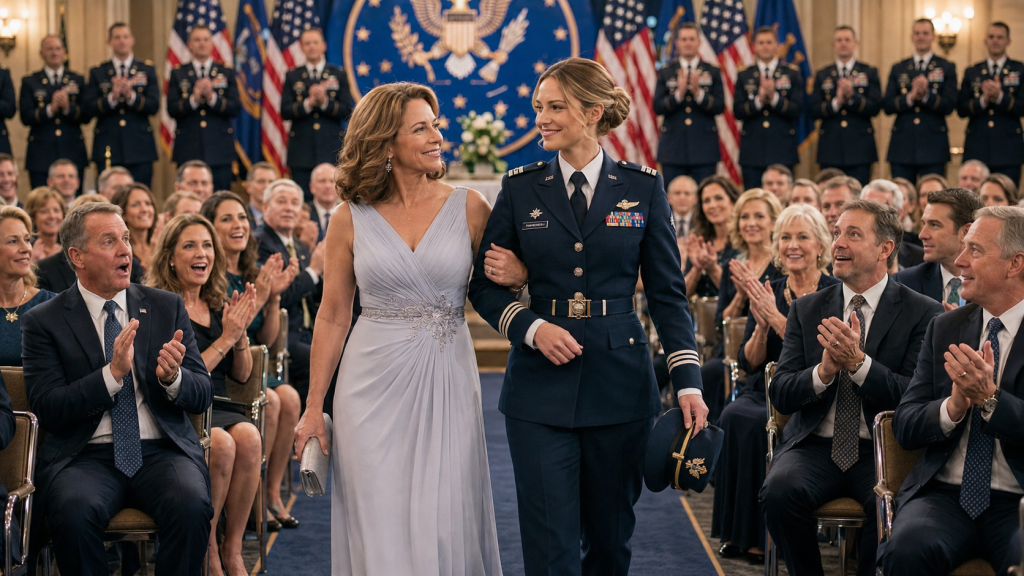
My name had been announced.
Lieutenant Hannah Morgan.
First in my graduating class.
Rachel Morgan—the woman who had raised me, loved me, and eventually adopted me—had pinned the silver lieutenant bars onto my uniform with tears shining in her eyes.
It should have been one of the happiest moments of my life.
Then I saw my biological parents standing three rows behind her.
Richard and Linda Barrett.
The people who had walked away from me when I was thirteen years old and fighting cancer.
And now Allison, the older sister I had not spoken to in fifteen years, was holding an envelope from the hospital where everything had fallen apart.
Linda’s face changed the instant she recognized it.
“Put that away.”
Allison stared at her.
“No.”
My father stepped forward.
“Allison.”
His voice carried the sharp warning I remembered from childhood.
She ignored him.
“This isn’t the place,” Richard said.
Allison gave a small, bitter laugh.
“That’s strange.”
Her hand shook harder.
“Because fifteen years ago, you thought a hospital room was the perfect place to decide whether Hannah’s life was worth ruining my future.”
The auditorium became unnaturally quiet.
I could hear people shifting in their seats.
Someone coughed.
A program slipped from someone’s lap and landed on the floor.
Rachel moved closer to me.
Her fingers brushed the side of my hand.
It was the same quiet touch she had used during chemotherapy whenever I was too frightened to speak.
I looked at Allison.
“What is that?”
She swallowed.
“A letter.”
Richard’s jaw tightened.
“Allison, enough.”
She turned on him.
“No, Dad.”
Her voice was still shaking.
But she wasn’t backing down.
“For once, you don’t decide what Hannah gets to know.”
Then she held the envelope toward me.
I stared at it.
The paper was yellowed around the edges.
The logo of St. Anne’s Medical Center was faded but recognizable.
And beneath it was a name I had not used in fifteen years.
HANNAH BARRETT.
I reached for it.
Linda stepped toward me.
“Hannah, please.”
I looked at her.
The woman who had once been my mother stopped immediately.
I opened the envelope.
There were several pages inside.
The first was an application for financial assistance.
The second was correspondence from the St. Anne’s charitable foundation.
The third page made my stomach drop.
I read the bold sentence once.
Then again.
Then a third time.
FULL TREATMENT COSTS APPROVED.
For several seconds, the words stopped making sense.
I turned the page over as if another explanation might be hiding on the back.
There wasn’t one.
The foundation had agreed to cover almost every major expense associated with my cancer treatment.
Medication.
Hospitalization.
Chemotherapy.
Specialist appointments.
Follow-up care.
Everything my parents had told me they could not afford.
My mouth went dry.
I slowly raised my head.
“You knew.”
Linda’s lips parted.
“Hannah—”
“You knew.”
Richard looked around the auditorium.
“This is far more complicated than you understand.”
“No.”
My voice surprised even me.
It was calm.
Military training had taught me how to keep my voice steady while everything inside me was falling apart.
“This is actually very simple.”
I lifted the paper.
“You told a thirteen-year-old girl that you couldn’t afford to save her life.”
Linda began crying.
“That isn’t what we said.”
I laughed once.
There was no humor in it.
“I remember exactly what you said.”
And I did.
I remembered everything.
Dr. Grant sitting across from us in that small hospital consultation room.
My mother gripping her handbag.
My father asking about treatment costs before asking about survival rates.
Allison’s college brochures sitting on our kitchen counter.
Then my parents arguing late at night.
I had stood at the top of the stairs and listened.
They thought I was asleep.
I wasn’t.
I heard my father say treatment could destroy Allison’s college future.
I heard my mother say they had spent years preparing Allison for success.
Then came the words I had never forgotten.
Allison has potential.
Hannah has always been average.
We cannot sacrifice one daughter’s promising future for another daughter whose outcome is uncertain.
I had been thirteen.
Sick.
Terrified.
And somewhere inside me, I had believed them.
Maybe I really was the daughter worth less.
Maybe I was the bad investment.
Maybe I was the life people could afford to lose.
For fifteen years, those sentences had lived beneath my skin.
Now I was holding proof that the money had never been the real reason.
I stared at my mother.
“If the treatment was covered, why did you leave?”
Linda looked away.
Allison answered instead.
“Because Dad had already accepted a job in Europe.”
Richard’s head snapped toward her.
“You have absolutely no idea what you’re talking about.”
“I found the emails.”
A murmur moved through the auditorium.
General Whitaker, who had presided over the commissioning ceremony, stood a few feet away.
He did not interfere.
Not yet.
Allison pulled another paper from the envelope.
“The company was paying relocation expenses. Housing. School tuition. Travel. Everything.”
She looked at me.
“The move was supposed to happen six weeks after your diagnosis.”
My stomach tightened.
“You were moving?”
Richard rubbed his jaw.
“It was an important professional opportunity.”
“For the entire family?”
No answer.
Allison looked miserable.
“I was already applying to schools there.”
I turned toward my parents.
“So my cancer became inconvenient.”
Linda shook her head quickly.
“That’s not fair.”
“No?”
Allison’s voice rose.
“Then tell her what you wrote.”
Linda froze.
“Allison.”
“Tell her.”
“What did she write?” I asked.
My sister slowly unfolded a printed email.
The date was three days after my diagnosis.
The sender was Linda Barrett.
The recipient was Richard.
I read.
If Hannah remains in treatment here, we will lose the relocation package. We cannot allow one unfortunate situation to destroy the future we planned for Allison.
My vision blurred.
One unfortunate situation.
That was me.
Not her daughter.
Not a frightened thirteen-year-old child.
Not Hannah.
A situation.
I kept reading.
Social services can arrange temporary placement until treatment is completed. She has always been adaptable.
I stopped.
Adaptable.
What an elegant word.
A polite word.
A word adults used when they wanted abandonment to sound practical.
I looked at Linda.
“You called me adaptable.”
Her eyes filled.
“I was terrified.”
“So was I.”
Richard stepped forward.
“We believed the arrangement would be temporary.”
I turned toward him.
“You never came back.”
He opened his mouth.
I kept going.
“You didn’t call when I finished chemotherapy.”
Silence.
“You didn’t come to my high school graduation.”
His eyes dropped.
“You didn’t send Christmas cards.”
Nothing.
“You didn’t call on my birthday.”
Linda whispered, “We thought you hated us.”
I stared at her.
“I was thirteen.”
Those words silenced both of them.
“I was thirteen years old and fighting cancer.”
My voice finally cracked.
“You were the parents.”
Rachel squeezed my hand.
Richard looked uncomfortable.
Not ashamed.
Uncomfortable.
There was a difference.
“Hannah,” he said carefully, “whatever mistakes we made, we came here today because we are proud of you.”
Something inside me snapped.
“Proud?”
“Yes.”
“Of what?”
His brows pulled together.
“Of everything you’ve accomplished.”
“You didn’t know what I accomplished.”
“We followed your career.”
“No.”
I shook my head.
“You searched for me online.”
Linda flinched.
“You saw that the daughter you threw away became useful enough to brag about.”
“That’s cruel,” she whispered.
I glanced at the graduation program in her hand.
Beside my name, she had written something in pen.
MY DAUGHTER.
She noticed me looking and covered the words with her fingers.
Too late.
I understood.
They hadn’t come because they missed me.
They had come because Lieutenant Hannah Morgan looked better than the abandoned, bald thirteen-year-old girl in room 314.
Rachel stepped beside me.
“I think Hannah deserves some space.”
Linda looked at her.
Something sharp entered her expression.
“You.”
Rachel remained calm.
“Yes.”
“You took my daughter.”
I felt Rachel stiffen.
Before she could speak, I stepped between them.
“No.”
Linda stared at me.
“Rachel didn’t take me.”
I looked directly into my biological mother’s eyes.
“She stayed after you left.”
The sentence hit her harder than shouting could have.
Her face collapsed.
“That’s not the same.”
“It is to me.”
Rachel had been my oncology nurse.
She was there when chemotherapy made me sick until I couldn’t lift my head.
She held the bowl.
She cleaned my face.
She learned which soup I could tolerate when everything else made me vomit.
When my hair began falling out, she cut her own hair short because she said we could both look ridiculous together.
When social services struggled to find a long-term placement during treatment, Rachel became my foster parent.
Then my guardian.
Then my mother.
She attended every school meeting.
Every appointment.
Every terrible scan.
Every good scan.
When I graduated high school, Rachel screamed so loudly that the principal laughed.
When I told her I wanted to join the military, she sat at the kitchen table for half an hour without speaking.
Then she finally said, “I’m going to worry every day.”
I had smiled.
“I know.”
“And I’m still going to support you.”
When I failed my first timed run, she mailed motivational cards every week.
Most were terrible.
One had a cartoon turtle wearing running shoes.
Another said, YOU DON’T HAVE TO BE FAST. YOU JUST HAVE TO BE SLIGHTLY LESS SLOW.
I hated that card.
I kept it.
During officer training, I called her one night after midnight.
“I don’t think I’m good enough.”
Rachel had been quiet for a moment.
Then she said, “Fine.”
I blinked.
“Fine?”
“Be bad at it today.”
“What?”
“Be terrible today. Be slightly better tomorrow. Keep going until you’re good.”
That woman was my mother.
Not because blood said so.
Because love had proved itself.
General Whitaker finally cleared his throat.
“Lieutenant Morgan.”
I turned.
“Yes, sir.”
His expression remained professional, although there was warmth in his eyes.
“We need to conclude the ceremony.”
“Yes, sir.”
Richard immediately stepped forward.
“General, perhaps afterward we could—”
Whitaker looked at him.
“I was speaking to Lieutenant Morgan.”
My father went silent.
I followed the general toward the stage.
Before stepping up, I looked back at Allison.
“How long have you known?”
She swallowed.
“Six months.”
“Why wait until today?”
Tears filled her eyes.
“Because every time I tried to contact you, Mom stopped me.”
Linda stared at her.
“What are you talking about?”
Allison pulled out her phone.
“I emailed Hannah three times.”
I had received nothing.
“I wrote letters to the academy.”
Nothing.
“I called.”
My number hadn’t changed.
Allison looked at Linda.
“I found out last month that Mom was logging into my email account.”
Linda shook her head.
“I was protecting this family.”
“From what?” I asked.
“From reopening old wounds.”
“Whose wounds?”
She had no answer.
A staff officer motioned toward the stage.
I returned to my place beside twenty-seven newly commissioned officers.
General Whitaker stepped to the podium.
His speech was about leadership.
Character.
Duty.
Integrity.
What a person did when nobody was watching.
I listened differently now.
Fifteen years earlier, my biological parents had failed every one of those principles.
Rachel had lived them.
And she had never needed a uniform to do it.
When the ceremony ended, the auditorium erupted again.
Families rushed toward their graduates.
Rachel reached me first.
She wrapped both arms around me.
For one brief second, I became thirteen again.
Except this time, I wasn’t alone.
“You okay?” she whispered.
“No.”
She pulled back.
I smiled through tears.
“But I will be.”
“That sounds like my girl.”
“My officer,” I corrected.
She laughed.
“Absolutely not. You will always be my girl.”
Behind her stood Allison.
My parents were near the exit.
Richard was arguing quietly with Linda.
I looked at my sister.
“Walk with me.”
We went outside.
Late afternoon sunlight spilled across the academy courtyard.
Families were taking photographs beneath banners.
Someone shouted congratulations nearby.
For everyone else, it was still a celebration.
For me, it felt like the first day of a new investigation into my own life.
Allison and I stopped beneath an oak tree.
She sat on the stone bench.
“I’m sorry,” she said.
“You were sixteen.”
“I should have done something.”
“You were sixteen.”
“I believed them.”
“So did I.”
She looked at me.
That seemed to hurt more.
“For years they told me your treatment became too difficult. They said you preferred living with Rachel. They said you stopped answering their letters.”
“There were no letters.”
“I know.”
She wiped her face.
“I spent fifteen years believing you hated me.”
I sat beside her.
“I spent fifteen years believing you chose your college fund over my life.”
Her face turned pale.
“Hannah, I swear I didn’t know.”
“I believe you.”
We sat in silence.
There was too much history between us for a hug to magically fix anything.
But there was something.
A beginning.
A narrow bridge over fifteen years of lies.
Then Allison said, “There’s something else.”
I almost laughed.
“Of course there is.”
She gave me a tired smile.
Then it disappeared.
“Dad didn’t suddenly become interested in you because of graduation.”
I looked at her.
“What does he want?”
“He’s in trouble.”
“What kind?”
“Financial.”
“That sounds like his problem.”
“It might become yours.”
She pulled a folder from her bag.
Inside were documents connected to Richard Barrett’s consulting company.
Debts.
Lawsuits.
Regulatory complaints.
A federal investigation.
I turned several pages.
“What does this have to do with me?”
Allison lowered her voice.
“Dad needs a military contract.”
My stomach tightened.
“He what?”
“He’s been trying to get his company approved as a defense subcontractor.”
I understood immediately.
“He thinks I can help him.”
“He thinks your name can.”
“I’m a brand-new lieutenant.”
“I told him.”
“I have zero authority over contracts.”
“I told him that too.”
“And?”
Allison gave me a bitter smile.
“You know Dad.”
Unfortunately, I did.
Then she said, “He knows General Whitaker.”
That got my attention.
“How?”
“I don’t know.”
Before I could ask more, footsteps approached.
Richard.
Linda followed several feet behind.
“Hannah,” he said.
“Lieutenant Morgan.”
His expression tightened.
“Fine. Lieutenant Morgan. We need to speak privately.”
“No.”
“It concerns your future.”
“My future stopped concerning you fifteen years ago.”
His jaw flexed.
Allison stood beside me.
“Dad, leave her alone.”
“This does not involve you.”
“It involves all of us.”
He glanced around the courtyard.
Then lowered his voice.
“You have an opportunity to repair this family.”
I stared at him.
The audacity almost impressed me.
“How?”
“General Whitaker clearly respects you.”
“And?”
“My company has submitted a defense systems proposal. Nothing improper. I simply need an introduction to the right people.”
“You want me to use my position to lobby my commanding general?”
“I said introduction.”
“No.”
“Hannah.”
“No.”
His expression darkened.
“You should think carefully.”
I stepped closer.
“Is that a threat?”
“Of course not.”
Rachel appeared behind him.
“What is happening?”
Richard smiled immediately.
“A family conversation.”
Rachel looked at me.
“Then why does Hannah look like she’s being cornered?”
Linda snapped, “Would you stop interfering?”
Rachel looked at her.
“No.”
One word.
Calm.
Absolute.
Linda almost recoiled.
Richard looked at me again.
“You have been manipulated for years.”
I blinked.
“By Rachel?”
“She isolated you.”
I stared at him.
“You left me.”
“We made a temporary decision.”
“You disappeared for fifteen years.”
“We are trying to correct that now.”
“No.”
My voice hardened.
“You’re trying to use me.”
Something changed in his expression.
Just slightly.
But I saw it.
So did Allison.
“Oh my God,” she whispered.
Richard turned toward her.
“Stay out of this.”
She stepped closer to me instead.
“No.”
For the first time in our lives, the Barrett sisters stood on the same side.
Richard looked between us.
Then his shoulders relaxed.
“All right.”
His voice became calm.
“Perhaps today isn’t the right time.”
“It never will be.”
He stared at me.
“We’ll see.”
Then he walked away.
Linda remained.
Her eyes were wet.
“I did love you,” she whispered.
I believed she believed that.
But love without courage had not helped thirteen-year-old Hannah.
Love without action had not made a single phone call.
Love that returned only after success was not the love I needed.
“I hope someday,” I said quietly, “you understand what that word requires.”
She left.
Allison exhaled.
“I’ve never seen Dad like that.”
Rachel stared after him.
“I have.”
I turned.
“What?”
Her face changed.
“Nothing.”
“Mom.”
She stopped.
That word always stopped her.
“What do you know?”
Rachel forced a smile.
“This is your graduation day.”
I folded my arms.
“Which apparently is also National Family Secret Day.”
Allison laughed despite herself.
Rachel didn’t.
Before I could press further, a uniformed officer approached.
“Lieutenant Morgan?”
“Yes, sir.”
“General Whitaker would like to speak with you privately.”
Something in his tone told me this had nothing to do with graduation.
I followed him inside.
Rachel came with me.
So did Allison.
We entered a conference room behind the auditorium.
General Whitaker stood near a window.
Two other people were waiting.
One was an Army Inspector General officer.
The other was a woman in civilian clothes with a federal identification badge clipped to her jacket.
The folder Allison had given me suddenly felt heavier.
Whitaker looked toward it.
“I see Mr. Barrett has already approached you.”
“Yes, sir.”
“Did he ask you to influence a procurement decision?”
“He asked me to make an introduction.”
The civilian investigator exchanged a glance with the inspector.
Whitaker nodded.
“Lieutenant, you are not in trouble.”
Nobody had ever felt better after hearing that sentence.
He continued.
“Richard Barrett’s company has been under investigation for eighteen months.”
I looked at Allison.
She looked stunned.
“For what?” I asked.
The federal agent answered.
“Fraud. Bribery. Falsified subcontractor certifications. Procurement interference.”
I stared at the papers in my hands.
My father had not returned to repair a family.
He had returned because his abandoned daughter had become potentially useful.
I looked at Rachel.
She was watching General Whitaker strangely.
There was something between them.
Some knowledge I didn’t have.
“You knew,” I said.
Rachel closed her eyes.
“Yes.”
“How?”
Whitaker answered for her.
“Rachel contacted investigators three weeks ago.”
I stared at her.
“Why?”
She reached into her purse.
Another envelope.
I laughed despite everything.
“Please tell me that is a birthday card.”
Rachel almost smiled.
“No.”
She handed it to me.
Inside was a photocopy of my adoption paperwork.
Someone had circled one line.
BIOLOGICAL FATHER: RICHARD ALLEN BARRETT.
Underneath, someone had written:
ASK HIM WHY HE REALLY LEFT HER.
A chill ran across my skin.
“Who sent this?”
“We don’t know,” Rachel said.
The federal agent placed a photograph on the table.
Richard was leaving an office building beside an older man.
Silver hair.
Familiar posture.
I recognized him.
Dr. Michael Grant.
The oncologist who had diagnosed me fifteen years earlier.
My pulse jumped.
“That’s Dr. Grant.”
Rachel nodded.
“He retired several years ago.”
“Why is my father meeting him?”
The agent said, “That is what we would like to know.”
I picked up the photograph.
Then I noticed the date.
Three months earlier.
Before graduation.
Before my parents reappeared.
“What happened three months ago?”
General Whitaker folded his hands.
“Your security clearance investigation began.”
I frowned.
Officer candidates undergo background investigations.
Mine had seemed routine.
Apparently it wasn’t.
The federal agent opened another folder.
“During that review, investigators found an inconsistency in your childhood medical records.”
“What inconsistency?”
She looked toward Rachel.
Rachel’s face was pale.
And suddenly I knew.
Whatever came next was not about money.
It wasn’t about abandonment.
It was something Rachel had protected me from.
“Hannah,” she whispered, “there is one thing I never told you about the night your parents left St. Anne’s.”
My chest tightened.
“What?”
“Dr. Grant ran additional tests.”
“What kind of tests?”
“The cancer diagnosis was real.”
I waited.
“But?”
Rachel reached for my hand.
“The bloodwork showed something else.”
Allison leaned forward.
“What?”
Rachel looked directly into my eyes.
“Richard Barrett may not actually be your biological father.”
The room disappeared.
Then the conference room door opened.
Dr. Michael Grant walked inside.
THE DOCTOR WHO HAD KEPT THE SECRET FOR FIFTEEN YEARS
Dr. Grant looked older.
His hair had turned silver.
His shoulders curved slightly.
But his eyes were exactly the way I remembered them.
Gentle.
Observant.
Impossible to fool.
For a moment, I was thirteen again.
I could almost smell disinfectant.
Hear the hospital machines.
Feel the knitted cap against my scalp.
“Hello, Hannah,” he said.
My throat tightened.
“You knew?”
“Yes.”
Rachel spoke immediately.
“She wanted to tell you when you were older.”
I turned toward her.
“You knew too.”
“Yes.”
“How long?”
Her face crumpled.
“From the beginning.”
I stepped away.
“Everyone knew except me.”
“No,” Dr. Grant said. “Very few people knew.”
I stared at him.
“That does not help.”
“I know.”
At least he didn’t pretend.
He placed a folder on the table.
“When you were admitted, we performed compatibility testing because your treatment might eventually have required a marrow donor.”
“Family testing.”
“Yes.”
“And?”
“Richard Barrett’s genetic markers were inconsistent with biological paternity.”
Allison gasped.
I stared at him.
“You told my mother?”
“Yes.”
“And Richard?”
“Yes.”
“When?”
“Three days after your diagnosis.”
The same day my mother had called me an unfortunate situation.
My stomach turned.
“What happened?”
“Richard became extremely angry.”
Of course.
Not because his daughter had cancer.
Because I might not be his daughter.
“He demanded another test,” Grant said.
“And?”
“We performed one.”
I already knew the answer.
Still, I needed to hear it.
“Richard Barrett was excluded as your biological father.”
The room went silent.
Allison whispered, “Oh my God.”
My mind raced backward through everything.
Average.
Not worth sacrificing for.
Adaptable.
Temporary placement.
Suddenly all of it looked different.
“He abandoned me because I wasn’t his.”
Dr. Grant spoke carefully.
“I cannot tell you what motivated him.”
“I can.”
Everyone turned.
Linda stood in the doorway.
I hadn’t heard her enter.
Her face was almost gray.
“Mom?” Allison whispered.
Linda walked inside.
“I should have told you.”
I stared at her.
“Who is my father?”
She started crying.
Not the quiet tears from earlier.
Her entire body shook.
I felt strangely numb.
Maybe I had used up every emotion available to me.
“His name.”
She closed her eyes.
“David Morgan.”
Rachel stopped breathing.
So did I.
Morgan.
I slowly turned toward her.
Linda continued.
“David Morgan was Rachel’s older brother.”
Rachel grabbed the chair beside her.
“My brother?”
Linda nodded.
The room tilted.
Rachel stared at me.
“My brother died when Hannah was four.”
“Yes.”
I could barely form the words.
“You adopted me without knowing?”
Rachel looked horrified.
“I swear to you, Hannah. I had no idea.”
Linda collapsed into a chair.
“I met David when Richard and I were separated. We thought our marriage was finished.”
Rachel’s expression hardened.
“David never told me.”
“He didn’t know I was pregnant.”
Linda wiped her face.
“Richard and I reconciled. Then I found out I was expecting. The dates were close. I told myself Hannah was Richard’s.”
“You told yourself?” Allison whispered.
“I wanted my family to survive.”
“So you lied.”
“Yes.”
Richard had discovered the truth after my diagnosis.
And suddenly everything made horrible sense.
The money had been an excuse.
The relocation had been convenient.
My cancer hadn’t made me disposable.
My DNA had.
I looked at Rachel.
“If David was your brother…”
She covered her mouth.
“You’re my aunt.”
Biologically.
Before she became my foster mother.
Before she became my adoptive mother.
Before either of us knew.
Tears poured down Rachel’s face.
“I didn’t know.”
Something inside me finally broke.
I crossed the room.
Rachel opened her arms.
I fell into them.
She had thought she was rescuing an abandoned child.
Instead, somehow, she had brought her dead brother’s daughter home.
After fifteen years of believing the universe had taken everything from me, I discovered that somehow it had quietly returned part of my father through Rachel.
Dr. Grant cleared his throat.
“The coincidence may not have been entirely accidental.”
We turned.
Rachel stared at him.
“What does that mean?”
“When Rachel applied to foster Hannah, I recognized her surname.”
Rachel frowned.
“You knew David?”
“Briefly.”
Grant smiled faintly.
“When David was in his twenties, he volunteered at St. Anne’s pediatric ward.”
Rachel nodded slowly.
“He did.”
“He was memorable.”
“How?”
“He was terrible at card tricks.”
Rachel laughed through her tears.
So did I.
The deck of cards.
Rachel had brought one to my hospital room years later.
My biological father had once entertained sick children in the same hospital where his daughter would eventually fight for her life.
Then a thought hit me.
“Why was Richard meeting you three months ago?”
Dr. Grant’s smile disappeared.
“Because Richard discovered something else.”
The federal agent stepped forward.
“Something connected to David Morgan.”
Dr. Grant nodded.
“David worked as an engineer.”
Rachel said, “Aerospace systems.”
The agent opened a folder.
“He helped develop an early navigation component that was later incorporated into military guidance technology.”
I stared at her.
“Richard’s company.”
She nodded.
“Richard Barrett’s company has been claiming rights to patents partly derived from David Morgan’s work.”
Allison turned pale.
“So Dad…”
“May have been profiting from intellectual property that never belonged entirely to him.”
Then everything clicked.
My military career.
My commission.
My biological identity.
Richard had not only discovered that his abandoned daughter had become an officer.
He had discovered I was David Morgan’s biological child.
His heir.
THE FATHER WHO RETURNED WHEN HIS ABANDONED DAUGHTER BECAME VALUABLE
Richard disappeared before investigators could question him.
By midnight, his phone was switched off.
By sunrise, his attorney had released a statement claiming he was traveling for business.
Nobody believed it.
My first morning as Lieutenant Hannah Morgan began in Rachel’s kitchen.
Not on a parade field.
Not with celebration.
My dress uniform hung over a chair.
Coffee cooled between my hands.
Across the kitchen table, Rachel had spread photographs of David Morgan.
My father.
My real father.
I stared at his face.
He had Rachel’s eyes.
Then I noticed something else.
My smile.
One photograph showed David kneeling beside a bicycle with grease across his cheek.
Another showed him beside Rachel at a university football game.
Another showed him in the pediatric wing of St. Anne’s holding playing cards while three children laughed.
“He would have loved you,” Rachel whispered.
I looked down.
“You can’t know that.”
“Yes, I can.”
“How?”
“Because David loved anyone who needed someone.”
That sounded familiar.
I glanced at her.
Rachel smiled sadly.
“He taught me how to stay.”
I touched the photograph.
For years, I thought becoming a Morgan began the day Rachel adopted me.
Now I understood something strange and beautiful.
The name had already been mine.
Neither of us had known.
The doorbell rang.
Allison stood outside carrying two suitcases.
“I left.”
I stepped aside.
“Left what?”
“Mom and Dad’s house.”
Rachel took one suitcase.
Allison looked exhausted.
“I confronted Mom last night.”
“And?”
“She admitted Dad knew David had engineering notebooks.”
Rachel froze.
“What notebooks?”
Allison held out a small metal key.
“There’s a storage facility outside Arlington.”
“Dad’s storage?”
“No.”
She looked at Rachel.
“David’s.”
Rachel stared at the key.
“My brother had a storage unit?”
“Apparently Mom kept the key.”
Of course she had.
Another secret.
We contacted investigators and drove to the facility.
The unit smelled like dust, old cardboard, and metal.
Inside were boxes.
Tools.
Technical books.
Binders.
Photographs.
And a green military-style footlocker.
Rachel knelt beside it.
“My father gave David this.”
The key fit.
Inside were notebooks filled with formulas.
Engineering sketches.
Letters.
Patent drafts.
And one document that changed everything.
David Morgan had developed a navigation algorithm with another engineer.
The rights were placed into a trust.
The beneficiary was listed clearly.
ANY BIOLOGICAL CHILD OF DAVID MORGAN.
Me.
Federal investigators arrived within the hour.
They photographed everything.
Cataloged everything.
Asked questions.
Richard’s company had spent years licensing versions of technology derived from David’s work through an intermediary corporation.
But the intermediary apparently never possessed complete ownership.
A legal heir could challenge everything.
I stared at the trust paperwork.
“He came to graduation because he needed my signature.”
The federal agent nodded.
“A waiver from David Morgan’s biological heir could significantly improve his legal position.”
Allison sat on a storage box.
“I can’t believe him.”
I could.
That was the worst part.
Later that afternoon, my phone rang.
Richard.
I answered.
“Hannah.”
“Lieutenant Morgan.”
He sighed.
“You’re enjoying this.”
“No.”
“Don’t pretend.”
“You think I’ve spent fifteen years fantasizing about revenge?”
Silence.
“I didn’t think about you nearly as often as you imagine.”
His breathing changed.
Then he switched tactics.
“The patent issue is complicated.”
“You mean the patents you stole?”
“Be careful with your language.”
I almost laughed.
“You abandoned a thirteen-year-old girl with cancer and now you’re concerned about manners?”
“My company employs four hundred people.”
That stopped me.
“Four hundred families depend on those salaries.”
There it was.
The pressure point.
He knew exactly where to push.
“What do you want?”
“A meeting.”
“Federal investigators present.”
“No.”
“Then we have nothing to discuss.”
He paused.
“Hannah.”
“What?”
“David Morgan was not the saint Rachel remembers.”
My grip tightened around the phone.
“What does that mean?”
“Meet me.”
Then he hung up.
Rachel watched me.
“What did he say?”
“That David had secrets.”
Her expression changed.
Every family had ghosts.
Mine apparently had an entire army of them.
THE LETTER MY REAL FATHER NEVER GOT TO GIVE ME
Richard chose a public restaurant.
Federal agents occupied nearby tables.
He knew they were there.
He didn’t care.
He looked tired.
His expensive suit was wrinkled.
His face had aged ten years in several days.
But the old confidence was still there.
He placed a folder on the table.
“Before you destroy my company, read this.”
I opened it.
Engineering reports.
David Morgan’s signature appeared throughout.
“What am I reading?”
“A failed prototype.”
Richard leaned back.
“David’s navigation system malfunctioned during a military test.”
I read.
A test aircraft suffered catastrophic systems failure.
Two pilots were seriously injured.
A technician later died from complications related to the incident.
David had been investigated.
No criminal charges.
But his professional reputation had suffered.
“He blamed himself,” Richard said.
“How do you know?”
“Because I knew him.”
I looked up.
“What?”
“We went to university together.”
A chill moved through me.
“You and David?”
“Yes.”
“Friends?”
Richard laughed bitterly.
“Best friends.”
Of course.
Nothing in my life could simply have one secret.
Richard continued.
“David introduced me to Linda.”
I stared at him.
“And years later she slept with him.”
His voice was controlled.
But fifteen years of resentment lived underneath it.
“I tried to forgive them.”
“You punished me instead.”
His jaw tightened.
“I raised you for thirteen years.”
“And abandoned me the moment a test said I wasn’t biologically yours.”
“I was angry.”
“You were an adult.”
He looked away.
For the first time, I saw shame.
“I made the worst decision of my life.”
“That explains abandonment.”
I tapped the folder.
“It does not explain the patents.”
“No.”
He slid another paper toward me.
A partnership agreement.
Richard Barrett.
David Morgan.
My father and the man who raised me had once worked together.
“The technology wasn’t stolen after David died,” Richard said. “We developed it together.”
“Then why is ownership disputed?”
“After the testing accident, David wanted the project destroyed.”
“Why?”
“He believed the guidance system was too dangerous.”
“And you disagreed.”
“Yes.”
Richard’s eyes hardened.
“I believed the flaw could be corrected.”
“What happened?”
“He destroyed months of updated research.”
I studied the trust document.
“Then why leave rights to his child?”
Richard looked at me.
“Because David discovered Linda was pregnant.”
My pulse jumped.
“He knew about me?”
“Eventually.”
I couldn’t breathe for a second.
Rachel had told me David died when I was four.
That meant he had years.
“If he knew, why didn’t he come for me?”
Richard reached into his jacket.
He placed an old envelope on the table.
My name was written across it.
HANNAH.
The handwriting was unfamiliar.
“This was found among David’s belongings after his death.”
My fingers shook.
“Why do you have it?”
“Linda gave it to me.”
I opened the envelope.
Dear Hannah,
You don’t know who I am, and perhaps that is best for now.
My throat tightened.
I continued.
Your mother sends me photographs from time to time. You have my terrible hair and your aunt Rachel’s stubborn expression.
I stopped.
Rachel.
David had written her name.
I kept reading.
I made choices I regret.
Your family is complicated because of choices made by adults before you were born.
Richard loves you, even if biology someday tells him something different.
I have no right to destroy the only family you know because I want the privilege of calling myself your father.
When you are old enough, I hope your mother tells you the truth.
If you want to find me afterward, I will answer every question.
If you do not, I will respect that.
My eyes blurred.
At the bottom was one final paragraph.
Whatever name you carry, Hannah, you are not responsible for the mistakes adults made before you were born.
David.
I closed my eyes.
He hadn’t rejected me.
He had waited.
Maybe too long.
Then time had run out.
Richard watched me.
“He wasn’t perfect.”
“Neither are you.”
“No.”
His answer surprised me.
For once, he didn’t argue.
“I was furious when the paternity test confirmed everything.”
His voice became quieter.
“But what I did afterward…”
He stopped.
“I convinced myself I was punishing Linda.”
“You punished me.”
“Yes.”
The admission didn’t heal anything.
But truth mattered.
“Why come back now?”
He looked directly at me.
“Because the company is collapsing.”
At least he didn’t lie.
“And because you discovered I was David’s heir.”
“Yes.”
I nodded slowly.
“That may be the first completely honest thing you’ve said to me.”
“Probably.”
Then he leaned forward.
“But there is something else.”
“What?”
“The federal investigators are looking in the wrong direction.”
I stared at him.
“Meaning?”
“Someone has been manipulating the company accounts.”
“Who?”
His face went cold.
“Your sister.”
My chair scraped backward.
“Allison?”
“She controls internal accounting.”
“That proves nothing.”
“I have evidence.”
He placed a flash drive on the table.
I did not touch it.
“Why would Allison destroy your company?”
Richard’s answer came quietly.
“Because she discovered what we did to you.”
THE SISTER WHO HAD BEEN PREPARING FOR WAR
I confronted Allison that night.
Rachel insisted we do it at home.
No uniforms.
No interrogation rooms.
No shouting in public.
Just family.
Rain tapped against the living room windows.
Allison stood beside the fireplace.
I placed the drive on the coffee table.
“Dad says this proves you sabotaged his company.”
Her expression barely changed.
“So he found it.”
My stomach dropped.
“You did something?”
“Yes.”
Rachel whispered, “Allison…”
“I moved money.”
I stared at her.
“How much?”
“Millions.”
My chest tightened.
She opened her laptop.
“Not into my account.”
She turned the screen toward us.
There were transaction records.
Holding accounts.
Payment trails.
“I discovered Dad was using consulting companies to send illegal payments.”
“Bribes?”
She nodded.
“I knew if I confronted him, the records would disappear.”
“So you moved the money?”
“I redirected suspicious funds into protected accounts where they could be documented.”
“Why didn’t you contact investigators?”
“I did.”
A voice behind me answered.
“She contacted us eight months ago.”
I spun around.
The federal agent from graduation walked in from the hallway.
Rachel gave me an apologetic look.
“She arrived ten minutes ago.”
I stared at Allison.
“You’ve been cooperating with investigators?”
“Yes.”
“For eight months?”
“Yes.”
Suddenly everything about my sister made sense.
The fear.
The secrecy.
The documents.
The hospital records.
Allison had not been trying to destroy Richard.
She had been building a case against him.
“He thought I was helping him,” she said.
“That’s why he gave me access to everything.”
“Does Mom know?”
“No.”
I sank onto the couch.
“This family treats truth like illegal contraband.”
The agent almost smiled.
Then her expression hardened.
“Richard Barrett is deeply involved in procurement fraud, but investigators believe he is not the person who created the network.”
“Then who did?”
The agent looked at Rachel.
“General Whitaker.”
I stared at her.
“No.”
“He approached Barrett’s company through intermediaries several years ago.”
My mind rejected the idea.
Whitaker.
The general who had commissioned me.
The man who had spoken about integrity.
The man who had stepped between Richard and me during graduation.
“He stood beside me today.”
“Yes.”
“You knew?”
“We suspected.”
“And you let him commission me?”
“We needed him to believe the investigation remained focused on your father.”
The betrayal felt different.
Less personal.
Still ugly.
“Does Dad know?”
“Not completely,” Allison said. “But he suspects.”
My phone rang.
Richard.
I answered.
His breathing was heavy.
“Hannah.”
“Where are you?”
“Listen to me. Get Allison out of Rachel’s house.”
The federal agent immediately signaled for silence.
“Why?”
“Whitaker knows.”
My skin turned cold.
“Knows what?”
“That Allison has been cooperating with investigators.”
“How?”
“I don’t know.”
A crash sounded through the phone.
“Dad?”
His voice came back urgently.
“Whatever you think of me, take your sister and leave.”
Then the line went dead.
Federal agents moved immediately.
Richard’s phone location placed him at his office.
When authorities arrived, his car was still in the garage.
His phone lay smashed on the floor.
Richard was gone.
Security footage showed him leaving through a service entrance.
Beside him walked a man wearing an Army uniform.
General Whitaker.
THE GENERAL WHO PREACHED INTEGRITY WHILE SELLING HIS OWN
Whitaker disappeared before dawn.
Military investigators locked down his office.
Federal agencies began searching.
News spread fast.
A decorated general.
Defense contracts.
Procurement fraud.
A missing businessman.
An investigation tied to a newly commissioned lieutenant.
My life became a headline without my permission.
I was immediately removed from anything related to the investigation.
It was correct.
Professionally necessary.
Personally unbearable.
For forty-eight hours, I knew nothing.
Then Linda called.
“Hannah.”
Her voice trembled.
“Mom?”
“Richard contacted me.”
I stood up.
“Where is he?”
“I don’t know.”
“What did he say?”
“He told me to give you a location.”
She gave me an address.
An old cabin in rural Virginia.
Rachel recognized it immediately.
“My parents owned that place.”
“When?”
“When David was young.”
“I thought it was sold.”
“So did I.”
Property records showed the cabin had been moved into a trust.
Investigators were contacted.
They refused to let me go anywhere near it.
For once, I obeyed without argument.
Agents reached the property first.
Richard was inside.
Alive.
Exhausted.
Furious.
But alive.
Whitaker had taken him there because he believed Richard still possessed original documentation connected to David’s patents.
Richard escaped after Whitaker stepped outside to retrieve something from a vehicle.
By evening, military police arrested General Whitaker at a small regional airfield.
There was no dramatic shootout.
No heroic chase.
No final speech.
Just an aging man standing beside a vehicle as investigators approached.
The evidence against him was overwhelming.
Payment trails.
Recorded conversations.
Corporate records.
Allison’s documents.
Richard’s testimony.
Whitaker had manipulated the procurement process for years.
Richard had participated because the contracts kept his company profitable.
When investigators began closing in, Richard panicked.
He needed to increase the company’s legitimate value.
That meant securing uncontested ownership of David Morgan’s technology.
And that meant finding David’s biological heir.
Me.
That was why he had returned.
Not love.
Not regret.
Necessity.
The truth hurt.
But there was something clean about knowing it.
Hope based on lies can poison you for years.
Truth hurts once.
Then healing can finally begin.
Three weeks later, Richard asked to see me.
He was cooperating with prosecutors.
His attorneys believed cooperation might reduce his sentence.
I met him in a federal interview facility.
Without the expensive suit, polished office, and reputation, he looked ordinary.
Smaller.
Older.
He sat beneath fluorescent lights.
“I owe you an apology,” he said.
“You owe me fifteen years.”
“I know.”
“No.”
I shook my head.
“You don’t.”
He lowered his eyes.
I surprised myself with what came next.
“I don’t hate you.”
He looked up.
“But I don’t forgive you either.”
His face tightened.
“I understand.”
“No.”
I almost smiled.
“I don’t think you do.”
He nodded anyway.
“I probably don’t.”
“What happens to the company?”
“It will likely be restructured.”
“And the employees?”
“Investigators are separating the legitimate divisions from the corrupted contracts.”
I exhaled.
That mattered.
Four hundred people had not chosen Richard Barrett’s decisions.
They deserved a chance to keep their livelihoods.
Richard reached into a small bag.
“There is something I want you to have.”
He placed a wooden box on the table.
Inside was a wristwatch.
Scratched steel.
Black face.
Simple.
“It belonged to David.”
I touched it.
“Why do you have it?”
“He gave it to me in college.”
“Why?”
Richard smiled faintly.
“Because we were friends.”
Before the betrayal.
Before resentment.
Before adults destroyed everything around them.
“You hated him.”
“Yes.”
“Did you ever forgive him?”
Richard stared at the table.
“No.”
Then he said something I did not expect.
“Maybe that is how I became someone I didn’t recognize.”
For the first time, I saw him differently.
Not as a monster.
Not as a misunderstood father.
Just a man who allowed resentment to rot everything inside him.
Understanding was not forgiveness.
But understanding had value.
When I left the interview room, Linda was waiting in the lobby.
She stood.
“Hannah.”
I stopped.
“I’m not asking you to forgive me.”
“Good.”
She swallowed.
“I only wanted to say I’m sorry.”
I studied her.
Fifteen years earlier, I would have given almost anything to hear those words.
Now they felt smaller.
Still, they mattered.
“Thank you for saying it.”
She began crying.
I walked away.
Not to punish her.
Sometimes healing means recognizing which doors can open a little.
And which ones should never open wide again.
THE NAME THEY COULD NEVER TAKE FROM ME
Six months later, I stood beneath another American flag.
This time there were no unexpected biological parents.
No hospital envelopes.
No federal investigators waiting behind curtains.
Just soldiers.
My unit.
My future.
I had completed additional officer training and was preparing to take responsibility for my first platoon.
Rachel sat in the visitors’ section.
Allison sat beside her.
Somehow, the two of them had become close.
Maybe surviving family secrets together had created its own strange bond.
Allison had left the Barrett company.
After the investigation, she accepted a job with a nonprofit that helped families facing medical debt.
When she told me, she said, “Apparently guilt can be turned into a career.”
I told her that was not how career development worked.
She told me Army officers had no sense of humor.
We were learning to become sisters.
Not pretending the fifteen years had never happened.
Not forcing closeness.
Just learning.
Slowly.
Honestly.
After the ceremony, Rachel handed me a package.
“What is this?”
“Something from David’s storage unit.”
I opened it.
Inside was a photograph.
David.
Rachel.
Dr. Grant.
All three standing in St. Anne’s pediatric ward.
On the back, my father had written:
People don’t remember who impressed them.
They remember who stayed.
I stared at the sentence.
Rachel’s eyes filled.
“So that’s where I got it.”
“Got what?”
“The staying thing.”
I smiled.
“You were pretty good at it.”
A voice behind us said, “Lieutenant Morgan?”
I turned.
Dr. Grant approached.
He was holding an envelope.
I immediately pointed at him.
“No.”
He stopped.
“What?”
“No more envelopes.”
Rachel laughed.
“Agreed.”
Grant held it up defensively.
“This one is good.”
“That is exactly what people carrying dangerous envelopes say.”
He laughed and handed it to me.
Inside was a letter from St. Anne’s Medical Center.
The pediatric oncology wing was being renovated.
A donor had funded a family support center.
They wanted permission to name it:
THE MORGAN FAMILY CENTER.
I stared at the page.
“What donor?”
Dr. Grant smiled.
“Anonymous.”
Allison stepped closer.
“How anonymous?”
“Legally anonymous.”
I looked at Rachel.
She shook her head.
Not her.
My phone buzzed.
A message.
Linda.
You deserved parents who stayed.
I cannot change what I did.
I cannot give thirteen-year-old Hannah the mother she needed.
But perhaps I can help another frightened child have someone beside them.
I read it again.
The donation was hers.
Rachel touched my arm.
“You okay?”
I nodded.
For once, the surprise didn’t hurt.
Linda could never rewrite my childhood.
She could never become the mother Rachel had already been.
She could not buy forgiveness.
But perhaps remorse, when genuine, could become useful.
I typed two words.
Thank you.
Nothing more.
Nothing less.
That evening, Rachel, Allison, and I visited St. Anne’s.
Room 314 still existed.
The walls were a different color.
The furniture had changed.
But I remembered the window.
I remembered the beeping machines.
I remembered lying awake at thirteen, terrified that nobody was coming back.
A little girl slept in the room now.
Her father sat beside the bed reading a book.
Every few seconds, he looked up from the page and checked whether she was comfortable.
I stood in the doorway.
For one moment, I saw myself in that bed.
Bald.
Thin.
Terrified.
Waiting for someone to choose me.
Rachel slipped her arm through mine.
“Ready?”
I looked at room 314 one last time.
“Yes.”
Outside, sunset spread gold across the city.
Allison walked ahead toward the parking lot.
Rachel remained beside me.
David’s watch rested against my wrist.
My biological father had given me blood.
And a name.
Rachel had given me a childhood after mine fell apart.
She had given me stability.
Discipline.
Bad motivational cards.
Soup.
Arguments.
Birthdays.
Christmas mornings.
A home.
My biological mother had eventually given me truth.
Too late.
But truth nevertheless.
My sister had given me another chance at family.
And Richard?
Richard had given me the hardest lesson.
A person’s value is never determined by the person who refuses to recognize it.
Fifteen years earlier, the Barretts had called me average.
Too expensive.
Inconvenient.
A future not worth sacrificing for.
They left believing they were protecting the daughter with greater potential.
For years, a small part of me wanted to prove them wrong.
Graduating first felt like proof.
Becoming an officer felt like proof.
Surviving felt like proof.
But eventually I understood something.
My uniform was not revenge.
My survival was not revenge.
My success was not revenge.
Because revenge would still make them the center of my story.
And they weren’t.
The victory was much simpler.
I could finally look back at that thirteen-year-old girl lying in room 314 and tell her the words nobody told her then.
You matter.
You mattered before the uniform.
Before the medals.
Before the grades.
Before anyone applauded.
You mattered when you were sick.
You mattered when you were scared.
You mattered when they walked away.
Their decision never determined your worth.
Rachel nudged me.
“What are you thinking about?”
I looked at her.
“That I’m hungry.”
She laughed.
“After all that intense staring at the hospital?”
“I contain multitudes.”
From the parking lot, Allison shouted, “Are you two coming or planning to live here?”
Rachel shouted back, “We’re coming!”
I pointed at Allison.
“She wants Italian food.”
Rachel frowned.
“You hate the place she likes.”
“I know.”
“Then why are we going?”
“Because apparently rebuilding sibling relationships requires carbohydrates.”
Rachel laughed.
We walked toward the car.
Three women.
One complicated history.
No perfect ending.
Something better.
An honest beginning.
Before I climbed inside, I looked back at the hospital.
Workers were installing a temporary sign above the entrance to the renovated wing.
MORGAN FAMILY CENTER.
Morgan.
The name my biological parents had never given me.
The name my biological father carried.
The name Rachel gave me when she adopted me without knowing it had already belonged to me.
The name I carried across the stage when General Whitaker announced Lieutenant Hannah Morgan.
The name written on the uniform of the daughter they once called average.
For most of my childhood, I believed names told you where you belonged.
Barrett meant the family I was born into.
Morgan meant the family that rescued me.
Then life revealed something stranger.
Blood mattered.
History mattered.
Names mattered.
But none of them mattered as much as the person who stayed.
Rachel started the engine.
Allison immediately complained about my restaurant choice.
“You chose it,” I reminded her.
“I changed my mind.”
“You cannot change your mind after making me agree.”
“Why not?”
“Because there are rules.”
Rachel looked at me in the rearview mirror.
“You’ve been an officer for six months and now everything has rules.”
“Civilization depends on rules.”
Allison rolled her eyes.
“This is going to be unbearable.”
I smiled.
“You survived fifteen years without me. You can survive dinner.”
Her expression softened.
“Yeah.”
Then she looked out the window.
“I wish I hadn’t had to.”
I didn’t answer immediately.
Neither did Rachel.
Some sentences deserved room.
Finally, I reached across the seat and touched Allison’s hand.
“You’re here now.”
She looked at me.
“So are you.”
Rachel began driving.
The hospital disappeared behind us.
For the first time in fifteen years, I didn’t feel like I was leaving something behind.
I felt like I was going somewhere.
A year later, the Morgan Family Center officially opened.
I almost didn’t attend.
Public attention still made me uncomfortable.
The investigation involving General Whitaker had received national coverage.
Richard pleaded guilty to several charges connected to procurement fraud.
His cooperation reduced his sentence, but it did not erase responsibility.
Allison testified.
So did several company executives.
Whitaker received far harsher consequences.
The legitimate divisions of Barrett Consulting survived under new leadership.
Hundreds of employees kept their jobs.
The disputed patents went through months of legal review.
Eventually, David Morgan’s trust was formally recognized.
A portion of the licensing revenue legally belonged to his estate.
To me.
When my attorney explained the amount, I stared at him.
“You’re joking.”
“I assure you I am not.”
“What am I supposed to do with that?”
He laughed.
“Most clients ask how quickly they can access it.”
“I’m serious.”
“So am I.”
I thought about David.
The engineer who had worried his work could hurt people.
The volunteer who performed terrible card tricks for sick children.
The father who had written me a letter he never lived long enough to give me.
Then I thought about room 314.
I knew exactly what I wanted to do.
A significant portion of the money went into a foundation supporting families whose children faced long-term medical treatment.
Not because I wanted my name on buildings.
I didn’t.
Not because I wanted anyone to call me inspirational.
I definitely didn’t.
I did it because I remembered what it felt like to be thirteen and listen to adults discuss your survival as though they were comparing prices.
No child should hear that.
No parent should have to choose between treatment and losing their home.
No sibling should grow up believing another child’s illness destroyed their future.
When I told Allison about the foundation, she became quiet.
Then she said, “Can my nonprofit work with it?”
I smiled.
“I thought you’d never ask.”
Rachel volunteered before I finished explaining the idea.
“You’re retired.”
“I’m aware.”
“You were supposed to relax.”
“I tried.”
“How long?”
“Two days.”
“That sounds right.”
Dr. Grant agreed to serve as a medical adviser.
When I asked him, he stared at me for several seconds.
Then his eyes filled.
“Your father would have been proud.”
I smiled.
“Which one?”
Grant gave me a look.
“That is an unfair question.”
“Answer it.”
He thought about it.
“David would be proud.”
I waited.
“And Richard?”
Grant sighed.
“I suspect Richard is beginning to understand pride and possession are not the same thing.”
That answer stayed with me.
For years, Richard had treated family like ownership.
His wife.
His company.
His reputation.
His daughters.
Even his friendship with David.
When he lost control, he became cruel.
Rachel had taught me something different.
Love did not mean owning someone.
Love meant wanting them to become fully themselves, even if their path frightened you.
Especially then.
The opening ceremony for the Morgan Family Center was small.
That was my condition.
No television crews inside the pediatric wing.
No children used as photographs for donors.
No speeches longer than five minutes.
Allison complained that I had become dictatorial.
I reminded her I outranked exactly zero civilians.
She said that had never stopped me from behaving like I did.
Linda attended quietly.
She sat near the back.
We had exchanged occasional messages over the year.
Nothing dramatic.
Nothing resembling the relationship we once had.
She never demanded more.
That helped.
She had started therapy.
Allison told me that.
I didn’t ask for details.
Richard sent a letter from prison.
I almost threw it away unopened.
Then I remembered David’s unopened letter.
So I read it.
Hannah,
I have rewritten this twenty times because every version sounds like a man asking for forgiveness he has not earned.
I will not ask.
I am learning that apologies are not transactions.
I cannot say “I’m sorry” and expect your pain to disappear in exchange.
You were thirteen.
You were sick.
I knew the foundation would cover your treatment.
I knew you were frightened.
I left anyway.
Everything that happened afterward grew from my refusal to face what I had done.
I blamed Linda.
I blamed David.
I blamed the company.
I blamed circumstances.
But eventually there was nobody left to blame except myself.
I do not know whether we will ever have a relationship.
If we do not, I understand.
I only want you to know something I should have told you when you were a child.
You were never average.
But even if you had been, it would not have mattered.
A child does not have to be extraordinary to deserve love.
I stopped reading.
That sentence hurt more than I expected.
A child does not have to be extraordinary to deserve love.
At thirteen, that was exactly what I had needed someone to tell me.
Not that I would survive.
Not that I would become successful.
Not that one day I would graduate first.
Simply that I did not have to earn the right to be loved.
I folded the letter.
I did not answer.
Not then.
Maybe someday.
Maybe never.
Healing wasn’t a contract either.
At the opening ceremony, Rachel stood beside me beneath the new sign.
MORGAN FAMILY CENTER.
Allison adjusted the collar of my uniform.
“You know this is crooked?”
“It is not.”
“It absolutely is.”
“You’re an accountant.”
“Former accountant.”
“You are not qualified to inspect military uniforms.”
“I have eyes.”
Rachel smiled.
“You two argue exactly like siblings.”
Allison and I both looked at her.
“We are siblings,” we said together.
Then we laughed.
A little boy approached holding a deck of cards.
“Are you Lieutenant Morgan?”
I knelt.
“Yes.”
He looked serious.
“My mom says your dad did card tricks here.”
My throat tightened.
“A long time ago.”
“Were they good?”
Rachel burst out laughing.
I looked at her.
“Control yourself.”
The boy stared at me.
“Well?”
I smiled.
“Apparently they were terrible.”
He held out the deck.
“I can do one.”
“Show me.”
He shuffled the cards badly.
Dropped three.
Picked them up.
Then somehow made the queen of hearts disappear.
I pretended to be shocked.
“That is impossible.”
He grinned.
“I’m better than your dad.”
“Probably.”
His mother called him.
He ran away.
I remained kneeling for a moment.
Rachel touched my shoulder.
“You okay?”
I stood.
“Yeah.”
And I was.
Not healed perfectly.
Not finished.
But okay.
There is a difference between forgetting what happened and no longer allowing it to control what happens next.
I would never forget being abandoned.
I would never forget chemotherapy.
I would never forget my mother’s email.
One unfortunate situation.
I would never forget Richard telling me Allison had potential while I was merely average.
But those memories no longer sounded like definitions.
They were evidence.
Evidence of what happened to me.
Not evidence of who I was.
That afternoon, after everyone left, I walked upstairs to room 314.
It was empty.
The bedsheets were clean.
Sunlight touched the floor.
For years, I had imagined thirteen-year-old Hannah waiting there.
Sometimes when life became difficult, I saw her clearly.
Small.
Bald.
Angry.
Trying not to cry.
I used to want to rescue her.
Now I understood something.
She had already rescued herself.
She survived the nights.
She accepted Rachel’s hand.
She went back to school.
She endured the stares when her hair returned unevenly.
She graduated.
She trained.
She failed.
She tried again.
She became me.
I walked to the window.
The city looked different from up there.
Rachel entered behind me.
“I knew I’d find you here.”
“Of course you did.”
“You were always predictable.”
“I am an officer. We prefer the term consistent.”
She stood beside me.
For a while, neither of us spoke.
Then I asked, “Do you ever think about what would have happened if you hadn’t been working that night?”
Rachel looked through the window.
“Yes.”
“What do you think?”
“That I don’t like thinking about it.”
“Me neither.”
She touched the wristwatch I wore.
David’s watch.
“Maybe David sent me.”
I smiled.
“You don’t believe that.”
“No.”
She paused.
“But sometimes I enjoy pretending.”
I looked at her.
“I’m glad you stayed.”
Her eyes filled.
“I’m glad you let me.”
That was Rachel.
Even after everything, she never claimed credit for saving me.
She acted as though loving me had been something we built together.
Maybe she was right.
Families are not created in one moment.
Not by biology.
Not by adoption papers.
Not by shared surnames.
They are built in thousands of ordinary decisions.
Answering the phone.
Showing up.
Making soup.
Sitting beside hospital beds.
Arguing about curfews.
Mailing stupid cards.
Remembering birthdays.
Forgiving some things.
Refusing to forgive others.
Returning tomorrow.
Staying.
Rachel and I walked downstairs.
Allison was waiting near the entrance.
“You two disappeared.”
“We were having a meaningful emotional moment,” I said.
Allison groaned.
“Again?”
Rachel laughed.
“You’ll understand when you’re older.”
“I’m older than Hannah.”
“Not emotionally.”
“Excuse me?”
I pushed open the doors.
“Please continue this argument outside.”
Allison pointed at me.
“See? Dictator.”
We stepped into the evening.
The letters above the entrance reflected the setting sun.
MORGAN FAMILY CENTER.
For years, I thought my life was a story about being abandoned.
Then I thought it was a story about proving people wrong.
Then I discovered it was neither.
It was a story about learning the difference between being chosen and being claimed.
Richard had claimed me as his daughter for thirteen years.
Until biology wounded his pride.
Rachel chose me every day.
Before she knew I was connected to her by blood.
After she learned.
It changed nothing.
That was love.
Allison once believed the lie that I had rejected her.
When she discovered the truth, she chose to cross fifteen years of silence to find me.
That was love too.
Linda failed me in the worst possible way.
Later, she chose to stop defending herself.
She could not undo the damage.
But she could stop causing more.
Perhaps that was the beginning of something resembling redemption.
And David?
He was complicated.
He made mistakes.
He waited too long.
But he left behind a sentence I carried with me.
Whatever name you carry, you are not responsible for the mistakes adults made before you were born.
I finally believed him.
At thirteen, people around me made terrible choices.
Those choices became part of my history.
But they never became my value.
I looked at Allison.
She was arguing with Rachel about dinner again.
Apparently Italian food remained controversial.
I shook my head.
“You two are exhausting.”
Allison smiled.
“You love us.”
I opened the car door.
“Unfortunately.”
Rachel pointed at me.
“That sounded suspiciously like affection.”
“Get in the car.”
“Yes, Lieutenant.”
“Do not call me Lieutenant sarcastically.”
“Yes, Lieutenant.”
Allison laughed.
I climbed into the passenger seat.
Rachel started the engine.
Behind us, the hospital lights came on one by one.
Ahead of us, traffic moved through the city.
Ordinary people heading home.
Ordinary families carrying ordinary problems.
For most of my life, I thought being ordinary was an insult.
Average.
That was the word Richard had used.
Average daughter.
Average future.
Average value.
Now I knew better.
There was nothing shameful about ordinary.
A child did not need to become extraordinary to deserve someone sitting beside her hospital bed.
A daughter did not need to graduate first to deserve her father’s pride.
A person did not need medals, titles, uniforms, money, or success to prove they were worth staying for.
That was the final gift buried inside all the pain.
I had spent years becoming extraordinary because a frightened part of me wanted to make abandonment look foolish.
But the abandoned girl had deserved love before she accomplished anything.
She deserved it simply because she existed.
Rachel pulled into traffic.
Allison leaned forward from the back seat.
“So where are we eating?”
“You chose Italian.”
“I changed my mind.”
“No.”
“Why?”
“Because we already decided.”
“Hannah.”
“Allison.”
Rachel sighed dramatically.
“I regret reconnecting you two.”
“No, you don’t,” Allison said.
Rachel smiled.
“No.”
She looked at me.
“I really don’t.”
I watched the hospital disappear in the side mirror.
For once, I did not look back again.
I didn’t need to.
Room 314 would always exist inside my memory.
So would the frightened child who waited there.
But she was no longer waiting for anyone.
She knew who stayed.
She knew who left.
More importantly, she finally knew neither decision determined her worth.
My parents abandoned me at thirteen because they decided my treatment was not worth sacrificing my sister’s future.
Fifteen years later, they came back after discovering I had become an Army officer.
Then I learned the money had never been the real reason.
I learned Richard Barrett wasn’t my biological father.
I learned my real father was Rachel’s brother.
I learned the company Richard built depended partly on technology connected to the father I never knew.
I uncovered lies, fraud, hidden letters, corrupted contracts, and a family history more complicated than anything I could have imagined.
But after all of it, the most important truth was the simplest.
Family is not the person who shares your blood.
It is not automatically the person whose name appears on your birth certificate.
It is not the person who arrives when your life becomes impressive enough to claim.
Family is the person who sits beside you when there is nothing impressive to see.
The person who stays through sickness.
Fear.
Failure.
Anger.
Ordinary Tuesdays.
Bad dinners.
Arguments.
Graduations.
And all the quiet moments nobody applauds.
Rachel had done that.
Allison was learning to do it.
I was learning too.
Maybe that was the inheritance David Morgan had truly left me.
Not the patents.
Not the trust.
Not the money.
Not even the name.
The lesson.
People don’t remember who impressed them.
They remember who stayed.
I looked at Rachel.
Then Allison.
And smiled.
For fifteen years, I thought the story of my life began with the family who left me behind.
I was wrong.
My real story began with the woman who stayed.
And everything after that was mine.
THE END! THANK YOU FOR READING!❤️