
For a moment, I almost gave him the answer I had been giving everyone for the past eight years. Home. Safe. Nothing exciting. Nothing anyone needed to worry about.
Instead, I looked toward the airplane window. Snow was collecting along the edge of the runway, and beyond it, the airport lights glowed through the gray December morning.
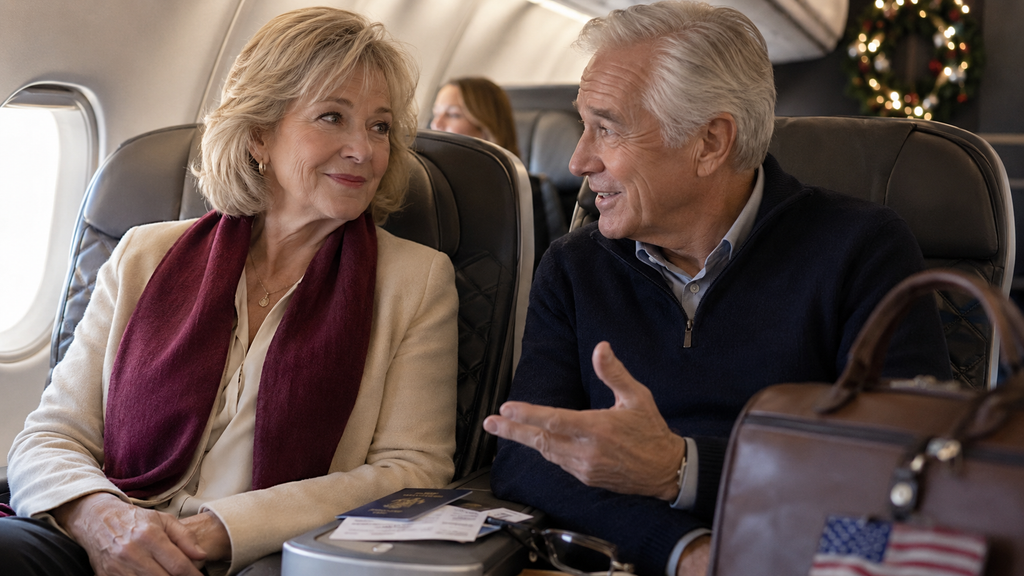
“Heading out,” I said.
The man smiled.
“Good.”
I laughed softly.
“You say that like there’s a correct answer.”
“There is when someone says it with the expression you just did.”
I turned toward him.
“What expression?”
“The expression of someone who has finally done something she’s been talking herself out of for a very long time.”
I stared at him.
He lifted both hands.
“I apologize. That sounded terribly intrusive.”
“No,” I said, surprising myself. “It was accurate.”
He smiled again.
Up close, I could see that he was probably a few years older than I was. He had kind blue eyes, a neatly trimmed silver beard, and the sort of calm confidence that didn’t need attention.
He extended his hand.
“Thomas.”
“Linda.”
“Nice to meet you, Linda.”
“You too.”
The plane began moving away from the gate.
My stomach tightened.
Not because I was afraid of flying.
Because until that exact moment, some part of me still believed Mark might call and say, “Mom, forget everything. Come spend Christmas with us.”
Some foolish little part of me expected the universe to restore everything to the way it used to be.
Then the wheels lifted from the runway.
The city disappeared beneath the clouds.
And with it went the Christmas I had spent years trying to preserve.
I didn’t know yet that the stranger sitting beside me was about to change the way my family saw me.
More importantly, I didn’t know he was about to change the way I saw myself.
Thomas opened a book after takeoff.
I tried to read too, but every few minutes I found myself staring through the window.
Eventually, he closed his book.
“First solo trip?”
“Is it that obvious?”
“Only because you’ve checked your passport four times.”
I looked down.
My passport was sitting safely inside my purse.
I laughed.
“Five.”
“That’s a respectable number.”
“Have you traveled much?”
“A little.”
There was something about the way he said it that made me suspect “a little” meant more than he wanted to admit.
“What about you?” he asked.
“My husband and I went to Europe once. Years ago.”
“Good trip?”
“The best.”
“What happened to him?”
There was no awkwardness in his voice.
No pity.
Just a simple question.
“He died eight years ago.”
Thomas’s face softened.
“I’m sorry.”
“Thank you.”
He looked toward the window.
“My wife died six years ago.”
There was a pause between us.
The strange thing about grief is that sometimes you can recognize another person who carries it without either of you saying much.
It is like noticing someone else speaking a language you thought only you understood.
“Was this a trip you took together?” I asked.
“No.”
He hesitated.
“It was a trip she wanted us to take.”
Something in his voice made me wait.
He continued.
“Evelyn loved Christmas markets. Every December she would cut pictures from magazines and leave them around the house where she knew I’d find them.”
I smiled.
“That sounds deliberate.”
“It was extremely deliberate.”
He chuckled.
“She wanted Vienna. Salzburg. Lucerne. Munich. I always told her we’d go the following year.”
His smile faded.
“There is always another year until suddenly there isn’t.”
Those words sat quietly between us.
I looked down at my hands.
“My husband used to tell me that I spent too much time taking care of everyone else.”
“What did you tell him?”
“That someone had to.”
Thomas nodded.
“And now?”
I thought about Hannah’s voice.
You can stay home and relax.
I thought about Mark promising they would “stop by after the holidays.”
I thought about my suitcase sitting upstairs for years while I waited for my life to become useful again.
“Now,” I said slowly, “I’m beginning to wonder if maybe he had a point.”
Thomas smiled.
“Well, Linda, if we survive airline food, I think Europe has a fair chance of helping us both.”
For the first time in days, I laughed without forcing it.
We talked on and off through most of the flight.
I learned Thomas had two grown daughters.
One lived in Boston.
The other lived in California.
Both had families of their own.
He told me that his daughters worried about him traveling alone.
“They think once a man turns seventy, he becomes incapable of reading signs in airports.”
“How old are you?”
“Seventy-one.”
“Then clearly they are right.”
He put a hand over his heart.
“Cruel.”
I smiled.
“What did you do before you retired?”
“Hotels.”
“That sounds interesting.”
“Sometimes.”
“Management?”
“You could call it that.”
Then he asked me about my life.
I told him I had worked as an elementary school librarian for nearly thirty years.
His face brightened.
“A librarian?”
“Yes.”
“Then I’m sitting beside a dangerous woman.”
“Dangerous?”
“You know things.”
I laughed again.
It had been so long since I had talked to a stranger without thinking about what they needed from me.
Thomas wasn’t asking whether I had made pecan pie.
He wasn’t asking me to watch children.
He wasn’t asking me to move dinner because someone else had plans.
He was simply curious about me.
Linda.
Not Mom.
Not Grandma.
Not Mark’s widowed mother.
Just Linda.
When we landed in Munich, I expected we would say goodbye and continue with our separate journeys.
Instead, while we were waiting for our luggage, Thomas looked at the tag hanging from my carry-on.
“You’re on the Evergreen Christmas tour?”
I stared at him.
“You too?”
He started laughing.
“Well, either fate has a sense of humor, or this tour company has very aggressive marketing.”
We were on the same trip.
Twelve days.
Germany.
Austria.
Switzerland.
I don’t know why, but that made me unexpectedly happy.
Our group met near the airport exit.
There were twenty-three of us.
Couples.
Two sisters from Arizona.
A retired teacher from Michigan.
A widower traveling with his adult daughter.
And me.
I noticed something else immediately.
Thomas didn’t act as though we had to stay together just because we had sat beside each other.
He spoke to everyone.
He carried one elderly woman’s suitcase when one of its wheels became stuck.
He asked the tour guide questions.
He helped a nervous man find his missing passport, which turned out to be inside the man’s coat.
He was comfortable anywhere.
That first evening, we arrived at our hotel near Munich’s old town.
I stood in my room looking at the bed, the heavy curtains, and the small chocolate placed on the pillow.
For a moment, loneliness returned.
I reached for my phone.
There were no messages from Mark.
No messages from Hannah.
They thought I was home.
Probably sitting beside my fireplace.
Probably wearing my slippers.
Probably waiting for Christmas to be over.
I almost called.
Then there was a knock on my door.
Thomas stood in the hallway wearing a dark wool coat.
“A few of us are walking to the Christmas market. You interested?”
Every instinct I had developed over the previous eight years told me to say no.
I was tired.
It was cold.
I should unpack.
I should call Mark.
I should behave like the version of myself everyone expected.
Instead, I grabbed my coat.
“Give me two minutes.”
Munich was glowing.
That is the only way I can describe it.
Thousands of tiny lights hung above the streets.
Wooden stalls surrounded the square.
There were ornaments, candles, roasted almonds, gingerbread, scarves, handmade toys, and cups of steaming mulled wine.
Church bells rang somewhere beyond the buildings.
Snowflakes drifted through the lights.
I stopped in the middle of the square.
Thomas looked at me.
“You all right?”
I nodded.
“I forgot places could look like this.”
He didn’t laugh.
He understood exactly what I meant.
We walked for hours.
I bought a small wooden angel.
Thomas bought nothing until we passed a stand selling hand-painted Christmas ornaments.
He picked up a tiny glass star.
“Evelyn would have bought twelve of these,” he said.
“Then you should buy one.”
He looked at me.
“I don’t need another ornament.”
“That’s not what I said.”
He considered this.
Then he purchased it.
Later, we stood near a large Christmas tree holding hot drinks.
Someone from our group offered to take our picture.
I almost said no.
For years, I had hated photographs of myself.
I always noticed the lines around my eyes.
The gray in my hair.
The difference between the woman in the photograph and the young bride standing beside Paul in our wedding album.
But Thomas simply stood beside me.
“Come on, librarian. Document the evidence.”
So I smiled.
A real smile.
The photograph showed the two of us beneath thousands of Christmas lights.
My cheeks were pink from the cold.
Thomas was holding his ridiculous glass ornament.
I looked happy.
Not pretending-to-be-happy happy.
Not “don’t worry about me” happy.
Happy.
That night, lying in bed, I looked at the picture again.
Then, without thinking too much, I posted it on Facebook.
I wrote:
“Sometimes the Christmas you didn’t plan becomes the one you needed. Munich tonight. I think I remembered how to smile.”
Then I went to sleep.
At 6:12 the next morning, my phone began vibrating.
At first, I thought it was my alarm.
Then it vibrated again.
And again.
And again.
I reached for it.
Seventeen missed calls.
Thirty-four text messages.
Dozens of Facebook notifications.
My heart jumped.
I immediately thought something terrible had happened.
Then I saw Mark’s messages.
MOM CALL ME.
MOM???
WHERE ARE YOU?
PLEASE CALL ME AS SOON AS YOU SEE THIS.
Then Hannah.
Linda, please call us.
We didn’t know you were traveling.
Please answer your phone.
Then another message appeared.
Linda, do you know who that man is?
I sat upright.
What man?
Then I remembered the photograph.
Thomas.
I stared at Hannah’s message.
I typed:
Yes. His name is Thomas.
Three dots appeared immediately.
Then disappeared.
Then appeared again.
Finally Hannah responded.
I know his name.
Do you know WHO he is?
Before I could answer, Mark called.
I stared at the screen for a few seconds.
Then answered.
“Hello?”
“Mom!”
He sounded panicked.
“Are you okay?”
“I’m fine.”
“Where are you?”
“Munich.”
“Germany?”
I looked around my hotel room.
“Unless there’s another Munich with this many pretzels.”
“Mom, this isn’t funny.”
“Why not?”
“Because you disappeared!”
“I didn’t disappear.”
“You left the country without telling us.”
I closed my eyes.
For a moment, I was tempted to apologize.
That reflex was so deeply rooted in me.
Sorry for worrying you.
Sorry for not asking permission.
Sorry for having a life you didn’t approve in advance.
Then I remembered Hannah telling me I could stay home.
“You told me you were spending Christmas with Hannah’s family,” I said.
“I know, but—”
“And you told me you would visit after the holidays.”
“Yes, but—”
“So I made plans.”
“With some man?”
I looked at the empty chair by the window.
“I met Thomas on the airplane.”
Mark went silent.
“You met him on the plane?”
“Yes.”
“You seriously don’t know who he is?”
“No.”
There was another pause.
Then Mark lowered his voice.
“Mom, that is Thomas Caldwell.”
“That’s what he told me.”
“Thomas Caldwell.”
“Yes, Mark. I understand his name.”
“The Caldwell.”
I frowned.
“Am I supposed to know what that means?”
In the background, I heard Hannah saying something quickly.
Then Mark said, “Caldwell Hospitality.”
Nothing.
“Caldwell Hotels?”
Still nothing.
“Mom, the Caldwell Grand in Chicago? The resort in Aspen? The properties in New York, London, Paris?”
“Oh.”
I looked toward the window.
“Those are his?”
“He founded the entire company.”
I blinked.
I thought about Thomas carrying Mrs. Jennings’s broken suitcase.
I thought about him searching for someone else’s passport on the airport floor.
I thought about him joking about airline food.
“You’re telling me Thomas owns hotels?”
“He owns more than hotels.”
“Interesting.”
“Interesting?”
Mark sounded as though I had just told him the weather forecast.
“Mom, the man is worth—”
“I don’t care.”
He stopped.
I surprised both of us.
I really didn’t care.
Not even a little.
Mark started again.
“How did you end up traveling with him?”
“We’re on the same tour.”
“You’re on a group tour with Thomas Caldwell?”
“Apparently.”
“Does he know who you are?”
That question bothered me.
I sat straighter.
“What exactly do you mean by that?”
“No, I just mean—”
“I’m your mother, Mark. That isn’t a secret identity.”
“I didn’t mean it like that.”
I could hear Hannah speaking in the background again.
Then Mark said, “Why didn’t you tell us you were going?”
“Would it have changed your Christmas plans?”
Silence.
There it was.
The answer.
“No,” I said softly. “I didn’t think so.”
“Mom…”
“You told me to relax at home. I decided Germany sounded more relaxing.”
“That’s not fair.”
I almost laughed.
“Which part?”
He had no answer.
Finally, he sighed.
“We were worried.”
“I understand.”
“Promise you’ll call us later.”
“I’m leaving for a walking tour in twenty minutes.”
“Then tonight.”
“We’ll see.”
“Mom.”
“Mark.”
It was the first time I had ever answered him that way.
Not angrily.
Not cruelly.
Simply as one adult speaking to another.
“I love you,” I said. “I’m safe. I’m having a wonderful time. And you don’t need to manage this.”
Then I hung up.
My hands were shaking.
I sat there staring at the phone.
For sixty-seven years, I had thought boundaries had to sound like anger.
That they required shouting or punishment or dramatic declarations.
But sometimes a boundary is nothing more than refusing to explain a decision that belongs to you.
There was another knock on my door.
When I opened it, Thomas stood there.
“Breakfast?”
I stared at him.
“What?”
He looked concerned.
“Are you all right?”
“Yes.”
Then I folded my arms.
“Actually, I have a question.”
“That sounds ominous.”
“Do you own half the hotels on the planet?”
Thomas closed his eyes.
“Oh.”
“That’s your answer?”
“I was hoping we might reach Vienna before Google ruined everything.”
I started laughing.
He looked embarrassed.
Actually embarrassed.
“You told me you worked in hotels.”
“I did.”
“You founded Caldwell Hospitality.”
“Technically.”
“Technically?”
“I had help.”
I stared at him.
He sighed.
“Would you prefer I start again?”
“Go ahead.”
He extended his hand as though we were meeting for the first time.
“Hello. My name is Thomas Caldwell. I am seventy-one years old. I’m retired. I have two daughters who tell me I need hearing aids. I make terrible coffee. I spent most of my adult life building hotels. I sold the controlling interest several years ago, although I still own a substantial portion of the company.”
I raised an eyebrow.
“How substantial?”
“Enough that your son apparently recognized me.”
I laughed.
“How do you know my son recognized you?”
“Your phone has been ringing loud enough to wake Austria.”
I shook my head.
Thomas’s expression became more serious.
“I should have told you.”
“Why didn’t you?”
“Because I enjoyed being Thomas.”
That answer stopped me.
He glanced down the hallway.
“People behave differently when they know.”
I understood that better than he realized.
“When Paul died,” I said, “people behaved differently around me too.”
Thomas looked at me.
“They stopped inviting me to couples’ dinners. People whispered when they mentioned anniversaries. Friends thought talking about their husbands would upset me.”
He nodded.
“For you, people saw money. For me, they saw grief.”
“And sometimes you just want someone to see you.”
“Yes.”
I smiled.
“Well, Thomas, I still think your taste in Christmas ornaments is questionable.”
Relief crossed his face.
“So we’re still getting breakfast?”
“Only if the billionaire buys coffee.”
“I knew this would happen.”
I laughed all the way to the elevator.
Over the next several days, I forgot about Facebook.
Mostly.
We traveled from Munich into Austria.
We walked through Salzburg beneath snow-covered roofs.
I listened to choirs sing in old churches.
I ate pastries I couldn’t pronounce.
I bought gifts for people I hadn’t planned to buy gifts for, including myself.
That felt strange at first.
Buying something simply because I liked it.
Not because it would look nice in Mark’s house.
Not because Hannah might use it.
Not because someone’s birthday was coming.
Because I wanted it.
In Salzburg, I bought a red wool scarf.
I stood in front of the mirror wearing it and heard Paul’s voice in my head.
Look at you.
I almost cried.
Then I smiled.
Thomas and I became friends in the effortless way that sometimes happens when two people meet at exactly the right moment.
We talked about our spouses often.
That surprised me.
I thought mentioning Paul around another man would feel wrong.
Instead, it felt comforting.
Thomas never competed with a ghost.
He asked questions.
What was Paul like?
What made him laugh?
What did we argue about?
I told him about Paul burning Thanksgiving dinner because he insisted on deep-frying a turkey after watching one television program.
Thomas laughed so hard he nearly spilled his coffee.
Then he told me Evelyn once tried to surprise him by repainting their bedroom while he was away.
“She chose yellow.”
“What kind of yellow?”
“Imagine a school bus suffering an identity crisis.”