
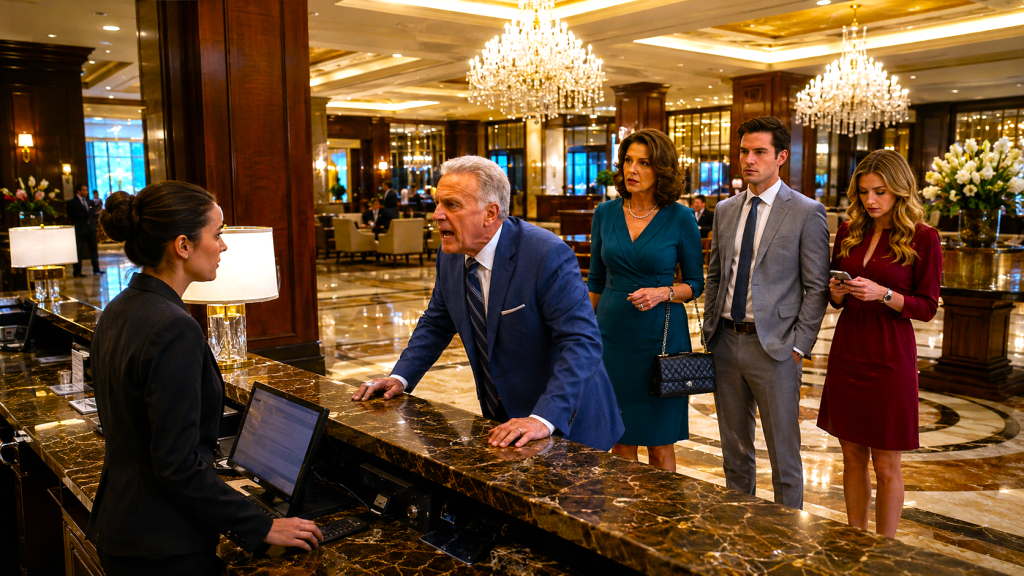
The family who erased me for seven years walked into my hotel like they still owned a piece of my future. My father didn’t say hello. He didn’t ask how I had been.
He stepped across the polished marble lobby, looked around at the brass lights, the fresh flowers, the guests checking in for the weekend, and said, loud enough for my front desk manager to hear, “So, you think owning a little hotel makes you better than us now?”
The lobby went still.
Behind him stood my mother, dressed carefully in a navy wrap dress, her hands folded around a small clutch like she had practiced looking gentle. My brother Derek stood beside her in a stiff collared shirt, his wife Cassandra scrolling on her phone as if this were already beneath her.
Seven years.
Not one birthday call.
Not one message after I graduated.
Not one word when I built my first property, sold it, reinvested, failed, tried again, and finally came back to Savannah as the owner of the Aldren.
And now they were standing in my lobby on a Friday night, under warm chandelier light, expecting me to shrink.
I kept my voice calm.
“Welcome to the Aldren,” I said. “Do you have a reservation?”
My father laughed.
It was the same laugh from my childhood. The one that made every room feel smaller. The one that always told me the joke was me.
“A reservation?” he said, turning toward my mother. “She’s asking if we have a reservation.”
My mother gave me that soft smile she used when she wanted something.
“Maya, sweetheart,” she said, “we didn’t even know this was your place. We’re here for Derek’s company dinner. He’s being recognized tonight.”
Derek glanced at me once and looked away.
That glance told me everything.
I stepped behind the front desk and checked the event list. The rooftop had been bought out by Hollis Group for a private client dinner.
Derek’s name was there.
One seat.
Not four.
No family guests.
No plus-three.
I looked back up at them.
“I’m seeing one confirmed seat under Derek Lawson,” I said. “The rooftop is a private event tonight, so I can’t add anyone without authorization from the host company.”
Derek’s jaw tightened.
“Can you just call up there and get it sorted?”
“I can contact the event coordinator, but the guest list is controlled by the host.”
My father stepped closer.
“Maya,” he said, lowering his voice just enough to make it feel personal. “We drove three hours. Your mother is tired. Surely you can find your family a table somewhere.”
Your family.
The words landed strangely after seven years of silence.
Still, I nodded.
“Of course. The dining room has availability.”
I had Celia, our dining manager, seat them near the window at one of the better tables because I ran my hotel professionally. I sent over the bread course. I checked on a rehearsal dinner in the courtyard. I handled a room-key issue for a couple from Nashville. I approved a last-minute dessert change for the rooftop event.
For thirty minutes, I let myself believe that would be the end of it.
Then Celia found me outside the kitchen.
“They’re asking for you again,” she said quietly.
When I reached the table, my father was sitting with his arms crossed. My mother’s bread roll sat untouched on the plate. Cassandra’s phone was face down now.
Derek was gone.
Of course he was.
Upstairs, where the important people were.
“Sit down,” my father said.
I stayed standing.
“Is there something wrong with the service?”
His mouth tightened.
“You can help us by acting like a daughter instead of a hotel employee.”
A server passed behind me carrying two plates. The silverware on the table caught the candlelight. My mother reached out and touched my wrist like she still had permission.
“We just want to talk, baby. We’ve missed you.”
Seven years, and the lie arrived wrapped in sweetness.
I gently moved my hand away.
“I’m working.”
My father leaned forward.
“Derek is being made partner next month.”
I said nothing.
“That changes things for this family,” he continued. “Socially. Professionally. People will be watching how we present ourselves.”
Cassandra lifted her chin slightly, as if the sentence had been written for her.
“They’re looking at a house in Ardsley Park,” my father said. “A real house. The kind that fits this next stage.”
There it was.
Not an apology.
Not a reunion.
A bill.
My mother rushed in softly.
“We only need help bridging the gap until Derek’s bonus comes through.”
“How much?” I asked.
My father didn’t blink.
“Sixty thousand.”
The table went quiet.
Outside the window, Savannah moved on without us. A couple walked past beneath the streetlamps. A valet opened the door for a guest. Somewhere upstairs, a room full of strangers laughed over drinks.
I looked at my father.
“No.”
The word came out clean.
His expression changed first in the eyes.
“You own a hotel, Maya. Don’t tell me you don’t have it.”
“What I have isn’t the point.”
“Then what is the point?”
“The last major financial decision this family made involving me was when my college fund disappeared without my knowledge,” I said. “Forty-two thousand dollars that had been meant for my education went to fix Derek’s situation. I worked my way through school after that. I built everything from there myself.”
My mother looked down.
Cassandra stopped pretending not to listen.
My father’s face hardened.
“That was years ago. You clearly landed on your feet.”
“I landed on my feet because I refused to stay where you left me.”
His hands flattened against the table.
“You chose to cut off your family.”
I almost smiled.
“No. I chose to stop standing at a locked door.”
For the first time that night, my father stopped performing.
His voice dropped.
“Let me be clear with you. Derek’s firm has relationships with people connected to this property. I happen to know someone who handles commercial leases in this area.”
Celia, across the room, froze near the host stand.
My father kept his eyes on me.
“It would be very easy for a concern to be raised when renewal comes around. Operators can be replaced. Buildings can change hands. You should think carefully about which relationships matter.”
My mother whispered, “Maya, don’t make this difficult.”
The candle between us flickered.
For a second, all I could hear was the old kitchen refrigerator from my childhood, humming while my father told me my future had already been spent.
Then I looked at the man across the table.
Calmly.
Directly.
And I asked, “Dad… who do you think owns this building?”
1. The Silence After the Question
My father stared at me.
It was only two or three seconds, but I watched an entire argument happen behind his eyes.
First confusion.
Then annoyance.
Then calculation.
Finally, he leaned back and gave a dismissive shrug.
“The investment company that owns half this block, obviously.”
Cassandra reached for her wine.
My mother looked between us.
I pulled out the empty chair at the end of the table and sat down for the first time.
“What investment company?”
My father frowned.
“Savannah Meridian.”
“Interesting.”
“What’s interesting about it?”
I folded my hands.
“Savannah Meridian Holdings LLC.”
He gave an impatient nod.
“Yes.”
I waited.
Nothing.
So I said, “I own Savannah Meridian.”
Cassandra’s wineglass stopped halfway to her mouth.
My mother blinked.
My father actually smiled.
Not because he believed me.
Because he thought I was joking.
“Maya.”
“I’m serious.”
“You own a hotel,” he said. “You do not own a commercial property company.”
“I own both.”
His smile disappeared.
I continued before he could interrupt.
“Savannah Meridian owns this building, the parking structure behind it, the retail unit next door, and two smaller properties on Whitaker Street. The Aldren Hotel is operated by Aldren Hospitality, which is another company I control.”
My father’s face went completely still.
Cassandra lowered her glass.
My mother whispered, “You own the building?”
“Yes.”
“All of it?”
“Yes.”
My father pushed back his chair slightly.
“That’s impossible.”
I almost asked which part.
The fact that I had succeeded?
Or the fact that I had succeeded without him?
Instead, I reached into my blazer pocket and pulled out my business card.
I set it on the table.
MAYA LAWSON
FOUNDER & MANAGING MEMBER
ALDREN HOSPITALITY GROUP
SAVANNAH MERIDIAN HOLDINGS
My father picked it up.
He looked at the front.
Then the back.
As if there might be an explanation printed somewhere in smaller letters.
“There’s no landlord for you to call,” I said. “There’s no lease renewal you can threaten. If someone from Derek’s firm told you otherwise, either they don’t know who owns the property or Derek has been telling you a story.”
For the first time that evening, Cassandra looked genuinely nervous.
My mother said, “Derek told us you managed this place.”
“Derek knows more than that.”
My father looked sharply at me.
“What does that mean?”
Before I could answer, the elevator doors opened across the lobby.
Derek stepped out with a man I recognized immediately.
Simon Hollis.
Founder of Hollis Group.
Derek’s employer.
And one of the people scheduled to meet me privately after the rooftop dinner.
Simon was in his late sixties, with silver hair and the calm manner of a man who had spent decades listening before speaking. His firm specialized in commercial redevelopment and private real estate investment.
Two years earlier, Hollis Group had tried to buy one of my properties.
I had declined.
Six months later, Simon and I had begun discussing something more interesting.
A joint redevelopment project.
Derek saw his family at the table and stopped.
Then he saw me sitting with them.
His face changed.
Simon followed his gaze.
“Maya,” he called warmly. “There you are.”
My father looked at me.
Then at Simon.
Then at Derek.
Simon came over and shook my hand.
“Beautiful event,” I said.
“You and your team have done a terrific job.”
He turned toward my family.
“Derek, I didn’t realize these were Maya’s parents.”
Derek cleared his throat.
“We’re related, yes.”
Related.
Not sister.
Not family.
Related.
Simon smiled politely at my parents.
“You must be proud of her.”
Nobody answered.
I almost laughed.
Simon’s smile weakened slightly.
Then he looked back at me.
“Are we still on for nine?”
“Absolutely.”
“Excellent. I have the revised numbers with me. I think you’ll like what the team put together.”
Derek was staring at me now.
“What revised numbers?”
Simon glanced toward him.
“For the East Broad project.”
Derek’s face drained of color.
I knew exactly why.
Because Derek had spent the last six months trying to become a partner at a firm where his estranged younger sister was quietly negotiating a multimillion-dollar development with the founder.
And apparently, he had never told our parents.
2. What Happened Seven Years Earlier
To understand why Derek looked frightened, you have to understand what happened the last time our family sat together around a table.
I was twenty-two.
Derek was twenty-eight.
He had always been the center of our parents’ plans.
He was the firstborn.
The son.
The one my father introduced by accomplishments.
“My son Derek, the future attorney.”
“My son Derek, top of his class.”
“My son Derek, joining a prestigious firm.”
I was usually introduced afterward.
“And this is Maya.”
When I was accepted into a highly regarded hospitality management program, my mother hugged me and said, “That’ll be nice until you decide what you really want to do.”
My father asked why I needed college to learn how to check people into hotels.
I laughed because I thought he was joking.
He wasn’t.
My grandmother, my mother’s mother, was different.
She had worked at a small inn near Charleston for nearly thirty years. She loved hotels—not the glamorous image of them, but the idea of temporary shelter becoming meaningful.
“A good hotel,” she once told me, “is a place where strangers trust you with a tiny piece of their lives.”
When she died, she left money for both Derek and me.
My parents managed the accounts until we were old enough to use them.
Mine contained forty-two thousand dollars by the time I entered college.
Or it should have.
During my junior year, I went to the bank because I needed tuition money.
The account held $1,137.
I thought there had been a mistake.
There hadn’t.
My father had transferred almost everything eighteen months earlier.
To Derek.
Derek had made what everyone called “a bad investment.”
That phrase was generous.
He had borrowed money to buy into a speculative restaurant project with two friends, used more borrowed money to renovate a leased building, and personally guaranteed debts he couldn’t repay.
When it collapsed, he panicked.
My father saved him.
With my money.
I confronted them at Sunday dinner.
I can still picture the room.
Roast chicken.
Green beans.
The chipped serving bowl my mother refused to throw away.
Derek staring at his plate.
My father drinking iced tea like we were discussing the weather.
“You weren’t using all of it,” he said.
“It was my college fund.”
“You had scholarships.”
“Not enough.”
“You can work.”
“Why couldn’t Derek?”
That changed everything.
My father put down his glass.
“Your brother made a mistake.”
“So you stole from me to fix it?”
My mother gasped.
“Don’t use that word.”
“What word should I use?”
“We’re family,” she said.
Apparently, family was the word people used when they wanted the victim to finance the person who hurt them.
I looked at Derek.
“Did you know the money was mine?”
He said nothing.
“Derek.”
Finally, he muttered, “Dad said it would get replaced.”
“Did you know?”
“Yes.”
That single word broke something in me.
Not because the money was gone.
Money can be earned again.
It broke because he had known.
My brother had watched our father take the security our grandmother left me and had accepted it because his failure mattered more than my future.
I stood up.
My father pointed at my chair.
“Sit down.”
“No.”
“Maya.”
“I’m done.”
He followed me into the kitchen.
“You walk out that door over money, don’t expect to come crawling back when the real world teaches you how hard it is.”
I remember turning around.
“The real world didn’t take my college money. You did.”
My mother began crying.
That made me the cruel one.
It always did.
I packed two bags that night.
I stayed with a classmate for three weeks.
Then I found a tiny room above a laundromat.
I worked mornings at a hotel front desk, classes during the afternoon, and restaurant shifts on weekends.
I graduated nine months later.
Nobody from my family came.
I sent my mother one text afterward.
I’m willing to talk if everyone can acknowledge what happened and we can discuss a repayment plan.
She responded the next morning.
Your father is too hurt by your behavior to speak with you.
That was the final message between us for seven years.
Until they walked into the Aldren.
3. The Things They Never Saw
My family assumed my life had become easier because they only saw the finished building.
They didn’t see the beginning.
My first job after graduation paid less than Derek spent leasing his first luxury car.
I worked at a struggling hotel outside Atlanta where the carpet smelled faintly damp and half the rooms needed renovation.
I loved it.
The owner was a seventy-year-old widow named Ruth Aldren.
Ruth knew everything about the property.
Which room had the best sunrise.
Which plumbing line froze first.
Which housekeeper was supporting three grandchildren.
Which corporate customer paid late.
She taught me that owning property had very little to do with marble lobbies and everything to do with numbers, maintenance, patience, and people.
For four years, I learned everything I could.
Eventually, Ruth offered me a tiny equity stake in a twenty-room property she wanted to renovate.
I invested every dollar I had saved.
It nearly ruined me.
Construction costs exploded.
Our lender changed terms.
A tropical storm damaged the roof three weeks before reopening.
I maxed out credit cards.
For six months, I slept in Room 8 because I couldn’t afford rent somewhere else.
But the property survived.
Then it thrived.
Three years later, we sold it.
My share was enough to change my life.
Not enough to retire.
Enough to choose my next risk.
I bought a neglected ten-unit building.
Renovated it.
Refinanced.
Bought another.
Sold one.
Lost money on another.
Made it back.
Learned.
Repeated.
By thirty-two, I had become very good at being underestimated.
Then Ruth died.
Her daughter called me six months later.
She was selling some of Ruth’s remaining holdings, including an old commercial building in Savannah that had once been a hotel.
The place was beautiful beneath the neglect.
Tall windows.
Original plaster.
Brass elevator doors.
A rooftop overlooking the historic district.
It also needed millions of dollars.
Everyone told me not to buy it.
I bought it.
I named the restored hotel the Aldren.
Not after myself.
After the woman who had treated my ambition as something worth teaching instead of something worth mocking.
Opening night was the proudest night of my life.
I stood alone on the rooftop after the guests left and cried.
Then I went downstairs and helped housekeeping because three employees had called out sick.
That was ownership.
Not the ribbon cutting.
The work after everyone went home.
My parents knew none of it.
But Derek did.
Because eighteen months before that Friday night, Hollis Group had approached Savannah Meridian about purchasing a parking structure I owned.
Derek was on the legal team.
He had seen my name.
He had seen the ownership records.
He had known.
And never once had he called.
4. My Brother’s Real Problem
Simon checked his watch.
“I’m going upstairs. Maya, whenever you’re ready.”
“I’ll see you at nine.”
He nodded and returned to the elevator.
Derek stayed behind.
The moment the doors closed, my father turned toward him.
“You knew?”
Derek glanced around the dining room.
“Can we not do this here?”
“You knew she owned the building?”
“I knew she had an interest in it.”
I raised an eyebrow.
“An interest?”
Derek looked at me sharply.
I could see the old instinct arriving—the belief that if he sounded confident enough, reality would adjust itself around him.
“The corporate structure is complicated.”
“No, it isn’t.”
“Maya.”
“Savannah Meridian owns the building. I own Savannah Meridian. That’s not complicated.”
My father looked at Derek.
“You told me her company leased the hotel.”
Derek ran a hand along his jaw.
“It technically does.”
I almost admired the desperation.
“Aldren Hospitality leases operating space from Savannah Meridian,” I said. “Both are mine. It’s an internal structure for liability and financing.”
My father’s expression darkened.
“So you lied.”
Derek pushed his chair in.
“I simplified it.”
Cassandra finally spoke.
“You told us Maya was basically the general manager.”
My mother looked genuinely confused.
“Why would you say that?”
“Because none of this matters!” Derek snapped.
Several diners turned.
Celia took one step toward us.
I gave her a tiny shake of my head.
Not yet.
Derek lowered his voice.
“The issue is the house.”
I looked at Cassandra.
“What house?”
She stared at her husband.
Apparently, this part had not been fully disclosed either.
My father answered.
“They have an offer accepted. Closing is next week.”
“For how much?”
“That’s private.”
“You came here asking me for sixty thousand dollars. Privacy has left the building.”
Cassandra closed her eyes briefly.
“One point three.”
I looked at her.
“One point three million?”
She nodded.
“They already own a house,” I said.
My mother answered, “It’s not appropriate anymore.”
I almost asked whether houses had developed social rankings while I was gone.
Cassandra spoke quickly.
“Derek’s partnership track changes our needs. We entertain clients. Other partners live in that area.”
Something in the way she said partnership track caught my attention.
Not partnership.
Track.
I turned to Derek.
“Dad said you’re being made partner next month.”
His jaw tightened.
“That’s the expectation.”
“The expectation according to whom?”
Silence.
My father looked at him.
“According to the firm.”
Derek didn’t answer.
I understood.
“Oh.”
Cassandra looked at me.
“What?”
“He hasn’t been offered partnership.”
Derek’s face flushed.
“You don’t know what you’re talking about.”
“I know Simon.”
“That doesn’t mean you understand internal firm decisions.”
“I understand he personally told me two weeks ago that the partnership committee wouldn’t finalize promotions until January.”
My father’s expression changed.
“January?”
Derek glared at me.
“You had no right to discuss me with Simon.”
“We weren’t discussing you.”
That hurt him more.
“He mentioned staffing for East Broad,” I continued. “Your name came up because you’ve been handling part of the preliminary work.”
My father stared at Derek.
“You said it was finalized.”
“It basically is.”
Cassandra whispered, “You told me the vote already happened.”
Derek turned on her.
“Not now.”
That was when I realized the sixty thousand dollars wasn’t merely for a house.
It was for a performance Derek could no longer afford.
He had told everyone he was becoming partner.
He and Cassandra had committed to a house based on money he didn’t have yet.
And somehow, after seven years without speaking to me, the family solution had once again become Maya pays.
Different decade.
Same table.
5. The Threat Becomes a Mistake
My father pointed at me.
“This is exactly why families should communicate. You know people at Derek’s company. You have resources. Instead of helping, you’re sitting here enjoying embarrassing him.”
“I didn’t bring any of this up.”
“You deliberately challenged him.”
“You asked me for sixty thousand dollars and threatened my business.”
“I did no such thing.”
Celia shifted near the host stand.
I looked directly at my father.
“You said you knew people connected to my lease and that a concern could be raised when renewal came around.”
“I was advising you.”
“No. You were threatening me.”
My mother reached for my hand again.
“Maya, your father gets forceful when he’s worried.”
I moved my hand.
“Mom, stop translating him into a nicer person.”
Her face fell.
For years, that had been her role.
Dad didn’t insult us.
He was under pressure.
Dad didn’t control us.
He cared.
Dad didn’t steal my college fund.