 Reading Time: 25 minutes
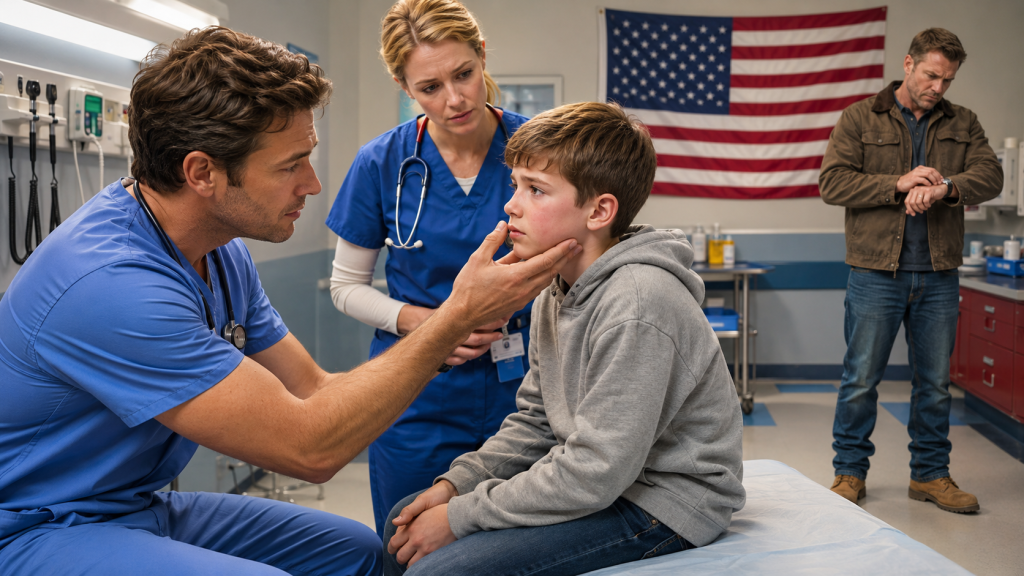
My nine-year-old patient’s stepfather dragged him into the emergency room by the wrist, demanded antibiotics, and said, “He’s not worth missing a shift over.”
Then I touched the boy’s swollen face—and something beneath his skin pushed back against my glove. The man stopped breathing.
So did I.
At 3:14 that rainy Tuesday morning, the emergency department at our small coastal Oregon hospital had finally gone quiet. Rain tapped against the ambulance-bay doors. Wet footprints crossed the waiting-room tile, a crooked stack of magazines sagged beside triage, and somebody’s coffee had been abandoned long enough to turn cold.
That was when Greg Mercer walked in with Leo.
Greg stayed close to the exit as though he had already decided how quickly they would leave. He wore work boots, a waterproof jacket, and a heavy steel watch that he checked three times before the registration clerk finished asking Leo’s name.
“Spider bite,” Greg announced. “Give him a Z-Pak or something. I work in three hours.”
Leo stood beside him in a gray hoodie soaked around the shoulders.
He was nine years old.
Greg could not remember his birthday.
“My wife handles that paperwork garbage.”
As he said it, his hand tightened around Leo’s wrist.
The boy did not cry out.
He simply turned his body sideways, almost automatically, making himself smaller.

I had worked emergency medicine for seventeen years. There are movements children make when they are frightened by needles, pain, or strangers.
And then there are movements children make when they are frightened of a specific person.
They are not the same.
I stepped between them.
“I’m Dr. Thomas. I’ll examine him in Room Four.”
Greg tried to follow close behind, but Leo walked ahead.
Inside, the boy sat on the paper-covered exam bed with both hands hidden in the front pocket of his hoodie while rainwater dripped from his shoes.
“Sit straight,” Greg ordered.
Leo’s shoulders snapped backward so quickly that the movement looked rehearsed.
Sarah, my night nurse, stood in the doorway holding the chart. She had been an ER nurse almost as long as I had been a doctor, and we had learned to communicate with expressions other people rarely noticed.
She tapped the chart twice.
Something was wrong.
Greg had told triage that the swelling had started after a spider bite.
He could not say when Leo had been bitten.
He could not describe the spider.
He did not know whether Leo had a fever.
And every time Sarah asked Leo a question, Greg answered.
“Looks dental from here,” Sarah murmured when Greg looked away.
I rolled my stool toward Leo but stopped well beyond his knees.
“Leo, can I lower your hood so I can see your face?”
He looked at Greg first.
Then he nodded.
I slowly pulled the hood back.
The right side of his face was swollen from his cheekbone almost to his jaw. Purple discoloration lay beneath hot, stretched skin. Near the center was a round opening that looked too deep and too clean to be an ordinary scratch.
There was also a smell.
Faint.
Damp earth mixed with something strangely sweet.
Greg wrinkled his nose.
“Nasty, right?”
Leo kept staring at the pens in my scrub pocket.
“Does your face burn?” I asked.
“No.”
“Does it sting?”
He shook his head.
“What does it feel like?”
For the first time, he looked directly at me.
“Heavy.”
Greg sighed dramatically.
“He exaggerates everything.”
I ignored him.
“When did you first notice it?”
Leo opened his mouth.
“Saturday,” Greg answered.
I turned toward him.
“I was asking Leo.”
Greg’s jaw tightened.
I needed the man farther away.
“There’s a pediatric examination clearance rule,” I said. “I need you against the far wall while I assess him.”
There was no such rule.
Greg looked at Sarah.
She did not blink.
He moved to the wall.
That was when Leo pulled his left hand from his pocket.
Bruises covered two fingers.
A thin red mark circled his wrist.
I also noticed how dry his lips were.
“When did you last eat?”
Leo thought about it.
“Yesterday.”
“What did you have?”
He looked uncertain.
“Toast.”
“Breakfast?”
He nodded.
It was after three in the morning.
Greg pushed away from the wall.
“He refuses food when he’s mad.”
I cleaned the skin beside the wound while Sarah prepared the equipment for blood work.
“Leo, I’m going to press gently around the swelling. Tell me if anything hurts.”
He nodded.
I placed two gloved fingers against his cheek.
The swelling was firm in some places, soft in others.
Then something underneath my fingertips rolled away.
I froze.
I told myself it was fluid shifting inside an abscess.
I pressed once more, very lightly.
Something moved toward my fingers.
Then pushed back.
I lifted my hand.
Across the room, Greg stopped checking his watch.
For half a second, nobody spoke.
Then he said, “We’re leaving.”
He crossed the room and grabbed Leo’s jacket.
Leo slid off the opposite side of the bed so quickly that the examination paper tore beneath his shoe.
Sarah pressed the silent security button.
Greg saw her thumb move.
His expression changed.
“You can’t hold my kid here.”
“You brought a seriously ill child into my department,” I told him. “He needs blood work, imaging, IV medication, and a surgical consultation.”
“He needs to stop lying.”
Leo lowered his eyes and moved until his shoulder almost touched my arm.
Two hospital security officers appeared outside the door.
Greg immediately smiled.
The transformation was remarkable.
One moment he had been furious.
The next he was the exhausted, reasonable parent dealing with a troublesome child.
“I’m tired,” he said. “The boy plays rough. His mother knows how he is.”
One officer asked Greg to step into the hall.
“I’m his father.”
“Step into the hallway, sir.”
“Stepfather,” Leo whispered.
Greg heard him.
The look he gave the boy lasted less than a second.
It was enough.
The officers escorted Greg away.
Sarah closed the door.
For a while, Leo and I said nothing.
I gave him water and crackers. He ate half of one cracker first, then glanced toward the door.
“No one is taking those away,” Sarah said gently.
He ate the rest.
I waited until the room had been quiet for several minutes before asking the question that mattered.
“Leo, did a spider make the mark around your wrist?”
He shook his head.
“What happened to your face?”
He picked at a loose thread on his hoodie and wound it around one finger.
Then he slowly let it unwind.
“He put me in the shed.”
1. The Shed
I kept my voice level.
“Who put you in the shed?”
“Greg.”
“For how long?”
Leo shrugged.
That worried me more than an exact answer would have.
“A few hours?”
Another shrug.
“Overnight?”
His eyes filled with tears.
“Two sleeps.”
Sarah turned away for a moment.
I felt something cold settle in my stomach.
“Was the door locked?”
Leo nodded.
“From the outside?”
Another nod.
“Why?”
This time his answer came immediately.
“I took food.”
“Food from where?”
“The kitchen.”
“What kind of food?”
“A granola bar.”
He said it like a confession.
Not stealing money.
Not breaking something.
A granola bar.
I asked why he needed to take food.
Leo rubbed his thumb across the red mark on his wrist.
“Greg said I was getting spoiled.”
I stopped asking questions.
There is a point in an examination when gathering more information yourself can do more harm than good. Children should not have to tell the same traumatic story to five different adults because each adult is curious.
I told Leo he had done nothing wrong by telling us.
Sarah called the pediatrician on call, the hospital social worker, and law enforcement. I contacted the regional pediatric surgery service because whatever was happening inside Leo’s cheek needed treatment beyond what our small hospital could safely provide.
His temperature was 102.1.
His heart rate was too fast.
Blood tests showed significant infection and dehydration.
We started IV fluids and antibiotics.
Then radiology called.
The CT scan did not show a dental abscess.
It showed a deep infected pocket extending through the soft tissue of Leo’s cheek.
Inside that pocket were several small irregular structures.
The radiologist hesitated before saying what he thought they might be.
“Foreign material?”
“Possibly.”
“Wood?”
“Some of it, maybe.”
“What about the movement?”
Another pause.
“I’d have surgery look.”
Twenty minutes later, Dr. Naomi Patel, the pediatric surgeon from the regional center, reviewed the images remotely.
She called me directly.
“Transfer him.”
“How urgent?”
“Now.”
“What do you think it is?”
“I’d rather confirm after exploration.”
That was physician language for something neither of us wanted to say over the phone.
I looked through the glass at Leo.
Sarah had given him a warmed blanket.
He was asleep sitting partly upright because lying on the swollen side of his face hurt too much.
“What should I tell the guardian?”
“Which guardian?”
“That,” I said, “is becoming complicated.”
A deputy arrived first.
Then our hospital social worker, Elaine.
Greg had already changed his story twice.
According to the deputy, Greg first claimed Leo had been playing in the shed.
Then he said Leo had locked himself inside.
Then he said there was no lock.
The deputy had asked him one simple question.
“If there’s no lock, why did you tell hospital staff you had to let him out Sunday morning?”
Greg stopped talking after that.
At 4:27 a.m., Elaine found Leo’s mother’s number.
Her name was Megan Mercer.
We called.
No answer.
Called again.
Nothing.
Greg claimed she was “probably asleep at work.”
“What does that mean?” I asked.
“She does overnight inventory at a distribution center inland,” Elaine said. “Four twelve-hour shifts.”
That meant Megan might have left for work before Leo was put into the shed and returned after he was released.
It did not explain the bruises.
It did not explain the hunger.
But it meant we still did not understand the entire house.
At 4:41, Megan finally called back.
Sarah handed me the phone.
A woman’s frightened voice said, “Where is my son?”
2. What His Mother Knew
I told Megan Leo was stable but seriously ill and needed transfer.
There was silence.
Then she asked, “Is Greg there?”
“He’s speaking with law enforcement.”
Another silence.
Longer this time.
“What happened?”
“I need you to come to the hospital.”
“I’m forty-seven miles away.”
“Drive safely. Leo is being transferred to Newport Children’s Medical Center. You can meet him there.”
Her breathing changed.
“Transferred?”
“Yes.”
“Greg said it was a mosquito bite.”
I looked at Sarah.
“What did Greg tell you happened?”
Megan began crying.
“He texted me a picture yesterday. He said Leo scratched a bug bite and it got infected. I told him to take Leo to urgent care. He said he would.”
“When did you last see your son?”
“Friday afternoon.”
It was now Tuesday morning.
“What?”
“I work four nights in a row. We’re short-staffed. I sleep at my sister’s apartment near the warehouse between shifts because the drive home is almost an hour.”
Her voice broke.
“Please tell me what happened.”
I could not give her all of Leo’s statement over the phone, especially with an investigation starting, but I told her his injuries did not fit the story Greg had provided.
Megan went silent again.
Then she said something I remembered for years.
“I knew he was too strict.”
Not violent.
Not dangerous.
Too strict.
People later asked how a mother could leave her son with a man like Greg.
That is an understandable question.
It is also rarely a simple one.
Abuse often does not begin with locked sheds.
It begins with rules.
With criticism.
With convincing someone that their instincts are wrong.
Greg controlled the household money because Megan was “bad with numbers.” He handled school messages because she was “too emotional.” He told her Leo manipulated her because she was “soft.” If Leo complained, Greg said the boy resented having a stepfather.
Then Greg gradually moved the line.
Push-ups as punishment became skipped dessert.
Skipped dessert became skipped meals.
Standing in the corner became standing outside.
A grabbed arm became “I had to restrain him because he was having a tantrum.”
By the time the behavior became unmistakably dangerous, everyone in the house had been trained to doubt their own interpretation of it.
That did not erase Megan’s responsibility.
But it helped explain why the truth had been hidden in plain sight.
The ambulance crew arrived at 5:06.
Before they took him, Leo grabbed my sleeve.
“Is Greg coming?”
“No.”
“Can he?”
“No.”
He studied my face as if he needed to know whether I was making a promise I could actually keep.
“Not in the ambulance?”
“Not in the ambulance.”
His fingers loosened.
“Okay.”
As paramedics rolled him toward the exit, one of the deputies returned.
“We’re getting a warrant for the property.”
“What changed?”
He held up a phone.
“Mom called back. Told us there’s a camera inside the shed.”
3. The Camera Greg Forgot
The camera had belonged to Megan’s father.
Years earlier, when the shed contained expensive fishing gear and power tools, he installed a small motion-activated security camera in the rafters.
After his death, Megan forgot about it.
Greg apparently did too.
The camera was old.
It did not transmit continuously.
But it saved short clips to a memory card whenever movement triggered it.
Police recovered the card that morning.
I did not see the footage that day.
I am grateful for that.
I eventually saw part of it months later during the court proceedings.
Twenty-six seconds were enough.
Leo stood inside the shed wearing the same gray hoodie he wore in my emergency room.
Greg stood outside.
There was no sound for the first few seconds.
Then Greg’s voice became audible.
“You want to behave like an animal, you can sleep where animals belong.”
The door closed.
A metal latch dropped.
The screen went dark.
Later clips showed Leo moving around inside.
He had no coat.
No blanket.
The nighttime temperature fell into the low forties.
In one clip, he held an empty plastic bottle beneath rainwater leaking through the roof.
In another, he pressed his face near a gap beside the door and called, “Mom?”
Nobody answered.
The final clip from the second night showed Leo sitting on the floor with his knees against his chest.
He barely moved for almost an hour.
The wound on his face had begun with an injury inside that shed.
Investigators found a broken wooden shelf with a protruding splintered edge and traces of blood.
Leo later remembered falling against it in the dark.
That explained the original wound.
It did not explain what pushed against my glove.
The pediatric surgeon called me shortly after seven that morning.
Leo had reached the children’s hospital.
He was already being prepared for surgery.
Dr. Patel’s voice was calm.
“Your instinct was correct.”
“Foreign body?”
“Partly.”
A fragment of decaying wood had remained embedded deep in the wound.
The wound then became badly infected.
But that was not all.
“Thomas,” she said, “there are larvae in the damaged tissue.”
For a second, I thought I had misheard her.
“Larvae?”
“Several.”
Wound myiasis is uncommon in healthy children receiving ordinary care. It occurs when flies deposit eggs in an exposed or neglected wound and the larvae develop in damaged tissue.
It was horrifying.
But the most horrifying part was not the medical condition.
It was what had to happen for a nine-year-old child in Oregon to develop it.
Leo’s wound had been open.
He had been confined in an unsanitary shed.
Then, after being released, nobody had properly cleaned or treated the injury.
By the time Greg brought him to our emergency room, infection had spread deeply enough that delaying treatment could have caused permanent damage.
Greg had wanted a prescription and a quick exit.
Had we given him what he demanded, Leo might have gone home.
I still think about that.
Medicine is full of moments that look insignificant while they are happening.
A nurse noticing a wrist.
A child looking at an adult before answering.
A man who checks his watch instead of watching the patient.
Two gloved fingers pressing a swollen cheek.
Small things.
Sometimes a life turns on them.
4. Megan Arrives
Megan reached the children’s hospital shortly before eight.
She called our ER afterward and asked for me.
I almost did not recognize her voice.
“He’s in surgery.”
“I know.”
“They said there were… things in the wound.”
“Yes.”
Then she started sobbing.
“I should have known.”
I said nothing.
There was nothing useful I could say.
She continued.
“Three weeks ago he had a bruise on his back. Greg said Leo fell off his bike. Leo said the same thing.”
Children frequently repeat the explanations they have been ordered to repeat.
“He hasn’t wanted me to go to work lately,” she said. “I thought he was having separation anxiety.”
Her words came faster.
“His teacher emailed me twice, but Greg said she was overreacting. He told me Leo was acting out because I babied him. Last month Leo asked if he could sleep at my sister’s house while I worked. Greg said no because running away from discipline would make him worse.”
“Megan.”
She stopped.
“You need to tell the investigators everything you remember. Even things that seem small.”
“I will.”
“And right now Leo needs one thing from you.”
“What?”
“He needs to know that when he tells the truth, adults believe him.”
She began crying again.
“I believe him.”
“Then tell him.”
Social services did not allow Megan to take Leo home when he was discharged.
That devastated her.
But I understood the decision.
When a child has been severely harmed in a home, love alone does not immediately make the environment safe.
Leo spent eleven days in the hospital.
The surgeons successfully cleaned the wound and removed the foreign material. He required repeated examinations, medication, and careful wound care.
He also required something that did not come through an IV.
Sleep.
Food.
Predictability.
The staff noticed that he hid crackers beneath his pillow.
He apologized whenever he asked for water.
If a man raised his voice in the hallway, Leo stiffened.
When a nurse accidentally dropped a metal tray, he slid off his bed and crouched beside it before anybody understood what he was doing.
A child-life specialist named Carmen eventually discovered that Leo loved drawing maps.
Not treasure maps.
Floor plans.
He drew the hospital room.
He drew the nurses’ station.
He drew every exit.
Carmen asked why.
Leo answered, “I like knowing where the doors are.”
That sentence ended up in the social worker’s report.
After discharge, Leo went to live temporarily with Megan’s older sister, Rachel.
Megan moved into the apartment next door.
She voluntarily agreed not to be alone with Leo until child welfare completed its assessment.
She attended every meeting.
She answered every question.
She quit defending Greg.
Most importantly, she stopped asking Leo why he had not told her sooner.
Instead, she began asking herself why he had believed he could not.
5. Greg’s Story Falls Apart
Greg was arrested the morning police searched the property.
He denied locking Leo in the shed.
Then investigators told him about the camera.
He said the footage was “taken out of context.”
He denied withholding food.
Police found a handwritten chart taped inside a kitchen cabinet.
It listed offenses and punishments.
TALKING BACK — NO DINNER.
LYING — OUTSIDE.
STEALING — SHED.
CRYING DURING PUNISHMENT — ADD ONE HOUR.
At the bottom was another line written in block letters.
DO NOT LET MEGAN CANCEL CONSEQUENCES.
Greg claimed it was a “behavior plan.”
Investigators found something else.
A stack of school notices hidden inside Greg’s workbench drawer.
Leo’s teacher had sent letters home documenting changes in his behavior.
He had fallen asleep in class four times.
He had asked classmates for pieces of their lunches.
He had stopped participating in soccer.
During recess, he remained close to the supervising teacher instead of playing with friends.
One note read:
Leo became visibly distressed when informed today was Friday. He repeatedly asked what time school would end and whether he could stay for the after-school program.
Megan had never seen the note.
Greg had signed it.
Police also recovered text messages between Greg and Megan.
They painted a familiar picture.
When Megan asked why Leo had bruises, Greg said:
Because boys play. Stop making him weak.
When she asked why Leo was losing weight:
He sneaks junk food. I’m fixing it.
When she said Leo sounded upset on the phone:
He performs for you because you reward drama.
And on Sunday morning, after Leo had spent the second night in the shed, Megan texted:
Please send me a picture of him. I miss him.
Greg replied:
He’s sleeping. Stop hovering.
Leo had not been sleeping in his bed.
He had been locked behind a shed door.
The evidence did not make Megan look blameless.
It showed months of warning signs she had failed to fully confront.
She admitted that.
That mattered.
At a child-welfare hearing, the judge asked whether she believed Greg had manipulated her.
“Yes.”
“Do you believe that excuses your failure to protect your son?”
Megan’s attorney began to rise.
Megan touched her arm.
“No,” she said.
The judge looked at her.
Megan continued.
“I want it to explain how I got there because I need to understand it so I never get there again. But no. It doesn’t excuse me.”
That answer mattered too.
6. The Question Leo Wouldn’t Answer
Three weeks after the ER visit, I received a call from Carmen, the child-life specialist.
Leo had asked about me.
Children remember surprising details from frightening nights.
He remembered Sarah’s purple shoes.
He remembered the warmed blanket.
He remembered that my pen had a cracked pocket clip.
And he remembered that I told him Greg would not ride in the ambulance.
“He wants to know something,” Carmen said.
“What?”
“Whether you knew.”
“Knew what?”
“That Greg was lying.”
I thought for a moment.
“What did you tell him?”
“That I’d ask you.”
I requested permission from his treatment team before speaking with him.
When Leo came on the phone, his voice sounded stronger.
“Hi, Dr. Thomas.”
“Hi, Leo.”
“Did you know Greg was lying before I told you?”
“I knew some things didn’t make sense.”
“How?”
I considered giving him the medical answer.
The injury did not match a spider bite.
The history was inconsistent.
His dehydration suggested neglect.
But that was not what he was asking.
“Because you looked scared when he talked.”
Silence.
Then:
“Oh.”
“You also looked at him before answering questions.”
Another silence.
“He said doctors always believe parents.”
“Doctors should listen to children too.”
Leo did not answer.
After a moment he asked, “Do you think I’m a liar?”
“No.”
“Even about the shed?”
“Especially about the shed.”
His breathing changed.
I heard him sniff.
Then he asked the question no nine-year-old should ever have to ask.
“If I told Mom sooner, would it have stopped?”
I closed my eyes.
“Leo, the adults were responsible for keeping you safe. You were responsible for being nine.”
He cried quietly.
So did I.
7. The Other Child
The investigation might have ended with Leo.
It did not.
Greg had a daughter from an earlier relationship.
Her name was Kayla.
She was nineteen and attending community college in Washington.
Detectives contacted her after finding her name in family records.
At first, Kayla said she had nothing to tell them.
Then an investigator mentioned the punishment chart.
Kayla went silent.
“What chart?”
The detective described it.
According to testimony later given in court, Kayla began crying before he finished.
Greg had used a similar system when she was a child.
No shed.
But closets.
Skipped meals.
Cold showers.
Hours standing with her nose against a wall.
She had told a school counselor when she was twelve.
Greg convinced people she was angry about his divorce from her mother.
Eventually Kayla stopped talking.
At sixteen, she moved permanently in with her grandmother and cut contact with him.
When detectives asked why she had never warned Megan, Kayla gave an answer that haunted everyone involved.
“I didn’t know there was a little boy.”
Greg had told her he was single.
Kayla agreed to testify.
That changed the case.
Greg could no longer argue that the shed was a single punishment taken too far.
A pattern existed.
Control.
Isolation.
Humiliation.
Then escalation.
The district attorney did not need to dramatize it.
Greg’s own words did most of the work.
His attorney argued that the wound itself was accidental.
Technically, that may have been true.
Leo had fallen against a broken shelf.
But the prosecution’s response was simple:
A child does not need to be intentionally cut for an adult to be responsible for locking him somewhere that turns an ordinary wound into a medical emergency.
8. The Hearing
Six months later, I was subpoenaed.
The courtroom was smaller than I expected.
Greg wore a dark suit.
Without the work boots, waterproof jacket, and steel watch, he looked ordinary.
That unsettled me.
People often imagine dangerous adults should somehow look dangerous.
Most do not.
Greg’s lawyer asked me whether I personally witnessed him put Leo into the shed.
“No.”
“Did you personally witness him strike the child?”
“No.”
“So you cannot testify that Mr. Mercer caused the facial injury?”
“I can testify about the child’s condition when he arrived.”
“And that injury could have resulted from an accident.”
“The original break in the skin could have.”
“Thank you.”
“I wasn’t finished.”
The lawyer paused.
“The severity of Leo’s condition resulted from delayed care and prolonged exposure of the wound. He was dehydrated, febrile, malnourished, and frightened. Those things were not caused by bumping into a shelf.”
Greg stared at me.
It was the same stare he had given Leo in Room Four.
His lawyer changed subjects.
“Doctor, children sometimes misstate events, correct?”
“Everyone can misstate events.”
“Children can lie?”
“Yes.”
“Children can exaggerate?”
“Yes.”
“So when Leo told you he had been locked in a shed, you could not know whether that was true.”
“Not from his statement alone.”
“Exactly.”
“But his account was later supported by physical evidence and video.”
The prosecutor objected before Greg’s attorney could respond.
The judge sustained part of it.
The lawyer moved on.
Then the prosecutor asked me one final question.
“What made you prevent the child from leaving that night?”
I looked at Leo.
He was not in the courtroom.
Children’s advocates had worked hard to spare him unnecessary exposure to the proceedings.
So I answered for the empty chair where I imagined him sitting.
“Because his body was telling us something his words were too frightened to say.”
The courtroom went quiet.
9. Leo Speaks
Leo eventually chose to give a recorded statement rather than testify in open court.
I saw only a small portion.
He sat beside a trained interviewer holding a stuffed sea otter.
The interviewer did not ask, “Did Greg hurt you?”
She asked open questions.
“Tell me about the shed.”
Leo began slowly.
Greg had become angrier after losing overtime hours at work.
He started blaming Leo for small things.
Milk left out.
Shoes near the door.
Television volume.
A missing screwdriver Leo had never touched.
Punishments grew longer.
Greg repeatedly told Leo his mother was exhausted because of him.
“If you weren’t so expensive, she wouldn’t have to work nights.”
That sentence appeared several times in Leo’s account.
It explained the stolen granola bar.
Leo was hungry, but he had also started believing food itself was something he cost his mother.
The Friday before the ER visit, he took a granola bar from the pantry after dinner had been withheld.
Greg found the wrapper.
He marched Leo outside.
The shed door closed.
Leo slept on flattened cardboard.
He urinated into an old bucket because he could not get out.
When he called for help, Greg returned once and told him the neighbors would call the police if he kept yelling.
Leo believed the police would arrest him.
On the second night, frightened by a noise outside, he stood quickly in the darkness and fell against the broken shelf.
His cheek began bleeding.
The following morning Greg opened the door.
He looked at Leo’s face and said, “That’s what happens when you act stupid.”
Leo was allowed to wash.
Greg put a bandage over the wound.
No doctor.
No urgent care.
No call to Megan.
By Monday evening, the swelling was obvious.
Leo developed fever and vomited.
Only then did Greg decide to take him to the hospital.
Not because Leo needed help.
Because Greg was afraid Megan would see him when she came home.
That was why he arrived at 3:14 a.m.
He wanted antibiotics before his shift.
He wanted a simple diagnosis.
He wanted a doctor to write “spider bite” in the chart.
Then he could show Megan paperwork confirming the story he had already created.
Instead, something beneath Leo’s skin moved.
And Greg realized the lie was no longer under his control.
10. Megan’s Choice
The most important court hearing was not Greg’s criminal proceeding.
For Leo, it was the custody hearing nine months later.
Megan had spent those months rebuilding her life.
She moved permanently out of Greg’s house.
She obtained a protective order.
She attended counseling focused on coercive control and protective parenting.
She changed jobs so she no longer spent four consecutive nights away.
She attended nearly every medical appointment, therapy appointment, school conference, and supervised visit available to her.
But nobody promised that effort would automatically return Leo to her care.
Rachel, her sister, had given him stability.
He was thriving there.
The judge made clear that the decision would be based on Leo’s safety, not Megan’s desire for forgiveness.
Megan understood.
When asked what she wanted, she said, “I want my son home.”
Then she added, “But if he isn’t ready, I want him safe more.”
Leo’s therapist had recommended a gradual reunification.
Weekend visits first.
Then school nights.
Then longer stays.
The judge approved it.
Megan cried.
Not because she had lost.
Because for the first time in months, the path forward was real.
Before leaving court, Leo asked to speak privately with the judge through his advocate.
Nobody told me the conversation until much later.
According to Megan, Leo asked one question.
“If I live with Mom again and I tell her something bad, does she have to believe me?”
The judge answered carefully.
“She has to listen, take you seriously, and keep you safe.”
Leo nodded.
“That’s what I want.”
11. What Happened to Greg
Greg eventually accepted a plea agreement after the video evidence, medical findings, and Kayla’s testimony made his chances at trial increasingly poor.
He pleaded guilty to multiple charges related to child mistreatment, unlawful confinement, and assaultive conduct.
He received a prison sentence and was prohibited from contacting Leo.
The exact number of years mattered enormously to lawyers and newspapers.
Oddly, it mattered less to Leo.
When Carmen told him Greg could not come to his school or home, he asked only:
“Can he come to the hospital?”
“No.”
“What about Aunt Rachel’s?”
“No.”
“What if I’m at the grocery store?”
“If that ever happens, the adults with you know what to do.”
Leo thought about that.
Then he asked:
“So I don’t have to hide?”
“No.”
That was the first thing about Greg’s sentence that seemed to matter to him.
He did not have to hide.
Kayla attended the sentencing.
She sat behind Megan.
Afterward, the two women spoke for the first time.
Megan apologized.
Kayla shook her head.
“You didn’t know about me.”
“I should have known about Leo.”
Kayla looked toward the hallway where the child advocates had taken him.
“Then make sure he grows up knowing none of it was his fault.”
They hugged.
Not as friends.
Not yet.
But as two people standing on opposite sides of the same terrible history.
12. One Year Later
Almost a year after the rainy night in Room Four, I was working another overnight shift when Sarah walked into the physician workroom holding an envelope.
“No return address,” she said.
My name was written across the front in uneven block letters.
Inside was a drawing.
A boy stood beside a hospital bed.
A doctor had enormous hands and hair that looked suspiciously like a broom.
A nurse wore bright purple shoes.
There was an ambulance outside.
At the top Leo had written:
ROOM 4
Underneath:
THIS IS WHERE THEY BELIEVED ME.
I sat staring at those words until they blurred.
There was also a note from Megan.
Leo was back home with her full-time.
He had gained weight.
He had joined an after-school robotics club.
He still disliked dark rooms.
He still stored snacks in odd places occasionally.
His therapist said not to make a battle of it, so Megan simply kept a basket of food in the kitchen with a handwritten sign:
LEO’S. ALWAYS AVAILABLE. NO PERMISSION NEEDED.
He had recently invited a friend to sleep over.
That might sound ordinary.
For Leo, it was enormous.
Megan wrote that he had checked the back door four times before bed.
Then he slept until eight in the morning.
She ended the note with one sentence.
Thank you for noticing what I had taught myself not to see.
I folded the paper slowly.
The sentence bothered me.
I did not want Megan carrying the story that way forever.
She had failed her son for a time.
That was true.
She had also done the much harder thing afterward: she stopped protecting her own explanation of the past and started protecting Leo.
People often think redemption should erase failure.
It does not.
Real redemption is learning to live honestly beside the thing you failed to do and choosing differently every day afterward.
I wrote her back.
I told her the person she really needed to thank was Leo.
He had survived long enough to speak.
And once the door closed between him and Greg, he had trusted us with four words:
He put me there.
13. The Second Visit
Two years passed.
Then one Saturday afternoon, while I was finishing charts, the unit clerk called me.
“There’s somebody asking for you.”
“Patient?”
“Not exactly.”
I walked toward the waiting room.
Leo stood near the vending machines.
He was eleven now.
Taller.
His hair was longer.
A faint pale scar remained along his right cheek, but if you did not know where to look, you might miss it.
Megan stood beside him.
Rachel was there too.
Leo held a paper bag.
“You still have the broken pen?” he asked.
I laughed.
“No. Eventually even doctors throw things away.”
He reached into the bag and handed me a boxed pen.
It was inexpensive.
Blue plastic.
Probably five dollars.
Across the side, someone had printed:
DR. THOMAS — ROOM 4
“I bought it with my allowance.”
“That is an excellent pen.”
“I tested it.”
“Even better.”
He looked toward the hallway.
“Is Room Four busy?”
At that moment it happened to be empty.
I asked the charge nurse, then brought them back.
The room had been remodeled since his visit. New cabinets. New monitor. Different paint.
Leo stood just inside the doorway.
“This isn’t how I remember it.”
“That happens.”
He walked to the exam bed.
“Was Greg standing there?”
He pointed toward the wall.
“Yes.”
“And Sarah was there?”
“Near the door.”
“And you were sitting here?”
He pointed to the stool.
“About there.”
He nodded.
Then he placed his hand against his cheek.
“Did you really feel it move?”
“Yes.”
“Were you scared?”
I could have said no.
Adults often believe children need us to be fearless.
But courage and fear are not opposites.
“I was.”
Leo looked surprised.
“You were?”
“Very.”
“Then why didn’t you let us leave?”
“Because being scared doesn’t mean you stop doing what needs to be done.”
He considered that.
Megan looked away, wiping her eyes.
Leo asked one more question.
“What would have happened if it hadn’t moved?”
This was the question I had asked myself countless times.
Would I still have stopped them?
His fever, dehydration, wound, bruises, wrist mark, hunger, and behavior were already concerning enough to justify intervention.
But the movement had transformed concern into certainty that something medically severe was happening.
“I think we still would have kept asking questions,” I said.
“You think?”
“I hope.”
He nodded.
That was not enough.
I corrected myself.
“No. I know Sarah would have kept asking. And I would have listened to her.”
From the doorway Sarah said, “Correct.”
None of us had heard her arrive.
Leo’s face brightened.
“You still have purple shoes.”
Sarah looked down.
“Different pair.”
“They look the same.”
“That’s because I have excellent taste.”
For the first time since I had known him, I heard Leo laugh inside Room Four.
14. The Door
Before leaving, Leo noticed something that had not changed.
The door.
Same heavy hospital door.
Same steel handle.
He reached for it.
Then stopped.
Megan did not rush him.
Neither did I.
Leo wrapped his fingers around the handle and pulled it open.
Then he let it close.
He opened it again.
Closed it.
Opened it a third time.
“What are you doing?” Sarah asked gently.
Leo smiled.
“Checking.”
“Checking what?”
“That it opens from this side.”
No one spoke for several seconds.
Then he walked through.
Children who survive frightening homes do not always measure recovery in the ways adults expect.
We look for grades.
Weight.
Medical healing.
Court outcomes.
Therapy reports.
Those things matter.
But sometimes healing is a door.
A snack basket.
Sleeping until morning.
Inviting a friend over.
Asking a question without checking an adult’s face before finishing it.
Sometimes it is walking into the room where the worst secret of your life finally became visible—and discovering that the door still opens from your side.
Leo returned to school.
Megan rebuilt their home around routines instead of punishments.
Breakfast was always available.
No locked food.
No punishment involving isolation.
No adult was allowed to demand secrecy from him.
If Megan worked late, Leo stayed with Rachel because that was what made him feel safest.
Kayla visited twice that year.
The first meeting was awkward.
The second was easier.
By the third, she and Leo had developed the peculiar closeness of siblings separated by years but connected by an experience neither wished the other understood.
Kayla once told Megan something worth remembering.
“Don’t make his whole childhood about what Greg did.”
So they did not.
Leo played soccer again.
He hated defense and insisted on playing forward.
He became obsessed with astronomy.
He broke his left thumb falling from a skateboard and complained loudly enough in the emergency room that Megan later joked it was the happiest she had ever been to hear him yell.
At twelve, he stopped sleeping with his bedroom light on.
At thirteen, he asked Megan if they could finally get rid of the emergency snack basket.
She asked why.
“Because I know there’ll be breakfast.”
She kept the basket anyway.
Not because she doubted him.
Because sometimes the visible promise matters.
15. The Thing I Remember
People who hear this story usually remember the same detail.
Something moved beneath Leo’s skin.
They ask what it felt like.
They ask what the surgeons found.
They ask whether I had ever seen anything like it.
Yes, the medical finding was unusual.
Yes, it was disturbing.
But that is not what I remember most.
I remember Greg saying, “He’s not worth missing a shift over.”
I remember Leo snapping his back straight when told to sit up.
I remember bruised fingers emerging from a hoodie pocket.
I remember him eating a cracker as though someone might punish him for finishing it.
I remember the red mark around his wrist.
I remember how quickly Greg wanted to leave the instant he understood we were no longer accepting his explanation.
And I remember four quiet words spoken only after the door had closed.
“He put me in the shed.”
The moving wound got everyone’s attention.
Leo’s fear told the deeper story.
That is the part I have never forgotten.
Years later, I keep his blue plastic pen in the top drawer of my desk.
It is not elegant.
It leaks occasionally.
The lettering has started to fade.
I own better pens.
I use that one anyway.
Whenever a frightened child comes into my department with an adult who speaks too loudly, answers too quickly, or seems more interested in leaving than in understanding what happened, I notice the pen.
Not because every demanding parent is abusive.
Not because every bruise hides a crime.
Medicine cannot operate on suspicion alone.
But children deserve space to speak.
They deserve questions asked directly to them.
They deserve adults willing to notice when an explanation does not fit.
Most of all, they deserve to know that telling the truth will not make things worse.
One rainy night, Leo walked into our hospital believing the opposite.
He believed adults automatically believed other adults.
He believed taking food could make him bad.
He believed punishment could be deserved simply because the person delivering it said so.
He believed a locked door meant nobody was coming.
By sunrise, police were searching the shed.
By afternoon, surgeons had treated the infection.
Within months, the man who terrified him could no longer reach him.
But none of those were the moment Leo later chose to draw.
He did not draw the police.
He did not draw the courtroom.
He did not draw Greg being taken away.
He drew an examination room.
A doctor with ridiculous hair.
A nurse in purple shoes.
And a door.
Above it he wrote:
THIS IS WHERE THEY BELIEVED ME.
For years I thought our job that night was to save Leo from an infection.
I eventually understood that the infection had already done something none of us could have predicted.
It forced a hidden truth to the surface.
Greg had walked into my emergency department wanting a prescription that would preserve his lie.
He expected an antibiotic, a discharge paper, and enough time to clock in for work.
Instead, he brought Leo into the first room where someone separated the child from the story Greg had built around him.
The first room where a bruise was not dismissed as rough play.
Where hunger was not called stubbornness.
Where fear was not called disrespect.
Where silence was not mistaken for proof that everything was fine.
And where, when a nine-year-old finally whispered what had happened behind a locked shed door, the adults did not ask him to prove he deserved to be believed before they protected him.
They simply listened.
That turned out to be the beginning of everything.
THE END!