 Reading Time: 10 minutes
On my thirty-second birthday, my father walked through my front door carrying a white bakery box and saw the bruises on my face. That was the moment everything changed. Until then, I had been pretending. Pretending the concealer worked.
Pretending my hands were not shaking. Pretending the purple marks along my cheekbone and jaw were not visible beneath the kitchen lights. Pretending my husband, Derek, had not turned my birthday morning into another reminder that fear had become the loudest thing in my marriage.
My name is Emily Bennett.
At least, that was my name before I married Derek Harlan and became someone I barely recognized.
I used to be loud.
I used to laugh with my whole body.
I used to wear red lipstick and sing in the car with the windows down.
Now I checked the driveway before opening curtains.
I kept my phone on silent.
I memorized the sound of Derek’s footsteps.
I learned which moods were dangerous and which smiles meant I should move quietly.
That morning, Derek’s mother Linda had come over with a pie.
Not because she loved me.
Because she loved watching her son sit at my table like a king.
She had seen the bruises.
Of course she had.
She saw everything.
She saw the way I flinched when Derek reached too quickly for his coffee.
She saw the way I stood near the sink instead of sitting down.
She saw the way I kept my sleeves pulled low even though the kitchen was warm.
But Linda had spent years explaining away her son.
“He has a temper.”
“He works hard.”
“You know how men are.”
“You should not provoke him.”
That morning, she cut slices of pie with slow, careful hands and never once looked me in the eye.
Derek sat at the dining table with one ankle resting over his knee.
He was sipping coffee from my favorite mug.
The one my father had bought me when I opened my little floral shop.
World’s Best Bloom Boss.
Derek hated that mug.
He said it made me look childish.
That day, he used it because he knew I would notice.
He liked small cruelties.
They were his appetizers.
I was setting paper plates on the counter when the doorbell rang.
For one foolish second, I smiled.
Dad.
Richard Bennett never missed my birthday.
Not once.
Even after my mother died.
Even after his knees got bad.
Even when Derek made excuses for why we could not visit.
My father always came.
The door opened before I could reach it.
Dad had a key.
He stepped inside carrying a white bakery box tied with red string.
My favorite strawberry shortcake from Miller’s Bakery.
“Happy birthday, sweetheart—”
The words died in his mouth.
His smile fell.
His eyes moved across my face.
The bruised cheek.
The swollen jaw.
The yellowing mark near my temple that powder could not hide.
For a second, nobody spoke.
Even Derek stopped sipping coffee.
Dad set the cake box on the counter very carefully.
Too carefully.
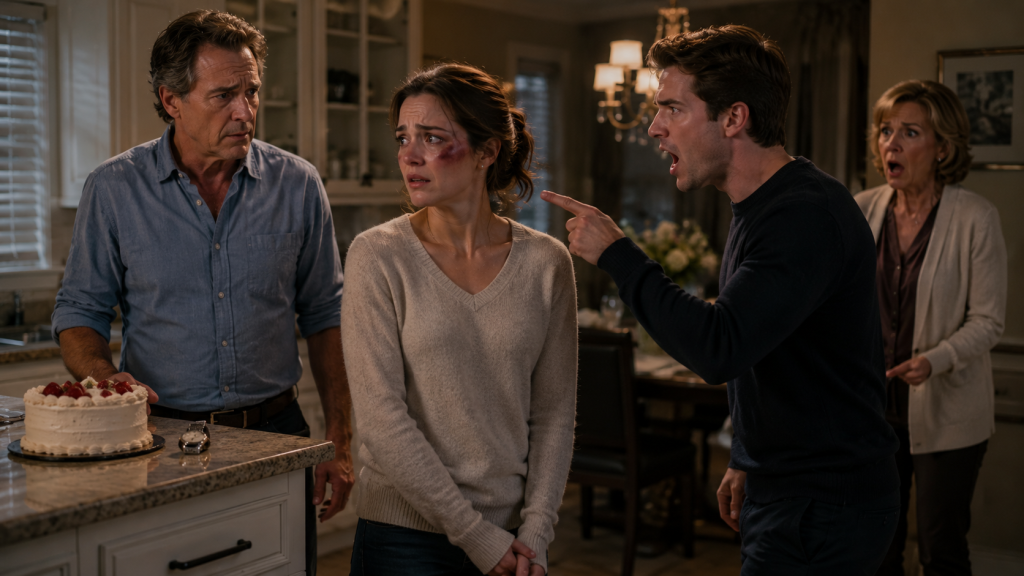
Like if he moved too fast, something inside him might break loose.
“Emily,” he said, voice low, “sweetheart… who did this to you?”
My throat closed.
I opened my mouth.
No sound came.
Derek answered first.
He actually laughed.
“Oh, that was me,” he said with a smug grin. “Instead of congratulations, I gave her a slap.”
Linda let out a short, nervous chuckle.
It was the ugliest sound I had ever heard.
Derek leaned back, still smiling.
He expected Dad to yell.
Or maybe he expected him to freeze.
Derek had always mistaken kindness for weakness.
He had never understood my father.
Richard Bennett was not a loud man.
He had spent thirty years fixing engines in a garage behind our old house.
He taught me how to change oil, patch a tire, plant tomatoes, and look people in the eye when I told the truth.
He was gentle with children.
Patient with broken machines.
Quiet in church.
But my father had one rule.
No one hurts family.
Dad stared at Derek for a long moment.
His expression went completely blank.
That scared me more than rage would have.
Then he slowly unbuckled his watch.
It was old silver.
Scratched from decades of work.
He placed it on the counter beside the cake.
The little click of metal against granite sounded enormous.
Linda stopped cutting pie.
Dad rolled up the sleeves of his blue button-down shirt.
One cuff.
Then the other.
Same calm focus he used when repairing engines.
Nothing hurried.
Nothing wasted.
Derek’s smile faltered.
Dad turned to me.
“Emily,” he said, never taking his eyes off my husband, “step outside.”
My heart hammered.
“Dad…”
“Outside, sweetheart.”
I stumbled toward the back porch.
My legs felt unsteady beneath me.
From the window above the sink, I looked back into the kitchen.
Derek stood up too fast, his chair scraping against the tile.
Linda pushed herself away from the table.
Panic overtook whatever loyalty she had pretended to have.
To avoid getting caught in what she thought was coming, my mother-in-law dropped down and scrambled out of the kitchen on all fours, knocking into a barstool as she fled toward the hallway.
That should have been funny.
It wasn’t.
It was terrifying.
Because even she knew my father’s calm meant something.
Dad walked toward Derek.
Derek puffed up.
“You think you can intimidate me in my own house?”
Dad stopped only a few feet away.
“You hit my daughter on her birthday?”
Derek shrugged, still trying to act amused.
“She needed to learn respect.”
Dad nodded once.
“No,” he said. “Today, you’re going to learn accountability.”
Derek laughed.
Then Dad reached into his pocket.
But instead of raising a fist, he placed a thick envelope on the kitchen table.
Derek’s laugh died.
Dad opened the envelope and spread documents across the table.
Photographs.
Medical records.
Printed text messages.
Bank statements.
Security camera stills.
Derek’s face changed.
I saw it through the window.
Confusion first.
Then recognition.
Then fear.
Dad’s voice remained calm.
“Emily called me crying three months ago. She hung up before she could say much. But I heard enough. After that, I hired a private investigator.”
My breath caught.
I remembered that night.
Derek had locked himself in the bathroom after a fight.
I called Dad.
When he answered, I whispered, “I can’t do this anymore.”
Then Derek opened the door, and I hung up.
I thought Dad had forgotten.
He had not.
My father never forgot pain in his daughter’s voice.
Derek looked down at the documents.
“You had me followed?”
“Yes,” Dad said.
“That’s illegal.”
Dad’s expression did not change.
“So is domestic abuse. So is financial coercion. So is threatening your wife if she leaves.”
Derek reached for the papers.
Dad stepped between him and the table.
“Don’t make another mistake.”
Linda peeked around the hallway corner, face drained of color.
Dad looked at her.
“And you watched.”
Linda’s mouth opened.
Nothing came out.
Dad turned back to Derek.
“The sheriff is on the way. So is Emily’s attorney. And a woman from the county domestic violence unit.”
My knees nearly buckled on the porch.
Attorney?
Sheriff?
Domestic violence unit?
Dad had not come to save me with anger.
He had come with a plan.
Derek lunged toward the back door.
I froze.
But Dad moved faster than I expected.
He stepped into Derek’s path.
“No.”
Derek’s voice rose.
“You can’t keep me from my wife.”
Dad leaned closer.
“She is not your property.”
A knock echoed through the house.
Derek spun toward the front door.
Two deputies entered with a woman in a navy blazer.
Dad had left the door unlocked for them.
One deputy looked directly at Derek.
“Mr. Harlan, we need to speak with you.”
Derek tried to smile.
“This is a family misunderstanding.”
The woman in the navy blazer looked past him and saw me through the back window.
Her expression softened.
“Mrs. Harlan, are you safe where you are?”
I could not answer.
Dad turned toward me.
“Sweetheart, you’re safe now.”
For the first time in years, I believed him.
Derek was not dragged away dramatically.
Life is not always like movies.
But he was separated from me.
Questioned.
Served with a temporary protective order.
Told to leave the house.
Told not to contact me.
The deputies waited while he packed a bag.
Linda cried in the hallway, not because she was sorry for me, but because consequences had finally entered the house she had helped poison.
“This is your fault,” she hissed as Derek carried his suitcase.
I looked at her.
For once, I did not lower my eyes.
“No,” I said. “It is yours too.”
She flinched like I had struck her.
Derek stopped by the door.
His face was twisted with disbelief.
“You’re really doing this?”
My father stood beside me.
“No,” I said quietly. “You did this. I’m surviving it.”
After they left, the house became too quiet.
The birthday cake still sat on the counter.
The pie Linda brought was half cut.
Derek’s coffee had gone cold in my mug.
I looked at all of it and started shaking.
Not gently.
My whole body trembled so hard Dad had to guide me into a chair.
“I’m sorry,” I kept saying.
Dad knelt in front of me.
“You have nothing to be sorry for.”
“I should have told you.”
“You told me enough.”
“I was ashamed.”
His eyes filled.
“Emily, shame belongs to the person who hurt you, not the person who survived.”
That broke me.
I cried into his shoulder like I was eight years old again.
He held me carefully, avoiding the bruised side of my face.
“I’ve got you,” he whispered. “I’ve got you.”
The woman from the county office, Melissa, stayed with us for nearly two hours.
She explained the protective order.
Safety planning.
Emergency contacts.
How to document injuries.
How to change locks.
How to make copies of important papers.
How to prepare for the emotional crash that often came after leaving.
“You may miss him,” she said gently. “That does not mean you made the wrong choice.”
I hated that she was right.
That night, after Dad fell asleep in the recliner because he refused to leave me alone, I walked through the house and saw memories everywhere.
The wedding photo in the hallway.
The blanket Derek and I bought on our first vacation.
The dent in the kitchen cabinet from the night he threw a plate.
The guest bathroom mirror where I had practiced smiling through fear.
Abuse does not erase love all at once.
That is what makes it confusing.
You can remember the man who brought you soup when you were sick and still fear the man who slammed doors inches from your face.
You can miss the apology and hate the injury.
You can grieve a marriage and still be grateful it ended.
The next morning was my first day of freedom.
It did not feel like freedom at first.
It felt like paperwork.
Police reports.
Attorney calls.
Medical photographs.
Bank account changes.
Password resets.
Locksmith appointments.
Dad stayed beside me through all of it.
He drove me to the clinic so my injuries could be documented.
He sat in the waiting room holding my purse.
When the nurse asked if I felt safe at home now, I looked through the doorway at my father.
“Yes,” I said.
My attorney, Caroline Reese, filed for divorce within the week.
Derek responded exactly as everyone warned me he would.
First came apologies.
Then anger.
Then accusations.
He claimed I had exaggerated.
He claimed my father had threatened him.
He claimed I was unstable.
He claimed I had always been dramatic.
He claimed bruises happen in “normal fights.”
Caroline read his response and looked at me over her glasses.
“Normal fights do not require concealer and sheriff’s deputies.”
I almost laughed.
It was the first almost-laugh in days.
Linda called me fourteen times.
I did not answer.
She left voicemails.
At first, she cried.
Then she blamed me.
Then she begged me not to ruin Derek’s life.
Finally, she said, “He only did it because he loved you too much.”
I saved that voicemail.
Caroline used it later.
Dad helped me pack Derek’s things.
Not all at once.
Only what was necessary.
Clothes.
Shoes.
Files.
His gaming console.
The ugly recliner he loved.
We put everything in boxes on the porch for his brother to collect.
When we reached the drawer where Derek kept my birthday cards, I found one from my father tucked behind old receipts.
It was from the year I turned twenty-one.
Inside, Dad had written:
No matter how old you get, you can always come home.
I sat on the floor and cried again.
Dad sat beside me.
“You know that’s still true,” he said.
“I’m thirty-two.”
“And I’m still your father.”
The divorce took months.
Healing took longer.
I went to therapy.
At first, I hated it.
I hated saying things out loud.
I hated admitting how many times I had minimized Derek’s behavior.
I hated hearing myself explain why I stayed.
Then one day, my therapist said, “You stayed because you were trying to survive with the tools you had. Now we build new tools.”
That helped.
Slowly, I changed the house.
I took down the wedding photo.
I repainted the kitchen a soft yellow.
I threw away the mug Derek had used that morning and bought a new one.
This one said:
Still Blooming.
Dad came every Saturday.
Sometimes with groceries.
Sometimes with flowers from my own shop.
Sometimes just with coffee and silence.
He never pushed me to be okay.
He simply stayed near enough for me to remember what safe felt like.
On what would have been my first wedding anniversary after filing, I nearly broke.
Derek sent flowers to my shop.
White roses.
My favorite.
The card said:
We were better than this.
For a minute, I believed him.
Then I opened the folder Caroline had told me to keep.
Photos.
Reports.
Texts.
Proof.
Not to torture myself.
To remember clearly.
We had not been better than this.
I had been better than what he gave me.
I threw the roses in the dumpster.
Then I called Dad.
He answered on the first ring.
“Want dinner?” he asked.
“Yes,” I said.
He did not ask why my voice shook.
He simply showed up with Chinese takeout and two forks.
A year after that birthday, I turned thirty-three.
This time, I hosted the party myself.
In my own kitchen.
With yellow walls.
New locks.
Fresh flowers.
My father arrived with strawberry shortcake.
When he stepped inside, I was wearing red lipstick for the first time in years.
His eyes filled a little.
“Look at you,” he said.
I smiled.
“Happy birthday to me.”
He placed the cake on the counter.
Then he took off his watch and set it beside the box.
I froze.
He saw my face and smiled gently.
“Relax. I’m just washing my hands.”
For the first time, the sound of that watch hitting the counter did not frighten me.
It made me laugh.
Really laugh.
The kind of laugh I thought I had lost forever.
Dad laughed too.
Later, after everyone left, we sat on the back porch.
The same porch where I had stood shaking while my old life ended.
The night was warm.
The yard smelled like grass and roses.
Dad looked at me.
“Are you happy, sweetheart?”
I thought about it.
Not healed completely.
Not untouched.
Not the same woman I was before Derek.
But alive.
Safe.
Free.
Still blooming.
“Yes,” I said. “I think I am.”
Dad nodded, looking out into the dark yard.
“Good.”
I leaned my head on his shoulder.
“Thank you for coming that day.”
His voice grew rough.
“I’ll always come.”
That is what I remember most now.
Not Derek’s smirk.
Not Linda crawling away.
Not the bruises.
Not even the fear.
I remember my father walking through the door with a birthday cake and seeing the truth no one else wanted to name.
I remember him taking off his watch, not to start a fight, but to end one the right way.
With evidence.
With protection.
With help.
With love that did not need to shout to be powerful.
Derek thought my birthday would be the day he humiliated me.
Instead, it became the day I came back to myself.
And every year now, when I blow out my candles, I make the same wish.
Not for revenge.
Not for the past to disappear.
Just this:
May every woman who is afraid find one safe door.
One steady voice.
One person who says, step outside, sweetheart.
You’re safe now.
THE END! THANKS FOR READING!