
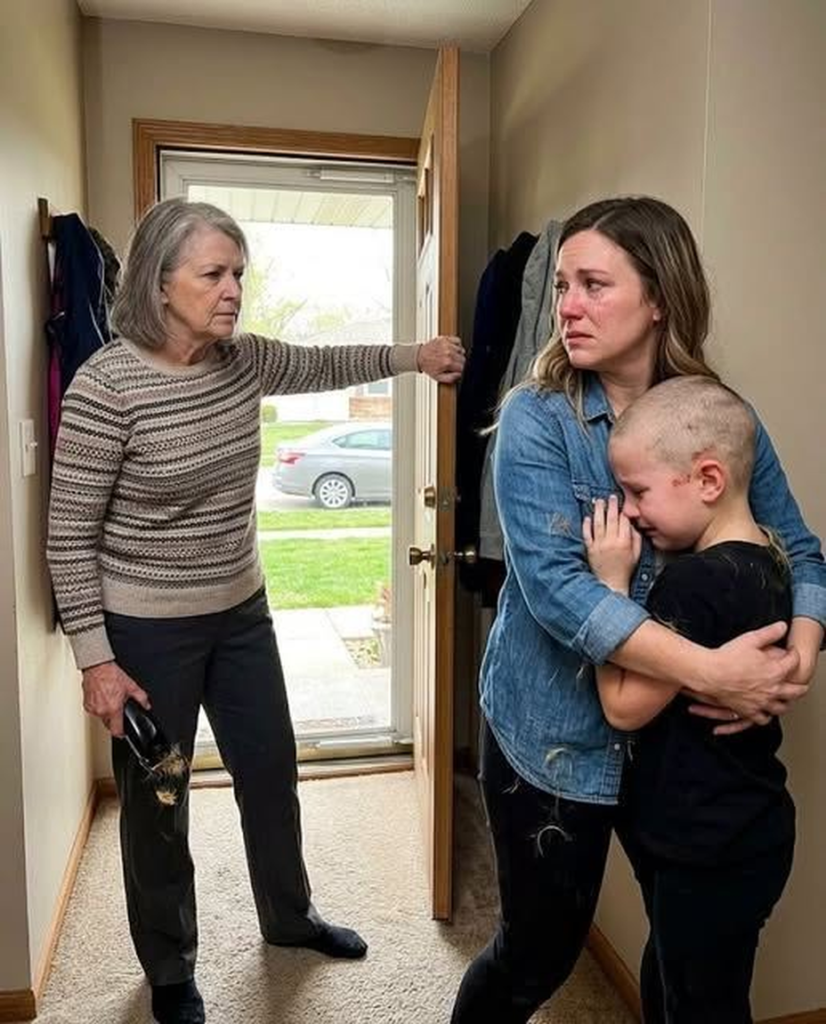
When I picked up my eight-year-old daughter from my mother-in-law’s house that Tuesday afternoon, I expected the usual things. A sticky face from too much candy.
A backpack filled with half-finished worksheets. And another lecture from Judith about how children needed more structure than I was apparently capable of providing.
Instead, I walked into the guest room and found Meadow sitting on the floor with her knees pulled tightly against her chest.

For several seconds, my mind refused to understand what I was seeing.
Her golden hair was everywhere.
It covered the beige carpet in long uneven strands.
Some pieces clung to Meadow’s shirt.
Others were wrapped around her bare feet.
The hair she had been growing since preschool—the hair she brushed carefully every morning and sometimes asked me to braid before school—was gone.
In its place was uneven stubble.
The skin above her left ear was red where the clippers had scraped too close.
Meadow looked up at me.
Her mouth opened.
Nothing came out.
Then she pressed both hands against her bare head and began shaking.
“Meadow?”
I dropped my purse.
Behind me, someone cleared her throat.
I turned.
My mother-in-law, Judith, stood in the doorway holding electric clippers.
She did not look embarrassed.
She did not look worried.
She looked satisfied.
As though she had finally corrected some terrible problem the rest of us had been too weak to address.
“What did you do?”
Judith gave me the same look she used whenever she believed I was being overly emotional.
“Don’t start.”
I stared at the clippers in her hand.
“What did you do to her?”
“She was becoming vain.”
For one strange second, I thought I had misheard her.
“What?”
“She spends too much time in front of mirrors. Always brushing that hair. Asking for ribbons. Wanting those silly braids.”
Judith shrugged.
“Girls who become obsessed with appearance need humility.”
I crossed the room so quickly that my knee hit the bedframe.
I barely felt it.
I dropped beside Meadow and crawled through piles of her hair to reach her.
She folded herself against me.
Her whole body trembled so hard her teeth clicked together.
I wrapped both arms around her.
“I’m here, baby.”
Her fingers grabbed my shirt.
I could feel her trying not to cry.
Judith kept talking.
“She was warned.”
I looked over my shoulder.
“Warned about what?”
“Talking back.”
Meadow made a tiny sound against my chest.
Judith continued as if she were describing a perfectly reasonable consequence for failing to finish homework.
“She refused to stop brushing her hair after I told her to clean the guest room. She rolled her eyes. I told her vanity had consequences.”
I stared at her.
“You shaved an eight-year-old child’s head because she brushed her hair?”
“You always twist everything.”
“Did she agree to this?”
Judith’s mouth tightened.
“She is eight. Children don’t get to agree with discipline.”
My stomach turned.
I pulled Meadow closer.
“Where is Dustin?”
“At work.”
“Does he know?”
Judith hesitated.
Only for half a second.
But I saw it.
“I called him.”
The room seemed to shrink.
“What did he say?”
“He said I should handle the behavior however I thought appropriate.”
I looked down at my daughter.
Meadow’s eyes were fixed on the clippers.
Then she whispered the sentence that split my marriage open.
“Daddy said Grandma knows best.”
My throat closed.
I wanted to tell myself Meadow had misunderstood.
I wanted to believe Dustin had said something harmless that Judith had twisted.
But I knew my husband.
I knew how often he defended his mother.
I knew how many times he had told me, “Mom is old-fashioned, that’s all.”
I knew how many times he had laughed when Judith criticized my parenting.
And most of all, I knew that Meadow did not invent sentences like that.
I stood with my daughter in my arms.
She was getting too big for me to carry comfortably, but at that moment she felt like a toddler again.
Small.
Terrified.
Completely dependent on me to get her out.
“We’re leaving.”
Judith stepped aside at first.
Then followed us down the hallway.
“You’re making this into something it isn’t.”
I kept walking.
“She’ll thank me someday.”
I reached the front door.
Judith moved in front of it.
She planted both feet on the hardwood floor and crossed her arms.
“You’re not taking her anywhere while you’re acting like this.”
Meadow buried her face against my shoulder.
I could feel tears soaking through my shirt.
“Move.”
Judith gave me a small smile.
“Hair grows back.”
“Move.”
“You need to calm down.”
“Get out of the doorway.”
She stared at me.
I must have looked different from the woman she was used to controlling because the smile disappeared.
For almost eleven years, I had swallowed my irritation for Dustin’s sake.
I had smiled through Thanksgiving insults.
Ignored comments about my weight.
Pretended not to hear when Judith called Meadow “too sensitive.”
I had spent years trying to keep peace in a family where peace meant Judith got her way.
That woman was gone.
“Move,” I said again.
Judith stepped aside.
She was still holding the clippers.
I carried Meadow outside.
I did not look back.
The Drive Home
Meadow did not speak during the twenty-minute drive.
Not once.
At every red light, I looked at her through the rearview mirror.
She sat in the back seat with her arms wrapped around herself.
Her head was turned toward the window.
I wanted to ask what happened.
I wanted every detail.
But something told me not to make her relive it while she was still trapped inside it.
So I simply said, “You’re safe with me.”
Her eyes moved toward the mirror.
“You didn’t do anything wrong.”
A tear rolled down her cheek.
I gripped the steering wheel tighter.
At home, Meadow went straight to her room.
I followed.
She stood in front of her dresser and stared at the mirror.
Then she turned the mirror toward the wall.
That nearly broke me.
Meadow had always loved her hair.
Not because she was vain.
Because it connected her to my mother.
My mother, Evelyn, had died when Meadow was five.
Before cancer took most of her strength, Mom spent Sunday mornings sitting behind Meadow with a comb and a spray bottle, teaching her how to braid.
“You’ve got sunshine hair,” Mom used to tell her.
After Mom died, Meadow began asking me to braid her hair the same way.
Sometimes she would touch the braid and say, “Grandma Evelyn taught us.”
Judith knew that.
She had heard Meadow say it.
And she shaved it off anyway.
I found a soft pink winter hat in the back of Meadow’s closet.
It was May.
She put it on and pulled it down over her ears.
That night she slept wearing it.
She wore it to breakfast the next morning.
I made strawberry pancakes, her favorite.
She pushed them around the plate.
“Does your head hurt?”
A tiny nod.
“Can I look?”
Her hands immediately went to the hat.
“No.”
“Okay.”
I did not touch it.
Twenty minutes later, I found her at the kitchen table drawing.
A small girl with no hair.
Beside her stood a huge woman with oversized arms.
In the corner was a man with no face.
“What’s this?”
Meadow covered the picture.
I backed away.
“You don’t have to tell me.”
Around noon, Dustin called.
I had ignored eleven previous calls.
This time, I answered.
“Where are you?”
His tone sounded irritated.
Not frightened.
Not concerned.
I looked through the doorway at Meadow.
“She’s with me.”
“Obviously. Mom said you stormed out like a lunatic.”
My grip tightened around the phone.
“Your mother shaved our daughter’s head.”
“I know.”
The casualness of those two words made me cold.
“You know?”
“Mom explained what happened.”
“Did you tell her she could do it?”
Silence.
“Dustin.”
“I told her Meadow had been difficult lately.”
“That isn’t what I asked.”
“I said Mom should handle it.”
I closed my eyes.
“You gave her permission.”
“I gave my mother permission to discipline her granddaughter.”
“She held clippers to our daughter’s head while Meadow was crying.”
“You weren’t there.”
“Neither were you.”
That stopped him.
Then he sighed.
“Can we not turn this into some dramatic crusade? Hair grows back.”
The exact same sentence.
I should have known.
Judith had not merely convinced Dustin afterward.
They had already decided together that what happened was acceptable.
“Her scalp is cut.”
“What?”
“There are red marks above her ear.”
“That happens with clippers.”
I almost dropped the phone.
“Do you hear yourself?”
He became defensive.
“Mom was trying to help.”
“Have you asked whether Meadow is okay?”
“I’m trying to talk to you.”
“That isn’t what I asked.”
Silence.
Then Dustin said something I never forgot.
“You always encourage her to be fragile.”
I hung up.
The Doctor
I called Meadow’s pediatrician.
When I explained what had happened, the receptionist’s voice changed immediately.
“Bring her in.”
We were there forty minutes later.
Meadow wore her pink hat into the examination room.
Dr. Melissa Grant had treated Meadow since infancy.
She did not ask Meadow to remove the hat immediately.
Instead, she sat on the rolling stool several feet away.
“Your mom told me something happened yesterday.”
Meadow stared at her shoes.
Dr. Grant spoke softly.
“You’re not in trouble.”
Meadow’s fingers tightened around the edges of the hat.
“No one here is angry with you.”
After almost a minute, Meadow whispered, “Grandma was angry.”
“I understand.”
Dr. Grant asked whether she could examine Meadow’s head.
Meadow looked at me.
I said, “Only if you want her to.”
Slowly, Meadow removed the hat.
Dr. Grant’s expression remained calm, but I saw her jaw tighten.
She examined the irritated areas and the small nicks left by the clippers.
She asked Meadow a few simple questions.
“Did you want your hair cut?”
“No.”
“Did you tell your grandmother that?”
“Yes.”
“What happened when you told her no?”
Meadow swallowed.
“She said I was being disrespectful.”
Dr. Grant waited.
Meadow continued.
“She made me sit on the floor.”
My hands went cold.
“Was anyone else there?”
“No.”
“Did she stop when you asked?”
Meadow shook her head.
Dr. Grant photographed the injuries with my permission.
Then she asked me to step into the hallway while a nurse stayed with Meadow.
I knew before she spoke.
“I have to make a report.”
I nodded.
“This is not about a haircut,” Dr. Grant said. “This is about an adult forcibly altering a child’s body as punishment while the child was distressed and refusing consent. Meadow is also showing signs of an acute trauma response.”
There it was.
The word I had been afraid to say.
“Abuse?”
Dr. Grant held my gaze.
“Yes.”
I leaned against the wall.
“And because of what you told me about the doorway and her father’s involvement, I’m documenting everything.”
I thought of Dustin defending Judith.
Calling Meadow fragile.
Calling me dramatic.
Something inside me hardened.
I had spent years asking whether I was overreacting.
I was finished asking.
The Question My Sister Asked
My older sister Francine worked as a paralegal at a family law firm.
When I called her, I made it halfway through the story before she interrupted.
“Where is Meadow now?”
“With me.”
“Is Dustin there?”
“No.”
“Good. Listen carefully.”
I grabbed a notebook.
“Photograph everything. Her scalp. The hair if you still have access to it. Any texts from Dustin. Any messages from Judith. Do not delete anything. Do not argue with them over the phone if you can avoid it.”
“What do I do next?”
“Did the doctor document it?”
“Yes.”
“Good.”
Francine paused.
“Pack what Meadow needs.”
I looked toward the living room.
She was sitting on the couch with her purple stuffed elephant pressed against her chest.
Francine asked, “Can you stay with me?”
“Yes.”
“Then come.”
“What about Dustin?”
“What about him?”
“He’ll say I kidnapped her.”
“You are her mother, and there is no custody order preventing you from leaving the marital home with her. We’ll talk to an attorney today.”
I sat down.
The reality of what I was considering finally landed.
Divorce.
Custody.
Lawyers.
Possibly selling the house.
Possibly losing friends.
Possibly losing people I had called family for more than a decade.
Francine’s voice softened.
“Abigail?”
“Yes?”
“What are you willing to lose?”
I watched Meadow.
Her fingers were gripping the purple elephant so tightly that the fabric folded beneath them.
I knew my answer.
“Everything except my child.”
We Left Before Dustin Came Home
I packed two suitcases.
Clothes.
School books.
Medication.
Meadow’s favorite blanket.
The small wooden jewelry box that had belonged to my mother.
Photographs.
Documents.
And the purple elephant.
Before leaving, I photographed every room in the house.
Francine’s attorney had told me not to remove joint property unnecessarily.
I took only what belonged to Meadow or me.
At 5:47 that evening, I pulled out of the driveway.
Dustin arrived home eleven minutes later.
The doorbell camera recorded him walking inside.
At 6:03, my phone rang.
Then again.
Then again.
By 6:30, he had left eight messages.
The first was angry.
“You can’t take my daughter and disappear.”
The second was offended.
“You are punishing me because you hate my mother.”
The third blamed me.
“You’re teaching Meadow she can run away whenever she doesn’t like discipline.”