 Reading Time: 10 minutes
Twelve years. That was how long it had been since my daughter Mary Lou left for South Korea. Not once had she come home. Not for Christmas. Not for my birthday. Not even when I had surgery on my knee and could barely walk to the mailbox.
But every year, exactly eighty thousand dollars arrived in my account. Always in December. Always with the same short message. Mom, take care of yourself. I’m doing well. Everyone told me I was lucky.
“Theresa,” my neighbor June said more than once, “some daughters don’t even call. Yours sends you eighty thousand dollars a year.”
I would smile politely.
But inside, something twisted.
Because I did not want her money.
I wanted her voice in my kitchen.
I wanted her coat hanging by the door.
I wanted to hear her laugh at the Christmas movies she used to claim she hated but always watched with me anyway.
Money could repair the roof.
Money could replace the old furnace.
Money could pay taxes and keep groceries in the fridge.
But money could not sit across from me at the table.
Money could not hug me.
Money could not look me in the eye and tell me why my only child had stayed away for twelve years.
My name is Theresa Miller.
I am sixty-three years old.
I raised Mary Lou alone after my husband died of a heart attack when she was seven.
We had never been rich.
But we had been close.
Mary Lou was bright from the time she could speak.
Curious.
Kind.
Stubborn in a quiet way.
She loved books, old songs, and helping me make biscuits on Sunday mornings.
When she went to college, I worked extra shifts at the library and sold my husband’s truck to help pay tuition.
I never regretted it.
A child like Mary Lou deserved the world.
When she was twenty-one, she met Kang Jun.
He was Korean.
Almost twenty years older than her.
A businessman, she said.
Polite, elegant, serious.
He wore tailored suits and spoke softly, but something about him made my stomach tighten.
Maybe it was the way he looked at Mary Lou.
Not like a man in love.
Like a man looking at something he had chosen carefully.
I opposed the marriage.
I begged her to wait.
“Baby, you barely know him.”
She cried.
“You don’t understand him, Mom.”
“You’re right,” I said. “I don’t.”
“He loves me.”
“Then he can love you slowly.”
But Mary Lou had already decided.
They married in a small courthouse ceremony.
Two weeks later, she moved to South Korea.
At the airport, she held me so tightly I could hardly breathe.
“I’ll visit soon,” she whispered.
I believed her.
I watched her walk through security, turning back twice to wave.
That was the last time I held my daughter for twelve years.
At first, she called often.
Then less.
Then only video calls.
Then video calls scheduled around her husband’s availability.
Kang Jun appeared sometimes in the background, smiling politely, saying, “Mother, you are well?”
I never liked how Mary Lou sat straighter when he entered the room.
One year turned into two.
Two into five.
Five into twelve.
The money kept coming.
Eighty thousand dollars.
Always exact.
Always too much.
Always wrapped in silence.
During one video call, I noticed Mary Lou’s eyes looked distant.
She was sitting in a beautiful room with cream walls and a vase of white orchids behind her.
Her hair was perfect.
Her makeup was perfect.
Her smile looked like something she had practiced.
“Why don’t you come home?” I asked.
She looked away from the camera.
“I’m very busy with work, Mom.”
“What work?”
She smiled.
“Family business.”
“What kind of business?”
Before she could answer, I heard a door open.
Her face changed.
“Mom, I have to go.”
“Mary Lou—”
The screen went black.
That night, I did not sleep.
I kept hearing the way her voice had dropped.
The way her smile vanished when someone entered the room.
I told myself I was imagining things.
A mother’s worry can turn shadows into monsters.
But every Christmas, when I set a place for her at the table, the empty chair looked back at me like an accusation.
Finally, after twelve years, I bought a plane ticket.
I did not tell her.
If she was truly busy, I would surprise her.
If she was not safe, I did not want anyone warned.
The trip was long and exhausting.
By the time I landed in Seoul, my legs ached and my hands shook from nerves.
I had her address from an old Christmas card.
A taxi driver helped me find it after two wrong turns and a translation app that made us both laugh nervously.
The house stood behind high stone walls and a black iron gate.
It was beautiful.
Too beautiful.
The kind of place that looked less like a home and more like a warning.
I rang the bell.
No answer.
I waited.
Rang again.
Still nothing.
The gate was not locked.
Neither was the front door.
That frightened me more than if both had been sealed shut.
“Mary Lou?” I called.
My voice sounded small inside the marble entryway.
The house was quiet.
Too quiet.
I stepped inside.
The air smelled faintly of jasmine and floor polish.
The living room was filled with framed photographs of my daughter.
Mary Lou in designer clothes.
Mary Lou at charity events.
Mary Lou beside Kang Jun at formal dinners.
Mary Lou smiling beside officials, executives, strangers.
But in every picture, her eyes looked empty.
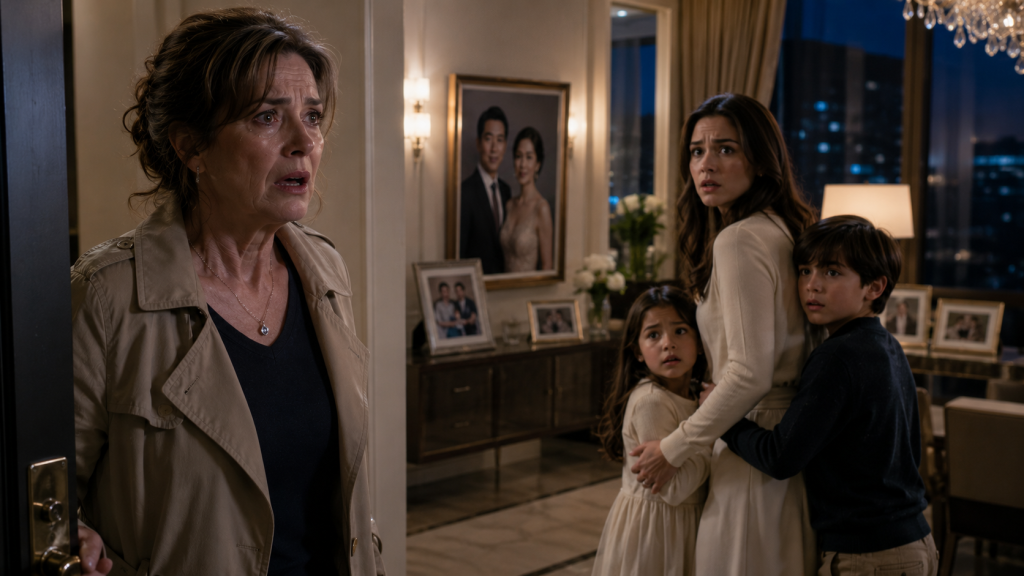
Then I heard a small voice from the hallway.
“Grandma?”
I froze.
A little girl stood there in pink pajamas, holding a stuffed rabbit.
She had Mary Lou’s face.
The same brown eyes.
The same small chin.
My heart stopped.
“Who are you?” I whispered.
“I’m Hana,” she said. “Mom said you live in America.”
Before I could speak, another child appeared behind her.
A boy, maybe nine.
He studied me carefully.
“Are you really Grandma Theresa?”
I gripped the wall.
Grandma.
No one had told me I was a grandmother.
For several seconds, I could not breathe.
Then an older woman rushed in from the hall.
She wore a gray housekeeper’s uniform.
When she saw me, fear crossed her face.
“You should not be here,” she whispered in English.
I stepped toward her.
“Where is my daughter?”
Her eyes filled with tears.
“Please. If Mr. Kang finds you, there will be trouble.”
“What trouble?”
The little girl, Hana, moved closer to me.
“Grandma, are you here to take Mommy outside?”
The question cut through me.
“Outside?”
The boy grabbed Hana’s hand.
“Don’t say that.”
I knelt slowly in front of them.
“My darlings, where is your mother?”
The housekeeper looked toward the stairs.
Then back at me.
Her voice trembled.
“Madam Mary Lou is not working.”
I stood.
“She is being kept.”
The words struck my chest like a stone.
“Kept where?”
The housekeeper shook her head.
“I cannot.”
I grabbed her hand.
“I am her mother.”
For a moment, we stared at each other.
Then something in her broke.
She whispered, “Third floor. East room. The door locks from outside.”
My knees nearly gave out.
I ran.
At sixty-three, with a bad knee and a heart pounding like a drum, I ran up those stairs faster than I had moved in years.
The second floor blurred past.
Then the third.
At the end of a long hallway, I saw a white door with a keypad beside it.
I pounded on it.
“Mary Lou!”
Silence.
Then a sound.
A gasp.
A voice I had heard only through screens for twelve years.
“Mom?”
I pressed both hands against the door.
“Baby, I’m here.”
She began to cry.
Not softly.
Not politely.
The way children cry when they finally see the person they have been waiting for.
“Mom, you shouldn’t have come.”
I looked at the keypad.
“Why is this door locked?”
She did not answer.
“Mary Lou.”
Her voice broke.
“He’ll be back soon.”
Behind me, the housekeeper appeared with shaking hands.
“I know the emergency code,” she whispered. “But if I open it…”
I looked at her.
“What is your name?”
“Mrs. Park.”
“Mrs. Park, if you open this door, I will say I forced you.”
She swallowed.
Then she entered the code.
The lock clicked.
I pushed the door open.
My daughter stood in the middle of a beautiful room with pale curtains, silk bedding, and a view of the city.
She looked elegant.
Thin.
Too thin.
Her hair was pinned back.
Her hands trembled.
For one terrible second, we only stared.
Then she ran into my arms.
“Mom.”
I held her as tightly as I had at the airport twelve years ago.
Only now, she felt smaller.
Breakable.
“What happened to you?” I whispered.
She sobbed against my shoulder.
“I thought I was protecting you.”
“From what?”
Before she could answer, a deep voice came from the hallway.
“From me.”
I turned.
Kang Jun stood at the end of the hall in a dark coat.
Older now.
Silver at his temples.
Still elegant.
Still calm.
But his eyes were not polite anymore.
They were furious.
Mary Lou stiffened in my arms.
The children appeared behind Mrs. Park, terrified.
Kang Jun looked at me.
“Theresa. You should have called before visiting.”
I stepped in front of my daughter.
“I should have come years ago.”
His smile was thin.
“There is nothing here for you to misunderstand.”
“There is a locked door.”
“For her protection.”
Mary Lou whispered, “Mom, don’t argue.”
That broke my heart all over again.
I looked at Kang Jun.
“You kept my daughter from me.”
He sighed.
“Your daughter has a fragile mind. She has suffered episodes. The money she sent you was proof she cared. I allowed it.”
Allowed.
The word filled the hallway like poison.
Mary Lou gripped my sleeve.
“That money,” she whispered. “It wasn’t mine.”
I looked at her.
“What?”
Kang Jun’s expression sharpened.
“Mary Lou.”
She flinched, but then she straightened.
For the first time, I saw my daughter under the fear.
“It was payment,” she said. “To keep you from asking questions.”
My blood went cold.
Kang Jun’s jaw tightened.
“Enough.”
“No,” I said. “Not enough. Not anymore.”
He took one step forward.
The boy suddenly shouted, “Don’t hurt Grandma!”
The whole hallway froze.
Kang Jun looked at the child, and something ugly passed across his face.
That was when I realized the children were afraid of him too.
Not respectful.
Afraid.
I pulled out my phone.
Kang Jun laughed quietly.
“Do you know who you will call in a country where you do not speak the language?”
I looked at Mrs. Park.
She was already dialing.
“Police,” she whispered.
Kang Jun’s face changed.
“You foolish woman.”
Mrs. Park raised her chin, trembling.
“I am finished being quiet.”
Everything happened quickly after that.
Kang Jun shouted in Korean.
Another staff member ran.
The children cried.
Mary Lou held my hand so tightly my fingers hurt.
I did not understand the words flying around me, but I understood power losing control.
Mrs. Park stayed on the phone.
Within minutes, security arrived at the gate.
Then police.
Then a woman from a family support organization Mrs. Park had secretly contacted weeks earlier but been too afraid to follow through with.
Mary Lou gave a statement.
Haltingly at first.
Then stronger.
She told them Kang Jun had controlled her passport, her phone, her bank access, her movements.
He had allowed video calls only when supervised.
He had told her that if she tried to leave, I would be financially ruined because the money sent to me would be framed as stolen funds.
He told her I would be arrested.
He told her the children would be taken.
Fear had built the prison.
Money had decorated it.
And shame had kept the door closed.
As officers spoke with Kang Jun, Mary Lou turned to me.
“I’m sorry, Mom.”
I touched her face.
“No.”
“I should have told you.”
“No, baby.”
“I thought if you had the money, at least you’d be safe.”
I began crying.
“I never wanted money.”
“I know.”
“I wanted you.”
She folded into me again.
“I wanted to come home every Christmas.”
The little girl, Hana, came closer.
“Can we go with Grandma?”
Mary Lou looked at her children.
Then at me.
For the first time since I arrived, hope appeared in her eyes.
“Yes,” she whispered. “We can.”
Leaving was not simple.
Nothing involving men like Kang Jun ever is.
There were legal meetings.
Emergency protections.
Embassy visits.
Temporary documents.
Interviews.
Translation errors.
Long nights in a safe apartment where Mary Lou slept with both children in her bed and the light on.
I stayed beside her through all of it.
Every time she apologized, I told her the same thing.
“You survived.”
At first, she could barely make decisions.
Coffee or tea.
Blue shirt or gray.
Call today or tomorrow.
Control had trained her to fear choice.
So we practiced small freedoms.
Walking outside.
Buying snacks.
Letting the children choose cereal.
Calling me without asking permission.
One afternoon, we went to a park.
Hana chased pigeons.
Her brother, Min Jae, climbed carefully over a low stone wall.
Mary Lou sat beside me on a bench.
“I thought you would hate me,” she said.
“For what?”
“For staying away.”
I looked at her.
“Mary Lou, I hated the silence. I hated the money. I hated not knowing. But I never hated you.”
She stared at her hands.
“He told me you were better off without the burden of me.”
I took her hand.
“You were never my burden. You were my child.”
She cried quietly then.
Not like in the locked room.
Not like fear breaking.
This was grief leaving.
Two months later, we flew home.
All four of us.
When our plane landed, Mary Lou held my hand through the entire airport.
At the exit, June from next door stood with a sign that read:
WELCOME HOME, MARY LOU.
Half the neighborhood was with her.
Mary Lou stopped walking.
“Mom…”
I smiled through tears.
“You were missed.”
The children were overwhelmed at first.
Hana stared at everything.
The sky.
The cars.
My old porch swing.
Min Jae inspected the backyard like a little soldier entering unknown territory.
That first night, I made chicken and biscuits.
Mary Lou sat at the kitchen table, watching me roll dough.
“I dreamed about this,” she whispered.
I handed her the biscuit cutter.
“Then help.”
Her hands shook.
But she pressed the cutter into the dough.
One circle.
Then another.
Then another.
Hana climbed onto a chair.
“Can I help too?”
Soon flour covered the table, the floor, the children, and half my shirt.
For the first time in twelve years, my house was noisy.
Beautifully noisy.
Christmas came three weeks later.
I set the table.
Not one empty place this time.
Four real plates.
Four chairs filled.
Mary Lou lit a candle for her father.
The children asked about the grandfather they never met.
We told stories.
About his laugh.
His terrible singing.
The way he once tried to fix the roof and got stuck until the fire department came.
Mary Lou laughed so hard she cried.
After dinner, she handed me an envelope.
For a moment, fear moved through me.
No more money, I wanted to say.
But when I opened it, there was no check.
Inside was a handwritten note.
Mom,
For twelve years I sent money because it was the only way I could still reach you.
This year, I have nothing to send except myself.
I hope that is enough.
I pressed the note to my heart.
“It is everything,” I said.
The legal battles in Korea continued, but from a distance.
Kang Jun’s influence did not disappear overnight.
Men like him believe ownership is love and control is protection.
But Mary Lou was no longer alone.
She had lawyers.
Advocates.
Her children.
And me.
The eighty thousand dollars had stopped.
People asked whether I was worried.
I said no.
The roof was fixed.
The furnace worked.
The pantry was full enough.
And my daughter was home.
Money had never been the miracle.
The miracle was hearing Mary Lou laugh from the living room while her children decorated my uneven Christmas tree.
The miracle was waking up and finding her drinking coffee at my kitchen table.
The miracle was Hana calling me Grandma like she had known me forever.
The miracle was Min Jae asking if he could sleep with the hallway light on, then slowly, night by night, learning he did not need to.
Twelve years.
That was how long my daughter was gone.
Every year, eighty thousand dollars arrived.
Everyone said I was lucky.
They were wrong.
I became lucky the day I stopped trusting the money and followed the ache in my chest across the ocean.
Because when I opened that house door, I did freeze.
I froze because I saw the truth.
My daughter had not stayed away because she forgot me.
She stayed away because fear had locked the door.
And a mother’s love finally opened it.
THE END! THANKS FOR READING!