 Reading Time: 9 minutes
At my daughter’s wedding, my son-in-law demanded that I hand over the farm keys in front of two hundred guests. When I refused, he struck me so hard I lost my balance. For one stunned second, the whole ballroom went silent.
The music faded beneath the gasps. Champagne glasses trembled on white tablecloths. A child near the back began to cry. And there I stood, sixty-two years old, one hand gripping the gift table, my cheek burning, my mouth tasting like blood.
Across from me stood Carter Whitmore.
My new son-in-law.
Still wearing his white tuxedo.
Still smiling like he already owned my entire life.
“Don’t embarrass yourself, Helen,” he said calmly. “Just hand over the farm keys.”
His hand was still stretched out in front of me.
Like I was a servant.
Like I owed him obedience.
Like the Bennett family farm was nothing more than a wedding envelope.
Beside him stood my daughter, Emily.
My only child.
Her face was pale beneath her bridal makeup, and her bouquet trembled in her hands.
“Mom,” she whispered. “Please. Just give him the keys.”
That hurt worse than what Carter had done.
The farm was not just land.
It was forty acres of orchards, cornfields, horse pasture, and the old white farmhouse where four generations of my family had lived, loved, worked, and died.
My grandfather planted the first apple trees.
My father built the red barn.
My husband, Thomas, rebuilt the farmhouse after a tornado tore half of it away twenty years ago.
Every fence post carried a memory.
Every acre held someone’s sweat.
Carter had mocked that farm from the first day Emily brought him home.
He called it “muddy.”
“Old-fashioned.”
“Useless dirt.”
Until the county announced plans for a new highway extension nearby.
Then that useless dirt became land worth millions.
Suddenly, Carter wanted to help me “manage it.”
Suddenly, his mother Vanessa called me “family.”
Suddenly, Emily began asking questions about deeds, taxes, and whether I had “thought about downsizing.”
I should have seen it sooner.
Maybe I did.
But no mother wants to believe her daughter is standing beside the person trying to rob her.
Vanessa Whitmore lifted her champagne glass with a smug little smile.
“This is getting ridiculous, Helen,” she said. “You’re sixty-two and living alone. How much longer did you really think you could handle that place by yourself?”
Several guests chuckled.
Alone.
That was what they believed I was.
Just a widow in practical shoes and a navy-blue dress.
A quiet churchgoing mother with dirt beneath her fingernails.
Someone easy to pressure.
Easy to humiliate.
Easy to control.
Carter stepped closer.
“The keys,” he repeated. “You promised Emily a wedding gift.”
“I promised her love,” I said softly.
His expression hardened.
“Love doesn’t pay property taxes.”
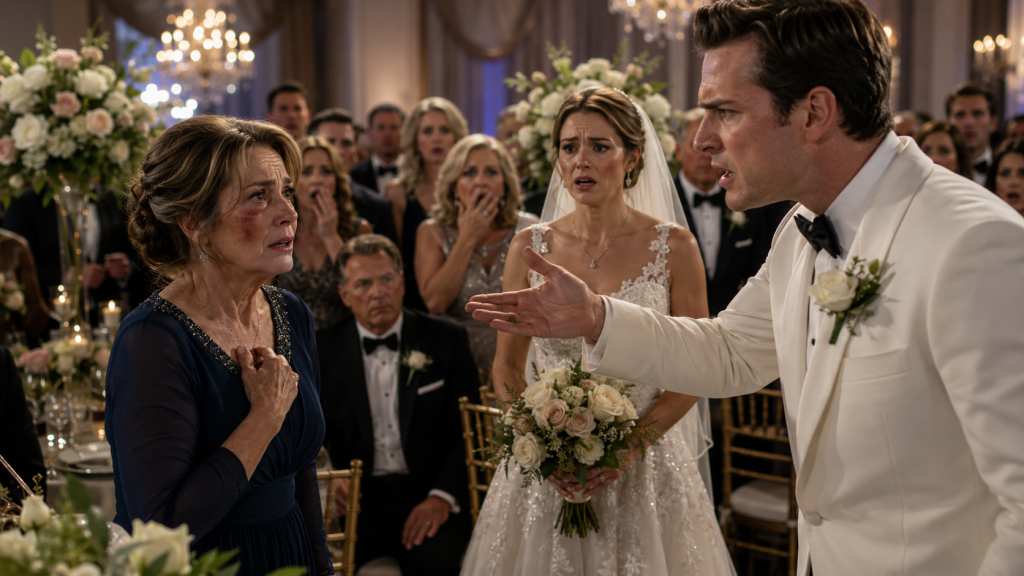
I touched the blood gathering near the corner of my mouth.
“No,” I replied. “But greed leaves evidence.”
For the first time all evening, fear flickered in Carter’s eyes.
Vanessa leaned forward sharply.
“What exactly is that supposed to mean?”
I straightened myself.
My cheek burned.
But my heart had gone strangely calm.
It was the kind of calm that came before a tornado.
Emily reached for me.
“Mom, please don’t ruin my wedding.”
I looked at my daughter.
Really looked at her.
The little girl who used to run barefoot through the orchard chasing chickens.
The teenager who learned to drive the tractor sitting on her father’s lap.
The daughter who once promised no man would ever come between us.
And in that moment, I understood something devastating.
They had not invited me there as family.
They had invited me as a signature.
The farm was the real guest of honor.
Carter reached for my purse.
That was his mistake.
I stepped back.
“No.”
His smile vanished.
“Don’t make a scene.”
I looked around the ballroom.
Two hundred people stared at me.
Some with pity.
Some with curiosity.
Some with the uncomfortable excitement people get when cruelty becomes entertainment.
“A scene?” I asked quietly. “Carter, you made one when you raised your hand to your wife’s mother.”
His jaw tightened.
“You’re being dramatic.”
“No,” I said. “I’m being done.”
I reached into my purse.
Carter smirked, thinking I was finally giving in.
Instead of keys, I pulled out my phone.
I pressed one number.
When the call connected, I said only three words.
“It’s time.”
Then I hung up.
Carter laughed.
“Calling your lawyer won’t save you.”
I smiled for the first time that night.
“Not my lawyer.”
Three minutes later, the ballroom doors opened.
Every conversation stopped.
A tall man in a dark suit walked in first.
Beside him came two county investigators and a sheriff’s deputy.
Carter’s smile disappeared.
Vanessa lowered her glass.
Emily stared at the doorway, confused.
The man in the suit walked straight toward me.
“Mrs. Bennett?”
“Yes.”
“We’re here regarding the complaint you filed and the documents you submitted.”
Carter stepped backward.
“What complaint?”
The investigator opened a folder.
“Evidence of forged transfer papers, attempted property fraud, and recorded conversations discussing coercion to obtain ownership of the Bennett family farm.”
Vanessa’s face drained of color.
Emily turned to Carter.
“Forged papers?”
Carter laughed too loudly.
“This is absurd.”
I reached into my purse again and removed a small digital recorder.
“No,” I said. “Absurd was thinking I would hand over four generations of my family’s land without protecting it first.”
The investigator nodded.
“Mrs. Bennett provided recordings, emails, draft contracts, and copies of documents bearing her forged signature.”
Carter’s eyes snapped to mine.
“You recorded me?”
“Yes.”
“When?”
I looked at him.
“When you and your mother sat in my kitchen last month and told me widows get confused with paperwork.”
A few guests murmured.
Vanessa stood.
“That conversation was private.”
The deputy looked at her.
“Ma’am, I suggest you sit down.”
She sat.
For the first time since I had known her, Vanessa Whitmore looked small.
Carter turned to Emily.
“Baby, this is your mother trying to control you.”
Emily’s eyes filled with tears.
“Did you forge her name?”
He did not answer fast enough.
That silence did more than my words ever could.
Emily took one step away from him.
“Carter?”
His face tightened.
“I was trying to secure our future.”
“With my mother’s farm?”
“Our future,” he snapped. “Not hers. She’s old. She doesn’t need forty acres.”
Something broke in Emily’s expression.
The last thread of denial.
The last little hope that he was misunderstood.
The investigator turned to Carter.
“Sir, we need you to come with us for questioning.”
Carter lifted his hands.
“I’m not going anywhere.”
The deputy stepped forward.
“You can cooperate here, or we can continue this outside.”
Carter looked around the room.
All those guests.
All those phones.
All those people who had laughed when his mother humiliated me.
Now they watched him unravel.
Vanessa rose again.
“My son has done nothing wrong.”
I looked at her.
“You helped him.”
Her lips parted.
The investigator opened another page.
“Mrs. Whitmore, we also have emails from your account discussing the property value after the highway announcement.”
Vanessa whispered, “This is a setup.”
“No,” I said. “This is harvest.”
The word silenced her.
Farmers understand harvest better than anyone.
You plant something.
You water it.
You wait.
And eventually, what is buried comes up.
Carter was escorted out of the ballroom still protesting.
Vanessa followed, shouting about lawyers and reputations.
The guests sat frozen.
No music.
No dancing.
No celebration.
Just the ruins of a wedding built on greed.
Emily stood in the middle of the room in her white dress, crying silently.
For a moment, I did not know whether to go to her.
She had asked me to hand over the keys.
She had stood beside him.
She had called my resistance an embarrassment.
But she was still my daughter.
I walked toward her slowly.
She looked at my cheek and sobbed.
“Mom…”
I stopped in front of her.
“I need to ask you something, Emily.”
She wiped her face.
“Did you know?”
Her lips trembled.
“I knew he wanted the farm. I knew his mom said it would be better if we handled it. But I didn’t know about forged papers. I swear, I didn’t know he would hurt you.”
I believed her.
Not completely.
Not easily.
But enough to know she had been manipulated before she became cruel.
“Why did you ask me to give him the keys?”
She broke down.
“Because he told me if you loved me, you would. He said you were selfish. He said you were trying to keep me small. He said the farm could pay off our debts and start our life.”
“His debts?”
She looked down.
That was answer enough.
I sighed.
“Oh, Emily.”
She reached for me.
“I’m sorry.”
I wanted to hug her.
But apology is not a broom.
It does not sweep away everything broken.
So I took her hand, but I did not pull her close.
“Sorry is a beginning,” I said. “Not an ending.”
The wedding ended within an hour.
Guests left quietly.
The cake remained untouched.
The flowers wilted under chandelier light.
Outside, I stood beneath the portico while the night air cooled my burning cheek.
Emily came out still wearing her wedding dress.
No veil.
No bouquet.
Just a frightened young woman who had finally seen the cage she had almost locked herself inside.
“Can I come home?” she asked.
I looked at her.
“To the farm?”
She nodded.
“For tonight,” I said. “Tomorrow, we talk.”
She cried again, but this time, she looked relieved.
We drove home in silence.
When we reached the farm, the porch light was on.
The old white house stood under the stars.
The orchard stretched dark and quiet beyond the fence.
Emily stepped out of the car and looked around like she was seeing the place for the first time in years.
“This was always home,” she whispered.
“Yes,” I said. “But home is not something you use when the world disappoints you. Home is something you protect.”
She nodded.
Inside, I gave her a blanket and the bedroom she had grown up in.
Then I went to the kitchen, put ice against my cheek, and finally let myself cry.
Not from pain.
From exhaustion.
From betrayal.
From the terrible relief of being right.
The next morning, Emily came downstairs in old sweatpants and one of Thomas’s flannel shirts.
She looked twelve years old again.
“Mom,” she said, “I need to tell you everything.”
So she did.
Carter had been in debt.
Credit cards.
Bad investments.
A failed business deal his mother had hidden from everyone.
When he learned about the highway extension, he saw the farm as salvation.
He told Emily I was too stubborn to understand opportunity.
He told her widows often got taken advantage of.
Then he became the one trying to take advantage.
He had convinced her that pressuring me was love.
That stealing from me was planning.
That my boundaries were betrayal.
By the time she realized how trapped she felt, the wedding was already days away.
“I thought if I just made it through,” she whispered, “things would get better.”
I looked at my daughter and saw how young she still was in all the ways that mattered.
“Things do not get better because you survive the wedding,” I said. “They get better because you stop walking toward the wrong life.”
Carter was charged after the investigation expanded.
The forged documents were only part of it.
There were emails.
Financial records.
Messages between him and Vanessa.
One message from Vanessa said, “Once Helen signs, she can stay in the farmhouse until development begins. After that, she’ll have no choice.”
No choice.
Those words became fuel.
My attorney filed everything necessary to protect the farm.
A trust.
Restrictions.
Clear inheritance terms.
No sale without my consent while I lived.
No transfer without independent review.
And most importantly, Emily would inherit only if the farm remained protected land for agricultural use or family residence.
Not a quick sale.
Not a development prize.
A legacy.
When I signed the papers, I felt Thomas beside me.
He had loved that land with his whole soul.
I could almost hear him say, “Good girl, Helen.”
Emily started therapy.
She annulled the marriage.
She wrote apology letters to several people, but the longest one was to me.
I did not read it right away.
I kept it on the kitchen table for three days.
When I finally opened it, the first line made me cry.
I forgot that the farm was not my inheritance. It was your life.
That was when forgiveness began.
Slowly.
Carefully.
Like planting after a hard winter.
Months passed.
The bruise on my cheek faded.
The whispers in town changed.
At first, people talked about the wedding scandal.
Then they talked about Carter’s charges.
Then, eventually, they talked about the farm stand reopening in spring.
Emily helped me plant tomatoes that year.
She wore old boots and tied her hair back.
She learned again what she had forgotten.
That land does not love greed.
It responds to patience.
To sweat.
To care.
One evening, we stood by the orchard fence watching the sunset turn the fields gold.
Emily looked at me.
“Do you think Dad would hate me?”
“No,” I said.
Her eyes filled.
“But he’d be disappointed.”
“Yes,” I answered honestly. “For a while.”
She nodded, crying softly.
“Would he forgive me?”
I looked over the land Thomas had rebuilt after wind tried to tear it apart.
“Yes,” I said. “But he would expect you to become someone worthy of that forgiveness.”
She wiped her face.
“I’m trying.”
“I know.”
The farm survived.
So did we.
Not unchanged.
Nothing survives betrayal unchanged.
But survival itself is holy work.
People later asked why I did not hand over the keys just to avoid making a scene.
I always tell them the same thing.
Because some doors should never open for greed.
Because a family legacy is not a wedding favor.
Because a quiet widow is not the same thing as a helpless woman.
And because keys are not just metal.
They are responsibility.
Memory.
Blood.
Years of sunrise labor and midnight worry.
They are my father’s hands, my grandfather’s trees, my husband’s hammer, my daughter’s childhood, and my own stubborn heart.
Carter thought he could take them in front of two hundred guests.
He thought public shame would make me weak.
He was wrong.
In that ballroom, when everyone stared and my cheek burned, I learned something I should have remembered all along.
I was never alone.
Behind me stood four generations of Bennetts.
Beside me stood the truth.
And in my purse, waiting quietly, was the evidence that greed had left behind.
So no, I did not hand over the keys.
I walked outside.
I made a phone call.
And by the end of the night, Carter finally understood what every farmer knows.
You reap exactly what you sow.
THE END! THANKS FOR READING!