
At my fifty-fifth class reunion, the woman who tormented me for four years handed me an apron and said, “Be a dear, the caterer’s short-handed, and honestly, you’d be more comfortable in the back anyway.” The whole table laughed. I put the apron on. I worked in that kitchen for one hour and ten minutes.
Then the hotel manager came looking for the person whose name was on the contract for the entire ballroom. I took the apron off. My name is Wilma Delacroix. I am seventy-three years old, and in 1971 I was the girl at Kettering High who wore her cousin’s dresses. Bernadette Voss was the girl who counted them out loud. You probably knew a Bernadette.
Maybe you had one in your school. Maybe she sat behind you in algebra or passed you in the hallway and somehow always knew exactly which insecurity you had spent the morning trying to hide.
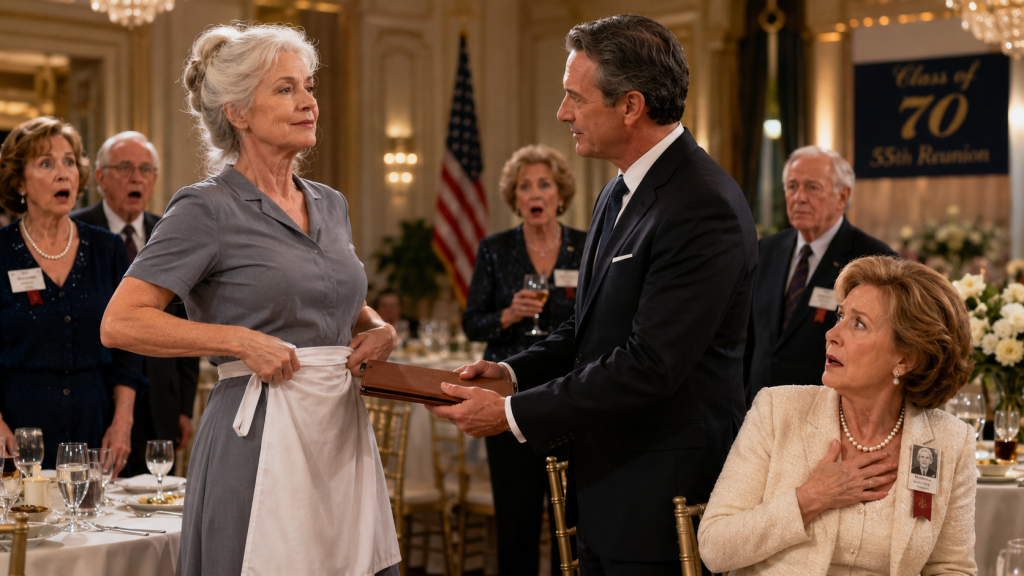
Or maybe, if you are being very truthful with yourself, you were someone’s Bernadette.
I will not make you sit through all four years of high school.
One night will give you the shape of it.
Junior prom.
The gymnasium had been decorated with silver paper stars and blue crepe streamers. Someone’s father had brought in a rotating light that threw tiny dots across the walls. The theme was something ridiculous like “Moonlight Memories.”
My mother and I had made my dress.
She worked mornings at a bakery and cleaned offices three nights a week, but for three weekends she sat beside me at our kitchen table sewing blue checked fabric my grandmother had saved in a cedar chest.
It was not expensive fabric.
It was originally intended for table linens.
We knew that.
We did not care.
My mother altered a pattern from a magazine, and I sewed most of the skirt myself. She did the difficult parts around the waist and zipper.
When I tried it on the Friday before the dance, she stood behind me in our narrow hallway and cried.
“You look beautiful, Willie,” she said.
Nobody except my mother called me Willie.
I believed her.
For one evening, I truly believed I looked beautiful.
A boy named Denny Fowler asked me to dance.
Denny was not my boyfriend. I barely knew him. He was simply kind enough to notice that I had been standing near the wall for three songs pretending to be interested in the refreshments.
Halfway through the dance, Bernadette appeared.
She cut between us, laughing.
“Denny, you know she made that dress out of a tablecloth.”
He looked confused.
Bernadette raised her voice.
“Ask her. Go on. Ask her about the tablecloth.”
People nearby turned.
Her friends laughed first.
Then several others joined them because cruelty spreads quickly when teenagers are frightened of becoming the next target.
My face burned.
Denny tried to say something kind.
“It looks nice, Wilma.”
That somehow made it worse.
Bernadette pinched the fabric near my waist between two fingers.
“Blue check. I swear my grandmother has napkins like this.”
The laughter grew.
I left the gymnasium.
I walked three miles home because I did not want to call my mother and make her come get me.
Halfway there, it began raining.
When I reached our house, my mother was sitting at the kitchen table drinking tea.
She stared at my wet hair and asked what happened.
“Nothing.”
She looked at the dress.
The hem was muddy.
“Nothing doesn’t usually walk three miles in the rain.”
I cried then.
Not dramatically.
Quietly.
The kind of crying where you try to breathe through your nose because making noise would feel like another humiliation.
My mother listened.
When I finished, she reached across the table and touched the blue fabric.
“This dress is not something to be ashamed of.”
“I know.”
“No, you don’t.”
I looked at her.
She said, “Some people spend money to prove they have value. Other people create value because they never had much money to spend.”
At seventeen, I did not understand how important those words would become.
I only knew that I never wanted to go to another school dance.
And I didn’t.
I skipped senior prom.
I skipped graduation.
My diploma came through the mail because I told the administration I was sick.
I wasn’t sick.
I simply could not face that gymnasium again.
Ten years later, in 1981, Russell convinced me to attend our class reunion.
I lasted ninety minutes.
Bernadette asked if my husband repaired toilets.
Russell repaired heating systems.
I know that sounds like a small distinction, but that was Bernadette’s talent.
She could turn anything into something smaller.
We left early.
I told Russell in the car that I would never attend another reunion.
He kept both hands on the steering wheel.
After a while, he said, “All right.”
That was Russell.
He never told me what I should feel.
He simply stayed beside me while I felt it.
I met him in 1973 at a grocery store.
I dropped a carton of eggs.
He helped me pick up the broken shells.
That is not a romantic story, but it is ours.
Russell was quiet.
He did not have expensive clothes.
He owned one decent jacket when we married.
He could fix almost anything involving pipes, boilers, radiators or stubborn machinery.
More importantly, he was never embarrassed by honest work.
We married in 1975.
Four years later, we bought a laundromat.
The building smelled like detergent, warm metal and quarters.
We borrowed money from everyone willing to lend us any.
My mother gave us six hundred dollars she had saved in a coffee tin.
Russell’s brother gave us twelve hundred.
The bank gave us just enough to be terrified.
For the first eighteen months, Russell continued working full-time while I managed the laundromat.
If a machine broke, I called him.
If a customer complained, I handled it.
If someone left lipstick in a pocket and turned an entire load pink, I learned how to explain that washing machines were not magicians.
We were exhausted.
But for the first time in my life, I owned something.
Not something impressive.
Not something anybody at Kettering High would have envied.
But something that belonged to us.
Three years later, we bought a second laundromat.
Then came the linen business.
It began with a restaurant owner named Mr. Carmichael.
He came into our laundromat one afternoon carrying three sacks of tablecloths.
His usual laundry service had failed to show up.
“Could you clean these by Friday?”
I asked how many he had.
“One hundred and forty.”
I laughed.
He did not.
Russell and I worked until nearly three in the morning for two nights.
We cleaned every tablecloth.
Pressed them.
Folded them.
Delivered them ourselves.
Mr. Carmichael paid us and asked if we could do the same thing every week.
That was the beginning.
We bought used commercial equipment.
Then a delivery van.
Then another.
A motel signed with us.
Then a restaurant group.
Then two nursing homes.
Then the Grand Regency Hotel.
Every time we grew, Russell would look at me across the office and say, “Think your tablecloth dress prepared you for this?”
He knew the story.
Of course he knew.
He was the only person who could joke about it without hurting me.
By the 1990s, we had thirty-two employees.
By the time Russell became ill, we had almost sixty.
Today, Delacroix Linen Services launders and supplies linens for eleven hotels, six restaurants and two hospitals across three counties.
My son, Michael, runs transportation and operations.
My daughter-in-law handles payroll.
My granddaughter works with us during summers while studying business.
I still review contracts.
People ask why.
I am seventy-three.
I have enough money.
I could sit on a porch.
I could travel.
I do travel occasionally.
But I like contracts.
Contracts tell you a great deal about people.
Everybody is polite until money appears on paper.
Then you see them clearly.
Russell died in 2016.
Pancreatic cancer.
Seven months from diagnosis to funeral.
After forty-one years of marriage, seven months feels like being told a library is burning and you may save only one book.
You start grabbing memories randomly.
The grocery store.
The broken eggs.
Our first apartment.
The first laundromat.
The night our son was born.
Russell teaching Michael to change a furnace filter.
Our twentieth anniversary.
Our fortieth.
His hand resting on mine in the hospital.
The last thing he said clearly was, “You’ll be fine, Willie.”
He was the only person besides my mother who ever called me that.
For almost two years after he died, I barely left the house except for work.
I eventually learned that grief does not disappear.
It changes jobs.
At first, grief stands in the middle of the doorway and blocks everything.
Later, it sits quietly in the corner while you live.
Eight months ago, an envelope arrived.
Kettering High School.
Class of 1971.
Fifty-Fifth Reunion.
Saturday evening.
Grand Regency Hotel ballroom.
I almost threw it away.
Then I saw the committee list.
Chairwoman: Bernadette Voss.
I actually laughed.
Some names carry their own temperature.
Even after fifty-five years.
Michael happened to be in my office when I opened the letter.
He looked at my face.
“What?”
“High school reunion.”
“You going?”
“No.”
He waited.
Michael knows me well.
“Who’s organizing it?”
I handed him the letter.
He read the name.
“Oh.”
He knew about Bernadette.
Not every detail, but enough.
He put the letter down.
“You should go.”
“I would rather have dental surgery.”
“Mom.”
“No.”
“You own half the tablecloths in the hotel.”
That stopped me.
Technically, the linens belonged to the company.
Still, I appreciated the irony.
That afternoon I called Amy Lawrence, the events director at the Grand Regency.
I had known Amy for fourteen years.
“Tell me something,” I said. “Who signed the contract for the Kettering reunion?”
“Nobody yet.”
“Why?”
Amy laughed.
“The chairwoman is negotiating.”
“For what?”
“Everything.”
That sounded familiar.
Amy continued.
“She wants a ballroom discount, a reduced service charge, complimentary dessert, upgraded centerpieces and a cheaper staffing package.”
“What did you tell her?”
“That we are a hotel, not a church basement.”
I smiled.
“Who is the chairwoman?”
There was a pause while Amy checked.
“Bernadette Voss.”
“I thought so.”
“Do you know her?”
“We were classmates.”
Amy could hear something in my voice.
“Oh.”
I asked for the estimated total.
She gave me the figure.
It was substantial, but not remotely dangerous to me.
I looked at Russell’s photograph sitting beside my desk.
Then I made a decision.
“I want Delacroix Linen to underwrite the evening.”
Amy went silent.
“All of it?”
“All of it.”
“Wilma, that’s—”
“I know what it costs.”
“Why?”
“Entertainment.”
She laughed.
I said, “There are conditions.”
“Of course there are.”
“My name appears nowhere in the program.”
“All right.”
“Nobody tells the reunion committee who paid.”
“Done.”
“And I want the event contracted privately through my company. They can believe whatever they like about the final bill.”
Amy hesitated.
“What exactly are you planning?”
“Nothing illegal.”
“That answer does not comfort me.”
“I am attending my reunion.”
“Oh.”
“One more condition.”
“I knew there would be.”
“At nine o’clock that evening, I want Mr. Prashad to come into the ballroom carrying the contract folder. I want him to find me personally.”
Amy was silent again.
“And?”
“And address me by my full name.”
“Wilma Delacroix?”
“Mrs. Wilma Delacroix will do.”
“What happens after that?”
“I have no idea.”
That part was true.
People may imagine I spent eight months creating a revenge fantasy.
I did not.
I did not know Bernadette would hand me an apron.
I did not know anyone would laugh.
I simply wanted to attend the reunion without arriving as a display.
I did not want to pull up in an expensive car.
I did not want my company logo anywhere.
I did not want to spend the evening explaining my life to people who had made assumptions about it fifty-five years earlier.
I wanted to see what they did when they believed nothing had changed.
So I bought a plain gray dress.
Not designer.
Not custom.
No expensive jewelry except Russell’s wedding ring, which I wear on a chain around my neck.
I drove my own six-year-old Buick.
And at 7:05 on Saturday evening, I entered the Grand Regency ballroom.
The first thing I noticed was how small everyone looked.
Not physically.
Age had done what age does.
Shoulders were rounder.
Hair was thinner.
Walking was slower.
But that was not what I mean.
The people who had once seemed enormous in my memory were simply elderly men and women standing around banquet tables trying to read name tags.
For decades, they had occupied some grand courthouse in my mind.
I had remembered them as judges.
Now I saw them clearly.
They were people.
Just people.
Some had oxygen tanks.
Some had canes.
One man had brought photographs of his grandchildren.
A woman I vaguely remembered from chemistry class hugged me and said she was happy I came.
That surprised me.
Her name was Elaine.
She apologized for not remembering whether we had ever spoken in school.
“We didn’t,” I said.
“Then we should correct that tonight.”
We talked for fifteen minutes.
She had been a librarian.
Her husband died three years earlier.
She had two daughters in Oregon.
It was pleasant.
Then I heard my name.
“Wilma?”
I turned.
Bernadette Voss was walking toward me.
Seventy-three years old.
Blond hair professionally styled.