 Reading Time: 25 minutes
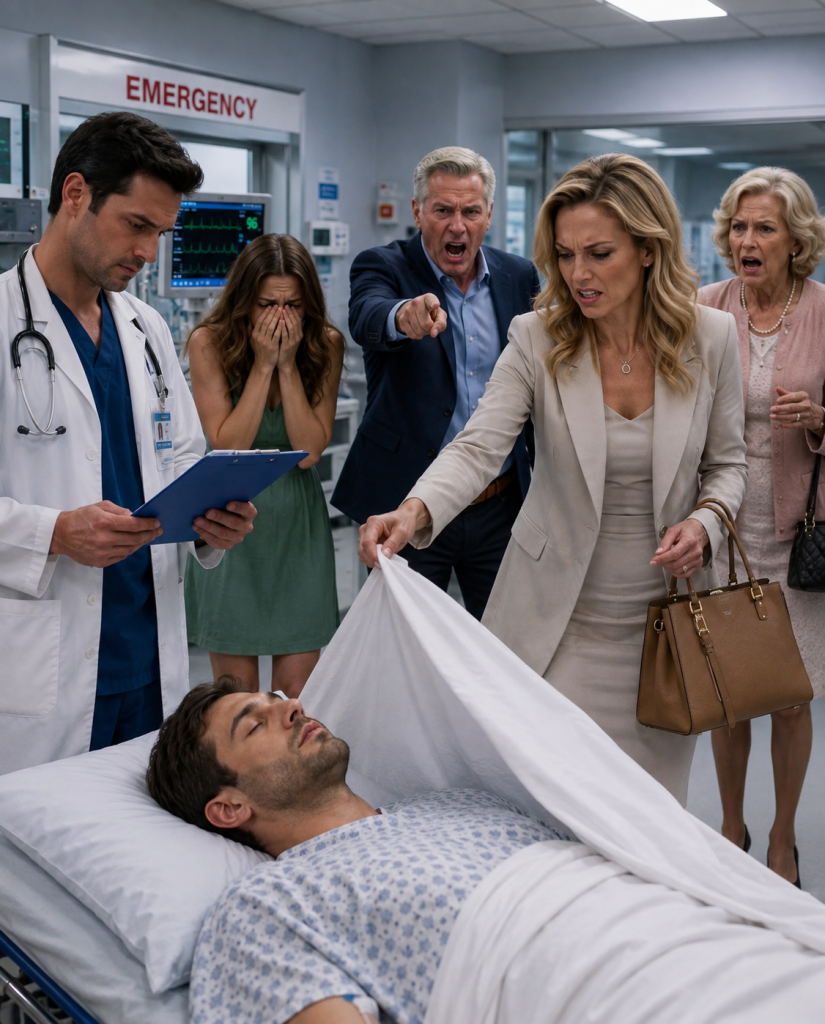
At three in the morning, the entire city seemed silent except for the ambulance siren tearing through the darkness. I arrived at St. Matthew’s Medical Center wearing pajama pants, an old gray sweater, and two different shoes.
I did not notice the shoes until much later. d, Jason Miller, had collapsed inside another woman’s apartment. And that woman was standing twenty feet away from me. “Sarah!”
My mother-in-law rushed toward me the second the emergency-room doors opened.
Margaret Miller grabbed my wrist so tightly that her fingernails dug into my skin.

“Jason is in critical condition. They said something about his heart, and now they’re preparing him for a procedure. You have to sign.”
She shoved a clipboard into my hands.
My father-in-law, Robert, stood behind her.
His face was pale.
“Do it, Sarah.”
I looked past them.
Through the glass doors, I could see nurses moving quickly around a hospital bed.
Jason was barely visible beneath wires, monitors, oxygen tubing, and blankets.
My husband of eleven years.
The father of our nine-year-old daughter.
The man who had kissed me goodbye that morning and told me he would be working late.
And behind the bed stood Emily Davis.
Jason’s new project manager.
She wore an expensive beige trench coat over a black dress.
Her hair was perfectly arranged.
Her makeup was slightly smudged.
And she was holding Jason’s phone.
That detail bothered me more than anything else.
Not the dress.
Not the apartment.
Not even the fact that my husband had apparently been with her at three in the morning.
His phone.
Why did she have it?
“Sarah!”
Margaret shook my arm.
“This is not the time to stare at people.”
I lowered my eyes to the clipboard.
There were forms clipped together, notes from the emergency department, preliminary imaging references, medication orders, and laboratory results.
I read quickly.
Then I read them again.
My pulse slowed.
That might sound strange.
Everyone around me was panicking, but the more frightened I became, the calmer my mind got.
It was an old habit.
One I had learned years earlier.
Potassium: 2.8.
Sodium: 158.
There were other abnormalities too.
Jason was severely dehydrated. His cardiac rhythm had been unstable. His neurological status had fluctuated after arrival.
The paperwork mentioned concern for an acute neurological event and possible cardiovascular complications, but what was being presented to me in the hallway did not match the certainty with which my in-laws were demanding that I sign.
I looked at Margaret.
“Who explained this procedure to you?”
“The doctor.”
“Which doctor?”
She blinked.
“I don’t know. A doctor.”
“What exactly did he say?”
“That Jason could die!”
Robert stepped closer.
“For heaven’s sake, Sarah, stop interrogating everyone and sign the paper.”
I kept reading.
I was not refusing treatment.
I was refusing to give uninformed consent to something no one had properly explained to me.
There is a difference.
A very important one.
I set the pen down.
“Not yet.”
Margaret stared at me.
“What?”
“I said I’m not signing this yet.”
Her face changed instantly.
Fear became anger.
It always did with Margaret.
For eleven years, that woman had believed I was too quiet, too ordinary, too unimpressive for her son.
Jason came from money.
His father had owned a regional construction company before retiring. Margaret chaired charity committees and treated every family gathering like a corporate board meeting.
I came from a small town in western Pennsylvania.
My father had repaired farm equipment.
My mother had worked nights at a nursing home.
To Margaret, that was apparently enough information to determine my value forever.
“You selfish woman,” she whispered.
I ignored her.
Robert pointed toward the treatment area.
“Our son is lying in there.”
“I know.”
“Then act like his wife.”
I looked directly at him.
“That is exactly what I’m doing.”
Behind him, Emily moved.
She stepped closer.
“What gives you the right to question the doctors?”
It was the first thing she had said to me.
Her voice was controlled, almost cold.
I looked at her.
“What did you say?”
“You’re delaying his treatment.”
She folded her arms.
“This isn’t the time to pretend you understand medical terminology because you searched something on your phone.”
Margaret actually nodded.
“Exactly.”
Emily looked at the papers in my hands.
“Jason needs professionals making decisions, Sarah. Not you.”
For the first time that night, I smiled.
“Who told you I wasn’t a doctor?”
Silence.
Emily’s expression disappeared.
Margaret released my wrist.
Robert stared at me.
A clipboard somewhere behind us hit the floor.
I turned toward the nearest nurse.
“My name is Dr. Sarah Miller. I’m a licensed internist. I’m not part of my husband’s treating team, obviously, and I’m not trying to direct his care. But before I provide surrogate consent for any non-emergent invasive procedure, I need the attending physician to explain the indication, alternatives, imaging findings, and whether his electrolyte abnormalities and unstable rhythm have been addressed.”
The nurse’s entire posture changed.
“Yes, Doctor.”
“Please ask the attending to speak with me.”
She hurried away.
Margaret stared at me as though I had just admitted to living a second life.
“You’re a doctor?”
I looked at her.
“Yes.”
“For how long?”
“Fourteen years.”
Robert’s mouth opened.
Then closed.
Emily looked from me to the trauma room.
I saw something in her face then.
Not surprise.
Fear.
And that was when I knew Jason’s presence in her apartment was only the beginning.
PART 1: THE LIFE MY IN-LAWS NEVER BOTHERED TO KNOW
There was a reason Jason’s parents did not know what I did.
It was not because I had lied.
They simply had never cared enough to ask.
When Jason and I met, I was completing residency.
Three years later, I joined a hospital group.
After our daughter Lily was born, I eventually moved away from full-time hospital medicine and began working primarily with a clinical research organization, reviewing patient-safety data and consulting on medication-related complications.
At family dinners, Margaret referred to my work as “Sarah’s little health research job.”
The first few times, I corrected her.
Eventually, I stopped.
Jason stopped correcting her too.
That should have bothered me more than it did.
But marriages rarely collapse because of one enormous event.
Usually, they erode through small permissions.
A disrespectful joke you let pass.
A lie you decide is easier not to confront.
A dinner your husband misses.
A phone he suddenly keeps facedown.
A coworker whose name appears too frequently.
Emily Davis had appeared in our marriage eight months earlier.
Jason worked as a senior financial director for a medical-device company.
Emily had been transferred from the company’s Boston office to lead a major acquisition project.
At first, Jason talked about her constantly.
Emily thinks we should restructure the account.
Emily stayed until midnight.
Emily understands the investors.
Emily says the board wants faster results.
Then he stopped mentioning her altogether.
That worried me more.
Two months before that night, I asked him directly whether something was happening between them.
He laughed.
“Sarah, she’s my boss.”
“That wasn’t my question.”
He became irritated.
“You spend too much time analyzing everything.”
I remember looking at him across our kitchen island.
“People usually say that when they don’t like what the analysis is showing.”
He slept in the guest room that night.
The next morning, he brought me coffee.
Neither of us mentioned Emily.
Another small permission.
Another crack.
Now my husband was unconscious in a hospital after collapsing inside her apartment at three in the morning.
And she had his phone.
The attending physician arrived ten minutes later.
His name was Dr. Patel.
He was calm, direct, and visibly exhausted.
That immediately reassured me more than the panic in the hallway.
“Dr. Miller?”
“Yes.”
“I understand you’re the patient’s wife.”
“I am.”
He led me slightly away from the others.
“We need to clarify something. There appears to have been confusion about what the family was told. We are not taking your husband directly into open surgery. Cardiology and neurology are both evaluating him. His initial presentation was concerning, but the current priority is stabilization and determining what caused the collapse.”
I exhaled.
“Thank you.”
“He has significant electrolyte abnormalities, and we’re correcting those carefully. He also had an arrhythmia recorded by EMS.”
“What about the neurological symptoms?”
“Still being evaluated.”
“Imaging?”
“Initial head imaging did not show the kind of large hemorrhage the family seems to believe he has.”
I glanced at Margaret.
She looked away.
Someone had misunderstood something.
Or exaggerated it.
Dr. Patel continued.
“There may still be additional procedures depending on what we find, but nobody should be pressuring you to sign a blanket consent without an explanation.”
“Agreed.”
Then he said something that made me turn cold.
“There is another issue.”
“What?”
“Do you know what medications your husband takes?”
I listed them.
A low-dose blood-pressure medication.
Occasional reflux medication.
Nothing else prescribed regularly.
Dr. Patel nodded.
“Any diuretics?”
“No.”
“Supplements?”
“Not that I know of.”
He paused.
“We’re repeating the labs and expanding the toxicology workup.”
“Why?”
“Because some parts of his presentation don’t fit neatly together.”
Behind me, I heard a shoe scrape against the floor.
Emily.
I turned.
She had moved closer.
Too close.
Dr. Patel noticed.
“Are you family?”
Emily hesitated.
“I’m his coworker.”
“Then I’m going to ask you to wait in the public area.”
“I brought him here.”
“EMS brought him here.”
“I called EMS.”
“And that was the right thing to do. But we need to speak with his wife privately.”
Emily’s jaw tightened.
She walked away.
But she took Jason’s phone with her.
I watched it disappear into her coat pocket.
“Doctor,” I said.
“Yes?”
“I want hospital security here.”
His eyebrows lifted.
“Is there a safety concern?”
“I don’t know yet.”
That was the truth.
“But my husband’s personal phone is currently in the possession of the woman whose apartment he collapsed in.”
Dr. Patel looked toward Emily.
“I understand.”
I added quietly, “And I don’t want her leaving with it.”
PART 2: THE PHONE
Security arrived within minutes.
Emily did not appreciate it.
“This is ridiculous.”
A security officer remained polite.
“Ma’am, we’re simply asking that the patient’s property be returned to his legal spouse.”
“It was at my apartment.”
“Whose phone is it?”
“Jason’s.”
“Then please return it.”
Emily looked at me.
“You really want to do this now?”
“Yes.”
“He could die.”
“And you’re worried about his phone?”
“I’m worried about everything.”
Her face hardened.
Then she pulled the phone from her pocket.
Before handing it over, she pressed something on the screen.
I saw it.
One quick movement of her thumb.
Then another.
“What did you just delete?”
“I didn’t delete anything.”
“You touched the screen twice.”
“It’s locked.”
“It uses facial recognition.”
“Exactly.”
I held out my hand.
“Give it to me.”
For several seconds, neither of us moved.
Then she placed it in my palm.
Our eyes met.
“Be careful what you go looking for,” she whispered.
I almost laughed.
People say things like that when they think information is dangerous.
But information is rarely dangerous by itself.
What people do because of it is dangerous.
I gave the phone to the security officer.
“Please document that this was recovered from Ms. Davis.”
Emily’s face changed.
“Document?”
“Yes.”
“Why?”
“Because you were in possession of his property.”
“I was helping him.”
“Then documentation shouldn’t bother you.”
She stared at me.
Behind us, Margaret suddenly spoke.
“Sarah, stop treating this poor girl like a criminal.”
Poor girl.
Interesting.
Margaret had met Emily for approximately twenty minutes and was already defending her against me.
I turned.
“Do you know why Jason was at her apartment?”
Margaret looked uncomfortable.
“He was working.”
“At three in the morning?”
“They had a deadline.”
I looked at Emily.
“Is that what happened?”
“Yes.”
“What project?”
She hesitated.
“The Norwell acquisition.”
“Where was the rest of the team?”
“Working remotely.”
“Why was Jason physically at your apartment?”
“My home office has confidential files.”
“You work for a medical-device corporation with a secured downtown office, yet confidential acquisition documents were safer in your apartment?”
Emily’s cheeks reddened.
“You’re twisting this.”
“No. I’m asking.”
Robert stepped between us.
“Enough.”
I looked at him.
He lowered his voice.
“Whatever Jason has done, deal with it when he wakes up.”
That sentence told me something important.
Robert believed Jason had done something.
Maybe they all did.
But I had a larger problem.
I looked through the glass at my husband.
A nurse was adjusting an IV line.
Jason’s eyes remained closed.
I suddenly remembered something from the previous evening.
Dinner.
Jason had barely eaten.
He had complained that everything tasted strange.
Metallic, he had said.
Then he had drunk two large glasses of water.
At the time, I assumed he was exhausted.
Now I replayed the scene.
“Did Jason eat or drink anything at your apartment?”
Emily blinked.
“What?”
“You heard me.”
“Coffee.”
“What kind?”
“Regular coffee.”
“Anything else?”
“No.”
“You’re sure?”
“Yes.”
Her answer came too quickly.
I looked at Dr. Patel.
“Please document that.”
Emily’s face went white.
“What exactly are you implying?”
“I’m not implying anything.”
“Yes, you are.”
“No. I’m establishing a timeline.”
“You think I poisoned him?”
Margaret gasped.
I had never used the word.
Emily had.
And everybody noticed.
I looked at her for a long moment.
“I didn’t say that.”
PART 3: WHAT THE TESTS SHOWED
At 4:17 a.m., Jason’s repeat results came back.
Some values had begun improving with treatment.
Others raised new questions.
Dr. Patel asked me to step into a consultation room with him and a toxicology specialist who had joined remotely.
They were careful.
No dramatic declarations.
No television-style certainty.
Medicine does not work that way.
Symptoms overlap.
Laboratory errors happen.
People take supplements they forget to mention.
Drug interactions create strange presentations.
But the toxicologist said one sentence I will never forget.
“Given the history and the pattern we’re seeing, an unreported medication exposure has to be considered.”
I felt my stomach tighten.
“What kind?”
“We don’t know yet.”
They were running additional tests.
I asked about Jason’s prognosis.
“He’s more stable than when he arrived,” Dr. Patel said.
“Neurological damage?”
“Too early to characterize completely, but there are encouraging signs.”
I closed my eyes.
For the first time that night, I allowed myself to feel relief.
Only for three seconds.
Then I asked, “Can you preserve blood and urine samples according to hospital protocol if there is concern for an unexplained exposure?”
Dr. Patel understood immediately.
“Yes.”
When I returned to the hallway, Emily was gone.
“Where is she?”
Robert looked around.
“She said she needed air.”
I turned to the security officer.
“Did she leave?”
“She exited through the main entrance.”
“With anything belonging to Jason?”
“Not that we observed.”
I pulled out my own phone.
Then I called the police.
Margaret nearly jumped out of her chair.
“What are you doing?”
“Reporting the circumstances.”
“For heaven’s sake!”
“My husband suffered an unexplained medical emergency inside someone else’s apartment. His treating physicians are investigating a possible unreported substance exposure, and the person who was with him has left.”
“You are going to destroy his career!”
I stared at her.
“Your son is unconscious, and you’re worried about his career?”
Margaret’s mouth closed.
Robert looked away.
I made the report.
I did not accuse Emily of poisoning Jason.
I stated facts.
The time.
The location.
The unexplained medical emergency.
The phone.
Her attempt to leave.
The medical team’s concern about possible medication exposure.
That was enough.
Two officers arrived around five.
One of them, Detective Lena Brooks, asked remarkably precise questions.
“When did you last see your husband conscious?”
“Yesterday at 7:40 p.m.”
“His condition then?”
“Tired. Thirsty. He mentioned a strange taste in his mouth.”
“Did he tell you where he was going?”
“He said the office.”
“Did he normally work at Ms. Davis’s apartment?”
“Not to my knowledge.”
“Relationship between them?”
“I don’t know.”
That answer hurt.
But it was true.
Then she asked, “Does your husband have enemies?”
Robert immediately said, “No.”
I looked at him.
Detective Brooks noticed.
“Dr. Miller?”
“My husband is a corporate financial director involved in a major acquisition.”
“Meaning?”
“Meaning large amounts of money, employment decisions, internal audits, contracts.”
Robert shifted in his chair.
The detective caught that too.
“Mr. Miller?”
Robert shook his head.
“Nothing.”
But I knew that look.
He knew something.
“Robert.”
“Not now.”
“What do you know?”
“Sarah.”
“What?”
He rubbed his forehead.
“Jason called me two days ago.”
My chest tightened.
“About what?”
“He said he’d found irregularities in some project expenses.”
Emily’s project.
“How much?”
“He didn’t say.”
“Why didn’t you tell me?”
“He asked me not to.”
Detective Brooks leaned forward.
“What kind of irregularities?”
“Consulting payments. Vendors. Something about duplicate invoices.”
My heart began pounding again.
“Connected to Emily?”
Robert stared at the floor.
“He mentioned her name.”
The room went silent.
PART 4: THE APARTMENT
Police went to Emily’s apartment shortly after sunrise.
By then, she had returned there.
According to Detective Brooks, Emily initially agreed to answer questions.
She said Jason came over around midnight to review confidential documents.
She said they drank coffee.
She said he suddenly became confused around 2:30 a.m., complained of weakness and dizziness, and collapsed.
She called emergency services.
On the surface, that sounded responsible.
Then police asked to see where they had been working.
Two coffee cups were still in the kitchen.
Jason’s laptop sat on the dining table.
Beside it was an open folder containing financial reports.
Emily told them they could look around the immediate area.
What she apparently did not expect was for Jason’s collapse to turn into a potential criminal investigation.
Nor did she expect police to ask her to preserve everything.
At 7:12 a.m., Detective Brooks called me.
“Do you know whether your husband uses prescription potassium-wasting diuretics?”
“No.”
“Has he ever been prescribed one?”
“Not that I’m aware of.”
“Any reason he’d carry loose tablets?”
“No.”
She paused.
“We found medication in the apartment.”
My grip tightened around the phone.
“Where?”
“I can’t discuss all evidentiary details yet.”
“Was it prescribed to Emily?”
“That’s being determined.”
I looked through the ICU glass.
Jason had been transferred upstairs.
His condition was stabilizing.
“Detective, is Emily under arrest?”
“No.”
Not yet.
Those two words hung between us even though she did not say them.
By eight that morning, Lily was awake.
My sister had picked her up before coming to the hospital.
I called her from a quiet stairwell.
“Mom?”
Her sleepy voice nearly broke me.
“Hi, sweetheart.”
“Is Dad okay?”
“He’s very sick, but the doctors are helping him.”
“Can I see him?”
“Not yet.”
“Was he in an accident?”
I closed my eyes.
“No.”
“What happened?”
“I don’t know everything yet.”
Children understand hesitation better than adults think.
“Mom?”
“Yes?”
“Are you crying?”
I wiped my face.
“A little.”
“Is Dad going to die?”
“No one knows exactly what will happen yet, but he is getting good care, and he’s more stable than he was earlier.”
I refused to promise what medicine could not promise.
But I gave her what certainty I could.
“I’m here with him.”
She became quiet.
Then she whispered, “Tell him I love him.”
“I will.”
After the call, I sat on the stairwell for five minutes.
I cried.
Not because of Emily.
Not because Jason might have betrayed me.
Not because his parents had humiliated me.
I cried because somewhere between our house and Emily’s apartment, my daughter’s father had made choices that had placed our entire family inside a nightmare.
Then I washed my face.
And went back upstairs.
PART 5: JASON WAKES UP
Jason opened his eyes at 1:43 that afternoon.
I was sitting beside him.
His gaze moved slowly around the room before settling on me.
“Sarah?”
His speech was weak but understandable.
“I’m here.”
He tried to move.
“Don’t.”
“What happened?”
“You collapsed.”
His eyes closed.
Then opened again.
“Where?”
I waited.
I wanted him to say it.
“Emily’s.”
“Yes.”
His face tightened.
“Sarah—”
“Not now.”
“I can explain.”
Those four words told me almost everything I needed to know about one part of the story.
Innocent husbands do not wake from medical emergencies and immediately say they can explain why they were at another woman’s apartment at three in the morning.
I leaned closer.
“Jason, listen carefully. The doctors are investigating whether you were exposed to medication or another substance that you didn’t report taking.”
His expression changed.
“What?”
“Did you take anything at Emily’s apartment?”
“No.”
“Think.”
“I didn’t.”
“Did she give you anything?”
“Coffee.”
“Food?”
He closed his eyes.
“Water.”
“What else?”
“I don’t know.”
“Jason.”
His breathing quickened.
“Sarah, I feel strange.”
I called the nurse.
We stopped questioning him.
His health came first.
Whatever our marriage had become, I was not going to jeopardize his recovery to satisfy my anger.
But thirty minutes later, when he was calmer, Jason asked for me.
This time, he volunteered something.
“The coffee tasted bitter.”
I felt cold.
“Did you finish it?”
“Most of it.”
“Did Emily make it?”
“Yes.”
“Did you see her put anything in it?”
“No.”
Then he whispered, “My water tasted strange too.”
I did not react.
“Why did you keep drinking it?”
“I thought it was the mineral water.”
He stared at me.
Then fear entered his face.
“Sarah, what did they find?”
“I don’t know enough yet.”
“Where’s Emily?”
“The police have spoken with her.”
He tried to sit up.
“What?”
“Lie down.”
“No. Sarah, you don’t understand.”
“Then help me understand.”
His face went pale.
“She knows.”
“Knows what?”
Jason looked toward the door.
“The audit.”
PART 6: THE REAL REASON FOR THE 3 A.M. MEETING
The affair I had feared was not exactly the secret that brought Jason to Emily’s apartment.
That did not mean my husband was innocent.
Far from it.
Over the next two days, the truth emerged in pieces.
Jason admitted that he and Emily had crossed professional boundaries months earlier.
They had kissed twice.
They exchanged messages that no married man should exchange with another woman.
He insisted they had never slept together.
I did not know whether I believed him.
And at that moment, I did not care.
Because something much larger had happened.
Jason had discovered that several vendors connected to the Norwell acquisition were billing his company for consulting services that did not appear to exist.
Payments were being routed through multiple entities.
The amounts individually looked ordinary.
Together, they exceeded $1.7 million.
Jason began reviewing the transactions.
One vendor had a connection to Emily’s brother.
Another had been established only months before the acquisition.
When Jason confronted Emily privately, she told him there was an explanation.
She said she had documentation at her apartment that could prove the expenses were legitimate but could not risk bringing it into the office.
Jason went.
At midnight.
Without telling me.
That decision nearly cost him his life.
According to Jason, Emily poured coffee while he reviewed documents.
After the first cup, he began feeling weak.
His hands trembled.
He became intensely thirsty.
He tried to stand and nearly fell.
Emily told him he was having a panic attack.
Then she brought him water.
He drank it.
His memory became fragmented after that.
He remembered dropping a folder.
He remembered Emily taking his phone.
He remembered trying to call me.
Then nothing.
Detective Brooks listened to his account from beside the hospital bed.
“Why would Ms. Davis want to hurt you?”
Jason stared at the blanket.
“The audit.”
“That’s your assumption?”
“Yes.”
“Anything else?”
He hesitated.
I knew immediately.
“Tell her.”
Jason looked at me.
“Sarah.”
“Tell her everything.”
He swallowed.
“I told Emily I was ending whatever had been happening between us.”
There it was.
The second betrayal.
Detective Brooks remained expressionless.
“When?”
“About three weeks ago.”
“How did she react?”
“Badly.”
“How badly?”
“She threatened to tell Sarah.”
I almost laughed.
As if that were the worst thing Emily could have done.
Jason continued.
“She said if I exposed the financial irregularities, she’d say I created them.”
Detective Brooks leaned forward.
“Did you document that threat?”
“Yes.”
“Where?”
Jason looked toward me.
“My phone.”
The phone Emily had tried to take away.
PART 7: THE DELETED MESSAGES
Jason gave police permission to examine the device.
Emily had deleted messages.
She had simply failed to understand something important.
Deleting a conversation from a phone does not necessarily erase every copy of it from backups, synced devices, servers, corporate systems, or forensic recovery.
Jason’s company became involved immediately.
By the third day, its legal and compliance teams had preserved email accounts, internal messages, access logs, expense records, and security footage.
The picture changed quickly.
Emily had not acted impulsively that night.
There appeared to have been preparation.
Investigators found searches on a device associated with her account concerning medication effects, electrolyte disturbances, and whether certain symptoms could resemble other medical emergencies.
That did not prove everything by itself.
But it mattered.
Then came the pharmacy records.
Emily had access to medication prescribed to a relative.
Investigators found tablets in her apartment consistent with that prescription.
Laboratory analysis was still required.
The cups and containers from the apartment were collected.
So were biological samples from Jason.
I was in the hospital cafeteria when Detective Brooks approached me.
“Dr. Miller.”
I stood.
“What happened?”
“We have enough at this stage to take further action.”
My chest tightened.
“Against Emily?”
“Yes.”
“For what?”
“I can’t walk you through every charge before the process is complete, but she is being detained and questioned in connection with your husband’s suspected exposure and the evidence recovered from her apartment.”
I sat down.
For three days, I had imagined that moment.
I thought I would feel triumphant.
I felt nothing.
Just exhaustion.
Then Margaret appeared.
She had heard enough to understand.
“Emily did this?”
Her voice cracked.
Detective Brooks excused herself.
Margaret sat opposite me.
For once, she did not look elegant.
Her hair was messy.
Her eyes were swollen.
She looked like a frightened mother.
“Sarah.”
I waited.
“I owe you an apology.”
I said nothing.
She began crying.
“If you had signed those papers…”
“Margaret.”
She stopped.
“This wasn’t about me being smarter than everyone. Jason’s treating doctors saved him. I simply refused to let panic replace informed consent.”
“But you knew something was wrong.”
“I knew we needed more information.”
She covered her face.
“We treated you terribly.”
“Yes.”
She looked up.
The answer surprised her.
Perhaps she expected me to comfort her.
I did not.
“You did.”
“For years.”
“Yes.”
“I thought…”
She stopped.
“What?”
“I thought you were embarrassed about your career because you never talked about it.”
I stared at her.
“Margaret, every time I tried to talk about my work, you interrupted me.”
Her face fell.
“You once told your friends I was a receptionist.”
“I didn’t know.”
“You never asked.”
That hurt her.
Good.
Some truths are supposed to.
PART 8: THE CASE AGAINST EMILY
Jason remained hospitalized for nine days.
His recovery was better than doctors initially feared.
The early neurological symptoms had been real, but the eventual medical picture was more complicated than the dramatic assumptions made in the emergency hallway.
His severe electrolyte abnormalities and cardiac instability had contributed significantly to his collapse.
There were still weeks of rehabilitation ahead.
But he was alive.
He could speak.
He could recognize Lily.
He could move all four limbs.
On the fifth day, investigators told us laboratory testing had strengthened their suspicion that Jason had been exposed to a medication he had not been prescribed.
The exact legal interpretation belonged to prosecutors.
But investigators now had physical evidence, digital evidence, and Jason’s account.
They also had something else.
Building security footage.
At 11:48 p.m., Jason entered Emily’s building carrying his laptop bag.
At 2:51 a.m., Emily appeared in the hallway outside her apartment.
She walked toward the elevator.
Then stopped.
She returned inside.
She did not call emergency services for several more minutes.
Investigators could not determine exactly what happened during that interval from the hallway camera alone.
But the delay became part of the timeline.
More importantly, Jason’s smartwatch recorded changes in his heart rate and movement before the emergency call.
The timeline did not perfectly match Emily’s original description.
Then police recovered a message she had sent to her brother hours before Jason arrived.
It said:
Tonight I fix the Jason problem.
Four words.
Four devastating words.
She later claimed she meant the financial dispute.
Perhaps she did.
But when combined with everything else, investigators took them very seriously.
The financial investigation expanded too.
Several questionable vendors were linked through relatives, former colleagues, and shared addresses.
The company placed multiple employees on administrative leave.
Emily was terminated.
Her attorney issued a statement denying intentional wrongdoing.
I did not respond publicly.
I did not need to.
Evidence would speak where anger could not.
PART 9: MY HUSBAND WANTED FORGIVENESS
Jason came home six weeks later.
Not to our bedroom.
To the downstairs guest room.
By then, he could walk independently for short distances, though he still tired easily.
Lily decorated his door with construction-paper hearts.
WELCOME HOME DAD.
He cried when he saw them.
That night, after Lily went to sleep, Jason found me sitting at the kitchen table.
The same kitchen where, weeks earlier, he had told me everything tasted metallic.
“Can we talk?”
I closed my laptop.
“Yes.”
He sat opposite me.
“I know saying sorry isn’t enough.”
“No.”
“I betrayed you.”
“Yes.”
“I didn’t sleep with her.”
I looked at him.
“Do you think that sentence repairs anything?”
“No.”
“Then stop using it as a shield.”
He lowered his head.
“I kissed her.”
“Yes.”
“I messaged her.”
“Yes.”
“I lied about where I was.”
“Yes.”
“I made you feel crazy for suspecting it.”
That one mattered.
“Yes.”
He began crying.
“I almost died.”
“I know.”
“And you saved me.”
I shook my head.
“The hospital saved you.”
“You stopped them from rushing.”
“I asked questions.”
“You called the police.”
“Yes.”
“You protected me after what I did to you.”
I looked at the man I had loved for eleven years.
“I protected Lily’s father.”
He flinched.
I continued.
“And because I am a physician, I could not stand in that hospital and ignore information that might matter just because I was angry at my husband.”
“Do you still love me?”
There it was.
The question I had avoided.
“Yes.”
Hope appeared in his face.
I destroyed it with the next sentence.
“But love does not automatically mean staying married.”
He stared at me.
“Sarah.”
“You chose secrecy over me repeatedly.”
“I know.”
“You let your mother disrespect me.”
“I know.”
“You lied about Emily.”
“I know.”
“You went to her apartment at midnight instead of telling compliance, your attorney, your board, or your wife.”
“I know.”
“You were trying to solve everything alone because admitting the truth would expose your affair.”
He did not answer.
That was the answer.
I stood.
“I am glad you survived, Jason.”
“Please.”
“I will support your recovery as Lily’s mother. I will make sure you receive proper care. I will never use our daughter to punish you.”
He was crying openly now.
“But our marriage cannot go back to what it was.”
“Can we try counseling?”
“Maybe.”
That surprised him.
I had not promised reconciliation.
Counseling can also help two people separate honestly.
“I need time,” I said.
“How much?”
“I don’t know.”
For once, Jason did not push.
He nodded.
PART 10: THE WOMAN WHO WAS “NOT EVEN A DOCTOR”
Three months after Jason’s collapse, Margaret invited us to dinner.
I almost declined.
Then Lily begged to see her grandparents.
So I went.
Jason was already there.
Robert stood when I entered.
Margaret came from the kitchen.
For years, I had entered that house feeling as though I were being evaluated.
My clothes.
My parenting.
My family.
My income.
My manners.
That evening felt different.
Margaret approached me slowly.
“I want to say something before dinner.”
I put down my purse.
“Okay.”
Robert remained standing.
Jason watched from the table.
Margaret looked directly at me.
“I spent eleven years deciding who you were without ever bothering to know you.”
No one spoke.
“I thought quiet meant weak.”
She swallowed.
“I thought because you didn’t advertise your accomplishments, you didn’t have any.”
I glanced at Jason.
He lowered his eyes.
Margaret continued.
“And when Jason was in danger, I treated you like an obstacle instead of his wife.”
“Yes.”
“I’m sorry.”
This time, I believed she meant it.
But forgiveness and access are not the same thing.
“I accept your apology.”
She began to smile.
Then I added, “But things will be different.”
The smile faded.
“How?”
“You don’t speak to me disrespectfully anymore.”
She nodded.
“You don’t undermine me in front of Lily.”
Another nod.
“You don’t make decisions about my household.”
“All right.”
“And if those boundaries are crossed, Lily and I leave.”
Margaret looked at Jason.
He said quietly, “Mom, she’s right.”
For perhaps the first time in our marriage, my husband defended me without being asked.
It did not erase eleven years.
But I noticed.
Dinner was peaceful.
Not warm.
Not yet.
But peaceful.
Sometimes peace is the first brick in rebuilding something.
PART 11: EMILY’S FINAL SECRET
Six months after the night at the hospital, prosecutors presented a much clearer picture of what investigators believed had happened.
The case was more calculated than I had wanted to believe.
Emily had been involved in manipulating vendor payments connected to the acquisition.
Jason’s growing suspicion threatened the scheme.
Their inappropriate personal relationship gave her another problem.
If Jason exposed the financial irregularities, she believed he could also expose messages that demonstrated her attempts to influence him.
Investigators alleged that on the night Jason came to her apartment, Emily intended to incapacitate him long enough to access information on his devices and determine what evidence he had collected.
She had not necessarily expected the medical consequences to become as severe as they did.
But intent does not make a dangerous act harmless.
Jason’s underlying health factors, dehydration, the substance investigators believed he had been exposed to, and his electrolyte disturbance combined disastrously.
When he deteriorated, Emily panicked.
She took his phone.
She delayed.
Then she called emergency services.
And after arriving at the hospital, she stayed close enough to hear what doctors were saying.
That explained the trench coat.
The phone.
The questions.
The fear in her eyes when I asked for reassessment.
It also explained why she had challenged me so aggressively.
She thought I was a medically ignorant wife who could be pressured.
She needed everyone to keep moving.
Keep panicking.
Keep assuming.
What she had not expected was for the woman she had dismissed to understand that the clinical picture needed another look.
Eventually, Emily entered a plea to several charges connected to the financial misconduct while continuing to contest the most serious allegations surrounding Jason’s medical emergency.
The criminal proceedings lasted far longer than the dramatic stories people later told about that night.
Real justice usually does.
There were hearings.
Motions.
Expert reports.
Forensic testing.
Attorneys arguing over timelines and interpretations.
I attended only when necessary.
I refused to build my life around Emily Davis.
She had already taken enough from us.
PART 12: WHAT HAPPENED TO OUR MARRIAGE
People always ask whether I stayed with Jason.
For a long time, I did not know the answer.
We went to counseling.
Separately first.
Then together.
Jason did something I did not expect.
He stopped defending himself.
No excuses about stress.
No claims that Emily manipulated him into the emotional affair.
No blaming his parents.
No blaming our marriage.
He simply admitted what he had done.
“I liked being admired,” he told me during one counseling session.
That sentence hurt more than the others because it sounded true.
“At home, I felt ordinary. Emily made me feel important.”
I looked at him.
“And what did I make you feel?”
“Known.”
The counselor remained silent.
Jason wiped his eyes.
“And I think that scared me more.”
I understood.
Admiration is easy.
Being known is dangerous.
Someone who admires you sees the version you display.
Someone who knows you sees the cowardice too.
I did not forgive Jason quickly.
I did not trust him because he nearly died.
A medical emergency does not erase betrayal.
But over the following year, he changed his behavior.
He gave me transparency without demanding credit for it.
He defended me when Margaret slipped into old habits.
He became more present with Lily.
He cooperated fully with investigators.
He accepted the consequences at work.
And he never again told me that my questions were the problem.
One evening, almost fourteen months after the collapse, we sat on the back porch.
Lily was chasing fireflies across the lawn.
Jason looked healthier.
There was a faint scar near his wrist from one of the hospital lines.
Otherwise, a stranger might never know what had happened.
“Do you remember the hospital?” he asked.
“Every second.”
“My mom told me what Emily said.”
“What?”
“That you weren’t even a doctor.”
I laughed.
It was the first time that sentence had seemed funny.
Jason smiled sadly.
“You know what bothers me?”
“What?”
“My parents didn’t know.”
I looked at him.
“You allowed that.”
“I know.”
“You let them think less of me because correcting them would have required you to confront them.”
“I know.”
He looked toward Lily.
“I was a coward.”
“Yes.”
He nodded.
No argument.
Then he asked, “Are we going to make it?”
I watched our daughter running barefoot through the grass.
“I think we’re making something.”
“What does that mean?”
“It means I don’t want the marriage we had.”
His face fell slightly.
I reached across the space between us and took his hand.
“I want a different one.”
His fingers closed around mine.
That was the first moment I knew I might stay.
Not because Jason deserved automatic forgiveness.
Not because our daughter needed married parents.
Not because his near-death experience magically transformed him.
I stayed because, after everything collapsed, both of us finally stopped pretending.
EPILOGUE
Two years have passed.
Jason still works in finance, but not for the same company.
He accepted a smaller position with fewer hours.
He says the title matters less now.
I returned to hospital work two days a week.
The first time Margaret introduced me to one of her friends after everything happened, she said:
“This is my daughter-in-law, Dr. Sarah Miller.”
I nearly laughed.
Later, I told her she could simply call me Sarah.
We are not best friends.
We probably never will be.
But she respects my boundaries.
Robert does too.
Jason and I are still married.
Our relationship is not perfect.
Trust does not return like a light switching on.
It returns like dawn.
Slowly.
Sometimes so gradually that you do not notice the darkness lifting until you can finally see the room again.
And Emily?
I rarely speak her name.
The legal consequences of that night and the financial investigation changed her life permanently.
But the most important thing she lost was not her job, her reputation, or her freedom during the legal process.
She lost control of the story.
Because that was what she had counted on from the beginning.
She counted on Jason being too frightened to expose their inappropriate relationship.
She counted on his parents panicking.
She counted on the hospital being chaotic.
And when I arrived, she counted on me being exactly what she thought I was:
The quiet wife.
The woman Jason’s family looked down on.
The woman who would cry, obey, and sign whatever was placed in front of her.
She was wrong.
I still remember standing beneath those fluorescent emergency-room lights at three in the morning.
My husband was unconscious.
My mother-in-law was shouting.
My father-in-law was demanding that I hurry.
Emily was watching me.
And the pen was sitting between my fingers.
For years, I had mistaken silence for patience.
That night taught me something different.
Silence can also be observation.
While people underestimated me, I had been listening.
While they interrupted me, I had been learning who they were.
While they assumed I knew nothing, I had been paying attention to everything.
So I put down the pen.
I asked questions.
I demanded a proper explanation.
And when the evidence suggested there might be more behind my husband’s collapse, I called the police instead of protecting appearances.
That single decision did not make me a hero.
It made me a wife who refused to let panic make decisions for her.
It made me a doctor who understood the limits of what she knew.
And eventually, it made me a woman who stopped accepting disrespect simply because it came from family.
Sometimes I think about what might have happened if I had arrived ten minutes later.
Or if Emily had successfully left with Jason’s phone.
Or if the cups in her apartment had been thrown away.
Or if Jason had never awakened.
I try not to live inside those possibilities.
Jason survived.
Lily still has her father.
The financial scheme was uncovered.
The evidence surrounding Emily was investigated.
And my family finally learned something they should have understood eleven years earlier.
Being quiet does not mean being powerless.
That night, everyone in the emergency room thought I was the frightened wife who could not bring herself to sign her husband’s consent form.
They were wrong.
I wasn’t frozen.
I was thinking.
And sometimes the most powerful thing you can do when everyone around you is screaming at you to act…
is refuse to move until you understand exactly what you are being asked to do.
Because the pen they forced into my hand at three in the morning was supposed to end the questions.
Instead, putting it down was what started them.
And those questions saved my husband’s life, exposed the woman who had tried to manipulate him, uncovered a financial scheme worth more than a million dollars, and forced my entire family to confront years of lies.
Emily thought Jason collapsing in her apartment was the moment everything had gone wrong.
It wasn’t.
For her, everything went wrong the moment she looked at me in that hospital hallway and said:
“You’re not even a doctor.”
Because that was the moment I finally looked her in the eyes and answered:
“Who told you I wasn’t?”
THE END! THANKS FOR READING!