
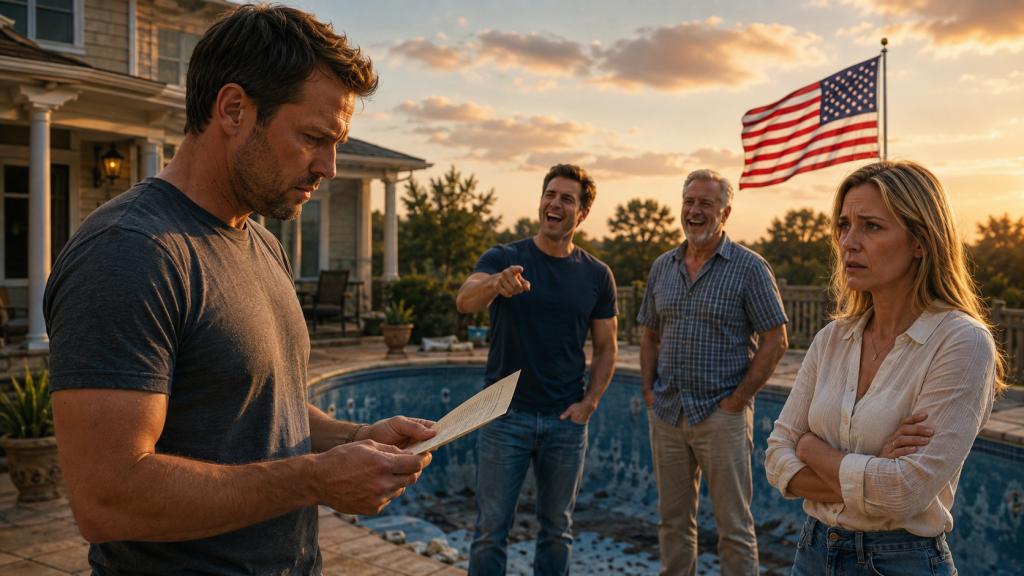
My in-laws used my pool for years without ever asking. But when I requested to borrow a tent, my brother-in-law laughed and said, “Buy your own. We’re not helping you.”
My father-in-law joined in, and even my wife agreed with them. Then I came home to find my pool completely ruined after another gathering they had held without permission. I did not argue. I did not threaten anyone. And I did not seek revenge.
I documented the damage, revoked their access, canceled every expense I had been quietly covering, and sent them the full repair bill.
By the next morning, their confident laughter had been replaced by desperate calls.
The backyard lights came on all at once, illuminating an empty blue shell where forty-one thousand gallons of water had been five days earlier.
I stood inside the kitchen with one hand still resting on the switch.
For several seconds, I could not understand what I was looking at.
The pool liner had pulled away from the walls. Mud covered the deep end. One of the cleaning units lay broken near the drain, while overturned cedar planters spilled dark soil across the stamped concrete.

Two patio chairs were on their sides.
A section of decorative fencing had been damaged.
There were cups beneath the outdoor table and food wrappers near the grill.
This had not happened while the house sat empty.
Someone had been here.
Sarah stopped behind me.
“Oh my God.”
I opened the back door and stepped onto the patio.
We had just returned from a camping trip near Yellowstone. Our bags were still sitting inside the front hallway. I had expected to water the planters, check the filter, take a shower, and go to bed.
Instead, the backyard looked as though someone had deliberately erased the one place I had built for peace.
I had designed that pool seven years earlier.
It was not merely something that came with the house.
I had saved for it.
I had compared contractors, chosen the stonework, selected the landscaping, and spent weekends planting shrubs around the privacy fence.
I worked in finance. Most of my days were spent inside offices, staring at numbers and listening to people talk about forecasts, risks, and quarterly projections.
The backyard was different.
It was quiet.
On summer evenings, I sometimes sat beside the pool after everyone else had gone inside and listened to the water moving through the filter.
Now there was no water.
Only mud.
“Matthew.”
Sarah’s voice trembled.
I looked toward the patio table.
A landscaping stone sat in the center.
Beneath it was a handwritten note.
The moment I saw the sharp, uneven letters, I recognized my brother-in-law Carter’s handwriting.
I picked up the stone.
Sarah moved beside me.
The note read:
Pool parties are over. Maybe now you’ll understand how it feels when someone takes something you care about. Don’t call me.
A smaller sentence had been added underneath.
The pump may have been left off. Accidents happen.
Sarah read over my shoulder.
Her face went pale.
“Call him,” she whispered. “Call Carter right now.”
I folded the note carefully.
“I’m not calling him.”
“What?”
I went inside, found a clean plastic document sleeve in my office, and placed the note inside.
Sarah followed me.
“Matthew, he ruined the pool.”
“He also left a written explanation.”
“What are you going to do?”
“Document it.”
She stared at me as if she had expected shouting.
Maybe six years earlier, I would have shouted.
Maybe even six months earlier.
But standing in that kitchen, something had changed.
I was no longer interested in convincing her family to respect me.
For four summers, Carter had treated my backyard like his personal recreation center.
The first time it happened, I had been trimming shrubs near the fence.
The side gate opened.
Carter walked through carrying a cooler.
His sons, Nathan and Tyler, followed him wearing swim trunks and goggles.
“Hey,” Carter called.
I looked at the cooler.
“What are you doing?”
He laughed.
“Swimming.”
“Did Sarah invite you?”
“No.”
He said it casually.
“Then why are you here?”
He looked genuinely confused.
“Because you have a pool.”
Nathan was already removing his sandals.
I lowered the hedge trimmer.
“You could have called.”
Carter opened the cooler.
“Family doesn’t need an invitation.”
Sarah hurried outside before I could answer.
She was carrying towels.
“Hey, boys!”
The children ran toward her.
I watched Sarah spread towels across the chairs.
Carter gave me a smile.
Not a friendly smile.
A victorious one.
That single afternoon became the rule.
By the following summer, Carter no longer asked whether the pool was available.
He sent announcements to Sarah.
Party Saturday at one.
Nathan is bringing friends.
Make sure the filter is running.
Sometimes I would be upstairs working and hear voices outside.
I would look through the window and discover ten people in my backyard.
Other times, Sarah would casually mention it over breakfast.
“Carter might bring the boys over later.”
“Might?”
“He already texted.”
“Then he isn’t asking.”
She would sigh.
“Matthew, please.”
Those two words became her answer to everything.
Matthew, please.
Please do not make it uncomfortable.
Please do not upset my father.
Please do not embarrass Carter.
Please do not turn something small into a family problem.
So Carter used my grill.
He filled the deck with children I did not know.
He borrowed pool floats and broke them.
He left wet towels on furniture.
Empty cans accumulated beneath chairs.
Once, someone dropped barbecue sauce on a seat cushion and turned it over rather than cleaning it.
Another time, Carter allowed one of his friends to bring a dog into the pool.
The following morning, I spent two hours cleaning the filter.
Whenever I complained, Sarah asked me to let it go.
“The boys don’t have a pool,” she would say.
“I’m not blaming the boys.”
“Carter is struggling.”
“He can still ask permission.”
“He’s family.”
“So am I.”
She never had an answer for that.
Her father, Joseph, made the imbalance worse.
Joseph had spent most of his adult life running a small construction-supply company. He was loud, confident, and absolutely convinced that earning money with your hands made you morally superior to anyone who worked behind a desk.
At family dinners, he praised Carter for being a “hustler.”
Carter changed jobs constantly.
Landscaping.
Roofing.
Used-car sales.
Home renovations.
Delivery work.
Every new job was going to make him rich.
Every failed job was someone else’s fault.
Joseph admired him anyway.
Meanwhile, my career was treated like an accident.
“You sit in meetings all day,” Joseph once said. “Must be nice.”
I had spent fourteen years building that career.
But I stopped defending it.
There was no point.
The first serious confrontation happened three summers earlier.
I came home on a Saturday afternoon and found seventeen people in the backyard.
I recognized four.
Someone had connected speakers near the pool.
Two strangers were cooking on my grill.
A teenager was jumping from the stone retaining wall into the shallow end.
I immediately told him to stop.
Carter walked toward me holding a beer.
“Relax.”
“Who are these people?”
“Friends.”
“Whose friends?”
“Mine.”
“This is my house.”
His smile disappeared.
“Here we go.”
“Yes. Here we go. You cannot invite strangers to my property without asking me.”
Sarah appeared behind him.
“Matthew.”
I turned toward her.
“No. Not this time.”
Carter laughed.
“You want me to kick everybody out?”
“Yes.”
His eyebrows rose.
Joseph happened to be there too.
He was sitting beneath an umbrella.
He leaned back in his chair.
“You have a large house and no children,” he said. “Sharing a pool should not be this difficult.”
I looked at Sarah.
I waited for her to say something.
Anything.
This is our home.
Matthew is right.
Carter should have asked.
Instead, she stared at her napkin.
That silence taught Carter more than anything I could have said.
It told him the family would protect him.
I did not make everyone leave that afternoon.
I regret that now.
I cleaned until nearly midnight after they left.
Carter did not help.
Joseph did not help.
Sarah helped for twenty minutes before saying she had a headache.
The following morning, I found a cracked underwater light.
I paid for the replacement.
Nobody offered.
That was how things worked in Sarah’s family.
What belonged to me was available.
What belonged to them was protected.
I just did not understand how complete that rule was until the tent.
Three years later, Sarah and I planned our Yellowstone trip.
We had been having problems in our marriage, and I thought five days away might help.
No family.
No work calls.
No backyard gatherings.
Just hiking, quiet evenings, and time together.
We owned almost everything we needed except a good tent.
Carter had purchased a four-person model during one of his brief outdoor phases.
He had used it once.
Afterward, it sat in his garage.
“Ask him,” Sarah suggested. “After all the times he’s used our pool, borrowing it for five days shouldn’t be a problem.”
I agreed.
I called him that afternoon.
Carter became quiet when I explained what I needed.
Then he laughed.
“You want my camping equipment?”
“Just the tent. I’ll clean it before returning it.”
“That thing cost four hundred dollars.”
“I know.”
“You can buy one.”
“I could. But yours is sitting in the garage.”
“It’s my property.”
There was something about the way he emphasized my property that irritated me.
I remained calm.
“You’ve used my pool for four years.”
“So?”
“So I’m asking to borrow a tent for five days.”
“A pool just sits there.”
I actually thought I had misheard him.
“What?”
“A pool just sits there, Matthew. You don’t lose anything when people swim in it.”
“I pay for chemicals, electricity, maintenance, water, repairs, food when you’re here, and usually cleanup afterward.”
Carter laughed again.
“Listen to yourself.”
“I am.”
“That tent is valuable property.”
“So is my home.”
There was silence.
Then he said, “Buy your own, Matthew. We’re not helping you.”
He ended the call.
That evening, we had dinner at Joseph and Linda’s house.
Carter apparently told them about the conversation before we arrived.
Joseph brought it up while slicing roast beef.
“Sarah tells me you’re upset about a tent.”
“I’m not upset about the tent.”
Carter smirked.
Joseph shook his head.
“You earn good money.”
“That has nothing to do with it.”
“Then buy one.”
“I will.”
“Problem solved.”
Carter laughed.
I looked at Sarah.
She shifted uncomfortably.
“He probably felt embarrassed because you earn more,” she said later when we were home.
“He insulted me.”
“You can afford another tent.”
“That isn’t the point.”
She sighed.
“Stop making this into something bigger. Buy your own and move on.”
Her words stayed with me.
The next afternoon, I drove to a sporting-goods store.
While the cashier scanned the tent, one detail bothered me.
At the time Carter supposedly purchased his expensive camping equipment, he had been behind on rent.
I remembered because Joseph had asked Sarah and me for money.
Carter’s truck had also needed repairs.
He certainly had not been spending hundreds of dollars on recreational equipment.
That evening, I went into my office and opened our archived credit-card statements.
I searched the month Carter bought the tent.
The charge was there.
$435.50.
Same outdoor store.
Sarah’s credit card.
Paid from our joint checking account.
I printed the statement and carried it upstairs.
Sarah was folding towels.
I placed the paper on the bed.
“You bought Carter’s tent.”
She froze.
“Matthew—”
“Did you?”
“Dad asked me to put it on my card.”
“Why?”
“He said Carter needed it.”
“For what?”
“A camping trip.”
“Did Joseph repay you?”
She looked down.
“No.”
“Did Carter?”
“No.”
“So we bought it.”
She said nothing.
I picked up the statement.
“Our money bought Carter a tent. Carter called me cheap for asking to borrow it. Your father laughed at me. And you told me to buy my own.”
“I was trying to keep the peace.”
“You kept their peace.”
Her eyes filled with tears.
“I didn’t think you would care about four hundred dollars.”
“It isn’t four hundred dollars.”
“Then what is it?”
“It’s the fact that you hid it.”
She sat down.
I started reviewing more statements.
The tent was not the only thing.
There were payments toward Joseph and Linda’s phone plan.