 Reading Time: 23 minutes
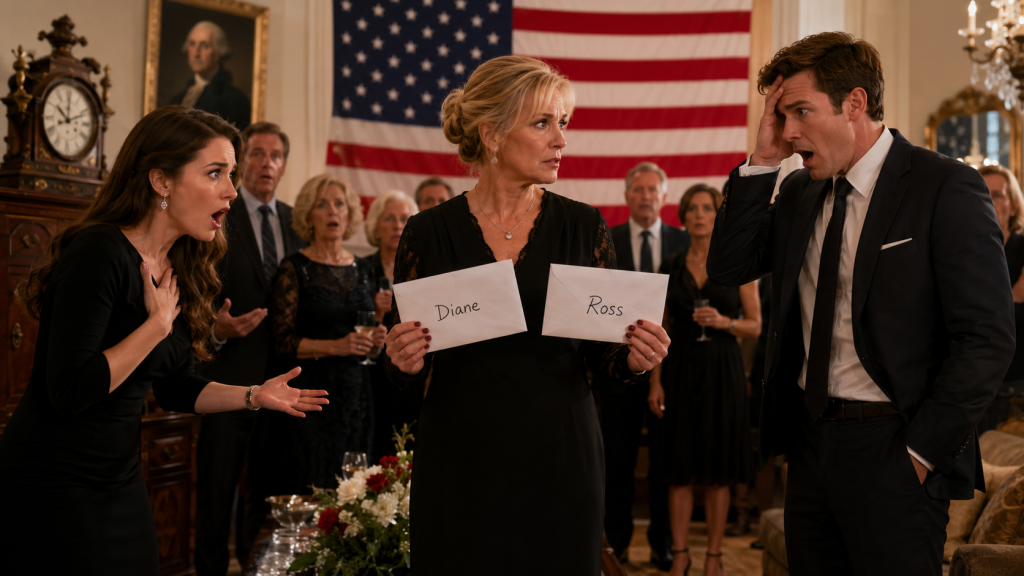
One hour after I buried my husband, his daughter started putting sticky notes on my furniture while the guests were still eating my ham. Pink for her. Blue for her brother.
When she reached for the clock my mother left me, I caught her wrist and said, “Not that one, sweetheart. But since we’re labeling things—your father left you each an envelope, and he made me promise you would open them in front of everyone.”
You should have seen how fast the sticky notes stopped.
My name is Eileen Mercer.

I was married to Frank for nineteen years.
I am his second wife, which his children, Diane and Ross, never once let me forget.
At our wedding, Diane raised her champagne glass and toasted, “To Dad’s replacement.”
Ross laughed so hard he spilled wine down the front of my dress.
Frank was mortified.
I told him it was fine.
That became something of a habit during our marriage.
“It’s fine.”
I said those words when Diane deliberately left my name off Christmas cards addressed to Frank.
I said them when Ross introduced me at his wedding as “Dad’s current wife.”
I said them when neither of them called on my birthday despite expecting me to remember theirs, their spouses’, and eventually their children’s.
Frank always noticed.
Sometimes he apologized.
Sometimes he became angry.
But I never wanted to be the woman who came between a father and his children.
So for nineteen years, I set their places at every holiday table.
For nineteen years, I bought their birthday gifts.
For nineteen years, I cooked Diane’s favorite sweet potato casserole at Thanksgiving and kept Ross’s preferred beer in the refrigerator.
And for nineteen years, Diane looked through me like I was a window.
Then Frank got sick.
Suddenly, I became useful.
I drove him to every appointment.
I learned the names of medications I could barely pronounce.
I kept a notebook beside our bed where I recorded doses, temperatures, meals, symptoms, questions for doctors, and every small change I thought might matter.
When Frank became too weak to climb the stairs, I turned our downstairs den into a bedroom.
When he stopped sleeping through the night, I slept in a recliner beside him.
When food tasted wrong, I tried fifty recipes until I discovered he could tolerate scrambled eggs with a little cheddar and toast with strawberry preserves.
When he was frightened, I held his hand.
When he was angry, I let him be angry.
When he was embarrassed that I had to help him bathe, I pretended it was no different from washing dishes together after Thanksgiving.
Diane visited four times in two years.
Ross came twice.
One of those times, he asked his dying father to co-sign a truck loan.
I was in the kitchen when I heard him.
“Dad, I’m not asking you to pay for it. I just need your name.”
Frank’s voice was weak.
“My name is about all I have left, Ross.”
Ross laughed.
“Come on. Don’t be dramatic.”
I walked into the room.
Ross saw my face and immediately leaned back.
“What?”
“Your father needs to rest.”
“We’re talking.”
“No. You’re asking a sick man for money.”
“I’m asking him to sign a form.”
“Leave.”
His eyebrows lifted.
“You don’t get to tell me when to leave my father’s house.”
Frank spoke before I could.
“Yes, she does.”
Ross looked at him.
Frank pointed toward the door.
“Go home, son.”
Ross left without saying goodbye.
I watched his taillights disappear down our driveway.
Frank stared at the dark window for a long time.
Then he said something I never forgot.
“Eileen, bring me my good pen and two envelopes.”
It was January.
The good pen was a black fountain pen I had given him for our tenth anniversary.
I brought it to him along with two cream-colored envelopes.
Frank wrote for nearly an hour.
He would stop every few minutes because his hand cramped.
I offered to write for him.
He refused.
“These need to be mine.”
When he finished, he folded the pages carefully.
He wrote Diane’s name on one envelope and Ross’s on the other.
Then he sealed both himself and licked the envelopes like they owed him money.
Three days later, he asked me to drive him downtown.
“To Whit’s office.”
Whit Coleman had been Frank’s lawyer for decades. He had handled our taxes, the purchase of the house, Frank’s first divorce settlement, several business matters, and eventually our estate planning.
I drove Frank there on a Tuesday morning.
Whit came downstairs personally and helped him from the car.
“You coming up?” Whit asked me.
Frank shook his head.
“Just me.”
I waited in the car for almost two hours.
Whatever those two men did upstairs, Frank came back smiling for the first time in a month.
Not a tired smile.
Not the little smile he used when he was pretending not to hurt.
A genuine Frank smile.
He settled into the passenger seat and closed his eyes.
“Everything okay?” I asked.
“Better than okay.”
“What did you do?”
“You’ll know when you need to.”
I gave him a look.
He reached over and squeezed my hand.
Then he became serious.
“Promise me one thing.”
“Anything.”
“They open those envelopes at the funeral.”
I stared at him.
“What?”
“Diane and Ross. They open their letters at the house after the funeral. In front of everybody.”
“Frank—”
“Not before. Not after.”
“Why?”
His mouth twitched.
“Because some lessons require witnesses.”
I should have known.
That was Frank.
Quiet for months.
Then one sentence that could move a mountain.
“I promise,” I said.
He squeezed my hand again.
“Good.”
Frank passed away during the first week of October.
He was seventy-four.
I was sixty-eight.
He died at home, holding my hand while I hummed “Abide with Me,” the hymn his mother used to sing when he was a boy.
His last word was my name.
Not because I deserved some grand romantic ending.
I think he was simply checking that I was still there.
I was.
The funeral was Saturday.
Diane arrived wearing new black from head to toe and cried into a tissue that remained mysteriously dry.
Ross checked his phone during the eulogy.
Twice.
After the cemetery, everyone returned to our house for the reception.
I had ordered ham, rolls, potato salad, fruit, coffee, and enough pie to feed half the county.
People filled the living room, kitchen, dining room, and back porch.
Neighbors told stories about Frank.
Former coworkers laughed about the time he accidentally locked himself in the supply room.
Pastor Dave told me Frank had once anonymously paid a young couple’s electric bill for six months.
I didn’t know that.
There were many things about my husband I was learning only after he was gone.
For the first forty-five minutes, Diane and Ross behaved themselves.
Then I saw the first sticky note.
Pink.
It was attached to the china cabinet.
I assumed one of the grandchildren had put it there.
Then I noticed a blue one on Frank’s leather recliner.
Another pink one appeared on the antique side table.
Then I saw Ross holding a tape measure against the television while Mrs. Hendricks from next door watched him with her mouth hanging open.
“What are you doing?” I asked.
Ross barely looked at me.
“Measurements.”
“For what?”
“The moving company.”
“What moving company?”
Diane appeared beside me holding a stack of pink sticky notes.
She smiled.
“Don’t worry about all this today, Eileen.”
She patted my arm.
I looked at her hand.
She removed it.
“Worry about what?”
“Sorting things.”
“Sorting my things?”
“Dad’s things.”
She said it slowly, as though explaining something to a child.
Ross stretched his measuring tape across the television stand.
“Fifty-eight.”
He wrote it down.
Diane placed a pink note on a lamp.
“Just being practical,” she announced to the room. “Eileen will hardly need all this. She’ll be going somewhere smaller.”
The conversations around us faded.
She smiled at me.
“Won’t you, hon?”
“Somewhere smaller,” Ross agreed. “You can keep whatever fits in your car.”
My sister Margaret stood up from the sofa.
Pastor Dave lowered his coffee.
Mrs. Hendricks stopped pretending she wasn’t listening.
I looked from Diane to Ross.
My husband had been buried barely an hour earlier.
There was dirt from his grave still caught in the edge of my shoe.
And his children were dividing my living room.
Oddly, I did not feel angry.
Not yet.
Mostly I felt tired.
Then Diane walked toward the mantel.
She reached for a small walnut clock.
My mother’s clock.
It had belonged to her for thirty-seven years.
After she died, it became mine.
Frank had never owned it.
Diane picked it up.
I caught her wrist.
“Not that one, sweetheart.”
She froze.
I gently removed the clock from her hand and placed it back on the mantel.
“That belonged to my mother.”
Diane pulled her arm away.
“We can figure out personal items later.”
“No need.”
I looked at the pink and blue notes scattered around my home.
Then I remembered my promise.
“But since we’re labeling things, your father left you each an envelope.”
Ross’s tape measure stopped retracting.
Diane stared at me.
“What envelope?”
“He made me promise you would open them after his funeral.”
Her entire expression changed.
“And you waited until now to tell us?”
“He specifically requested that you open them in front of everyone.”
Ross dropped the measuring tape onto the sofa.
“Where are they?”
I walked to the breakfront.
The envelopes had been waiting in the top drawer for three months.
I removed them.
Frank’s handwriting was on the front.
DIANE.
ROSS.
The room became quiet as snow.
Guests suddenly became extremely interested in the contents of their plates while somehow positioning themselves for a better view.
Mrs. Hendricks did not even pretend.
Ross took his envelope first.
“Finally,” he muttered. “Some respect.”
I said nothing.
I handed Diane hers.
She opened it with one red fingernail.
Inside was a single sheet of paper in Frank’s handwriting.
Because Diane apparently assumed the first line would contain either an apology or a dollar amount, she read it aloud.
“By the time you read this, Diane, you have already put your stickers on the furniture.”
She stopped.
Nobody moved.
Her eyes ran down the page.
Her face changed.
Smugness disappeared first.
Then certainty.
Then color.
Ross grabbed the letter.
“What does it say?”
“Give it back.”
He ignored her.
He read the next line aloud.
“And the man standing quietly by the front door is not one of the funeral guests. Say hello to him. He has been waiting all afternoon, and in his briefcase is—”
Ross stopped.
Every head in the room turned toward the front door.
A man in a gray suit stood beside the coat rack.
He had arrived twenty minutes earlier.
I recognized him.
Diane and Ross did not.
He placed his coffee cup on the small entry table.
Then he picked up his briefcase.
“My name is Benjamin Hale,” he said. “I’m an associate with Coleman, Hale and Mercer.”
Diane looked at me.
“Lawyer?”
Benjamin nodded.
“I represent your father’s estate.”
Ross glanced at the envelope in his hand.
“Where’s Whit Coleman?”
“Mr. Coleman retired in July. I assumed responsibility for several of his clients, including your father.”
Diane looked down at Frank’s letter.
“What exactly is in that briefcase?”
Benjamin gave the smallest smile.
“Your father’s final instructions.”
Nobody touched the ham after that.
Benjamin stepped into the living room and placed his briefcase on the coffee table.
Diane sat.
Ross remained standing.
I took Frank’s recliner.
For two years I had refused to sit in it because it was his chair.
That afternoon, I sat down without thinking.
Maybe some part of me understood that Frank was no longer coming back to claim it.
Benjamin opened his briefcase.
He removed a thick folder.
Ross immediately leaned forward.
“Let’s get this over with.”
Benjamin looked at him.
“Your father anticipated you might say something similar.”
Mrs. Hendricks made a sound suspiciously like a cough covering a laugh.
Benjamin continued.
“Frank Mercer signed a new will and several accompanying documents on January seventeenth of this year.”
Diane’s head snapped toward me.
“You knew?”
“No.”
That was true.
I knew Frank had met Whit.
I did not know what he had signed.
Benjamin removed two copies.
“Mr. Mercer requested that I explain the estate structure immediately following the funeral, with both adult children present and, if possible, several neutral witnesses.”
“Why witnesses?” Diane demanded.
Benjamin glanced toward the sticky notes.
“I suspect your father had his reasons.”
Ross crossed his arms.
“Just tell us what we inherited.”
Benjamin nodded.
“The answer requires a little history.”
He turned to me.
“Mrs. Mercer, are you comfortable with me discussing the property arrangements in front of your guests?”
I thought about it.
Then I looked at Diane’s pink note on my china cabinet.
“Very.”
Benjamin opened the folder.
“The residence at 1847 Willow Bend Road was purchased by Eileen Mercer twelve years before her marriage to Frank.”
Diane blinked.
“What?”
I felt something inside me settle.
That house had been mine since I was thirty-seven.
My first husband had never lived there.
Frank moved in after we married.
He contributed to household expenses and improvements, but the deed remained solely in my name.
Apparently Diane and Ross had never bothered to check.
Benjamin continued.
“Frank Mercer had no ownership interest in this property at the time of his death.”
Ross stared around the room.
“That’s impossible.”
“No,” Benjamin said. “It’s recorded at the county clerk’s office.”
Diane pointed toward me.
“Dad paid for this house.”
I laughed.
I could not help it.
It was the first time I had laughed since Frank died.
“No, sweetheart. Your father moved into this house with two suitcases, a fishing rod, and a television that turned everything green.”
Several people smiled.
Diane did not.
“But he renovated it.”
“He paid for half the kitchen renovation,” I said. “I paid the other half.”
Ross frowned.
“So the house isn’t in the estate?”
“No,” Benjamin said.
Ross looked around at all his blue sticky notes.
Slowly, he started pulling them off.
Mrs. Hendricks smiled into her coffee.
Diane was not finished.
“What about Dad’s assets?”
Benjamin turned another page.
“At the time of his death, Frank held retirement accounts, investment accounts, savings, a life insurance policy, a small commercial property interest, two vehicles, and several personal assets.”
Diane straightened.
There it was.
Hope.
Money could revive her faster than smelling salts.
“And?”
“The life insurance beneficiary is Mrs. Mercer.”
Diane’s jaw tightened.
“The retirement account?”
“Mrs. Mercer.”
“Investments?”
“Mostly transferred into a trust.”
“What trust?”
Benjamin looked at me.
“The Eileen Mercer Lifetime Trust.”
This time I was the one who stared.
“I have a trust?”
“You do.”
I almost heard Frank laughing.
Diane stood.
“This is ridiculous.”
Benjamin remained calm.
“Your father created the trust in January.”
“While he was sick.”
“Yes.”
“He was on medication.”
“Yes.”
“He wasn’t thinking clearly.”
Benjamin closed the folder halfway.
“Your father anticipated that argument as well.”
He removed another document.
“Two days before signing the trust, Mr. Mercer underwent an independent capacity evaluation conducted by a physician who had never treated him. The physician concluded that he was fully competent to make financial and legal decisions.”
Diane’s mouth closed.
Benjamin added, “The signing was also recorded.”
Ross looked toward me.
“You set this up.”
“No.”
“You drove him there.”
“Yes.”
“You knew he was cutting us out.”
“I didn’t know anything.”
“Come on.”
I stood.
For nineteen years, I had tried to keep peace.
Frank was buried.
I was tired.
Peace suddenly seemed overrated.
“You visited your father four times in two years,” I said to Diane.
Then I looked at Ross.
“You came twice.”
“That has nothing to do with—”
“One of those times you asked him to co-sign a truck loan while he could barely walk.”
Ross’s face reddened.
“That was between me and Dad.”
“Yes. And apparently Dad remembered it.”
Benjamin cleared his throat.
“There is more.”
Everyone looked at him.
Diane sat down again.
Benjamin opened Frank’s letter.
“Your father asked that you continue reading.”
Diane shook her head.
“I’m not reading that.”
“I will,” I said.
She looked at me.
I held out my hand.
After several seconds, she gave me the page.
Frank’s handwriting wavered slightly, but every word was legible.
I read.
“Diane, if you are angry right now, that means you have reached the part where you discovered the house was never mine. I imagine you have already selected a few things you planned to take home. Please remove your labels from Eileen’s belongings before you leave.”
Mrs. Hendricks laughed outright.
Pastor Dave hid his smile behind his cup.
I continued.
“I love you because you are my daughter. Love, however, is not the same thing as approval. For too many years I watched you treat my wife as though her kindness made her weak. It did not. Her patience was a gift, and you mistook it for permission.”
My voice caught.
I stopped.
For a moment, I could not see the page clearly.
Frank had never said those words to me.
Not exactly.
Benjamin waited.
I swallowed and continued.
“When I became sick, Eileen gave me two years of her life without keeping score. You gave me four afternoons. I know because I kept count.”
Diane stared at the floor.
“You called when you needed money. You visited when you wanted information about my will. The last time you came, you spent seventeen minutes asking Eileen whether I had updated my beneficiaries while I was asleep ten feet away.”
Diane looked at me sharply.
I remembered that afternoon.
I had never told Frank.
Apparently he had been awake.
The letter continued.
“I am not punishing you for failing to love Eileen. I am responding to the choices you made about me.”
I lowered the page.
Diane’s eyes were wet now.
For the first time that day, the tissue in her hand was not dry.
Ross pointed toward his envelope.
“What does mine say?”
Benjamin looked at him.
“You should probably read it.”
Ross tore his open.
He did not read aloud at first.
His eyes moved quickly.
Then stopped.
“What the hell?”
“Ross,” Pastor Dave said quietly.
Ross ignored him.
“He sold it?”
Benjamin nodded.
Ross held up the letter.
“What does this mean, he sold his share?”
Benjamin answered calmly.
“Your father owned a twenty-five-percent interest in Mercer Auto Supply, the company founded by your grandfather.”
“I know what he owned.”
“He sold that interest in February.”
“To who?”
“To the other shareholders.”
Ross stared at him.
“For how much?”
“That information is part of the estate accounting.”
“And where’s the money?”
Benjamin glanced toward me.
“The majority funded Mrs. Mercer’s trust.”
Ross looked as though someone had unplugged him.
For years, he had talked about “Grandpa’s company” as though he already owned it.
He had never worked there.
Not one day.
Frank had.
For thirty-eight years.
Ross had simply assumed family blood was an employment contract.
He looked down at the letter again.
Then, despite himself, he began reading aloud.
“Ross, you have spent twenty years waiting to inherit a business you never helped build. Your grandfather started Mercer Auto Supply in a rented garage. I swept that garage at fourteen. I worked Saturdays through high school and came back after the Army. You declined every job I offered you because you said you didn’t want to waste your life behind a counter.”
Ross stopped.
His face burned.
Benjamin said nothing.
Ross continued more quietly.
“You were entitled to choose your own life. You were not entitled to reject the work and expect the reward.”
Nobody moved.
“I offered you a position seven times. You lasted eleven days the one time you accepted. You quit because the warehouse manager asked you to arrive by eight.”
Mrs. Hendricks suddenly became fascinated by a deviled egg.
Ross folded the letter.
“I’m done.”
Benjamin nodded.
“That’s your choice.”
Diane looked at him.
“So we get nothing?”
Benjamin paused.
“No.”
Her expression changed again.
Frank had left them something.
“Your father left each of you an inheritance.”
“How much?” Ross asked immediately.
Benjamin did not answer immediately.
Instead, he removed two thin envelopes from the folder.
“Ten thousand dollars each.”
Ross laughed.
Not because anything was funny.
It was the kind of laugh people make when reality is too insulting to accept.
“Ten thousand?”
“Yes.”
“Dad’s estate is worth what? A million? Two?”
Benjamin did not answer.
Diane stared at him.
“What is the trust worth?”
“That information is private.”
“I’m his daughter.”
“And Mrs. Mercer is the beneficiary.”
Diane turned toward me.
“How much did he leave you?”
“I don’t know.”
“You expect me to believe that?”
“I buried my husband this morning, Diane. I haven’t exactly checked my portfolio.”
She stood.
“You manipulated him.”
Margaret stepped forward.
“That’s enough.”
Diane pointed at me.
“No, it isn’t. She took everything.”
I stood too.
“I took care of him.”
“You kept us away.”
My grief disappeared beneath something hotter.
“I begged you to come.”
Diane flinched.
“I called you the week before his surgery. You said you had theater tickets.”
“That wasn’t—”
“I called you on his birthday. You said driving two hours was too much because you had work Monday.”
“I did.”
“It was Saturday.”
Her mouth closed.
I turned to Ross.
“I called you when your father asked for you in March.”
“I was working.”
“You were in Florida.”
He stared.
“Frank saw the pictures online.”
That landed.
Hard.
I continued.
“You both had every opportunity to be his children while he was alive. You cannot arrive after his funeral and make up for it by measuring his television.”
The room was silent.
Then Benjamin spoke.
“There is one additional condition attached to the ten-thousand-dollar bequests.”
Ross closed his eyes.
“Of course there is.”
Benjamin handed each of them a document.
“The money is payable ninety days after probate begins, provided neither beneficiary contests the will or trust.”
Diane laughed bitterly.
“So he bought our silence.”
“No,” Benjamin said. “You are free to contest the documents. If you do, the conditional bequest lapses.”
“And where does our twenty thousand go?”
Benjamin glanced at Frank’s instructions.
“To the county hospice program.”
I looked away.
That was Frank.
Even his backup plan had a purpose.
Ross crumpled the paper slightly.
“Fine. I’ll get my own lawyer.”
“You’re entitled to.”
“I’ll prove he wasn’t competent.”
“You’re entitled to try.”
“I’ll subpoena the medical records.”
“Your attorney can advise you.”
Ross clearly hated Benjamin’s calmness.
Diane was staring at her father’s letter.
Then she asked something I did not expect.
“Did Dad really think I would put stickers on things?”
Nobody answered immediately.
Finally I did.
“Yes.”
Her eyes lifted.
“How?”
I thought about January.
Frank asking for his good pen.
Frank watching Ross drive away.
Frank hearing Diane ask me about beneficiaries while pretending to sleep.
“He knew you.”
Diane looked around the room.
Pink notes were everywhere.
On the china cabinet.
The lamp.
A painting.
A side table.
Even the silver serving tray holding the ham.
One by one, she began removing them.
Nobody helped her.
Ross stood there for another minute.
Then he began pulling off the blue ones.
There was something almost sad about watching them.
Not satisfying.
Not triumphant.
Sad.
They were two middle-aged people discovering that their father had seen them clearly.
When the last sticky note was gone, Diane walked toward the door.
She stopped beside me.
For a second, I thought she might apologize.
Instead she whispered, “You won.”
I looked at her.
“No, Diane.”
My voice broke.
“I buried my husband today. Nobody won.”
She left.
Ross followed.
The door closed.
For several seconds, nobody spoke.
Then Mrs. Hendricks picked up the plate she had abandoned.
“Is anybody going to eat this ham?”
Everyone laughed.
Even me.
Especially me.
Maybe because grief occasionally needs somewhere else to go.
Over the next several weeks, I learned what Frank had done.
He had been planning carefully for months.
The trust was substantial.
Not enormous.
We were never secretly wealthy.
But Frank had saved more than I realized.
He had invested patiently.
He had sold his interest in Mercer Auto Supply.
He had increased his life insurance years earlier.
He had also left me his car, his tools, his fishing equipment, his personal accounts, and one very ugly ceramic duck he had refused to throw away since 1989.
Benjamin gave me the estate inventory.
I read it twice.
Then I asked, “What am I supposed to do with all this?”
He smiled.
“Whatever you want.”
That was the hardest answer anyone could have given me.
For two years, every day had revolved around Frank.
Medication at seven.
Breakfast at eight.
Appointment at ten.
Rest at noon.
Dinner at five.
Evening pills.
Night checks.
Then suddenly there was no schedule.
No oxygen machine humming.
No water glass beside the bed.
No Frank calling, “Eileen?”
The first month after his funeral, I woke up every night at 2:15.
That was when his pain medication had been due.
My body remembered even though he no longer needed me.
Diane did not call.
Ross did.
Three weeks after the funeral.
I nearly let it go to voicemail.
“Hello?”
Silence.
Then he said, “I need Dad’s socket wrench set.”
I almost laughed.
Of course.
“What for?”
“They’re mine.”
“No.”
“Dad would want me to have them.”
“Your father’s will left his personal tools to me.”
“What are you going to do with socket wrenches?”
“I haven’t decided.”
“That’s ridiculous.”
I looked toward the garage.
Frank’s red toolbox sat exactly where he had left it.
“I’ll think about it.”
“Think about what? They belonged to my father.”
“Yes.”
“I’m his son.”
“Yes.”
“So?”
I waited.
He had no answer.
Finally I said, “Ross, you spent years treating me as though being your father’s wife gave me no place in this family. You don’t get to invoke family now only because you want something from my garage.”
He hung up.
Two days later, Diane called.
She wanted Frank’s watch.
That request was different.
It was the silver watch Frank had worn almost every day for twenty-seven years.
I had taken it off his wrist the night he died.
It sat in my dresser.
“Why?” I asked.
“He wore it when he walked me down the aisle.”
I remembered.
There was something in her voice I had not heard before.
Not entitlement.
Grief.
“I’ll think about it.”
She did not argue.
A week later, I put the watch in a small box.
I also put in a photograph from Diane’s wedding.
Frank was standing beside her.
She was twenty-six.
He looked impossibly young.
I mailed it.
Three days later, Diane called.
“Thank you.”
“You’re welcome.”
Then neither of us spoke.
Finally she whispered, “I didn’t know he kept that picture.”
“He kept everything.”
Another silence.
“Eileen?”
“Yes?”
“I’m sorry about the clock.”
Not the furniture.
Not nineteen years.
The clock.
It was a start.
“You’re welcome here when you’re ready to come without sticky notes.”
She laughed once.
A tiny, embarrassed laugh.
“Fair enough.”
Ross took longer.
He hired a lawyer.
The lawyer reviewed Frank’s documents.
Apparently he advised Ross not to contest anything.
The ninety-day deadline passed.
Both Diane and Ross accepted their ten thousand dollars.
Neither challenged the estate.
I donated Frank’s ugly ceramic duck to Ross.
I did not ask permission.
I packed it carefully and mailed it with a note.
“Your father loved this. Now it’s your problem.”
Ross called me laughing.
It was the first time I had heard him laugh with me rather than at me in nineteen years.
“You knew I hated this thing.”
“Frank knew too.”
“He used to put it in my bedroom when I came home from college.”
“I know.”
There was a pause.
Then Ross said, “I miss him.”
Three words.
No request attached.
“I miss him too.”
We talked for twenty minutes.
Not about money.
Not about the estate.
About Frank.
Ross told me about a fishing trip when he was twelve.
I told him about the time his father accidentally bought twenty pounds of onions because he misunderstood an online grocery order.
For the first time, we shared the same man instead of fighting over different versions of him.
Spring came.
I did not move somewhere smaller.
In fact, I did the opposite.
I renovated the back porch.
Frank and I had always talked about enclosing it.
He wanted big windows.
I wanted bookshelves.
So I did both.
I turned it into a sunroom with two comfortable chairs facing the garden.
One chair was mine.
The other remained empty for a while.
Then one Sunday in May, Diane sat in it.
She had called the week before.
“Could I come by?”
“For what?”
“Coffee.”
I almost asked what she wanted.
Instead I said yes.
She arrived carrying a bakery box.
No sticky notes.
I checked.
She noticed.
“Very funny.”
“I wasn’t joking.”
She laughed.
We sat in the sunroom.
For a while we talked about harmless things.
Weather.
Her daughter’s new job.
The garden.
Then Diane looked toward the mantel.
My mother’s clock was still there.
“I really was awful that day.”
“Yes.”
She looked surprised.
Maybe she expected me to rescue her from the truth.
I had spent nineteen years doing that.
I was finished.
“I don’t know what I was thinking.”
“Yes, you do.”
She looked down.
After a moment she nodded.
“I thought Dad’s things were proof that I mattered to him.”
That sentence changed something.
Not everything.
But something.
She continued.
“When Mom and Dad divorced, I was fifteen. Then he married you and built this whole life, and every time I came here, I felt like I was visiting somebody else’s family.”
“You were always invited.”
“I know.”
“You were always included.”
“I know that now.”
“You were thirty-six when Frank and I married, Diane. You weren’t fifteen anymore.”
“I know.”
I let the silence sit.
Then she said, “I think staying angry was easier than admitting Dad was happy.”
That one hurt.
Because I understood it.
Frank had loved his first wife once.
He had loved his children.
Then life changed.
He met me.
We built something new.
Maybe Diane had spent nineteen years believing that accepting me meant betraying her mother.
“You didn’t have to love me,” I said.
“I know.”
“But you could have been kind.”
Her eyes filled.
“I know.”
There was no dramatic embrace.
No instant forgiveness.
Life rarely behaves that neatly.
But when she left, she hugged me.
It was awkward.
Her purse got caught between us.
We both laughed.
Two months later, Ross came over.
He wanted to help me clean the garage.
I suspected he still had designs on the socket wrench set.
He did.
But this time he asked.
“Could I have Dad’s tools?”
I looked at him.
“Why?”
“I’m fixing up an old Ford.”
“Do you know how?”
“No.”
I smiled.
“Then you definitely need the tools.”
I gave him the red toolbox.
He ran his hand across the scratched lid.
Then he noticed Frank’s initials scratched near the handle.
His face changed.
“Dad did that when he was eighteen,” I told him.
Ross swallowed.
“I’ll take care of it.”
“I know.”
Before he left, he handed me something.
A blue sticky note.
I stared at it.
He had written:
MOM’S.
I looked at him.
“What is this?”
He nodded toward the house.
“All of it.”
I laughed so hard I had to sit down.
“You’re an idiot.”
“Probably.”
He hugged me.
Ross had never hugged me before.
Not once.
I wish I could tell you everything became perfect.
It didn’t.
Diane and I still occasionally irritated each other.
Ross still forgot birthdays.
I still remembered things they had said that I wished I could forget.
Forgiveness is not amnesia.
It is deciding that the past will not receive unlimited permission to control the future.
A year after Frank died, we gathered at my house on the anniversary of his passing.
Diane brought sweet potato casserole.
It was terrible.
I ate two servings.
Ross grilled steaks and somehow burned half of them while leaving the others nearly raw.
Frank would have mocked him without mercy.
We laughed until Diane cried.
Then I brought out one final envelope.
Frank had left it with Benjamin.
This one was addressed to me.
I had known about it since probate ended, but I had not been ready to open it.
That evening, with Diane and Ross sitting beside me, I finally broke the seal.
Frank’s handwriting covered two pages.
I read silently at first.
Then Diane asked, “What does it say?”
I smiled.
“He says your casserole needs more butter.”
Her mouth fell open.
“No.”
I turned the page around.
There it was.
In Frank’s handwriting.
Diane laughed.
Ross nearly fell out of his chair.
Then I continued reading.
“Eileen, if you are reading this, I hope enough time has passed that hearing my voice in your head makes you smile more than it hurts.”
I stopped.
It did both.
“I know you will worry that I left you too much. You always worry when someone gives you anything. Please don’t. Money is only stored time. I am giving you back some of the time you gave me.”
My eyes filled.
“You gave me nineteen good years and two hard ones, and somehow you made even the hard ones worth staying for.”
I could not read the next line.
Diane took my hand.
So I continued.
“I also know my children. I know they may arrive with expectations larger than their gratitude. Please do not let guilt make decisions for you.”
Ross looked down.
“Help them if you want to. Love them if they let you. But do not buy their affection. I tried that mistake myself.”
Then came the line I have remembered every day since.
“Leave room in your life for people who come carrying chairs, not people who come carrying labels.”
I looked toward the sunroom.
Two chairs.
One mine.
One that no longer stayed empty.
Frank ended his letter with simple instructions.
Travel somewhere.
Plant tomatoes.
Keep singing badly.
Do not sell the house unless I wanted to.
And throw away the ceramic duck.
I laughed so hard I cried.
Ross protested.
“He gave me that duck!”
“Apparently that was revenge.”
We sat there until dark.
Eventually Diane gathered the dishes.
Ross took out the trash.
I stood alone for a moment beside the mantel.
My mother’s clock ticked quietly.
Pink sticky notes had once marked the things Diane thought she deserved.
Blue sticky notes had marked Ross’s claims.
Every label had disappeared.
Except one.
I still have that blue sticky note Ross gave me.
MOM’S.
I keep it inside Frank’s final letter.
Not because I needed ownership of the house confirmed.
The county records had already done that.
Not because I needed to win.
Frank was right about that too.
There had never been a winner.
A husband died.
A father died.
A family wasted years resenting one another.
Money could not repair that.
A will could not repair it.
Even Frank’s carefully planned surprise could only force us to stand still long enough to see what we had become.
The repair came afterward.
It came when Diane returned without wanting anything.
It came when Ross asked instead of taking.
It came in awkward apologies.
Burned steaks.
Bad casserole.
A ridiculous ceramic duck.
It came slowly enough that I almost missed it.
Two years after Frank died, I finally traveled.
I went to Maine.
Frank had always wanted to see the coast in autumn.
I carried a small photograph of him in my suitcase.
On my last morning there, I sat near the water with coffee and watched the sunrise.
For nineteen years, I had been Frank’s wife.
For two years, I had been Frank’s caregiver.
Then I became Frank’s widow.
Sitting there, I realized I could also simply be Eileen.
I could miss him without disappearing with him.
I could love his children without surrendering myself to them.
I could forgive without pretending nothing happened.
And I could go home afterward to the house that had always been mine.
When I returned, Diane picked me up from the airport.
Ross was waiting at the house.
He had fixed the loose railing on my porch while I was gone.
Neither asked whether I had changed the will.
Neither asked about the trust.
Neither measured anything.
We ordered pizza and sat in the sunroom.
At one point, Diane noticed a pink sticky note on my refrigerator.
Her eyes widened.
“What is that?”
I looked.
It was my grocery list.
MILK.
EGGS.
BUTTER.
Ross started laughing.
Diane pulled it off dramatically.
“No pink sticky notes in this house.”
“Oh, for heaven’s sake.”
She threw it away.
“Family rule.”
I looked at the two of them.
Frank’s children.
Not mine by blood.
Not quite mine by history.
But somehow, after all the resentment and grief and terrible choices, partly mine by love.
Maybe families are not defined by what we inherit.
Maybe they are defined by what we stop trying to claim.
Frank understood that before any of us did.
That was why he wrote those letters.
Not simply to protect his money.
Not simply to protect me.
He wanted his children to see themselves.
He knew that if he confronted them while he was alive, they would argue.
They would blame me.
They would leave.
But after his funeral, standing in the house they had already begun dividing, surrounded by witnesses and their own ridiculous sticky notes, there was nowhere for them to hide from the truth.
Frank’s final gift to Diane and Ross was not ten thousand dollars.
It was embarrassment.
It was accountability.
It was one last chance to become better people.
And, eventually, they took it.
As for me, I still live in the same house.
I never downsized.
The china cabinet is still in the dining room.
Frank’s recliner eventually went to Ross, who put it in his garage beside the red toolbox.
Diane has the silver watch.
I have my mother’s clock.
And on the mantel beside it is a photograph from my wedding day.
Frank is smiling at me.
Diane is visible in the background.
Ross is holding the wineglass he would spill on my dress five minutes later.
For years, I hated that photograph.
Now I love it.
Because none of us knew what was coming.
We did not know about nineteen years of holidays.
We did not know about cancer.
We did not know about hospital waiting rooms, medication charts, funeral flowers, wills, lawyers, sticky notes, terrible casseroles, or second chances.
We were simply people standing at the beginning of a complicated life together.
Sometimes I look at Frank’s face in that photograph and imagine telling him how everything turned out.
Diane comes for coffee.
Ross calls me Mom occasionally, usually when he wants to annoy me.
The ceramic duck survives despite Frank’s instructions.
And nobody has tried to take my mother’s clock again.
I think Frank would be satisfied.
But knowing him, he would probably look around the living room, point toward the mantel, and ask one final question.
“Eileen, why on earth did you keep that ugly duck?”
And I would tell him the truth.
Because sometimes the things a family almost throws away become the things that remind them how far they have come.
THE END! Thank you for reading.