 Reading Time: 25 minutes
I arrived home from the Denver airport five days earlier than anyone expected, still wearing the navy suit I had slept in during the flight.
My consulting assignment in Phoenix had ended unexpectedly after the client’s board suspended the project. I should have been annoyed. The assignment was supposed to last another week, and I had rearranged half my life around it.
Instead, as I sat on the first available flight back to Colorado, I found myself strangely relieved.
I wanted my own bed. I wanted a shower that didn’t involve tiny hotel bottles.

Most of all, I wanted to see my fourteen-year-old son. It was 12:17 a.m. when my Uber pulled up outside our house in Lakewood.
I paid the driver, dragged my suitcase up the walkway, and stopped.
Every window was dark.
That immediately felt unusual.
My wife, Madison, always left the porch light on whenever I traveled. My mother, Evelyn, rarely went to bed before one in the morning. My seventeen-year-old daughter, Chloe, usually had music playing behind her bedroom door late enough for me to complain about it.
Yet the house looked abandoned.
I unlocked the front door.
“Madison?”
Nothing.
“Mom?”
Silence.
Then I heard it.
A low mechanical hum coming from the back of the house.
The washing machine.
I left my suitcase beside the stairs and followed the sound.
The laundry-room door was partly open.
My son, Noah, stood barefoot beneath the bright ceiling light.
He was wearing gray sweatpants and an old Denver Broncos T-shirt. A basket of clean clothes sat on the dryer. He was carefully folding one of his school shirts.
For a moment, I simply watched him.
There was something about the scene that bothered me before I even understood why.
Fourteen-year-old boys can wash clothes. That wasn’t the problem. Noah had been doing his own laundry for more than a year because I believed children should know how to take care of themselves.
It was the time.
It was the silence.
It was the way his shoulders tightened when he heard me enter.
He turned.
“Dad?”
The shirt slipped from his hands.
His face changed so quickly that I will never forget it.
First surprise.
Then relief.
Then fear.
Not fear of me.
Fear of what my being home might mean.
“What are you doing awake?” I asked.
He stared at me.
“You’re supposed to be in Phoenix.”
“The project ended early.”
He swallowed.
I looked around.
“Where is everybody?”
Noah didn’t answer immediately.
Instead, he pointed toward the kitchen.
That was when I knew something was seriously wrong.
I walked into the kitchen.
There was a sheet of white paper on the counter.
My name was written across the top.
ETHAN.
Madison had written it in the neat, rounded handwriting she used on birthday cards and grocery lists.
I picked it up.
There were only two sentences.
Took the family on a cruise.
The boy isn’t invited—he’s your mistake.
I read it twice.
Then a third time.
I wish I could say I immediately became furious.
I didn’t.
At first, I felt nothing.
Sometimes the worst sentences don’t hit you like explosions.
They remove the air from the room.
I turned slowly.
Noah was standing in the kitchen doorway.
He was watching my face.
That hurt more than the note.
My son was studying my expression as though preparing himself for the possibility that I might agree with what had been written.
I folded the note once.
Then again.
I slipped it into my pocket.
“Noah,” I said, “how long have they been gone?”
“Since this morning.”
“Who went?”
“Madison. Grandma. Chloe. Aunt Rebecca and Uncle Dean met them at the airport.”
My sister and her husband.
Apparently, everybody qualified as family except my son.
“Where?”
“Caribbean cruise. They flew to Miami this morning.”
I stared at him.
Madison and I had discussed taking a family vacation.
We had not discussed booking one.
Certainly not while I was away.
Certainly not without Noah.
“Why didn’t you call me?”
Noah looked down.
“Grandma told me not to.”
“What exactly did she say?”
He hesitated.
“Tell me.”
“She said you already knew.”
My stomach tightened.
“She said you’d agreed I shouldn’t come because I make family trips uncomfortable.”
I had to turn away.
I walked to the refrigerator and opened it.
Half a carton of milk.
Three eggs.
Mustard.
A container of leftover pasta.
Two apples.
A nearly empty loaf of bread.
That was what they had left a fourteen-year-old boy for what they believed would be almost a week.
There was money in Noah’s account. He knew how to order food. Our neighbors knew him. He wasn’t helpless.
That wasn’t the point.
They had intentionally abandoned him emotionally and then made him believe his father had approved.
I closed the refrigerator.
“Did Madison say goodbye?”
He shook his head.
“Chloe?”
Another shake.
“Grandma?”
“She told me there were frozen dinners downstairs.”
I closed my eyes for a second.
My mother had been living with us for eighteen months.
After my father died, she had struggled with the large house they had shared, so I invited her into mine.
I converted my downstairs office into a bedroom.
I paid most of her expenses.
I drove her to appointments.
And apparently she had helped my wife leave my son behind while they vacationed together.
But Noah wasn’t finished.
“Dad?”
I looked at him.
“There’s something else.”
“What?”
He glanced toward the hallway.
“Grandma has no idea I found something in her cupboard.”
I almost told him it could wait.
Then I saw his expression.
“Show me.”
He pulled out his phone.
The first photograph showed the locked cabinet at the end of the upstairs hallway.
I knew that cabinet.
My mother had moved it into our house with her belongings. It was an antique walnut cupboard that had belonged to my grandfather.
She kept it locked.
Whenever anyone asked what was inside, she said old tax records and family papers.
Noah swiped to the next photograph.
Folders.
Bank statements.
Property records.
Insurance documents.
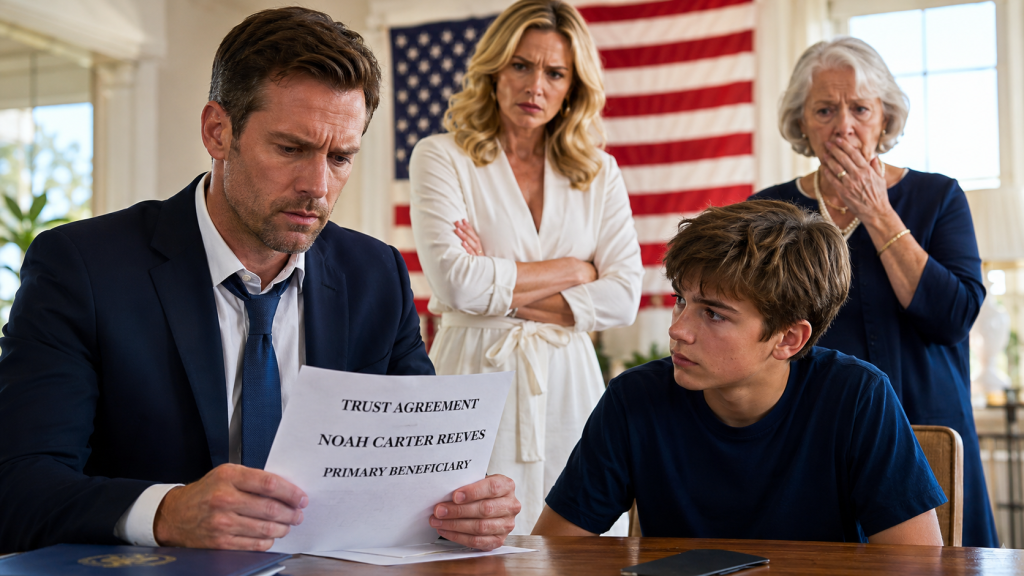
Then he showed me a photograph of a legal document.
I enlarged it.
My father’s full name appeared near the bottom.
WILLIAM HENRY REEVES.
His signature was notarized.
Across the first page were words that made my hands start trembling.
THE WILLIAM H. REEVES FAMILY TRUST
And beneath it:
PRIMARY BENEFICIARY: NOAH CARTER REEVES
I looked at my son.
“Where did you get this?”
“Grandma’s cabinet.”
“How did you open it?”
“She left the key.”
“Where?”
“In her desk drawer. I wasn’t trying to snoop.”
He said that quickly.
“I was looking for my passport.”
“Your passport?”
He nodded.
“I thought maybe they’d changed their minds and were going to take me. Grandma said she needed everybody’s passport last week. I couldn’t find mine, so after they left, I looked in her room.”
That detail almost broke me.
Even after they had left him behind, my son had spent part of the day hoping there had been a misunderstanding.
I pulled out a chair.
“Sit down.”
We sat at the kitchen table.
“Start from the beginning.”
Noah explained that while searching for his passport, he had found a small brass key inside my mother’s desk.
He recognized it because he had seen her use it on the hallway cupboard.
Curiosity got the better of him.
He opened it.
Inside were seven folders.
One contained my father’s estate documents.
Another contained records for two rental properties.
Another contained investment statements.
Noah had photographed everything because he was afraid Grandma would return and move them.
“How much did you read?”
“Not much.”
He looked embarrassed.
“I don’t understand most of it.”
Neither did I.
But I understood enough.
My father had died three years earlier.
At the time, my mother told me his estate was simple.
She said everything had passed directly to her.
I never questioned it.
Why would I?
She was my mother.
My father and I had been close, but he had always trusted her with financial matters.
Or so I believed.
I enlarged another photograph.
The trust had been established six years before Dad died.
Noah would have been five.
There were amendments.
Property schedules.
Account numbers.
A letter from a law firm in Denver.
And one sentence appeared repeatedly.
Upon the grantor’s death, control was to pass to an independent successor trustee for the benefit of Noah Carter Reeves.
Not Evelyn.
Not me.
Noah.
My son stared at me.
“Am I in trouble?”
The question hit me harder than anything else that night.
I reached across the table.
“No.”
“For opening Grandma’s cupboard?”
“Noah, look at me.”
He did.
“You are not in trouble.”
His eyes filled, but he blinked quickly.
I continued.
“And there’s something else you need to understand.”
“What?”
“I did not know about that cruise.”
He said nothing.
“I would never agree to leave you here.”
His chin trembled.
“Never.”
He looked down.
“I figured maybe you were tired of fighting about me.”
That sentence told me how badly I had failed him.
Not because I had mistreated him.
Because I had allowed other people to do it gradually enough that I could pretend each incident was small.
Madison forgetting to buy him a Christmas gift one year.
My mother correcting him more harshly than Chloe.
Family photographs where someone always seemed to ask Noah to stand at the edge.
Restaurant reservations accidentally made for four instead of five.
Madison calling him “your son” whenever she was angry.
My mother describing Chloe as “our family’s future” while calling Noah “that serious little boy.”
I had noticed.
I had confronted them sometimes.
But then came apologies.
Excuses.
Promises.
And I had accepted them because keeping peace seemed easier than admitting the peace was fake.
My son had paid the price for my comfort.
I stood.
“Pack a bag.”
Noah looked alarmed.
“Why?”
“We’re going somewhere.”
“Where?”
“A hotel.”
“Are we leaving?”
“For tonight.”
He glanced upstairs.
“What about Grandma’s papers?”
“We’re not touching them.”
“Why?”
“Because tomorrow morning I’m calling an attorney.”
The First Call
At 8:03 the next morning, I called a man I hadn’t spoken to in nearly two years.
His name was Daniel Mercer.
Daniel and I had gone to college together. He later became an estate attorney in Denver.
When my father died, I had almost asked Daniel to review the estate documents.
My mother persuaded me not to.
“Don’t turn your father’s death into a legal circus,” she had said.
So I backed away.
Now I understood why she had been so determined.
Daniel agreed to meet us at ten.
Before leaving the hotel, I bought Noah breakfast.
He ordered pancakes.
Then he asked if he could get bacon too.
The question nearly destroyed me.
“Buddy, you can order whatever you want.”
He gave me a small smile.
For the first time since I had walked into that laundry room, he looked fourteen again.
At Daniel’s office, I showed him the photographs.
His expression changed immediately.
“Where are the originals?”
“At my house.”
“Accessible?”
“Yes.”
“Does Evelyn know you have seen them?”
“No.”
“Keep it that way for the moment.”
He spent nearly forty minutes reading the photographs Noah had taken.
Finally, Daniel removed his glasses.
“Ethan, this isn’t something I can conclusively interpret from photographs, but if these documents are authentic, your father established a substantial trust for Noah.”
“How substantial?”
Daniel looked at Noah, then back at me.
“We should discuss numbers carefully.”
“Noah can hear it.”
Daniel nodded.
“The real estate alone could be worth well over a million dollars at current values. The investment account shown on these statements was approximately $1.4 million three years ago.”
Noah’s eyes widened.
I barely reacted.
Money wasn’t what had my attention.
“What was my mother’s role?”
Daniel pointed to the document.
“Limited administrative authority before the successor trustee assumed control.”
“Who was the successor trustee?”
“A professional fiduciary named Margaret Sloan.”
“Never heard of her.”
“That’s concerning.”
“Why?”
“Because according to this document, she should have been notified immediately after your father’s death.”
“Could Mom legally hide this?”
Daniel paused.
“Let’s establish facts before we use words like hide.”
Fair enough.
He made several calls.
One was to the county recorder.
Another was to a title company.
A third went to the law firm named on Dad’s trust documents.
That firm still existed.
And so did the attorney who had prepared the trust.
His name was Samuel Greene.
Daniel spoke with him privately.
Twenty minutes later, he returned.
His face was serious.
“We need to retrieve those original documents.”
What My Father Had Done
My father had always loved Noah.
Not casually.
Not in the distant way some grandparents love children through birthday cards and Christmas checks.
Dad understood him.
When Noah was six, Dad bought him his first telescope.
When he was eight, they built a model railroad together.
When he was ten, Dad taught him how to change a tire.
Noah could sit silently beside my father for an hour, and neither of them felt the need to fill the room with noise.
I once asked Dad why the two of them got along so well.
He laughed.
“Because the boy listens before he talks. That’s becoming rare.”
What I hadn’t known was that Dad had become worried about the way my mother treated Noah.
Samuel Greene later explained it.
Six years before his death, Dad had visited Samuel alone.
He wanted to establish a trust.
Not for me.
For Noah.
Dad believed I could support myself.
He also knew my marriage to Madison was becoming increasingly centered around Madison, Chloe, and my mother’s expectations.
He worried Noah would eventually become an outsider inside his own family.
He had been right.
Dad transferred two rental properties into the trust.
He designated an investment account.
And most surprisingly, he placed his Lakewood property into the trust as well.
The house where my mother had lived before moving in with us.
The house she repeatedly referred to as “my house.”
Legally, it wasn’t.
It belonged to the trust established for Noah.
My mother had been permitted to remain there during her lifetime under certain conditions.
But eighteen months earlier, she had rented it out.
The rental income should have been reported to the trust.
According to Daniel, that opened a much bigger question.
Where had the money gone?
We returned home that afternoon with Daniel and a professional locksmith.
I wasn’t changing locks yet.
We were opening the cupboard properly and documenting its contents.
Daniel photographed everything before moving a single sheet.
Then he found a sealed envelope.
My name was written across it.
ETHAN — IF EVELYN DOESN’T GIVE THIS TO YOU, SOMETHING HAS GONE WRONG.
I knew my father’s handwriting immediately.
My knees weakened.
I sat down on the hallway bench.
The envelope had never been opened.
Daniel handed it to me.
“It’s addressed to you.”
I opened it.
Inside were four handwritten pages.
Dad had written them during the final year of his life.
The first page explained the trust.
The second explained why Noah was the beneficiary.
The third page was about my mother.
The fourth was about me.
I read that page twice.
Son, you have always mistaken endurance for loyalty.
I stopped.
Dad knew me too well.
You believe keeping everyone together is the same as protecting your family. Sometimes it isn’t. Sometimes protecting the person who has the least power requires disappointing everyone else.
I covered my mouth.
Noah stood several feet away.
I continued reading.
Watch how they treat the boy when you are not in the room.
That sentence changed something inside me permanently.
Dad had seen it.
Years before I was willing to see it.
At the bottom, he had written:
Noah should never have to earn his place in this family. He was born with it.
I couldn’t continue.
I handed the letter to Daniel and walked downstairs.
Noah found me ten minutes later sitting on the back steps.
“Dad?”
“Come here.”
He sat beside me.
I put my arm around his shoulders.
“Your grandfather loved you very much.”
“I know.”
“No. I mean he really understood you.”
Noah looked toward the yard.
“I miss him.”
“So do I.”
After a moment, he asked, “What happens now?”
That was the question.
Five days remained before the cruise ended.
Five days before Madison, my mother, Chloe, Rebecca, and Dean came home expecting everything to continue exactly as before.
They had no idea I was back.
I decided not to tell them.
Not because I wanted revenge.
Because for once, I wanted the truth fully documented before somebody had time to rewrite it.
Day Two
Daniel brought in a forensic accountant.
Her name was Priya Shah.
Within hours, Priya identified inconsistencies.
Rental income from Dad’s two properties had been deposited into accounts controlled by my mother.
Some money had later moved into another account.
That account appeared to have funded several large expenses.
One of them caught my attention.
A payment to a cruise company.
I stared at the figure.
“You’re telling me—”
Priya stopped me.
“I’m telling you the payment appears to originate from an account receiving rental income connected to trust property. I am not yet telling you whether that constitutes misuse. We need complete records.”
But the implication was obvious.
The vacation from which Noah had been excluded may have been funded partly with money generated by property intended for Noah.
I laughed once.
There was nothing humorous about it.
It was simply the only sound my body knew how to make.
Noah was upstairs when I called Madison.
I put the phone on speaker so Daniel could hear.
She answered cheerfully.
“Hey, handsome!”
Music played in the background.
“Having fun?”
“Amazing. You would love this ship.”
“Where’s Noah?”
Silence.
Only half a second.
But I heard it.
“Oh, he’s home.”
“Alone?”
“He’s fourteen, Ethan. We talked about this.”
“No. We didn’t.”
Another pause.
Then she laughed lightly.
“I mean, not specifically. But your mom said—”
“My mother said what?”
“That Noah hates cruises.”
“He’s never been on one.”
Madison sighed.
“Ethan, please don’t do this while I’m on vacation.”
“Do what?”
“Turn everything into a Noah issue.”
I looked at Daniel.
He said nothing.
I asked, “Why wasn’t he invited?”
“Because Chloe deserved one trip without everything revolving around him.”
Everything revolving around him.
My quiet son, who asked permission to order bacon.
“Did you leave me a note?”
Madison became silent.
“What note?”
“I’ll talk to you when you get home.”
“Wait. Ethan—”
I ended the call.
Thirty seconds later, she called again.
I didn’t answer.
Then my mother called.
I didn’t answer that either.
The messages began arriving.
Madison: You’re making this into something it isn’t.
Mom: Call me immediately.
Madison: Noah is perfectly safe.
Mom: Your wife is crying because of you.
Madison: We can discuss this like adults.
Then came the message that removed any remaining doubt about my marriage.
Madison: You knew when you married me that Noah complicated things. Stop pretending otherwise.**
I took a screenshot.
Then I forwarded everything to Daniel.
Day Three
Noah and I spent most of the third day doing something completely unrelated to lawyers.
We went fishing.
Dad used to take us to Bear Creek Lake.
I hadn’t taken Noah in almost two years.
Work was always busy.
Madison always had plans.
Chloe always needed something.
There was always a reason.
That morning, I realized how many of those reasons had actually been choices.
We sat near the water with sandwiches and two fishing rods.
Noah didn’t talk much.
Eventually, he said, “Are you divorcing Madison?”
Fourteen-year-olds have an incredible ability to walk directly into questions adults spend hours avoiding.
“I don’t know yet.”
He nodded.
“Would you be upset?”
“No.”
The answer came too quickly.
I looked at him.
“Why?”
He stared at the water.
“She doesn’t like me.”
I wanted to argue.
Instead, I asked, “How long have you felt that?”
“Since I was nine.”
Five years.
I had been married to Madison for six.
My son had spent nearly our entire marriage knowing something I had refused to admit.
“What did she do?”
“Nothing huge.”
That phrase.
Nothing huge.
The shelter under which years of cruelty can hide.
“She just makes it clear.”
“How?”
“If Chloe and I both need something, Chloe comes first.”
He picked at the bread on his sandwich.
“If Grandma gets angry, Madison agrees with her. If Chloe says I embarrassed her, I have to apologize even when I didn’t do anything.”
He hesitated.
“Last Christmas, Grandma said the family photo looked better without me.”
I turned toward him.
“What?”
“She said it was a joke.”
I remembered that photograph.
Madison, Chloe, my mother and me in front of the fireplace.
Noah wasn’t in it.
I had assumed he was upstairs.
Now I understood.
“Why didn’t you tell me?”
He finally looked at me.
“Because whenever I did, everybody got mad at you.”
That sentence hurt because it was true.
Noah had been protecting me.
A child had learned to absorb mistreatment so his father wouldn’t have to deal with conflict.
I put down my sandwich.
“I need to apologize to you.”
“You didn’t do it.”
“I allowed it.”
He said nothing.
“I kept telling myself I was keeping the family together. But I was asking you to live in a family where you were treated like a guest.”
His eyes became wet.
“I should have stopped it years ago.”
He wiped his face quickly.
“Grandpa would’ve.”
“Yes.”
That was painful to admit.
“He would have.”
Day Four
The legal picture became clearer.
The trust was valid.
The property transfers were recorded.
The investment account still existed.
The successor trustee, Margaret Sloan, had never been properly informed of Dad’s death because a notification sent to her office had been returned during an office relocation.
Samuel Greene had attempted to contact my mother several times afterward.
She told him the family was handling matters privately.
That explanation had apparently delayed things.
But it had not erased the trust.
Margaret joined us by video call.
She was sixty-two, direct, and visibly unhappy.
“Noah’s interests should have been protected from the moment William died,” she said.
“What happens now?” I asked.
“We establish the current value of the trust, review transactions, and determine whether recovery is necessary.”
“Can my mother sell anything?”
“Not trust property.”
“Can she access Noah’s investments?”
“Not legally under the documents I’m reviewing.”
That was the first moment I felt something resembling relief.
Not because Noah was wealthy.
Because my father had built a wall around him.
And although that wall had been ignored for three years, it was still standing.
Then Daniel raised another issue.
My house.
The house where we were sitting did not belong to the trust.
It belonged to me.
I had purchased it seven years earlier, before marrying Madison.
Her name had never been added to the deed.
That did not automatically resolve every marital-property question, and Daniel made that very clear.
But it did resolve one immediate issue.
I had the legal authority to control access to my home, subject to Colorado law and Madison’s rights as my spouse.
So I didn’t recklessly throw her belongings onto the lawn.
I didn’t do anything theatrical.
I followed legal advice.
Daniel helped me arrange a temporary separation properly.
Madison would be given access to retrieve necessary belongings.
My mother’s residence in my home would be terminated according to the appropriate process.
Rebecca and Dean had no right to enter at all.
And Chloe?
Chloe was seventeen.
She was my stepdaughter.
Despite everything, I loved her.
That complicated things.
I refused to punish a teenager for the failures of adults.
So I called her privately.
She answered from the ship.
“Ethan?”
“Can you talk?”
“Yeah.”
“Did you know Noah wasn’t coming before you left?”
Silence.
“Yes.”
“Did you know he was being left alone?”
Another pause.
“Grandma said you knew.”
“Did you believe her?”
“At first.”
“At first?”
Chloe started crying.
“Mom said Noah ruins everything because you always worry whether he’s having fun.”
I closed my eyes.
“Chloe, worrying whether both children are included isn’t ruining anything.”
“I know.”
“Why didn’t you call me?”
“Mom told me not to.”
I heard something in her voice.
Guilt.
Not cruelty.
That mattered.
“Did you agree with leaving him?”
“No.”
“Then why did you go?”
She began crying harder.
“Because I wanted to go on the cruise.”
At least it was truthful.
“Thank you for telling me.”
“Are you mad?”
“I’m disappointed.”
She sniffed.
“Is Noah okay?”
“He is now.”
“Can I talk to him?”
I asked Noah.
He thought about it.
Then he said yes.
They spoke privately for twenty minutes.
When he came downstairs afterward, he didn’t tell me what they discussed.
I didn’t ask.
Some things belonged to them.
Day Five
They were scheduled to arrive home at 6:30 p.m.
By five, everything was ready.
Not for revenge.
For accountability.
Daniel would be present.
Margaret Sloan had flown to Denver that afternoon.
Samuel Greene joined us as well.
Priya had prepared a preliminary financial summary.
And Noah had one request.
“I want Grandpa’s letter on the table.”
So I put it there.
At 6:47, headlights appeared outside.
A large SUV stopped at the curb.
The front door opened a minute later.
Madison entered first, pulling a white suitcase.
She was tanned.
Relaxed.
Smiling.
Then she saw me.
The smile disappeared.
“Ethan?”
My mother stepped in behind her.
She froze.
Chloe came next.
Rebecca and Dean remained outside.
Noah was sitting at the dining-room table.
Not because I wanted some dramatic throne-like scene.
Because he had been working on a puzzle while we waited.
But the visual effect was impossible to miss.
The boy they had left behind was sitting calmly in the center of the home.
Surrounded by adults they didn’t recognize.
My mother looked at Daniel.
Then Samuel.
Then Margaret.
Her face changed.
She recognized Samuel.
That told me everything.
“Hello, Evelyn,” Samuel said.
My mother’s suitcase slipped from her hand.
“What is he doing here?”
I reached into my pocket.
I still had Madison’s note.
I placed it on the table.
Madison stared at it.
“Ethan, I can explain that.”
“Good. You’re going to get the opportunity.”
My mother looked toward the hallway.
Then toward Noah.
Her expression hardened.
“You opened my cabinet.”
Noah didn’t answer.
I did.
“The cabinet containing my father’s trust documents?”
Her face went pale.
Madison looked between us.
“What trust?”
Nobody answered her.
She turned to my mother.
“Evelyn?”
I had never seen my mother unable to speak.
Margaret stood.
“My name is Margaret Sloan. I’m the successor trustee appointed by William Reeves.”
Madison stared blankly.
My mother whispered, “This is unnecessary.”
Margaret continued.
“I’m afraid it is extremely necessary.”
I slid a copy of the trust summary across the table.
Madison picked it up.
She read Noah’s name.
Then she looked at him.
“What is this?”
“My father’s estate plan.”
“What does Noah have to do with your father’s estate?”
“Apparently quite a lot.”
My mother finally found her voice.
“William wasn’t thinking clearly.”
Samuel immediately responded.
“I met with William repeatedly. His capacity was evaluated. His instructions were consistent.”
“He changed his mind.”
“No,” Samuel said. “He did not.”
My mother turned toward me.
“You don’t understand.”
“Then help me understand.”
“I was protecting the family.”
“From what?”
She pointed toward Noah.
“From this.”
The room went silent.
I stood.
“Be very careful what you say next.”
She lowered her hand.
But the damage was done.
Noah had seen it.
Madison had seen it.
Even Chloe had seen it.
My mother had finally stopped pretending.
“He was your first wife’s child,” she said.
“He is my child.”
“You had another family.”
“I had another marriage.”
“Madison and Chloe gave you a fresh start.”
“Noah isn’t something I needed a fresh start from.”
My voice remained calm.
That surprised even me.
“He is my son.”
My mother looked at Madison for support.
Madison didn’t give it.
She was still reading the trust summary.
Then she saw the estimated value.
Her expression changed again.
It was subtle.
But I noticed.
So did Daniel.
“What does this mean?” Madison asked.
“It means,” Margaret said, “that significant assets were placed into trust for Noah years ago.”
Madison sat down.
“And Evelyn knew?”
“Yes.”
My wife slowly turned toward my mother.
“You told me the rental properties were yours.”
My mother didn’t answer.
“You told me you were paying for the cruise.”
Still nothing.
Madison’s face went white.
“Where did the cruise money come from?”
Priya spoke for the first time.
“We’re still establishing that.”
Madison looked frightened.
“Am I in trouble?”
Daniel answered carefully.
“This meeting isn’t a courtroom, and nobody is making accusations beyond what the records establish. The relevant transactions will be reviewed.”
My mother snapped, “This is ridiculous.”
Then Noah spoke.
He hadn’t said anything since they entered.
“Grandma?”
Everyone looked at him.
He held my father’s letter.
“Why did Grandpa leave it to me?”
My mother stared at him.
For a moment, I thought she might soften.
Instead, she said the cruelest possible thing.
“Because he felt sorry for you.”
I moved immediately.
Not toward her.
Toward Noah.
But he didn’t break.
He looked at her for several seconds.
Then he unfolded Dad’s letter.
“No.”
He read one sentence.
“Noah should never have to earn his place in this family. He was born with it.”
My mother’s face collapsed.
Noah put the letter down.
“He didn’t feel sorry for me.”
He looked directly at her.
“He knew you.”
Nobody spoke.
That was the unexpected surprise waiting for them.
Not police.
Not screaming.
Not revenge.
Truth.
Documented, signed, notarized truth.
What Happened Afterward
Madison and I separated that week.
She initially tried to explain the cruise as a misunderstanding.
Then she called it poor judgment.
Then she blamed my mother.
Finally, during a counseling session three weeks later, she admitted the truth.
She resented Noah.
Not because he had done anything wrong.
Because he represented the part of my life she could never completely possess.
Every time I prioritized him, she felt she was competing with my past.
I told her the same thing I should have told her years earlier.
“There was never a competition. You created one.”
We eventually divorced.
It wasn’t quick.
It wasn’t painless.
Real divorces rarely fit neatly into one paragraph.
There were attorneys, financial disclosures, difficult conversations, and nights when I wondered whether I had somehow destroyed my family by finally defending my son.
Then I would remember Dad’s sentence.
Sometimes protecting the person who has the least power requires disappointing everyone else.
So I kept going.
Chloe chose to maintain a relationship with me.
That surprised Madison.
It surprised me too.
But Chloe apologized to Noah without being prompted.
Not a vague apology.
A real one.
“I knew it was wrong, and I went anyway because I wanted the vacation.”
Noah accepted it.
He didn’t instantly forget everything.
He shouldn’t have.
Trust doesn’t regenerate because someone says sorry.
But they began again.
Slowly.
Chloe started coming over for dinner once a week.
Sometimes she and Noah argued.
Sometimes they laughed.
Sometimes they barely spoke.
In other words, they started behaving like siblings instead of competitors created by adults.
My relationship with my mother was different.
The financial review took months.
Margaret and Daniel handled most of it.
The final accounting established that substantial rental income connected to trust property had been improperly controlled.
Some funds remained recoverable.
Other transactions required settlement.
My mother eventually agreed to a resolution rather than prolong the dispute.
She moved into a condominium owned by my sister Rebecca.
We didn’t speak for almost six months.
Then she sent me a letter.
I left it unopened for three days.
When I finally read it, there were explanations.
Many explanations.
She believed Dad had favored Noah unfairly.
She believed I had allowed my first marriage to influence my second.
She believed Chloe deserved more.
She believed she had been preserving family stability.
But near the end was one sentence that mattered.
I convinced myself that excluding Noah was acceptable because admitting otherwise would mean admitting what I had become.
I showed Noah the letter.
He read it.
“Are you going to forgive her?” he asked.
“I don’t know.”
He nodded.
“Do I have to?”
“No.”
That answer seemed to surprise him.
“You never owe someone immediate forgiveness just because they’re related to you.”
He folded the letter.
“Maybe someday.”
“Maybe.”
That was enough.
One Year Later
A year after the night I found Noah doing laundry, we returned to Bear Creek Lake.
Just the two of us.
He was fifteen now.
Taller.
More confident.
Still quiet.
The trust had been fully transferred into Margaret’s administration.
Noah didn’t suddenly become a spoiled teenager with unlimited money.
Quite the opposite.
The assets remained protected for his future under the trust terms.
He still had chores.
He still earned spending money.
He still complained when I told him to put his phone away during dinner.
And yes, he still did his own laundry.
But never because an entire household had abandoned him.
Dad’s former house was still being rented.
One of the other properties was sold and the proceeds reinvested.
The investment account had recovered much of what had been lost through market growth and the settlement.
Noah understood very little about the total value.
That was intentional.
I wanted him to understand responsibility before wealth.
One afternoon, while we were fishing, he asked me something.
“Dad?”
“Yeah?”
“Do you think Grandpa knew all this would happen?”
“No.”
“You sure?”
I laughed.
“Your grandfather was smart. He wasn’t psychic.”
Noah smiled.
Then he became serious.
“Why did he pick me?”
I looked across the lake.
For a long time, I had wondered the same thing.
Eventually, Samuel gave me the answer.
Dad hadn’t chosen Noah because he loved him more than everyone else.
He chose him because he believed Noah would be the easiest person in the family to overlook.
Dad trusted me to earn my own living.
He believed my mother was financially secure.
He knew my sister had built her own career.
But he looked at a quiet little boy standing at the edge of family photographs and saw something the rest of us had ignored.
Vulnerability.
So Dad planned for it.
“He wanted to make sure you always had somewhere you belonged,” I told Noah.
Noah cast his line.
“I would’ve rather had Grandpa.”
“So would I.”
We sat silently.
A few minutes later, his fishing rod jerked.
“Dad.”
“What?”
“I’ve got something.”
He stood.
I grabbed the net.
For thirty seconds, we were both shouting and laughing while Noah fought with what he was convinced was the largest trout ever recorded in Colorado.
It wasn’t.
It was embarrassingly small.
He insisted we photograph it anyway.
I took the picture.
Later that evening, I looked at the photograph on my phone.
Noah was standing beside the water holding that tiny fish.
His hair was messy.
His shirt was wrinkled.
His smile was enormous.
And something occurred to me.
I had hundreds of photographs of my family.
Christmas photographs.
Birthday photographs.
Professional portraits.
Cruise pictures Madison had once posted online.
Everyone perfectly dressed.
Everyone positioned correctly.
Everyone smiling.
But that photograph of Noah was the first one in years that looked completely honest.
The Cupboard
We kept my mother’s walnut cupboard.
That might sound strange.
For a while, I wanted it gone.
Every time I walked past it, I remembered the documents hidden inside.
Then Noah asked if he could have it.
“What for?”
“Grandpa’s stuff.”
So we cleaned it together.
We removed the old folders.
Margaret stored the necessary originals securely.
Inside the cupboard, Noah placed Dad’s fishing photographs, his old pocket watch, several model trains, the telescope manual from the telescope Dad had given him, and a framed copy of the final paragraph from Dad’s letter.
The cupboard was no longer locked.
That was Noah’s decision.
One Sunday afternoon, Chloe came over and noticed it.
“You don’t lock it anymore?”
“No.”
“Aren’t you worried somebody will take something?”
Noah shrugged.
“Anything important isn’t in there.”
She pointed at Dad’s pocket watch.
“That looks important.”
Noah shook his head.
“The important stuff is what it means.”
I heard that from the kitchen.
Sometimes children become wise because adults protect them.
Sometimes they become wise because adults fail to.
I wish Noah had been given the first kind of wisdom.
But I am proud of what he did with the second.
Two Years Later
On Noah’s sixteenth birthday, there was a knock at the door.
My mother stood outside.
I hadn’t invited her.
She held a small wrapped package.
She looked older.
Not dramatically.
Just enough that I noticed.
“Is Noah home?”
“Yes.”
“May I give him something?”
I hesitated.
Then I called him.
The decision was his.
Noah came downstairs.
When he saw her, he stopped.
My mother didn’t attempt to hug him.
That was probably the smartest thing she could have done.
“Happy birthday,” she said.
“Thank you.”
She offered the package.
Noah opened it.
Inside was a wooden box.
He lifted the lid.
My father’s fountain pen.
Noah stared at it.
“Your grandfather used that pen to sign the trust,” she said.
Nobody spoke.
Then my mother did something I never expected.
She apologized.
No excuses.
No explanation about protecting the family.
No mention of Madison.
No claim that Dad had confused her.
“I treated you like you were less important because I was angry about things that happened before you were old enough to understand them.”
Noah listened.
“That was wrong.”
Her voice trembled.
“And hiding what your grandfather left you was wrong.”
Noah looked at the pen.
My mother continued.
“You didn’t cause any of it.”
I watched my son’s face.
He had every right to tell her to leave.
Instead, he said, “I know.”
Two words.
They weren’t forgiveness.
But they were freedom.
He knew.
He finally knew none of it had been because he was defective, inconvenient, awkward, or a mistake.
My mother wiped her eyes.
“I don’t expect you to forgive me.”
Noah nodded.
“Okay.”
She almost laughed.
That was Noah.
No false comfort.
No performance.
After a moment, he asked, “Do you want some cake?”
My mother looked at him.
Then at me.
I said nothing.
This wasn’t my invitation to give.
“Yes,” she whispered.
So she came inside.
She stayed twenty-seven minutes.
Then she left.
Noah didn’t call her Grandma again that day.
But three months later, he did.
Healing didn’t arrive like a movie ending.
It arrived in inches.
The Thing I Almost Missed
People who hear our story usually focus on the money.
They ask how much Noah inherited.
They ask what happened to the properties.
They ask whether my mother faced consequences.
They ask whether Madison regretted the cruise.
Those are understandable questions.
But they aren’t the most important ones.
The most important thing happened at 12:17 a.m. in a laundry room.
I came home five days early.
Five days.
Had that Phoenix project continued as scheduled, I wouldn’t have seen Noah standing barefoot beside the washing machine.
I would have arrived home after everyone else.
Madison would have explained the cruise.
My mother would have supported her version.
Noah might have stayed quiet.
The cupboard might have been relocked.
The documents might have disappeared somewhere else.
Maybe I would eventually have discovered the truth.
Maybe not.
But I know something else.
If I had returned on schedule, my son would have spent nearly a week believing his father had agreed that he wasn’t family enough to go on vacation.
That is the part I cannot forgive myself for almost allowing.
Not because I knew.
Because I had created an environment where he could believe it.
I had spent years confusing peace with goodness.
There is a difference.
Peace can exist because everyone is respected.
Peace can also exist because one person has learned to remain silent.
Our house had been quiet for years.
I thought that meant we were doing well.
Noah knew better.
The Last Letter
When Noah turned eighteen, Margaret gave him another envelope.
Dad had arranged for it to be delivered when Noah reached adulthood.
We sat together at the kitchen table.
The same table where I had first seen the photographs of the trust.
The same table where Madison and my mother had returned from their cruise.
Noah opened the envelope.
Inside was one page.
He read it silently.
Then handed it to me.
Dad had written:
Dear Noah,
If you’re reading this, you’ve reached eighteen, which means your father has probably developed more gray hair and you have probably developed stronger opinions.
I laughed.
Noah smiled.
Then I continued.
Dad wrote about money.
He told Noah not to worship it.
Not to fear it.
Not to use it to impress people.
He told him that inheritance was responsibility, not identity.
Then came the final paragraph.
There may be moments in your life when someone makes you feel as though your place at the table depends on their approval. It doesn’t. Build your own table if you have to. Then make sure the people sitting around it never have to wonder whether they belong.
I couldn’t speak.
Noah took the letter back.
He read the final paragraph again.
Then he walked toward the dining room.
Dad’s old walnut cupboard stood against the wall.
Unlocked.
Noah placed the letter inside beside the fountain pen.
Then he closed the doors.
“Dad?”
“Yeah?”
“You hungry?”
“Always.”
“Pizza?”
“Sure.”
“Chloe’s coming.”
“Even better.”
By then, Chloe was twenty-one and finishing college.
Our relationship had survived.
So had hers with Noah.
Madison had remarried.
We spoke occasionally when something involved Chloe.
There was no dramatic hatred between us anymore.
Just distance.
My mother was still part of Noah’s life, carefully and imperfectly.
She never regained the authority she once had.
But over time, she earned something smaller and healthier.
A relationship.
That evening, Chloe arrived carrying pizza.
Noah set plates on the table.
I brought drinks.
Nobody asked who belonged there.
Nobody needed permission.
There was no extra place setting.
There was no mistake.
There was simply my son sitting across from me, arguing with Chloe over the last slice of pepperoni pizza.
I watched them and thought about my father’s letter.
For years, I believed family meant keeping everyone together.
Dad had understood something I didn’t.
Family isn’t defined by how many people you can force to remain under the same roof.
It is defined by what happens to the most vulnerable person when the door closes and nobody else is watching.
That night years earlier, when I returned unexpectedly from Phoenix, I found my son washing his clothes alone after midnight.
I thought I had come home to discover what my family had done.
I was wrong.
I had come home to discover what I needed to do.
Protect my son.
Believe him.
Stop asking him to tolerate cruelty simply because it came from people we were related to.
And finally become the father he had been waiting for.
The cruise lasted five days.
The consequences lasted years.
But so did the lesson my father had hidden inside that locked cupboard:
A child should never have to prove that he deserves a place in his own family.
And no child should ever hear the words “you were a mistake” and wonder whether his father believes them too.
Noah wasn’t my mistake.
Ignoring what was happening to him had been.
Thankfully, I came home in time to correct it.
THE END — THANK YOU FOR READING.