 Reading Time: 20 minutes
I came home early from work and caught my husband moving his mistress and their two secret babies into my living room. The mistress was ripping down my late mother’s portrait to hang a TV.
“They’re moving in. Deal with it,” he sneered. “We need the space.” He expected me to cry and beg. I didn’t. I calmly set my keys on the table, pulled out my phone, and called the one person who could entirely destroy him.
“Starting today, Maya and the little ones are moving in here,” my husband said. “So if you have a problem with it, that is just too bad for you, Kate.”
That was what Ben told me while I was still standing in the foyer of my own house in Maplewood, unable to process why there were two babies in my living room, a woman tossing my mother’s antique books into a box, and my husband holding a hammer where my mother’s portrait used to hang.
I had come home early because a leadership summit in Oak Creek had been canceled.
For once, I thought I would have a quiet afternoon.
I imagined taking off my heels, making coffee, maybe sitting in the sunroom with the windows open.
It had been a brutal month at work.
I was tired.
I wanted one peaceful hour inside the house my mother had left me.
Instead, the moment I opened the front door, I heard crying.
Not one cry.
Two.
Small, high, tired cries.
Then the scrape of furniture across hardwood.
Then Ben’s voice.
“Just put that box anywhere. We’ll clear her things out later.”
Her things.
My hand froze on the door handle.
The foyer smelled like cardboard, baby powder, and the sharp metallic scent of panic.
A stack of plastic storage bins blocked the hallway.
A folded stroller leaned against the console table my mother had polished every Sunday after church.
A diaper bag sat on the marble floor.
And there, in the middle of my living room, was Maya.
My second cousin.
The same Maya who had stood at my wedding reception in a silver dress and toasted to my “fierce independence.”
The same Maya who had cried into my shoulder after her last breakup.
The same Maya I had once let sleep in our guest room for three weeks because she said she had nowhere else to go.
Now she was sitting on my velvet armchair with a baby on her lap, while a toddler banged a toy against the hardwood floor.
There were baby bottles on my counters.
Baby wipes on my coffee table.
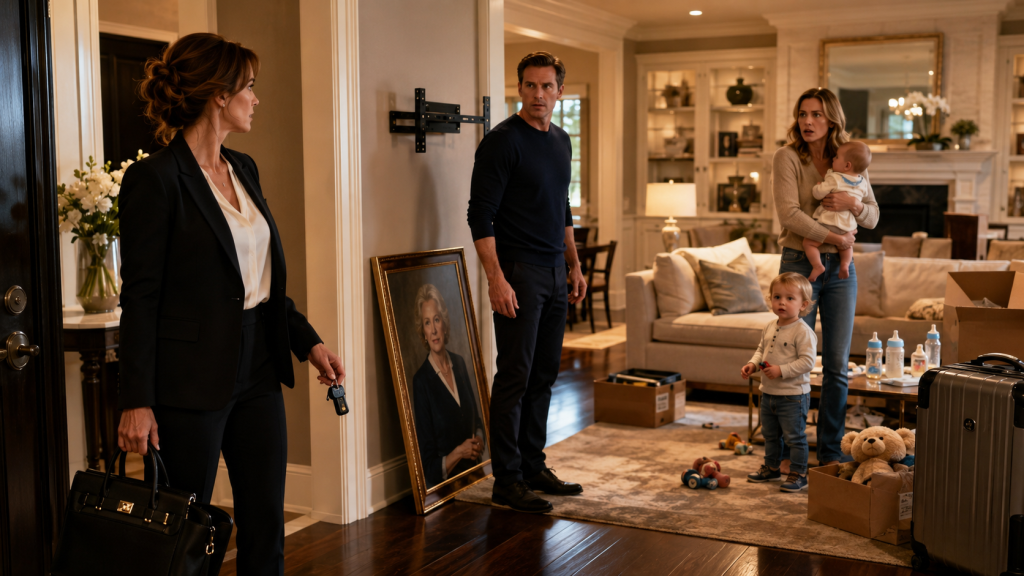
A half-open suitcase beside my mother’s bookshelf.
And Ben, my husband of nine years, stood with a hammer in his hand beneath the empty space where my mother’s portrait had been.
The portrait itself leaned against the wall, face down.
I stared at it.
My mother’s face was turned toward the baseboard like an insult.
“What is the meaning of this?” I asked.
Maya shrank back as if she had not expected me.
Ben did not.
He puffed out his chest and gave me the tired expression of a man pretending to be patient with a hysterical woman.
“It means I am finished hiding the truth.”
The room tilted slightly.
He looked at the children.
“These are my children. Maya has nowhere else to go. We are going to settle this like mature adults, and you are going to learn to share.”
The quiet hum of my car cooling in the driveway seemed to vanish.
I looked at the toddler.
Then the baby.
Then Maya.
Then Ben.
“Your children?” I repeated.
“Yes,” he said. “And please do not start with your hysterical drama.”
That was when I realized he had staged the entire confrontation.
Not confessed.
Staged.
There was a difference.
He wanted me to come home and find this.
He wanted shock to hit me in the doorway.
He wanted me to scream, sob, and break down while Maya looked frightened and the babies cried.
He wanted a witnessable domestic scene.
Something messy.
Something he could later describe as “unstable.”
Something he could use.
Ben had always been most dangerous when he spoke calmly.
Maya stood slowly.
“Kate, please, let me explain.”
I looked at her with pure ice.
“Do not speak to me while you are standing inside my home, suffering the consequences of a betrayal you helped build.”
Her lips trembled.
Ben stepped forward.
“Don’t talk to her like that.”
I looked at him.
For nine years, I had loved that face.
The strong jaw.
The dark eyes.
The smile that had charmed my friends, my colleagues, even my mother before she died.
Now I could see something behind it I had ignored too long.
Entitlement.
Not confidence.
Entitlement.
“When did it start?” I asked.
Ben rolled his eyes.
“This is not the time for interrogation.”
“When?”
Maya whispered, “Kate—”
I turned on her.
“When?”
The baby began crying harder.
Maya bounced the child automatically, her face pale.
Ben’s mouth tightened.
“Two years.”
Two years.
The words landed without sound.
Two years ago, my mother had still been alive.
Two years ago, Ben had held my hand beside her hospital bed and promised her he would take care of me.
Two years ago, Maya had come to our house every Thursday with soup, flowers, and that soft voice of hers saying, “Family shows up.”
Family shows up.
Apparently, family also sleeps with your husband and gives birth to his children.
I looked at the toddler again.
Maybe two.
Maybe a little less.
My stomach turned.
“Both children are yours?”
Ben lifted his chin.
“Yes.”
“And you thought the solution was to move them into my house?”
“Our house.”
“No.”
He blinked.
I said it again, slower.
“No.”
His jaw flexed.
“You’re upset. I understand. But you do not get to throw children into the street.”
There it was.
The shield.
The innocent children he had already decided to place between himself and consequences.
I looked at them.
They were entirely innocent.
That made the whole scene more repulsive.
Ben was not protecting them.
He was using them.
He had carried two babies into the home of the woman he betrayed and expected their presence to silence me.
He thought my decency would do what his lies could not.
I did not raise my voice.
“Take them somewhere safe.”
Maya’s eyes filled.
“We have nowhere.”
“You had two years to think about that.”
Ben sneered.
“And there it is. The cold corporate queen. No maternal instinct. No compassion.”
I almost laughed.
I had heard versions of that before.
From him.
From his mother.
From friends who thought a woman without children must have extra rooms in her heart and schedule for everyone else’s needs.
Ben and I had talked about children early in our marriage.
I wanted them someday.
Then my mother got sick.
Then Ben’s business had a downturn.
Then I was promoted.
Then life became something we kept postponing.
By the time I realized he had stopped imagining a family with me, he had already started one somewhere else.
And now he stood in my living room pretending my heartbreak was a character flaw.
I walked past him.
He reached for my arm.
I stopped and looked at his hand.
“Touch me and I will call the police.”
He withdrew.
Smart man.
I went into the master bedroom, pulled my Rimowa suitcase from the closet, and began tossing tailored work suits inside without folding them.
Ben followed, leaning against the doorframe, his confidence swelling now that I was packing.
“Stop acting ridiculous, Kate.”
I ignored him.
“This is my house just as much as it is yours,” he said.
I stopped.
“You really believe that?”
He went quiet for a microscopic second.
That tiny hesitation was everything.
Ben had practiced this performance.
But he had forgotten one detail.
The house was my mother’s.
The deed was solely in my name.
It had never been marital property.
My mother, who had survived a marriage to a charming liar, had been clear before she died.
“Katherine,” she told me from her hospital bed, her fingers thin but her voice steady, “love anyone you want. But do not hand a man the keys to what women before you bled to keep.”
I had laughed softly then, wiping tears from my face.
“Mom, Ben loves me.”
“I hope he does,” she said. “And I hope you never have to learn whether he loves you more than access.”
Access.
That word returned to me now with a chill.
I zipped the suitcase halfway, then walked back to the living room.
Ben trailed behind me.
Maya had picked up my mother’s portrait and leaned it against the sofa, still face down.
I looked at the wall.
A television bracket lay on the floor.
Beside it were screws, a drill, and a measuring tape.
They had not even waited for me to come home before removing her.
My mother.
In her own house.
I went to the mahogany console drawer and opened it.
Ben’s expression shifted.
I removed the keys one by one and dropped them onto the glass coffee table.
The front door key.
The gate key.
The garage key.
The sunroom key.
And finally, the tiny brass key to the wall safe hidden behind the old bedroom mirror.
Clack.
Clack.
Clack.
Each sound cut through the room.
Ben’s face drained of color.
He suddenly remembered the detail his arrogance had pushed aside.
Inside that safe were documents he never had the right to touch.
The deed.
The trust papers.
My mother’s estate documents.
The postnuptial agreement he had signed after my mother transferred the house to me before she died.
The one he had joked was “unromantic.”
The one my mother insisted on anyway.
Maya stared at the keys.
Ben tried to recover.
“And what exactly do you think you can do if I decide I simply don’t want to leave?”
I smiled faintly.
“By tomorrow afternoon, you are going to learn the hard way the difference between changing a lock and holding a legal title.”
His eyes narrowed.
“What is that supposed to mean?”
“It means you should enjoy your last night pretending.”
I picked up my suitcase.
Maya stepped toward me.
“Kate, please. The kids—”
I turned back.
“The children deserve safety. They also deserve adults who do not use them as weapons.”
She began crying.
I did not comfort her.
My compassion was not gone.
It had simply learned boundaries.
I walked to the front door.
Ben called after me.
“You walk out now, don’t expect to come back and control everything.”
I paused with my hand on the knob.
Then I looked over my shoulder.
“Ben, I’m walking out because unlike you, I know when to call professionals.”
I closed the door behind me without looking back.
As I got into my car, my hands finally began to shake.
Not from grief.
Not yet.
Grief was somewhere behind the shock, waiting its turn.
My phone buzzed in the cup holder.
A critical alert from my financial monitoring app glowed on the screen.
Possible title activity detected: Maplewood property.
My breath stopped.
I opened it.
Someone had attempted to open a $250,000 home equity line using my property as collateral.
The application had been submitted forty-three minutes earlier.
Forty-three minutes.
While Maya was inside my home tearing down my mother’s portrait.
While Ben was staging his dramatic little patriarch performance.
While I was supposed to be crying.
The alert sharpened everything.
Ben had not moved Maya in because she needed shelter.
He needed my house occupied.
My mind shattered.
My signature copied.
He needed chaos in the living room while fraud happened in the background.
I stared at the screen until the words became something colder than fury.
Then I dialed the only person who could destroy him.
Eleanor Price.
My mother’s attorney and trustee of the estate.
She answered on the second ring.
“Kate?”
I had not called her in months, but she knew my voice well enough to hear the trouble before I spoke.
“Ben is inside my house with Maya and two children,” I said. “He tried to borrow against the property.”
Silence.
One breath.
Then Eleanor’s voice turned cold.
“Do not go back inside.”
“I’m in the driveway.”
“Leave the property.”
“I need to—”
“No,” she said sharply. “Listen to me. If he is attempting to establish occupancy for another adult and children while simultaneously encumbering protected inherited property, you need court intervention, police documentation, and title fraud involvement. Not a confrontation.”
I gripped the steering wheel.
“He took down Mom’s portrait.”
Eleanor’s voice softened for half a second.
“I know what that means to you. But do not let that make you walk back inside.”
My eyes burned.
“What do I do?”
“Drive to the Maplewood Inn. Check in under your first initial. Send me the financial alert, the deed documents if you have copies, and any messages from him. I’m calling the title fraud unit, the police liaison, and the emergency court clerk.”
“He has the safe key.”
“Does he have the combination?”
“No.”
“Good. And Kate?”
“Yes?”
“Do not cry to him. Do not threaten him. Do not warn him. Let him believe he has time.”
I looked back at the house.
Through the living room window, I could see Ben pacing.
Maya stood near the sofa, holding the baby.
My mother’s portrait still lay face down.
Let him believe he has time.
“All right,” I said.
Then I started the car and drove away.
At the Maplewood Inn, I checked into a room with beige walls and a floral bedspread.
It smelled like lemon cleaner and old carpet.
I placed my suitcase beside the bed and opened my laptop.
For the next three hours, I worked with Eleanor.
I sent screenshots.
Mortgage records.
The deed.
The estate trust summary.
The postnuptial agreement.
The financial alert.
Photos from my home security system.
That was the part Ben had forgotten too.
My mother had installed discreet cameras after a break-in fifteen years earlier.
When I inherited the house, I upgraded them.
Ben knew about the exterior cameras.
He did not know about the interior motion-triggered clips in the foyer, living room, hallway, and study.
He had called them “paranoid” when I renewed the service.
I called them useful.
The footage showed everything.
Ben opening the door for Maya at 1:12 p.m.
Maya bringing in suitcases.
Ben carrying a box of children’s clothes.
Maya removing books from my mother’s shelf.
Ben taking down the portrait.
Their conversation before I arrived.
I watched it once.
Then again.
Maya said, “Are you sure she can’t throw us out?”
Ben laughed.
“She won’t. She’s too worried about looking cruel.”
Maya said, “And the loan?”
Ben answered, “Almost done. Once the money clears, we’ll negotiate from strength.”
Negotiate from strength.
My hands went still on the keyboard.
There is a kind of betrayal that hurts because it is impulsive.
A kiss.
A lie.
A night.
Then there is a kind of betrayal that arrives with paperwork.
That one does not stab.
It excavates.
Ben had not merely fallen into an affair.
He had built a plan.
A family outside our marriage.
A financial scheme inside my home.
A staged scene designed to make me look unstable.
A stolen future using my mother’s house as fuel.
I sent the clip to Eleanor.
She called me one minute later.
Her voice was pure steel.
“Kate, go to sleep if you can. By morning, this becomes his problem.”
I did not sleep.
I sat in the hotel chair all night, watching the dark window reflect my face back at me.
At 2 a.m., Ben texted.
Stop being dramatic. Come home tomorrow and we’ll discuss house rules.
I did not answer.
At 2:17, another message.
Maya is upset. You owe her an apology.
I almost threw the phone.
At 2:31.
You can’t just abandon your home.
I stared at that one for a long time.
Then I whispered to the empty room, “Watch me.”
At 6:45 a.m., Eleanor called.
“Emergency petition granted for preliminary property protection. Police will accompany us at 9. A locksmith is on standby. Title fraud division has flagged the loan. The lender has frozen the application pending criminal review.”
My throat tightened.
“You got all that overnight?”
“Your mother paid me very well to be prepared for men like Ben.”
For the first time since yesterday, I almost laughed.
“Thank you.”
“Don’t thank me yet. Wear something calm.”
“Calm?”
“Yes. People underestimate calm women holding documents.”
So I wore a navy suit.
Low heels.
Hair back.
No makeup except lipstick.
I wanted Ben to see the woman he had tried to break and understand that he had miscalculated the foundation.
At 8:57 a.m., I turned onto my street behind Eleanor’s black sedan.
Two police cruisers followed.
A locksmith van pulled up behind them.
A court clerk’s courier arrived with a sealed envelope.
Neighbors peeked through curtains.
I did not care.
Ben opened the front door smiling, as if he had rehearsed benevolence.
Then he saw the officers.
Then Eleanor.
Then the paperwork.
His smile died in pieces.
Maya appeared behind him, wearing one of my cream cardigans.
My cream cardigan.
The audacity almost impressed me.
She held the baby against her shoulder.
The toddler peeked from behind her leg.
That saved her from the first thing I wanted to say.
Children were present.
So I said nothing.
Eleanor stepped forward.
“Benjamin Caldwell?”
Ben’s jaw tightened.
“Yes.”
“I’m Eleanor Price, counsel and trustee representative for the Whitmore estate property trust. You have been served with an emergency protection order, notice of title fraud investigation, and demand to vacate premises not legally owned by you.”
Ben scoffed.
“This is marital residence. You can’t just—”
Eleanor lifted one finger.
“Do not interrupt me unless you want these officers to hear me explain the felony portion before I reach the civil one.”
Ben went quiet.
Maya began crying quietly.
Eleanor handed him the first packet.
“You attempted to encumber protected inherited property using forged authorization. The lender has frozen the application. The title fraud unit has been notified. The court has ordered preservation of documents, electronic devices, and any communication related to the loan application.”
Ben looked at me.
“Kate, this is insane.”
I said nothing.
Eleanor continued.
“You are also ordered not to remove, damage, transfer, conceal, or destroy any property belonging to Katherine Whitmore or the Whitmore estate.”
I glanced toward my mother’s portrait.
It was upright now, leaning against the wall.
Too late.
Ben followed my gaze.
“That was an accident.”
Eleanor glanced at her tablet.
“We have video.”
Three words.
That was all it took.
Ben’s face changed.
Maya’s head snapped up.
“You recorded us?”
I finally spoke.
“My mother recorded everyone who entered her house after the burglary in 2008. You knew that, Maya. You were at Thanksgiving when she told the story.”
Maya looked away.
Eleanor turned to the officers.
“We need the safe secured.”
Ben stepped back.
“No one is touching anything until my attorney gets here.”
One officer said, “Sir, the order authorizes entry and securing of estate documents.”
“This is my home,” Ben snapped.
“No,” I said softly.
Everyone looked at me.
I stepped inside the foyer.
The house smelled like diapers, coffee, and betrayal.
But underneath it, I caught the faint lavender scent from the sachets my mother used to keep in the hall closet.
It steadied me.
“This is not your home,” I said. “It is the house my mother left to me. You signed a postnuptial agreement acknowledging that. You signed the occupancy terms. You signed the estate access waiver.”
Ben’s eyes flashed.
“You made me sign that.”
“No. My mother did.”
He looked toward Eleanor.
“She poisoned you against me from the beginning.”
I felt a bitter smile touch my mouth.
“No, Ben. She understood you from the beginning.”
That landed.
He had spent years pretending my mother’s caution was snobbery.
Her legal planning was distrust.
Her advice was interference.
But the truth was simpler.
She recognized hunger when she saw it.
The officers entered.
The locksmith changed the front lock first.
Maya started sobbing harder.
One officer spoke gently to her.
“Ma’am, no one is throwing children onto the street. You will be given time to gather essential belongings and arrange safe temporary housing. But you cannot remain in someone else’s home without permission.”
She looked at Ben.
“You said she couldn’t do this.”
Ben snapped, “Shut up, Maya.”
The officer’s expression sharpened.
Maya flinched.
There it was again.
A crack.
Not my problem, but noted.
Eleanor noticed too.
She stepped toward Maya and lowered her voice.
“Ms. Reyes, for the sake of your children, I suggest you cooperate fully. If Mr. Caldwell misrepresented ownership of this property to you, that may matter later.”
Maya stared at her.
“He told me the house was his.”
Ben exploded.
“Maya.”
“No,” she whispered, backing away from him. “You said she was going to leave. You said the loan was your right because you paid bills.”
“I paid bills!” Ben shouted. “I lived here nine years!”
“You paid utilities,” I said. “Sometimes.”
His eyes turned toward me with hatred.
“You think you’re so untouchable because Mommy left you a house.”
I felt the old wound twist.
He knew how to aim.
But for once, the wound did not bleed.
“Yes,” I said. “My mother left me a house. And apparently, a map of your character.”
The officers secured the wall safe.
Ben did not have the combination, but he had scratched the frame trying to access it.
Eleanor photographed the damage.
Inside the safe, everything remained intact.
The deed.
The trust papers.
My mother’s estate plan.
My emergency cash.
A velvet pouch holding her wedding ring.
And a sealed letter I had forgotten she placed there.
Eleanor saw me look at it.
“Take that with you,” she said quietly.
Not now.
My hands were too steady for grief.
If I read my mother’s words in that room, I might finally break.
And Ben did not deserve to witness that.
Maya packed quickly.
Clothes.
Diapers.
Formula.
Children’s items.
She tried to take my cardigan, then froze when she realized I was watching.
Slowly, she removed it and placed it on the armchair.
“Keep it,” I said.
Her face crumpled.
Not because of the cardigan.
Because mercy can be more humiliating than anger.
Ben packed nothing.
He stayed in the living room with his arms crossed, pretending the order was temporary theater.
Then Eleanor handed him another document.
“Your access to the residence is suspended pending full hearing. You may return at a scheduled time with counsel and police escort to retrieve personal belongings.”
“You can’t separate me from my children.”
I looked at him.
“Those children are not on the order because they are not mine and they do not live here legally. Their safety is Maya’s responsibility and yours. Not mine.”
Maya stared at me, then at Ben.
“Where are we supposed to go?”
Ben did not answer.
That was when she understood the same thing I had.
Ben did not have a plan for safety.
Only control.
By noon, they were gone.
The locksmith finished the doors.
The alarm codes changed.
The lender confirmed the loan application was dead.
The title fraud investigation formally opened.
Eleanor stayed with me in the kitchen while the last officer took my statement.
I described everything.
Coming home.
The children.
Maya removing books.
Ben taking down the portrait.
His claim they were moving in.
His words about the house.
The financial alert.
The loan.
The footage.
The officer asked if I feared Ben might return.
I looked around my mother’s kitchen.
“Yes.”
That answer felt strange.
Not weak.
Honest.
When everyone finally left, the house was silent.
Truly silent.
I walked to the living room and picked up my mother’s portrait.
She looked at me from the frame, painted in soft blues and golds, her eyes steady the way they had been in life.
There was a scratch across the bottom of the frame.
Not deep.
Repairable.
I touched it with one finger.
“I’m sorry,” I whispered.
Then I hung her back on the wall myself.
Not straight at first.
My hands were shaking now.
The house was mine again, but the air still held the shape of invasion.
I moved room to room.
Baby wipes on the counter.
A bottle under the coffee table.
A small sock near the fireplace.
Maya’s perfume in the hallway.
A dent in the bookshelf.
My mother’s books piled carelessly in boxes.
I wanted to scream then.
Not at the affair.
Not even at the loan.
At the casualness.
The way they had entered my mother’s home and started erasing her as if the house had been waiting for them.
As if I was already gone.
That was the part that finally made me cry.
I sat on the living room floor beneath my mother’s portrait and sobbed into my hands until my ribs hurt.
Not for Ben.
Not anymore.
I cried for the version of myself who had explained away warning signs for years.
The missing statements.
The changed passwords.
The business trips.
The way he criticized my attachment to the house.
The way he said, “Your mother is gone, Kate. You can’t live in a shrine forever.”
I cried because my mother had known.
And I had defended him to her.
That evening, I opened the sealed letter from the safe.
My mother’s handwriting curved across the page.
Katherine,
If you are reading this because something has gone wrong, take a breath.
You are not foolish for loving someone.
You are not weak because someone betrayed the trust you gave them.
A thief is responsible for stealing, not the door for opening.
But now that you know, close the door.
Close it legally.
Close it fully.
Do not let pity reopen what wisdom has locked.
This house is not just wood and stone.
It is the proof that women in our family survived men who thought charm was a deed.
Keep it.
Defend it.
Then live in it with joy, not fear.
Love,
Mom
I pressed the letter to my chest.
Then I laughed through tears.
“Charm was a deed.”
Only my mother could make a legal warning sound like poetry.
The next weeks were war.
Ben hired an attorney who tried to argue that the house had become marital property because he had lived there, hosted holidays there, and “contributed emotionally to the home environment.”
Eleanor responded with the deed, trust, postnuptial agreement, and bank records showing his contributions were minimal and mostly reimbursed through joint accounts funded primarily by my income.
His attorney argued he had intended the home equity loan for “family consolidation.”
Eleanor produced the application with my forged signature and the security footage of him discussing the loan with Maya.
His attorney argued Maya and the children needed housing.
Eleanor said, “Then Mr. Caldwell should provide housing using property he owns, not property he attempted to steal.”
Ben’s criminal problems grew.
The lender’s fraud department found that the signature on the loan authorization had been copied from a scanned tax document.
The IP address traced to Ben’s office laptop.
A draft email to Maya included the line:
Once the HELOC clears, Kate will have to negotiate. She won’t risk a scandal with kids involved.
That sentence became the centerpiece of everything.
He had counted on my compassion.
He had counted on my fear of public embarrassment.
He had counted on my mother being dead.
He had forgotten Eleanor was very much alive.
Maya eventually gave a statement.
I did not know what she said until later, but her statement helped establish that Ben told her the house was “basically his,” that I would be “managed,” and that the loan would provide them a start once I “accepted reality.”
Accepted reality.
Men like Ben love that phrase.
It always means accepting theirs.
Maya claimed she did not know the loan was forged.
Maybe she did.
Maybe she did not.
By then, I no longer needed to decide which part of her betrayal came from ignorance and which came from greed.
Both had entered my house.
Both had touched my mother’s things.
Both had to leave.
The divorce filing was brutal but efficient.
Eleanor worked alongside a family attorney named Camille Rhodes.
Camille was sharp, calm, and allergic to nonsense.
At our first meeting, she looked through the documents and said, “Your husband appears to have confused adultery, trespass, fraud, and poor strategy into one afternoon.”
I liked her immediately.
Ben requested spousal support.
Camille laughed.
Not in court.
Unfortunately.
But in her office.
“He tried to borrow against your protected property while moving in his mistress. Let him request the moon too, while he’s embarrassing himself.”
Ben also tried to claim emotional distress from being “removed from his residence.”
Camille filed a response that included photos of my mother’s portrait face down on the floor.
After that, his attorney became quieter.
My family reacted in layers.
My aunt Celia called first.
“I heard something happened with Ben.”
“That depends who told you.”
“Maya’s mother says you threw two babies into the street.”
I closed my eyes.
“Of course she does.”
“What happened?”
I told her the short version.
There was silence.
Then Celia said, “Your mother would have set the house on fire before letting him keep it.”
I laughed for the first time in days.
“She would have done it legally.”
“Worse,” Celia said. “She would have done it legally.”
Word spread.
Some relatives blamed me.
Not directly.
They said things like, “The children are innocent.”
As if I did not know that.
As if innocence required my house as payment.
I began answering with one sentence.
“Ben is their father. Ask him where they are living.”
That ended most conversations.
At work, I told the truth only to my closest colleague, Amara.
She brought soup, wine, and a list of reputable contractors to repair the scratches in the walls.
“Do we hate him quietly or loudly?” she asked.
“Legally,” I said.
She nodded.
“My favorite volume.”
Slowly, the house returned to itself.
The books went back on the shelves.
The portrait frame was repaired.
The living room was professionally cleaned.
I changed the curtains.
Not because Maya had touched them.
Because I wanted one decision in the room that belonged only to me.
I turned the guest room into a library.
Ben had always wanted it to be a media room.
I filled it with my mother’s books, my work files, and a deep green chair where sunlight hit in the afternoon.
The first time I sat there with coffee, I cried again.
But softer this time.
Not because I had lost.
Because I had kept something.
Three months later, Ben was charged with fraud-related offenses connected to the loan application.
He was not led away dramatically in front of me.
Life is rarely that cinematic.
Instead, Camille called and said, “He has been formally charged.”
I was standing in the grocery store aisle holding a bag of oranges.
I stared at them.
Then put them in my cart.
That was healing too.
Learning that big news could arrive and I could still buy fruit.
The divorce finalized almost a year after the day I came home early.
I kept the house.
All of it.
Ben received no interest in the property.
He was responsible for his own debts.
The attempted HELOC became part of the permanent record.
He was ordered to communicate only through attorneys for a set period after he violated temporary boundaries by sending messages like:
You destroyed my family.
I replied only once, through Camille.
Mr. Caldwell destroyed his marriage and endangered his family through fraud. Ms. Whitmore will not be responding personally.
That was the last message he got from me.
Maya moved out of state with the children.
I heard through relatives that she lived with her mother for a while.
Sometimes I thought about the children.
The toddler with the toy on my hardwood floor.
The baby crying while adults failed them.
I hoped they were safe.
I hoped someone in their lives eventually taught them that love should not begin with trespassing.
But I did not confuse my hope for responsibility.
That distinction saved me.
One year after everything, I hosted a dinner in the house.
Not a big one.
Just Eleanor, Camille, Amara, Aunt Celia, and Mason, my neighbor who had helped install the new garden lights.
I cooked my mother’s rosemary chicken.
The house smelled like garlic, lemon, and warmth.
For the first time since her death, the dining room felt alive without feeling haunted.
Eleanor stood in the living room beneath my mother’s portrait, holding a glass of wine.
“She would be proud,” she said.
I looked at the painting.
“I wish I had listened sooner.”
Eleanor shook her head.
“Your mother never expected you not to love. She only wanted you protected if love failed.”
That sentence stayed with me.
Love failed.
Protection held.
After dinner, when everyone left, I walked through the rooms turning off lamps.
In the living room, I paused beside the portrait.
The repaired frame caught the light.
If you looked closely, you could still see where the scratch had been.
I liked that.
Not because damage is beautiful by itself.
Because repair does not always mean pretending nothing happened.
Sometimes repair means the mark remains, but it no longer controls the room.
I thought about the afternoon I came home early.
The suitcase.
The babies.
Maya in my chair.
Ben with the hammer.
My mother’s portrait on the floor.
The alert on my phone.
The call to Eleanor.
The officers at the door.
The keys clacking on the table.
Every moment had felt impossible while it happened.
Now it felt like the moment my life returned to me.
Ben had expected me to cry and beg.
He had expected shock to make me stupid.
He had expected children to make me silent.
He had expected my mother’s death to mean her protection died too.
He was wrong about all of it.
My mother was gone, but her signature remained.
Her trust remained.
Her attorney remained.
Her warnings remained.
And finally, when it mattered most, my backbone remained.
I came home early from work and caught my husband moving his mistress and their two secret babies into my living room.
He told me to deal with it.
He told me they needed the space.
He thought possession was ownership because he had carried boxes through the door.
But a house is not won by standing inside it.
A marriage is not saved by forcing a mistress into the living room.
A crime is not erased because babies are present.
And a woman is not powerless just because she refuses to scream.
I calmly set my keys on the table.
I walked out.
I made one phone call.
And by the next afternoon, Ben learned what my mother had tried to teach me all along.
Charm is not a deed.
Confidence is not consent.
And no man gets to steal a house from a woman whose mother already taught her where to hide the detonator.
THE END! THANKS FOR READING!