 Reading Time: 16 minutes
One year after my divorce, my ex-mother-in-law spotted me at the clinic with a smug grin. She told me her son had made the right choice leaving me and was now raising a daughter with my former friend.
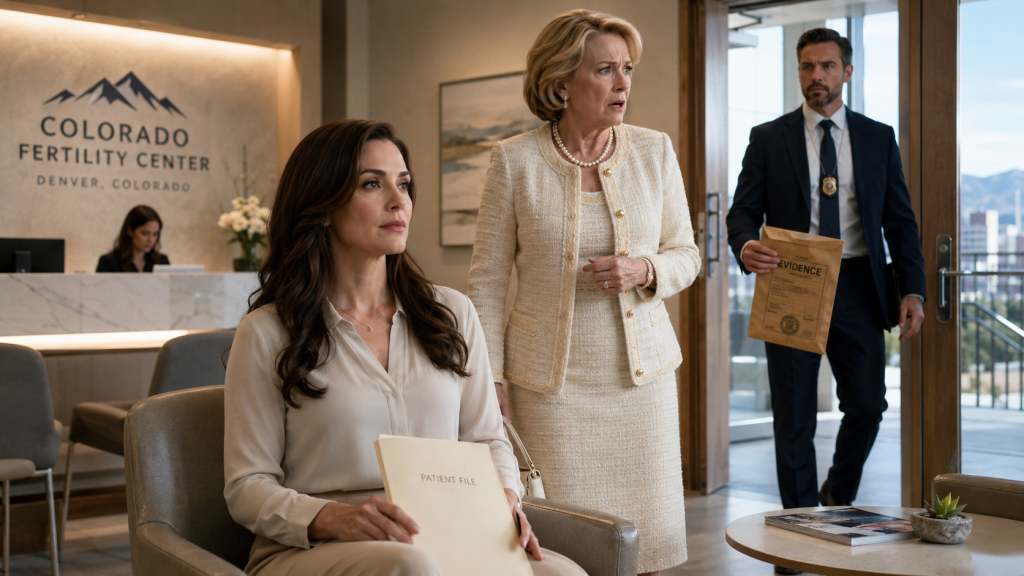
I stayed calm, smiled, and said, “Is that what you think?” Then a man stepped inside, and her face went completely pale.A year after the divorce, my ex-mother-in-law saw me in the waiting room of Westbridge Fertility Clinic in Denver.
Patricia Parker was wearing pearls, perfume, and the same smug smile she had worn in court when my ex-husband, Ryan, said our marriage had been “emotionally empty.”
I had not seen her since the divorce hearing.
That day, she had hugged Megan Ellis, my former best friend, right in front of me.
Not discreetly.
Not by accident.
She had wrapped both arms around Megan as if welcoming a new daughter into the family while I sat ten feet away, holding divorce papers with hands that would not stop shaking.
Now Patricia stopped beside my chair and looked me up and down.
“Well,” she said, loud enough for the receptionist to hear, “isn’t this interesting?”
I closed the folder in my lap.
“Hello, Patricia.”
She smiled wider.
“I heard you were still alone.”
I said nothing.
That was the first lesson I learned after divorce.
Not every insult deserves the dignity of a response.
Her eyes shone with satisfaction.
“Leaving you was the best choice my son ever made. Now he’s raising a beautiful daughter with Megan. A real family. Something you could never give him.”
My throat tightened.
But I did not let my face change.
Ryan and I had tried for years to have a baby.
Seven years, to be exact.
Seven years of appointments, bloodwork, injections, calendars, ovulation tests, failed transfers, debt, grief, and hope so fragile we stopped saying it aloud.
We had two frozen embryos stored at this very clinic.
Two tiny possibilities.
Two almost-futures.
After our last miscarriage, Ryan changed.
At first, he became quiet.
Then distant.
Then resentful in the way people become when they blame you for a pain they helped create.
He stopped coming to follow-up appointments.
He stopped asking how I felt after injections.
He started saying things like, “Maybe we need to accept what life is telling us.”
I thought he meant grief.
I did not know he meant Megan.
Megan Ellis had been my best friend for twelve years.
She knew everything.
She knew which injections made me dizzy.
She knew how many embryos we had.
She knew the names I had secretly loved for a daughter.
She knew the combination of hope and terror I carried every time the clinic called.
When Ryan became distant, Megan became helpful.
She brought soup.
She sat with me on the bathroom floor after I cried through another negative test.
She told me Ryan was “processing differently.”
Then “helpful” became late-night calls between them.
Late-night calls became coffee.
Coffee became hotel receipts I found too late.
By the time Ryan asked for divorce, Megan had already stopped looking me in the eyes.
Six months after the divorce, Megan announced she was pregnant.
Patricia told everyone it was a miracle.
Ryan posted a picture with one hand on Megan’s stomach, captioned:
Sometimes life gives you what you were always meant to have.
People congratulated them.
Some even tagged me by mistake.
I had believed the miracle story too, though believing it nearly killed me.
I told myself life was cruel.
I told myself Megan was lucky.
I told myself the universe had mocked me in the most personal way possible.
Then a billing notice from Westbridge Fertility Clinic arrived at my old email by mistake.
It listed an embryo transfer date two weeks after Ryan filed for divorce.
Not a general fertility appointment.
Not a consultation.
An embryo transfer.
Connected to our storage account.
My embryo.
My consent form.
My signature.
Except I had never signed it.
That was the day grief turned into something colder.
Something steadier.
I did not call Ryan.
I did not call Megan.
I did not even call Patricia, though God knew I wanted to.
I called an attorney first.
Then the clinic.
Then a detective I had met years earlier through a fraud case involving Ryan’s business partner.
His name was Andrew Cole.
Detective Andrew Cole had once investigated insurance fraud at a company Ryan invested in.
Everyone in the Parker family knew him because Patricia had spent months complaining that “that detective” was trying to ruin Ryan’s reputation.
Now Detective Cole was the reason I was sitting in Westbridge Fertility Clinic one year after my divorce, holding a folder full of copied documents and waiting for a meeting with clinic compliance.
So when Patricia leaned closer and whispered, “That little girl is proof my son chose right,” I finally smiled.
“Is that what you think?”
Before she could answer, the clinic door opened.
A tall man in a navy suit walked in, carrying a sealed evidence envelope.
Patricia turned.
The color drained from her face.
Detective Cole walked straight toward us, nodded to me, and looked at Patricia.
“Mrs. Parker,” he said. “Good. You’re here too.”
Patricia gripped her handbag.
“Why would I need to be here?”
Detective Cole held up the envelope.
“Because your son’s daughter was created using Mrs. Bennett’s frozen embryo,” he said. “And the consent form appears to have been forged.”
The waiting room went silent.
A woman near the magazine table stopped turning pages.
The receptionist froze with her hand on the phone.
Patricia’s lips parted, but no sound came out.
Detective Cole stepped closer and lowered his voice just enough to make every word sharper.
“We have clinic access logs, altered consent records, and a payment trail from an account connected to your family trust.”
Patricia shook her head.
“That’s impossible.”
I opened the folder in my lap and placed a copy of the forged consent form on the chair between us.
“Look familiar?”
Her eyes dropped to the signature.
Then flicked away too fast.
“I don’t know anything about that.”
Detective Cole said, “Then you’ll have no problem explaining why your phone number was listed as the emergency contact on the embryo release paperwork.”
Patricia’s face collapsed.
Behind the reception desk, a nurse covered her mouth.
I stood slowly.
“For a year, you called that child proof I was broken. But she was created from the embryos Ryan and I made together. My embryo. My medical history. My stolen consent.”
Patricia whispered, “Megan wanted a baby.”
“And I wanted honesty,” I said. “You chose theft.”
The elevator doors opened behind us.
Ryan stepped out with Megan holding a diaper bag.
He froze when he saw Detective Cole.
Megan looked at the envelope, then at me, and her knees nearly buckled.
Ryan whispered, “Claire, please.”
I smiled.
“No, Ryan. Today you explain to the police how your miracle began with my name forged on a form.”
For a moment, no one moved.
Ryan looked thinner than I remembered, but still handsome in that expensive, effortless way that had once made people assume he was trustworthy.
Megan stood beside him, her hair loose over one shoulder, one hand gripping the diaper bag strap.
She did not look triumphant anymore.
She looked afraid.
Good.
Fear was not justice.
But it was a beginning.
Patricia stepped between Detective Cole and her son, the way she always had.
“This is a medical misunderstanding.”
Detective Cole looked at her calmly.
“Then everyone should cooperate.”
Ryan’s gaze moved from him to me.
“Claire, can we talk privately?”
“No.”
“Please.”
“You lost the right to private conversations when you used my name on a medical consent form.”
Megan’s eyes filled.
“I didn’t know.”
I looked at her.
That lie hurt more than Patricia’s cruelty.
Megan knew my life better than anyone.
She knew the clinic.
The storage dates.
The embryos.
The password hints Ryan and I used.
She knew because I had trusted her with the parts of myself I was most ashamed of.
“You didn’t know?” I repeated.
Her chin trembled.
“Ryan said you were done with them.”
“The embryos?”
“He said you didn’t want them.”
I laughed once.
It came out sharp.
“You sat on my bathroom floor while I bled after the miscarriage and told me one day I would hold my baby. Did that sound like I was done?”
Megan looked away.
That was answer enough.
A clinic administrator hurried into the waiting room.
“Mrs. Bennett? Detective Cole? We have a private conference room prepared.”
Ryan turned to her.
“I want our lawyer present.”
Detective Cole nodded.
“You may call one. But no one leaves until basic statements are taken.”
Patricia’s jaw tightened.
“You cannot detain us.”
“No,” he said. “But I can ask the officers outside to ensure evidence preservation while warrants are processed.”
Officers outside.
Patricia heard it too.
For the first time since I had known her, she had nothing elegant to say.
We were led into a conference room with frosted glass walls.
A rectangular table sat in the middle.
A box of tissues rested near the center, absurdly cheerful in a room built for devastation.
I sat on one side with Detective Cole.
Ryan, Megan, and Patricia sat opposite us.
The clinic administrator, Ms. Leighton, placed a file on the table.
Her face was pale.
“Mrs. Bennett,” she said, “before anything else, on behalf of Westbridge, I want to say we are cooperating fully with law enforcement and our compliance review.”
“Did your clinic transfer my embryo without my consent?”
She swallowed.
“That is what our preliminary review indicates.”
The words landed, and the room disappeared for a second.
I had known.
I had documents.
I had suspected.
But hearing it confirmed aloud still hit like a physical blow.
My embryo had been taken from storage.
My name had been used.
My body’s history had been mined and handed to the woman who helped ruin my marriage.
Ryan leaned forward.
“Claire, listen. We never meant to hurt you.”
I stared at him.
“You used my embryo.”
He flinched.
“We were desperate.”
“No. Desperate is crying in a parking lot after another failed transfer. Desperate is injecting hormones into your stomach at midnight because the schedule says so. Desperate is paying storage fees for embryos you’re too heartbroken to use but too hopeful to release.”
My voice shook then.
I let it.
“What you did was not desperation. It was theft.”
Megan whispered, “I wanted to be a mother.”
I looked at her.
“So did I.”
The room went silent.
Even Patricia looked down.
Ms. Leighton opened the clinic file.
“The transfer authorization was submitted with a digital consent form, a scanned photo ID, and confirmation from a phone number on file.”
“Whose phone number?” I asked, though I already knew.
Ms. Leighton looked uncomfortable.
“Mrs. Patricia Parker’s.”
Patricia lifted her chin.
“I was helping manage family paperwork.”
“You were not my family,” I said.
She snapped, “You were still legally married to Ryan when the process began.”
“And no longer willing to let you treat my body like Parker property.”
Ryan closed his eyes.
Detective Cole removed papers from the sealed envelope.
“We have more than phone contact. We have access logs showing Ryan’s credentials were used to enter the embryo storage portal. We have a payment from Parker Family Trust covering outstanding storage charges and the transfer procedure. We have an internal note stating ‘wife consent confirmed by mother.’”
He looked at Patricia.
“Which mother were they referring to?”
Patricia said nothing.
Megan looked at Ryan.
“You told me Claire signed.”
Ryan’s face tightened.
“She was never going to use them.”
Megan recoiled.
“That’s not what I asked.”
He turned on her.
“Don’t act innocent. You wanted this too.”
Her tears stopped.
There it was.
The fracture.
The moment a shared lie became too heavy to carry together.
Megan’s voice dropped.
“You said she abandoned the embryos.”
“You believed what you wanted,” he hissed.
I watched them turn on each other with a strange calm.
Not satisfaction.
Something sadder.
These two people had built a family on my stolen consent, then called it destiny.
Now destiny had paperwork.
Detective Cole asked Ryan when he first accessed the embryo storage portal.
Ryan refused to answer.
He asked Megan if she had attended the consultation before the transfer.
She hesitated.
Then nodded.
He asked whether she had personally spoken to me about using the embryos.
“No.”
He asked Patricia whether she had confirmed consent on my behalf.
“My son was the husband.”
“That is not an answer,” Detective Cole said.
Patricia looked at me with hatred.
“She was going to let them sit there forever. Ryan deserved a child.”
I felt the air leave the room.
There it was.
Not denial.
Not confusion.
Permission.
In her mind, Ryan deserved a child more than I deserved consent.
I leaned forward.
“And did I deserve to be told?”
Patricia’s eyes flashed.
“You were never going to give him what he needed.”
“What he needed was a divorce, therapy, and a spine. Not my embryo.”
Megan covered her face.
Ryan muttered, “Claire, don’t make this uglier than it has to be.”
I almost smiled.
“Ryan, the ugly part happened in a clinic room when Megan got pregnant with my biological child.”
The words hit everyone.
My biological child.
Until that moment, no one had said it plainly.
Not even me.
I had avoided the phrase because it felt too enormous.
Too impossible.
But there it was.
A little girl existed.
She had Megan’s arms around her.
Ryan’s last name.
Patricia’s pride.
And my biology.
My history.
One of the embryos I had cried over, paid for, prayed over, and mourned.
“What is her name?” I asked quietly.
Ryan looked startled.
“What?”
“The baby.”
Megan’s eyes lifted to mine.
For the first time, she looked ashamed.
“Ella,” she whispered.
Ella.
A name I had once written in a notebook.
Not my final choice, but one I loved.
Megan knew that too.
Of course she did.
I stared at her.
“You named her Ella?”
She broke.
“I’m sorry.”
“No,” I said. “You are sorry you were caught.”
Detective Cole closed the file.
“We will need formal statements from each of you. Given the evidence, this may involve charges related to forgery, identity theft, medical consent fraud, and unlawful use of reproductive material.”
Patricia gasped.
“Unlawful use? That child is my granddaughter.”
Detective Cole’s voice hardened.
“That child is also evidence of a crime.”
Megan made a sound like she had been struck.
For the first time, I felt something inside me twist.
Not for Megan.
For Ella.
A baby who had done nothing.
A child created in betrayal, but innocent of all of it.
I looked down at my hands.
My rage had carried me this far.
But the truth was larger than rage now.
There was a child.
A living, breathing child.
Not an idea.
Not an embryo in storage.
Not proof.
Not property.
A girl.
Ella.
I stood.
“I want legal counsel present before any discussion about the child’s status.”
Ryan looked relieved.
“Claire—”
I cut him off.
“Do not mistake that for mercy toward you.”
His relief vanished.
I turned to Megan.
“And do not mistake my concern for Ella as forgiveness.”
Megan nodded, crying silently.
The meeting ended with officers taking Ryan and Patricia to separate rooms for questioning.
Megan stayed behind with a social worker who had been called once the case involved a child born from disputed consent.
I sat in my car afterward for almost an hour.
My hands rested on the steering wheel.
I did not cry at first.
Then I saw a mother carrying a baby out of the clinic.
The baby wore a pink hat.
That was what broke me.
Not the fraud.
Not Patricia’s cruelty.
Not Ryan’s pleading.
A pink hat.
I sobbed so hard my chest hurt.
For years, I had cried because I could not become a mother.
Now I was crying because, in the most horrifying way possible, I might already be connected to a child I had never held.
The next months were brutal.
There are no clean legal paths for heartbreak that complicated.
My attorney, Nora Vale, was careful from the beginning.
“We are not going to treat Ella like property,” she said. “She is a child, not evidence to be divided.”
“I know.”
“But your rights matter. Your consent matters. Your genetic relationship matters. The fraud matters.”
“I know that too.”
The case became both criminal and civil.
Ryan’s access to the embryo portal was documented.
Patricia’s phone number was tied to consent verification.
A clinic employee admitted she had accepted Patricia’s confirmation under pressure because Ryan was known to the clinic and the Parker family had donated money to a hospital foundation.
Megan claimed Ryan told her everything was legal.
Then messages contradicted her.
Megan: Are we sure Claire can’t challenge this?
Ryan: She won’t know.
Megan: Patricia said the clinic just needs confirmation.
Ryan: Mom handled it.
Megan: If Claire finds out, she’ll destroy us.
Ryan: Then don’t tell her.
That message became the one I read over and over.
She’ll destroy us.
Not she’ll be hurt.
Not we’re wrong.
Destroy us.
They knew.
All of them knew enough.
The first time I saw Ella in person was not dramatic.
It was in a court-appointed family services office with beige walls and children’s books on a shelf.
She was ten months old.
Dark curls.
Wide brown eyes.
A tiny hand gripping a rubber giraffe.
Megan held her tightly, as if I had come to snatch her.
I had not.
I stood in the doorway and could not move.
Ella looked at me with complete innocence.
No recognition.
No burden.
No idea that adults had wrapped her existence in lies.
My attorney touched my elbow.
“Breathe, Claire.”
I did.
Barely.
The social worker introduced me as “Ms. Claire.”
Not mother.
Not aunt.
Not anything.
Just Claire.
Ella stared at me, then held out the giraffe.
I took it.
My hand shook.
Megan began crying.
I wanted to hate her in that moment.
Part of me did.
But another part of me saw the way she clutched Ella and realized motherhood, however stolen the beginning, had become real for her.
That made everything worse.
Because pain is easier when villains remain flat.
Megan had betrayed me.
Megan had lied.
Megan had benefited from my stolen consent.
Megan also loved the child.
Those truths did not cancel each other.
They made the wound deeper.
The court did not remove Ella from Megan immediately.
My attorney had warned me not to expect that.
A child’s stability mattered.
Bonding mattered.
The law moved cautiously where babies were concerned.
But Ryan’s unsupervised parental access was restricted during the investigation.
Patricia was barred from contact during the criminal process.
Megan was required to cooperate with all testing, records, and child welfare assessments.
And I was granted legal standing to pursue recognition of my genetic and consent-related rights.
That phrase sounded sterile.
Legal standing.
Consent-related rights.
No words existed for what I felt.
Was I a mother?
A victim?
A genetic parent?
A stranger?
All of it?
None of it?
At night, I dreamed of the clinic freezer.
Tiny embryos behind metal doors.
Two names on a file.
Mine and Ryan’s.
One still frozen.
One now breathing.
The remaining embryo became another battle.
Ryan tried to claim he had equal rights.
I filed immediately to block any use, transfer, or destruction without court approval.
The judge granted the order.
For the first time in years, I slept through a whole night.
Not peacefully.
But without fear someone would steal the last possibility too.
Ryan’s reputation collapsed.
The Parker family had money, but money does not look clean when attached to forged medical documents.
Patricia’s friends stopped mentioning miracles.
Megan deleted her social media.
The clinic issued a public statement without names, citing “internal procedural failures” and promising reform.
I sued them too.
Not because money could repair it.
Because policies written after harm are only meaningful when someone pays enough attention to enforce them.
Detective Cole remained steady through all of it.
He never treated the case like gossip.
Never like a custody scandal.
He called it what it was.
Fraud.
Forgery.
Violation.
When I thanked him once, he said, “People think paperwork crimes are bloodless. They’re not.”
He was right.
My body had not been touched in that clinic room.
Yet something intimate had been taken.
My consent.
My genetic material.
My chance to decide.
That is not bloodless.
Six months after the clinic confrontation, Ryan took a plea related to the forged consent and identity fraud components.
Patricia’s attorneys fought harder.
She claimed she was an elderly mother confused by medical forms, though she had somehow been lucid enough to route phone verification through herself and pay from the family trust.
Her own recorded call ruined her.
Clinic representative: “Mrs. Bennett, do you consent to release one embryo for transfer?”
Patricia’s voice, imitating softness but not mine: “Yes. This is Claire Bennett. I consent.”
When the prosecutor played that recording, I felt something in me go still.
There she was.
A woman who had mocked my infertility.
A woman who had called me defective without using the word.
A woman who had taken my voice and used it to give away one of my embryos.
After the hearing, Patricia saw me outside the courtroom.
She looked smaller without pearls.
“You have no idea what this has done to my family,” she said.
I stared at her.
“You used my name to create a child.”
Her mouth tightened.
“Ryan was suffering.”
“So was I.”
“He wanted to be a father.”
“So did I.”
Her eyes flickered.
For one second, I thought she might understand.
Then she said, “But Megan could carry.”
There it was.
The old cruelty.
Quiet.
Precise.
I smiled, but there was no warmth in it.
“And you could lie. We all have talents.”
I walked away before she could answer.
The civil case around Ella took longer.
Eventually, the court ordered a structured arrangement.
Not custody in the traditional sense at first.
But supervised introductory visitation for me.
A recognition that I had a genetic relationship and had been deprived of consent.
Megan remained Ella’s legal mother during the review, but the court required ongoing mediation and evaluation.
I know some people might expect me to say I fought to take Ella away.
I did not.
My pain did not give me permission to harm her.
But I also refused to disappear.
Ella would not grow up with a lie as the foundation of her life.
She deserved the truth in age-appropriate ways.
She deserved to know where she came from.
She deserved adults who did not treat her like a trophy, miracle, or stolen prize.
The first supervised visit was awkward.
Ella was nearly one.
She loved stacking blocks and throwing them more than stacking them.
I sat on the floor across from her, unsure what to do with my hands.
She crawled toward me, grabbed my bracelet, and babbled as if we had known each other forever.
I laughed.
Then cried.
The social worker handed me a tissue.
Megan watched from a chair across the room, pale and silent.
After the visit, she approached me in the hallway.
“I know you hate me,” she said.
I looked at her.
“I don’t know what I feel about you anymore.”
She nodded, tears in her eyes.
“I love her.”
“I can see that.”
“I was wrong.”
“Yes.”
“I should have stopped it.”
“Yes.”
She wiped her face.
“I was scared if I said no, Ryan would leave me too.”
That sentence made me tired.
“So you helped him take from me before he could take from you.”
She flinched.
“I’m sorry.”
For the first time, the words sounded less like defense and more like confession.
But apologies do not undo paperwork.
They do not unforge signatures.
They do not restore years.
“I hope you become the kind of mother who teaches her daughter that wanting something does not justify stealing it,” I said.
Megan nodded.
“I will.”
I hoped she meant it.
For Ella’s sake.
Over time, visits became easier.
Not simple.
Never simple.
But easier.
Ella learned my face.
She called me “Cee” before she could say Claire.
She liked my silver bracelet.
She laughed when I made animal sounds.
I brought books, not gifts that competed with Megan.
I refused to make love a battlefield.
Some days, after visits, I went home and collapsed on the floor because the grief was too large for furniture.
Other days, I felt something like gratitude and hated myself for it.
Because if the crime had not happened, Ella would not exist.
But the fact that I loved seeing her did not make the crime less terrible.
That was the hardest truth to live with.
Beauty can grow from wrongdoing and still not excuse the wrong.
The second embryo remained frozen.
I visited the clinic once after the lawsuits were filed.
Not for treatment.
Just to sign updated security protocols.
Two-person verification.
Independent legal confirmation.
No phone-only consent.
No family trust payments accepted without primary party authentication.
No substituted emergency contacts.
Policies that should have existed before my life became a warning.
Ms. Leighton apologized again.
I accepted the apology without forgiving the institution.
Those are different things.
A year after the waiting room confrontation, I stood outside Westbridge again.
Snow fell lightly over the parking lot.
Detective Cole had called that morning to tell me Patricia’s plea had been entered.
Ryan’s sentencing was pending.
The clinic settlement was moving forward.
Megan had agreed in mediation to a long-term plan that allowed me a defined role in Ella’s life and required a truthful origin plan when Ella was old enough to understand.
Nothing was neat.
Nothing resembled the motherhood I had dreamed of.
There was no nursery painted by a smiling husband.
No baby shower with Megan laughing beside me.
No Patricia holding my hand and saying she was sorry for all the cruel things she said.
But there was truth.
At last, there was truth.
My phone buzzed.
A message from Megan.
A photo of Ella in a purple coat, holding a snowball and laughing.
Caption:
She said “Cee” when she saw your picture today.
I stared at the photo until my eyes blurred.
Then I saved it.
Not because everything was healed.
Because some things deserved to be kept even when their origin hurt.
That evening, I went home and opened the old notebook where I had once written baby names.
Ella was there.
I had written it years earlier in blue ink.
I ran my finger over the name.
Then I turned the page.
For the first time, I wrote something new.
Consent is not a form.
It is a voice.
Mine was stolen.
Now I use it.
One year after my divorce, Patricia Parker thought she could humiliate me in a fertility clinic waiting room.
She thought her son’s daughter was proof I had failed as a woman, a wife, and a mother.
She thought Megan’s baby was a victory.
She did not know I already had the billing notice.
The forged signature.
The access logs.
The payment trail.
The detective.
She did not know the miracle she bragged about had been built from my stolen consent.
And when Detective Andrew Cole walked through that clinic door with the sealed evidence envelope, Patricia finally learned what I had learned through years of infertility, betrayal, and grief.
The body remembers.
The paperwork remains.
And the truth waits patiently until the people who stole your voice are forced to hear it spoken back to them.
I did not get the life I planned.
I did not get the child the way I dreamed.
But I got my name back.
My consent back.
My remaining embryo protected.
My place in Ella’s truth.
And I got one moment I will never forget.
Patricia’s smug smile vanishing in the clinic waiting room.
Ryan begging.
Megan shaking.
Detective Cole holding the evidence.
And me, standing steady at last, no longer the broken woman they left behind.
Just the woman they should never have stolen from.
THE END! THANKS FOR READING!