 Reading Time: 16 minutes
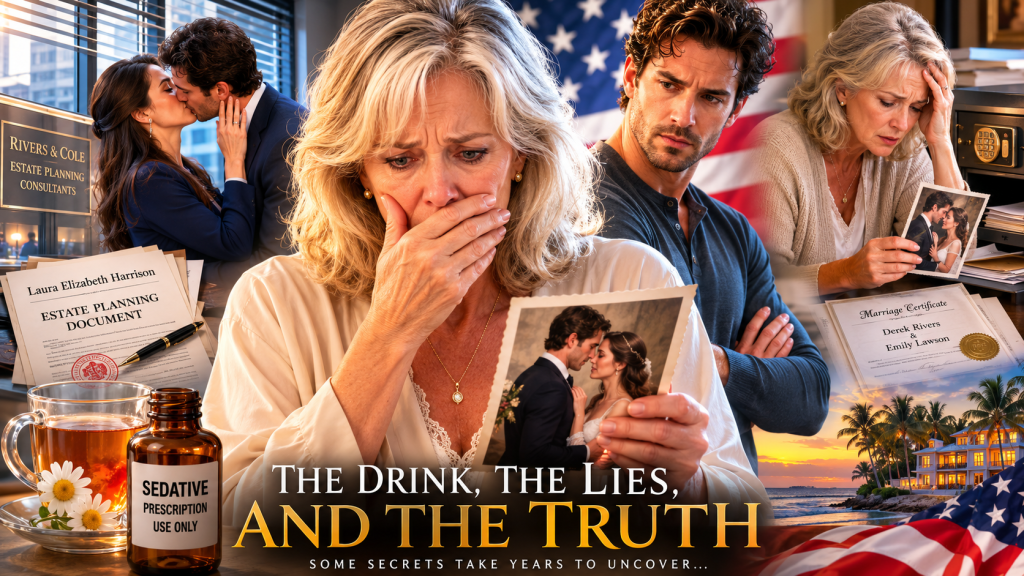
The paper trembled in my hands before I even touched it. I was sitting across from Dr. Bennett in a small consultation room that smelled faintly of disinfectant and coffee. Outside the narrow window, people crossed the hospital parking lot beneath a bright afternoon sun. Cars came and went. Somewhere down the corridor, a telephone rang.
Everything beyond that room seemed perfectly ordinary. My life no longer did. Dr. Bennett folded his hands on the desk and studied me for several seconds. He had always been straightforward with me, which was one of the reasons I trusted him. But that afternoon, he looked like a man searching for the least frightening way to deliver frightening news.
“Mrs. Harrison,” he finally said, “before I explain these results, I need to ask you something.”
I swallowed.

“All right.”
He tapped the laboratory report.
“Have you been drinking this every night?”
I knew exactly what he meant.
The warm drink Derek prepared before bed.
Chamomile tea, honey, warm water, and what he always described as a few drops of a natural sleep supplement.
I nodded.
“For about six years.”
Dr. Bennett’s expression changed.
Not to shock.
To concern.
“A healthy person should not have been consuming this substance regularly for that length of time without medical supervision.”
My fingers tightened around the arms of the chair.
“What substance?”
He pushed the report toward me.
“The laboratory detected traces of a sedative.”
For a moment, the word meant nothing.
Then it meant everything.
“A sedative?”
“Yes.”
He spoke carefully.
“The concentration isn’t extremely high. It wouldn’t normally render someone completely unconscious. But it could make a person unusually drowsy, slow their reflexes, and make them significantly less likely to wake during the night.”
I heard my heartbeat inside my ears.
For six years, Derek had prepared that drink.
For six years, he had brought it upstairs himself.
Sometimes he carried it on a little wooden tray.
Sometimes he kissed my forehead before handing it to me.
“Drink this, my little wife. You need your rest.”
My little wife.
I used to love those words.
Now they made my stomach turn.
“So he wasn’t trying to poison me?”
I hated myself for asking the question.
Dr. Bennett hesitated.
“It doesn’t appear to be an immediate poison.”
Relief washed through me.
It lasted less than a second.
“However…”
There was always a however.
He turned another page.
“The laboratory found something else.”
I stared at him.
“What?”
“Trace amounts of a plant-derived compound.”
“What kind?”
“We’re still confirming the exact source. It’s uncommon enough that I don’t want to speculate until we have a definitive identification.”
He paused.
“But compounds in this family can have neurological effects.”
My palms became cold.
“What kind of neurological effects?”
“Memory impairment can be one.”
The words settled over me like snow.
Memory.
I almost laughed.
Not because anything was funny.
Because it sounded absurd.
“That’s ridiculous.”
“I wish it were.”
He leaned forward.
“Have you noticed yourself forgetting things?”
“No.”
The answer came automatically.
Then I stopped.
Hadn’t I?
There had been little incidents.
I would walk into a room and forget why I was there.
I repeated stories to neighbors.
I misplaced my glasses constantly.
Once, I accused our cleaning lady of moving a necklace that had belonged to my mother.
Three days later, I found it inside a plastic container in the freezer.
I had no memory of putting it there.
I had laughed about it.
Derek had laughed too.
“My little wife,” he had teased, wrapping his arms around me. “You’re getting wonderfully absent-minded.”
I had slapped his shoulder playfully.
“Watch yourself. I’m not that old.”
“Never said you were.”
He kissed my cheek.
“You’re perfect.”
That memory felt different now.
I looked at Dr. Bennett.
“I’m almost sixty.”
“Being nearly sixty doesn’t explain everything.”
I stared at the report.
Six years.
Six years of warm drinks.
Six years of heavy sleep.
Six years of strange little gaps in my memory.
The doctor interrupted my thoughts.
“Until we understand exactly what you’ve been consuming, stop drinking anything you haven’t prepared yourself.”
I nodded.
Then he said something I wasn’t expecting.
“And Mrs. Harrison?”
“Yes?”
“If I were you, I wouldn’t tell your husband about these results yet.”
That sentence followed me all the way home.
Derek was already in the kitchen when I arrived.
He was standing over the stove preparing my favorite tomato soup.
The smell of basil and roasted garlic filled the house.
“There she is,” he said cheerfully.
“My little wife.”
He crossed the kitchen and kissed my forehead.
His lips were warm.
Familiar.
The same lips that had whispered goodnight beside me for years.
The same hands that had prepared thousands of cups of evening tea.
“Everything okay?” he asked.
“You seem tired.”
“I had errands.”
“You should rest.”
Always rest.
Always sleep.
I studied his face.
Derek was twenty-nine when we met.
I was fifty-nine now, almost thirty years older than him.
People had warned me.
My sister said he wanted money.
Friends whispered that he would eventually leave me for someone younger.
Strangers stared when we held hands.
But Derek had been patient, gentle, attentive.
When people joked about our age difference, he never seemed embarrassed.
When I worried that one day he would wake beside me and see an old woman, he would touch my cheek and say, “I see Laura.”
I believed him.
I had defended him to everyone.
Now I wondered whether everyone had seen something I had refused to see.
That evening, Derek prepared another glass.
Honey.
Chamomile.
Warm water.
I didn’t see the amber bottle.
That frightened me more.
He carried the drink upstairs and placed it beside me.
“For a good night’s sleep.”
I smiled.
“Thank you.”
He remained there.
Watching.
Waiting.
I raised the glass.
Then I coughed.
“Excuse me.”
“You okay?”
“Fine. I’ll drink it after I brush my teeth.”
“Of course.”
I carried it into the bathroom.
Locked the door.
Then poured every drop down the sink.
I rinsed the glass thoroughly and filled it with plain warm water.
When I returned, Derek was reading in bed.
I climbed beneath the blankets and drank the entire glass.
His eyes flicked toward me.
Then his shoulders relaxed.
It was a tiny movement.
Barely noticeable.
But I noticed.
Because for the first time in six years, I was watching my husband instead of trusting him.
The following week became a performance.
Every night Derek prepared my drink.
Every night I found a way not to consume it.
Every morning I pretended to wake exactly as I always had.
Nothing changed.
Except me.
Without the nightly drink, my head gradually felt clearer.
I woke more easily.
My dreams became vivid again.
Most importantly, I began paying attention.
Derek left the house every Tuesday at exactly 10:15 in the morning.
He always said he was meeting private yoga clients.
He returned shortly after one.
I had never questioned it.
The next Tuesday, I followed him.
I stayed several cars behind.
He drove past the park where he occasionally taught outdoor classes.
Then he passed the shopping district.
Then the yoga studio.
My hands tightened around the steering wheel.
Where was he going?
Twenty minutes later, he entered a quiet neighborhood filled with accountants, attorneys, insurance offices, and financial firms.
He parked beside a small brick building.
There was no yoga sign.
No gym.
No wellness center.
Only a discreet bronze plaque beside the entrance.
I parked farther down the street.
Derek entered the building.
I waited ten minutes before walking closer.
The plaque read:
RIVERS & COLE
ESTATE PLANNING CONSULTANTS
Estate planning.
I stared at the name.
Rivers.
Derek Rivers.
Surely it was a coincidence.
I moved toward one of the windows.
The blinds were partially closed.
Through a narrow gap, I could see a conference room.
Derek sat at a polished table.
Across from him was an older man in a gray suit.
Beside the man sat a woman.
My breath stopped.
I knew her.
Or at least I thought I did.
Dark hair.
Elegant posture.
Silver shell necklace.
I had seen that woman years earlier at my wedding.
Derek had introduced her.
“This is my cousin Emily.”
I remembered thinking how beautiful she was.
Now she was sitting beside my husband in an estate planning office he had never mentioned.
Then she reached across the table.
Touched Derek’s hand.
And kissed him.
On the lips.
I stumbled backward.
My knees nearly gave out.
But before I moved away, the older man opened a thick folder.
He removed several documents.
One page was turned toward Derek.
I couldn’t read most of it.
But I could read the name printed above the signature line.
Laura Elizabeth Harrison.
My full legal name.
Not Laura Rivers.
Not Mrs. Derek Rivers.
Laura Elizabeth Harrison.
The name appearing on my property deeds.
My investments.
My late husband’s trust.
My inheritance.
I ducked behind a row of hedges.
Suddenly every warning I had ignored came rushing back.
He’s thirty years younger.
He wants your money.
You barely know him.
Men like that don’t marry women like you without a reason.
I had called those people cruel.
Maybe they had simply been right.
Twenty-five minutes later, the meeting ended.
The older man left first.
The dark-haired woman followed.
Derek came out last.
His face looked exhausted.
He glanced up and down the street.
For one terrible second, I thought he had seen me.
Then he adjusted his jacket.
The woman stepped toward him.
He kissed her forehead.
They separated.
I waited until all three vehicles disappeared.
Then I approached the building.
The door was locked.
I was about to leave when a young receptionist emerged carrying a cardboard box filled with folders.
“Excuse me,” I said.
She smiled politely.
“Yes?”
“I think my husband had an appointment here.”
“What’s his name?”
“Derek Rivers.”
Her face brightened.
“Mr. Rivers?”
I nodded.
“He owns the firm.”
For a second, I thought I had misheard her.
“Owns it?”
“Yes. He and Mr. Cole have been partners for almost eight years.”
Eight years.
I had known Derek for a little over six.
Everything he had told me about struggling financially before meeting me…
About barely paying rent…
About teaching yoga because it was his passion and his only real career…
A lie.
I went home feeling as if I had married a stranger.
That night Derek arrived carrying white roses.
“My little wife.”
He smiled.
“I thought these might brighten your day.”
I accepted them.
They smelled wonderful.
I wondered whether flowers could lie too.
At dinner, Derek talked about yoga clients and a charity event.
I smiled at the appropriate moments.
Inside, I counted every lie.
That night I waited until his breathing became slow and steady.
At 2:17 a.m., I slipped from bed.
Derek had a downstairs office that I was never encouraged to enter.
“Boring client paperwork,” he always said.
“I don’t want business cluttering your mind.”
I had found that charming once.
Now it sounded controlling.
The office door was locked.
But six years of marriage teaches you habits.
I tried his birthday.
Nothing.
Our anniversary.
Nothing.
Then I remembered Derek often joking that thirty was the luckiest number of his life because it represented the year he believed his real life began.
The year he met me.
I tried a variation using the month.
The lock clicked.
Inside, the room looked disappointingly ordinary.
Shelves.
Files.
A desk.
A framed wedding photograph.
I searched slowly.
Nothing.
Then I noticed one bookshelf wasn’t flush against the wall.
I pushed it.
The shelf moved.
Behind it was a small steel safe.
Another keypad.
I studied the keys.
There were faint fingerprint marks around four numbers.
I tried them in several combinations.
On the third attempt, the safe clicked.
Inside were three things.
A stack of legal documents.
A flash drive.
And an old photograph.
I picked up the photograph first.
Derek was standing beside the dark-haired woman.
They were younger.
They were smiling.
And they were dressed as bride and groom.
On the back, someone had written:
Forever begins today.
The date was one year before Derek met me.
My stomach twisted.
I grabbed the papers.
The first document was a marriage certificate.
Derek Rivers.
Emily Lawson.
Legally married.
I searched desperately for a divorce decree.
Nothing.
Then I reached for the flash drive.
Footsteps sounded behind me.
I froze.
Derek’s voice came from the doorway.
“You’ve always been curious, Laura.”
I turned.
He stood barefoot in his gray sleep shirt.
There was no anger on his face.
No panic.
Only sadness.
His eyes moved from the open safe to the photograph in my hands.
“I was hoping,” he said quietly, “you wouldn’t find out like this.”
“You’re married.”
“I was.”
“The certificate says you married her.”
“Yes.”
“Where is the divorce?”
His eyes dropped.
“There wasn’t one.”
My chest tightened.
“So you married me while you were still married to someone else?”
“No.”
“Then explain it.”
Derek closed his eyes.
“Emily died.”
The anger inside me stopped.
“What?”
“Three months after that photograph.”
He sat down.
“Car accident.”
I stared at him.
He reached into the safe and pulled out another folder.
Inside was a newspaper clipping.
Then a death certificate.
Then a funeral notice.
Emily Lawson Rivers.
Age thirty-one.
Deceased.
The date matched his story.
“But I saw her today.”
“No,” Derek said.
“You saw Claire.”
He handed me another photograph.
The same face.
Almost exactly.
Underneath was a name.
Claire Lawson.
Emily’s identical twin sister.
“The necklace?” I asked.
“They both had one. Their mother gave them matching shell necklaces when they were teenagers.”
I felt dizzy.
“Then why did you kiss her?”
Derek stared at his hands.
“Claire is sick.”
“How sick?”
“Terminal cancer.”
I said nothing.
“She asked me to meet with her because she needed help organizing her estate. She has less than a year, according to her doctors.”
“And the kiss?”
His face tightened with embarrassment.
“She was frightened. Emotional. We were talking about Emily. Claire said she sometimes wondered what her sister had felt when she knew someone loved her completely.”
He looked at me.
“She kissed me.”
“And you kissed her back.”
“For a second.”
“That matters.”
“I know.”
I looked away.
One mystery had an explanation.
But the most frightening one remained.
I reached into my purse and removed the laboratory report.
Derek’s face changed the moment he saw it.
“So you know,” he whispered.
“I know you’ve been putting a sedative in my drink.”
He said nothing.
“For six years, Derek.”
“I can explain.”
“Then explain.”
He went to the kitchen.
When he returned, he carried the amber bottle.
He placed it on the desk.
“It was originally prescribed because of my sleep disorder.”
“For you?”
“My nightmares.”
After Emily’s death, Derek explained, he had suffered severe night terrors.
Years later, after we married, they returned.
I remembered some of those nights.
He would wake shouting.
Once he grabbed my wrist while still asleep.
Another time I found him standing in the hallway, confused and terrified.
He had gone to a sleep specialist.
But his explanation only made me angrier.
“So your doctor prescribed medication for me without my permission?”
Derek looked ashamed.
“The situation was more complicated than that. I discussed how easily you woke whenever I had an episode. A sleep aid was suggested as one possible temporary measure, but you should have been properly informed. You weren’t.”
“Because you didn’t tell me.”
“No.”
“Why?”
“I was ashamed.”
I stared at him.
“You were ashamed, so you drugged your wife?”
His eyes filled with tears.
“When you started sleeping through my episodes, everything became calmer. You woke rested. I stopped frightening you.”
“So you continued.”
“Yes.”
“For six years.”
“Yes.”
My voice shook.
“And the plant extract?”
He looked confused.
“What plant extract?”
I studied his face.
For the first time that night, his surprise looked completely genuine.
“The laboratory found another substance.”
Derek shook his head.
“I never added anything except what the doctor originally gave me.”
That changed everything.
The following morning, I called Dr. Bennett.
Further testing eventually revealed that the mysterious plant compound had not come from Derek’s bottle at all.
It came from a concentrated herbal sleep supplement I had begun taking years earlier after a friend recommended it.
I had forgotten I was using it because Derek eventually began mixing my supplements into the tea.
The combination was likely responsible for some of the memory problems.
That discovery cleared Derek of one terrible suspicion.
But it did not clear him of the truth.
He had still given me medication without my informed consent.
He had still decided what happened to my body because he believed he knew what was best for me.
And there was one more question.
“The documents,” I said.
“What documents?”
“The ones I saw at Rivers & Cole.”
Derek nodded slowly.
He returned to the safe and removed a thick folder.
“Read them.”
I opened it.
I expected a rewritten will.
A transfer of property.
Something that would give Derek control over my estate.
Instead, I found the opposite.
The documents transferred every financial authority Derek possessed back into my sole control.
My investment accounts.
My properties.
My late husband’s trust.
My beachfront villa in Key West.
Then I reached the final page.
I, Derek Rivers, voluntarily renounce any present or future claim to the estate of Laura Elizabeth Harrison.
Signed.
Notarized.
Dated three weeks earlier.
I stared at him.
“What is this?”
“I was preparing to leave.”
I looked up.
“What?”
“Not because I stopped loving you.”
His voice broke.
“Because Claire’s diagnosis forced me to look at my life differently.”
He sat across from me.
“I realized I’ve spent years making decisions for people because I convinced myself I was protecting them.”
He looked toward Emily’s photograph.
“After Emily died, I controlled everything around me because control made grief feel less frightening.”
His eyes returned to mine.
“Then I did it to you.”
I said nothing.
“I told myself the tea helped you.”
“I told myself hiding the firm protected you from worrying that I married you for business connections.”
“I told myself keeping my finances separate proved I wasn’t after your money.”
“I told myself a hundred things.”
“But they all meant the same thing.”
He swallowed.
“I didn’t trust you to make your own choices.”
That was the first thing he said that truly reached me.
Because it was exactly what I had been feeling.
This wasn’t ultimately about money.
It wasn’t about the age difference.
It wasn’t even about another woman.
It was about choice.
Mine.
I had spent decades teaching other people to think independently.
Yet inside my own marriage, decisions about my body and my life had been quietly made without me.
“Why didn’t you tell me about the company?”
“I founded it before I met you.”
“Why pretend you were only a yoga instructor?”
“Because after Emily died, I hated the firm. I kept my ownership but stepped away from daily operations. Yoga became the only thing that made me feel human again.”
“You could have told me.”
“I know.”
“You could have told me all of it.”
“I know.”
“And every time you didn’t, you made another choice for me.”
His head lowered.
“Yes.”
I cried that night.
Not loudly.
Not dramatically.
I sat in the room where we had built six years of marriage and mourned something I couldn’t name.
Derek had not married me for money.
He had not been plotting to kill me.
The woman at the office was not his secret lover.
Yet somehow the truth did not return us to happiness.
Because innocence is not the same as honesty.
Three months later, Derek moved into a small apartment across town.
Not because a judge ordered him to.
Because I asked him to leave.
He packed quietly.
On his final morning in the house, he stood in the kitchen where he had made my tea thousands of times.
“I’m sorry, Laura.”
“I know.”
“I did love you.”
“I know that too.”
He looked surprised.
“Then why does this have to happen?”
“Because love isn’t the only thing a marriage needs.”
He nodded slowly.
“What else?”
“Respect.”
I looked at him.
“And respect means allowing someone to make choices you might not make for them.”
He cried then.
So did I.
But I didn’t change my mind.
Trust does not return simply because the worst suspicion turns out to be wrong.
Sometimes the truth reveals a different wound.
Derek continued visiting Claire.
Several months later, she became too weak to live independently.
He helped arrange her care.
I visited her once.
She apologized for kissing him.
“I wasn’t thinking clearly,” she said.
“I knew he loved you.”
I believed her.
Claire died the following spring.
I attended her funeral.
Standing several rows behind Derek, I finally understood the sadness I had always noticed behind his smile.
Some grief never disappears.
It simply learns to whisper instead of scream.
A year later, I sold my beachfront villa in Key West.
I had once imagined Derek and me growing old there, though the joke between us had always been that I had a thirty-year head start.
After everything that happened, the villa felt like part of a life that no longer belonged to me.
So I sold it.
I used part of the proceeds to establish a scholarship for adults returning to education after fifty.
I had spent much of my life teaching, and I knew how many people believed opportunity had an expiration date.
It doesn’t.
Neither does courage.
Neither does beginning again.
I traveled.
I went to Italy and ate breakfast alone overlooking the Mediterranean.
I visited small towns where nobody knew my name.
I learned to order dinner for one without feeling embarrassed.
I slept without anyone preparing my drinks.
And slowly, something unexpected happened.
My memory improved.
Not perfectly.
I still occasionally forgot where I left my glasses.
I still entered rooms and wondered what I had come to find.
I was nearly sixty, after all.
But I no longer treated every forgotten name or misplaced key as evidence that I was disappearing.
I trusted myself again.
As for Derek, we never remarried.
We never even officially became a couple again.
But we did something people found difficult to understand.
Every December 14, we met for coffee.
It was the anniversary of the yoga class where we first met.
The first year was awkward.
The second was easier.
By the third, we could laugh.
Sometimes we talked for hours.
Sometimes twenty minutes was enough.
There was affection between us.
There was regret.
Eventually, there was forgiveness.
But forgiveness, I learned, is not the same as returning to what once was.
You can forgive someone and still keep the door closed.
You can understand why someone hurt you without pretending the hurt didn’t matter.
You can love someone and decide that loving them from a distance is healthier than sharing a home.
The last time Derek and I met, he looked older.
Not old.
Just older.
There were faint lines around his eyes.
I teased him about them.
“Careful,” I said. “You’ll catch up with me eventually.”
He laughed.
“Impossible.”
For a moment, we were the couple we used to be.
Then his expression softened.
“I haven’t called you ‘my little wife’ in years.”
“No.”
“Do you miss it?”
I thought carefully.
“Sometimes.”
He smiled sadly.
“Me too.”
Then I shook my head.
“But it wouldn’t fit anymore.”
He looked at me.
“What would?”
I picked up my coat.
“You tell me.”
Derek thought for a long moment.
Then he smiled.
Not the charming smile of the young man I had married.
Not the secretive smile I had eventually learned to fear.
Just the tired, sincere smile of someone who had finally understood the price of his mistakes.
“My greatest lesson,” he said.
I stood.
He stood too.
We hugged.
There was no romance in it.
But there was love.
A different kind.
I walked toward the café door.
“Laura?”
I turned.
“I really am sorry.”
“I know.”
“And I really did love you.”
I smiled.
“I know that too.”
Then I stepped outside.
The December air was cold against my face.
People hurried along the sidewalk carrying shopping bags and cups of coffee. Somewhere nearby, Christmas music played through an open shop door.
I stood there for a moment and thought about the woman I had been six years earlier.
Nearly sixty.
Terrified of growing older.
Secretly grateful that a handsome man thirty years younger had chosen her.
I wished I could speak to that woman.
I would tell her something she had taken far too long to learn.
Being chosen is not the same as being valued.
Being protected is not the same as being respected.
And love—real love—does not require one person to surrender the right to decide what happens to their own life.
Derek had not been the villain I feared.
There was no secret plot to steal my fortune.
No young mistress waiting to replace me.
No plan to slowly poison an aging wife.
The truth was less dramatic.
And somehow more painful.
He had loved me.
He had also lied to me.
He had tried to protect me.
And while doing so, he had taken away choices that were never his to make.
That was the contradiction I had to learn to live with.
Good people can make terrible decisions.
Love can exist beside betrayal.
Forgiveness can exist without reconciliation.
And sometimes the bravest ending is not revenge.
It is simply reclaiming your own life.
I was nearly sixty when I finally understood that.
People talk about youth as though it is the only age when life can change.
They are wrong.
At fifty-nine, I thought my story was already written.
At sixty, I discovered I still held the pen.
I traveled.
I taught.
I made new friends.
I woke every morning knowing that whatever decisions waited for me that day—good ones, foolish ones, frightening ones—they belonged to me.
And that became more valuable than the villa.
More valuable than the investments.
More valuable than being adored by a younger husband.
Because some mysteries end with shocking revelations.
Mine ended with something far more difficult.
The realization that the man I feared was trying to steal my life had never wanted my money or my death.
He had wanted to protect me.
But somewhere between love and fear, he forgot the most important thing.
My life was never his to manage.
My body was never his to medicate without my knowledge.
My future was never his to arrange behind closed doors.
My choices belonged to me.
They always had.
And they always would.
THE END. Thank you for reading.