 Reading Time: 10 minutes
On My Daughter’s 18th Birthday, My Mother Humiliated Her With a $15 Bracelet and Said, “She Gets Scraps. The Real Grandkid Gets a Jeep,” Before Giving My Niece the Keys to a Wrangler. Then I Handed My Daughter the Keys to a Fully Paid Mustang GT—and Mom Went Pale When the Dealer Arrived With an Envelope.
On the morning of my daughter’s eighteenth birthday, Lily Carter stood in my mother’s driveway in Columbus, Ohio, struggling to hold back tears.
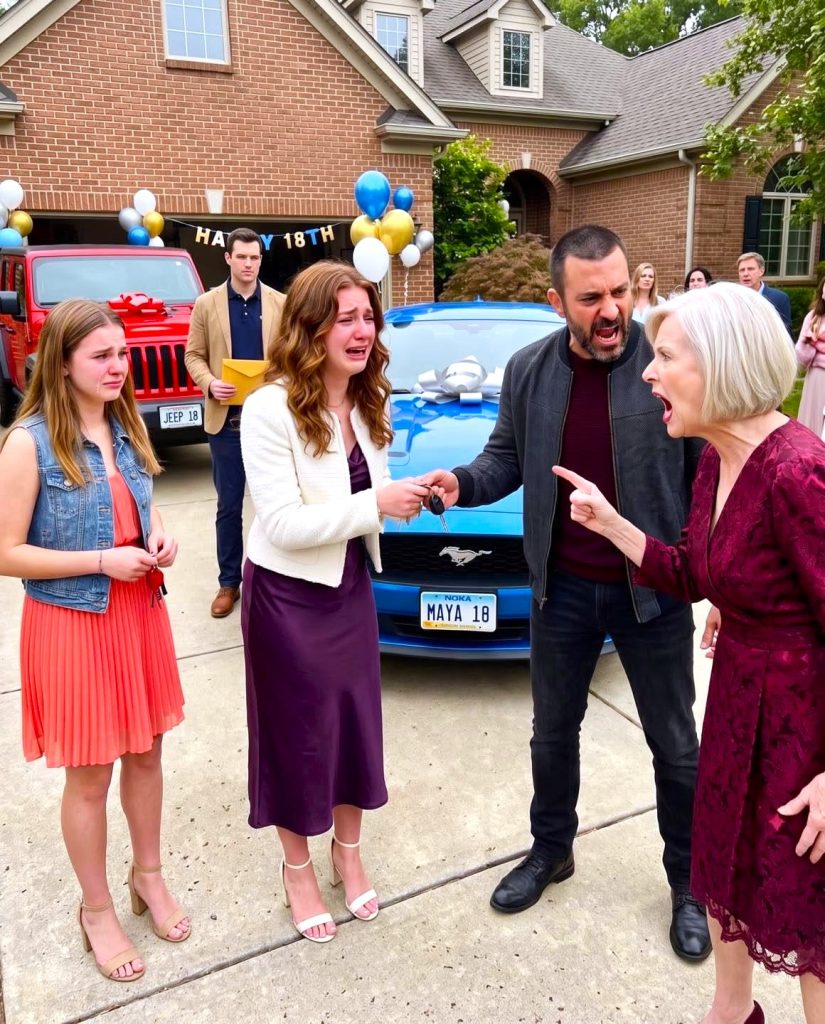
Mom had invited the entire family for what she described as a “double celebration” honoring both Lily and my niece, Brianna, who had turned eighteen three weeks earlier. I should have realized something was wrong the moment I noticed a brand-new red Jeep Wrangler beneath a silver bow beside the garage.
Mom called everyone over to the patio table, raised a tiny jewelry box, and smiled at Lily.
“For you,” she said.
Inside was a thin bracelet that already looked tarnished. A clearance sticker remained attached to the bottom of the box: $14.99.
Lily murmured, “Thank you, Grandma.”
Mom laughed loudly enough for every guest to hear. “Well, sweetheart, some girls appreciate what they get. She gets scraps because she never learned to aim higher.”
Then she faced Brianna and lifted a set of Jeep keys.
“And the real grandkid gets a real gift.”
My sister, Denise, applauded. Brianna squealed with excitement. Several relatives lowered their eyes toward the ground.
Lily’s face lost all color.
That was when I reached into my jacket and placed another key fob in her palm.
“Happy birthday, baby.”
She turned toward the street. Behind my truck sat a dark blue 2022 Mustang GT, fully paid for and polished so carefully that the hood reflected the morning sky.
Mom’s smile vanished.
“You bought that?” she asked.
“Paid in full,” I said. “No loan. No strings.”
Lily covered her mouth as tears filled her eyes, but this time she was smiling.
Mom’s expression tightened. “You are trying to humiliate this family.”
“No,” I replied. “You handled that yourself.”
Before she could respond, a man wearing a dealership polo shirt walked up the driveway. His name was Aaron Blake, the sales manager who had delivered the Mustang earlier that morning.
“Mr. Carter,” he said, extending a sealed envelope toward me. “I’m sorry to interrupt, but this was left at the dealership yesterday with instructions that it be handed to you in front of your mother.”
The color drained from Mom’s face. Denise stopped applauding. Even Brianna lowered the Jeep keys, sensing that the morning had shifted from a cruel performance into something much more serious.
Mom stepped forward. “Give me that.”
Aaron pulled the envelope away. “It’s addressed to Daniel.”
I opened it.
Inside were a copy of the Jeep’s purchase agreement, a bank withdrawal receipt, and a handwritten message from my late father’s former attorney.
The money used to purchase Brianna’s Wrangler had been taken from an account established for Lily’s college education.
Mom had emptied it six days earlier.
Her signature appeared on the transfer authorization, but the second required signature had been copied from another document containing my name.
At the bottom, the attorney had written a single sentence:
“Call me before anyone leaves.”
PART 2
For several moments, no one moved.
I read through the documents again, hoping I had interpreted them incorrectly. My father, Robert Carter, had opened the account when Lily was six years old. Every year, he added more money, explaining that it was meant for tuition, textbooks, or whatever first step she chose after graduating from high school.
When he died two years earlier, Mom had been appointed temporary trustee because I was recovering from spinal surgery and unable to manage the estate paperwork.
Temporary was the word that mattered.
“What did you do?” I asked.
Mom folded her arms. “Your father wanted his grandchildren treated equally.”
“Then why did all of Lily’s money buy Brianna a Jeep?”
Denise moved between us. “Don’t accuse Mom in front of everyone. She helped Dad manage his finances for years.”
Aaron spoke quietly. “The dealership received a cashier’s check from the education trust. Our accounting department flagged the account name because it did not match the buyer. The attorney contacted us after the bank called him.”
Mom glared at him. “This is private.”
“No,” I said. “You made it public when you called my daughter scraps.”
Brianna stared at the Jeep keys resting in her hand. “Mom, did you know?”
Denise paused for far too long.
That silence hurt Brianna more deeply than an admission would have.
Lily remained beside me, clutching the Mustang key. “Grandma, was that money really mine?”
Mom’s tone hardened. “You were going to waste it. You have no plan. Brianna was accepted to Ohio State, and she needs reliable transportation.”
“I was accepted to Cincinnati,” Lily said softly. “I got the email yesterday.”
Everyone turned toward her.
She had kept the news to herself because she planned to announce it during dinner.
Mom blinked before quickly regaining her composure. “A Mustang is not a responsible college car.”
“The Mustang came from me,” I said. “I sold my restored ’69 Camaro and used part of the money. You stole from her.”
At that moment, my phone rang.
The caller was Harold Pierce, my father’s former attorney.
I placed the call on speaker.
“Daniel,” he said, “do not let the Jeep leave the property. The trust required your written approval for any withdrawal over five thousand dollars. The bank believes your signature was forged. I have already advised them to freeze the remaining estate accounts.”
Mom reached for the phone, but I stepped out of her reach.
Harold continued, “There is another issue. Robert anticipated possible misuse. His trust contains a penalty clause. Any trustee who diverts funds for personal favoritism must repay the amount and may lose her beneficiary share.”
Denise’s expression twisted. “What beneficiary share?”
“The lake house,” Harold replied. “Margaret was scheduled to inherit it outright next month.”
Mom dropped heavily into a patio chair.
The Michigan lake house had consumed her thoughts since Dad’s death. She had already hired an interior designer, purchased furniture, and announced to everyone that she intended to spend her summers there.
Harold remained calm. “Daniel, photograph every document. Aaron should retain the Jeep keys. I will meet you at the bank at nine tomorrow.”
Brianna crossed the patio and placed the Wrangler keys in Aaron’s hand.
“I don’t want it,” she said.
Denise seized her wrist. “Don’t be ridiculous.”
Brianna pulled free. “You let Grandma steal from Lily, then let her humiliate her in front of us.”
Mom stared at me with undisguised panic. “We can settle this as a family.”
I returned the documents to the envelope.
“We stopped being a family the moment you decided one eighteen-year-old needed to be broken so the other could feel important.”
PART 3
The celebration ended without anyone cutting the cake.
Relatives departed in small, uncomfortable groups. Aaron arranged for the Jeep to be towed back to the dealership until its ownership could be resolved. Denise drove away angrily while Brianna sat in the passenger seat, staring through the window.
Mom remained alone on the patio, surrounded by untouched food and silver decorations that suddenly looked cheap.
Lily and I drove the Mustang home.
She said almost nothing during the trip. When we stopped at a red light, she finally spoke.
“Did Grandpa really save that money for me?”
“He did.”
“And Grandma knew?”
“She knew exactly what it was.”
Lily glanced down at the bracelet in her lap. She had brought it with her, though I did not yet understand why.
“I kept thinking maybe she hated me because I did something wrong,” she said. “Maybe because I’m quieter than Brianna. Maybe because Mom left.”
Lily’s mother, Rachel, had moved to Arizona when Lily was ten and had visited only twice since then. My mother frequently used Rachel’s absence as a weapon, praising Brianna’s “stable family” while suggesting that Lily’s circumstances were proof of some personal failure.
I turned into an empty parking lot and shut off the engine.
“None of this is your fault,” I said. “Your grandmother made choices. So did your mother. You do not carry the shame for either of them.”
Lily nodded, though I knew it would take time for those words to truly reach her.
The following morning, we met Harold at Franklin Community Bank. Aaron arrived with the dealership’s finance director. Mom appeared ten minutes late, accompanied by Denise and an attorney named Martin Shaw.
Martin opened the meeting by describing the withdrawal as a misunderstanding.
Harold responded by laying three documents on the conference table.
The first was the trust agreement.
The second was the forged authorization.
The third consisted of security footage showing Mom giving the form to a bank teller and confirming that I had signed it.
The room became silent.
Martin requested a private conversation with his clients.
Twenty minutes later, they returned with an offer. Mom would restore the college fund over five years, the family would keep the Jeep, and no one would notify the police.
A single laugh escaped me, not because the situation was amusing, but because their proposal was so offensive.
“You used Lily’s money to buy Denise’s daughter a car,” I said. “Then you planned a party so you could shame Lily while showing everyone what you had done. Five years is not repayment. It is another way to make her wait while you stay comfortable.”
Mom leaned toward me. “I made one bad decision.”
“No. The transfer was one crime. The party was a separate decision. The bracelet was another. The speech was another. You had six days to stop.”
Denise struck the table with her palm. “Brianna needed that Jeep.”
A voice came from the doorway.
“No, I didn’t.”
Brianna had taken a rideshare to the bank after Denise refused to bring her. She entered carrying a folder and chose the chair beside Lily instead of the one near her mother.
The folder held screenshots of messages exchanged between Denise and Mom. Brianna had discovered them on a family tablet synchronized with Denise’s phone.
In one message, Denise had written, “Make sure Lily opens hers first. It’ll be funnier when Bri gets the keys.”
Mom had replied, “Daniel needs to learn he can’t turn that girl into something special just by spoiling her.”
Another exchange discussed using the trust because “Robert isn’t here to object.”
Martin shut his eyes.
Harold asked Brianna whether she had known where the money came from.
“No,” she said. “I knew Grandma was buying me a Jeep. I thought it came from the lake house account.”
Denise hissed, “You are betraying your family.”
Brianna met her gaze without flinching. “I’m telling the truth about my family.”
That ended any possibility of negotiation.
The bank’s fraud officer entered the room. I signed a formal complaint regarding the forged authorization, although Harold explained that prosecutors would make the final decision about criminal charges.
The dealership canceled the Wrangler purchase and returned the funds directly to the trust after deducting a modest transportation and processing fee, which Mom was ordered to repay.
Because the money was recovered quickly, the financial loss remained limited.
The emotional damage did not.
Over the next month, Harold filed a petition in probate court seeking Mom’s removal as trustee. The judge reviewed the messages, the bank footage, and the provisions of the trust.
Mom’s attorney argued that she had always planned to return the money. However, there was no written repayment agreement and no evidence that she had considered the withdrawal a loan.
The judge removed her.
Under Dad’s penalty clause, Mom also forfeited her right to inherit the Michigan lake house. The court ordered the property sold and directed the proceeds into educational trusts for Lily and Brianna.
Denise protested that Brianna deserved a larger portion because Mom had already promised her the house someday.
The judge reminded her that promises involving property a person did not own had no legal significance.
Mom did not go to prison.
Following her attorney’s advice, she accepted a plea agreement involving a reduced forgery-related charge. She paid restitution and fines and received probation with mandatory community service.
Some relatives were angry because they believed she should have been incarcerated. Others claimed I should never have pursued the complaint.
I stopped trying to please either side.
My only responsibility was Lily.
That fall, she began studying mechanical engineering at the University of Cincinnati. During her first semester, she left the Mustang at home because campus parking was expensive and decided that taking the bus made more sense.
Mom would have called that proof that the car had been wasted on her.
I saw it differently.
Lily understood the difference between owning something valuable and needing everyone else to see it.
On weekends, she returned home and worked with me in the garage. Together, we changed the Mustang’s oil, replaced its worn brake pads, and fitted it with a better set of tires.
The car became more than an eighteenth-birthday present.
It became a place where Lily learned to trust her own decisions.
Brianna changed as well.
She enrolled at Ohio State but refused to allow Denise to drive her to campus. Instead, she purchased a used Honda Civic using income from a summer job and a small loan she could comfortably repay.
At first, Brianna and Lily behaved awkwardly around one another. Neither knew how to discuss the competition that the adults in their lives had deliberately created over eighteen years.
One evening in October, Brianna arrived at our house carrying the fifteen-dollar bracelet.
“I found this in Grandma’s kitchen,” she told Lily. “You left it at the party.”
Lily rotated the bracelet in her fingers.
“I didn’t leave it,” she said. “I put it beside her chair.”
A faint, uneasy smile appeared on Brianna’s face. “That’s better.”
They remained on the front steps for almost an hour.
I stayed indoors, but through the screen door, I heard fragments of their conversation. Brianna apologized for laughing when Mom presented the bracelet. Lily admitted that she had resented Brianna long before the Jeep appeared.
They did not undo eighteen years of hurt in a single evening, but they finally stopped treating that hurt as though it belonged between them.
By Christmas, they were regularly exchanging messages.
Mom spent the holiday by herself.
I had not demanded that outcome. I told Lily she was free to visit her grandmother if she wished, and I gave Brianna the same assurance.
Both refused.
Denise hosted a small dinner, but Brianna remained there for only an hour. Several relatives invited Mom to join them out of obligation. She declined every offer because none included the public apology from me that she believed she deserved.
In January, a letter from Mom arrived at my house.
She wrote that she forgave me for “overreacting” and was prepared to repair the family, provided I admitted that purchasing the Mustang had provoked her.
She also argued that Lily’s college account contained more money than she needed and that using part of it for Brianna had been reasonable.
I gave the letter to Lily.
She read it twice before placing it in the kitchen shredder.
“I kept waiting for her to say she was sorry,” she said. “She isn’t.”
“No,” I replied. “She isn’t.”
Lily pressed the button, and the letter vanished into narrow strips.
One year later, on her nineteenth birthday, we drove the Mustang north to visit the lake house before the sale was completed.
Dad had taught me how to fish there, and Lily still remembered roasting marshmallows with him near the dock.
The house stood empty. The designer furniture Mom had ordered had been returned months earlier. We wandered through bare rooms while afternoon sunlight moved slowly across the wooden flooring.
Lily stopped beside a window overlooking the lake.
“Do you miss her?” she asked.
“Sometimes I miss who I thought she was.”
Lily understood immediately.
Before we left, we sat together on the dock. She told me she had earned a place on the dean’s list and secured a paid internship with an automotive supplier.
She intended to use her trust only for tuition and save the income from her internship.
Then she pulled the Mustang keys from her pocket and tossed them toward me.
“You drive home,” she said. “I want to sleep.”
On the highway, she rested her head against the window and fell asleep, looking more peaceful than she had on the morning of her eighteenth birthday.
The Mustang had never been the true victory.
Neither had the lake house, the court ruling, or the sight of Mom’s face turning pale when the envelope appeared.
The real victory was that Lily no longer judged her worth according to what her grandmother handed her in front of an audience.
Mom had attempted to label one granddaughter as scraps and the other as real.
In the end, both young women rejected the identities she had assigned them.
And the family she had controlled through favoritism learned how to continue without her.
THE END! THANKS FOR READING!