 Reading Time: 12 minutes
My 81-year-old mother fired her sweet caregiver and replaced her with a heavily tattooed biker. Mom had been bedridden for twelve years. After her second stroke, the doctors told us she would probably never walk again.
Her mind remained sharp, but her body betrayed her slowly. Her hands shook. Her legs weakened. Some days, even lifting a spoon exhausted her. Since I worked full-time, we hired Brenda.
Brenda was the kind of woman everyone trusted immediately.
Soft voice.
Floral dresses.
A silver cross necklace.
Homemade banana bread wrapped in plastic.
She sang hymns while she folded laundry.
She called my mother “Miss Margaret” and me “sweetheart.”
For twelve years, Brenda was in our home almost every weekday.
She managed Mom’s medicine.
She helped her bathe.
She cooked soups and soft meals.
She brushed Mom’s hair.
She read devotionals to her in the afternoon.
People at church told me how blessed we were.
“Good caregivers are hard to find,” they said.
And I believed them.
I believed Brenda was a gift.
Then two months ago, Brenda called me crying.
I was at work, sitting in a staff meeting, when my phone buzzed three times in a row.
I stepped outside to answer.
Brenda’s voice came through trembling.
“Margaret kicked me out.”
“What?”
“She told me not to come back. She said she already found my replacement.”
I gripped the phone.
“What replacement?”
Brenda began sobbing harder.
“Trust me, honey. You’re better off not knowing who he is.”
My stomach dropped.
I left work immediately.
The whole drive home, I imagined every possible disaster.
Had Mom been scammed?
Had someone threatened her?
Had Brenda made a mistake?
My mother could be stubborn.
Sharp-tongued, too.
But she was not careless.
She knew she depended on help.
She knew I depended on Brenda being there.
When I burst into Mom’s room, I froze.
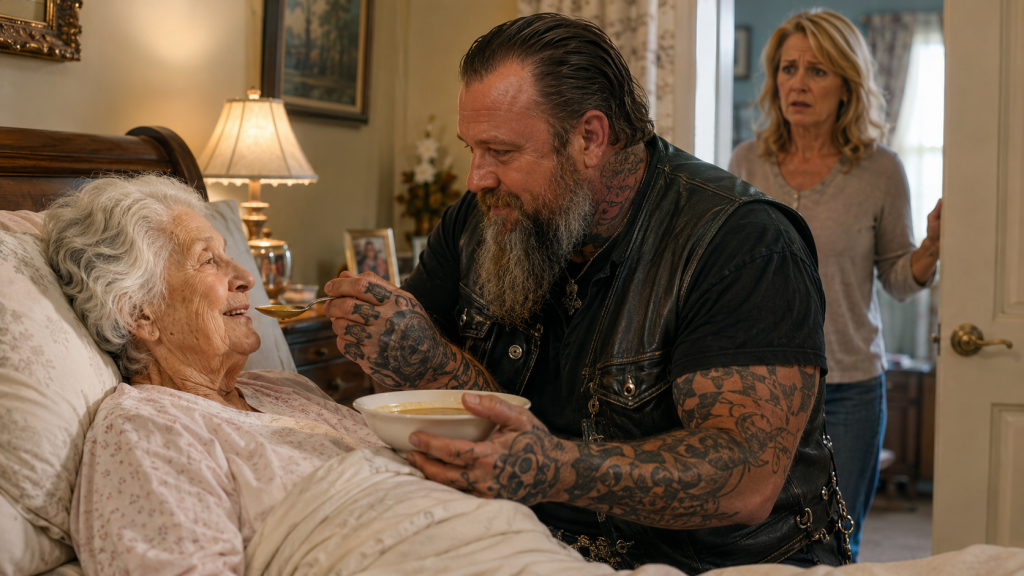
Sitting beside her bed, feeding her chicken soup, was a huge man.
Black leather vest.
Thick arms.
Beard down to his chest.
Tattoos crawling up his neck and across both hands.
A silver chain hung from his belt.
His boots looked heavy enough to crack tile.
In one hand, he held a spoon.
In the other, a napkin folded carefully beneath my mother’s chin.
My mother was beaming at him like he had hung the moon.
“Mom,” I said carefully, “can I talk to you alone?”
The biker did not even look offended.
He placed the bowl on the bedside table and wiped my mother’s mouth gently.
“I’ll be in the garden, Miss Margaret.”
His voice was deep, but surprisingly soft.
“Thank you, Louis,” Mom said.
Louis.
He stood, nodded once to me, and walked out of the room.
The second the door shut, I lost it.
“Have you lost your mind?”
Mom lifted one eyebrow.
Even bedridden, she still had the power to make me feel twelve years old.
“Good afternoon to you too, Clara.”
“Who is that man?”
“His name is Louis.”
“I know his name. Why is he in your bedroom feeding you soup?”
“Because I hired him.”
“You fired Brenda.”
“Yes.”
“After twelve years?”
“Yes.”
“Mom, Brenda called me crying. She said you kicked her out.”
“I did.”
“Why?”
Mom’s face changed.
Just slightly.
A flicker of something I did not understand.
Then she looked toward the window and said, “Because I wanted Louis.”
“You wanted a biker with neck tattoos instead of the woman who has cared for you for over a decade?”
My mother’s jaw tightened.
“He is staying no matter what.”
“Mom—”
“No.” Her voice became firm. “I want Louis to be the one taking care of me.”
I stared at her.
There was something final in her tone.
Something afraid under the firmness.
But I was too angry to hear it clearly.
“Do you even know him?”
“Yes.”
“From where?”
She pressed her lips together.
“From before.”
“Before what?”
“Before you needed to know.”
That was all she would say.
I found Louis in the garden.
He was kneeling beside the rose bushes, pulling weeds with hands that looked made for breaking concrete.
When he saw me, he stood.
“Ma’am.”
“Don’t call me ma’am.”
“Yes, ma’am.”
I hated that I almost laughed.
Instead, I crossed my arms.
“What are your qualifications?”
“Certified home health aide. CPR. Medication administration. Twelve years working with veterans and disabled adults. References in my bag.”
That stopped me.
“You’re a certified caregiver?”
“Yes.”
“And a biker?”
“Yes.”
“You don’t see how that might concern me?”
He looked at me steadily.
“I understand appearances.”
“Do you?”
“Yes.”
His calm irritated me more than defensiveness would have.
“Why did my mother hire you?”
“You should ask Miss Margaret.”
“I did. She won’t tell me.”
“Then it’s not my story to tell.”
That answer made me furious.
For the first week, I watched him like a hawk.
I checked Mom’s medications every night.
I counted pills.
I reviewed the schedule.
I listened outside the door more than once.
I am not proud of that.
But I was afraid.
And guilt makes fear aggressive.
Yet as much as I hated to admit it, Louis cared for Mom beautifully.
He turned her every two hours without hurting her.
He learned exactly how she liked her pillows arranged.
He warmed her soup but never made it too hot.
He massaged her hands when the arthritis flared.
He cleaned her room quietly.
He replaced the batteries in the television remote without being asked.
He even trimmed the rose bushes because Mom said she liked seeing them neat from her window.
And Mom blossomed.
That is the only word for it.
Blossomed.
Her appetite returned.
She laughed again.
She asked for lipstick one morning because Louis was taking her outside in the wheelchair.
For years, I had thought her silence was illness.
Maybe part of it was.
But part of it had been something else.
Every day, they spent hours together.
They talked quietly when I was not home.
But the second I walked into the room, their conversations stopped.
Mom would look away.
Louis would stand and busy himself with something ordinary.
A blanket.
A cup.
The window.
It made me feel like a stranger in my own house.
One evening, I walked in and found Mom crying.
Louis was sitting beside her, holding a small photograph.
When they saw me, he tucked it away.
“What is that?” I asked.
“Nothing,” Mom said quickly.
“Mom.”
“Clara, please.”
Louis stood.
“I’ll make tea.”
The door closed behind him.
I sat beside Mom.
“Why are you hiding things from me?”
She looked at me with tired eyes.
“Because some things hurt before they heal.”
“What does that mean?”
“It means I am old, not helpless.”
I did not know what to say.
Everything changed three weeks later.
I was at the grocery store when Louis called.
“Clara, your mother had an episode. I called an ambulance. We’re going to St. Anne’s.”
My cart stayed in the aisle.
“What happened?”
“Breathing trouble. Confusion. Sudden weakness. She’s conscious, but she needs the hospital.”
“I’m coming.”
When I arrived, Mom was already in an emergency room bed with monitors attached.
She looked pale and fragile beneath the bright hospital lights.
Louis stood beside her, leather vest gone, wearing a plain black T-shirt.
He had both hands folded in front of him like he was praying.
The doctor said the episode was related to her illness.
A complication.
Something that could happen after years of decline.
But I could not help blaming Louis.
Maybe because I needed someone to blame.
Maybe because Brenda had planted suspicion in me from the beginning.
Louis never left Mom’s hospital bed.
He sat in the hard chair all night.
He adjusted her blanket.
He answered nurses’ questions.
He knew the medication schedule better than I did.
It irritated me.
The way he acted as if he were her son.
The way nurses looked to him for answers.
The way Mom’s hand relaxed whenever he spoke.
When Mom finally fell asleep, I followed Louis into the hallway.
“You need to stop acting like you belong here.”
The words came out sharper than I intended.
Louis looked at me for a long moment.
He did not argue.
Did not defend himself.
Instead, he quietly reached into his wallet and pulled out an old photograph.
He handed it to me.
My breath caught.
The photo showed my mother, thirty years younger, standing outside a shelter.
Beside her was Louis.
But not the huge man I knew now.
A boy.
Maybe fourteen.
His face bruised.
His arm in a sling.
His eyes hollow with fear.
My mother’s hand rested protectively on his shoulder.
I looked up.
“What is this?”
“Your mother saved my life,” Louis said.
His voice was steady, but his eyes were wet.
“Before she was bedridden, she volunteered at a shelter. My father nearly destroyed me, and Miss Margaret was the only adult who believed me.”
I leaned against the wall.
I knew Mom had volunteered years ago.
I remembered her leaving on Saturdays with casseroles and boxes of donated clothes.
But I had been young, busy, impatient with anything that did not involve my own life.
I never asked many questions.
Louis looked toward Mom’s room.
“She testified for me. She found me a safe placement. She came to every court date. She wrote letters to my school. She made sure I knew one adult in the world thought I was worth saving.”
My throat tightened.
“Why didn’t she tell me?”
“Because Brenda knew too,” he said. “And Brenda was using it against her.”
The hallway seemed to tilt.
“What?”
Louis lowered his voice.
“Brenda wasn’t sweet. Not to your mother.”
“No.”
“She was stealing her medication. Cashing small checks. Taking cash from her drawer. Threatening to put her in a nursing home if she told you.”
My chest went cold.
“No,” I said again, but weaker.
Louis reached into his bag and pulled out a folder.
“Your mother called me because she remembered I became a private investigator. She saw my name in a newspaper article about elder fraud. She found a way to call me from the house phone when Brenda went outside.”
My hands shook as I opened the folder.
Inside were photographs.
Bank slips.
Pharmacy records.
Copies of small checks made out to cash.
Medication refill logs that did not match Mom’s actual doses.
And recordings.
Louis pressed play on his phone.
Brenda’s soft church voice came through, but it was not sweet now.
“Your daughter will never believe you, Margaret. She’s busy. She likes thinking I’m the good one.”
Another recording.
“You tell Clara, and I’ll make one call. I’ll say you’re confused, refusing care, unsafe at home. They’ll put you somewhere she can visit on Sundays and feel guilty.”
Another.
“Sign the check. It’s not like you go anywhere.”
My knees weakened.
Louis caught my arm before I hit the floor.
I covered my mouth.
All those years.
All those times Mom seemed withdrawn.
All those missing little things I explained away.
A twenty-dollar bill.
A ring I thought Mom misplaced.
Pain pills that ran out early.
Mom saying she did not want to be alone with Brenda, then quickly changing the subject when Brenda walked in.
I had not listened.
Because Brenda looked safe.
Because Brenda sounded kind.
Because Louis looked like danger.
I sat in a hospital chair with the folder open in my lap and cried until I could not breathe.
Louis sat beside me quietly.
He did not say I told you so.
He did not say I should have believed my mother.
That mercy made it worse.
When Mom woke up the next morning, I was sitting beside her bed.
Louis had gone for coffee.
She opened her eyes and smiled faintly.
“You know now,” she said.
I started crying again.
“I’m sorry.”
She closed her eyes.
“Oh, Clara.”
“I should have seen it.”
“You saw what she wanted you to see.”
“But you tried to tell me.”
“I was afraid.”
“Of Brenda?”
“Yes,” Mom whispered. “And of becoming a burden you couldn’t manage anymore.”
That broke something in me.
“You are not a burden.”
“I needed so much.”
“You are my mother.”
She looked away.
“Sometimes those two things feel the same when you’re old.”
I took her fragile hand.
“They are not the same to me.”
Her eyes filled.
“Louis believed me right away.”
“I know.”
“He always did.”
I looked toward the door.
“He loves you.”
Mom smiled through tears.
“He is alive because someone once believed him. He said it was his turn.”
Brenda was arrested two weeks later.
Louis had already gathered enough evidence, but my statement and Mom’s testimony completed it.
At first, Brenda denied everything.
She cried.
She clutched her cross necklace.
She told police she had loved my mother like family.
Then investigators found deposits matching Mom’s missing checks.
They found pills in Brenda’s purse.
They found jewelry in her bedroom.
They found records showing she had done similar things to another elderly client years earlier, but the family had dropped it to avoid scandal.
Brenda’s sweetness dissolved under evidence.
People from church were shocked.
Some refused to believe it at first.
“She was so kind,” they said.
I stopped being polite after the third time.
“No,” I told them. “She was convincing.”
Mom came home after a week.
Louis was there when the ambulance brought her back.
He had cleaned the room, washed the curtains, changed the bedding, and placed fresh roses by the window.
Not red roses.
Yellow.
Mom’s favorite.
She looked at them and began to cry.
Louis leaned down.
“Welcome home, Miss Margaret.”
She touched his tattooed hand.
“Thank you, my boy.”
My boy.
I had resented that before.
Now I understood it.
Louis was not replacing me.
He was returning a debt love had never asked him to repay.
Over the next months, our house changed.
Not physically, at first.
The same bed.
The same window.
The same rose garden.
But the air changed.
Mom spoke more freely.
She told me about the shelter.
About the children she had helped.
About Louis arriving with bruises he tried to hide.
About the night he called her from a payphone because he had nowhere else to go.
“I thought I only helped him a little,” she said one afternoon.
Louis was in the garden, repairing a loose fence board.
“You helped him live.”
Mom smiled.
“Maybe that’s enough for one life.”
I wanted to say she had helped me too.
But the words tangled in my throat.
For years, I had reduced my mother to her illness.
Her schedule.
Her medications.
Her needs.
I forgot she had been a whole woman before the bed.
A woman with secrets.
Courage.
History.
People who owed her gratitude I knew nothing about.
I also had to face my own guilt.
Louis never blamed me, but I blamed myself.
One evening, I told him that.
We were sitting on the back porch while Mom slept.
“I should have believed her sooner.”
Louis looked out at the roses.
“When you grow up with people judging by appearances, you learn how easy it is to miss the truth.”
“I judged you.”
“Yes.”
I winced.
He smiled faintly.
“But you’re learning.”
“I’m sorry.”
“I know.”
He was quiet for a moment.
Then he said, “Brenda counted on you being tired. That’s how people like her work. They don’t just exploit the vulnerable person. They exploit the caregiver’s exhaustion too.”
That sentence stayed with me.
Because it was true.
I was tired.
Tired from work.
Tired from bills.
Tired from watching my mother fade.
Tired from guilt.
Brenda stepped into that exhaustion and made herself look like relief.
Louis stepped into the truth and looked like trouble.
I had chosen the prettier lie.
After Brenda’s arrest, Mom asked for one thing.
A day outside.
Not just in the wheelchair by the window.
Outside.
In the garden.
Louis and I wrapped her in blankets and rolled her beneath the old maple tree.
The roses were blooming.
Mom tilted her face toward the sun.
For a long time, none of us spoke.
Then she said, “Clara, do you remember when you were little and you hated my shelter work?”
I laughed softly.
“I didn’t hate it. I hated sharing you.”
“I know.”
“I was jealous of strangers.”
“You were a child.”
“I’m not now.”
She looked at me.
I took a breath.
“I want to know about them. About the people you helped. About who you were before all this.”
Mom’s eyes shone.
“All right.”
So she told me.
Stories poured out of her like someone had opened a locked room.
A young mother who needed diapers.
A veteran who cried over soup.
A teenage girl who learned to read at nineteen.
A boy named Louis who hid in the pantry because loud voices made him shake.
Louis pretended not to listen while trimming rose stems nearby.
But I saw his shoulders move.
After that day, Mom’s room became less like a sickroom and more like a life.
We placed old photographs on the wall.
Not only family photos.
Shelter photos.
Church picnic photos.
A photo of Mom at forty-two, holding a microphone at a charity auction.
A photo of Louis as a teenager, wearing an oversized suit at his high school graduation, standing beside Mom.
I had never seen it before.
Louis had kept a copy all those years.
When I asked why, he said, “Some people keep trophies. I kept proof someone showed up.”
Mom lived eight more months.
Good months, considering everything.
Not easy.
Not painless.
But honest.
She spent her last Christmas at home.
Louis cooked chicken soup because she said his was better than mine.
He was right, annoyingly.
I bought him a sweater.
Black, of course.
Mom laughed until she coughed when he opened it.
“You’re trying to civilize him,” she said.
Louis held the sweater against his leather vest.
“Miss Margaret, I am already a gentleman.”
“You are,” she said softly.
And he was.
A gentleman with tattoos.
A gentleman with scarred knuckles.
A gentleman who checked medication labels three times and cried in the hallway when Mom had bad days.
The night Mom died, Louis was there.
So was I.
She had been sleeping most of the day.
Near midnight, she opened her eyes and looked first at me, then at Louis.
“My children,” she whispered.
I took one hand.
Louis took the other.
Neither of us corrected her.
After the funeral, Louis stood at the back of the church.
Brenda’s old friends avoided looking at him.
Some still whispered about his tattoos.
I wanted to turn around and shout at all of them.
But Louis only stood quietly, holding a yellow rose.
At the cemetery, after everyone left, he placed the rose on Mom’s grave and bowed his head.
“She saved me twice,” he said.
I wiped my tears.
“Twice?”
“Once when I was a boy,” he said. “And once when she reminded me I could still be needed by someone good.”
I hugged him then.
For the first time.
He stiffened in surprise, then hugged me back gently.
“Thank you for protecting my mother,” I whispered.
He said, “Thank you for sharing her.”
Months have passed now.
The house is quieter.
Sometimes I still expect to hear Mom call my name.
Sometimes I walk into her room and forget, just for a second, that the bed is empty.
Louis visits every Sunday.
He says he comes to help with the garden.
But we both know he comes because grief is easier when shared by someone who loved the same person differently.
The roses are blooming again.
Yellow, mostly.
Mom would like that.
I still think about Brenda sometimes.
Not with fear anymore.
With anger, yes.
But also with understanding.
Evil does not always arrive with a snarl.
Sometimes it arrives with banana bread, hymns, and a silver cross necklace.
And kindness does not always look gentle from the doorway.
Sometimes it wears leather.
Sometimes it has tattoos across both hands.
Sometimes it kneels beside an old woman’s bed and feeds her soup with more tenderness than anyone expects.
My mother did not lose her mind when she fired Brenda.
She found her courage.
She reached back through her own past and called the boy she had once saved.
And he came.
Not as a debt.
Not as charity.
But as family.
When I first saw Louis beside her bed, I thought he did not belong.
I was wrong.
He belonged because love had invited him long before I understood the story.
And the day I opened that folder in the hospital hallway and heard Brenda’s voice saying my mother would never be believed, my knees gave out because I realized something I will carry forever.
My mother had been telling the truth.
The stranger had been the safe one.
And the sweet caregiver had been the danger in the room all along.
THE END! THANKS FOR READING!