 Reading Time: 9 minutes
My daughter married a Korean man when she was twenty-one. She had not come home in twelve years. But every year, she sent me eighty thousand dollars. Exactly eighty thousand. Not one dollar more.
Not one dollar less. People called me lucky. They said, “Theresa, your daughter married well. She still takes care of you.” I smiled whenever they said it. But money cannot sit across from you at Christmas dinner.
Money cannot laugh in your kitchen.
Money cannot call you Mom in the voice you remember from childhood.
You can have a beautiful house because of your daughter’s money and still feel like the poorest woman alive because your daughter is missing from it.
My name is Theresa Whitman.
I am sixty-three years old.
I was widowed young and raised my only daughter, Mary Lou, alone.
She was the kind of child who made teachers smile before they even said her name.
Smart.
Quiet.
Gentle.
Beautiful without knowing it.
When she was little, she used to sleep with one hand curled around my sleeve, as if even in dreams she needed to know I was still there.
I worked two jobs after her father died.
Cleaned offices at night.
Worked at a bakery in the morning.
My hands were always cracked from soap and flour, but Mary Lou never complained.
She studied hard, helped with chores, and told me one day she would give me a life where I never had to worry again.
At twenty-one, she met Kang Jun.
He was Korean, nearly twenty years older, elegant, polite, and too serious for a girl who still looked young enough to sleep with a stuffed bear.
I opposed the relationship.
Not because he was foreign.
Not because he was Korean.
But because he was older.
Because he lived across the world.
Because he looked at my daughter with a quietness I could not read.
Mary Lou begged me to trust her.
“Mom,” she said, “I know what I’m doing.”
Maybe every mother hears that sentence and feels her heart break a little.
Because no child truly knows what she is doing when love is leading her by the hand.
The wedding was small.
One month later, she left for South Korea.
At the airport, she hugged me so tightly I could hardly breathe.
She cried into my shoulder.
“I’ll come back, Mom,” she whispered. “I promise.”
I believed her.
That was twelve years ago.
The first year, she sent photos.
Her in a pale coat near a river.
Her beside a bowl of noodles.
Her standing in front of a two-story house in a quiet neighborhood.
The second year, the photos became fewer.
The third year, only messages.
Mom, take care of yourself.
I’m doing well.
Then the money started.
Eighty thousand dollars.
Every year.
Always with the same short message.
Mom, always take care of yourself. I’m doing well.
That word worried me most.
Well.
It sounded too clean.
Too rehearsed.
Too empty.
Once, we had a video call.
Her face appeared on my phone screen.
Still beautiful.
Still my daughter.
But her eyes were different.
Always hurried.
Always watching something beyond the camera.
“Why don’t you come home?” I asked.
She went silent.
Then smiled too quickly.
“I’m busy with work, Mom.”
“What work?”
“Business.”
“What kind of business?”
“Import paperwork. Translation. Things like that.”
I wanted to ask more.
But fear is a strange thing.
Sometimes a mother becomes a coward because she is afraid the truth will be worse than uncertainty.
So I stopped asking.
Every Christmas, I set a plate for her anyway.
I cooked beef stew the way she liked it, thick with carrots and potatoes.
I put a napkin beside her empty chair.
Some years, I cried before dinner.
Some years, after.
On the twelfth Christmas without her, I made my decision.
I was going to Korea.
I did not tell her.
I did not tell anyone except my neighbor, Linda, who helped me buy the ticket, organize the documents, and write the address in Korean for the taxi driver.
“For a woman who has never been on a plane,” Linda said, “you’re very brave.”
I shook my head.
“No. I’m just tired of being afraid.”
The flight felt endless.
My hands gripped the armrests during takeoff until my knuckles turned white.
When I landed, the airport swallowed me whole.
So many people.
So many signs.
Words I could not read.
Voices I could not understand.
But I had the address.
And a mother can cross the world with one piece of paper if her child is at the other end.
The taxi took me through streets full of winter light and unfamiliar buildings.
Finally, it stopped in front of a two-story house in a quiet neighborhood.
The same house from the old photo.
My heart began to pound.
The gate was not locked.
The garden was neat, but cold.
No toys.
No shoes.
No signs of life.
I rang the bell.
No answer.
I waited.
Rang again.
Still nothing.
Then I tried the front door.
It opened.
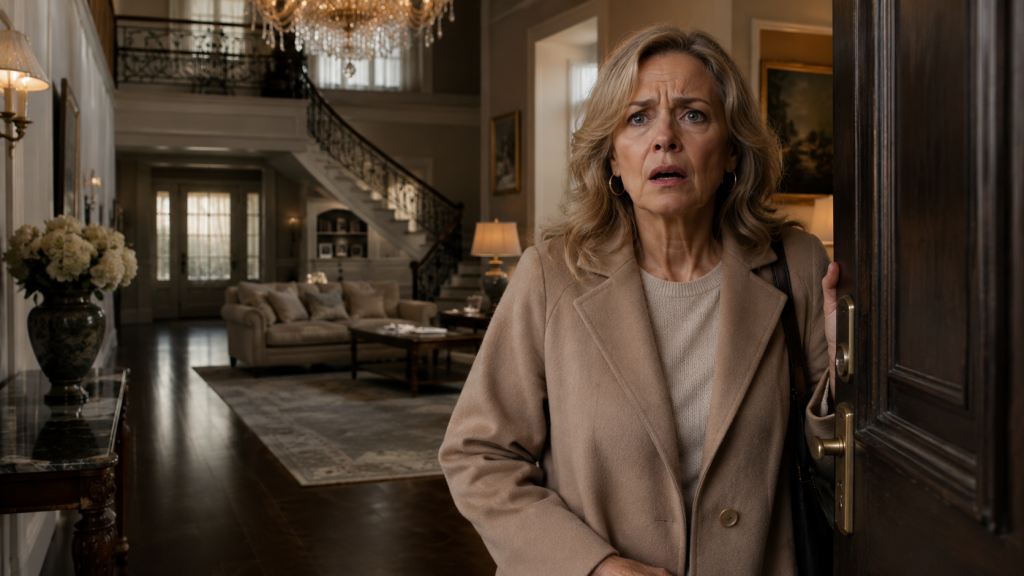
“Mary?” I called softly.
No one answered.
The living room was spacious and spotless.
Too spotless.
Not like a home.
Like a showroom.
There were no jackets hanging near the door.
No shoes scattered on the mat.
No half-read books.
No smell of food.
No coffee.
No warmth.
Plastic flowers sat on the table, perfect and lifeless.
I walked into the kitchen.
The refrigerator held only bottles of water, a few withered fruits, and one covered bowl that looked untouched.
My chest tightened.
This was not how my daughter lived.
Mary Lou used to leave mugs everywhere.
She used to stack library books beside the sink.
She used to hang little notes on the fridge.
Don’t forget milk, Mom.
Love you, Mom.
Where had that girl gone?
Upstairs, I found three rooms.
The first was a bedroom.
One bed.
Perfectly made.
No sign that two people slept there.
The closet was full of women’s clothing.
Not a single man’s shirt.
Not a pair of men’s shoes.
Nothing belonging to Kang Jun.
The second room was an office.
A desk.
A chair.
Closed drawers.
No family photos.
No business papers.
No objects with personality.
The last door was locked, but the old key was hanging on a nail beside the frame.
That frightened me more than if it had been hidden.
I opened it.
My knees weakened.
Boxes filled the room.
Some closed.
Some open.
Inside were stacks of cash.
Dollars.
Bundles and bundles of American money.
My hands shook as I touched one stack.
“What is this?” I whispered.
The money she sent me each year was already impossible to understand.
But this was more.
Much more.
Where had it come from?
Why was it hidden?
And why did the house feel abandoned?
Then I heard the front door open downstairs.
My heart stopped.
“Mary?” I called.
Footsteps moved slowly through the hallway.
Not hurried.
Not surprised.
As if whoever had entered already knew I was there.
Then my daughter’s voice rose from the stairs.
“Mom?”
I turned.
There she was.
Mary Lou.
Twelve years older.
Thinner.
Pale.
Wearing a gray coat and holding a grocery bag that slipped from her hand the moment she saw me standing inside that room.
For a moment, neither of us moved.
Then she looked past me.
Saw the open boxes.
And all the blood seemed to drain from her face.
“You shouldn’t have come,” she whispered.
Those words hurt more than any scream.
I stepped toward her.
“What is this money? Where is your husband? Why is this house empty?”
Her eyes filled with tears.
“Mom, please. Not here.”
“Not here?” I repeated. “I crossed the world to find my daughter living like a ghost in a house full of hidden cash, and you tell me not here?”
She gripped the stair railing as if her legs might give out.
“Kang Jun is dead.”
The room tilted.
“Dead?”
She nodded, tears falling now.
“He died nine years ago.”
I stared at her.
Nine years.
For nine years, I had imagined a husband beside her.
A marriage.
A life.
“Then who has been sending me money?” I asked. “Who wrote those messages? Why did you never come home?”
“I sent it,” she whispered. “All of it.”
“From where?”
She shook her head.
“I can’t explain quickly.”
Then a car door slammed outside.
Mary Lou rushed to the window.
Her face changed instantly.
Fear.
Pure fear.
She grabbed my arm so tightly it hurt.
“Mom, listen to me carefully. If anyone asks, you are not my mother. You are the cleaning lady.”
My whole body went cold.
“Mary, who is here?”
She pulled me toward the closet.
“The people who think I still owe them my life.”
Before I could ask another question, heavy footsteps entered downstairs.
A man’s voice called something in Korean.
Mary Lou wiped her face, straightened her coat, and whispered, “Stay hidden.”
I stood in the dark closet, barely breathing.
Through the crack in the door, I watched my daughter walk downstairs like a prisoner returning to her cell.
The man spoke sharply.
Mary answered quietly.
Then another voice.
A woman.
Cold.
Impatient.
I could not understand the language, but I understood tone.
Threat.
Control.
Ownership.
A few minutes later, Mary returned with two people behind her.
A tall man in a black coat.
And an older Korean woman with pearl earrings and eyes like stone.
The woman entered the cash room and looked around.
Then she said in accented English, “You are short again.”
Mary’s hands trembled.
“I transferred what I could.”
“To America,” the woman said.
Mary went still.
My heart pounded so loudly I feared they would hear it.
The man stepped closer to her.
“You still protect the mother?”
Mary said nothing.
The woman laughed softly.
“Twelve years, and still she does not know her daughter bought her safety with dirty money.”
Dirty money.
I nearly fell.
Mary lifted her chin.
“I paid everything Kang Jun owed.”
“No,” the woman said. “You paid what kept your mother untouched.”
The truth began to form in pieces.
Kang Jun had died.
But he had left debt.
Or crime.
Or both.
And my daughter had spent nine years sending me money while trapped in a web that used me as leverage.
The woman opened one box and counted a bundle.
“Tomorrow, you will move this. Then you may continue pretending you are free.”
Mary whispered, “I want out.”
The man laughed.
The woman stepped closer.
“You were out the day you chose not to call police. Now you belong to silence.”
That sentence did something to me.
I had spent twelve years being afraid of the truth.
My daughter had spent twelve years being swallowed by it.
I reached into my pocket and touched my phone.
Linda had taught me before I left how to use the emergency recording feature.
I pressed it.
I recorded everything.
The voices.
The money.
The threats.
The names they mentioned.
When they finally left, Mary collapsed on the floor.
I burst from the closet and fell beside her.
She clung to me like she was twenty-one again at the airport.
“I’m sorry, Mom,” she sobbed. “I’m so sorry.”
I held her face in my hands.
“No more lies.”
She told me everything.
Kang Jun had not been the rich businessman everyone imagined.
He had been involved with people who moved money through shell companies.
Mary had learned too late.
When he died suddenly, those people came for the debts.
They threatened to expose her as his partner.
They threatened me.
They had my address.
Photos of my house.
My church.
My mailbox.
“They said if I went home, they would come for you,” she whispered. “So I stayed.”
“And the money?”
“I started taking small amounts from what they forced me to move. Then more. I sent it to you because I thought if anything happened, at least you would survive.”
My heart broke in a way I had no name for.
All those years, I thought my daughter’s money was a wall between us.
It had been her way of trying to protect me from a prison I never saw.
“Mary Lou,” I said, “we are calling the police.”
She shook her head wildly.
“They know people.”
“Then we call the embassy.”
Her eyes widened.
I held up my phone.
“And we have their voices.”
For the first time in twelve years, I saw hope flicker in my daughter’s face.
Not much.
But enough.
The next twenty-four hours became a blur.
The U.S. embassy.
Local authorities.
A translator.
Officers in plain clothes.
Mary gave names, dates, account numbers, storage locations, everything she had memorized and hidden.
The cash room was photographed.
The boxes were seized.
The people who came to the house were arrested two days later in a larger investigation that, according to one official, had already been quietly building.
Mary was not innocent of everything.
She had moved money because she was afraid.
But fear, coercion, and years of threats told a story the authorities could understand.
More importantly, they understood she had finally cooperated.
Three weeks later, Mary Lou came home with me.
Not forever, she said.
But for now.
At the airport, she held my hand the entire time.
This time, when she cried, she was not leaving me.
She was returning.
The neighbors gathered when we reached my house.
They stared at her like a ghost.
Mary smiled politely, then went inside and stood in the kitchen where her childhood drawings still hung in an old box I had never thrown away.
That Christmas, I set two plates at the table.
Not one for hope.
One for her.
The beef stew simmered on the stove.
The house smelled like onions, carrots, and home.
Mary sat across from me, thinner than she should have been, older than her years, but alive.
“Mom,” she whispered, “I’m not well yet.”
I reached across the table and took her hand.
“You don’t have to be well,” I said. “You just have to be here.”
She began to cry.
So did I.
For twelve years, I thought my daughter had chosen money over coming home.
I thought she had forgotten me.
I thought the checks were love made convenient.
But when I opened the door to her house in Korea, I did not find a rich daughter living in comfort.
I found a woman trapped by fear.
A house full of secrets.
And proof that sometimes the children who seem farthest away are the ones fighting hardest to protect us.
Now, every Christmas, I still set a plate for Mary Lou.
But it is no longer empty.
And every time she sits down across from me, I remember the lesson I learned too late.
A mother should never be satisfied with money when her heart is asking for the truth.
THE END! THANKS FOR READING!