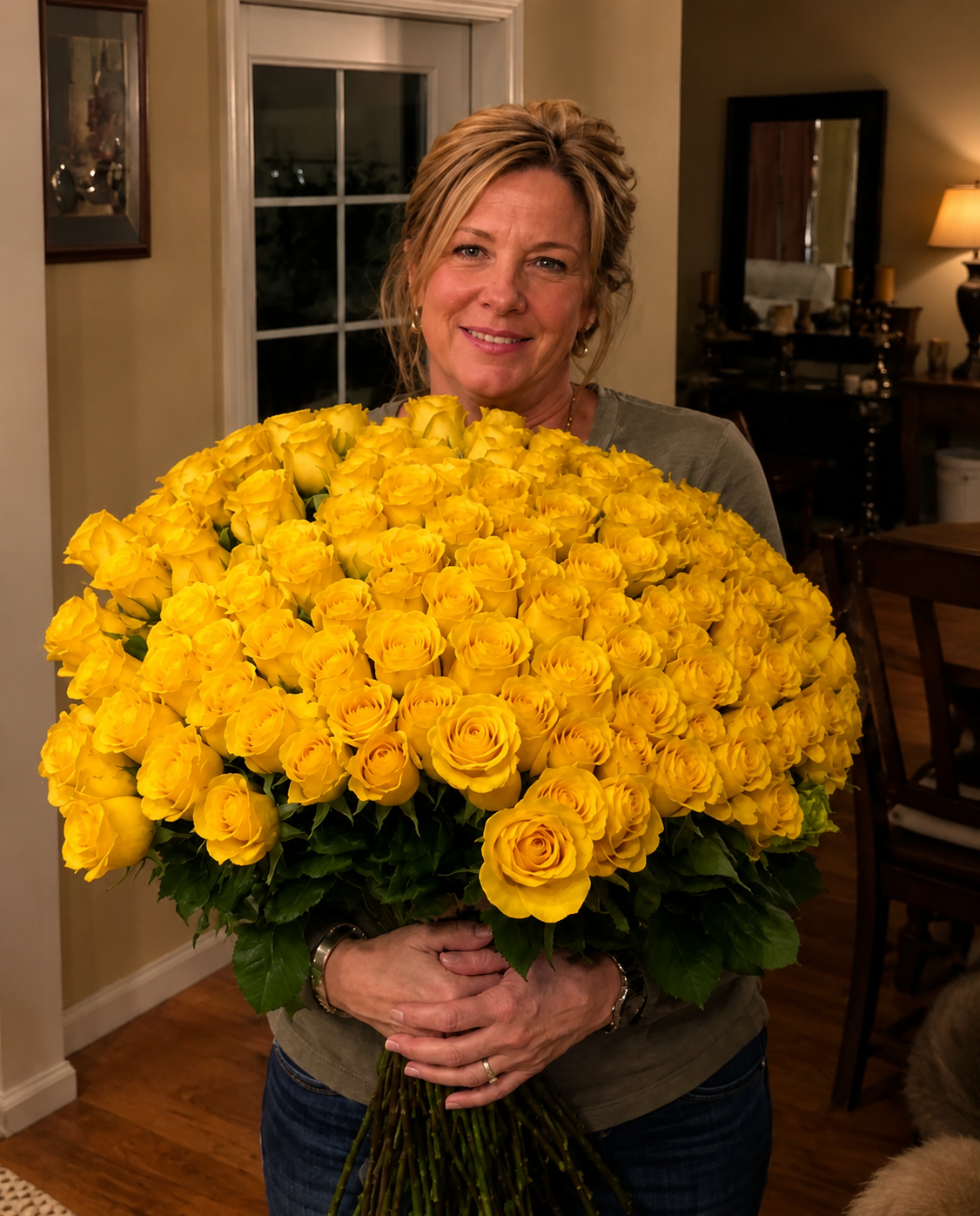
Several roses in the center were arranged differently. Almost like someone had intentionally placed them there. I leaned closer. The outer flowers were full and open, angled outward in a neat, circular pattern. But near the middle, a few stems sat lower, their heads tilted just slightly inward. Not enough for most people to notice. Enough for me. Curious, I started counting. Ten rows of ten. I counted once, then again, touching each bloom lightly as I moved through them. Ten rows of ten. Except one row was not entirely yellow. One rose near the middle had a tiny red mark hidden beneath a petal. At first, I thought it was a flaw.
Maybe a bruise. Maybe dye from another flower. I gently lifted the petal with my fingertip. The red mark was small but deliberate. My breath caught. Then I found another. And another. There were exactly three. Three marked roses. My stomach dropped. I forgot about the unanswered calls. I forgot about the sunlight on the table and the coffee mug still sitting by the sink. For a moment, all I could hear was my own breathing. Three marked roses. I had seen that pattern before. Years ago.
A memory stirred, old and unwelcome, like something buried under floorboards suddenly scratching to be let out. My hands started shaking. “No,” I said aloud, but my voice had no strength in it. I grabbed my phone again. This time, I did not call Daniel. I called the police. The dispatcher asked for my name, my address, and what had happened. I tried to explain without sounding insane. “A bouquet was delivered to my house,” I said, gripping the edge of the table. “One hundred yellow roses. No card. No signature. Just my name.” There was a pause. “Ma’am, are you in immediate danger?” “I don’t know,” I admitted. “But three of the roses are marked. Exactly three.” Saying it out loud made my throat tighten.
“Marked how?” “Red,” I said. “Tiny red marks hidden under the petals.” Another pause. “And you believe this is threatening?” I looked at the bouquet again, at those three hidden marks staring back at me like old wounds. “Yes,” I said. “I do.” The officer on the line told me to stay inside, lock my doors, and not touch anything else until someone arrived. I did exactly what she said. I locked the front door. Then the back. Then I stood in the middle of my dining room, staring at the flowers that had arrived while my husband was away, waiting for the police and waiting for Daniel to call me back.
But he did not. And the worst part came an hour later. By then, two uniformed officers had arrived and were standing in my dining room, looking at the bouquet with the careful politeness people use when they think you may be frightened over nothing. One of them, Officer Voss, asked, “You said your husband usually sends white roses?” “Yes,” I replied. “Always white. Never yellow.” “And he is away for work?”
“That’s what he told me.” The younger officer glanced at the flowers. “Ms. Amber, I understand this feels unsettling, but sometimes florists make mistakes.” I wanted to believe him. I truly did. Then a dark sedan pulled up outside. A man in his late 60s stepped through my front door a few minutes later. He had silver hair, tired eyes, and the kind of face that looked as if it had carried too many secrets for too long. “I’m Detective Kellan,” he said.
The name stirred something in me. “My father knew a Kellan,” I whispered. His eyes shifted to mine. “Your father was Detective Ron.” I nodded, surprised by the pain that still came with hearing Dad’s name. He had been a homicide detective for most of his life. Before he died, he occasionally shared stories from old investigations, never the worst details, but enough that I knew some cases stayed with him. Detective Kellan moved toward the roses. At first, his expression was calm. Then he saw the three marked flowers. The color drained from his face. “Where did these come from?” he asked, his voice low. “I told them. A florist delivered them. No card. No sender. Just my name.”
He turned to the officers. “Secure the house. Call it in.” Officer Voss straightened. “Sir?” “Now.” My legs weakened. “You recognize this.” Detective Kellan looked at me, and for the first time since the bouquet arrived, someone believed me. “Twenty-two years ago,” he began, “three women disappeared. Each one received one hundred yellow roses before she vanished.”
My throat tightened. “One hundred,” I said. He nodded. “Not 99. Not 101. Exactly 100. Your father believed the number meant the end. A complete cycle. A final goodbye.” I gripped the back of a chair. “And the red dots?” “Three marked flowers,” he confirmed. “Every time.” The room seemed to tilt.
I remembered sitting with Dad on our old porch years earlier. He had been staring into the dark, rolling a cold cup of coffee between his hands. “Some monsters don’t leave fingerprints,” he had said. “They leave symbols.” I had thought he was just tired. I had not known he was warning me. The police tried calling Daniel again. I called too. Each attempt went unanswered. Then Detective Kellan contacted Daniel’s company. I watched his face while he listened. “What is it?” I asked when he hung up. He did not answer right away. “Please tell me.” “Daniel was never on a business trip.” My mouth went dry.