 Reading Time: 13 minutes
When my brother proudly announced that his wife was pregnant with baby number five, my parents cheered like the whole family had been blessed. Dad smiled and said, “Great job, son.”
But Mom’s eyes shifted straight to me. “You’ll handle the kids,” she said, as if my future belonged to them. I said, “Absolutely not.” That was when my sister-in-law snapped, “You have no family. This is your training.”
I walked out without saying another word and let them believe they had won.
But the next morning, I got a call from the police.
“Hello, ma’am,” the officer said. “This is Officer Daniels.”
My stomach tightened before he even finished his sentence.
Because by then, I already knew my family.
And I knew they had not accepted my no.
My name is Olivia Carter.
I was thirty-one years old, single, childless, employed full time, and somehow still treated like spare furniture in my parents’ house.
For eight years, I had been my brother Ryan’s unpaid emergency plan.
Not a person.
A plan.
When his first child was born, everyone said, “Olivia, can you help just for a few weeks?”
When the second came, it became, “You’re so good with kids.”
When the third arrived, it became, “You don’t have a husband, so your schedule is flexible.”
When the fourth was born, nobody asked anymore.
They simply told me.
Pick up Mason from school.
Take Lily to dance.
Watch Emma Saturday.
Help Noah with reading.
Bring snacks.
Stay late.
Cancel your plans.
This is what family does.
I missed work meetings.
I used vacation days for children who were not mine.
I bought birthday gifts Ryan forgot.
I helped with science projects at midnight because Madison, my sister-in-law, said pregnancy made her tired even when she was not pregnant.
And every time I hesitated, my mother looked disappointed.
“You’re their aunt,” she would say.
As if aunt meant unpaid employee.
As if love meant availability.
As if not having children made my time less real.
Sunday dinner was always at my parents’ house.
The same dining room where I had grown up being told not to talk back.
The same table where Ryan had always been praised for breathing correctly while I was expected to clear dishes without being asked.
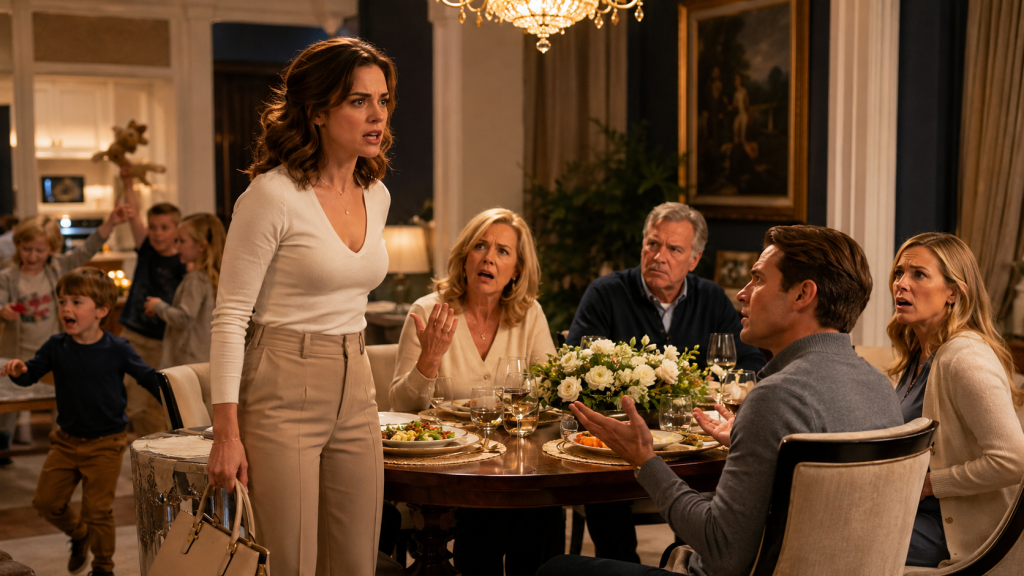
That night, the kids were wild before dinner even began.
Mason, eight, was chasing Lily, six, around the hallway.
Emma, four, was standing on the couch with a marker in her hand.
Noah, two, was crying because someone had taken his dinosaur cup.
Ryan sat at the table scrolling his phone.
Madison sat beside him, one hand resting dramatically on her stomach even though no one yet knew why.
Mom was in the kitchen, smiling at them like chaos was proof of prosperity.
Dad poured himself iced tea and ignored the crash from the living room.
I got up, took the marker from Emma, wiped blue ink from the couch cushion, picked Noah’s cup off the floor, and told Mason and Lily to slow down before somebody got hurt.
Ryan looked up and grinned.
“See? Natural.”
I did not smile.
By dessert, Madison cleared her throat and placed her hand on Ryan’s arm.
“We have news,” she said.
Ryan puffed up like a man accepting applause before it started.
“We’re pregnant again.”
For one second, the room went still.
Then my parents erupted.
Mom gasped and clapped her hands over her mouth.
Dad stood and slapped Ryan on the back.
“Great job, son.”
Great job.
As if Ryan had built a hospital.
As if he had solved world hunger.
As if creating another child while barely caring for the four already screaming through the house was an achievement everyone else should fund with time.
Madison smiled like a queen receiving tribute.
“Baby number five,” she said.
Mom wiped her eyes.
“Another blessing.”
I looked at the broken toy pieces on the floor near the hallway.
A blessing, apparently, that someone else would be expected to manage.
Then Mom turned to me.
“You’ll handle the kids.”
Not a question.
A sentence.
A decision.
An assignment.
I lowered my fork.
“Absolutely not.”
The silence that followed was almost beautiful.
Ryan frowned.
“Don’t start, Olivia.”
“I’m not starting anything,” I said. “I’m ending something.”
Madison’s smile disappeared.
Mom looked confused, as if the chair had suddenly spoken.
Dad cleared his throat.
“Your brother needs support.”
“He has a wife.”
Madison scoffed.
“I’m pregnant.”
“You’re also a parent.”
Ryan put his fork down.
“Olivia, stop being selfish.”
There it was.
The family word for any boundary I had ever tried to set.
Selfish.
If I would not babysit, selfish.
If I would not lend money, selfish.
If I would not take a day off work because Madison forgot a pediatrician appointment, selfish.
If I wanted one weekend to myself, selfish.
I looked at Ryan.
“I have given you eight years of free childcare.”
He rolled his eyes.
“Don’t exaggerate.”
I pulled my phone from my purse and opened my calendar.
“I have school pickups logged. Doctor appointments. Weekends. Sleepovers. Sick days. I can show you.”
Madison laughed coldly.
“You kept records?”
“Yes,” I said. “Because nobody else in this family remembers my labor once it benefits them.”
Mom’s face tightened.
“Olivia, that’s enough.”
“No, Mom. It was enough years ago. I’m done.”
Madison leaned forward, eyes sharp.
“You have no family. This is your training.”
The words landed colder than I expected.
You have no family.
Because I was single.
Because I had not had children.
Because my life did not look like hers.
My mother looked away.
My father said nothing.
Ryan only sighed, as if I was embarrassing him.
I stood up, placed my napkin beside my plate, and grabbed my purse.
Mom followed me to the door.
“Olivia, don’t be dramatic.”
I looked back at the room.
At the people who had decided my life was available because I had not given birth.
“I’m not dramatic,” I said. “I’m done.”
Then I left.
I did not answer the group chat that night.
It started before I got home.
Mom: Olivia, you upset everyone.
Ryan: You owe Madison an apology.
Madison: I hope you enjoy being alone forever.
Dad: Family helps family.
Then Mom again.
You will understand once you have a family of your own.
I stared at that message for a long time.
Then I typed:
I have a family. They just forgot I am part of it unless I am useful.
I sent it.
Then I muted the chat.
I slept badly.
Not because I regretted leaving.
Because saying no after years of yes leaves your body confused.
It waits for punishment.
The next morning, my phone rang at 7:42.
I almost ignored it, but the number was local and unfamiliar.
“Hello?”
A calm male voice answered.
“Ma’am, this is Officer Daniels with the Brookhaven Police Department. Am I speaking with Olivia Carter?”
My stomach tightened.
“Yes.”
“Your brother and sister-in-law listed you as the responsible caregiver for four minor children this morning.”
I sat up in bed.
“They what?”
There was a pause.
“Ma’am,” he said carefully, “we need you to come to the station and make a statement. The children were found alone.”
The room tilted.
“Alone?”
“A neighbor called after hearing the youngest crying outside. Your brother and his wife left a note saying you would arrive by eight.”
My hands went cold.
“I never agreed to that.”
“That is why we need your statement.”
I threw on jeans, a sweater, and shoes without socks.
My hands shook so badly I dropped my keys twice.
On the drive to the station, the truth settled in piece by piece.
They had decided my no was temporary.
They had decided I would fold.
They had decided to leave four children alone and blame me if anything happened.
At the station, Ryan and Madison were already there.
Madison was crying, but not the way frightened mothers cry.
She was crying with anger.
Ryan looked furious.
Not ashamed.
Furious.
The children sat in a side room with juice boxes and blankets.
Mason had one arm around Lily.
Emma was sucking her thumb.
Noah’s face was blotchy from crying.
My heart hurt for them.
Whatever I felt toward Ryan and Madison, the kids were innocent.
They had been placed in the middle of adult entitlement.
Madison saw me and pointed.
“If you had just done what family is supposed to do, none of this would have happened.”
Officer Daniels looked from her to me.
“Ms. Carter, did you agree to care for the children this morning?”
“No,” I said clearly. “I told them yesterday I would not babysit again.”
Ryan stepped toward me.
“Olivia, don’t make this worse.”
I looked at him.
“You left your children alone.”
“We left them for fifteen minutes.”
Officer Daniels spoke evenly.
“According to the neighbor, the toddler was outside near the driveway.”
Ryan’s face twitched.
Madison snapped, “Because Olivia wasn’t there.”
I opened my phone.
“I have the family group chat.”
Ryan’s eyes narrowed.
“Olivia.”
I ignored him and showed Officer Daniels the messages.
Mom: Olivia will learn her place once the baby comes.
Madison: We’ll drop them off anyway. She has nothing else.
Ryan: She’ll cave. She always does.
Dad: She just needs reminding what family means.
Officer Daniels read silently.
His expression changed.
“That helps clarify things.”
Madison’s face went pale.
“You saved those?”
“Yes,” I said. “Like I said, I keep records.”
Child services arrived before noon.
That was when everyone finally realized this was not going to be solved by yelling at me.
My parents came rushing into the station.
Mom went straight to Ryan, hugging him like he was the victim.
Then she turned on me.
“How could you do this to your brother?”
I stared at her.
“How could he do this to his children?”
Dad’s face was red.
“You should have just gone over there.”
“I didn’t know they left them.”
“You knew they needed help.”
“Needing help does not give them permission to abandon their kids.”
Madison sobbed louder.
“They’re making us look like criminals.”
Officer Daniels said, “Ma’am, please lower your voice.”
That shocked her more than anything.
In our family, Madison was allowed to cry until the room bent around her.
The police station did not bend.
Child services interviewed everyone separately.
I told the truth.
The years of unpaid childcare.
The dinner conversation.
My refusal.
The messages.
The call.
The officer thanked me and asked if I was willing to take temporary custody if needed.
That question hurt.
Because I loved those children.
I did.
But love had been used against me for so long that even kindness felt like a trap.
I asked, “If I say yes, does that teach them they can do this again?”
The social worker’s face softened.
“It would be voluntary, but I understand your concern.”
I looked through the glass at Mason helping Noah with his juice box.
My heart cracked.
“I can keep them for one night,” I said. “Only one. And only with paperwork clearly stating I did not cause this situation.”
Ryan exploded when he heard.
“One night? They’re your nieces and nephews.”
“And they’re your children.”
Madison glared at me.
“You’re enjoying this.”
“No,” I said. “I am grieving the fact that all of you forced me to protect children from their own parents.”
My mother gasped as if I had said something obscene.
Maybe truth sounds obscene to people who live on denial.
That night, the kids slept in my apartment.
It was cramped.
Mason and Lily took the couch.
Emma slept on an air mattress.
Noah curled up beside me because he kept waking.
At 2 a.m., Mason appeared in my bedroom doorway.
“Aunt Liv?”
“Yeah, buddy?”
“Are Mom and Dad going to jail?”
I sat up.
“I don’t know.”
He looked down.
“They said you were coming.”
My throat tightened.
“I know.”
“You said no yesterday.”
I nodded.
“I did.”
He swallowed.
“I told Mom that. She said adults change their minds when family needs them.”
I closed my eyes.
Even the children had been taught that my boundaries were temporary.
I patted the edge of the bed.
Mason sat beside me.
“Listen to me,” I said. “What happened today was not your fault. It was not Lily’s fault. Not Emma’s. Not Noah’s.”
“Is it yours?”
“No.”
He nodded slowly.
“Then whose is it?”
I thought carefully.
“Your parents made a bad decision. They are responsible for that.”
He seemed to breathe easier.
Children need truth in small, sturdy pieces.
Not lies that make the floor softer for adults.
The next morning, Ryan and Madison were allowed to take the children home under conditions.
Parenting classes.
Scheduled check-ins.
No leaving the children with any caregiver without written consent.
That last part made Madison glare at me with pure hatred.
I smiled politely.
Not because I was happy.
Because documentation had finally become my shield.
The family group chat exploded again.
Mom: You humiliated us.
Dad: This could have been handled privately.
Ryan: Hope you’re proud.
Madison: You ruined everything.
I replied only once.
You left four children alone after I clearly refused responsibility. The police were called by a neighbor, not me. Do not contact me unless it is about an emergency involving the children’s safety.
Then I left the chat.
Not muted.
Left.
It felt like stepping out of a burning house.
For the first week, my mother called constantly.
I did not answer.
Then she sent a long message.
Your brother is under stress. Madison is pregnant. You should understand that not everyone has your freedom.
My freedom.
That was what they called my life when they wanted to use it.
Not my work.
Not my bills.
Not my exhaustion.
Not my dreams.
Freedom.
I typed back:
My life is not empty just because I did not fill it with children. Do not mistake availability for lack of value.
She did not reply.
Work became my refuge.
I managed accounts for a logistics firm, and for the first time in years, I did not request emergency time off for Ryan’s family.
My supervisor noticed.
“You seem calmer,” she said one afternoon.
I almost laughed.
A police call had somehow made my life calmer.
Because chaos with boundaries is still better than peace built on exploitation.
Two weeks later, Mason called me from Ryan’s phone.
“Aunt Liv?”
My whole body tensed.
“What’s wrong?”
“Nothing. I just wanted to say I got a hundred on my spelling test.”
Tears filled my eyes.
“That’s amazing.”
“Dad said not to bother you.”
I closed my eyes.
“You can call me to tell me good things.”
He was quiet.
“Are you still our aunt?”
That question broke me.
“Yes,” I said immediately. “Always.”
“Even if you don’t babysit?”
“Especially then.”
He did not understand, but one day he would.
Being an aunt did not require being consumed.
Love did not require disappearing.
Over the next months, things changed.
Slowly.
Ugly at first.
Ryan and Madison struggled with the new rules.
My parents complained about “outsiders” interfering.
But the system had eyes on them now, and for once, I was not the invisible safety net absorbing every failure.
Madison’s fifth pregnancy became less of a royal event and more of a responsibility.
Imagine that.
When she was put on partial bed rest, Ryan called me.
I let it go to voicemail.
His message was stiff.
“Olivia, we need help Saturday. Paid help. If you’re willing.”
Paid help.
I listened twice just to hear it again.
Then I texted:
My rate is $25 an hour, paid in advance, with drop-off and pickup times in writing.
He did not respond for six hours.
Then:
Forget it.
I replied:
Okay.
That one word felt better than any argument.
They hired a sitter.
A real one.
A neighbor’s college-age daughter.
They paid her.
On time.
A miracle, apparently.
My mother eventually asked me to lunch.
I almost said no.
Then I went because I wanted to see whether she could speak without an audience.
She looked older sitting across from me at the diner.
Tired.
“I didn’t realize how much we were asking of you,” she said.
I stirred my coffee.
“You weren’t asking.”
She winced.
“You’re right.”
I waited.
“I thought because you were single, you had more room.”
“I had more silence,” I said. “That’s not the same.”
Her eyes filled.
“I’m sorry.”
It was not enough.
But it was a beginning.
Dad took longer.
Fathers who build their pride around sons do not enjoy discovering the son endangered the children everyone praised him for having.
But eventually, he showed up at my apartment with a toolbox.
“My sink still leaks,” I said.
“I know.”
He fixed it in silence.
At the door, he cleared his throat.
“You did the right thing.”
I looked at him.
“Say it again.”
He blinked.
“What?”
“I need to hear it without you choking on it.”
His mouth twitched.
Then he said clearly, “You did the right thing.”
I cried after he left.
Not because everything was healed.
Because some sentences arrive late and still matter.
Baby number five was born in October.
A girl.
They named her Grace.
I visited at the hospital two days later.
Madison looked exhausted.
For once, truly exhausted.
Not theatrical.
Human.
She watched me hold the baby.
“I shouldn’t have said what I said,” she whispered.
I looked up.
“Which part?”
Her face flushed.
“That you had no family. That this was training.”
“No. You shouldn’t have.”
“I was jealous.”
That surprised me.
“Of what?”
She looked toward the hospital window.
“Your quiet. Your apartment. Your ability to leave.”
For the first time, I saw something beneath her entitlement.
Not excuse.
Explanation.
“I love my children,” she said. “But I think I wanted everyone else trapped too.”
I looked down at Grace, tiny and sleeping.
“I won’t be trapped, Madison.”
She nodded.
“I know.”
I held Grace for a few more minutes, then handed her back.
“She’s beautiful.”
Madison’s eyes filled.
“Thank you.”
That was the most peaceful conversation we had ever had.
I did not become their unpaid babysitter again.
I became Aunt Olivia.
The one who came to birthdays with gifts.
The one who took one kid at a time for planned outings.
The one who said no without explaining for twenty minutes.
The one who loved them without letting their parents use that love as a contract.
Mason and I started monthly library trips.
Lily liked painting classes.
Emma wanted pancakes.
Noah still loved dinosaur cups.
And baby Grace, when she grew old enough to know me, reached for my necklace every time I held her.
Sometimes Ryan still looked annoyed when I enforced boundaries.
That was his problem.
Sometimes Mom almost slipped into old habits.
“Olivia, can you just—”
Then she would stop herself.
“Sorry. Let me ask properly.”
Progress is not always pretty.
Sometimes it is a sentence interrupted before it becomes a demand.
One year after the police call, Officer Daniels came into my office for a community outreach meeting.
He did not recognize me at first.
Then he did.
“Ms. Carter,” he said warmly. “How are the kids?”
“Better,” I said. “Thank you.”
“And you?”
I thought about it.
My quiet apartment.
My full weekends.
My family learning, slowly, that my no had weight.
“Better too.”
That Sunday, I hosted dinner at my place.
Not because anyone demanded it.
Because I wanted to.
I made pasta, garlic bread, and salad.
The kids watched a movie on the floor.
Ryan helped wash dishes without being asked.
Madison packed leftovers.
Mom complimented my apartment without sounding sorry for me.
Dad fell asleep in the armchair.
It was ordinary.
Imperfect.
Still complicated.
But different.
At the end of the night, Mason hugged me at the door.
“I like when we visit and you’re not mad,” he said.
I hugged him back.
“I like that too.”
He pulled away.
“But you can still say no, right?”
I smiled.
“Always.”
“Good,” he said. “My teacher says no is a complete sentence.”
I laughed.
“Your teacher is very smart.”
After they left, my apartment was quiet again.
Not empty.
Quiet.
There is a difference.
I stood by the window and thought about that Sunday dinner a year earlier.
Ryan’s proud announcement.
Dad’s praise.
Mom’s command.
Madison’s cruel words.
You have no family.
This is your training.
They were wrong.
I did have a family.
But I also had a life.
And the police call they never expected became the moment everyone finally had to admit those two things were not the same.
I was not born to be Ryan’s backup plan.
I was not responsible for children I did not create.
I was not selfish for refusing to disappear into someone else’s chaos.
I am Aunt Olivia.
I am a sister.
A daughter.
A worker.
A friend.
A woman with her own calendar, keys, bills, dreams, and limits.
And if my family wanted me in their lives, they had to learn the one lesson they had avoided for years.
Love is not labor you can demand.
Family is not a debt you can collect.
And no, when spoken clearly, is still an answer.
THE! END! THANKS FOR READING!